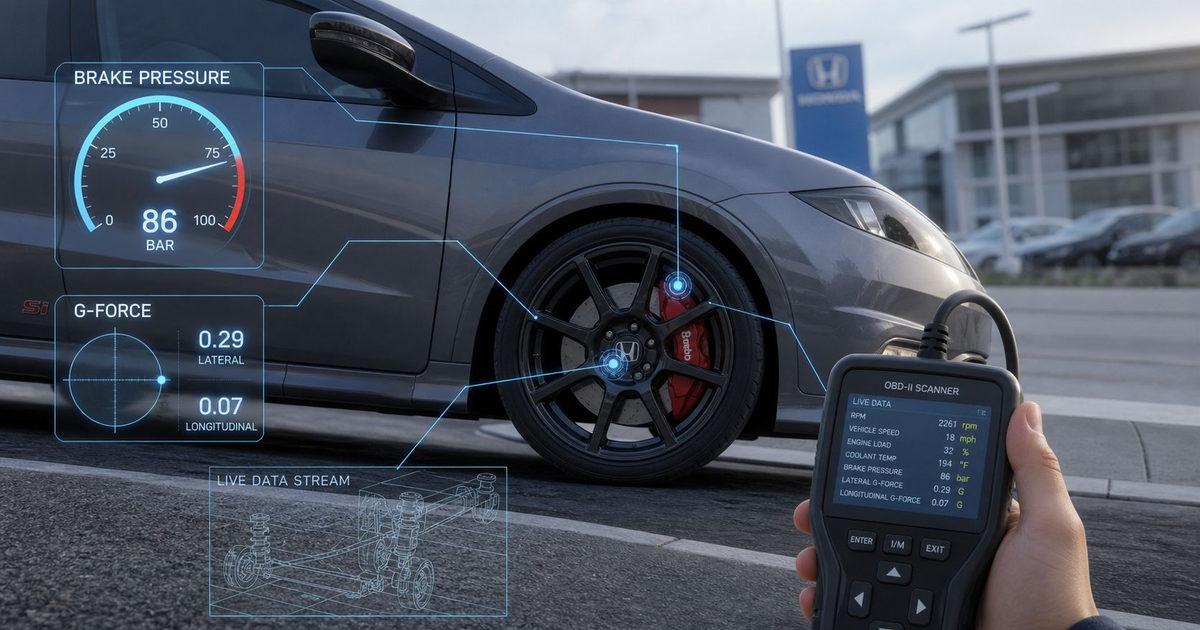
You can buy a car that looks clean on the auction sheet, drives fine on the forecourt, and still leaves the next owner complaining that it rolls back on a hill. That's the sort of fault that doesn't always show up in a short appraisal, especially when the dashboard stays quiet and the car behaves normally on level ground. In trade terms, hill start assist is one of those features that can hide a real risk until after the sale, when the customer finds the brake-hold logic isn't doing what the spec sheet implied.
For motor traders, the issue isn't the convenience feature itself, it's what a failure says about the wider car. A weak sensor signal, an ESP warning that never got fully investigated, or a brake system that's marginal under load can turn into a comeback, a warranty headache, or a valuation dispute. A proper vehicle history check UK process helps, but it won't tell you whether the car's rollback-prevention logic is healthy, calibrated, or already on the edge.
Table of Contents
- Why Hill Start Assist Matters in Used Car Appraisal
- How Hill Start Assist Systems Work
- Sensor inputs and brake hold logic
- Why the release point matters
- Hill Start Assist Across Different Powertrains and Transmissions
- Manual cars
- Hybrids and EVs
- Common Failure Modes and Diagnostic Warning Signs
- What to check on the road test
- When the fault is present but hidden
- Connecting Hill Start Assist Issues to Vehicle Provenance Red Flags
- Pre-Purchase Inspection Checklist for Hill Start Assist
- Why Basic Vehicle History Checks Fall Short on ADAS Features
Why Hill Start Assist Matters in Used Car Appraisal
A car comes in from auction with a clean-looking pack, decent tyres, and no obvious dash lights. Two weeks after retail, the buyer rings up and says the car rolls back every time they pull away on a slope, which turns a minor complaint into a proper comeback because the feature was clearly present in the brochure and never proved properly during appraisal. That's how a used car history report can still miss the real-world problem, because the report doesn't test the way the car behaves when the driver moves from brake to throttle under load.
The trade mistake is assuming the presence of hill start assist means the function is healthy. In reality, it's a conditional safety aid, not a permanent parking brake, and it can be disabled by other faults that don't always announce themselves loudly at the point of sale. A vehicle can look mechanically tidy, pass a quick forecourt drive, and still have an underlying stability-system issue that becomes obvious only on an incline.
Practical rule: if a customer will notice a rollback on day one, you need to prove the system on day one.
That's where the appraisal mindset changes. Instead of treating hill start assist as a feature checkbox, treat it as part of motor trade risk and factor it into the buying decision alongside brakes, stability systems, and prior complaint history. In practice, the same discipline that improves dealer vehicle checks on mileage and service continuity should also be applied to driver-assistance behaviour, because a saleable car is one that behaves consistently under real driving conditions.
The clearest way to reduce the risk is to combine physical inspection with provenance. If you want a deeper record before money changes hands, the sort of vehicle provenance view that links servicing, ownership patterns, and risk flags is far more useful than a glossy description alone, and a report like AutoProv's vehicle provenance report fits that trade workflow better than a basic spec lookup.
How Hill Start Assist Systems Work
Sensor inputs and brake hold logic
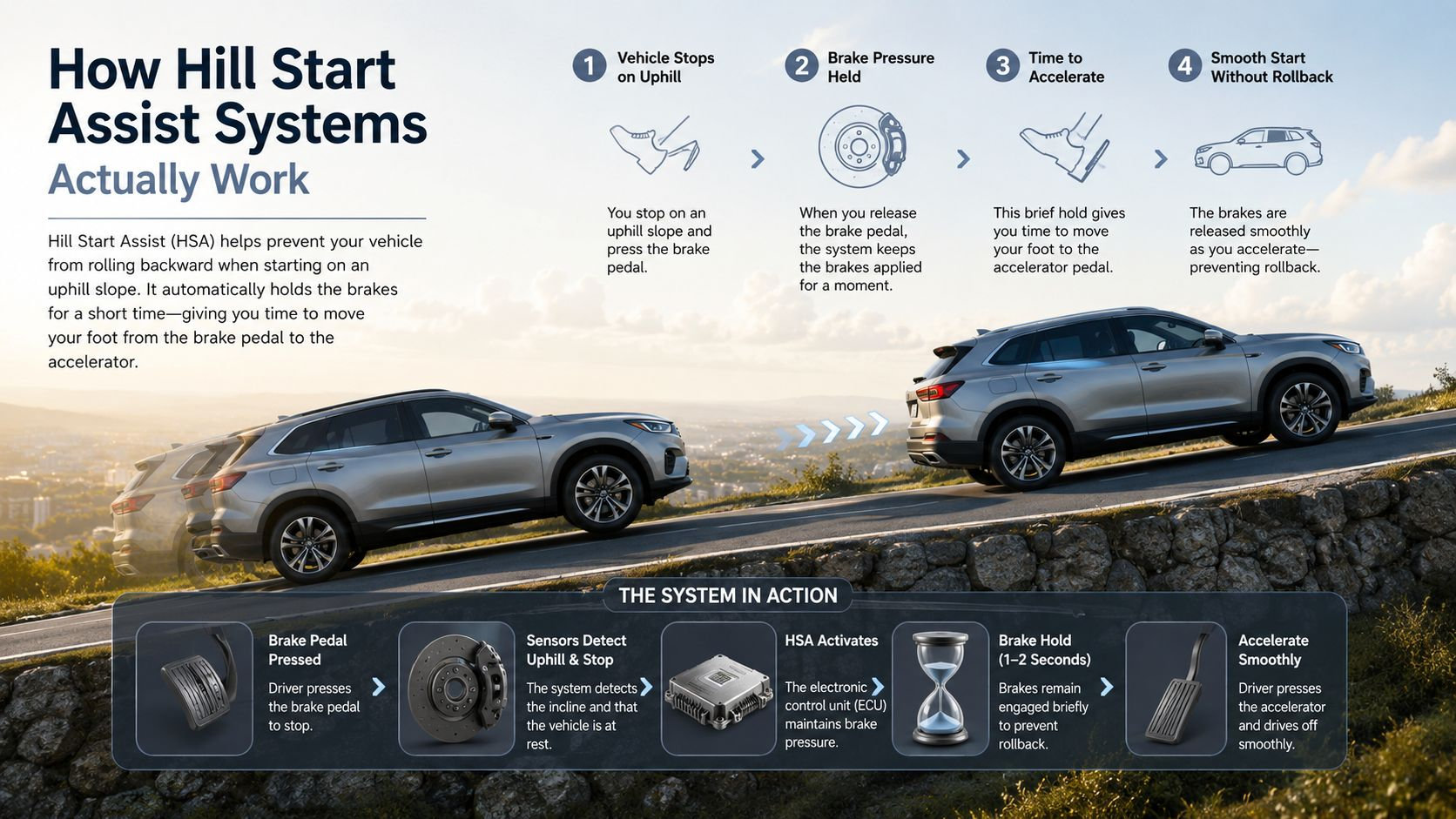
The cleanest way to read hill start assist is as a digital handbrake assistant. The driver stops on a slope, the vehicle recognises the incline through onboard sensors, and the brake ECU keeps hydraulic pressure in place long enough for the driver to move from the brake pedal to the accelerator or clutch. Honda describes this with a G-force sensor that detects forward or backward acceleration, while Nissan states that an acceleration sensor working through vehicle dynamic control identifies the slope and holds brake pressure for a short period.
That short hold is the point that matters in appraisal. It is a calibrated control system with a defined launch window, and the way that window is set changes how the car feels when it leaves a hill. On some cars the system only needs to keep the brakes applied for a brief handover. On others, the logic has to coordinate more input before it releases cleanly.
Why the release point matters
The release logic changes with the drivetrain. On some cars, the brakes let go when the throttle signal arrives. On manual cars, they often stay engaged until the clutch is brought up or sufficient engine torque is detected, rather than dropping the hold the moment the brake pedal comes up. That matters in the trade because a customer describing “rollback” might be feeling normal disengagement timing on a borderline slope, or a fault in the launch logic rather than a brake hardware issue.
The hold window is short on purpose. It gives the driver time to make the handover, not a licence to ignore the incline.
For appraisal, that means the function should feel controlled, not abrupt. If the car lurches, releases too early, or holds so long that the take-off feels delayed, you have a calibration question or a related fault to chase. A quick OBD-2 reader check will not explain everything, but the right codes can separate a genuine brake-control issue from a sensor plausibility problem, which is why a targeted scan like how to use an OBD-2 reader is useful before you decide whether the car belongs on your stock book.
Hill Start Assist Across Different Powertrains and Transmissions
Manual cars
Manual cars are where hill start assist matters most in day-to-day use, because the system has to bridge the gap between pedal release and clutch engagement. The feature commonly stays active until the clutch is brought up or the engine produces enough torque to move away, which is why a manual that feels hesitant on a hill can point to clutch wear, sensor drift, or driver-assist calibration rather than just “old car behaviour” (manual-transmission explanation).
That makes the inspection different from an automatic. On a manual, you're not only listening for clutch slip, you're watching whether the launch aid matches the clutch bite point cleanly. If the brakes hold too briefly, the car can roll before the clutch takes load. If the feature feels inconsistent from one pull-away to the next, the issue may sit with clutch position sensing or stability-system input rather than the clutch plate itself.
Hybrids and EVs
Hybrids and EVs change the feel again because the launch is no longer dominated by engine idle and clutch take-up. In some electrified cars, the system can lean on motor torque rather than brake pads to keep the car stationary, which means customer complaints about rollback may point to torque calibration, software logic, or battery-related limitations rather than a conventional brake fault. That's why a complaint from an EV driver needs a different reading from a complaint on a manual hatchback.
The trade implication is straightforward. A standard mileage check UK or a basic condition appraisal doesn't tell you how the launch aid is implemented, and the same symptom can come from different systems depending on the powertrain. A hybrid that feels odd on a slope might be fine mechanically but in need of software attention, while an EV can present a “creep” complaint that has nothing to do with brake wear at all.
For buyers handling electrified stock, that's where battery and propulsion context matter. The kind of deeper review you'd apply before stock acquisition, including a focused electric vehicle battery health check, helps frame whether a launch complaint is isolated or part of a wider drivability pattern.
Common Failure Modes and Diagnostic Warning Signs
What to check on the road test
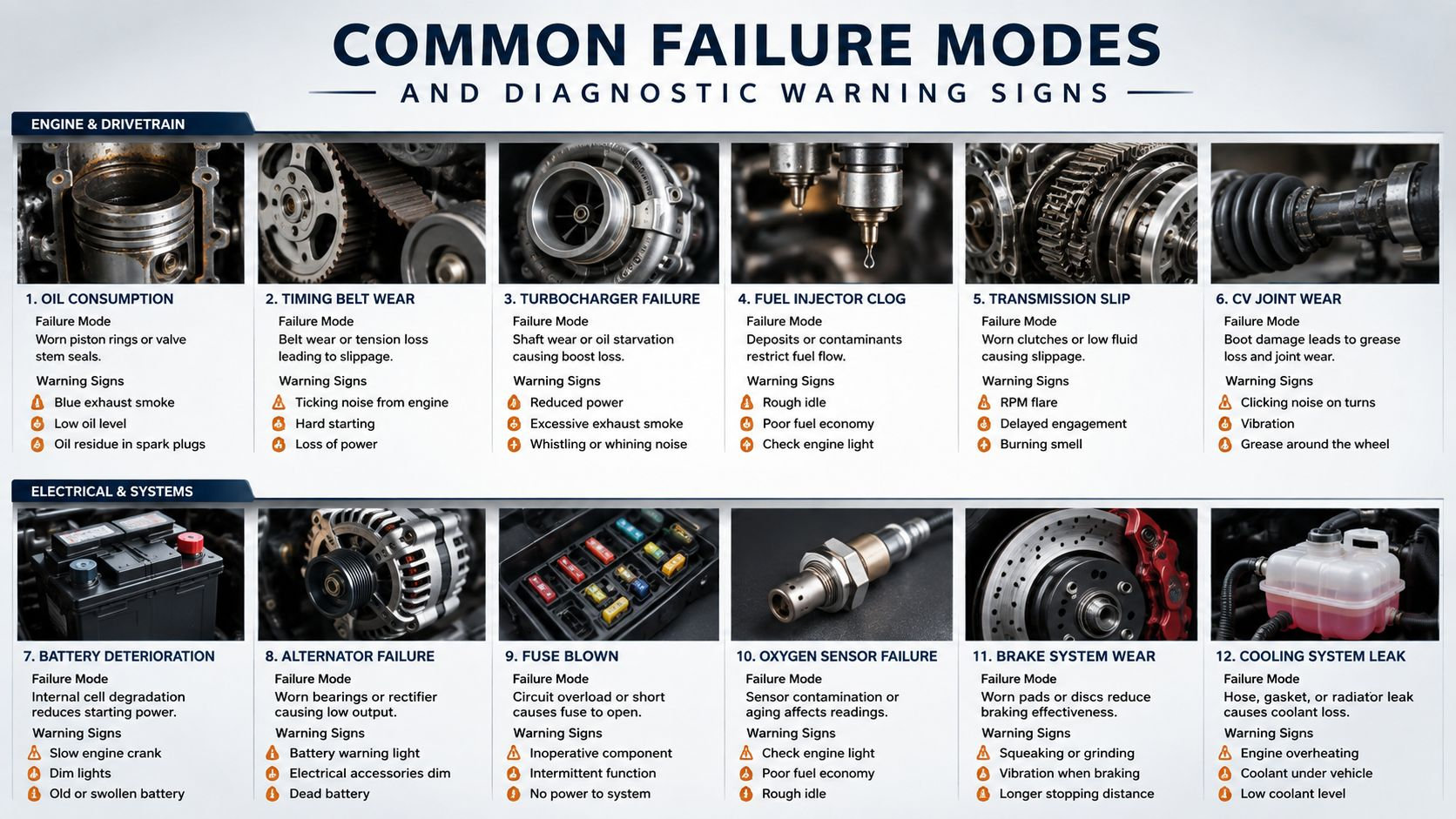
The failure I see most often is subtle. A car holds on one incline, then creeps on the next, or behaves differently from one pull-away to the next. That pattern usually points to sensor plausibility, brake-pressure retention, or stability-system input rather than a simple wear item. On some systems, the launch aid is tied closely to slope detection, so a weak sensor signal can create a complaint that feels like a brake fault even when the pads are still serviceable.
On the road test, I want a clean incline, a full stop, and at least two launch attempts. Watch the brake release timing, not just whether the car moves off. If it rolls slightly before torque arrives, or the hold disappears as soon as the driver lifts off the brake, that is a warning sign. If the dashboard shows an ESP-related message, treat that as a red flag until you have confirmed whether the launch aid is being suppressed by the stability system.
When the fault is present but hidden
The harder cases are the ones with no obvious warning. A car can look normal on the forecourt and still fail a proper hill test because the slope is too shallow, the stability system has been interrupted, or the sensor state is out of tolerance. Some vehicles also limit how long the brake hold stays applied, so a short hold period can be normal on one model and a defect on another.
Environmental conditions matter too. The system is not intended for slopes so steep that normal braking would already struggle, and slippery surfaces can still let the car slide once the brake is engaged. If the vehicle is being tested in icy or snowy conditions, separate genuine failure from a system that is working within its limits.
For a trader, the practical warning signs are straightforward, even if the root causes are not.
- Brake hold feels too short: the car starts to roll before the driver has time to move their foot across.
- ESP or stability warnings appear: the launch aid may be suppressed by a related fault.
- Launch feel changes from run to run: that often points to sensor plausibility or software behaviour.
- No fault on level ground, fault on slope: that is usually where the hidden issue lives, not in the forecourt drive.
If the complaint sits alongside clutch return issues, a focused clutch pedal sticking guide helps separate pedal return problems from launch-assist behaviour.
Connecting Hill Start Assist Issues to Vehicle Provenance Red Flags
A hill start assist complaint often sits at the end of a longer paper trail. If the car has patchy brake servicing, repeated stability-related advisories, or an ownership record that looks rushed, the launch problem may be only one clue among several. A trade vehicle intelligence approach is better than a one-line history check, because the fault you feel on a slope is often tied to what the paperwork has been hinting at for months.
Quick keeper changes deserve attention. A car that moved on soon after a brake or ESP complaint needs a closer look than one with stable custody and a consistent service record. MOT advisories matter too, especially where they mention brake feel, stability warnings, or an electrical or hydraulic inconsistency, because those notes can sit close to the root cause even if the car is currently showing no warning light.
The same fault can point to different provenance issues depending on the powertrain. On a manual, a weak clutch or poor pedal return may sit behind what looks like a hill start assist problem. On a hybrid or EV, the concern is often deeper in the brake-control network, regenerative braking logic, or a stored ABS or stability fault that has already been cleared from the dash. That difference matters at appraisal stage, because a standard history check will not tell you whether the car has had a nuisance warning or a pattern that points to missed repair work.
A better appraisal pulls the clues together:
- Service gaps: missing brake fluid or brake-system maintenance reduces confidence in how the hydraulic side will behave under load.
- Recurring advisories: repeated brake or ESP comments suggest the issue was never fully resolved.
- Ownership clustering: a quick resale after a repair period can mean the previous keeper passed the problem along.
- Stored ECU traces: advanced scans can reveal fault history even after the light has been cleared.
The inspection should follow the evidence, not the dashboard. If a manual car has a clean MOT history but a scan shows clutch-switch or brake-switch plausibility faults, that is a provenance concern as much as a drivability issue. If a hybrid or EV shows repeated ABS or brake ECU entries, the next step is to ask whether the vehicle has had proper dealer-level attention or whether someone has cleared codes to move it through sale. Provenance checks only become useful when they are read alongside the fault data.
That is why vehicle provenance is more valuable than an isolated history check. A basic used-car report can confirm ownership and some event markers, but it will not join up a clutch complaint, an ESP warning, and a recent keeper change. A report focused on context, like why vehicle provenance matters more than isolated checks, gives a trader a better basis for deciding whether to retail the car, spend more on reconditioning, or walk away.
Pre-Purchase Inspection Checklist for Hill Start Assist
Start with the car standing still on level ground, then move through the brakes and electronics before you drive it. The physical side is straightforward, check brake fluid condition, inspect lines and calipers for corrosion or seepage, and confirm the tyres are in consistent condition and pressure because unstable rolling resistance can confuse how the car feels on a slope.
Then move to diagnostics. Scan for stored ABS, ESP, and brake ECU fault codes, and don't stop at the dashboard if the car otherwise drives cleanly. A clear light doesn't mean the system has never logged a problem, and that matters because hill start assist often depends on the same network of sensors and stability inputs as the wider brake-control system.
Trade rule: test the feature on a real incline, not in the yard and not in your head.
A practical road-test sequence is enough for most auction-viewing windows.
- Stop on a proper incline. Use a slope that's obvious enough to load the system, not a near-flat ramp.
- Release the brake smoothly. Watch whether the car stays put for the expected hold window.
- Apply throttle or clutch normally. Judge whether the handover feels consistent, not abrupt.
- Repeat the pull-away. One good launch proves less than two or three consistent ones.
- Check for warnings afterwards. Look again for ESP, ABS, or brake-related messages once the test is finished.
Provenance checks should sit beside the physical inspection, not after it. Cross-reference the service history against brake maintenance expectations, and confirm whether there are any recorded stability-control or brake-system actions in the file. If the story is incomplete, or the car has a patchy maintenance trail, that should influence the bid just as much as a soft pedal or a poor launch.
For a trade buyer, the point is not to prove the feature is glamorous. It's to prove it's dependable enough that the next customer won't discover the problem for you.
Why Basic Vehicle History Checks Fall Short on ADAS Features
A clean history report is useful, but it only shows part of the picture. It can tell you whether a car has finance, a write-off marker, or a mileage issue, yet it will not tell you whether an ADAS function like hill start assist is working properly, fading in and out, or being held back by another stored fault. That is the gap I see most often in dealer vehicle checks, especially on cars where drivability depends on several linked electronic systems rather than one simple mechanical part.
A second problem is that basic checks do not show how the feature behaves on the road. On a manual car, a weak clutch switch, low battery voltage, or a brake-system warning can make hill start assist feel lazy or inconsistent. On hybrids and EVs, the handover can be shaped by regenerative braking, pedal calibration, and software logic, so a car may feel fine on a short move yet still have a fault hidden in the control modules. That is why the same system needs a different inspection approach depending on the powertrain.
Service history and fault-code data need to be read together. A missing stamp, repeated advisory, or pattern of ownership changes does not prove a hill start assist problem by itself, but it does tell you where to look harder. That is also where why traditional provenance checks are no longer enough for professional traders fits the trade process, because a basic report rarely connects the dots between usage history, stored faults, and the kind of intermittent issue that only shows up under load.
For a buyer, the point is straightforward. Hill start assist should be judged as part of the wider vehicle story, not as a box ticked by a history report. If the paperwork is thin, the fault memory is active, or the launch behaviour does not match the drivetrain, that is a provenance problem as much as a road-test issue. Using AutoProv alongside the physical inspection gives a cleaner view of launch-assist faults, ownership patterns, and the hidden risk signals that standard checks miss.
Frequently Asked Questions
AI-Generated Content Notice
This article was created with the assistance of artificial intelligence technology. While we strive for accuracy, the information provided should be considered for general informational purposes only and should not be relied upon as professional automotive, legal, or financial advice. We recommend verifying any information with qualified professionals or official sources before making important decisions. AutoProv accepts no liability for any consequences resulting from the use of this information.
From our AI insights
- Mastering Paint Code Checks: Detecting Hidden Car Repairs
Discover how to use paint code verification to identify hidden car repairs and ensure a smarter purchase.
- UK Part-Exchange Checks: Protecting Dealer Margins
Explore essential part-exchange checks for UK dealers to safeguard profit margins, including provenance and finance verification.
- Why Every Keeper Matters: Insights for UK Car Traders
Understand the importance of checking previous keepers for UK motor trade compliance and risk management.
Related Articles

Your Ultimate Guide to Buying a Used Car in the UK
Navigate the UK used car market with confidence using our comprehensive buying guide. Tips, checks, and AutoProv Provenance insights included.

Difference Between MOT and Service: What You Need to Know
An MOT is a mandatory legal inspection that every car on UK roads needs to pass.Think of it as the government's way of ensuring your vehicle meets the absolute minimum safety and environmental standards to be considered roadworthy. A service, on the other hand, is a completely different beast. It's the proactive maintenance routine recommended by the people who built your car, designed to keep it running smoothly and catch problems before they start. In short, an MOT is a pass-or-fail exam required by law. A service is a comprehensive health plan for your car.

Your Ultimate Used Car Inspection Checklist
A solid used car inspection checklist is the single most powerful tool you have to avoid buying a lemon. It gives you a methodical way to look past the shiny paint and assess a car's real condition, helping you spot hidden problems and get a fair price before you shake hands on the deal.
Published by AutoProv
Your trusted source for vehicle intelligence