
Ever considered buying a car at auction? It's a fantastic way to access a massive range of vehicles at prices you simply won't find on a dealer's forecourt. The process boils down to registering with an auction house, inspecting the cars you're interested in, and then placing your bids. Success, however, really hinges on doing your homework, setting a firm budget, and knowing exactly what you’re bidding on.
Ever considered buying a car at auction? It's a fantastic way to access a massive range of vehicles at prices you simply won't find on a dealer's forecourt. The process boils down to registering with an auction house, inspecting the cars you're interested in, and then placing your bids. Success, however, really hinges on doing your homework, setting a firm budget, and knowing exactly what you’re bidding on.
Your Guide to UK Car Auctions
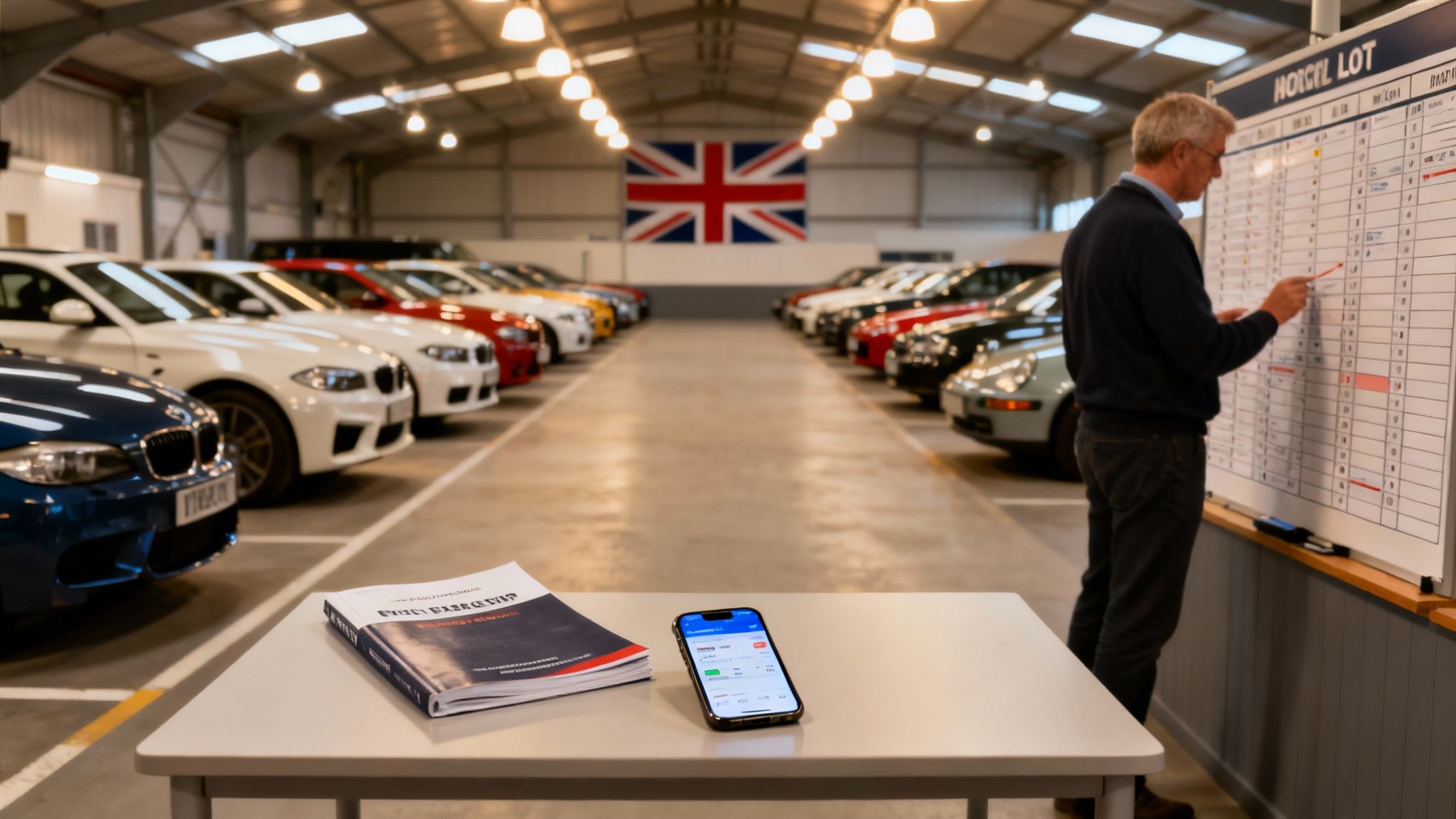
Dipping your toes into the world of UK car auctions can feel like you've stumbled upon a trade secret. It's a fast-paced, dynamic marketplace where thousands of vehicles find new owners every single week. You'll find everyone from seasoned motor trade professionals to savvy private buyers looking for a genuine bargain. And don't think it's just about salvage or end-of-life cars; this is a primary channel for ex-fleet vehicles, dealership part-exchanges, and finance repossessions.
The Appeal of the Auction Lane
Let's be honest, the main draw is the potential for some serious savings. The pricing at an auction is a completely different beast compared to retail. I've seen it time and again: there's a persistent price gap between what you see on a forecourt and the auction 'hammer price'.
Many UK dealers will price their stock 10% to 20% above the CAP Clean valuation, which is a trade benchmark for second-hand cars. To put that in perspective, a 2021 Volkswagen Golf GTD listed at £21,495 on a forecourt could realistically be won at auction for around £17,800, and that's including fees. That’s a saving of nearly 17%.
Beyond the price, the sheer variety is incredible. Whether you're after a reliable family hatchback, a workhorse commercial van, or even a niche classic, you’ll find options that you just don't see in the usual classifieds.
The real advantage of buying at auction isn’t just saving money—it’s gaining access to the same pool of vehicles that dealers use to source their own stock. You are effectively cutting out the middleman.
Understanding Different Auction Types
Not all auctions are created equal, so picking the right one is your first move. Your options generally fall into two main camps.
First, you have Physical Auctions. These are the traditional events you probably imagine, with a proper auctioneer, a live crowd, and cars being driven through the hall. The huge advantage here is being able to inspect the vehicles in person before the bidding kicks off.
Second are Online Auctions. These have exploded in popularity, giving you the convenience of bidding from your sofa. They often have more detailed listings and condition reports, but you do lose that hands-on feel of seeing the car in the metal.
For anyone new to this, it's a game of balancing caution with confidence. The deals can be fantastic, but the "sold as seen" nature of most sales means your own due diligence is absolutely critical. This is where preparation becomes your best friend.
Before you even think about raising a paddle (or clicking a button), you need a plan. You need a budget. And you absolutely need to understand the vehicle's history. This is where tools like an AutoProv vehicle history check move from being 'helpful' to 'essential'—it’s your best defence for uncovering a car’s past and protecting your wallet. For a great starting point, our used car buying guide for the UK covers all the foundational knowledge you'll need.
Setting Yourself Up for a Successful Purchase
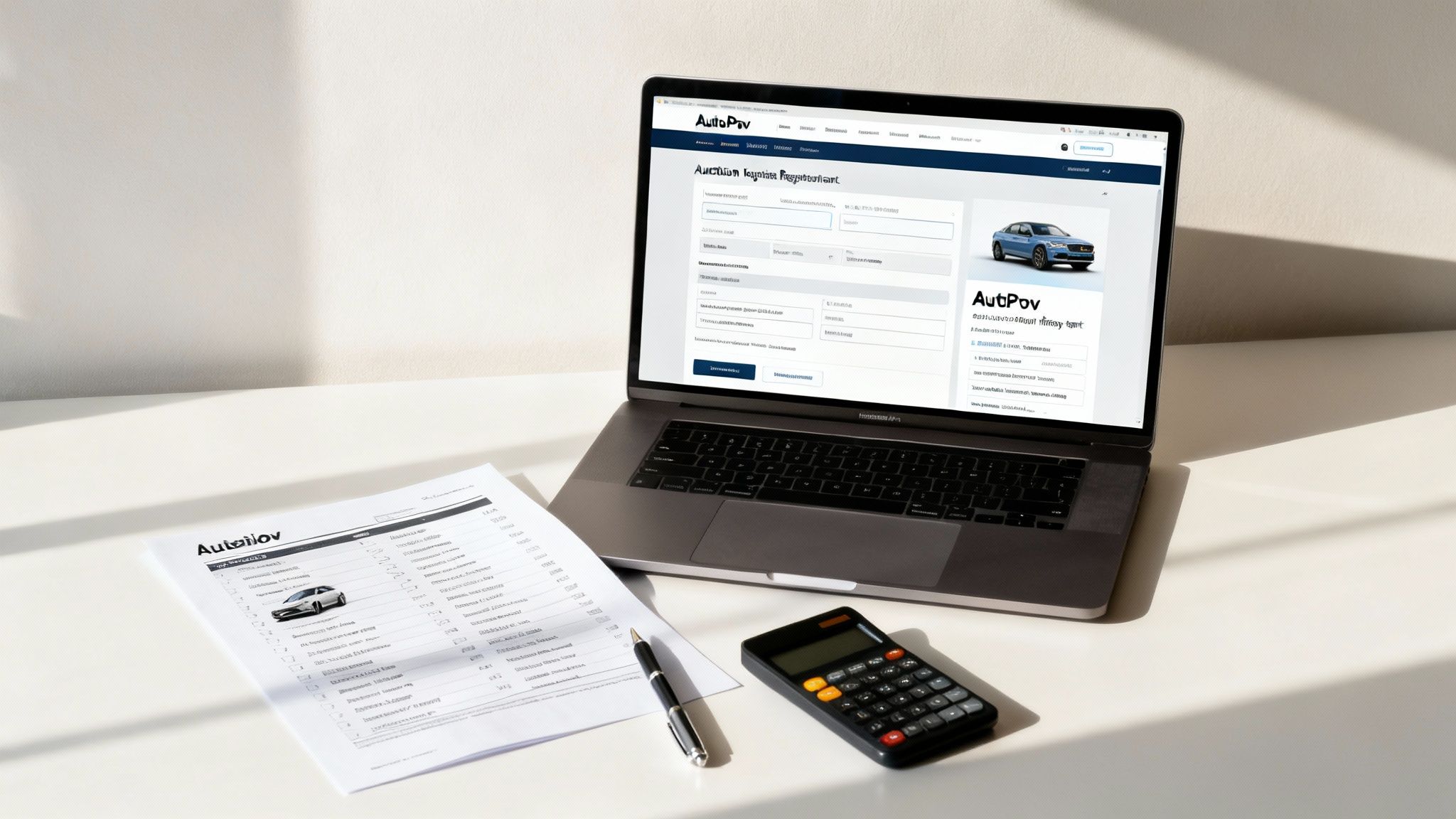
Let's be clear: a successful auction buy is made long before the hammer ever falls. The real work—the stuff that separates a savvy buyer from someone who’s just made a very expensive mistake—happens in the prep phase. This is your pre-auction masterclass, covering the vital groundwork to make sure you bid with total confidence.
Your first move is to get familiar with the auction houses. In the UK, you’ve got the big players like BCA and Manheim, and they are fantastic. But don’t write off the smaller, independent auctions. Sometimes they specialise in specific types of vehicles and you can find some real gems. Each one has its own rules, fee structures, and sign-up process, so getting to know them is non-negotiable.
Navigating Registration and Rules
Getting registered is usually a straightforward online job. You'll need to provide some ID and will likely be asked for a refundable deposit to get your bidding number. Simple enough.
But before you even think about looking at cars, you need to sit down and properly read the auction's terms and conditions. I know, I know—it’s tempting to skip. Don’t. This document is packed with crucial details you need to understand.
Key things to look for include the Buyer's Fees. This is the auction house's cut, a percentage added on top of your final bid. It varies wildly, so you absolutely must factor this into your budget from the get-go.
You must also be aware of VAT (Value Added Tax). Pay very close attention here. Commercial vehicles are almost always subject to VAT on the hammer price, which adds a hefty 20% to your total bill.
Finally, check the Payment Deadlines. Auctions move fast. They expect payment quickly, often within 24 to 48 hours. Make sure you know how they accept payment and that your funds are ready to go.
Getting these details straight from the start saves you from any nasty shocks after the excitement of a winning bid wears off.
Creating a Shortlist and Setting a Budget
Right, with the admin sorted, it's time for the fun part: diving into the auction catalogues. This is where you'll build a shortlist of potential targets. An effective shortlist isn't just a list of cars you fancy; it's about spotting vehicles that fit your criteria and are worth a closer look.
As you browse, your most important job is to set a rock-solid budget for every single car on your list. And I don’t just mean a single number. A proper auction budget has a few key parts. First, you need your Maximum Hammer Price, the absolute most you are willing to bid, with no exceptions. Then, add the Buyer's Premium, calculated on top of your max bid. If it’s a commercial vehicle or marked as VAT-qualifying, add the Applicable VAT. Finally, always set cash aside for a Contingency Fund for immediate repairs, transport, and a basic service.
This total figure is your true "walk-away" price. Sticking to it is the only way to avoid buyer's remorse and ensure you’ve actually bagged a bargain. The used car market is buzzing right now. Recent figures from the Society of Motor Manufacturers and Traders (SMMT) show that used car sales hit nearly 2 million units in Q2—the best second-quarter performance since 2021. That means plenty of stock is flowing through the auction lanes, giving you lots of choices.
Your preparation is your power. The more you know about the car, the fees, and your own budget before the auction starts, the less likely you are to be swayed by the fast-paced bidding environment.
The AutoProv Advantage: Your Secret Weapon
This is where you gain a serious edge. A physical inspection is great for checking a car's current condition, but an AutoProv report uncovers its entire life story. Before you get emotionally or financially invested in anything on your shortlist, a full history check is an absolute must.
This isn't just about dodging a lemon; it's about making a smart business decision. Our reports pull data from over 10 sources to give you the complete picture in seconds. For instance, an auction catalogue might not tell you a car has outstanding finance. If you buy it, that car could be repossessed, leaving you with no vehicle and a massive hole in your wallet. Our guide on the importance of finance checks in a vehicle purchase dives deeper into this exact risk.
By running an AutoProv check on your shortlisted cars, you can quickly vet each one for critical issues like outstanding finance or a write-off history. Our system flags mileage discrepancies by comparing recorded mileage against its MOT and service history, helping you spot potential "clocking". We also verify the vehicle isn't listed as stolen on the Police National Computer (PNC), ensuring your purchase is legitimate. This level of due diligence turns you from a hopeful bidder into a strategic buyer, armed with the facts you need to either bid with confidence or walk away from a disaster waiting to happen.
How to Inspect an Auction Vehicle Like a Pro
In the fast-paced world of car auctions, the phrase 'sold as seen' is the absolute rule of the game. There are no returns, no warranties, and certainly no second chances. This is why your ability to inspect a vehicle quickly and accurately is the single most important skill you can bring to the auction hall.
Even with just a few precious minutes before the bidding kicks off, a systematic check can be the difference between bagging a bargain and driving home a money pit.
A physical inspection tells you about the car's present condition, but it reveals very little about its past. That’s why you must combine your own hands-on checks with a professional-grade vehicle history report. It’s all about building a complete picture and verifying that what you see in the metal aligns with the hard data.
The Exterior Walk-Around
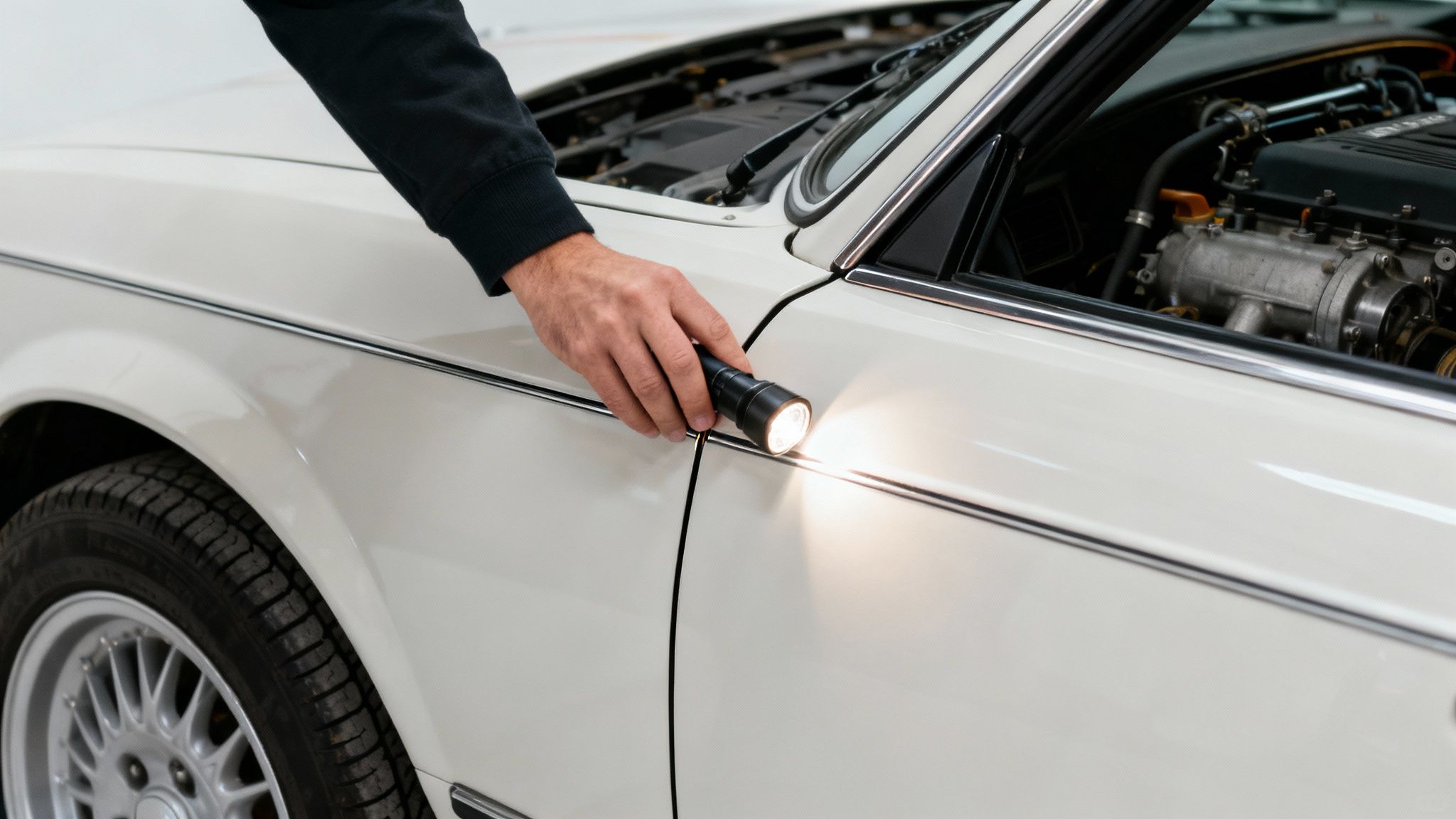
Start with a slow, deliberate walk around the car. Keep a bit of distance at first – this helps you spot any inconsistencies in the bodywork that you might miss up close. You’re looking for misaligned panels, particularly around the bonnet, boot, and doors. Uneven panel gaps are often a dead giveaway of previous accident damage and shoddy repair work.
Now, get closer and really scrutinise the paint. Crouch down and look along the side of the car; this angle is brilliant for revealing the tell-tale ripples or waves in the panels that point to filler. Pay close attention to the paint's texture and colour match between adjacent panels. Even a slight difference in shade under the harsh auction hall lights can indicate a respray.
You should also check for overspray by peeking inside the wheel arches and on the rubber seals around doors and windows. Finding paint where it shouldn't be is a classic sign of a rushed paint job. Then, inspect the glass for chips, cracks, and the manufacturer's stamp on each window; a mismatch is a sure sign of replacement. Finally, examine the tyre condition. Uneven wear can point to serious alignment or suspension issues.
Diving into the Interior and Electrics
Once you're inside, the first thing to do is trust your nose. A damp or musty smell is a massive red flag for water leaks, which can be a notoriously difficult and expensive problem to fix. Don't forget to check for dampness under the floor mats and in the boot.
Now it's time to test every single button, switch, and dial you can get your hands on. Don't be shy about it. Turn on the ignition (without starting the engine) and watch the dashboard. All the warning lights should illuminate and then go out as they should. A light that stays on—or worse, doesn't come on at all—is a major warning.
Flick all the switches for the electric windows, mirrors, infotainment system, air conditioning, and lights. Electrical gremlins can be a complete nightmare to diagnose and repair, so a thorough check here is time very well spent. The condition of the steering wheel, gear knob, and driver's seat bolster should also be consistent with the car's advertised mileage. Excessive wear on a low-mileage car should set alarm bells ringing.
Your physical inspection is your frontline defence. It's about finding the immediate, visible issues. But remember, the most expensive problems are often invisible—a hidden write-off history, outstanding finance, or a mileage discrepancy.
Under the Bonnet and Beyond
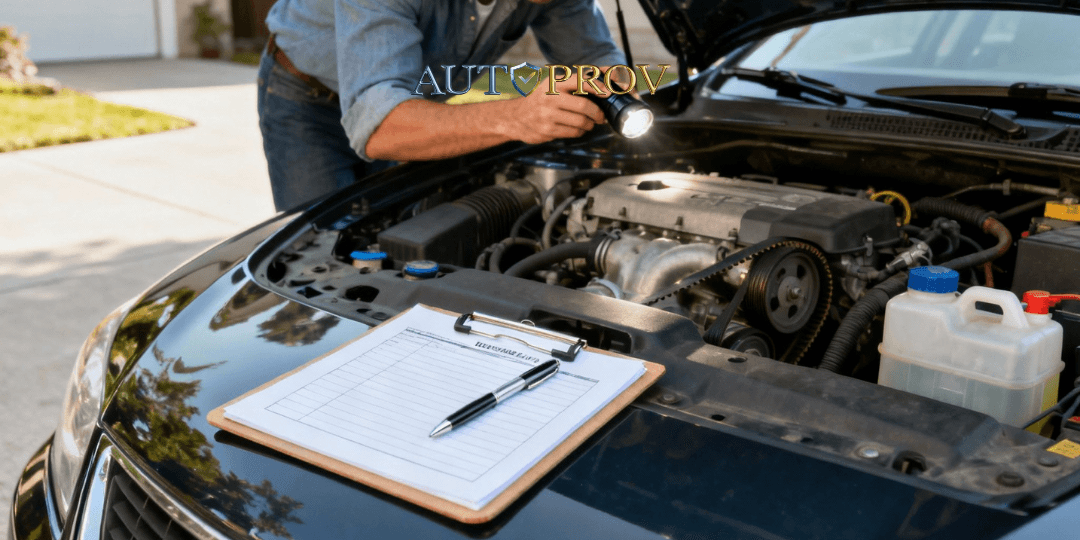
You probably won't be able to start the engine, but you can still learn a lot by looking in the engine bay. Pull the dipstick and check the oil level and its colour; it should be a clean, golden-brown, not black and sludgy.
Next, look for a creamy, mayonnaise-like substance on the underside of the oil filler cap. This is a potential sign of head gasket failure, a hugely expensive repair. Also, examine the coolant level and colour in the expansion tank. It should be a bright colour (often pink or blue), not a murky brown. Give the whole engine bay a quick scan for any obvious signs of fluid leaks.
The Final Verdict: Combining Sight and Data
This is where it all comes together. You've completed your physical checks and have a list of observations. Now, you cross-reference this with the data from your AutoProv vehicle history report.
Does the MOT history on the report mention advisories for tyre wear that match what you’ve just seen with your own eyes? Do the mileage records from previous services and MOTs line up with what the odometer is showing? Crucially, does the report show a past insurance write-off that could explain that mismatched paint you spotted?
This two-pronged approach gives you the full story. It allows you to bid based on solid evidence, not just a gut feeling. Knowing how to combine what you see with what the data tells you is the key to mastering how to buy cars at auction.
For an even more exhaustive list of checks, our ultimate used car inspection checklist provides an excellent framework to follow. This detailed process ensures you’re not just buying a car; you're making a smart, informed investment.
Crafting Your Winning Bidding Strategy
This is where the auction really comes alive. The bidding is where the pulse quickens, but it’s the exact moment you need a calm head and a solid plan. While the excitement is undeniable, a well-thought-out strategy is what separates a great buy from a costly mistake. It’s all about balancing psychology, timing, and unshakeable discipline.
The single most important part of any bidding strategy is setting your maximum bid and sticking to it, no matter what. This isn't just a rough number in your head; it’s your hard limit. You calculate it by taking the car's market value and subtracting every anticipated cost: the buyer's premium, VAT, transport fees, and a buffer for any immediate repairs. Think of this number as your financial safety net, there to stop you from getting swept up in the heat of the moment and overpaying.
The goal isn't just to 'win' the car; it's to win it at the right price. Walking away from a bidding war that goes over your budget is a victory in itself. It means your strategy is working.
Reading the Room and Timing Your Bid
Whether you're standing in a bustling auction hall or watching a countdown timer online, getting a feel for the flow is key. In a physical auction, listen to the auctioneer. They have a rhythm, a cadence that builds momentum. Understanding this helps you anticipate when the bidding is about to close.
The same idea applies online. Watch how quickly the bids are coming in. Is it a flurry of activity right from the start, or are bids trickling in slowly? This tells you a lot about how much interest there is in the vehicle.
There are a few different schools of thought on when to jump in. The Early Bidder puts a bid in early to show they're serious, which can sometimes scare off less confident bidders. The risk is that you might kickstart a bidding war too soon. The Mid-Auction Bidder jumps in as bidding slows to position themselves as a fresh competitor. Finally, The Late Bidder (or 'Sniper') waits until the very last seconds, a high-risk, high-reward tactic best suited to online auctions.
Calculating Your Maximum Bid with Confidence
Your maximum bid has to be based on solid data, not just a gut feeling. This is where combining your own research with professional tools really pays off. You need to start with a baseline retail value for the car in its current state, then work your way backwards.
Let’s walk through a real-world example. Say you're looking at a Ford Focus with a retail value of about £8,000. You’ve set aside £500 for immediate costs like a service and getting it transported. The auction house charges a 10% buyer's premium.
First, work out your target cost: you want to buy the car for at least £1,500 below its retail price, so your absolute total spend is £6,500. Next, subtract your costs: take your £6,500 target and minus the £500 you’ve budgeted for initial costs, leaving £6,000. Finally, factor in the fees. This £6,000 has to cover the buyer's premium. To find your maximum hammer price, you need to calculate £6,000 ÷ 1.10. That gives you roughly £5,450.
That number, £5,450, is your absolute ceiling. Don’t go a penny over. To get this even more accurate, our guide on understanding market insights and vehicle pricing dives deeper into how trade valuations shape these calculations. Using an AutoProv report gives you access to current trade and retail valuations, making your sums much more precise. This ensures your bid is competitive but still leaves room for profit.
Knowing when to stop is the most powerful tool you have when learning how to buy cars at auction. It’s what keeps you in control.
What to Do After the Hammer Falls
 The final bid is in, the auctioneer's hammer has fallen, and the car is yours. It's a fantastic feeling, but don't get carried away just yet—the process isn't quite over.
What comes next is a series of crucial administrative steps to formally transfer ownership to you. Acting quickly and efficiently here ensures a smooth handover, letting you enjoy your new purchase without any last-minute stress. The moments immediately following your winning bid are governed by the auction house's specific rules, and they expect prompt action.
Settling the Bill
First things first: payment. Auction houses work to tight schedules and expect you to settle your account very quickly, often within 24 to 48 hours of the sale. Missing this deadline can lead to penalties or even the cancellation of your purchase, so it's vital to have your funds ready to go.
Most UK auction houses prefer payment via bank transfer, especially for larger sums. Some might accept debit cards, but it's always a good idea to check for any transaction limits with your bank beforehand. For security reasons, cash is rarely an option.
Your final invoice will break down the total cost. This includes the hammer price (your winning bid), the buyer's premium (the auction house's fee), and any applicable VAT (Value Added Tax), particularly on commercial vehicles.
Speaking of commercial vehicles, it's worth noting how popular they've become. The demand for Light Commercial Vehicles (LCVs) has seen huge growth at UK auctions. For example, a major player like British Car Auctions (BCA) reported that the average LCV auction value recently hit £7,892, a year-on-year jump of over 13.7%. This just goes to show how important it is to factor in potential VAT when you're budgeting for these sought-after vehicles.
Managing the Paperwork
Once you've paid up, the focus shifts to the legal paperwork. This is where you officially become the new keeper. The most important document is the V5C logbook, which the auction house will provide. It’s your responsibility to fill out the relevant section to notify the DVLA of the change in ownership.
You'll also need to sort out road tax for the vehicle immediately. Under UK law, road tax isn't transferable from the previous owner, meaning you cannot legally drive the car on public roads until it is taxed in your name. This is usually straightforward and can be done online or at a Post Office using the reference number from the V5C.
Don't overlook the importance of the sales receipt or invoice from the auction house. This document is your proof of purchase and is absolutely essential for your records. Think of it as the cornerstone of your vehicle sale contract.
Getting to grips with the legal side of buying a car is vital. For a more detailed look at the contractual bits and pieces, have a read of our guide to the UK car sale contract, which clearly explains your rights and responsibilities.
Arranging Collection and Transport
Finally, you need to get your new car home. You have two main options here: drive it away yourself or arrange for a professional transport service.
If you plan on driving it, you must have valid insurance cover in place before you get behind the wheel. Driving without insurance is illegal in the UK and comes with some very severe penalties.
Alternatively, using a vehicle transport company is often a smart and convenient choice, especially if the car is located far away or isn't roadworthy. Many auction houses have partnerships with local transport services and can help you arrange collection. This takes the stress out of sorting insurance and tax on the day, allowing you to get the car to your chosen destination safely and without any hassle.
Common Questions About Buying Cars at Auction
Even with the best prep, stepping into a car auction for the first time can feel a bit overwhelming. It’s a fast-paced world, and a few nagging questions are perfectly normal. Getting them answered beforehand is the final piece of the puzzle, giving you the confidence to bid like you’ve been doing it for years.
Let's clear up some of the most common queries we hear from new buyers.
What Are the Hidden Costs Besides the Hammer Price?
This is probably the most critical question you can ask. The hammer price is just the starting point, and forgetting about the extra fees is a classic rookie mistake that can wipe out your bargain in a heartbeat.
The biggest one to watch for is the buyer’s premium. This is the auction house's fee for their service, and it's calculated as a percentage of the final bid. It varies from place to place, so you absolutely must know this figure before you raise your hand.
But that’s not all. You’ll need to factor in a few other potential costs. VAT (Value Added Tax) is a near certainty on commercial vehicles and adds a hefty 20% to the bill. You may also encounter an Auction Indemnity Fee, a small, fixed charge for protection on the car's title, and a V5C Document Fee for handling the logbook transfer. Failing to add these up is the quickest way to blow your budget. Always work out your true 'all-in' price before you even think about bidding.
Can I Get a Warranty on an Auction Car?
In almost every case, the answer is a firm no. The vast majority of vehicles heading through UK auctions are sold on a strict 'as is, where is' basis.
What this means is you’re buying the car exactly as it stands, warts and all. The principle is 'sold as seen', so you accept it with all its existing faults, whether they're obvious or hiding under the surface. This is precisely why doing your homework beforehand is non-negotiable. You simply don’t have the warranty safety net or consumer rights you'd get from a retail dealer.
The responsibility for uncovering any issues with the vehicle rests entirely on you, the buyer. This is where the combination of a thorough physical inspection and a detailed vehicle history report becomes your most powerful tool.
So, while warranties are incredibly rare, the takeaway is simple: you must be happy with the car's condition before you bid. Once that hammer falls, there's usually no going back for mechanical problems found later.
What Happens If I Discover a Major Fault After Purchase?
This is the nightmare scenario for any buyer, but because of that 'sold as seen' rule, your options are pretty limited. If you drive away and the gearbox starts making strange noises, you generally have no comeback against the auction house or the seller for mechanical faults.
However, there's a huge difference between a mechanical failure and a serious misrepresentation of the car's history. This is where your AutoProv report becomes your crucial piece of evidence.
Let's say you buy a car that was described as having a clean record. If your check later proves it was an undisclosed insurance write-off or has a major mileage discrepancy, you might have a solid case. Auction houses have terms about the accuracy of their descriptions. If they got it wrong, your report is tangible proof of misrepresentation, giving you a powerful starting point for a dispute.
Is an AutoProv Check Really Necessary for Auction Cars?
One hundred percent, yes. A physical inspection is vital, but it only tells you about the car's condition right now. It can’t tell you a single thing about its hidden past.
Think of an AutoProv vehicle history check as your defence against a car’s secret history. It’s like an X-ray, uncovering the kind of critical information that is completely invisible to the naked eye. For a small fee, you can instantly find out if the vehicle you're looking at has outstanding finance, a stolen status, mileage discrepancies, or a hidden write-off history. An AutoProv check is an essential tool, stopping you from accidentally buying a car that could be repossessed or is unsafe. It isn't just another cost; it's a cheap insurance policy against making a multi-thousand-pound mistake. It gives you the facts, helping you sidestep the lemons and bid with total confidence on the cars that are genuinely a great deal.
Frequently Asked Questions
AI-Generated Content Notice
This article was created with the assistance of artificial intelligence technology. While we strive for accuracy, the information provided should be considered for general informational purposes only and should not be relied upon as professional automotive, legal, or financial advice. We recommend verifying any information with qualified professionals or official sources before making important decisions. AutoProv accepts no liability for any consequences resulting from the use of this information.
From our AI insights
- UK Part-Exchange Checks: Protecting Dealer Margins
Explore essential part-exchange checks for UK dealers to safeguard profit margins, including provenance and finance verification.
- Why Every Keeper Matters: Insights for UK Car Traders
Understand the importance of checking previous keepers for UK motor trade compliance and risk management.
- Navigating UK Car Auctions: Dealer Insights
Master UK car auctions with these strategic dealer insights and avoid common pitfalls.
Related Articles

Your Ultimate Guide to Buying a Used Car in the UK
Navigate the UK used car market with confidence using our comprehensive buying guide. Tips, checks, and AutoProv Provenance insights included.
Difference Between MOT and Service: What You Need to Know
An MOT is a mandatory legal inspection that every car on UK roads needs to pass.Think of it as the government's way of ensuring your vehicle meets the absolute minimum safety and environmental standards to be considered roadworthy. A service, on the other hand, is a completely different beast. It's the proactive maintenance routine recommended by the people who built your car, designed to keep it running smoothly and catch problems before they start. In short, an MOT is a pass-or-fail exam required by law. A service is a comprehensive health plan for your car.
Your Ultimate Used Car Inspection Checklist
A solid used car inspection checklist is the single most powerful tool you have to avoid buying a lemon. It gives you a methodical way to look past the shiny paint and assess a car's real condition, helping you spot hidden problems and get a fair price before you shake hands on the deal.
Published by AutoProv
Your trusted source for vehicle intelligence