
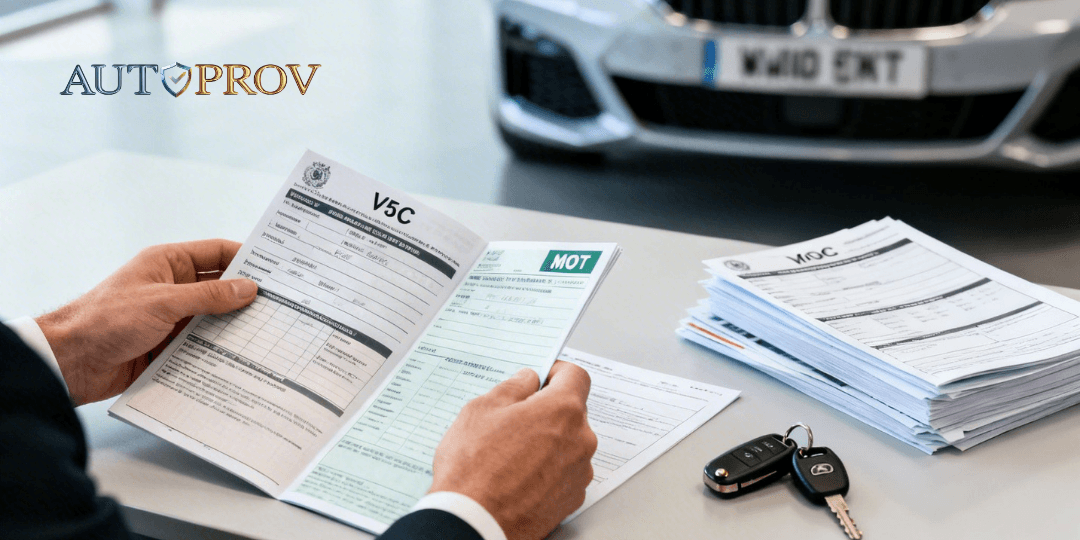
For any motor trade professional, establishing legal ownership of a vehicle is a foundational risk management discipline. It is not about a single document, but a process of building a verifiable case based on consistent evidence. While the V5C logbook is a key document, it does not, by itself, prove legal title. A professional buyer must look deeper.
What Constitutes Proof of Ownership in the UK

In the UK motor trade, there is a critical distinction between the ‘registered keeper’ and the ‘legal owner’. This is a concept many private sellers do not understand, but it is fundamental to professional vehicle acquisition. The V5C Registration Certificate identifies the person responsible for the vehicle's licensing and use; it is not proof of ownership and does not confer the right to sell.
True verification requires assembling a clear evidence trail. This process is akin to building a vehicle provenance file, where each document corroborates the others to form a complete and logical history. With a UK vehicle parc of nearly 42 million, the scale of the market presents significant opportunities for ownership disputes and fraud. Without robust due diligence on every acquisition, a dealership exposes itself to considerable financial and reputational risk.
The Core Documents for Verification
To begin the verification process and build a vehicle's history file, several key documents must be obtained and scrutinised. No single document is definitive, but reviewed together, they provide a clear picture of a vehicle's provenance.
The table below outlines the essential documents a trader should inspect to begin verifying a vehicle's ownership and history.
Core Documents for Verifying Car Ownership
Document What It Indicates Key Verification Point for Traders V5C (Logbook) The identity of the registered keeper responsible for the vehicle. Ensure keeper's details match the seller's ID and that the VIN/registration on the document match the vehicle itself. Purchase Invoice / Bill of Sale The transfer of legal ownership at a specific point in time. This is the primary evidence of ownership. Does the seller possess the original invoice or bill of sale from their acquisition? Full Service History A timeline of maintenance, usage, and recorded mileage. Scrutinise for consistency in dates, stamps, and mileage entries. Gaps or anomalous records are significant risk signals. MOT Certificates A record of roadworthiness tests and recorded mileage at specific dates. Cross-reference mileage readings against service records and other data to identify potential discrepancies or odometer tampering. These documents form the foundation of a vehicle's known history and are the starting point for any professional appraisal.
Let's break down the specific points of scrutiny for each of these core items.
- The V5C (Logbook): This is the cornerstone of your checks. The details on the V5C must align perfectly with the vehicle’s VIN plate and the seller’s photographic ID. For a detailed review of this document, our quick guide on what a V5C document is is a useful resource.
- Original Purchase Invoice or Bill of Sale: This is arguably the most powerful evidence of ownership. It is the legal record of the transaction that transferred title to the current seller. From a legal standpoint, true ownership is typically established by a valid proof of purchase.
- Full Service History: A complete service record, ideally from main dealers or reputable specialists, corroborates the vehicle’s mileage and indicates its maintenance standard. Significant gaps or inconsistent entries are a major red flag requiring further investigation.
- MOT Certificates: While this data is available online via the DVSA service, physical certificates can provide a quick method for cross-referencing mileage readings and identifying discrepancies that warrant a more detailed digital analysis.
The professional's role is not merely to collect these documents, but to forensically examine them for inconsistencies. Do names, dates, and mileage data align across all records? Any deviation introduces risk and requires a credible explanation.
This methodical process is what differentiates a professional buying operation from an amateur one. It is the first and most critical line of defence, protecting capital and reputation before a high-risk vehicle enters your stock.
Developing Your Provenance Intelligence

For a professional trader, a cursory review of the V5C and service book is insufficient. True due diligence requires developing provenance intelligence—the skill of actively interrogating a vehicle's history, not just passively collecting documents. It involves learning to interpret the narrative of a car's past, particularly the risk signals a seller may wish to conceal.
This means moving beyond face-value acceptance of information and actively hunting for gaps, anomalies, and red flags. A vehicle can appear immaculate but conceal issues ranging from a clocked odometer to a problematic ownership history. The ability to identify these issues at the point of appraisal is what separates a profitable acquisition from a future liability that erodes capital and damages reputation.
Interrogating the MOT and Service History
The online MOT history is a valuable tool, but its real power is unlocked when cross-referenced against physical service records and other data points. The objective is not just to confirm a clean pass history, but to identify contradictions that indicate potential issues.
Consider a common scenario: a vehicle's MOT history shows a plausible mileage progression. However, the service record includes an invoice for major work with a mileage entry 20,000 miles higher than the MOT from the same period. This is a significant red flag for potential odometer tampering ("clocking"), where the mileage may have been altered after the service but before the next MOT test.
Another risk signal is a significant gap in service history that coincides with a change of keeper. This could be innocuous, but it could also indicate a period of neglect or an undisclosed accident repair conducted outside of official networks.
The guiding principle is that all evidence must be corroborative. MOT records, service invoices, and even old repair receipts build a timeline. Any data point that breaks this logical sequence requires closer investigation.
Analysing Ownership Timelines for Risk
A basic vehicle history check UK providers offer will show the number of previous keepers, but this figure alone lacks context. The timeline of ownership changes is a far more powerful indicator of risk. Rapid ownership cycles, often termed short-term ownership, are one of the most significant warning signs in the motor trade.
For instance, a vehicle with three registered keepers within 18 months should trigger immediate concern. This pattern often points to underlying issues such as:
- A recurring, difficult-to-diagnose fault that previous owners were unable or unwilling to resolve.
- Poorly repaired accident damage that becomes apparent only after a period of use.
- A history of undisclosed high-stress use, such as private hire or courier work.
Disputes over vehicle provenance in the UK motor trade frequently involve mileage and ownership discrepancies, with DVLA and MOT data serving as key evidence. With the average age of cars on UK roads increasing, the risk of encountering vehicles with compromised histories is growing. An ageing fleet creates more opportunities for fraud, making this type of pattern analysis more critical than ever.
Advanced trade vehicle intelligence platforms like AutoProv are designed to address this challenge. Our system analyses data patterns from multiple sources to flag anomalies that standard checks may miss. We go beyond a simple keeper count, highlighting suspiciously short ownership periods that indicate a high-risk vehicle. Learning to interpret this data is a key advantage; you can explore this further by understanding how to check how many owners a car has had and what those patterns mean for your business. This is how basic data is transformed into actionable intelligence to protect your investment.
Navigating Complex Ownership Scenarios

While standard private transactions are routine, a trader's expertise is truly tested by non-standard ownership situations, such as deceased estates, ex-company vehicles, and assets subject to finance agreements. In these scenarios, the risk of acquiring a vehicle with a compromised title increases significantly.
An error in these situations can result in unsaleable stock, reputational damage, and complex legal challenges. Proving ownership in these cases requires a more rigorous approach. A standard document check is insufficient; you must demand specific legal paperwork that proves the seller's authority to transact. A robust process and professional scepticism are essential.
Purchasing from a Deceased Estate
Acquiring a vehicle from a deceased person’s estate is a common but high-risk transaction. You are often dealing with a bereaved relative who may be unfamiliar with the correct legal procedure. Your role is to be professional and firm in your due diligence.
The person selling the vehicle must have the legal authority to dispose of the deceased's assets. To prove this, you must inspect two critical documents:
- The Death Certificate: This is non-negotiable and confirms the registered keeper has passed away.
- The Grant of Probate: This is the key legal instrument. It is a court-sealed document that officially names the executor(s) of the will, granting them the legal power to sell assets, including the vehicle.
Never accept a will in lieu of a Grant of Probate. A will expresses intent; the Grant of Probate confers legal authority. The name on the grant must be verified against the photographic ID of the person you are dealing with.
A common pitfall is a trader accepting a relative's word and completing the transaction. Subsequently, the actual executor may emerge, leading to a legal dispute over a vehicle for which you have already paid.
Dealing with Outstanding Finance
A vehicle with outstanding finance is the property of the finance company, not the registered keeper. Paying the seller directly without clearing the debt is a direct route to acquiring a significant liability. Any basic dealer vehicle check will flag an active finance agreement, which is your signal to manage the settlement process directly.
Your procedure must be watertight:
- Obtain a Settlement Letter: The seller must request an up-to-date settlement letter from the finance company. This document specifies the exact amount required to clear the loan and typically has an expiry date.
- Pay the Finance Company Directly: Do not transfer settlement funds to the seller. You must pay the finance provider directly to ensure the debt is settled.
- Confirm Clearance: Obtain written confirmation from the finance company that the agreement is satisfied and their interest has been removed from the vehicle's record (e.g., the provenance marker).
- Pay the Seller the Balance: Only after receiving this confirmation should you pay the seller any remaining equity.
Adhering strictly to this process is the only way to guarantee you obtain a clean title.
Other Tricky Scenarios
Other non-standard situations demand the same level of scrutiny. For example, a pending private plate transfer can create V5C complications if the original registration is not confirmed on the logbook before payment is made.
When purchasing from a company in administration, you must see documentation proving the administrator has the legal right to dispose of assets. The risk is identical to that of a deceased estate: you must verify you are dealing with the person legally empowered to conduct the sale.
This table summarises the essential checks for these common but complex cases.
Handling Special Ownership Cases: A Trader's Checklist
Scenario Essential Document(s) Critical Verification Action Deceased Estate Death Certificate & Grant of Probate Match executor's ID to Grant of Probate. Never accept just a will. Outstanding Finance Settlement Letter from the finance company Pay the finance company directly. Never give the funds to the seller. Company in Admin Letter of appointment for the administrator Confirm the administrator has the legal authority to sell assets. Plate Transfer Updated V5C showing original registration Do not finalise the purchase until the new V5C arrives. Repossession Repossession documents & authority to sell from lender Verify the seller (often an agent) has the legal right to sell. This checklist should be your standard reference. In all such cases, the rule is simple: verify authority, document everything, and do not allow urgency or personal stories to rush you into a poor commercial decision.
Finally, a vehicle's history can conceal other risks, such as being recorded as stolen. It is advisable to review best practices on how to check for a stolen vehicle as another vital layer of risk management.
Spotting Red Flags Before You Buy
Experienced motor trade professionals develop an instinct for deals that feel 'off', even when the paperwork appears correct. This is not intuition; it is pattern recognition, honed by experience, identifying deviations from the norm.
Trusting this instinct is a valuable skill, but it must be backed by data. It's about looking beyond a basic history check and training yourself to notice the subtle signals that differentiate a good acquisition from a future problem. This instinct should prompt deeper investigation, with data used to confirm or deny the initial suspicion.
A Recent V5C Issue Date
This is a classic red flag that is easily missed. A seller claiming to have recently acquired a new V5C due to "losing the old one" should be treated with extreme caution. A logbook issued just weeks or a few months prior to a sale is often a deliberate tactic.
The reasons for this are often to:
- Conceal a rapid ownership history: A fresh V5C hides the details of previous keepers, obscuring a pattern of short-term ownership which often indicates an underlying vehicle fault.
- Obscure a recent finance settlement or repossession: A seller may attempt to dispose of the vehicle before a finance or repossession marker appears on standard data checks.
- "Wash" a cloned vehicle's identity: In serious fraud cases, criminals obtain a new V5C at a new address as a step toward building a seemingly legitimate paper trail for a stolen or cloned vehicle.
Always ask to see the previous V5C or demand a credible reason for its absence. If the seller is evasive, a deeper provenance check is essential.
Mismatched Seller and Document Details
This should be an immediate deal-breaker. The person selling the vehicle must be the same person named on the V5C logbook, and the address on their ID should match the address on the document.
Stories about "selling for a friend" or "just moved house" are unacceptable in a professional transaction. You must inspect their photo driving licence or passport and verify it against the V5C. Any discrepancy means you are almost certainly not dealing with the legal owner.
Trust must be earned, not assumed. If the seller's identity and the official paperwork do not align perfectly, the default professional position must be to walk away. The risk of acquiring a stolen vehicle or one with a disputed title is too great.
Cash-Only Demands and Document Reluctance
A seller’s behaviour can be as revealing as their paperwork. Be wary of any individual insisting on a cash-only transaction, particularly for higher-value vehicles. While some sellers may prefer cash, an insistence on it is often a method to avoid the digital audit trail created by a bank transfer, which complicates tracing a fraudulent sale. This is a common tactic when a vehicle has outstanding debt; our guide on how to check for outstanding car finance in the UK provides more detail.
Similarly, a seller who is vague about the vehicle’s service history should raise alarm. If the service book has "gone missing," it is a significant red flag. A genuine owner is typically proud of a full service history. Reluctance to produce it almost always indicates there is information within that they would prefer you not to see.
These behavioural red flags, combined with any documentary issues, paint a clear picture of risk. This is where advanced tools add value. The trade vehicle intelligence from AutoProv can highlight anomalies in ownership timelines, turning a gut feeling into hard data and providing the confidence to either walk away or proceed with full awareness of the risks.
Building a Bulletproof Buying Process
Knowledge is only effective when applied within a systematic framework. To consistently acquire clean, profitable stock, every buyer within a dealership must adhere to the same repeatable, risk-mitigation process. A robust buying framework is a core business discipline that protects capital, prevents disputes, and preserves brand reputation.
This process begins at the first point of contact with a seller and concludes only after the transaction is fully documented. The objective is to create an efficient, data-led acquisition operation where every decision is supported by verifiable evidence. It means moving from ad-hoc checks to an integrated strategy where vehicle intelligence informs every stage.
This graphic highlights some of the immediate red flags that should trigger a more cautious and thorough approach.

Each of these signals—a recent V5C, mismatched ID, or a push for cash—is an early warning to slow down the transaction and conduct more rigorous scrutiny.
Setting Up Your Standard Buying Procedure
Your buying process must be standardised, whether you are a sole trader or a large dealership with a team of buyers. Consistency prevents errors, especially under pressure. A sound framework can be structured in tiers.
Tier 1: Initial Contact and Triage This initial stage serves to quickly qualify or disqualify a potential acquisition.
- Screen the Seller: Ask direct questions via telephone. "Is the car registered in your name on the V5C?" and "Is there any outstanding finance on the vehicle?" Their response and manner can be very revealing.
- Quick Digital Check: Use a basic data checker to review MOT history and vehicle details. This can instantly flag major issues, such as a significant mileage discrepancy, before more time is invested.
Tier 2: Physical Inspection and Document Review This is the on-site appraisal where you inspect the vehicle and its paperwork. The goal is to verify that the physical evidence aligns with the digital records.
- Scrutinise Documents: Review the V5C, service history, and the seller’s photographic ID with meticulous attention to detail. All names, addresses, and VINs must match perfectly.
- Inspect the Vehicle: Beyond a mechanical check, verify that the VIN plates and stickers on the vehicle are intact and match the V5C. Look for any signs of tampering or repair in these areas.
Knowing When to Go for a Full Provenance Analysis
Not every vehicle requires the same depth of investigation. The skill is in knowing when a standard history check is sufficient, and when a full vehicle provenance report is non-negotiable.
A standard history check may be adequate for a low-risk, low-value part-exchange from a long-standing customer. However, for high-value stock, vehicles from new sources, or any unit that triggers a red flag, a full provenance analysis is an essential risk management step.
This is where true trade vehicle intelligence becomes a mandatory part of your buying process. A deeper analysis, such as an AutoProv vehicle provenance report, is critical when you identify risk signals like:
- Short-term ownership (multiple keepers in a short period).
- Gaps in the service or MOT history.
- A recently issued V5C.
- Any hesitation from the seller to provide documentation.
Finally, every acquisition must be formalised. Using a legal document like a Bill of Sale template is a crucial final step. This document creates an undeniable record of the transaction, detailing the price, date, and parties involved. It provides a clean legal record for your files and solidifies the vehicle's provenance from the moment it enters your stock.
Frequently Asked Questions on Car Ownership
Even with a robust buying process, complex situations will arise. In the motor trade, proving ownership is not a simple checklist; it requires having clear, concise answers for common challenges.
Here are the direct, professional answers to questions frequently asked by traders.
Is the V5C Log Book Proof of Ownership?
No. This is the most critical distinction in the UK motor trade. The V5C Registration Certificate, issued by the DVLA, identifies the registered keeper—the person responsible for licensing and ensuring the roadworthiness of the vehicle. It does not prove legal ownership.
Legal ownership is established through a chain of evidence. The primary document is a bill of sale or purchase invoice from when the seller acquired the vehicle. When combined with a consistent service history, finance clearance letter, and a correctly completed V5C, this evidence builds a strong case for ownership. The V5C is the starting point of your investigation, not the conclusion.
What if the Seller's Name Does Not Match the V5C?
This is a major red flag and, for a professional trader, should be an immediate deal-breaker. The person selling the vehicle must be the person named on the V5C or must possess clear legal authority to act on their behalf.
Legitimate reasons for a mismatch are rare and require watertight documentation. A dealer selling on consignment must provide a written agreement with their customer. An executor of a deceased estate must present the Grant of Probate.
Without this level of proof, you are likely dealing with an individual who has no legal right to sell the vehicle, exposing your business to fraud and the risk of acquiring a stolen asset.
In the motor trade, a story of "selling it for a mate" is not a valid basis for a transaction. The seller must prove their legal connection to the vehicle with official documents that match their personal identification.
How Should I Handle a Car with a Recent V5C Issue Date?
Proceed with extreme caution. A V5C issued only a few weeks or months prior to a sale is highly suspicious. While the seller may claim the original was lost, this is a classic tactic used to obscure a problematic history.
A new logbook can be a deliberate attempt to conceal:
- Rapid sales: A new V5C erases the record of recent keeper changes, which often signals a recurring fault.
- Previous keeper details: The seller may be preventing you from contacting a previous owner who could reveal undisclosed issues.
- A fraudulent transfer: It could be a tactic to quickly sell a vehicle before negative information, such as a finance marker, appears on a used car history report.
Challenge the seller for a credible explanation and request any legacy paperwork. In this scenario, a deep-dive vehicle provenance check is not just recommended; it is essential to uncover the full ownership history and identify what the seller may be trying to hide.
Can I Buy a Car Without Its V5C Log Book?
No. For any professional motor trade business, this represents an unacceptable level of risk. The absence of a V5C at the point of sale is one of the most significant warning signs you can encounter.
A missing logbook can indicate several serious problems:
- It may be held by a finance company as security against an outstanding loan.
- It could have been deliberately withheld or destroyed to hide the vehicle's true identity or history.
- It is a common characteristic of a stolen or cloned vehicle.
A legitimate seller can apply for a replacement V5C from the DVLA using a V62 form. However, you should never transfer funds until the seller has the new document in their possession and you have verified it. Acquiring "no logbook" vehicles is a gamble that professional businesses must refuse to take.
A robust buying process relies on layering document checks with advanced trade vehicle intelligence. AutoProv provides the deeper insights you need to verify ownership timelines, spot high-risk patterns like rapid resale, and make safer, more profitable buying decisions. Protect your business by uncovering the risks that basic checks miss.
Frequently Asked Questions
AI-Generated Content Notice
This article was created with the assistance of artificial intelligence technology. While we strive for accuracy, the information provided should be considered for general informational purposes only and should not be relied upon as professional automotive, legal, or financial advice. We recommend verifying any information with qualified professionals or official sources before making important decisions. AutoProv accepts no liability for any consequences resulting from the use of this information.
From our AI insights
- Navigating ULEZ Compliance for Used Car Dealers
A deep dive into ensuring your used car stock meets ULEZ standards, avoiding costly fines.
- Mastering Paint Verification with VIN Decoding
Learn how UK traders verify original paint using VIN decoding and provenance data.
- Understanding VIN Decoding: Avoid Misleading Imports
Learn how VIN decoding reveals vehicle origins and specs, preventing import pitfalls.
Related Articles

Car Specs by Reg: Instantly Find Vehicle Details & MOT History
Trying to find the full car specs by reg? In the UK, that little number plate is the key to unlocking a huge amount of information about a vehicle. From the exact engine size and CO2 emissions to its MOT history and tax status, it's all tied to the registration.
How to Check Previous Owners of a Car in the UK
Before you even start thinking about how to check the previous owners of a car, you need to get your head around why it's so important. This isn't just about being nosy; it’s a non-negotiable step that protects you from serious financial headaches and safety risks lurking under a shiny bonnet.
How to Check Service History in the UK
Think of a car's service history as its detailed CV, not just some dusty folder in the glovebox. To check service history is to get the real story behind a vehicle, digging into everything from its routine oil changes to any major surgery it's had. For any savvy car buyer in the UK, this record is the single most important document you can get your hands on.
Published by AutoProv
Your trusted source for vehicle intelligence
