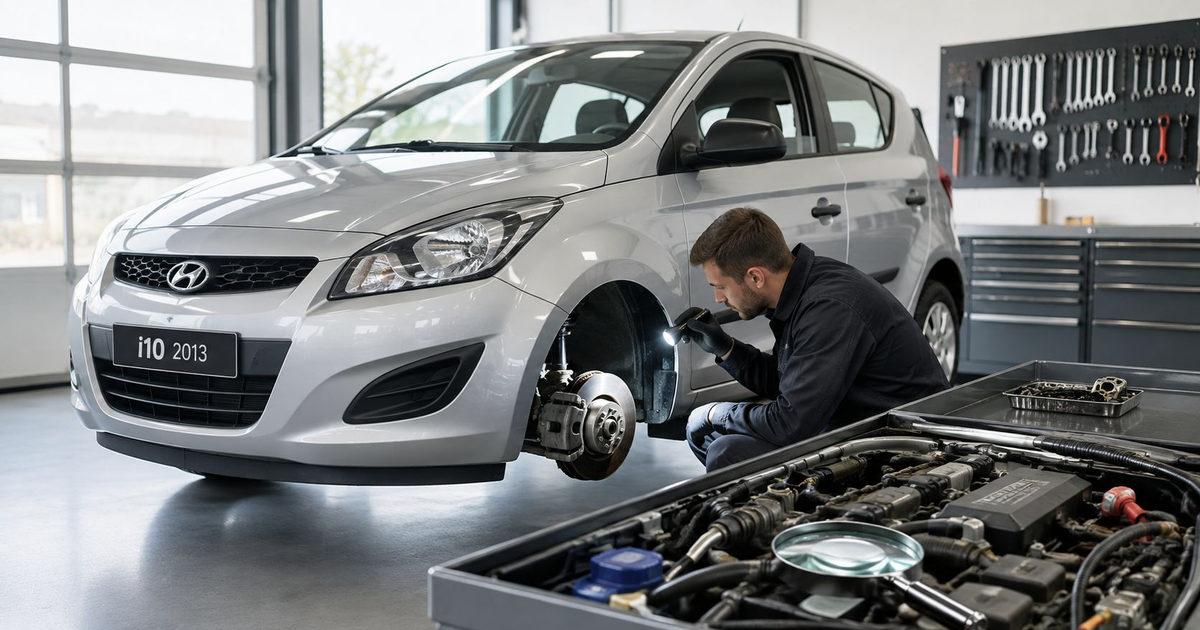
The popular advice on the Hyundai i10 2013 is too simple for trade buying. It's often sold as a cheap, safe, low-risk city car, but the UK evidence says the bigger exposure sits in brakes, lights, and electrics, not just engine wear or cosmetic condition. That matters at auction and on part-ex, because a tidy car with a clean story can still become a post-sale problem if the safety systems haven't been checked properly.
Table of Contents
- Why the 2013 Hyundai i10 Is Not the Low-Risk Buy Traders Assume
- Engine Specifications and Trade Valuation Implications
- 2013 Hyundai i10 Engine Comparison
- MOT Defect Patterns and Safety-Critical Failure Points
- What those failures mean in the yard
- Pre-Purchase Inspection Checklist for Trade Buyers
- Focus areas at the point of purchase
- Ownership Patterns and Provenance Red Flags
- Red flags that change the buying decision
- How Trade-Focused Vehicle Intelligence Reduces Risk
- What better intelligence actually adds
- Key Decision Criteria for Sourcing 2013 Hyundai i10 Stock
Why the 2013 Hyundai i10 Is Not the Low-Risk Buy Traders Assume
The 2013 Hyundai i10 gets treated like easy stock because it is small, simple, and cheap to run. That is exactly why it can catch traders out. A car that appears clean on the forecourt can still carry the sort of maintenance risk that matters once it reaches an MOT bay, and the UK defect picture points to more than routine wear.
The issue is the pattern, not just the badge. UK MOT statistics for the 2013 i10 show an overall defect rate of 220 per 100 vehicles, with Brakes at 124 per 100 and Lights & Electrics at 68 per 100 (MOTSearch Hyundai i10 2013 stats). That puts pressure on the systems that most often turn into retest work, pricing disputes, and post-sale frustration.
A trader can get a false sense of security from a tidy body and a quiet test drive.
Brake wear, weak lighting, and electrical faults are not cosmetic problems. They are the kind of issues that can move a car from straightforward retail stock into a file that needs a discount, a repair allowance, or a harder conversation with the buyer. On a small hatchback, those faults are easy to underestimate because the car feels basic, but basic does not mean low-risk.
Generic buying advice still pushes mileage, engine choice, and whether the car starts first time. That is too shallow for this model. A vehicle history check UK buyers rely on can confirm identity, keepers, and recorded events, but it will not tell you whether the next failure is likely to come from brakes, lights, or another safety-related item. Traders sourcing this car need to judge it as a maintenance-sensitive buy, not just a cheap runabout, and they should set that against their own stock turn and reconditioning appetite, including Mmr pricing for inventory.
If you want a clearer view of how hidden history can distort purchase decisions, the logic in The true cost of buying a vehicle with hidden history applies here as well.
Engine Specifications and Trade Valuation Implications
The 2013 i10 was not a one-spec proposition. In the UK market, the 1.0 BlueDrive version used a 66PS 1.0 Kappa MPI engine with integrated Stop & Go, alternator management, and low-rolling-resistance tyres to achieve 4.3 l/100 km combined fuel consumption and 98 g/km CO2 emissions (Hyundai i10 2013 EU specification PDF). That specification matters because it explains why some cars were bought for tax-sensitive urban use and why they still appeal in the used market.
The more substantial alternative is the 1.2. Hyundai's UK brochure rates it at 85 bhp at 6,000 rpm and 121 Nm at 4,000 rpm, with the engine using 1,248 cc, DOHC 16-valve hardware, and a 10.5:1 compression ratio (Hyundai i10 2013 UK specification PDF). For trade valuation, that extra torque changes how the car feels under load, especially with passengers or on faster roads. The 1.2 is the easier car to place when the buyer wants less fuss and more flexibility.
2013 Hyundai i10 Engine Comparison
Specification 1.0-litre 1.2-litre Output 66PS in BlueDrive form 85 bhp Torque 69 lb ft at 4,500 rpm in UK road test data 121 Nm at 4,000 rpm Economy position 4.3 l/100 km combined in BlueDrive spec 61.4 mpg official figure quoted in UK materials CO2 position 98 g/km in BlueDrive spec 108 g/km quoted in UK materials Transmission Five-speed manual Five-speed manual The trade read-across is straightforward. The 1.0 is the better fit for low-mileage urban stock where running-cost messaging matters. The 1.2 is usually the safer retail choice for buyers who'll use the car beyond pure city work, because it has more flexibility and less strain when loaded.
For pricing discipline, use the engine spec first, then anchor the market view with a proper valuation source such as MMR pricing for inventory. A stock card that mixes up the 1.0 and 1.2, or claims the wrong output, is a valuation and compliance problem, not just a spec error.
If you need a factory-data cross-check before you commit, the vehicle build spec sheet report is the right place to verify what should be on the car.
MOT Defect Patterns and Safety-Critical Failure Points
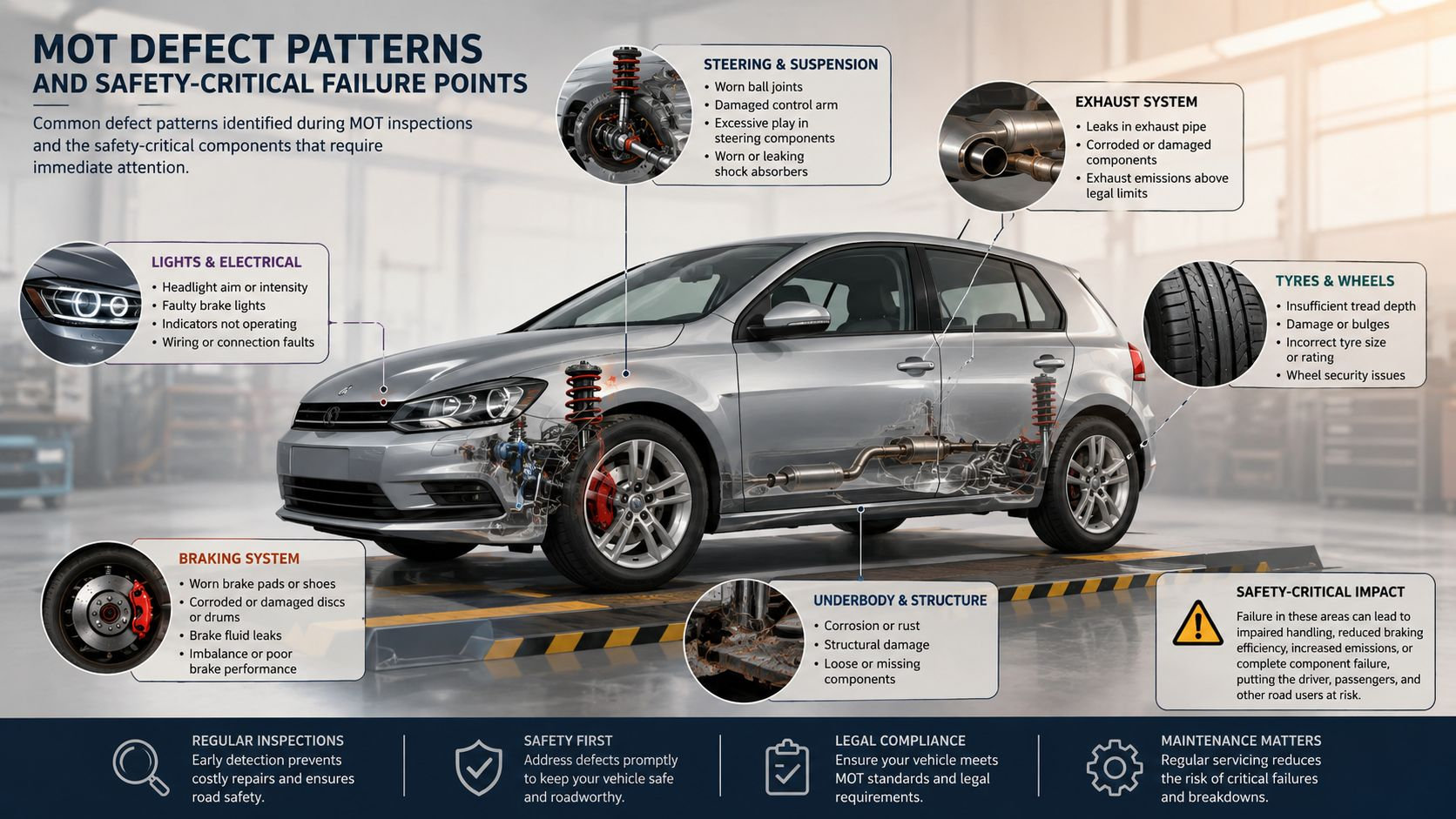
The MOT history changes how the 2013 i10 should be priced and inspected. As shown in the defect profile above, the car's weak points sit in the areas that cost time and money to put right, especially brakes, lighting, and other electrical items. For a model that is often bought on the promise of simple ownership, that is the part traders need to respect first.
Brake work is the one that can swallow margin fastest. A car can still present well on the forecourt while needing discs, pads, calipers, or a proper brake strip-down before it is ready for retail. Lights and electrics are more awkward in a different way, because faults can be intermittent, hard to reproduce, and easy for a customer to spot only after handover.
What those failures mean in the yard
A clean MOT pass at one point in time does not remove the underlying pattern. It only means the car met the standard on that day. If the i10 has short-trip urban use, patchy servicing, or signs of long-term exposure, the reconditioning risk moves up, and it usually moves up in the areas that are most visible to the MOT tester. That is the trade-off buyers miss when they treat a small hatchback as automatic easy stock.
In practical terms, the question is not whether the car can be retailed. It is whether the cost of putting the braking system and electrical items right still leaves enough gross after prep, valeting, warranty cover, and any lane fees. That is why the MOT history matters as a buying tool, not just a compliance record. For a plain-English check on the inspection standards behind those failures, the MOT rules guide is worth having to hand.
The 2013 i10 can still make sense in trade, but only if you treat it as a safety-maintenance job first and a cheap runabout second. Cars with a tidy-looking body and ordinary mileage still need the same hard questions about braking performance, warning lights, and whether the last test was a pause, not a fix.
Pre-Purchase Inspection Checklist for Trade Buyers
A 2013 i10 needs a tighter inspection routine than its reputation suggests. The inspection should start with the systems most exposed in the MOT data, then move to specification verification so you're not paying for a car that's been misdescribed.
Focus areas at the point of purchase
- Brake feel and wear pattern: Check pedal consistency, disc condition, warning lights, and any imbalance on the test drive. If the car feels hesitant, spongy, or noisy under braking, price in remedial work before you negotiate.
- Electrical operation: Test lights, dash illumination, window switches, central locking, and any intermittent warning lamps. Electrical issues on a small car can look minor until you try to retail it.
- Underbody and corrosion checks: Inspect the usual UK exposure points, especially where road salt and older repairs can hide problems. A clean exterior doesn't rule out structural neglect.
- Specification match: Confirm whether the car is the 1.0 or 1.2, then compare trim, gearbox, and factory output with the advert and the V5C.
- Service evidence: Look for regular maintenance rather than a stamped book that stops telling a story after the first few years.
A used car that passes a quick visual can still be the wrong buy if the brake and electrical systems haven't been proved.
If you're buying from auction, use the time on the lane to separate genuine retailable stock from cars that need immediate spend. If you're buying part-ex, the inspection should be even stricter, because the seller has usually already had the benefit of the car's best years. A trade buyer who can compare build data against the metal, not just the advert, will catch more misdescribed stock and avoid avoidable disputes.
For factory confirmation and option-level checking, a spec report is more useful than a generic summary because it helps you spot when the car's description doesn't quite line up with the car in front of you.
Ownership Patterns and Provenance Red Flags
The history profile matters as much as the workshop profile. A 2013 i10 that's been passed around quickly, shown unusual mileage jumps, or sat in a pattern of short-term keeper changes deserves more scrutiny than a car with a stable timeline. That's where a basic mileage check UK approach is too narrow on its own.
Red flags that change the buying decision
- Short keeper periods: Repeated quick sales can mean a problem car is being moved on before the next repair bill lands.
- Mileage inconsistency: Odometer data that doesn't fit the service story, old auction notes, or prior adverts needs explanation before you bid.
- Patchy history intervals: Gaps in service records often matter more than the total number of stamps, because they hide how the car was used.
- Insurance or incident signals: Any evidence that suggests repairs, even if the seller frames them as cosmetic, should prompt a deeper check of the provenance trail.
The reason this matters on the i10 is that its low-value image can mask abuse. Cars used for dense urban work often rack up repetitive stop-start wear, and that usage pattern makes hidden issues easier to miss if you rely on a single vehicle history report. A proper used car history report should be read alongside keeper history, mileage pattern, and the physical condition of the car.
For deeper keeper pattern analysis, DVLA keeper history and what it reveals about a vehicle is the right kind of context. In trade buying, the question isn't just whether the car has a record. It's whether the record makes sense.
How Trade-Focused Vehicle Intelligence Reduces Risk
Basic dealer vehicle checks answer part of the question, but not all of it. The 2013 i10 is a good example because the main exposure isn't a headline write-off event, it's the combination of keeper movement, mileage pattern, maintenance gaps, and a defect profile that concentrates in safety-critical systems. That's why contextual trade vehicle intelligence is more useful than a pass/fail summary.

What better intelligence actually adds
A trade-oriented platform looks for the pattern behind the record. It can combine MOT history, DVLA-style keeper data, mileage signals, and spec verification so you're not making a decision off one snapshot. That's especially useful when stock looks inexpensive but carries hidden reconditioning risk.
AutoProv is one option in that space. It provides UK motor trade provenance analysis that brings together history, mileage patterns, ownership timelines, and vehicle specification checks in one workflow. That kind of view is most valuable when you're deciding whether to bid, not after the car is already in the compound.
Decision rule: if the history is thin, the keeper pattern is noisy, or the MOT story points to safety-system work, don't rely on a basic check alone.
This matters for margin as well as compliance. A good stock decision is rarely about finding a perfect car. It's about spotting the one that gives you enough certainty to buy, recondition, and retail without building in avoidable risk. On a car like the i10, the difference often comes down to whether the data tells a coherent story.
If your buying process still depends on single-source checks, the weakest part of the process is usually the one that looks quickest. Better provenance intelligence slows the decision down just enough to stop expensive mistakes.
Key Decision Criteria for Sourcing 2013 Hyundai i10 Stock
The cleanest buying rule on the 2013 i10 is to separate the easy retail cars from the cars that look cheap because they need hidden work. Start with the brakes, electrics, and keeper timeline, then check whether the engine variant matches the intended buyer profile. The 1.2 is usually easier to place for mixed-use buyers, while the 1.0 fits urban, value-led stock where running-cost messaging is the priority.
A useful acquisition threshold is simple. If the MOT history is noisy, the service story is thin, or the car shows signs of repeated short-term ownership, the discount needs to reflect the likely reconditioning and comeback risk. If the car is structurally tidy, spec-correct, and backed by a coherent record, it's a more workable piece of stock.
Trade buyer checklist for live decisions
- Brake system: Buy only when the braking system feels consistent and the history doesn't hint at repeated related faults.
- Electrical function: Walk away or reprice hard if lights, warning lamps, or switches are unreliable.
- Provenance: Treat short keeper runs and mileage mismatches as real risk, not administrative noise.
- Specification accuracy: Make sure the advert, paperwork, and actual car agree on engine and trim.
- Margin discipline: Price the likely spend before you bid, not after the car arrives.
A 2013 Hyundai i10 can still be a solid trade line, but only if you buy it as a monitored risk, not a default cheap hatchback. The best buys are the ones where the record, the car, and the asking price all tell the same story.
If you want a sharper way to assess stock like the Hyundai i10 2013, AutoProv can help you review provenance, ownership patterns, mileage signals, and specification consistency before you commit capital. Use it to tighten your buying process, reduce avoidable reconditioning surprises, and make quicker trade decisions with more confidence.
Frequently Asked Questions
AI-Generated Content Notice
This article was created with the assistance of artificial intelligence technology. While we strive for accuracy, the information provided should be considered for general informational purposes only and should not be relied upon as professional automotive, legal, or financial advice. We recommend verifying any information with qualified professionals or official sources before making important decisions. AutoProv accepts no liability for any consequences resulting from the use of this information.
From our AI insights
- Auction Pitfalls: Avoiding Costly Mistakes
Navigate UK car auctions with confidence by avoiding finance, write-off, and mileage risks.
- Mastering Paint Code Checks: Detecting Hidden Car Repairs
Discover how to use paint code verification to identify hidden car repairs and ensure a smarter purchase.
- UK Part-Exchange Checks: Protecting Dealer Margins
Explore essential part-exchange checks for UK dealers to safeguard profit margins, including provenance and finance verification.
Related Articles

Your Ultimate Guide to Buying a Used Car in the UK
Navigate the UK used car market with confidence using our comprehensive buying guide. Tips, checks, and AutoProv Provenance insights included.

Difference Between MOT and Service: What You Need to Know
An MOT is a mandatory legal inspection that every car on UK roads needs to pass.Think of it as the government's way of ensuring your vehicle meets the absolute minimum safety and environmental standards to be considered roadworthy. A service, on the other hand, is a completely different beast. It's the proactive maintenance routine recommended by the people who built your car, designed to keep it running smoothly and catch problems before they start. In short, an MOT is a pass-or-fail exam required by law. A service is a comprehensive health plan for your car.
Your Ultimate Used Car Inspection Checklist
A solid used car inspection checklist is the single most powerful tool you have to avoid buying a lemon. It gives you a methodical way to look past the shiny paint and assess a car's real condition, helping you spot hidden problems and get a fair price before you shake hands on the deal.
Published by AutoProv
Your trusted source for vehicle intelligence