VIN verification confirms a vehicle's true identity, preventing cloned plates, finance fraud, and mis-described stock. Essential trade intelligence for UK dealers.
By CiteFlow
What VIN Verification Reveals That Registration Checks Cannot
VIN verification cross-references the Vehicle Identification Number stamped on the chassis against registration data, manufacturer records, and provenance databases to confirm a vehicle's true identity. Unlike registration plate checks, which only verify the current keeper and plate assignment, VIN-based verification exposes cloned identities, confirms original specifications, and validates that the physical vehicle matches its documented history. For motor traders, this distinction prevents buying vehicles with stolen identities, mismatched components, or fraudulent documentation that registration-only checks routinely miss.
The registration plate tells you what the DVLA database says about a vehicle. The VIN tells you what the vehicle actually is. These two things should match, but in cases of cloning, identity theft, or administrative errors, they diverge. When they do, the VIN is the definitive source. A cloned vehicle might present a clean registration check because the plate has been copied from a legitimate vehicle, but VIN verification reveals the chassis number belongs to a different vehicle entirely, often one with write-off history, outstanding finance, or theft markers.
Manufacturer databases, insurance records, and professional vehicle check platforms increasingly use VIN as the primary key for data retrieval. Digital service history, factory build specifications, and recall notices are all indexed by VIN, not registration. Checking by registration alone means you miss this layer of verification. For trade buyers assessing stock quality and compliance risk, VIN-based checks provide the technical foundation that registration searches cannot deliver.
How VIN Structure Confirms Manufacturing Origin and Specification
The VIN is a 17-character code structured according to ISO 3779 and ISO 4030 standards, encoding the manufacturer, model year, assembly plant, and sequential production number. Characters 1-3 identify the World Manufacturer Identifier (WMI), character 10 denotes the model year, and character 11 specifies the assembly plant. This structure allows immediate verification of claimed origin, build date, and production location before you even run a database check.
A vehicle presented as a 2018 UK-supplied model should have a VIN with the tenth character corresponding to 'J' (2018 model year). If the VIN shows 'G' (2016), the vehicle is either mis-described or the VIN has been altered. Similarly, a car claimed as a genuine UK market vehicle should have a WMI and plant code consistent with European production and UK specification. Grey imports, re-imports, and vehicles built for other markets carry different WMI codes and plant identifiers, which VIN decoding reveals immediately.
Factory build sheet retrieval depends entirely on VIN accuracy. OEM build data indexed by VIN confirms original equipment, trim levels, and factory-fitted options. If the VIN on the vehicle does not match the VIN in the manufacturer's database, the build sheet either returns no data or returns data for a completely different vehicle. Traders relying on VIN-based build verification to describe stock accurately need confidence that the VIN is genuine and correctly recorded.
VIN Cloning and Identity Fraud Risks in the Motor Trade
VIN cloning involves copying the identity of a legitimate vehicle onto a stolen, written-off, or imported vehicle to disguise its true history. The cloned vehicle carries the registration plate, VIN plates, and documentation of the donor vehicle, passing superficial checks while concealing theft markers, structural damage, or outstanding finance. For dealers, buying a cloned vehicle means acquiring stock with hidden liabilities that surface only after sale, triggering CRA 2015 rejections, police seizures, and reputational damage.
Cloning is particularly common with high-value models, prestige marques, and vehicles with strong export demand. Thieves steal a vehicle, source a written-off or salvage example of the same make, model, and colour, then transfer the identity of the stolen vehicle onto the salvage chassis. The cloned vehicle presents a clean registration check because the plate and VIN match a legitimate vehicle on the DVLA database. Only physical VIN verification, cross-referenced against chassis stampings, door pillar plates, and windscreen etchings, exposes the fraud.
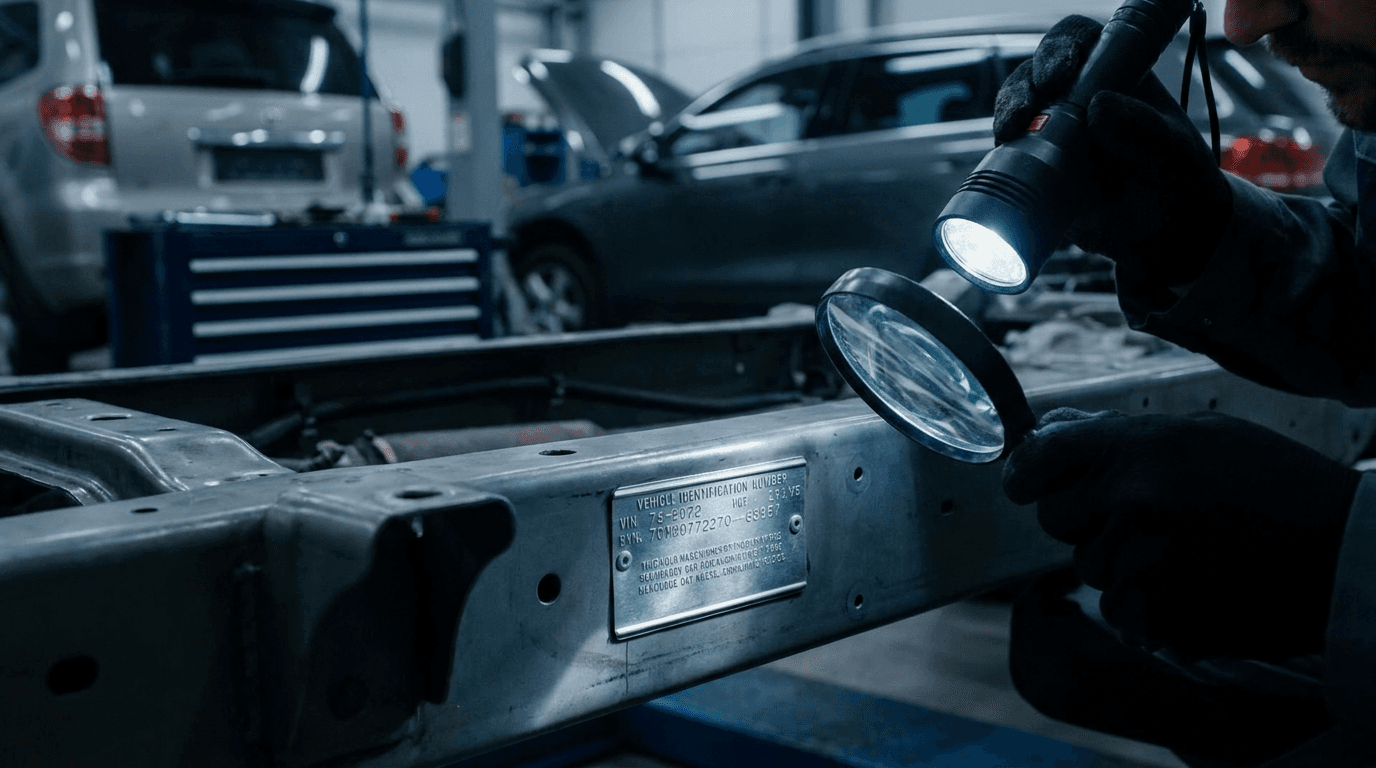
Physical VIN inspection should verify that chassis stampings match VIN plates and that characters show consistent stamping depth, font, and alignment. Signs of VIN tampering include mismatched fonts, irregular spacing, evidence of grinding or re-stamping, and discrepancies between the VIN on the chassis and the VIN on door pillar or windscreen labels. Digital checks complement physical inspection by cross-referencing the VIN against theft databases, insurance write-off records, and finance markers, revealing whether the VIN has been reported in connection with theft or total loss claims.
Why VIN-Based Provenance Checks Outperform Plate-Only Searches
Provenance databases increasingly prioritise VIN as the primary identifier because it is harder to alter than a registration plate and provides a permanent link to the vehicle's manufacturing origin. Experian, DVLA, DVSA MOT records, and finance houses all index data by both registration and VIN, but VIN-based queries return more reliable results when identity fraud is present. A cloned vehicle queried by registration returns the donor vehicle's clean history. The same vehicle queried by VIN returns the true history of the chassis, including write-off markers, theft flags, and finance agreements.
MOT history retrieved by VIN confirms mileage progression against the actual chassis tested, not just the registration presented. If a vehicle has been cloned, the MOT history by registration shows the donor vehicle's test records, while the MOT history by VIN shows the true vehicle's test records, often revealing mileage discrepancies, failure patterns, or test gaps that indicate the vehicle has been off the road or re-registered. Traders using mileage verification as part of due diligence need VIN-based MOT data to confirm accuracy.
Finance checks by VIN expose outstanding agreements linked to the chassis, not just the current registration. A vehicle with cloned plates might show no finance when checked by registration because the donor vehicle is finance-free, but the same vehicle checked by VIN reveals an active hire-purchase agreement on the true chassis. For dealers, this distinction prevents buying stock subject to repossession, protecting both cash flow and customer relationships.
VIN Verification in Digital Service History and Manufacturer Data
Digital service history systems operated by manufacturers retrieve maintenance records exclusively by VIN. The VIN is the unique key linking service events, recall campaigns, warranty claims, and technical bulletins to the specific vehicle. Registration plates can change through private sales, cherished transfers, and re-registration, but the VIN remains constant throughout the vehicle's life. Manufacturers index service records, parts replacements, and diagnostic logs by VIN to ensure continuity regardless of ownership or registration changes.
When verifying digital service history from manufacturer databases, the VIN must match the chassis exactly. A single character error in VIN entry returns either no data or data for the wrong vehicle, leading to incorrect service history conclusions. Traders relying on manufacturer service history verification to assess stock condition and support retail pricing need to confirm VIN accuracy before querying manufacturer systems.
Recall and safety campaign data is also indexed by VIN. Manufacturers issue recalls based on VIN ranges corresponding to specific production batches, build dates, or component suppliers. A vehicle affected by a safety recall can only be identified definitively by VIN, not by registration or model year alone. For fleet operators and dealers managing compliance obligations, VIN-based recall checks ensure that affected vehicles are identified and remedied before sale or deployment.
How VIN Decoding Supports Accurate Stock Description and Compliance
Factory build sheets retrieved by VIN confirm original equipment, trim levels, paint codes, and optional extras as specified at the point of manufacture. This data supports accurate stock descriptions, prevents mis-selling claims, and enables dealers to identify high-value factory options that justify premium pricing. A vehicle described as having a premium sound system, adaptive suspension, or panoramic roof should have these features listed on the factory build sheet. If the VIN-based build data shows a different specification, the vehicle has either been retro-fitted or mis-described.
CRA 2015 compliance requires that vehicles are sold as described, with specifications matching advertised claims. VIN-based build verification provides objective evidence of original specification, protecting dealers from consumer disputes based on mis-description. If a customer claims a vehicle lacks advertised features, the factory build sheet retrieved by VIN confirms what was fitted at the factory, distinguishing between mis-description and post-production modifications.
VIN decoding also confirms market designation, distinguishing UK-specification vehicles from grey imports, parallel imports, and re-imports. UK market vehicles carry specific VIN codes, emissions certifications, and equipment levels mandated by UK type approval. Vehicles built for other markets may lack UK-compliant lighting, speedometers in mph, or emissions equipment required for UK registration. VIN structure reveals the intended market, allowing dealers to identify grey imports and assess the compliance costs of bringing non-UK vehicles to market standard.
Integrating VIN Verification into Trade Due Diligence Processes
Professional trade due diligence should include VIN verification at multiple stages: initial appraisal, pre-purchase checks, and pre-sale compliance validation. At appraisal, visually inspect the VIN on the chassis, door pillar, and windscreen, confirming that all instances match and show no evidence of tampering. Cross-reference the VIN against the V5C registration document, service records, and any available manufacturer documentation.
Pre-purchase checks should query provenance databases by both registration and VIN, comparing results to identify discrepancies. If the registration check returns different data from the VIN check, investigate further before committing to purchase. Request a comprehensive vehicle intelligence report that includes VIN-based queries across finance, theft, write-off, and MOT databases, ensuring that the chassis identity is verified independently of the registration plate.
Pre-sale validation should confirm that the VIN on the vehicle matches the VIN recorded in all documentation, including the V5C, service history, and any compliance certificates. For distance sales and remote appraisals, request photographs of the VIN plate, chassis stamping, and door pillar label to verify consistency before completing the transaction. VIN verification is particularly critical for high-value stock, prestige marques, and vehicles purchased from unfamiliar sources where identity fraud risk is elevated.
VIN-Based Checks and Experian Indemnity Protection
Experian indemnity protection, included with professional vehicle checks, covers financial losses arising from inaccurate data on write-off status, stolen vehicle markers, and outstanding finance. However, indemnity is only valid if the check was performed using the correct VIN and registration combination. If a vehicle is checked using a cloned identity and the VIN is not verified, the indemnity may not apply because the check was performed against the wrong vehicle.
To ensure indemnity coverage is valid, verify that the VIN submitted for the check matches the VIN stamped on the chassis. Retain photographic evidence of VIN plates and chassis stampings as part of your due diligence records. If a claim arises, you will need to demonstrate that the check was performed against the correct vehicle and that the VIN was verified at the time of purchase.
Indemnity limits vary by check provider and subscription tier, with professional trade platforms offering coverage up to £50,000 per vehicle. This protection is only meaningful if the underlying data is accurate and the vehicle identity is correctly verified. VIN verification is therefore not just a fraud prevention measure but a prerequisite for valid indemnity protection.
Common VIN Verification Errors and How to Avoid Them
Manual VIN entry errors are common, particularly with characters that resemble each other. The letters 'I', 'O', and 'Q' are excluded from VIN standards to avoid confusion with the numbers '1' and '0', but the letters 'B' and '8', 'S' and '5', and 'Z' and '2' can still be misread. A single character error in VIN entry returns incorrect data or no data, leading to false conclusions about vehicle history.
To minimise transcription errors, photograph the VIN plate and use optical character recognition (OCR) tools or VIN scanning apps to capture the code digitally. Cross-reference the VIN against multiple sources, including the V5C, door pillar label, and windscreen etching, to confirm consistency. If different sources show different VINs, investigate the discrepancy before proceeding.
Some older vehicles, particularly those manufactured before 1981, may have VINs shorter than 17 characters or structured according to pre-ISO standards. These vehicles require specialist checks and may not return full data from modern VIN decoding tools. For classic and vintage vehicles, supplement VIN checks with chassis number verification against manufacturer heritage records and marque-specific databases.
Frequently Asked Questions
AI-Generated Content Notice
This article was created with the assistance of artificial intelligence technology. While we strive for accuracy, the information provided should be considered for general informational purposes only and should not be relied upon as professional automotive, legal, or financial advice. We recommend verifying any information with qualified professionals or official sources before making important decisions. AutoProv accepts no liability for any consequences resulting from the use of this information.
From our AI insights
- Navigating UK Grey Imports: A Trader's Guide
Understand the complexities and opportunities of UK grey imports for savvy motor traders.
- Navigating VIN Checks Post-Brexit: What UK Traders Need to Know
Discover how Brexit impacts VIN checks for UK traders and the crucial data to review.
- Navigating Low-Cost Vehicle Checks in the UK
Learn how to safely conduct low-cost vehicle checks and avoid pitfalls.
Related Articles

Essential Vehicle Checks Before Buying a Used Car
Learn essential checks to ensure your used car purchase is safe and sound in the UK market.

Why a Provenance Check is Essential for Used Car Buyers
Ensure your used car is a smart investment by understanding the importance of a provenance check and how AutoProv can help.
A Guide to Vehicle Check with VIN Number
A vehicle check with vin number is easily the most important thing you can do before buying a used car. Think of it as your first line of defence—a quick, simple step that pulls back the curtain on a vehicle's past, protecting you from expensive mistakes, legal headaches, and downright dangerous cars.
Published by AutoProv
Your trusted source for vehicle intelligence