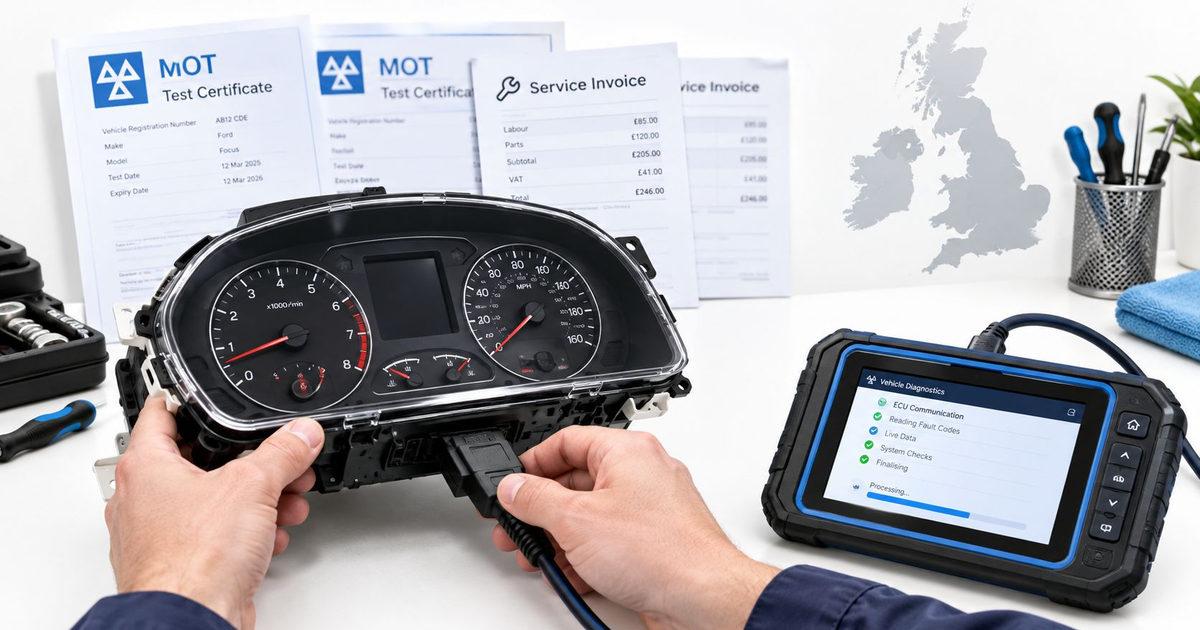
A wholesaler delivers a vehicle with a failed instrument cluster and the replacement unit shows a different mileage. The dealer has a saleable car, but the stock file now contains a basic question that can't be answered with a verbal assurance: what happened to the mileage, and can the business prove it?
That's the practical issue behind searches for a mileage correction tool UK traders can use responsibly. Cluster replacement and mileage correction can be legitimate repair activities, but the same technical capability becomes a serious compliance and reputational risk when the original fault, displayed reading, and repair history aren't recorded clearly.
Table of Contents
- Why Mileage Correction Matters for UK Motor Traders
- The missing-document problem
- The Legal Position on Mileage Adjustment in the UK
- Where the exposure starts
- Documentation Standards Every Trade Purchase Requires
- A workable evidence trail
- Using MOT Timelines to Detect Mileage Anomalies
- Read the pattern, then test the explanation
- Vehicle Provenance Intelligence Beyond Basic History Checks
- What basic checks can miss
- Building a Risk-Resistant Buying Workflow for Trade Stock
- Put the controls at the buying decision
- Protecting Your Dealership from Post-Sale Mileage Disputes
- Make the record usable after the sale
Why Mileage Correction Matters for UK Motor Traders
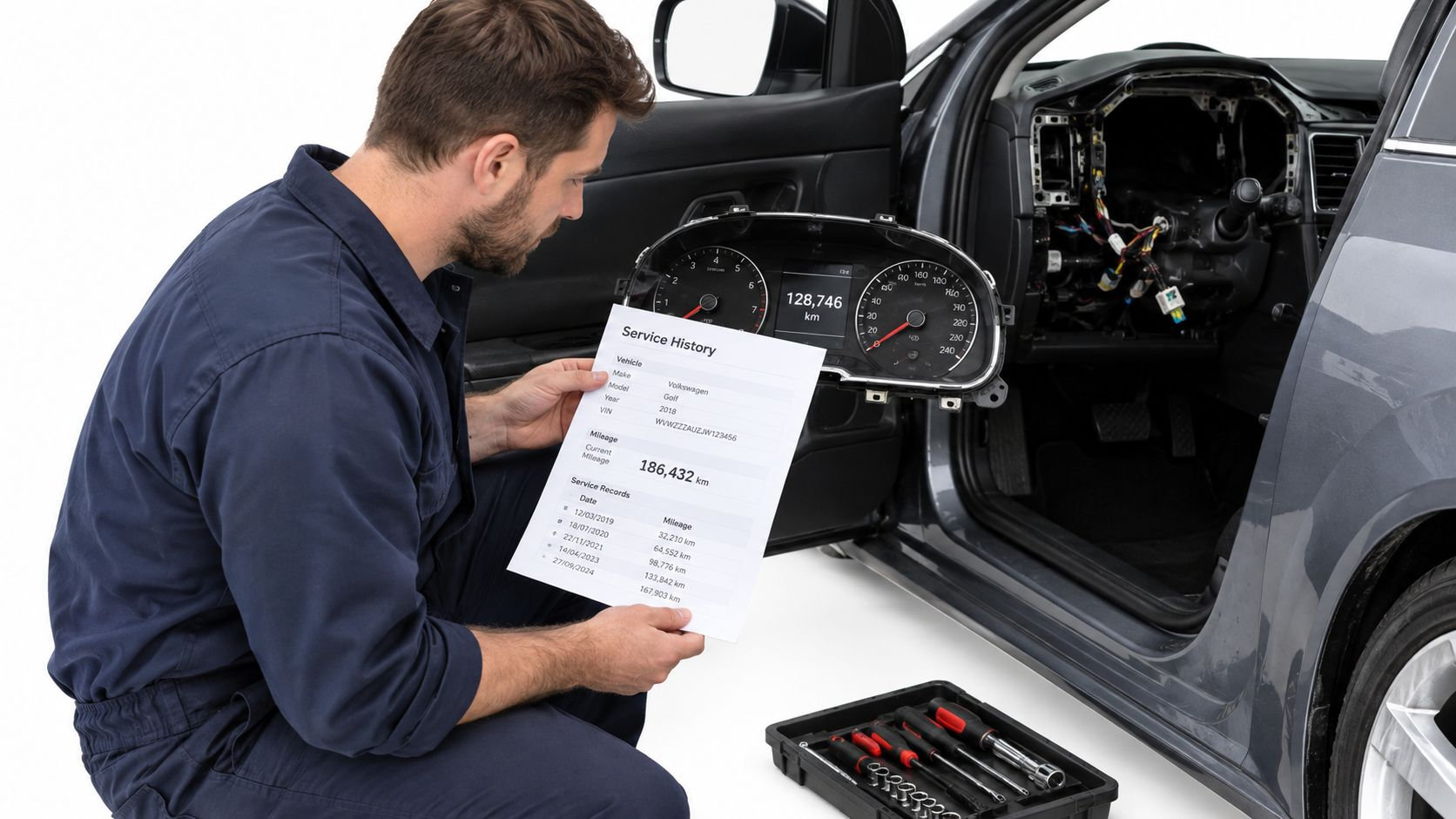
A vehicle can arrive in trade stock with a failed, water-damaged, or unreadable instrument cluster. The replacement unit may show a different stored mileage. Correcting that display to match the vehicle's established history can be legitimate repair work. The compliance problem starts when the dealer cannot show why the reading changed, who carried out the work, and what evidence supported the corrected figure.
Mileage correction is therefore a controlled trade process, not a straightforward programming task. A discrepancy in the MOT record, service file, or electronic history can make a routine cluster repair look like an attempt to misrepresent the car. That risk remains even when the underlying repair was genuine.
The missing-document problem
The weak point is often the stock file rather than the repair itself. Keep records that answer each of these questions:
- Was the original cluster defective? Retain the diagnosis, inspection note, or job card.
- Can the replacement be traced? Record the supplier, part details, and invoice.
- Are all readings recorded? Log the old display, replacement display, and final reading.
- Will the sales team disclose the work consistently? Add clear wording to the vehicle file and customer paperwork.
- Was the final figure independently checked? Compare the display with MOT, service, inspection, and ownership information.
A practical mileage check for a car should support the workshop record, not replace it. The history check tests whether the displayed figure fits the wider vehicle record. The repair file explains why the adjustment was made and identifies the evidence used.
Operational rule: Treat mileage correction as a controlled repair workflow. Do not treat it as an isolated programming task.
The market risk is substantial. A UK market-study estimate later referenced by the CMA placed potential consumer loss from illegal car clocking at up to £580 million per year, while the same compliance review also cited 64,986 mileage failures in a sample of 1,000,000 vehicles, a 6.49% failure rate, and an extrapolation of more than 2.4 million vehicles with discrepant mileages among roughly 38 million cars on UK roads at the time (CMA mileage correction compliance review). Those figures explain why an undocumented correction can create disproportionate commercial risk. A complete file gives the buyer, auditor, and dealership a clear account of the vehicle's mileage history.
The Legal Position on Mileage Adjustment in the UK
A replacement cluster arrives with a different reading, and the buyer asks why the dashboard does not match the advert. That situation is manageable when the dealer can show what failed, what was fitted, how the final figure was established, and what the customer was told.
UK guidance distinguishes between altering a reading and misrepresenting a vehicle. Changing an odometer reading is not automatically a criminal offence. The serious exposure begins when a trader presents an inaccurate mileage as genuine or enters an undisclosed figure into official records. Auto Express guidance on mileage correction describes undisclosed correction as illegal where a trader sells the vehicle or completes official records such as MOT documentation.
Where the exposure starts
A cluster replacement raises several separate compliance questions:
- Was the original cluster defective? Keep the diagnosis, inspection note, or job card.
- Can the replacement be identified? Record the supplier, part details, and invoice.
- Does the final mileage have supporting evidence? Compare the available MOT, service, inspection, and ownership records.
- Was the adjustment disclosed? Sales descriptions and customer paperwork must not suggest an uninterrupted, independently verified display when that is not true.
- Were official records corrected through the right process? An MOT input error is handled differently from a repaired or replaced instrument cluster.
An incorrect MOT entry may result from tester input error rather than tampering. If discovered within 28 days, the MOT centre can correct the record and issue a replacement certificate. After that period, DVSA requires evidence such as an invoice, emissions printout, service receipt, or job card showing the correct mileage, according to its mileage recording guidance.
For an MOT correction, GOV.UK says the evidence must show the correct mileage and be dated within one day of the MOT test. Accepted documents include an MOT invoice, emissions printout, service receipt, or test-centre job card (GOV.UK correcting MOT certificate mistakes).
The customer-facing risk also extends to vehicle descriptions and unfair commercial practices. Dealers should review the UK dealer's guide to the Consumer Rights Act 2015 as background, while obtaining transaction-specific legal advice where needed. A documented correction supports legitimate repair work without allowing an inaccurate history to pass into the sale.
Documentation Standards Every Trade Purchase Requires
A replacement cluster arrives with a supplier invoice, but the vehicle file contains no fault report and the displayed mileage cannot be explained. That gap can turn legitimate repair work into a compliance problem. Start the record at acquisition by logging the mileage shown on the vehicle, the seller's stated figure, and the result from the initial vehicle history check UK search. Any difference should pause the purchase until its cause is recorded.
Cluster work needs a connected evidence trail. Keep enough information for another manager to understand what failed, which part was fitted, what the readings were, and why the final display is accurate without relying on the technician's memory.
A workable evidence trail
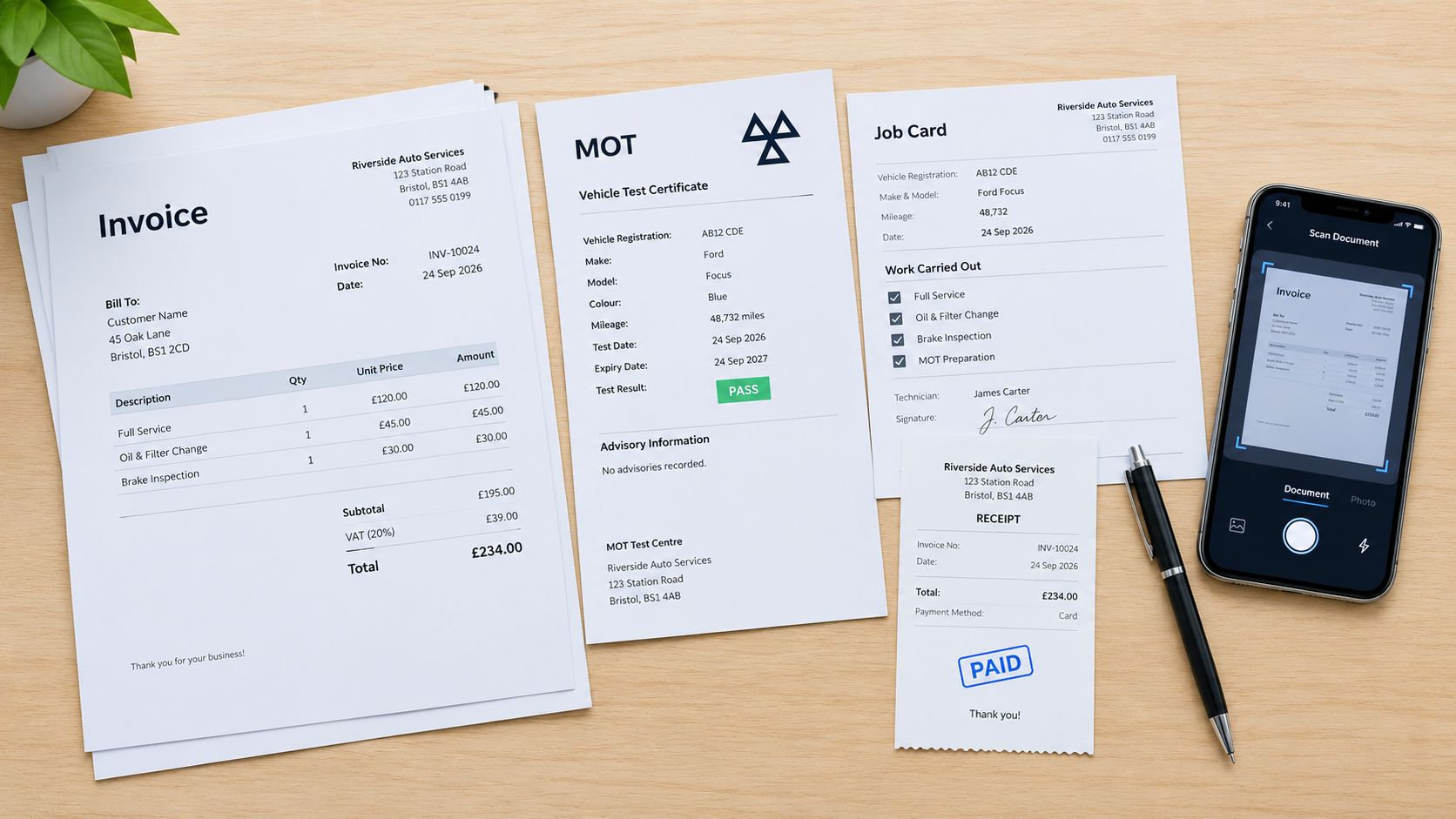
- Capture the fault: Retain the diagnostic report, inspection note, or job card describing the cluster failure.
- Identify the part: Record whether the unit was repaired, replaced, or supplied used, and keep the supplier invoice.
- Record both readings: Photograph or log the old display and the replacement display before any adjustment.
- Document the work: The technician's job card should state the vehicle identity, date, work completed, and final displayed mileage.
- Retain supporting history: Store MOT results, service receipts, inspection reports, and earlier mileage evidence used to establish the final figure.
- Prepare disclosure wording: Explain the cluster replacement and any mileage correction plainly in the stock file and sales paperwork.
For an MOT mileage correction, the supporting document should show the correct reading and be dated within one day of the test. An undated workshop note or wording such as “mileage set as advised” leaves too much room for doubt and will not carry the same evidential weight.
Store every record against the vehicle identification number in a system that preserves the original file, rather than relying on an editable spreadsheet. Scan paper documents, check that copies remain readable, and give buying, preparation, and sales teams access to the same version. Dealers applying disciplined records to truck fleet cost control advice will recognise the value of consistent capture across departments. It prevents repair details from disappearing before the vehicle reaches sale.
File test: Someone who was not involved in the repair should be able to explain the mileage change from the documents alone.
Using MOT Timelines to Detect Mileage Anomalies
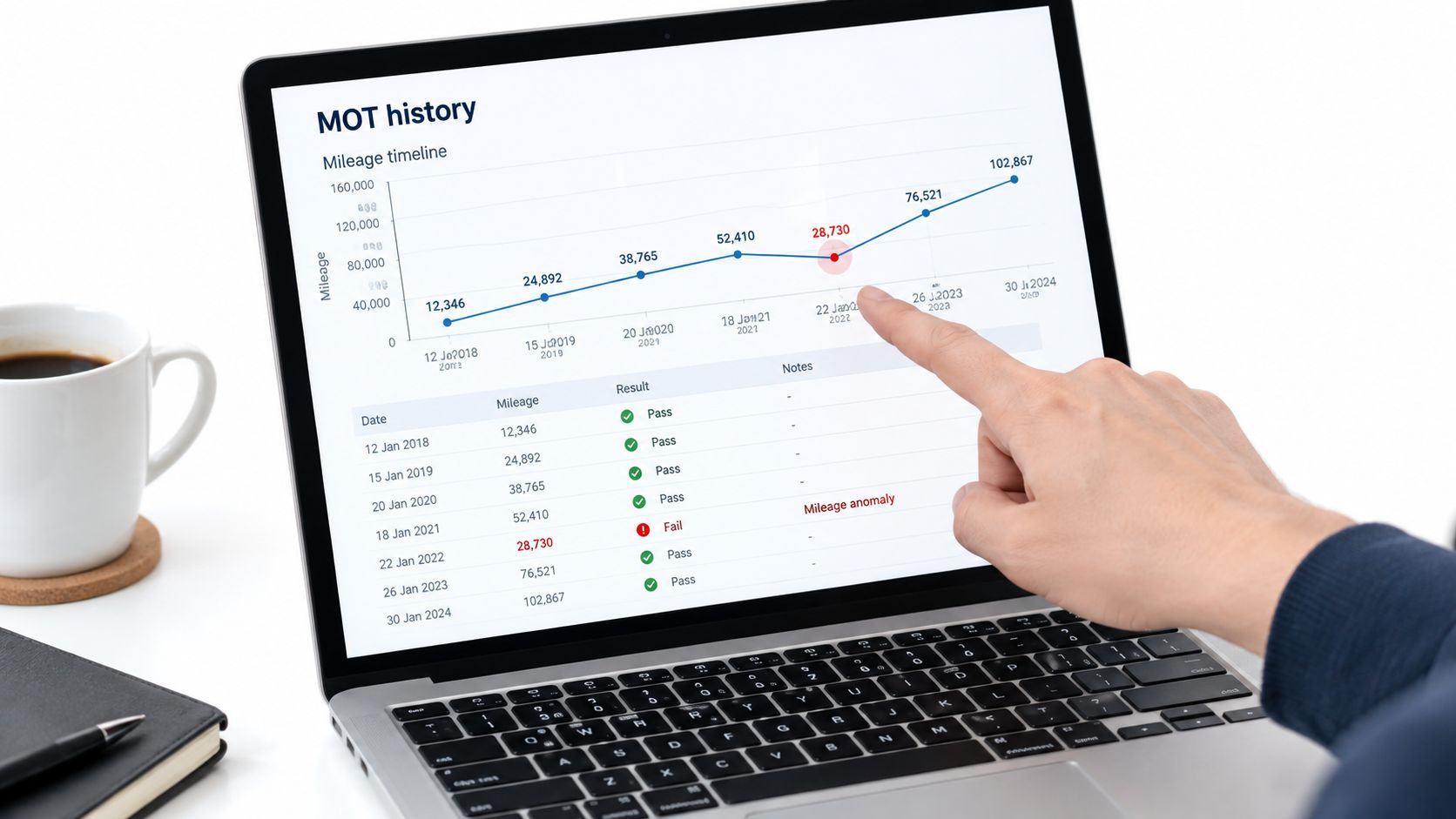
A replacement cluster can leave a legitimate vehicle with a different displayed reading. The buying risk starts when that change cannot be reconciled with the MOT record, repair history, and vehicle use. The MOT history is one of the most practical controls available to UK stock buyers. Every MOT since 2005 has recorded an odometer reading, creating an independently logged sequence that can be compared with the current display (guidance on using MOT mileage history). Use a structured check of MOT and mileage to compare the current display against the timeline.
Read the sequence from oldest to newest rather than relying on one figure. A decrease between MOT tests is a strong tampering indicator. A sudden jump may reflect heavy use, a delayed test, or a recording issue, but it still needs evidence. Unusually small annual increases also deserve attention when the vehicle's condition, ownership pattern, or selling price points to more intensive use.
Read the pattern, then test the explanation
A practical stock-control check should cover:
- Compare the current display with the latest MOT reading. The difference is not proof of fraud, but it identifies what happened after the test.
- Check progression between every MOT entry. Mark decreases, implausible jumps, and long gaps that do not fit the vehicle's apparent use.
- Match anomalies to ownership duration. A short keeper period followed by rapid resale makes an unexplained change more significant.
- Check the repair chronology. A cluster replacement should have a date, supplier, fault description, and final reading.
- Escalate unresolved gaps. Request service evidence, auction condition reports, or a written explanation before committing funds.
A 2019 HPI analysis reported 836,214 vehicles with a confirmed mileage discrepancy, an 8.99% hit rate, compared with 7.35% in 2018, and a year-on-year increase of 22.2% (HPI road to ruin analysis). Another UK estimate recorded 443,061 discrepancies out of seven million checks, or 6.32%, and extrapolated to 2,458,480 cars with incorrect mileages, as noted in the HPI analysis.
Late-plate stock still needs the same check. UK reporting cited analysis indicating that 1 in 7 used cars checked showed signs of mileage or identity fraud, while separate reporting found 2.27% of checked cars showed signs of clocked mileage during the 2024-2025 period. That coverage also reported average rollback of more than 20,000 miles in two-year-old vehicles, with 2021 models at 1.8% and 2022-2023 models at about 1.5% showing discrepancies (UK odometer fraud reporting). A recent registration date does not remove the need to reconcile the timeline.
Vehicle Provenance Intelligence Beyond Basic History Checks
A standard used car history report often answers binary questions. It may show an MOT record, an insurance marker, or a mileage warning. That's useful, but a pass or fail result doesn't always explain how the signals relate to one another.
Trade buying requires context. Consider two vehicles with the same mileage discrepancy flag. One has a documented cluster replacement, consistent servicing, and a long ownership period. The other has several short-term keepers, rapid resale activity, and incomplete maintenance records. The flag is similar, but the motor trade risk is not.
What basic checks can miss
A conventional report may record ownership changes without making the commercial significance obvious. A trade-focused review asks:
- How long did each keeper retain the vehicle? Repeated short-term ownership can justify further questions.
- Was the vehicle rapidly resold? Quick movement through several sellers can make provenance harder to establish.
- Do insurance-related events fit the repair story? A cluster fault after damage or a major repair should leave a coherent trail.
- Is ownership concentrated or fragmented? A pattern of transfers may matter when paired with mileage anomalies.
- Does the advertised price reflect the risk? A low figure may be compensation for condition, but it can also encourage rushed buying.
This is why dealers shouldn't treat mileage anomalies as standalone proof. The right decision may be to investigate further, negotiate a risk-adjusted value, or reject the vehicle where the explanation remains unsupported. A report that just says “no issue found” can create false comfort if it doesn't surface the wider pattern.
AutoProv's vehicle-check data sources describe the broader principle behind professional vehicle intelligence. The useful output isn't raw data alone. It's a structured view of MOT history, mileage patterns, ownership timelines, insurance-related events, and other risk indicators at the point of purchase.
If a discrepancy requires tracing a former keeper, supplier, or transaction detail, specialist UK tracing agents may be relevant for appropriate business enquiries. That's an escalation route, not a substitute for a disciplined acquisition file.
Decision principle: A warning is a prompt for proportionate investigation. It isn't a verdict, and a clean binary result isn't proof of complete provenance.
Building a Risk-Resistant Buying Workflow for Trade Stock
Mileage compliance works best when it's built into buying, not reconstructed after a complaint. The process can remain fast if each checkpoint has a defined owner and a clear stop condition.
At sourcing, the buyer records the current display, asks directly about cluster replacement, and runs a mileage check UK search before agreeing the price. At appraisal, the stock controller compares the latest MOT figure with the display and scans the timeline for progression breaks. At preparation, the workshop attaches the fault diagnosis, invoice, readings, and completion note to the vehicle file.

Put the controls at the buying decision
Before purchase, require the buyer to resolve any mismatch between the display, seller statement, MOT history, and service evidence. Don't rely on “the previous dealer said it was corrected” without a dated invoice or job card.
At appraisal, classify the vehicle as clear, explainable, or unresolved. A documented cluster replacement with a coherent timeline can proceed to valuation. An unexplained decrease, missing history, or inconsistent seller account should move the vehicle to a hold queue.
Before advertising, ensure the sales description matches the evidence. If the cluster has been replaced or the mileage has been corrected, the disclosure should be accurate and easy for the customer to understand. Sales staff need access to the same wording used in the file.
At handover, retain signed acknowledgement of material disclosures with the vehicle paperwork. The objective isn't to bury the customer in technical detail. It's to prevent an avoidable dispute about what the dealer knew and represented.
A simple escalation matrix helps preserve buying velocity:
Finding Required action Cluster fault documented, readings reconciled, history coherent Proceed with recorded disclosure MOT entry appears wrong and evidence is available Follow the DVSA correction route Current display differs from history with partial paperwork Pause and request supporting evidence Mileage decreases across MOT records or explanation remains unsupported Decline or escalate for senior approval AutoProv can be used as one trade vehicle intelligence option to cross-reference mileage records, ownership timelines, and wider provenance signals before capital is committed. The platform's role is decision support. It doesn't remove the need for workshop evidence or accurate disclosure.
Protecting Your Dealership from Post-Sale Mileage Disputes
A complete file protects more than a single transaction. It gives the dealership a defensible account of what it knew, what it checked, what the workshop repaired, and what the buyer was told. That matters when a customer challenges the mileage months after purchase and the original technician is no longer available to answer questions.
The strongest dealerships make disclosure part of the normal sales process. They don't wait for a buyer to discover a mismatch in an MOT timeline. They explain the cluster replacement, identify the supporting documents, and ensure the advertised mileage doesn't imply more certainty than the evidence supports.
Make the record usable after the sale
- Use one vehicle record: Keep invoices, job cards, MOT evidence, history reports, photographs, and disclosures together under the vehicle identity.
- Write plain explanations: State what failed, what was replaced, what reading was displayed before and after the work, and how the final figure was established.
- Control sales descriptions: Prevent generic phrases such as “genuine mileage” where the file contains a correction or unresolved gap.
- Train handover staff: Staff should know where the evidence is and how to explain it without speculation.
- Review exceptions: A manager should approve any vehicle where the history, display, or repair evidence doesn't align cleanly.
The financial impact of one disputed vehicle may be manageable. The operational damage can be wider if the dealer's process appears careless, especially when similar stock files contain the same gaps. A repeatable workflow reduces reliance on individual memory and makes compliance the default rather than an afterthought.
For difficult cases, a structured dispute response workflow can help organise the chronology, supporting records, and communications. It shouldn't replace professional legal advice where needed, but it can prevent the dealership from responding with fragmented documents and inconsistent explanations.
A mileage correction tool UK operation can support legitimate cluster repair, but the tool isn't what determines compliance. The dealer's evidence trail, provenance analysis, MOT checks, and buyer disclosure decide whether the repair remains a controlled trade activity or becomes a post-sale liability.
AutoProv provides UK motor traders with vehicle history, mileage verification, ownership timeline, and provenance risk intelligence for point-of-decision buying. Use it alongside workshop documentation and disclosure controls, then visit AutoProv to assess how its trade-focused checks can fit your stock acquisition workflow.
Frequently Asked Questions
AI-Generated Content Notice
This article was created with the assistance of artificial intelligence technology. While we strive for accuracy, the information provided should be considered for general informational purposes only and should not be relied upon as professional automotive, legal, or financial advice. We recommend verifying any information with qualified professionals or official sources before making important decisions. AutoProv accepts no liability for any consequences resulting from the use of this information.
From our AI insights
- Decoding Mileage: Impact of Seasonal Driving Patterns
Explore how seasonal driving impacts your car's mileage verification.
- Tackling Mileage Fraud in Electric Vehicles
Explore how motor traders can prevent mileage fraud in electric vehicles using advanced techniques.
- Mileage Verification for Hybrid Cars: A 2024 Update
Explore the nuances of mileage verification for hybrid vehicles in 2024 with our expert guide.
Related Articles

Understanding Vehicle Mileage Importance
Discover the critical role of accurate mileage in vehicle provenance and how AutoProv can safeguard your purchase.
What Is the Average Annual Mileage in the UK?
Right now, the average annual mileage for a car in the UK hovers around 7,000 miles. For anyone in the motor trade, that number is more than just a statistic; it’s a vital benchmark that helps buyers, sellers, and insurers get a quick read on a car's usage and potential wear and tear.

Car Mileage Discrepancy Explained: A Guide for UK Motor Traders
When it comes to a car’s history, its mileage record should tell a simple, straightforward story: the number always goes up. A mileage discrepancy is what happens when that story suddenly does not make sense.
Published by AutoProv
Your trusted source for vehicle intelligence