
You're standing on the forecourt with a car that should be straightforward. The dashboard reading looks sensible. The MOT trail climbs in the right direction. The seller says the history is clean. But something doesn't sit right. That's usually the point behind the search for check mileage on my car in the trade. It isn't really about reading the odometer. It's about deciding whether that mileage is believable enough to buy against, retail against, and defend later if a customer challenges it. A single number on a dash won't do that. A clean sequence in the MOT record won't always do it either.
For trade buyers, mileage sits right in the middle of valuation, preparation cost, warranty exposure and post-sale complaints. If the reading is wrong, or technically consistent but commercially misleading, the problem doesn't stay in the appraisal lane. It turns into margin loss, stock ageing, returns, disputes and compliance questions. That's why a proper mileage check UK process belongs inside wider dealer vehicle checks, not as a quick admin line before bidding.
Table of Contents
- Why Checking Mileage Matters More Than Ever in the UK Motor Trade
- The real test is plausibility
- Why clean records can still hide risk
- Why this affects margin, complaints and defence
- Where UK Mileage Data Actually Lives and What It Covers
- Start with MOT history, but know its limits
- Supporting records that matter on the ground
- Why correction rules matter to buyers
- How to Check Mileage on My Car Using MOT History and Service Records
- Match the dashboard to the latest recorded evidence
- Read the MOT trail backwards, not just the last line
- Cross-check service history properly
- Treat dates as seriously as miles
- Keep evidence while the decision is live
- Spotting Mileage Discrepancies and Understanding What They Mean
- What a discrepancy can actually be
- The more dangerous cars are often the nearly believable ones
- What to keep on file before you proceed
- Don't collapse error and misrepresentation into one answer
- Why Basic Checks Miss Risk and How Provenance Intelligence Helps
- Basic History Check Versus Provenance Intelligence for Mileage Risk
- What traders actually need at point of decision
- Why this changes buying behaviour
- Trade Best Practice for Confident Mileage Verification and Next Steps
- A workable trade standard
- What to do when it still feels wrong
- The practical next move
Why Checking Mileage Matters More Than Ever in the UK Motor Trade
By the time a mileage problem becomes obvious, the money has usually already gone. The harder cases are the ones that look tidy at first glance. The odometer reads sensibly, the paperwork is present, and the MOT pattern does not immediately trip an alarm. Those are the cars that catch buyers out, because the question is not just whether the numbers line up. It is whether the mileage is believable for the life that car appears to have had.
That distinction matters on the forecourt every day. A 9-year-old hatchback showing modest mileage may be perfectly genuine if it has had long-term private ownership, local servicing and the sort of wear you would expect. The same reading on an ex-fleet diesel with several keepers in a short period, patchy servicing and heavy seat bolster wear deserves a much harder look. Basic checks often treat both cars the same. A trade buyer should not.
The real test is plausibility
Checking mileage properly means judging the reading against age, use and ownership history, not just against the dashboard and the last MOT entry. A car can pass the simple consistency test and still be a poor mileage risk.
The market still prices heavily off the displayed figure. Buyers use it to judge desirability, funders use it in residual assumptions, and retail customers use it as a shortcut for expected condition. Once that figure stops being trustworthy, valuation accuracy starts to fall away with it.
Practical rule: Verify whether the mileage is plausible, not merely recorded.
That is one reason mileage remains a live trade issue. Analysts at Total Car Check, reviewing half a billion MOT records, found 3.42 million vehicles out of 62.7 million showed a mileage reduction between MOTs after anomalies were excluded, equal to 5.45 percent, or roughly 1 in 18 vehicles. The same analysis found the average reduction on clocked vehicles was 46,089 miles (Total Car Check analysis of MOT records).
Why clean records can still hide risk
A clean MOT sequence is useful, but it is only one strand of evidence. It does not explain whether the car spent years doing motorway miles, sat unused for long periods, changed hands repeatedly, or came through channels where paperwork quality tends to be weaker.
That is where trade judgment earns its keep.
If the cabin wear is ahead of the stated mileage, if service intervals suggest heavier use than the odometer implies, or if ownership changes do not fit the story being sold, the file needs more work. None of those points proves clocking on its own. Together, they can show that the mileage may be commercially misleading even when the visible record looks clean enough to pass a quick appraisal.
Why this affects margin, complaints and defence
Mileage errors do not stay confined to the buying stage. They flow through the whole deal.
- Valuation risk: You can bid retail money for trade-grade history.
- Preparation risk: Mechanical wear and cosmetic condition may point to a harder-used vehicle than the mileage suggests.
- Warranty and complaint risk: Customers often challenge the condition outcome, not just the odometer figure itself.
- Defence risk: If a complaint lands months later, you need a record of what you checked, what did not fit, and why you still bought or retailed the car.
This is why experienced buyers treat mileage as a provenance issue as much as a number-checking exercise. The stronger question is simple. Does the whole story hang together well enough to stand behind at sale, not just at purchase?
When it does, the car is easier to value, prep and retail with confidence. When it does not, a tidy dashboard reading offers very little protection.
Where UK Mileage Data Actually Lives and What It Covers
The strongest mileage check starts with understanding the data. In the UK, mileage verification is unusually good by used-car standards because official MOT history records include the odometer reading captured at each test.
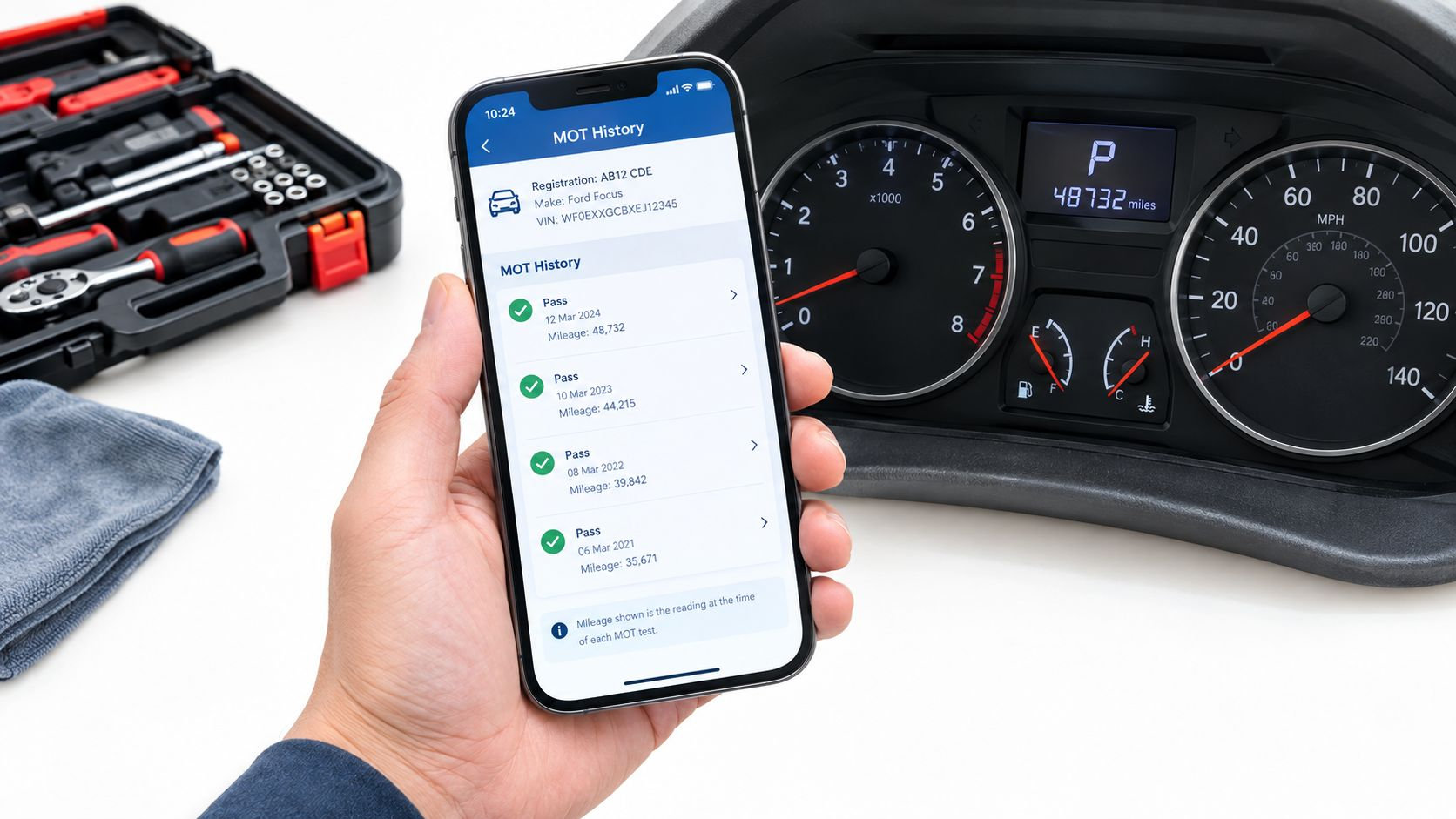
That DVSA record is the backbone. The DVSA MOT history API dataset makes clear that mileage readings are available in MOT history records, with coverage going back to 2005 in Great Britain and 2017 in Northern Ireland. For trade buyers, that means you can compare readings over time rather than relying on one point-in-time declaration.
For a broader view of what should sit around that MOT trail, this overview of data sources a trade vehicle check should include is useful.
Start with MOT history, but know its limits
MOT mileage data is strong because it is sequential. You can review the pattern from test to test and look for drops, flatlines or jumps that don't fit the age and use of the vehicle.
What it can do:
- Show recorded test-point mileage: That gives you a historical ladder rather than a single reading.
- Highlight formal inconsistencies: A lower later reading stands out quickly.
- Support chronology checks: Dates and mileage can be tested together.
What it can't do:
- Explain what happened between tests: The record only captures the vehicle at MOT dates.
- Fill gaps on older vehicles or limited regional coverage: Pre-2005 Great Britain history and pre-2017 Northern Ireland history won't be there in the MOT system.
- Resolve every anomaly on its own: A suspicious pattern still needs supporting documents and physical context.
A clean upward MOT sequence only proves that the test-point readings rise. It doesn't prove the car's mileage story is commercially complete.
Supporting records that matter on the ground
Once the MOT trail is checked, the next layer is documentary support. For trade purposes, the useful records are the ones that tie mileage to a dated event.
Look for:
- Service invoices and receipts: These often show the mileage recorded at routine maintenance and can support or challenge the MOT pattern.
- Previous MOT certificates or workshop printouts: They help confirm whether a questionable entry was repeated elsewhere.
- Job cards and inspection records: These are useful when a seller claims an entry error or instrument replacement.
- Instrument cluster history: If the dashboard has been replaced, the paperwork matters more than the explanation.
Why correction rules matter to buyers
The MOT system does allow mileage errors to be corrected, but only with evidence. According to the government guidance on correcting MOT certificate mistakes, a mileage record can only be formally corrected if the mistake is backed by documents showing the correct mileage and a date within one day of the MOT test. If the mistake is spotted within 28 days, the original MOT centre can update it. After that, DVSA requires proof such as an MOT invoice, emissions printout, service receipt or job card.
That matters in appraisal because it gives you a practical standard. If someone says, “that was just entered wrong”, ask whether they can prove it in the way the system itself would require.
How to Check Mileage on My Car Using MOT History and Service Records
On the forecourt, the process needs to be fast enough to use in real buying conditions and thorough enough to hold up later. The aim isn't to prove fraud on the spot. The aim is to decide whether the mileage can be trusted, qualified, or escalated before money is committed.
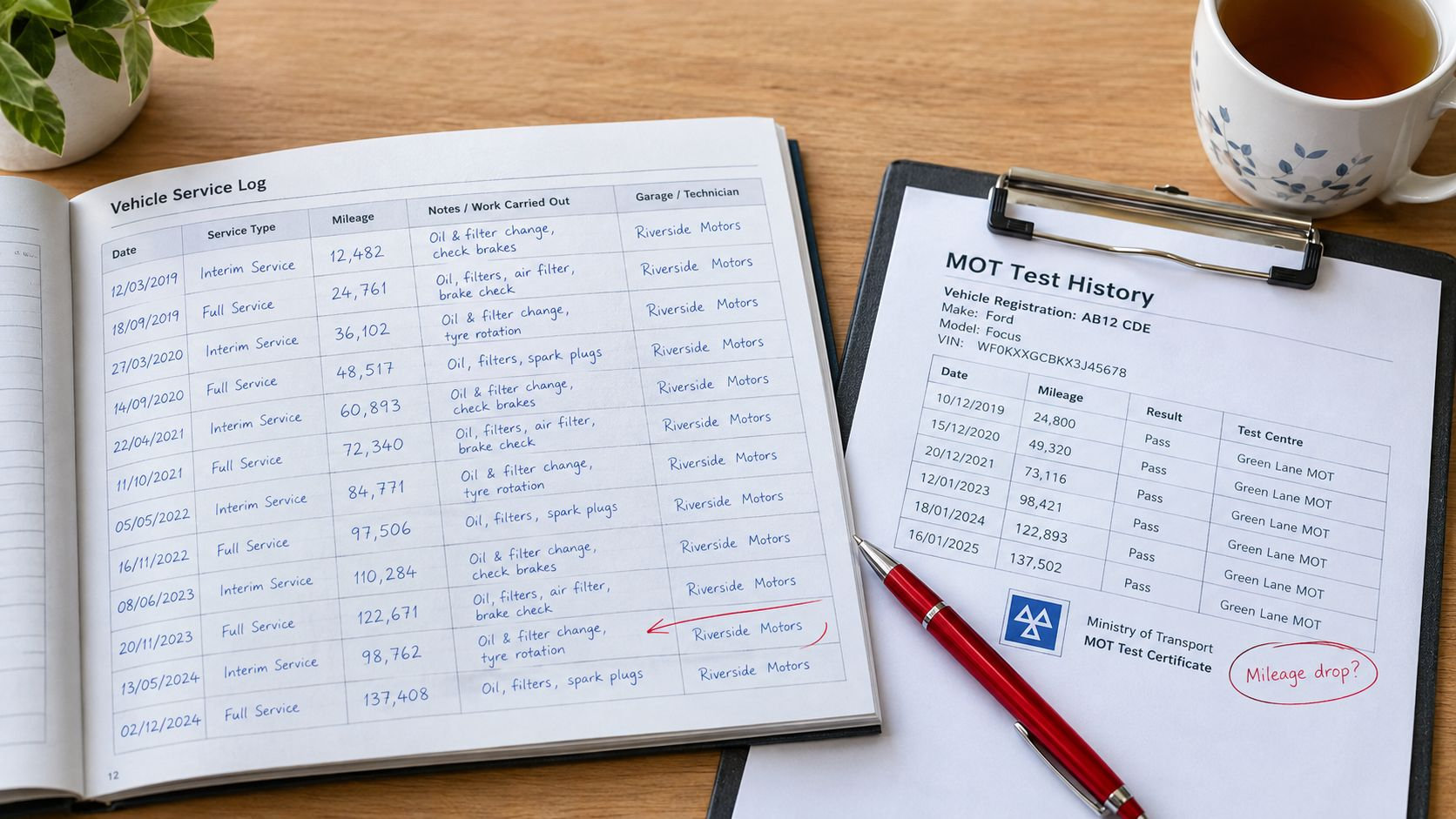
A more focused walkthrough of how to check MOT and mileage sits well alongside this workflow.
Match the dashboard to the latest recorded evidence
Start with the odometer reading in front of you. Then compare it with the latest MOT mileage entry and the most recent service document you can see.
If the dashboard is lower than the latest recorded MOT figure, that's an immediate stop-and-prove issue. Don't explain it away for the seller. Ask for records.
If it's higher, that's expected. The question becomes whether the increase is sensible in light of the dates and the vehicle's use.
Read the MOT trail backwards, not just the last line
Many buyers only compare today's odometer with the last MOT. That catches the obvious cases but misses the shape of the record.
Work backwards through the sequence and check for:
- Mileage drops: Any recorded reduction needs explaining with documents, not conversation.
- Flat or near-flat periods: These aren't automatically wrong, but they need context. Storage, seasonal use or long off-road periods can explain them.
- Odd jumps: A sharp rise can be genuine heavy use, but it should line up with ownership and condition.
- Long gaps between tests: A long interval reduces visibility and gives more room for undocumented changes.
Cross-check service history properly
Service books are useful, but invoices are stronger because they tie mileage to dates and workshop activity. A stamped book with no supporting invoices doesn't carry the same evidential weight when a dispute starts.
Use the service file to test the MOT trail in both directions:
- Forward consistency: Does each later service record broadly support the later MOT pattern?
- Backward consistency: Do earlier invoices make the vehicle's current story plausible?
- Event consistency: If major work was done, does the recorded mileage fit the age and use implied by that repair?
If the seller says the mileage is right, ask them to show where the paper trail proves it. Explanations are common. Evidence is what counts.
Treat dates as seriously as miles
A lot of weak appraisals focus on the odometer and ignore timing. Dates often expose the problem faster than the figures alone.
A few examples:
- Recent service, very little movement since: Fine if the vehicle has been standing, less convincing if it has moved through auction and trade hands.
- Big mileage increase over a short period: Possible, especially with fleet or motorway use, but the condition should support it.
- Replacement cluster claim: Check whether the paperwork sits close to the date of the alleged change and whether later records reflect the corrected position.
Keep evidence while the decision is live
If there's a discrepancy or a suspicious pattern, retain copies or photos of the relevant documents before the vehicle moves on. In a trade environment, stock can pass quickly. The paperwork tends to become harder to recover once the argument starts.
The practical workflow is simple:
- Capture the current dash reading
- Review the MOT sequence
- Check service invoices and workshop records
- Test dates and mileage together
- Pause the buy if the explanation isn't documented
Many used car history report workflows fail. They identify a mismatch, but they don't help the buyer decide whether the mismatch is clerical, mechanical or commercial. That judgement still sits with the trader.
Spotting Mileage Discrepancies and Understanding What They Mean
Not every discrepancy is fraud. Not every clean trail is safe. Most of the work sits in that middle ground, where the mileage is either slightly wrong, thinly documented or plausible enough to pass a casual check while still carrying risk.
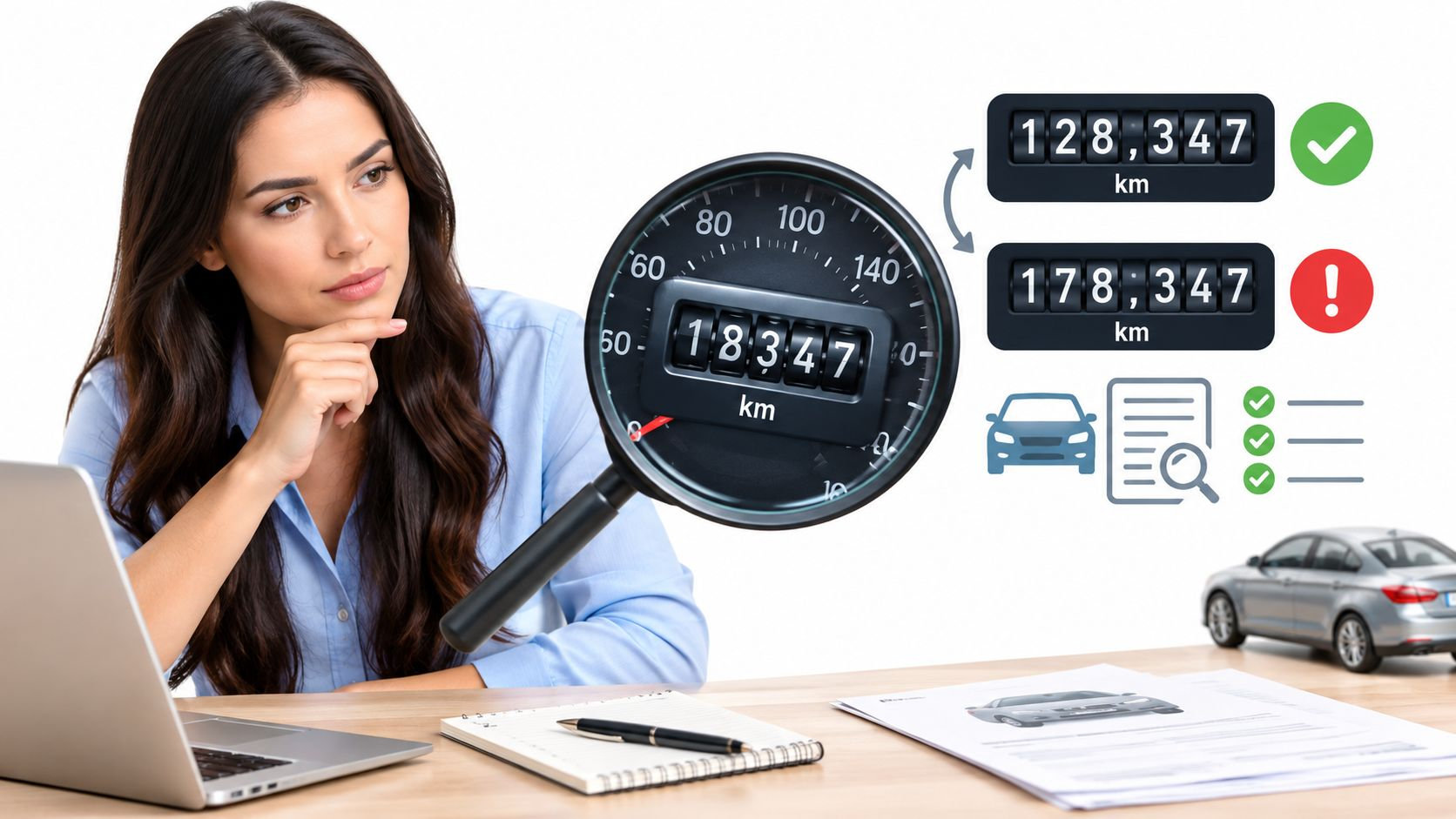
Pattern analysis matters more than a simple match. The logic behind vehicle anomaly detection is useful because unusual mileage often makes sense only when viewed against the wider history.
What a discrepancy can actually be
A lower recorded mileage can mean different things. It can be deliberate clocking. It can also be an MOT data-entry error or a replacement instrument cluster that was never documented properly.
Trade buyers need to separate those possibilities before making a hard call. Practical UK guidance on mileage discrepancy checks points to the strongest method: compare the latest MOT odometer entry against older MOT and service records, then inspect original certificates, service invoices and instrument history before concluding clocking.
That last point matters. If the paperwork is weak, the risk is still real even if intent can't be proved at appraisal stage.
The more dangerous cars are often the nearly believable ones
A clean upward sequence can still hide periods of heavy use, rapid resale or instrument changes between tests. UK-focused guidance on mileage checks and their limits highlights the practical gap here. MOT history records mileage only at test points, so a car can look tidy on paper while still carrying unexplained wear or timing issues that matter to a trader.
That's why believability has to be tested against context:
- Age of the vehicle: Does the mileage fit the sort of life the car appears to have had?
- Ownership pattern: Has the car moved through hands quickly, with little documentary depth?
- Condition and use signals: Do wear points, servicing events and general presentation support the claimed reading?
- Recent stock movement: Has it appeared in trade channels in a way that makes the story feel too neat?
Some of the highest-risk cars aren't the blatant rollbacks. They're the ones that give you just enough comfort to stop asking the next question.
What to keep on file before you proceed
When the trail feels wrong, keep evidence before you decide. That means screenshots, copies of invoices, photos of the dash reading, service paperwork and any written explanation from the seller.
You're trying to answer a practical question. If this issue comes back after purchase or after retail sale, can you show how you assessed it?
The evidence threshold should include:
- Whether the discrepancy appears once or repeatedly
- Whether a cluster replacement is documented
- Whether service records support or undermine the MOT trail
- Whether the vehicle's condition is materially out of line with its claimed mileage
Mileage fraud risk in the UK isn't marginal. Independent market analysis of millions of checked vehicles reported discrepancy rates ranging from 2.1% to 16.25%, implying roughly 160,000 UK vehicles with potential mileage issues in a typical year (Auto Express reporting on vehicle check data).
Don't collapse error and misrepresentation into one answer
There's also a legal and operational difference between an honest recording mistake and deliberate misrepresentation. UK commentary on the issue notes that the response differs depending on whether the problem is an MOT-entry error, a clerical mistake or intentional odometer fraud, and it also discusses the legal regime said to apply from April 2025 for traders and private sellers in different circumstances (UK odometer fraud law commentary).
For trade buyers, the practical takeaway is simpler than the law. Don't label it fraud unless the evidence supports that conclusion. But don't buy as though it's harmless if the file doesn't support the mileage either.
Why Basic Checks Miss Risk and How Provenance Intelligence Helps
A standard vehicle history check UK workflow is useful, but it tends to answer narrow questions. Is there an MOT trail? Is the current reading broadly consistent with that trail? Has anything obvious been flagged?
That's not the same as understanding risk at the point of purchase. The missing piece is context. Mileage only becomes decision-grade when it's read alongside vehicle provenance, ownership behaviour and anomaly signals.
The practical gap is visible in how many trade decisions still rely on snapshots. A basic report may tell you the recorded history looks orderly. It may not tell you whether the ownership timeline, short-term keepers or resale pattern make that mileage less believable.
Basic History Check Versus Provenance Intelligence for Mileage Risk
Capability Basic Vehicle History Check Provenance and Risk Intelligence MOT mileage trail Shows recorded entries and obvious mismatches Reads the sequence in context with timing, gaps and related signals Dashboard versus recorded figure Supports direct comparison Adds judgement on whether the figure is believable for the vehicle's profile Ownership patterns Often limited or point-in-time Highlights turnover speed, short-term keepers and unusual chronology Between-test risk Usually weak Looks for supporting indicators that suggest hidden use or inconsistent history Anomaly review Flags simple discrepancies Surfaces patterns that are technically consistent but commercially suspicious Buying decision support Data reference Risk interpretation for appraisal, valuation and stock selection
What traders actually need at point of decision
In live buying, the issue isn't access to more raw data. It's whether the data helps you decide. A used car history report that lists entries without interpreting relationships still leaves too much judgement pressure on the buyer under time constraints.
That's where a trade-focused layer helps. Why traditional provenance checks are no longer enough for professional traders explains the problem well. A point-in-time record can be factually correct and still operationally incomplete.
One option in that category is AutoProv, which is built for the motor trade and uses multiple authoritative datasets to support trade vehicle intelligence, including mileage patterns, ownership timelines and anomaly signals. In practice, that helps dealers look beyond a basic pass or fail view and judge motor trade risk in the round.
Why this changes buying behaviour
Provenance-led appraisal usually changes decisions in three ways:
- It slows weak buys early: The car that looks fine at first glance gets challenged before capital is committed.
- It improves negotiation: A documented concern gives the buyer something concrete to price against.
- It strengthens records: If the vehicle is bought, the rationale for that decision is easier to defend later.
The key point is simple. Basic checks confirm history entries. Provenance intelligence helps interpret whether the story built from those entries is credible enough to support a trade decision.
Trade Best Practice for Confident Mileage Verification and Next Steps
The most reliable approach is to make mileage verification a standard buying discipline across all stock, not a judgement call reserved for the obviously risky cars. The process should be repeatable, quick to audit and strong enough to survive a later challenge.
That discipline starts with three questions. Does the dashboard align with the latest recorded evidence? Does the sequence hold up across MOT and service records? Does the mileage make sense for the vehicle's age, ownership pattern and visible use?
A workable trade standard
For most dealers, the process can be standardised into a short appraisal rule set:
- Check the current odometer against the latest records: Don't rely on seller description alone.
- Review the pattern, not just the latest entry: A sequence tells you more than a single match.
- Use service invoices as evidence, not decoration: Stamps help, but invoices usually carry more weight.
- Escalate undocumented anomalies: If the story depends on explanation rather than paperwork, pause the buy.
- Retain the file: Keep copies of what you checked and what conclusion you reached.
A broader operational checklist for that sits well alongside these complete vehicle appraisal checklists for trade buyers.
What to do when it still feels wrong
Some cars won't fail the basic test, but they still won't read cleanly. That instinct often comes from mismatch between mileage and context. The cabin wear is heavier than expected. The service rhythm feels thin. The ownership timeline doesn't support the seller's narrative. The MOT ladder is neat, but the whole file feels assembled rather than lived.
That's the point to stop treating mileage as an isolated data field. Fold it into valuation and risk. If confidence is low, either buy at a level that reflects uncertainty or leave the car alone.
Clean records are useful. Credible records are what you need.
The practical next move
Strong dealer vehicle checks don't chase certainty that doesn't exist. They aim for documented, defensible decisions. Mileage sits inside that discipline with provenance, ownership analysis and anomaly review.
If you're handling stock acquisition professionally, the phrase check mileage on my car should mean more than matching a dashboard to an MOT entry. It should mean testing whether the mileage is believable enough to buy, price and retail with confidence.
AutoProv gives UK motor traders a way to assess mileage in context, not just as a standalone figure. Its reports combine vehicle history, provenance and risk signals to support smarter appraisal and buying decisions when the MOT trail looks clean but the story still needs testing. If that's the gap in your current process, visit AutoProv.
Frequently Asked Questions
AI-Generated Content Notice
This article was created with the assistance of artificial intelligence technology. While we strive for accuracy, the information provided should be considered for general informational purposes only and should not be relied upon as professional automotive, legal, or financial advice. We recommend verifying any information with qualified professionals or official sources before making important decisions. AutoProv accepts no liability for any consequences resulting from the use of this information.
From our AI insights
- Decoding Mileage: Impact of Seasonal Driving Patterns
Explore how seasonal driving impacts your car's mileage verification.
- Tackling Mileage Fraud in Electric Vehicles
Explore how motor traders can prevent mileage fraud in electric vehicles using advanced techniques.
- Mileage Verification for Hybrid Cars: A 2024 Update
Explore the nuances of mileage verification for hybrid vehicles in 2024 with our expert guide.
Related Articles

Understanding Vehicle Mileage Importance
Discover the critical role of accurate mileage in vehicle provenance and how AutoProv can safeguard your purchase.
What Is the Average Annual Mileage in the UK?
Right now, the average annual mileage for a car in the UK hovers around 7,000 miles. For anyone in the motor trade, that number is more than just a statistic; it’s a vital benchmark that helps buyers, sellers, and insurers get a quick read on a car's usage and potential wear and tear.
Car Mileage Discrepancy Explained: A Guide for UK Motor Traders
When it comes to a car’s history, its mileage record should tell a simple, straightforward story: the number always goes up. A mileage discrepancy is what happens when that story suddenly does not make sense.
Published by AutoProv
Your trusted source for vehicle intelligence