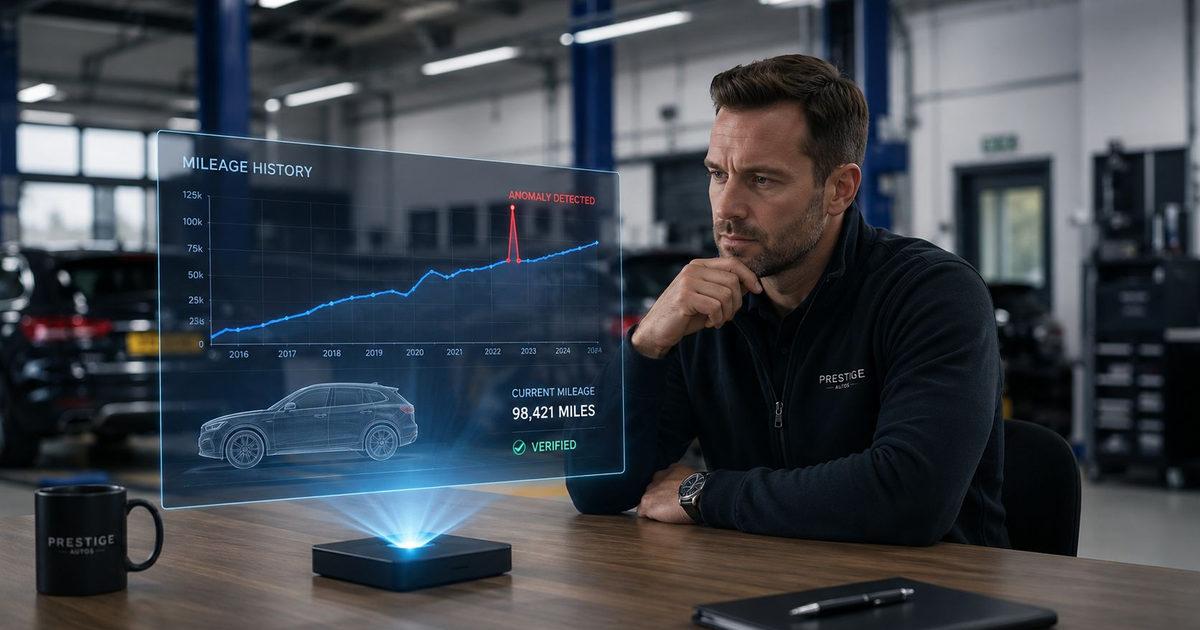
You're looking at a car in the lane, on a trade platform, or on a part-ex bid. The basic check looks acceptable. The MOT history is present. The registration lines up. Nothing obvious says walk away. Then the problems start after you've bought it.
The mileage story doesn't fit the wear. The keeper pattern feels wrong in hindsight. A plate change that looked administrative turns out to matter. What looked like a clean unit was really a vehicle with a hidden pattern of risk.
That's where anomaly detection matters in the UK motor trade. Not as a buzzword, and not as an academic model, but as a disciplined way of connecting data points that don't make sense together. Most experienced buyers already do this instinctively. They look at dates, usage, provenance, and presentation, then decide whether the story hangs together. Anomaly detection is that judgement process, made systematic.
A useful way to frame it is through a data quality perspective on anomalies. In vehicle data, the issue usually isn't one odd field on its own. It's the relationship between fields over time. That's also why strong automotive data analytics in the trade matter more now than a simple pass or fail response.
Table of Contents
- A Trader's Introduction to Anomaly Detection
- It's the method behind the instinct
- It protects margin and reputation
- What Anomaly Detection Means for Vehicle Data
- A baseline matters more than a single alert
- Think of it like a credit report for provenance
- How Anomaly Detection Uncovers Hidden Vehicle Risks
- Rule based checks catch the obvious first
- Statistical analysis finds the outliers humans miss
- Machine learning connects weak signals
- Spotting Red Flags in Mileage and Ownership History
- Mileage anomalies traders see every week
- Ownership patterns that deserve a second look
- When records agree individually but not together
- Why Standard Vehicle History Checks Are Not Enough
- The contextual gap in trade buying
- What basic checks leave unresolved
- Integrating Anomaly Insights into Your Buying Process
- A practical buying discipline
- Decision support beats data overload
A Trader's Introduction to Anomaly Detection
A lot of bad stock doesn't look bad at first glance. That's the whole problem.
A vehicle can arrive with a usable MOT trail, a plausible odometer reading, and no immediate sign of distress on a basic vehicle history check UK search. Yet once you start lining up the years, the mileage accumulation, the keeper changes, and the condition of the cabin, the story stops being coherent. Traders usually describe that feeling in plain terms. Something about it doesn't add up.
That instinct is anomaly detection.
It's the method behind the instinct
In practical motor trade terms, anomaly detection means identifying data or behaviour that sits outside what would normally make sense for that vehicle. It isn't just about spotting an impossible event. It's also about spotting a pattern that is technically possible, but commercially suspicious.
A buyer might see:
- An MOT sequence that exists but feels uneven. The record is there, but the usage pattern changes sharply without an obvious reason.
- A keeper history that looks ordinary in isolation. Then you match it to resale timing and the sequence starts to look less routine.
- Condition that conflicts with the paper trail. The numbers may appear tidy, but the physical vehicle tells a different story.
Experienced traders rarely lose money because one field was missing. They lose money because several fields looked acceptable on their own.
That's why anomaly detection matters to dealer vehicle checks and broader motor trade risk management. It helps you move from a static checklist to a working narrative. Instead of asking, “Is this item present?”, you ask, “Does this vehicle's history make sense from one event to the next?”
It protects margin and reputation
Used car history report data is only useful if someone interprets it in context. A tidy-looking report can still conceal misuse, identity issues, mileage concerns, or resale behaviour that should change your valuation or stop the purchase altogether.
For trade buyers, what is anomaly detection really about? It's about finding the hidden story before you commit capital.
What Anomaly Detection Means for Vehicle Data
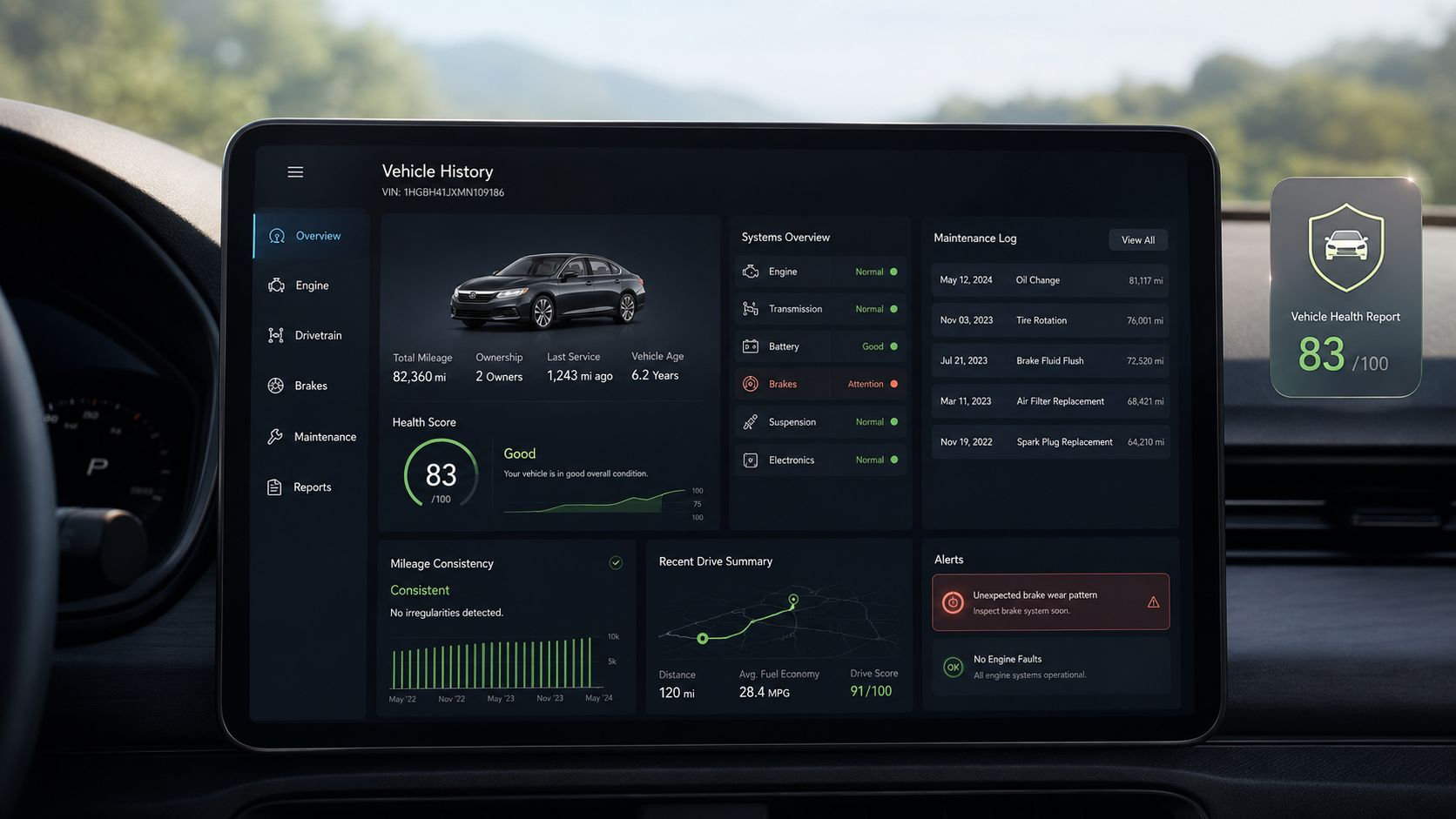
At its simplest, anomaly detection means establishing what looks normal, then flagging what departs from that normal pattern.
For vehicle data, that normal pattern isn't limited to mechanical behaviour. It includes provenance, usage, and timing. Milvus notes that anomaly detection operates by building a behavioral profile of normal vehicle operation, then triggering alerts when data indicates anomalous behavior. In the motor trade, this mechanism enables detection of hidden risks by cross-referencing DVLA records, MOT history, and insurance databases, where anomalies manifest as rapid deviations from expected ownership timelines or mileage patterns.
A baseline matters more than a single alert
A single odd data point doesn't always mean fraud or a bad buy. Data entry errors happen. Administrative changes happen. Genuine low-mileage use happens.
What matters is the baseline.
If you're evaluating vehicle provenance properly, you need a sense of what should be expected for that specific car across time:
Vehicle data area Normal baseline question Anomaly question Mileage Does annual use build consistently? Has usage dropped or changed in a way that needs explanation? Ownership Does keeper timing look stable? Is there unusual churn or rapid resale? MOT record Is the chronology coherent? Are there gaps, reversals, or sequences that don't fit? Identity data Do registration events make sense? Do changes create provenance uncertainty? That's the difference between a raw alert and actual trade vehicle intelligence.
Think of it like a credit report for provenance
The easiest analogy is a credit report. One missed payment might not define the whole picture. A wider pattern of strain does.
Vehicle anomaly detection works the same way. One plate change might be harmless. One low-mileage year might be credible. But when number plate history, ownership timing, MOT chronology, and usage patterns start leaning in the same direction, the risk profile changes.
That's why stronger trade vehicle check data sources matter. Better decision-making comes from seeing related signals together, not from collecting disconnected facts.
Practical rule: Treat anomalies as prompts for investigation, not automatic verdicts. The value is in understanding why the deviation exists.
A proper mileage check UK process or dealer vehicle checks workflow should therefore answer two questions. What changed, and does that change make sense for this vehicle's story?
How Anomaly Detection Uncovers Hidden Vehicle Risks

Different anomaly detection methods solve different problems. In the trade, no single method is enough on its own. The strongest risk assessment combines simple rules, pattern analysis, and broader contextual review.
That matters because some threats are obvious and some are hidden in combinations of otherwise ordinary events. It's the same principle used in other forms of managed monitoring, where teams combine alerts with interpretation rather than trusting isolated triggers. A useful parallel sits in GoSafe insights on managed detection, where raw signals only become useful once someone puts them into context.
Rule based checks catch the obvious first
Rule-based detection is where most dealers start, and it still has real value.
These checks are blunt by design. They look for events that should immediately trigger review:
- Impossible chronology. A mileage figure falls when it should only rise.
- Unusual gaps. A record sequence has a break that needs explanation.
- Timing flags. A keeper change or resale happens in a window that doesn't fit normal holding behaviour.
This approach is fast, explainable, and ideal at appraisal stage. It won't catch every risk, but it stops traders missing the straightforward cases.
Statistical analysis finds the outliers humans miss
The second layer looks for data that is unusual relative to expected behaviour.
That doesn't require a dramatic event. It's often about shape rather than shock. A vehicle's annual usage might taper too sharply. Its resale pattern may sit outside what you'd expect for age, type, or ownership flow. Nothing looks impossible, but the pattern is off.
A strong used car history report is more than just an archive. It becomes a way to identify outliers worth pricing differently, inspecting harder, or rejecting.
A practical example from provenance risk is number plate activity and finance exposure. The Car Expert reports that 27.5% of used vehicles checked had an issue with a number plate change, while 17.6% had outstanding finance debt attached. Those aren't automatic fail points in every case, but they are clear signals that free checks don't surface well enough.
Machine learning connects weak signals
Machine learning is most useful when the risk sits between data points rather than inside one field.
A private plate change followed by an abrupt change in mileage behaviour may not look serious as separate events. Taken together, they can become much more relevant. The same goes for unusual keeper timing combined with inconsistent usage patterns.
That's where contextual analysis earns its keep. Instead of asking whether one record is wrong, it asks whether the overall behaviour departs from a credible ownership and usage story.
For traders working through digital histories and mileage anomalies, that layered approach is what turns data into practical buying intelligence.
You're not trying to prove misconduct from one anomaly. You're trying to decide whether the full pattern justifies confidence, caution, or a walk-away.
Spotting Red Flags in Mileage and Ownership History
The easiest way to understand anomaly detection is to look at the kinds of red flags traders handle in real stock decisions.
Mileage anomalies traders see every week
Some mileage issues are blatant. Others are subtle enough to pass through a rushed appraisal.
A clear example is an MOT mileage that moves backwards. ServiceStamp explains that overt anomalies occur when a recorded mileage drops from a previous value, such as 78,000 miles in 2022 to 62,000 in 2023, while subtle anomalies include sudden drops from normal to low annual mileage. It also notes that free MOT history checks on gov.uk are a primary tool for flagging those discrepancies.
That gives traders two separate jobs:
- Spot the impossible. A backward movement in recorded mileage needs immediate explanation.
- Spot the improbable. A vehicle that was doing normal annual miles and then almost stops may still deserve scrutiny, even if the sequence doesn't technically break.
For a broader view than the MOT line alone, some traders also review a full mileage report to compare wider record sources before deciding whether the vehicle's usage pattern is credible.
Ownership patterns that deserve a second look
Ownership data often looks harmless until you line it up against the rest of the vehicle's history.
A short holding period on its own isn't proof of anything. The same goes for several keepers over time. But when rapid resale, recent keeper changes, and abrupt usage changes appear together, the vehicle starts to look less like ordinary stock and more like a provenance question.
Common concerns include:
- Rapid hand-offs. The vehicle moves quickly between keepers, then appears for sale again almost immediately.
- Business to private transitions before disposal. That change can be legitimate, but it may deserve checking against timing and mileage.
- Keeper churn without a convincing usage story. Repeated change with little coherent pattern often weakens confidence.
When records agree individually but not together
The hardest cases are the ones where every single record appears plausible in isolation.
The MOT exists. The V5C details look in order. The plate history appears administrative. The insurance-side data doesn't immediately scream problem. Yet when you review them together, the sequence still feels wrong.
That's where practical trade judgement matters most. Good buyers don't just check if records are present. They check whether the records support the same story.
If the mileage, the keeper timeline, and the vehicle condition all point in different directions, the safest assumption is that the full story still hasn't surfaced.
A structured review of clocked mileage using MOT and service history data helps turn that instinct into a repeatable buying process.
Why Standard Vehicle History Checks Are Not Enough
Standard checks still have a place. They are a necessary first filter. The problem starts when traders treat them as a conclusion instead of a starting point.
The contextual gap in trade buying
Basic checks are good at confirming whether a record exists. They are much weaker at analysing the relationship between records.
That blind spot matters. Research discussed by Electric Motor Engineering highlights the contextual gap, noting that unsupervised ML models detect only 35% of fraudulent anomalies without contextual data integration. In plain trade terms, a tool that produces raw alerts without connecting ownership timelines and mileage patterns will miss a large part of the actual risk.
That's why what is anomaly detection in the motor trade can't be answered with “it flags outliers”. A useful system has to assess whether events make sense together.
What basic checks leave unresolved
Free and basic checks leave traders exposed in areas that directly affect buying risk.
AutoProv's guidance on free car history checks explains that free UK vehicle history checks cannot confirm if a vehicle has been cloned using official DVLA flags or VIN verification, nor can they detect mileage fraud occurring between annual MOT tests. Those gaps matter because fraud rarely presents itself neatly at the exact moment a free data source happens to record it.
A standard report may tell you that a vehicle passed an MOT. It may not tell you whether the ownership flow, identity trail, and usage pattern form a coherent provenance picture.
For professional buyers, that's the issue. Not lack of data, but lack of connected meaning.
A more detailed view of why traditional provenance checks are no longer enough for professional traders makes the same point from a trade risk angle. Basic checks answer isolated questions. They don't always support point-of-decision judgement.
Integrating Anomaly Insights into Your Buying Process
Anomaly detection only earns its place if it changes how you buy.
A practical buying discipline
The best approach is procedural, not theoretical.
- Read the vehicle as a timeline. Start with ownership, mileage, and MOT chronology together. Don't review them as separate boxes.
- Investigate breaks in the story. If usage changes sharply, keeper timing looks unusual, or identity-related events create uncertainty, slow the deal down.
- Use deeper provenance checks where the margin justifies them. A basic screen is fine for filtering. It isn't enough for higher-risk stock or borderline calls.
Decision support beats data overload
Most traders don't need more raw data. They need better judgement at the point of purchase.
That means treating trade vehicle intelligence as decision support. The job isn't to collect every possible alert. The job is to work out whether the vehicle's history is coherent enough to buy, value, and retail with confidence.
If you build that discipline into your dealer vehicle checks process, you reduce the odds of buying stock with hidden provenance problems and improve consistency across appraisals, valuations, and compliance review.
AutoProv supports that process with UK-focused vehicle provenance, used car history report analysis, and trade vehicle intelligence designed to help dealers connect mileage, ownership, MOT, and risk signals before they commit capital.
Frequently Asked Questions
AI-Generated Content Notice
This article was created with the assistance of artificial intelligence technology. While we strive for accuracy, the information provided should be considered for general informational purposes only and should not be relied upon as professional automotive, legal, or financial advice. We recommend verifying any information with qualified professionals or official sources before making important decisions. AutoProv accepts no liability for any consequences resulting from the use of this information.
From our AI insights
- Auction Pitfalls: Avoiding Costly Mistakes
Navigate UK car auctions with confidence by avoiding finance, write-off, and mileage risks.
- Mastering Paint Code Checks: Detecting Hidden Car Repairs
Discover how to use paint code verification to identify hidden car repairs and ensure a smarter purchase.
- UK Part-Exchange Checks: Protecting Dealer Margins
Explore essential part-exchange checks for UK dealers to safeguard profit margins, including provenance and finance verification.
Related Articles

Your Ultimate Guide to Buying a Used Car in the UK
Navigate the UK used car market with confidence using our comprehensive buying guide. Tips, checks, and AutoProv Provenance insights included.

Difference Between MOT and Service: What You Need to Know
An MOT is a mandatory legal inspection that every car on UK roads needs to pass.Think of it as the government's way of ensuring your vehicle meets the absolute minimum safety and environmental standards to be considered roadworthy. A service, on the other hand, is a completely different beast. It's the proactive maintenance routine recommended by the people who built your car, designed to keep it running smoothly and catch problems before they start. In short, an MOT is a pass-or-fail exam required by law. A service is a comprehensive health plan for your car.

Your Ultimate Used Car Inspection Checklist
A solid used car inspection checklist is the single most powerful tool you have to avoid buying a lemon. It gives you a methodical way to look past the shiny paint and assess a car's real condition, helping you spot hidden problems and get a fair price before you shake hands on the deal.
Published by AutoProv
Your trusted source for vehicle intelligence