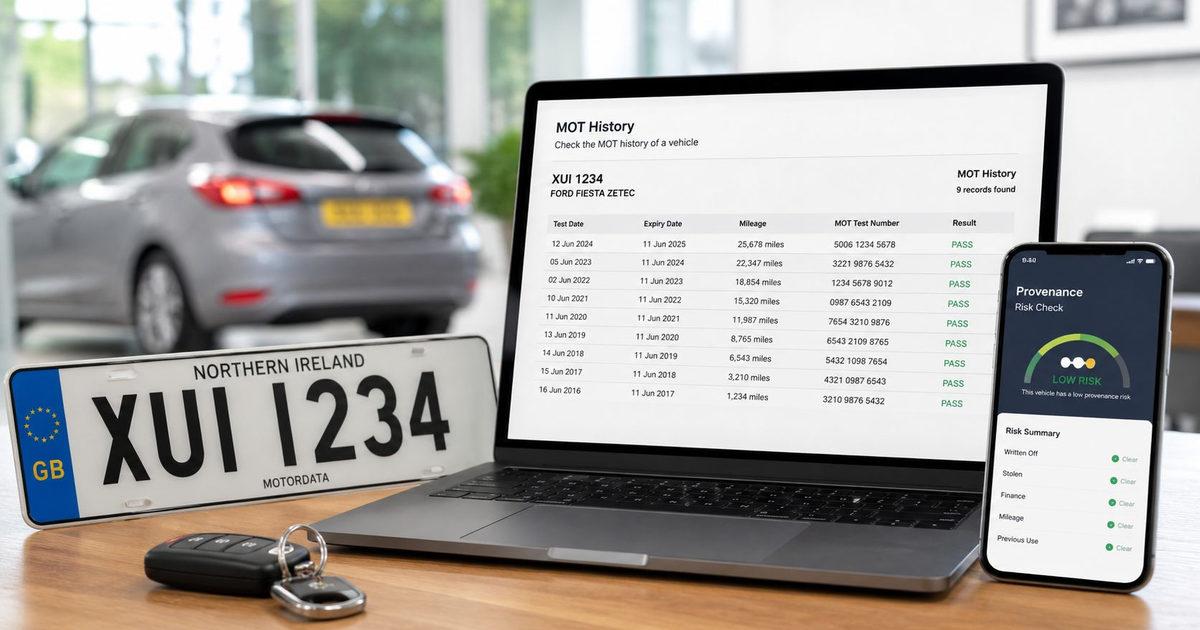
A stock car lands in your inbox with clean photos, a sensible spec, and a price that gives you room. Then you notice the registration history points to Northern Ireland. That's usually the moment a straightforward appraisal turns into a risk exercise.
For GB stock, most traders know the rhythm. Check the registration, review the MOT trail, compare mileage progression, then decide whether the car belongs in the lane, on the pitch, or nowhere near your account. With NI vehicles, that workflow can break down if you rely on the same assumptions you use in England, Scotland, or Wales.
The issue isn't that Northern Ireland vehicles are higher risk in themselves. The issue is data separation and interpretation. If you pull a standard vehicle history check UK buyers commonly use and treat a missing GB MOT record as a dead end, you can miss useful context or misread an otherwise normal NI history. Good trade buying depends on knowing the difference.
Table of Contents
- The Challenge of Sourcing Vehicles from Northern Ireland
- Where traders get caught out
- Why NI Vehicle History Requires a Different Approach
- What this means in practice
- Why standard checks can miss the point
- The direct consequence for risk assessment
- How to Check an MOT History for NI Vehicles
- A practical checking routine
- What the NI MOT output is useful for
- What not to do
- Interpreting NI MOT Results and Spotting Red Flags
- Mileage patterns that deserve scrutiny
- Repeated failures tell a story
- Gaps and awkward records
- Beyond the MOT A Complete Provenance Check
- What the MOT won't show you
- Why provenance intelligence matters
- Frequently Asked Questions for NI Vehicle Checks
- What should I look for on an NI V5C
- What if the vehicle has recently moved from NI to GB registration
- What if the online NI MOT check returns no record
- Is a clean NI MOT enough to buy the car
- When should I walk away
The Challenge of Sourcing Vehicles from Northern Ireland
A familiar trade scenario goes like this. The car looks right on paper, the seller sounds organised, and the margin still works after transport. Then your usual dealer vehicle checks don't return the MOT picture you expected.
That gap matters because a missing or thin MOT trail can mean very different things depending on where the vehicle has been administered. NI stock sits in a part of the UK market where the registration and testing environment has long required a more careful read. If you treat it as a standard GB lookup, you risk making a decision on incomplete context.
Where traders get caught out
The most common mistake isn't failing to run checks. It's assuming all UK records behave the same way.
For Northern Ireland vehicles, traders often run into these issues:
- Incomplete first impression: A standard used car history report may not show the MOT trail a GB buyer expects.
- False reassurance: A clean headline result can distract from unresolved provenance questions.
- Valuation distortion: If you can't place the car properly within its maintenance and ownership context, your bid can drift too high or too cautious.
- Workflow delays: Buyers lose time chasing documents after the appraisal, when the risk should have been assessed before commitment.
A stronger starting point is to treat NI stock as its own workflow, not as an exception to tidy up later. That means checking the record source first, then reading the result in context. Traders working across both jurisdictions usually get cleaner buying decisions when they build that distinction into their process. For a broader look at the market context, AutoProv's guide to Northern Ireland vehicle valuations and market insights is a useful reference point.
Practical rule: If the registration points to Northern Ireland, don't decide on the vehicle until you've confirmed where its MOT and administrative history actually sits.
Why NI Vehicle History Requires a Different Approach
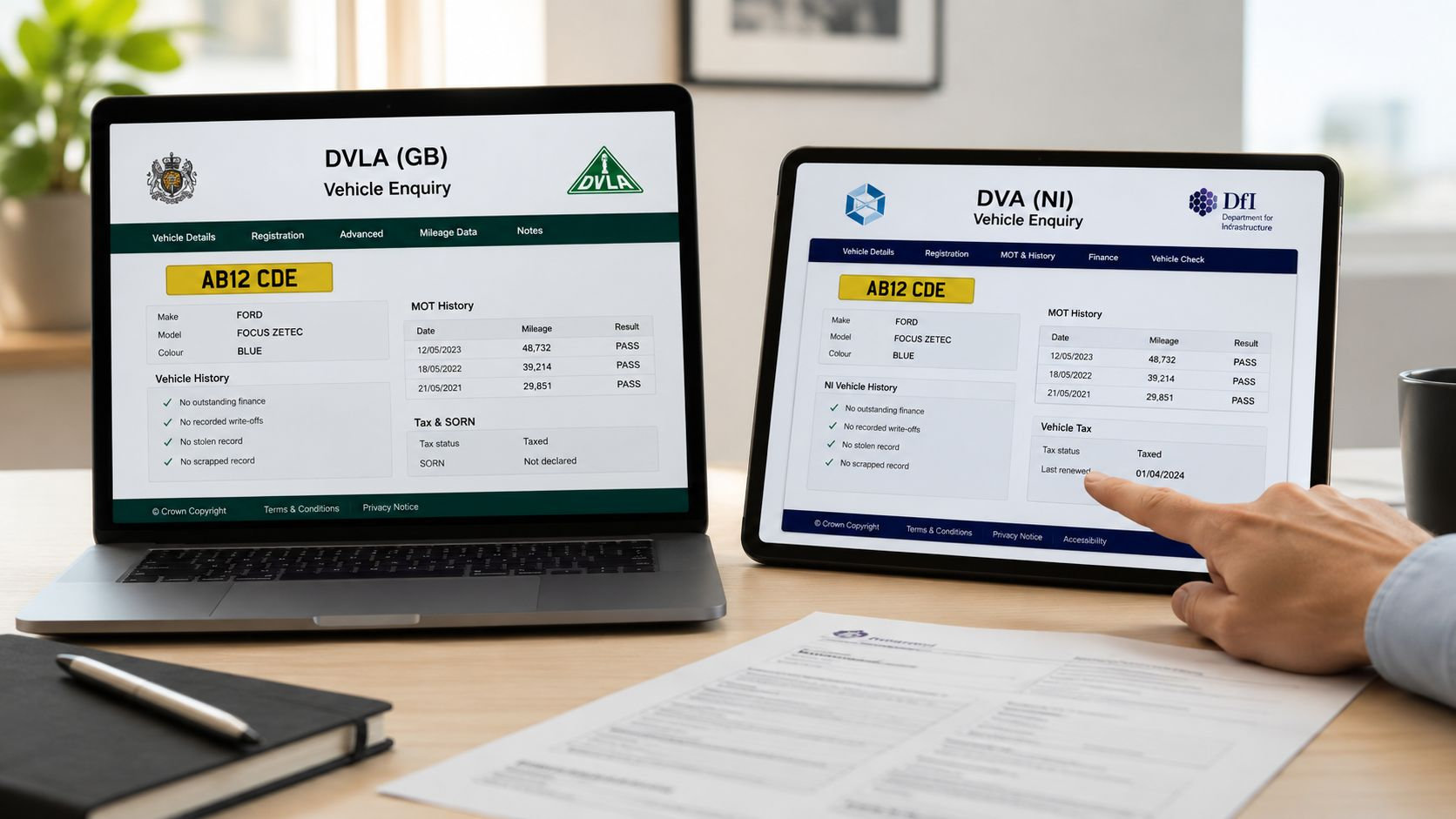
The core issue is structural. DVLA and DVA are not the same organisation, and motor traders need to treat that distinction as operational, not academic.
DVLA handles vehicle registration and licensing across Great Britain. Northern Ireland vehicle administration involves the Driver and Vehicle Agency, and MOT testing records for NI vehicles have historically sat within that framework. When traders forget that split, they can mistake an unavailable GB MOT view for an absent MOT history.
What this means in practice
A GB-focused check can still be useful, but it may not answer the specific MOT history NI question you're trying to resolve. That's where traders can go wrong at appraisal stage.
If a buyer sees no familiar MOT trail, several bad assumptions can follow:
- They infer neglect too quickly: The issue may be the lookup route, not the vehicle.
- They over-rely on seller paperwork: Printed MOT evidence without direct verification is weak due diligence.
- They miss mileage context: Without the proper test history, a mileage check UK process loses one of its most valuable reference points.
- They underprice risk: A stock decision based only on headline identity and condition is thin protection in the used market.
Why standard checks can miss the point
Basic checks are designed to answer broad questions. They're not always built to interpret the quirks that matter to a trade buyer dealing with NI provenance. That's a limitation of scope, not necessarily a flaw.
A proper assessment of vehicle provenance needs more than a yes or no output. You need to know whether the record source is correct, whether the MOT trail aligns with the vehicle's administrative path, and whether any apparent gaps are explainable. AutoProv's article on a vehicle history check for Northern Ireland sets out that distinction clearly.
Traders don't usually lose money because a record exists. They lose money because they interpret an incomplete record as a complete one.
The direct consequence for risk assessment
For NI stock, point-of-decision judgement matters more than speed alone. If the source system differs, your buying workflow has to adapt. That's why trade vehicle intelligence is less about pulling more screens and more about asking the right question of the right database before you bid.
How to Check an MOT History for NI Vehicles
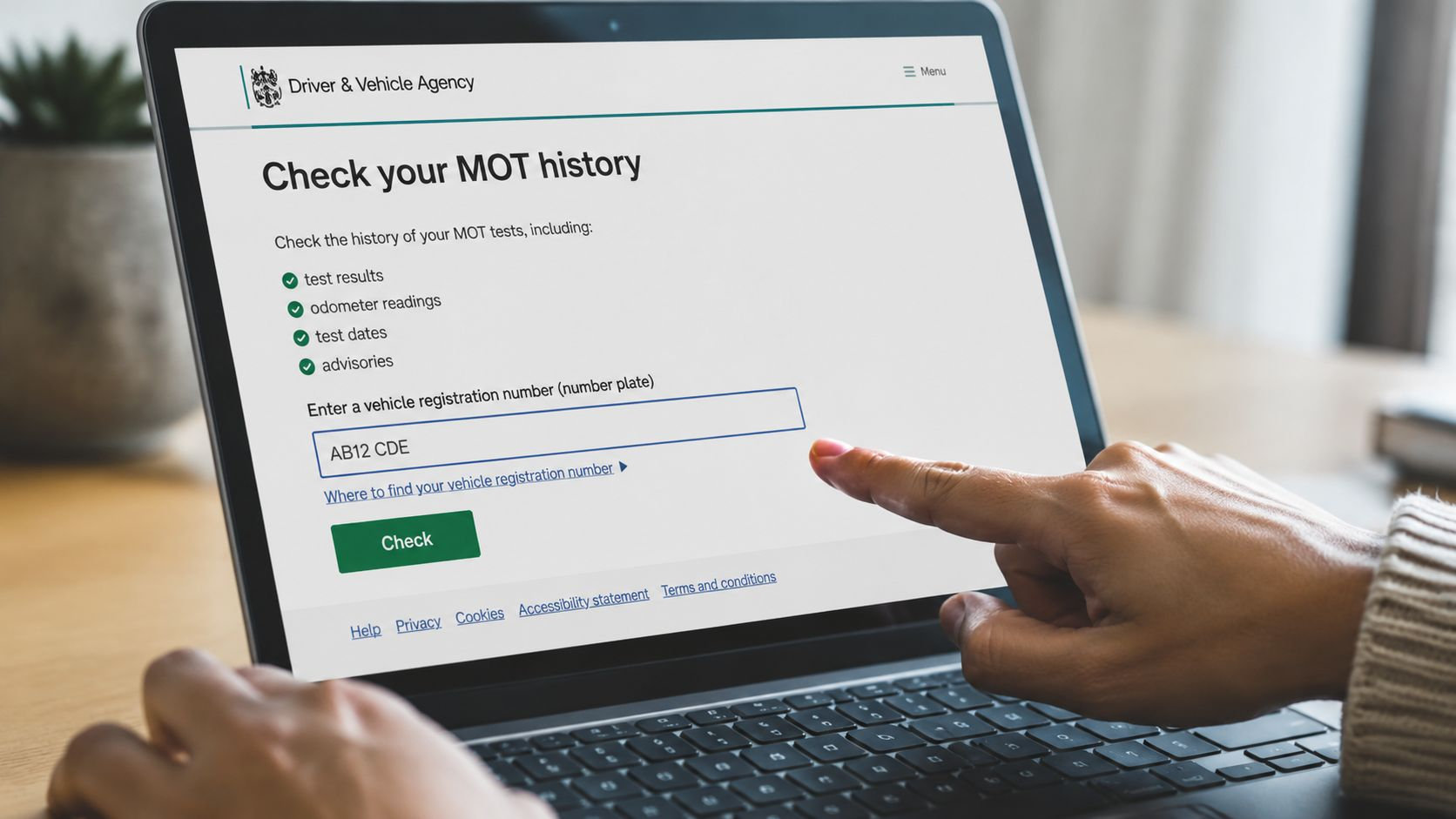
When you're dealing with an NI vehicle, the right move is simple. Go to the official NI MOT route first and verify the test trail directly, rather than trying to infer it from a GB result that may not be designed for that purpose.
The good news is that checking MOT history is straightforward when you use the correct service. According to the government guidance summarised by GetCOC's overview of checking vehicle MOT history, you typically only need the registration number to access MOT records through the official service.
A practical checking routine
Use a repeatable process. That keeps your buying desk consistent and makes handovers cleaner when several people are sourcing stock.
- Confirm the registration basis
- Start with the vehicle registration and establish whether you're dealing with an NI administrative history, a GB administrative history, or a vehicle that has moved between the two.
- Use the official NI MOT history service
- Enter the registration on the appropriate government checker rather than relying on screenshots, PDFs, or verbal confirmation from the seller.
- Read the record in sequence
- Don't just look at current MOT status. Review the progression of tests, mileages, pass or fail outcomes, and any advisory pattern.
- Capture the result at appraisal stage
- Save a copy to the stock file before bidding, not after purchase approval. That protects your audit trail and helps the next person reviewing the deal.
What the NI MOT output is useful for
A proper MOT history NI review usually helps with four trade decisions:
- Condition judgement: Repeated failures or recurring advisories can point to neglected maintenance.
- Mileage sense-check: Recorded test mileages give you another anchor when reviewing the odometer story.
- Preparation forecasting: The pattern of wear items and previous issues can hint at likely workshop spend.
- Seller credibility: If the seller's description doesn't line up with the official trail, you've learned something important before money moves.
What not to do
The weak approach is to treat MOT data as a standalone buying answer. It isn't. It's one of the few official maintenance-related trails available at speed, but it still needs interpretation.
Avoid these shortcuts:
- Don't accept a missing result at face value: First confirm you're searching the correct system.
- Don't stop at pass or fail: A pass with heavy advisories can still be poor stock.
- Don't ignore chronology: A used car history report only becomes useful when the timeline makes sense.
- Don't separate MOT from appraisal notes: If your buyer spots wear, trim damage, or service gaps, compare those observations against the MOT trail immediately.
For traders who want a practical workflow around test records, AutoProv's guide on how to view MOT history and make smarter buying decisions is worth keeping in your buying process notes.
Interpreting NI MOT Results and Spotting Red Flags
Pulling the record is the easy part. The key insight comes from reading it like a buyer, not like an admin clerk. A clean current status doesn't tell you whether the car has been consistently maintained, prepared only for sale, or pushed through a cycle of temporary fixes.
Mileage patterns that deserve scrutiny
Most traders start with the odometer, and rightly so. MOT mileage readings can expose inconsistencies, but the obvious rollback isn't the only concern.
Watch for patterns such as:
- Mileage movement that doesn't fit the ownership story: If the seller describes regular use but the test trail looks oddly static, ask why.
- Uneven jumps between tests: A sharp change isn't proof of wrongdoing, but it does need explanation.
- Administrative mismatch: If auction notes, service invoices, dashboard display, and recorded MOT progression don't sit comfortably together, pause the deal.
A good mileage check UK process doesn't stop at spotting a discrepancy. It asks whether the explanation is documented, plausible, and commercially acceptable for your exit route.
A mileage anomaly isn't always fraud. It is always a reason to slow down.
Repeated failures tell a story
One failure on wear-and-tear items doesn't concern most experienced buyers. The pattern matters more than the single event.
Use MOT history to identify whether the vehicle has:
Pattern What it can suggest for a trader Repeated advisories on the same area Deferred maintenance or superficial preparation Failures followed by similar advisories later Repair quality may have been poor or temporary Corrosion-related notes over time Structural issues may be progressive, not historic Brake, tyre, or suspension repetition The previous keeper may have run the car reactively rather than properly maintained it Trade judgement ultimately outperforms raw data. The MOT record won't tell you whether the car is wrong for your forecourt, but it can tell you whether your inspection needs to become far more targeted.
Gaps and awkward records
A gap in the MOT trail doesn't automatically make the vehicle bad stock. It does mean you need supporting context. That might come from service history, keeper narrative, registration movement, or a better provenance review.
Use a simple red-flag filter:
- Explainable and documented: Continue, but note it in the deal file.
- Explainable but unsupported: Price for uncertainty or walk away.
- Not explainable: Treat it as increased motor trade risk.
For a sharper framework on reading test records as risk signals rather than isolated events, the AutoProv piece on decoding MOT history red flags is a useful trade reference.
Beyond the MOT A Complete Provenance Check
An MOT record can tell you a lot about testing outcomes and recorded mileage progression. It can't tell you everything that matters to a buyer putting capital into stock. That's why a vehicle history check UK workflow should start with MOT, then move into broader provenance.
A vehicle can show a tidy MOT trail and still present risk through finance, write-off history, identity concerns, or ownership behaviour that doesn't fit a stable retail proposition. This matters even more with cross-jurisdiction stock, where the temptation is to treat one clean data point as enough.
What the MOT won't show you
A dealer-grade risk review needs context around the vehicle, not just a test history. In practice, that means looking at:
- Ownership timelines: Short-term keepership and rapid resale can change how you read the rest of the file.
- Insurance-related events: A structurally or economically significant past event won't be revealed by MOT results alone.
- Identity consistency: Registration, specification, and documentary trail need to align.
- Commercial suitability: Some cars are genuine. They're just wrong for your risk appetite, prep model, or customer base.

Why provenance intelligence matters
Trade buyers don't need more disconnected data. They need a view that helps them decide whether a vehicle is normal, explainable, or uncomfortable.
That's where tools built for trade vehicle intelligence have a place. AutoProv's Northern Ireland vehicle provenance report is one example of a trade-focused report that combines MOT history, ownership timelines, mileage patterns, and wider risk indicators so buyers can assess context rather than just headline results.
There's also a wider industry shift toward traceability and structured product information. For readers thinking about where vehicle records may go over time, DPP Grid's explainer on understanding digital product passports is useful background reading.
Trade view: The strongest used car history report is the one that helps you decide what the data means, not just what the data says.
Frequently Asked Questions for NI Vehicle Checks
What should I look for on an NI V5C
Check that the document details align with the vehicle in front of you and the digital records you've already reviewed. Pay attention to keeper sequence, registration details, and any sign the paperwork story is cleaner than the vehicle story. If the document is present but the wider provenance still feels thin, keep digging.
What if the vehicle has recently moved from NI to GB registration
Treat it as a timeline exercise. Establish when the move happened, then line up the administrative history with the MOT record and the seller's description. Vehicles that have moved jurisdictions aren't automatically problematic, but they do need a more careful chronology review.
What if the online NI MOT check returns no record
Don't guess. First confirm the registration has been entered correctly and that you're using the correct official route for the vehicle's history. If there's still no result, ask for supporting documentation and decide whether the absence is properly explainable or too weak for your buying standards.
Is a clean NI MOT enough to buy the car
No. It's useful evidence, but it isn't a complete provenance decision. A clean MOT doesn't answer every question relevant to motor trade risk, resale confidence, or compliance workflow.
When should I walk away
Walk away when the timeline doesn't reconcile, the seller can't support obvious anomalies, or the risk sits outside your stock policy. Good buying discipline often means rejecting cars that look attractive at first glance but don't stand up once the record is read properly.
If NI stock forms part of your sourcing mix, AutoProv can support the due diligence side with trade-focused vehicle provenance and risk intelligence that goes beyond a basic MOT lookup.
Frequently Asked Questions
AI-Generated Content Notice
This article was created with the assistance of artificial intelligence technology. While we strive for accuracy, the information provided should be considered for general informational purposes only and should not be relied upon as professional automotive, legal, or financial advice. We recommend verifying any information with qualified professionals or official sources before making important decisions. AutoProv accepts no liability for any consequences resulting from the use of this information.
From our AI insights
- MOT History: Understanding Seasonal Trends
Explore how seasonal trends impact MOT history and what it means for vehicle checks in 2026.
- Predicting Mechanical Issues with MOT Patterns
Learn how to analyse MOT patterns to foresee potential mechanical issues and make informed buying decisions.
- Mastering MOT Data for Smart Stock Acquisitions
Unlock the potential of MOT data to make smarter stock decisions and reduce risks.
Related Articles

Understanding the MOT History: A Comprehensive Guide
Explore everything you need to know about MOT history, including its significance, how to check it, and what to look out for.
Understanding MOT History: A Key to Smart Used Car Purchases
Discover how MOT history can guide your used car buying decisions and ensure you make an informed choice.

How to View MOT History and Make Smarter Buying Decisions
For anyone in the UK motor trade, a vehicle's Ministry of Transport (MOT) history is much more than a simple pass or fail certificate. It's the car's diary, a detailed logbook of its life on the road. Glancing only at the latest MOT is a rookie mistake, and a costly one at that. To really get under the bonnet of a vehicle's past, you need to view MOT history in its entirety—it’s the only way to see the true timeline of maintenance versus neglect.
Published by AutoProv
Your trusted source for vehicle intelligence