
As a professional in the motor trade, your first line of defence against buying bad stock isn't your gut feeling—it's a comprehensive motorbike history check. This isn't just about avoiding a lemon; it's about protecting your business from the serious financial and reputational fallout that comes with unsafe or financially compromised bikes. Think of it as essential due diligence before you part with a single penny.
Why a Motorbike History Check Is Essential for Your Business
In the fast-paced world of the UK used motorbike market, what you can't see is almost always what costs you the most. A bike can look immaculate on the forecourt after a good polish, but its hidden history could be a ticking time bomb for your profitability and hard-earned reputation. Skipping a professional motorbike history check isn't a shortcut; it's a massive business risk.
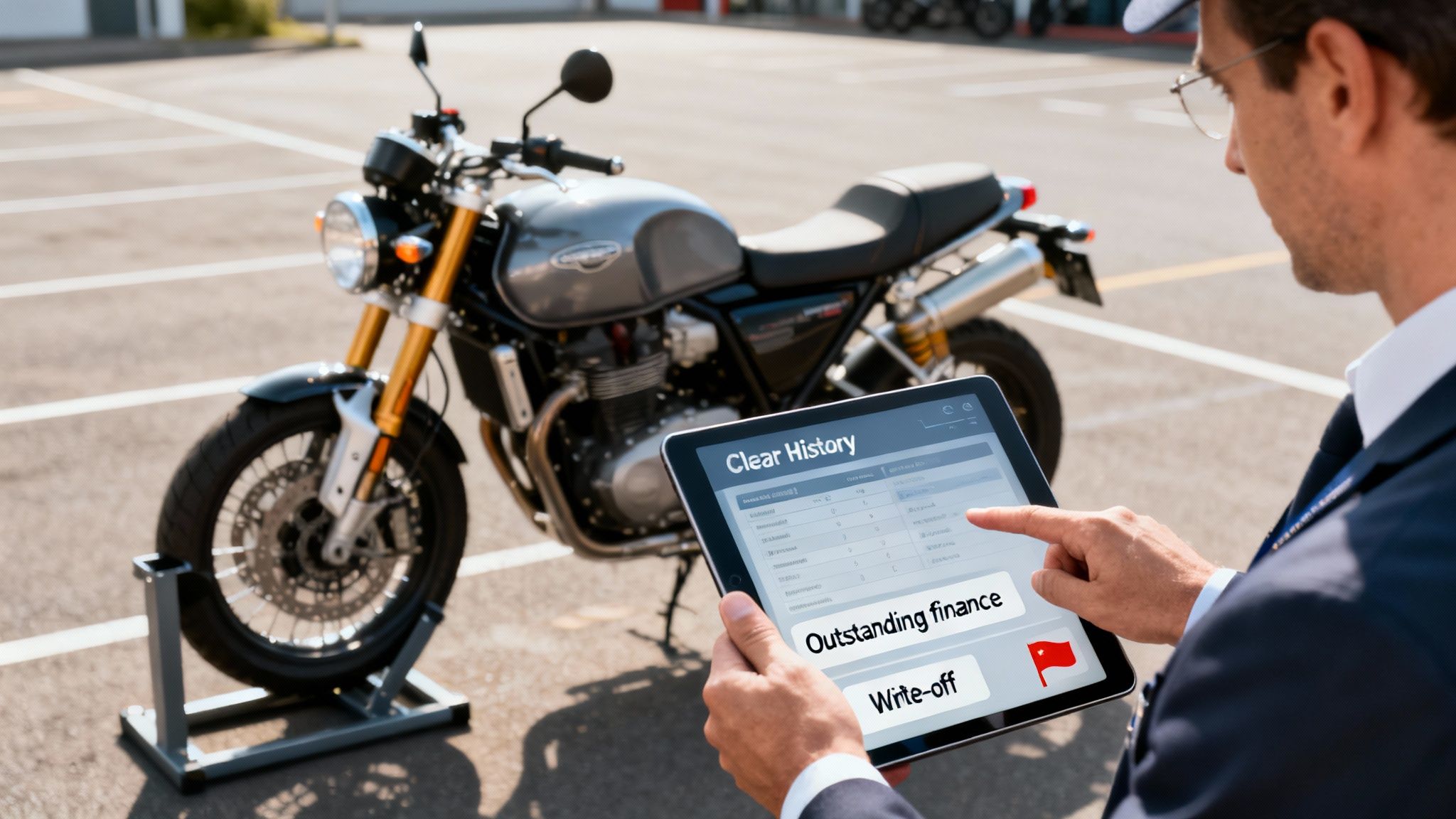
This goes far beyond just dodging a bad purchase. It’s about shielding your entire operation from the knock-on effects of one problematic machine.
Uncovering Hidden Financial Dangers
Picture this: you've just brought in a popular touring model that looks like a guaranteed quick flip. The V5C is present, the mileage seems about right, and the bike is clean. But a quick check with AutoProv reveals it has outstanding finance attached to a logbook loan. Just like that, you don't actually have a clear title. The bike is unsellable until that debt is cleared.
That single oversight immediately ties up your capital, stalls your stock turn, and can drag you into messy legal headaches. Without a proper check, you're buying blind and just hoping the seller is being honest.
A single bike with a hidden history can easily wipe out the profit from several good sales. It's a risk that's simply not worth taking when instant, detailed checks from AutoProv are at your fingertips.
This principle isn't exclusive to two wheels, of course. For more on this, you can see why a used car history report is essential for dealers, as many of the same dangers apply.
Protecting Your Dealership's Credibility
Your reputation is everything. It's the most valuable asset you own. Selling a bike with a chequered past, even if you do it unknowingly, can cause damage that’s hard to come back from. Imagine a customer finding out their new pride and joy was previously a Category S write-off—structurally damaged and repaired.
Not only does this lead to angry customers and potential legal battles, but it also shatters trust in your brand. Word travels fast in this industry, and a name for selling dodgy bikes is nearly impossible to shake. A thorough history check is your guarantee that every bike you sell is up to standard, protecting both your customers and your business.
A professional check from AutoProv brings the skeletons out of the closet. A few of the critical issues our service uncovers are:
- Undisclosed Write-Off History: Instantly see if a bike has been declared a total loss by an insurer (e.g., Cat S, Cat N), which massively impacts its value and safety.
- Mileage Discrepancies: Flag inconsistencies in the bike's recorded mileage history—a classic sign of clocking to inflate its price tag.
- Stolen Vehicle Markers: Run checks against the Police National Computer (PNC) to ensure you aren't about to buy stolen property.
- Number Plate Changes: Track any registration changes, which can be a red flag for someone trying to hide a vehicle's murky past.
Your First Line of Defence
This is exactly where a professional-grade tool like AutoProv becomes non-negotiable. Our platform is designed to be your first line of defence, going far beyond basic free checks to pull deep intelligence from over 10 trusted data sources. It's not just about flagging problems. It’s about giving you the complete, unvarnished picture you need to make smart, profitable, and secure buying decisions, every single time.
By delivering clear, actionable data in under 30 seconds, AutoProv turns due diligence from a chore into a powerful strategic advantage, safeguarding your business with every bike you consider.
Decoding What the Data in a Motorbike History Report Actually Means
Running a motorbike history check is the easy part. The real skill is in reading between the lines of the report to understand what the data is telling you. A professional report from a service like AutoProv is dense with information, and knowing how to interpret it is what separates a savvy buyer from one who gets caught out.
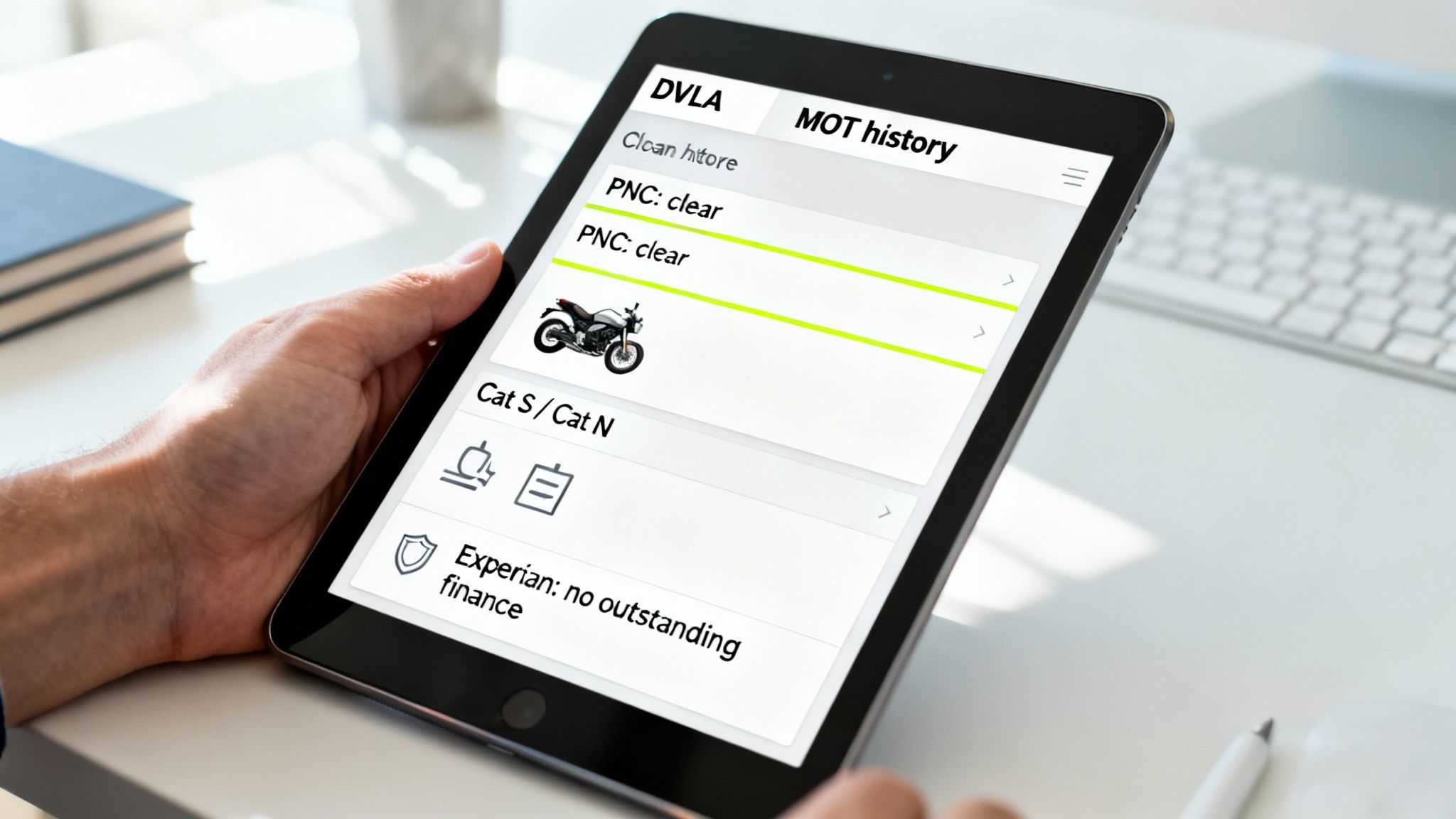
This isn't just about looking for a green tick or a red cross. It’s about piecing together the bike's entire life story from the details in front of you.
Scrutinising DVLA and MOT Records
Your first port of call should always be the official DVLA data. This is the bedrock of the bike's identity—its make, model, colour, and when it was first registered. If any of this doesn't match the V5C logbook you're holding, that’s an immediate red flag. Stop and investigate.
Next, get stuck into the full MOT history. Don't just check for a current certificate; that's the bare minimum. You're looking for the story behind the passes and fails.
A solid MOT history with only minor advisories that get fixed promptly is a great sign. It points to an owner who cares. On the flip side, big gaps in the MOT history can be a warning sign. It might mean the bike's been sitting unused, potentially leading to seized parts, perished seals, or hidden corrosion.
Keep an eye out for the same advisories popping up year after year, like worn tyres or thinning brake pads. This often signals a neglectful owner who only ever does just enough to scrape through the test, leaving you to pick up the bill for proper maintenance down the line.
Spotting the Critical High-Risk Markers
With the basics covered, it's time to hunt for the big-ticket problems—the kind that can make a bike worthless or illegal overnight. A comprehensive report from AutoProv will flag these clearly, so you can make a quick call.
- PNC Stolen Vehicle Marker: This is an absolute deal-breaker. A check against the Police National Computer (PNC) confirms if the bike is listed as stolen. You don't want to touch it. Handling stolen goods, even accidentally, comes with serious legal and financial pain.
- MIAFTR Condition Alerts: The Motor Insurance Anti-Fraud and Theft Register (MIAFTR) is where you'll find out if a bike has been written off by an insurer. This is non-negotiable information for getting the valuation right.
- Outstanding Finance: Using data from Experian, our service will tell you if there's an active finance agreement attached to the bike, like a hire purchase (HP) or PCP deal. If you buy a bike with outstanding finance, the finance company still owns it, not the seller. They can—and will—come to repossess it.
These markers are the core of a bike's provenance. While the VIN is a crucial identifier, it doesn't tell the whole story on its own. If you want to dig deeper into that, our guide to a vehicle check with a VIN number explains how that unique code fits into the bigger picture.
Understanding Write-Off Categories
Hearing the term "write-off" can set alarm bells ringing, but it’s crucial to know that not all write-offs are created equal. The insurance industry uses specific categories to classify damage, and understanding them is key to valuation.
An AutoProv report will tell you plainly if a bike has been written off and which category it falls into.
- Category S (Structurally Damaged): This is the serious one. It means the bike has taken a hit to its frame or chassis. It can be professionally repaired and put back on the road, but that structural integrity must be properly restored. These bikes come with higher risk and a much lower price tag.
- Category N (Non-Structurally Damaged): This category covers damage that doesn't affect the main frame. It could be smashed fairings, damaged electrics, or bent forks. It’s less severe than Cat S, but it still knocks the bike's value and needs to be repaired correctly.
AutoProv lays this information out clearly, so you can quickly grasp the situation. It helps you decide whether to walk away or start negotiating a price that properly reflects the bike's history and what it’ll cost to put right. By decoding every piece of data, you stop just buying a bike and start making smart, profitable investments.
Using Provenance Data to Navigate Market Volatility
The used motorbike market is never a quiet place. It’s a constantly shifting landscape where things like new government regulations can stir up serious turbulence overnight. For anyone in the motor trade, reading these waves is key to staying afloat, and a proper motorbike history check is the only reliable compass you’ve got.
Market volatility isn’t just about prices going up and down; it creates strange registration patterns that are perfect for hiding a bike's underlying problems. A classic example was the recent scramble to register Euro 5 stock before the tougher emissions standards kicked in. Suddenly, the market was flooded with late-registered, practically new machines.
On the face of it, these bikes look like absolute bargains. And that’s exactly where the danger lies.
The Euro 5 Registration Rush
This wave of pre-emptive registrations wasn't driven by genuine customer sales. It was all about dealers needing to clear old stock off their books, fast. That kind of pressure can lead to rushed processes and bikes being pushed through under less-than-ideal circumstances. The result? A market awash with low-mileage "deals" that might be hiding some serious skeletons in the closet.
We saw this play out in a big way right here in the UK. The run-up to the Euro 5+ standards triggered a massive spike in registrations. One month saw a 122.6% surge compared to the year before as dealers raced against the clock. You can see the full picture by looking into these British motorcycle market trends.
This is where a professional-grade check from AutoProv becomes your most valuable tool. Our service digs into data from over 10 sources, including the DVLA and Experian, to give you the full story in less than 30 seconds.
Turning Uncertainty into a Strategic Advantage
Without a comprehensive history, you're flying blind. A late-registered bike from that period could have been thrashed as a demonstrator, shuffled between dealerships, or even had a knock that was never officially recorded. The registration date tells you almost nothing; you need to know the story behind it.
A detailed provenance report cuts right through the noise. It lets you:
- Spot 'Fire Sale' Risks: Instantly flag bikes with hidden finance agreements, unaddressed manufacturer recalls, or patchy mileage records that suggest it's had a harder life than the registration date implies.
- Validate the Narrative: Does the bike’s history actually match what the seller is telling you? A solid report confirms the number of keepers, the dates of V5C changes, and other markers that paint a complete picture.
- Negotiate from a Position of Strength: When you have all the facts, you’re in control. You can challenge any oddities and make sure the price reflects the bike's real history, not just its age on paper.
In a choppy market, data is your anchor. It helps you dodge the hidden liabilities and focus on buying genuinely good stock, turning market uncertainty into a real competitive edge.
The fundamentals of checking a vehicle's background are the same whether it has two wheels or four. For a wider look at this, have a read of our ultimate guide to a car provenance report in the UK, which gets into similar risks and checks.
Seeing the Full Picture with Consolidated Data
The trouble with 'fire sale' stock is that the red flags are often scattered. A finance marker is with Experian, the MOT history is with the DVLA, and a write-off record is buried in the MIAFTR. Trying to stitch all that together yourself is slow, and it's easy to miss something crucial.
This is where AutoProv really shines. It pulls every critical data point into one simple, clear report. You’re not just looking for one problem; you're seeing the bike's entire lifecycle at a glance.
This allows you to know instantly whether that late-registered bike is a genuine find or a ticking time bomb that could blow up your inventory and your reputation. By understanding the real story behind every registration number, you stop seeing market turbulence as a threat and start seeing it as an opportunity.
Turning Raw Data Into Profitable Decisions
Getting the raw data from a motorbike history check is one thing. Knowing how to turn those facts and figures into smart, profitable decisions for your dealership is where the real skill comes in. This is the point where you move beyond just spotting red flags and start using that information to sharpen your negotiation strategy, nail your valuations, and manage risk across your entire stock.

It’s all about reading between the lines. For instance, a single, minor mileage discrepancy might just be an honest clerical error. But a consistent pattern of odd jumps and dips over several years? That’s a massive warning sign for potential clocking.
From Discrepancies to Negotiation Levers
Every piece of data on an AutoProv report can become a powerful tool when you're at the negotiating table. You're no longer working on gut instinct; you're operating with cold, hard evidence. This allows you to justify your offer with complete precision, turning what could be a tense back-and-forth into a straightforward, fact-based discussion.
Take the MOT history. A bike that has scraped through its last two tests with a list of advisories for chain wear, brake pads, and thinning tyre tread is a walking liability. You can point directly to this evidence and factor the immediate cost of parts and labour straight into your offer. This isn't about lowballing; it's about accurately pricing the bike based on its genuine condition and the work it needs right now.
Every data point tells a story about a bike's past and its future cost to you. Use these details to build a clear, evidence-based valuation that protects your margins from the moment of purchase.
Valuing the Impact of Write-Off History
Understanding the real-world commercial impact of a write-off category is absolutely crucial. A Category N (non-structural) write-off on a high-demand, quick-turnaround model like a Honda PCX125 has a totally different financial implication than the same category on a niche, classic bike. The PCX might still sell in a flash if priced right, but that classic could end up gathering dust due to buyer nerves.
An AutoProv report doesn’t just tell you a bike was written off; it gives you the context you need to value it intelligently. By combining this information with our real-time market insights, you can accurately judge its impact on both trade and retail prices.
Our data can help shape your strategy:
- A Cat N on a high-demand commuter: You know there's a market, but the price has to reflect its history. The report confirms the damage was only cosmetic, so you can confidently price it for a quick sale to savvy, budget-conscious buyers.
- A Cat S on a performance bike: This is a big deal – a major structural issue. Even with a top-notch repair, its desirability and value have taken a serious hit. The check gives you clear grounds to either walk away or make a significantly lower offer, acknowledging the tiny pool of potential buyers and the risk involved.
Leveraging Market Insights for Accurate Pricing
This is where integrating provenance data with live market intelligence becomes a genuine game-changer. An AutoProv report gives you the critical valuation data, showing the current trade vs. retail price range, depreciation curves, and even a model's market desirability score. For a deeper dive, our guide on how to use market insights for vehicle pricing lays out strategies that work just as well for bikes as they do for cars.
Imagine you're looking at a bike with a perfect history. The data check confirms it’s clean as a whistle, but the market insights reveal that this specific model is currently oversupplied in your area. That information gives you the power to negotiate a better trade price, because you know that even a pristine example is going to face tough competition on your forecourt.
On the flip side, the data might show a one-owner, low-mileage bike is part of a limited edition run. The market insights confirm it has high desirability and rock-solid residual values. Armed with this knowledge, you can confidently pay a premium, secure that you've just bought a highly profitable asset that will pull in serious buyers and command a top retail price. This strategic use of data turns every check into an opportunity to protect and maximise your profit.
Managing Risk Across High-Volume Acquisitions
For high-volume operations like franchised dealerships or remarketing firms, the sheer number of bikes you're turning over multiplies your risk exponentially. When you’re acquiring dozens of bikes a week, a single missed issue isn't just a possibility; it becomes a statistical certainty if you don't have a rock-solid system in place. Let's be honest, manually checking every single bike just isn't sustainable when speed is critical to protecting your margins.
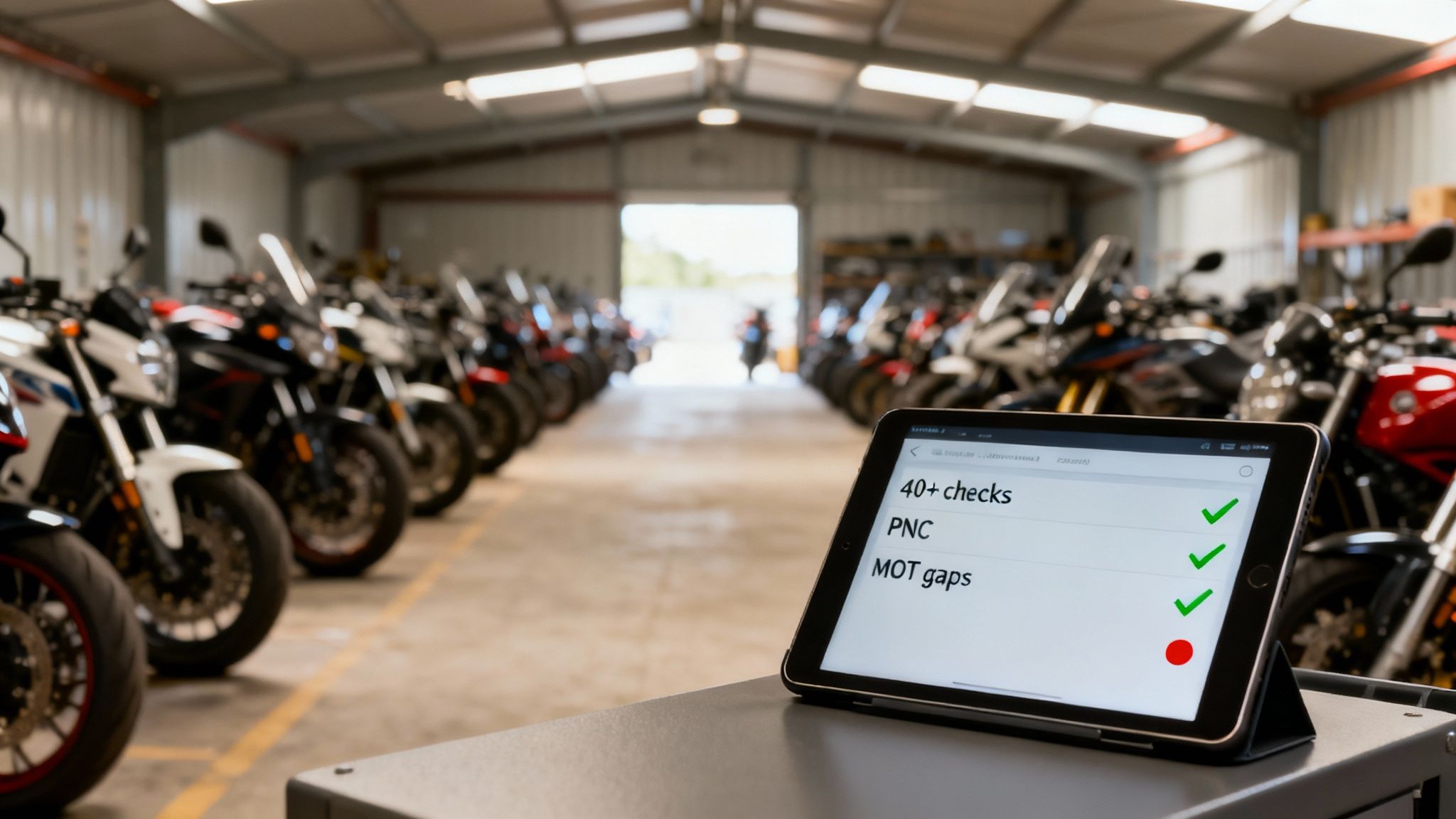
This is where scale becomes a double-edged sword. More volume means more profit potential, but it also means more exposure to costly mistakes. One bike with a PNC stolen marker or undisclosed finance can wipe out the profit from ten good sales.
The Problem with Manual Checks at Scale
Relying on individual, manual checks for each acquisition creates a dangerous bottleneck. It’s slow, it’s inconsistent, and frankly, it’s wide open to human error. One buyer might be meticulous, while another, under pressure to hit targets, might cut corners.
This approach is especially risky when you’re dealing with the high-turnover models that dominate the market. The UK used motorbike market sees around 500,000 transactions every year, a figure that dwarfs new sales. With Honda leading the charge, models like the PCX125 top both new registrations and used listings. For dealers trying to sift through this huge inventory, it's easy to miss crucial alerts like PNC stolen status, write-offs, or a history of taxi licensing—issues that are instantly flagged by a professional check. You can find in-depth rankings and analysis of UK bike sales to see just how prevalent these models are.
When you’re processing that many popular bikes, the law of averages will eventually catch up with you.
Built for Speed and Accuracy
This is precisely the challenge that professional platforms like AutoProv are designed to solve. When you need to process dozens of bikes daily, you need a tool that delivers comprehensive intelligence without slowing you down. AutoProv pulls together over 40 business-critical data points from more than 10 sources, giving you a single, clear report in under 30 seconds.
This speed isn't just about convenience; it's a fundamental part of managing risk. It means your buyers can make informed, confident decisions on the spot, whether they're at an auction, on a forecourt, or assessing a part-exchange.
For a high-volume business, efficiency is your protection. The ability to instantly verify a bike’s history prevents bad stock from ever entering your inventory and protects your margins from avoidable losses.
By centralising the check process with AutoProv, you also guarantee consistency. Every bike is scrutinised against the same high standards, eliminating the variables of manual due diligence. This level of rigour is vital for maintaining profitability and your reputation at scale. The principles are the same whether it's two wheels or four, as we detail in our practical guide to provenance checks for traders.
High-Turnover Models and Hidden Dangers
Let's take a look at two of the most popular bikes on UK roads: the Honda PCX125 and the Yamaha MT-07. Their popularity makes them prime targets for issues that can easily slip through the cracks of a less-than-thorough check.
- The Honda PCX125 Scenario: As a top-selling scooter, a huge number of PCX125s have a past life as courier or delivery vehicles. This means they've endured far more wear and tear than their mileage might suggest, with constant stop-start city riding. A standard check might miss this, but an AutoProv report can flag its previous use, giving you crucial context for your valuation.
- The Yamaha MT-07 Scenario: The MT-07 is a favourite for everyone from new riders to seasoned pros, making it a common sight in the used market. Unfortunately, its lively performance also means it's more likely to have been in an accident. A seller might try to pass off a poorly repaired Cat N write-off as a clean bike. A professional-grade motorbike history check from AutoProv instantly uncovers this, saving you from buying a compromised machine.
In both of these all-too-common scenarios, a fast, accurate, and deep data check is your only real defence. It turns the buying process from a risky gamble into a calculated business decision, allowing your operation to scale confidently without multiplying your exposure to hidden liabilities.
Got Questions About Motorbike Checks? We’ve Got Answers.
When you’re deep in the trade, buying and selling used bikes, you’re bound to have a few questions. Here are some of the most common ones we hear from professionals across the UK, with straight-to-the-point answers to help you lock in a good deal and steer clear of a bad one.
How Quickly Can I Get a Motorbike History Check?
Let's face it, time is money, especially when you're at an auction or have a potential part-exchange standing in front of you. You can't afford to wait.
With a professional-grade platform like AutoProv, you get the full picture – over 40 data points from the DVLA, Experian, and the Police National Computer (PNC) – in under 30 seconds. That’s fast enough to make a confident call on the spot, without ever letting a deal go cold.
Is a Free Check Good Enough?
It’s tempting, I get it. But relying on a free check is a false economy that could cost your business thousands. They just don't have access to the high-risk data that truly matters.
A free check will NOT tell you about:
- Outstanding Finance: The single biggest risk to getting a clean title.
- Write-Off Categories (Cat S/N): Absolutely essential for accurate valuation and knowing if a bike is even safe to be on the road.
- PNC Stolen Vehicle Markers: The ultimate red flag that free services simply can’t access.
For genuine financial protection and peace of mind, a comprehensive, professional check from a service like AutoProv is the only way to go.
Relying on a free check is like only checking one tyre before a long journey; it gives a false sense of security while ignoring potentially catastrophic issues just out of sight.
What If a Bike's History Is From Another Country?
Imports can be great finds, but they definitely add another layer of complexity. A standard UK motorbike history check will only show what’s happened since the bike was registered here, not its life story from before.
While a service like AutoProv gives you the complete UK history from the moment of registration, you absolutely need to push for documentation from its country of origin. Be extra vigilant with imports. Their past is often a black box, which makes a thorough UK check even more critical to confirm its status since it landed on our shores.
Frequently Asked Questions
AI-Generated Content Notice
This article was created with the assistance of artificial intelligence technology. While we strive for accuracy, the information provided should be considered for general informational purposes only and should not be relied upon as professional automotive, legal, or financial advice. We recommend verifying any information with qualified professionals or official sources before making important decisions. AutoProv accepts no liability for any consequences resulting from the use of this information.
From our AI insights
- Navigating UK Grey Imports: A Trader's Guide
Understand the complexities and opportunities of UK grey imports for savvy motor traders.
- Navigating Private Plate Challenges in UK Vehicle Checks
Learn how private plates affect UK vehicle checks and how traders verify provenance and spot cloning risks.
- Navigating VIN Checks Post-Brexit: What UK Traders Need to Know
Discover how Brexit impacts VIN checks for UK traders and the crucial data to review.
Related Articles

Essential Vehicle Checks Before Buying a Used Car
Learn essential checks to ensure your used car purchase is safe and sound in the UK market.

Why a Provenance Check is Essential for Used Car Buyers
Ensure your used car is a smart investment by understanding the importance of a provenance check and how AutoProv can help.

A Guide to Vehicle Check with VIN Number
A vehicle check with vin number is easily the most important thing you can do before buying a used car. Think of it as your first line of defence—a quick, simple step that pulls back the curtain on a vehicle's past, protecting you from expensive mistakes, legal headaches, and downright dangerous cars.
Published by AutoProv
Your trusted source for vehicle intelligence