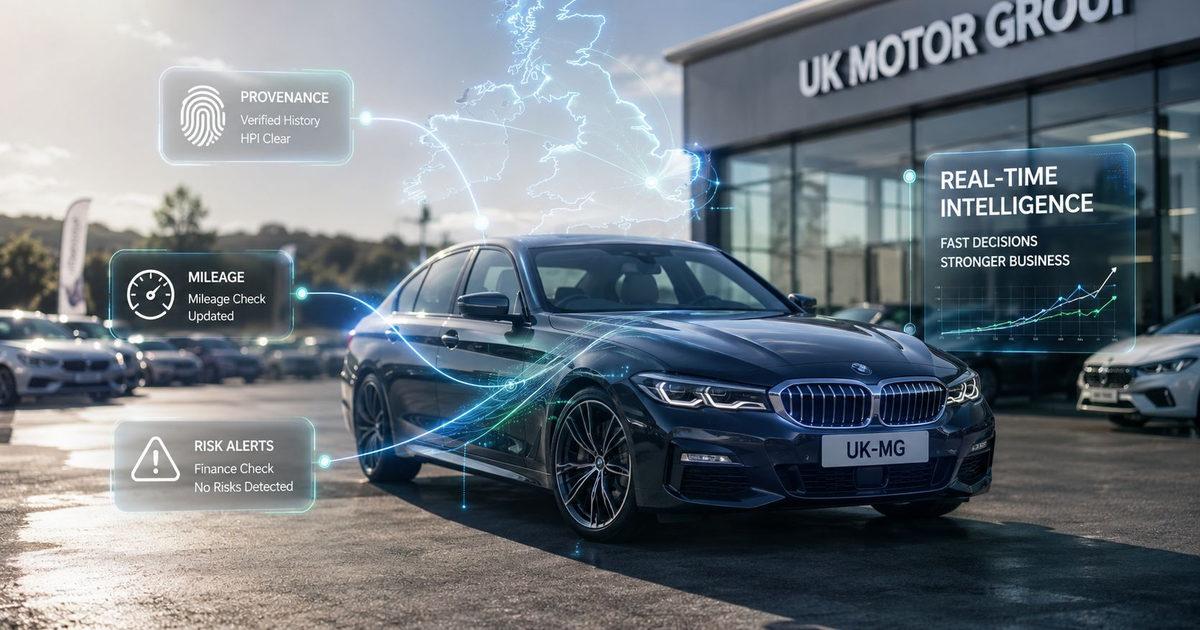
You're on the forecourt, the car looks clean, the dealer pack is tidy, and the margin still works if you can turn it quickly. Then a mileage anomaly, keeper change, or provenance gap lands after the paperwork has started, and the deal stops being a simple stock turn and starts becoming a problem you now own. That's where real time intelligence matters in the motor trade, not as an IT phrase, but as the difference between seeing a risk early enough to act and seeing it after the money has moved.
The UK motor trade has always lived on timing. The National Crime Agency, created in 2013, was built to coordinate and act on fast-moving intelligence across serious and organised crime, which is a useful precedent for dealers because vehicle-risk decisions also depend on reducing delay between detection and action. Real-time intelligence only has value when it changes a buying decision at pace, especially where fraud, cloning, short-term ownership, and cross-border movement can distort the picture before a retail buyer ever sees the car (techtarget.com definition of real-time business intelligence).
For dealers, that means looking beyond whether a vehicle history check UK product exists and asking when the data reaches you, how fresh the inputs are, and whether the output changes what you buy, reject, or renegotiate. A slow answer can still be accurate and still be too late. That difference is the whole story.
Table of Contents
- When Speed of Information Changes the Outcome
- Why the timing matters more than the dataset
- What Real Time Intelligence Actually Means in the Motor Trade
- Freshness first, speed second
- How to test the claim
- The Four Parts of a Real Time Vehicle Intelligence Workflow
- Ingestion, transformation, querying, action
- Trade-Specific Use Cases for Real Time Intelligence
- Provenance, mileage, and ownership patterns
- A worked ownership example
- Implementation Considerations for UK Dealers
- What to evaluate first
- Compliance and practical restraint
- Real Time Intelligence Versus Traditional Vehicle History Checks
- Where each approach helps
- KPIs and Metrics for Evaluating a Real Time Intelligence Solution
- What to measure
- Practical Next Steps for UK Motor Traders
When Speed of Information Changes the Outcome
A buyer at auction sees a car that looks right on the surface. The paint, the tyres, the pack, and the story all line up. The decision is made on the day, because that's how trade stock is won, and there's rarely time to sit on a vehicle while someone re-checks every detail.
Then the late signal arrives. A keeper pattern looks unusual, a mileage update doesn't sit comfortably with the timeline, or a new ownership event lands after the bid has closed. The car hasn't changed, but the risk picture has, and that delay has already cost the dealer the chance to walk away or pay differently.
Why the timing matters more than the dataset
A lot of buying mistakes don't happen because the data was missing. They happen because the data was late. That is the practical problem real time intelligence solves in a trade buying environment, and it's why point-in-time reports often fail at the point of decision.
If you want a useful broader view of digital change in the automotive sector, the practical guide for car dealers from carBoost is a sensible reference point. It helps frame why stock acquisition now depends on faster information movement, not just more information.
Practical rule: if the risk signal arrives after the deal is committed, it isn't decision support. It's post-mortem evidence.
This is also why auction buying rewards dealers who can interpret signals before the hammer falls. If you're refining your own process, our internal auction buying tips piece sits naturally alongside that mindset, because the best buying discipline is built around what you can verify at speed, not what you can explain later.
The operational point is simple. Vehicle provenance only protects margin when it is early enough to shape the bid, the trade-in allowance, or the decision to pass. A slower workflow can still be useful, but it can't do the same job as live decision support when stock is moving quickly.
What Real Time Intelligence Actually Means in the Motor Trade
The cleanest way to define real time intelligence is this, it's analysis that uses fresh data close to the moment an event occurs, not data that has already gone stale. In a motor trade setting, that freshness matters more than the label on the product. A fast answer over old data is still an old answer.
Freshness first, speed second
An auction analogy makes the difference obvious. If a bidder gets a response in minutes instead of seconds, the result can still be wrong for the deal, because the price has already moved. In vehicle buying, the same logic applies to keeper changes, mileage updates, or incident signals. The value lies in seeing them while they can still alter the purchasing decision.
One useful industry description says analytics may rely on data from the past few milliseconds, seconds, or minutes rather than history that has already aged, and it warns that a fast query over data older than 15 minutes is not really real-time intelligence because the freshness of the input is what matters (Complex Events).
For UK provenance workflows, that means the live or recently updated inputs are the point. DVLA, MOT history, ownership patterns, mileage progression, and related risk signals only help if they are joined early enough to influence the buying call. If a product is only faster at presenting yesterday's records, it's not the same thing.
How to test the claim
A trader can usually separate genuine live intelligence from dressed-up batch reporting by asking three blunt questions:
- How fresh are the inputs? If the data source is stale, the output will be too.
- What changes the decision? A report that doesn't affect bid, price, or pass/fail isn't operational intelligence.
- Where does delay enter the workflow? If the answer is “everywhere”, the tool is probably reporting, not intelligence.
For a practical vehicle-risk perspective, our internal what is anomaly detection article is useful because anomalies are often what real-time workflows are built to surface first, not after the stock is already retailed.
The point is not to demand instant everything. It's to recognise that in trade buying, freshness is the primary asset. Speed only matters because it protects freshness at the point where money changes hands.
The Four Parts of a Real Time Vehicle Intelligence Workflow
A real-time workflow isn't one thing, it's four moving parts working in sequence. If one part is slow or badly designed, the whole system becomes a near-real-time report with a better marketing label. Dealers don't need enterprise jargon, they need to know where the delay lives.
Ingestion, transformation, querying, action
The first part is ingestion, where live or recently updated records enter the workflow from authoritative sources. In a provenance context, that might include a mileage update, an ownership change, or a new event that changes the risk picture. Microsoft Fabric describes Real-Time Intelligence as handling ingestion, transformation, storage, modelling, analytics, visualisation, AI, and trigger-based actions for data in motion, which is a useful technical model even if you never see the layers yourself (Microsoft Fabric overview).
The second part is transformation, where records get linked. One mileage record on its own means very little. Link it to a keeper timeline, MOT history, and other provenance signals, and the picture starts to sharpen. Trade vehicle intelligence adds value here, because it doesn't just show you raw data, it helps you see the relationship between events.
The third part is querying, which is where the dealer asks, “Does this look normal?” A system built for this job should be able to surface patterns fast enough for an auction desk, acquisition team, or buying manager to use them while the opportunity is still live. The practical guide for Fabric RTI notes end-to-end latency is typically 2 to 30 seconds, Eventstream-to-KQL Database ingestion is usually under 5 seconds, and KQL queries return in milliseconds to low seconds for most operational queries (Power BI Consulting guide). That's near-real-time, which is usually enough for vehicle risk decisions.
The fourth part is triggered action. Microsoft says Fabric Real-Time Intelligence can alert a production manager when equipment is overheating or rerun jobs when pipelines fail, which shows the general pattern, streaming data in, insight out, action triggered (Microsoft Fabric video).
A good workflow doesn't just tell you what happened. It tells the buyer what to do before the next buyer takes the car.
The dealer takeaway is straightforward. Ask where the workflow ingests, where it links, where it queries, and where it alerts. That tells you whether the platform is built to reduce delay or merely display it more neatly.
Our internal how it works page fits naturally here for anyone scoping a provider against those four stages.
Trade-Specific Use Cases for Real Time Intelligence
A dealership doesn't need real-time intelligence for abstract curiosity. It needs it where money, reputation, and retail friction are exposed. The best use cases are the ones that change the buy, not the ones that just make the report look modern.
Provenance, mileage, and ownership patterns
Vehicle provenance tracing is the most obvious one. A trader wants to know whether the car's background reads like ordinary retail stock or like something that's been moving through unusual hands. If a live or recently updated signal changes the story before purchase, the buying desk can reprice, renegotiate, or pass.
Mileage discrepancy detection works the same way. A mileage check UK process is only useful if it catches the mismatch early enough to affect the deal. A delayed flag might still help after the fact, but it won't protect the margin you've already committed.
Short-term ownership and rapid resale screening is where real-time ownership analysis becomes especially useful. Three keepers in eighteen months doesn't automatically kill a deal, but it changes the conversation. It can mean fleet cycling, retail churn, or a vehicle that's been passed around because something about it has been hard to hold.
A worked ownership example
Suppose a car shows three keepers in eighteen months. A basic check may just log the keeper count and move on. A live or near-live provenance workflow asks different questions, such as whether the ownership changes cluster tightly, whether the mileage progression is coherent, and whether the timing suggests repeated resale rather than normal use.
That context matters because the risk isn't the number alone. The risk is the pattern around the number. A dealer looking at stock in real time can use that pattern to decide whether the car belongs in the front line, whether it should be priced conservatively, or whether it's better left alone.
Here's how the main trade use cases usually break down:
- Provenance tracing: Signal matters, unusual ownership flow or record gaps. Dealer decision, deeper investigation or walk-away.
- Mileage checks: Signal matters, inconsistency between recorded mileage points. Dealer decision, reprice or reject.
- Rapid resale screening: Signal matters, short holds across multiple ownership events. Dealer decision, treat as heightened risk.
- Point-of-purchase risk scoring: Signal matters, multiple weak signals appearing together. Dealer decision, adjust bid immediately.
- Fraud pattern recognition: Signal matters, combinations that don't fit normal retail history. Dealer decision, escalate before money leaves the desk.
If you want a practical example of how dealer-facing vehicle intelligence is framed, our internal AutoProv versus traditional provenance checks article sits directly in this territory, because the difference is usually in context, not in the headline data.
For trade buyers, the gain is not knowing more for its own sake. It's knowing sooner, with enough context to act before the vehicle becomes your problem.
Implementation Considerations for UK Dealers
Adopting real-time intelligence is mostly a workflow decision, not a technology vanity project. The first question is always the same, what sources do you trust, and how quickly can the system join them together without making the buying desk wait.
What to evaluate first
A practical UK dealer should start with the inputs that shape provenance and value, such as DVLA records, MOT history, mileage patterns, and insurance-related signals where they're available within the chosen workflow. The point isn't to collect more data for its own sake. It's to reduce uncertainty at the moment of purchase.
The second question is latency. The trade doesn't need sub-millisecond processing to make a good stock decision. It needs near-real-time performance that is fast enough to influence the bid, the trade-in allowance, or the pass decision before commitment. That's why the seconds-to-low-minutes benchmark discussed earlier is usually sufficient for dealer risk work.
The third question is integration. If the intelligence can't sit inside the buying process, it becomes another tab the team forgets to open. That's why buying desks, auction workflows, and trade portals matter. For some dealers, integration with a DMS or stock management layer is what turns a useful report into a repeatable control. Our internal dealer management system integration article is a useful reference for thinking about that operational fit.
Compliance and practical restraint
UK dealers also need to think about privacy and governance. Vehicle and ownership data should be handled in a way that matches the operational purpose, which is risk control and sourcing discipline, not curiosity. Keep access tight, document who sees what, and make sure the team understands why the alert exists.
Dealer rule: if the system can't be explained to the buyer who uses it, it won't survive contact with the forecourt.
If you're evaluating a provider, compare how they handle freshness, integration, and traceability. A black box that just returns a polished score is less useful than a system that shows what changed and when it changed.
Real Time Intelligence Versus Traditional Vehicle History Checks
Traditional checks still have a place. They remain useful as a baseline, because no dealer should buy blind. The issue is not that they are wrong, it's that they are often a point-in-time snapshot in a market where the relevant signals can move quickly.
Dimension Traditional Vehicle History Check Real Time Intelligence Data freshness Point-in-time snapshot Uses fresh or recently updated inputs Risk view Mostly record-based Record-based plus contextual risk signals Ownership analysis Often static and descriptive Looks for timing, pattern, and rapid change Decision support Confirms history Helps decide whether to buy, reprice, or pass Buying speed Good for basic screening Better for point-of-decision action
Where each approach helps
A conventional used car history report is still valuable when you need a quick baseline and a familiar control. It can confirm that a vehicle has a traceable record and help a team avoid obvious mistakes. But if the car has changed hands quickly, if mileage signals don't line up neatly, or if the buying desk is dealing with a live opportunity, a static check can only tell part of the story.
That's where real time intelligence earns its place. It adds context, and context is what turns raw history into a buying decision. If the system can show that the risk profile has shifted recently, the dealer can respond before stock is acquired on the wrong terms.
For a wider perspective on importing and checking vehicle history records, the 2026 import guide from DreamBid is a practical reminder that provenance always depends on the quality and timing of the underlying records, not just the brand of the report.
The trade difference is simple. Traditional checks tell you what the file says. Real-time intelligence tells you what the file means right now for this specific car, this specific price, and this specific buying decision.
KPIs and Metrics for Evaluating a Real Time Intelligence Solution
A dealer trial should be measured like a buying process, not like an IT rollout. If the numbers don't connect to acquisition decisions, the platform is noise. Keep the evaluation tight and practical.
What to measure
Start with time from event to alert. If a keeper change, mileage update, or other relevant event takes too long to surface, the workflow isn't protecting live buying decisions. Measure it by timestamping the event and the alert, then compare what your team received.
Track the proportion of stock screened before purchase. A solution that only gets used after the deal is weak in operational terms. The goal is to get the check into the acquisition path, not the handover path.
Monitor post-sale dispute rates and the number of cases where an earlier alert would have changed the decision. That gives you a concrete read on whether the tool is catching issues early enough to matter commercially.
Finally, look at margin protected on flagged vehicles. You don't need to overcomplicate this. Compare the bid or purchase price before and after the alert, then record whether the dealer adjusted, passed, or retained margin through better negotiation.
For teams refining process design, the how to optimize workflows guide from Matil is a useful reference because the same principle applies here, if the check is awkward, it won't get used consistently.
A good trial shows you two things, whether the data is fresh, and whether the team changes behaviour because of it. If the provider can't show both, it's probably giving you speed without decision value.
Practical Next Steps for UK Motor Traders
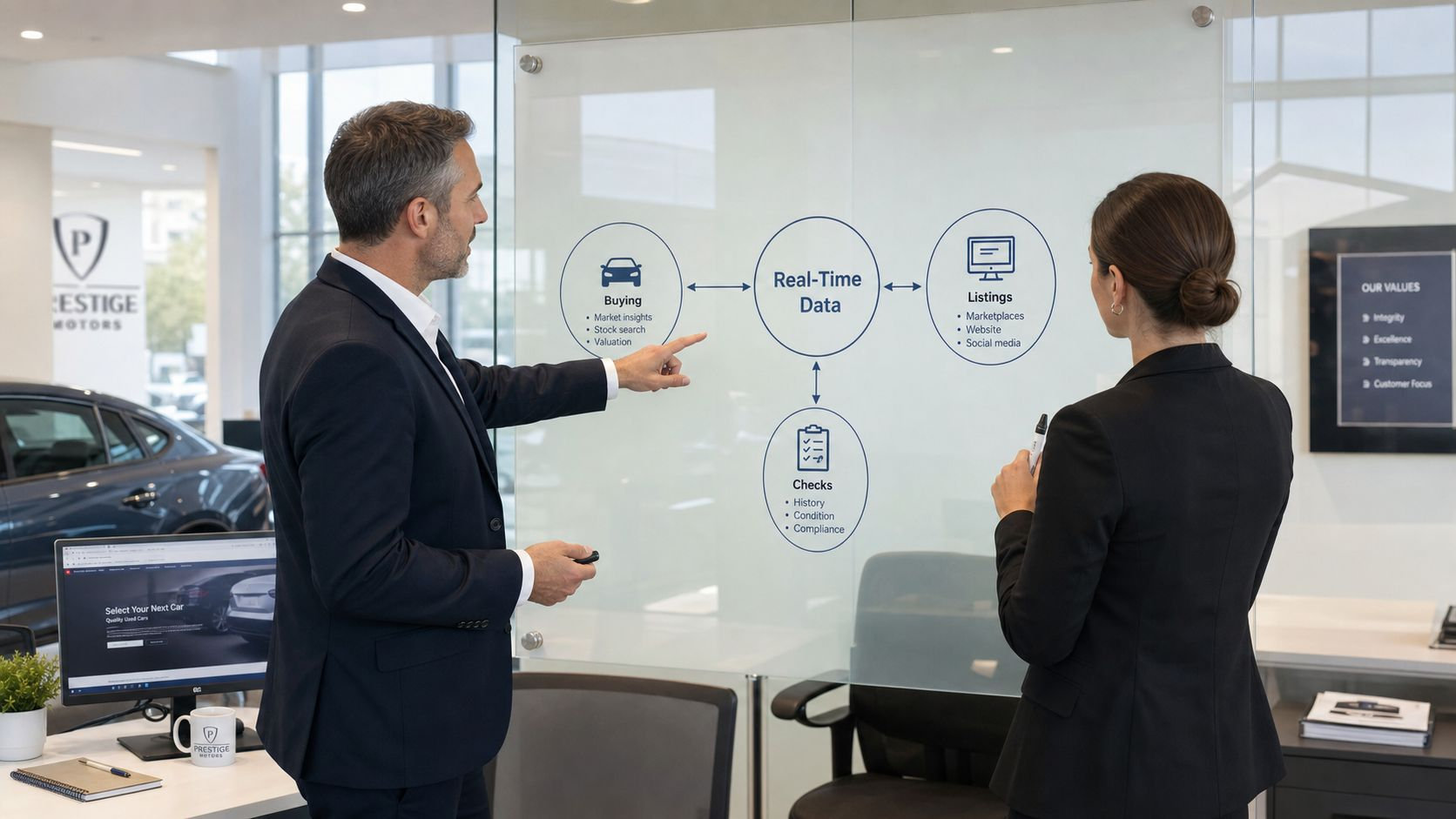
Start by mapping where your buying process loses time, especially between auction appraisal, trade-in valuation, and final approval. Then shortlist providers that can prove freshness of inputs, not just query speed. Run a controlled trial on a slice of stock where provenance risk is highest, and judge the result by whether the team changed bids, passed cars earlier, or reduced avoidable disputes.
AutoProv approaches this as vehicle intelligence for the UK motor trade, with provenance and risk signals designed to support buying decisions rather than replace them. The objective is simple: shrink the gap between a risk becoming visible and a trader being able to act on it.
If you want to tighten your buying process around fresher provenance signals, visit AutoProv and review how its vehicle history and risk intelligence can support your stock acquisition decisions. It's built for dealers who need better context before they commit capital, not after the paperwork has already gone through.
Frequently Asked Questions
AI-Generated Content Notice
This article was created with the assistance of artificial intelligence technology. While we strive for accuracy, the information provided should be considered for general informational purposes only and should not be relied upon as professional automotive, legal, or financial advice. We recommend verifying any information with qualified professionals or official sources before making important decisions. AutoProv accepts no liability for any consequences resulting from the use of this information.
From our AI insights
- Advanced Mileage Verification for UK Dealers
Explore innovative mileage verification tactics for UK car dealers to mitigate risks and enhance negotiations.
- Harnessing Real-Time Data in UK Motor Trading
Explore how real-time data aids UK traders in identifying vehicle risks swiftly.
- Predictive Insights: Using DVLA Data for Stock Risk Analysis
Explore how DVLA data transforms into predictive insights for UK car dealers managing stock risk.
Related Articles

Navigating the UK Used Car Market
Explore the latest trends in the UK used car market and how AutoProv can reveal true vehicle values.
Understanding Market Insights for Vehicle Pricing
Learn how market insights can guide UK traders in setting the right vehicle prices.

7 Best Second Hand Cars to Buy UK: A 2025 Guide
The search for the best second hand cars to buy in the UK can feel like navigating a maze of private listings, vast online showrooms, and conflicting advice. With prices fluctuating and new models constantly entering the used market, how do you identify a reliable, fairly-priced vehicle that truly suits your needs? This guide is designed to cut through the noise and provide clear, actionable insights for your next purchase.
Published by AutoProv
Your trusted source for vehicle intelligence