
Beyond the hammer, the work starts before the bidding. UK motor traders use auctions because they move stock quickly, open up buying opportunities, and create margin where others hesitate. They also compress decision time, hide weak provenance behind fast catalogue turnover, and punish anyone who treats a listing as a substitute for due diligence.
That pressure is familiar. You shortlist a handful of cars, scan the photos, check the guide prices, and start doing the maths on retail potential. Then the doubts creep in. Is the mileage stack clean. Has it changed hands too often. Is there finance exposure, a category issue, or a service record gap that turns a cheap buy into a slow loss.
Good auction buying tips don't start with bidding tactics. They start with risk control. In practice, the traders who stay disciplined usually aren't the ones winning every lot. They're the ones avoiding the bad metal, pricing uncertainty correctly, and only pushing hard when the vehicle provenance supports the margin.
This guide takes that risk-first view. It sets out 10 trade-focused auction buying tips that go beyond paddle discipline and hammer-price psychology. The focus is vehicle history check UK workflows, ownership analysis, mileage check UK discipline, and trade vehicle intelligence that helps you decide whether a car deserves your capital at all. That's where provenance turns from background admin into a buying edge.
Table of Contents
- 1. Conduct Pre-Auction Vehicle History Analysis Before Bidding
- Build the file before the sale
- 2. Identify Mileage Discrepancies and Odometer Irregularities
- Read mileage as a pattern, not a number
- 3. Analyse Ownership Patterns and Short-Term Resale Red Flags
- When rapid turnover changes the valuation
- 4. Verify Vehicle Title Status and Ownership Documentation
- Documentation problems don't stay small
- 5. Cross-Reference Insurance History and Loss Records
- Condition must match the record
- 6. Assess Service History Gaps and Maintenance Pattern Anomalies
- No record is still a signal
- 7. Investigate Vehicle Type Changes and Category Shifts
- Classification affects resale, compliance, and buyer trust
- 8. Establish Baseline Risk Profiles by Vehicle Make, Model, and Age Cohort
- Build your own model memory
- 9. Use Advanced Risk Scoring to Prioritise Due Diligence Effort
- Score first, inspect deeper where it matters
- 10. Document Decision Rationale and Maintain Audit Trail for Compliance and Learning
- Write down why you bought it
- 10-Point Pre-Auction Vehicle Due-Diligence Comparison
- From Reactive Bidding to Proactive Intelligence
1. Conduct Pre-Auction Vehicle History Analysis Before Bidding
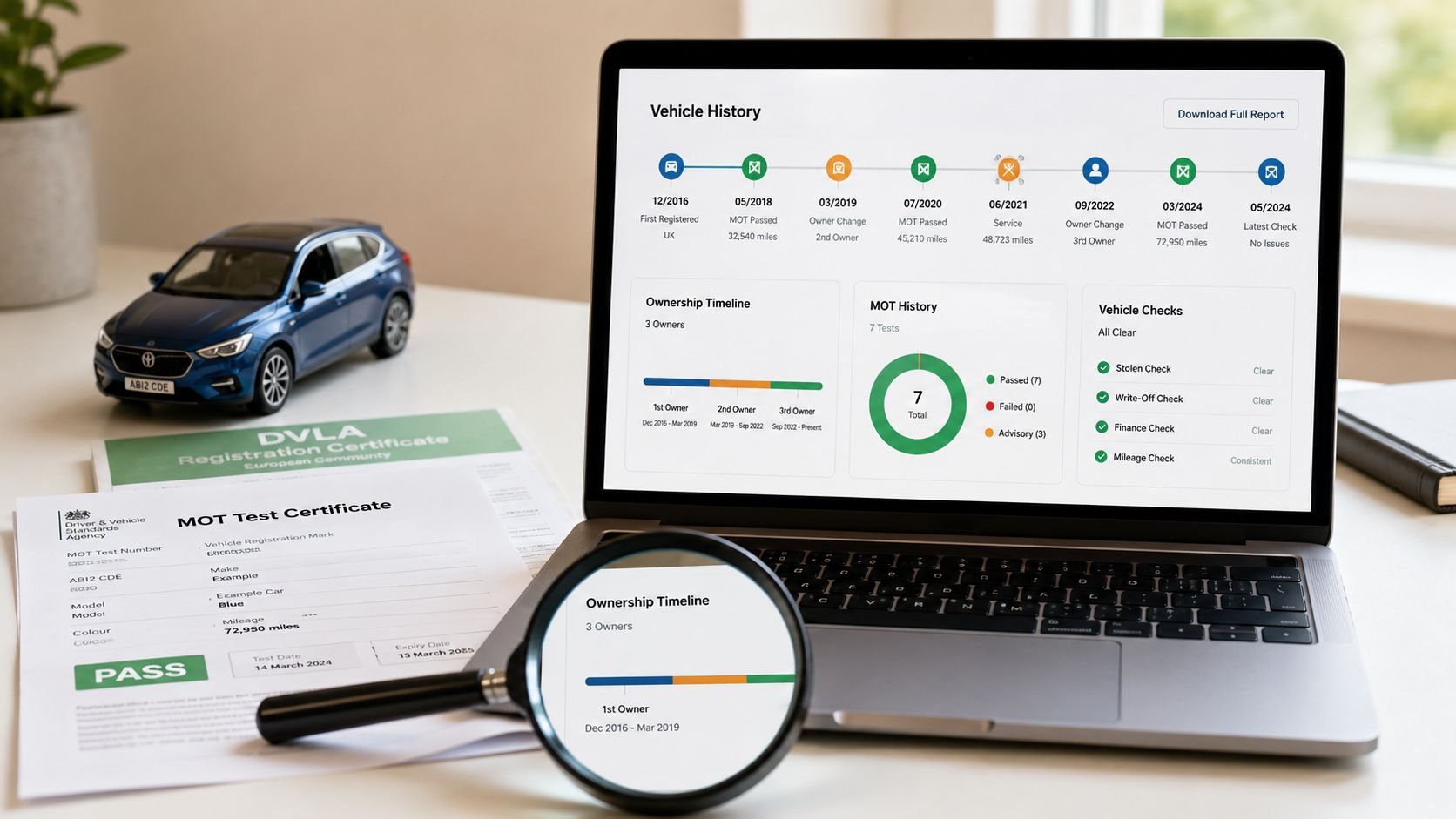
Most auction losses are baked in before the first bid lands. If you're relying on catalogue photos, a quick MOT glance, and instinct, you're buying blind. A proper used car history report should be built before sale day so you already know which cars deserve your attention and which ones only look cheap.
Start with the shortlist, not the full catalogue. UK auctions often list between 50 and 350 lots, which gives you time to observe behaviour and hold back rather than rushing in early. In the UK auction market, auctioneers may cut the advertised price by about 30% when opening bids don't appear, so your edge comes from knowing the true floor before the room reacts.
Build the file before the sale
A pre-auction review should combine MOT history, DVLA details, ownership sequence, mileage progression, and any visible gaps that need an explanation. A deeper auction due diligence workflow for dealers aids in this, by turning scattered records into a point-of-decision view.
Practical rule: If the file raises a question you can't answer before the sale, bid as if the worst reasonable explanation is true.
That changes behaviour fast. A hatchback with repeated fail and retest patterns may still be viable stock, but only if your bid reflects the likely prep. A premium saloon with fast keeper turnover and patchy servicing may look attractive in-lane and still be the wrong car for your forecourt.
Use a simple buying log as you review:
- Record the risk: Note the issue clearly, such as mileage inconsistency, rapid keeper changes, or missing service support.
- Set the effect on value: Decide whether the risk lowers your cap, increases your prep reserve, or rules the car out entirely.
- Keep the rationale: When the car comes back into your discussions later, your team won't have to start again from memory.
2. Identify Mileage Discrepancies and Odometer Irregularities
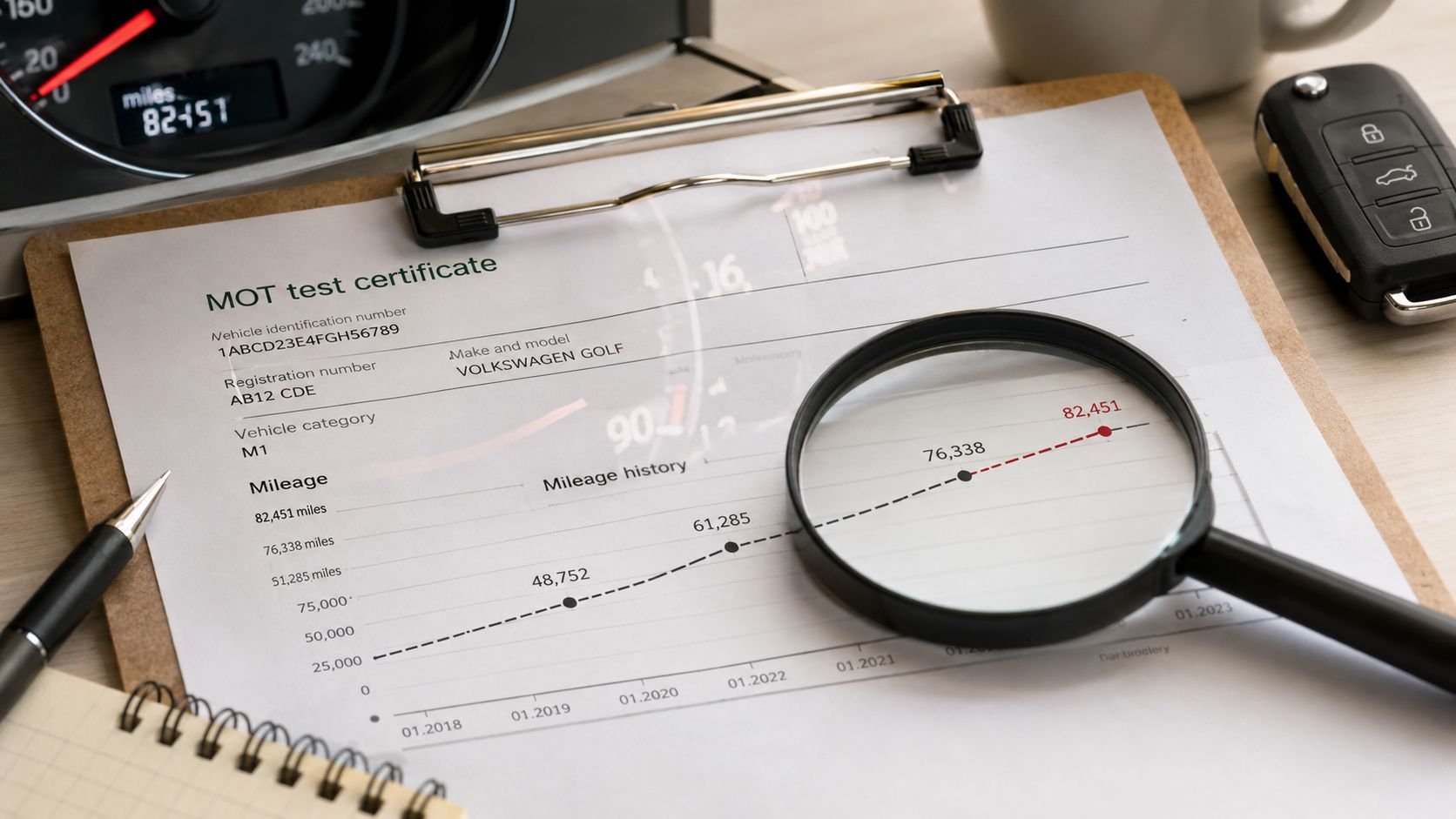
Mileage fraud still catches experienced buyers because the number itself can look plausible. The problem usually sits in the pattern behind it. One reading out of sequence, one unexplained drop, or one service entry that doesn't line up with MOT timing is enough to turn a straightforward buy into a disclosure problem.
Trade buyers already know customers ask harder questions about mileage than they used to. That caution is justified. 78% of UK used car buyers report concern over mileage fraud, and 1 in 5 vehicles sold have undisclosed issues. In an auction setting, where inspection windows are short, that makes a disciplined mileage check UK process absolutely essential.
Read mileage as a pattern, not a number
Look at progression across MOT entries, service visits, and keeper periods. A van doing low mileage one year and then a sharp spike the next might be explainable. A late-model Mercedes showing a reduced reading year on year usually isn't. The point isn't to prove fraud in-lane. The point is to price uncertainty correctly, or walk away.
A stronger guide to spotting clocked mileage before purchase can help structure that review.
Use a quick triage method:
- Check the direction: Mileage should progress logically. Any drop needs explanation.
- Check the tempo: The annual pattern should broadly fit the vehicle type and use case.
- Check the support: Service entries should reinforce the mileage story, not contradict it.
A clean latest MOT doesn't clear a dirty mileage history.
A common trade mistake is treating a single recent reading as proof. It isn't. Mileage only becomes useful when the full chronology holds together.
3. Analyse Ownership Patterns and Short-Term Resale Red Flags
Fast turnover often tells you more than a polished appraisal sheet. A vehicle that changes hands repeatedly in a short period can still be legitimate stock, but it deserves heavier scrutiny because traders and private keepers usually don't move good, trouble-free cars along that quickly without a reason.
Basic dealer vehicle checks often stop too early, as free UK vehicle history checks don't show the number of previous keepers or how long each ownership lasted, and they also don't confirm if a vehicle has been declared scrap by the DVLA or verify the VIN or chassis number needed to spot clones, as outlined in AutoProv's breakdown of free car history check limitations.
When rapid turnover changes the valuation
Ownership sequence gives context to everything else. Three keepers over many years may be ordinary. Several keepers inside a compressed period, especially across trade and private hands, can indicate a car that keeps being moved on instead of properly resolved.
Look for combinations rather than isolated signals:
- Multiple short holds: Brief ownership periods can suggest repeated disposal after problems emerge.
- Trade-to-private churn: Rapid movement between traders and retail buyers can obscure the actual history of complaints or defects.
- Timing against repairs: If ownership changes cluster around MOT failures, repair work, or sale preparation, the pattern matters.
A 2019 Audi A4 with six keepers in two years would concern most experienced buyers even if the paint and trim present well. A BMW that repeatedly appears to move from dealer acquisition to private resale within weeks deserves the same caution. Those patterns don't prove misconduct, but they do alter your motor trade risk assessment and your bid ceiling.
4. Verify Vehicle Title Status and Ownership Documentation
Documentation problems don't become easier after the hammer falls. They become yours. That's why title status, keeper identity, and transferability need checking before you commit, not when the invoice lands.
In the current market, title and finance risk is far from theoretical. In 2023, £2.2 billion in unpaid vehicle finance remained attached to around 400,000 cars in UK private sales, while finance anomalies rose by 45% in 2022 and were flagged in 8.5% of trade-ins inspected in 2024. If your acquisition process only checks the obvious, you're exposed.
Documentation problems don't stay small
At preview, ask to see the V5C where possible, confirm the registration details, and note whether anything in the paperwork doesn't align with the vehicle description. If the registered keeper, selling party, and auction representation don't fit together, treat that as a live issue.
A practical guide to understanding the UK car logbook is useful here because it sharpens what you're looking for.
The cheapest car in the hall becomes expensive the moment you can't transfer it cleanly.
Two scenarios come up regularly in trade discussions. One is the car carrying undeclared finance exposure. The other is a title complication that delays or disrupts transfer. Neither problem improves because the hammer price looked attractive. If anything feels unclear, you either need an answer before bidding or a lower cap that reflects the administrative and reputational risk.
5. Cross-Reference Insurance History and Loss Records
Insurance history only helps if you compare it with what is physically in front of you. Too many buyers tick the box mentally once they hear "repaired" or "no structural issue noted". That isn't analysis. It's assumption.
A good vehicle provenance process looks at declared losses, theft events, collision records, and visible repair quality together. If a quarter panel repair is rough, panel gaps don't sit right, and the claim history suggests a more serious impact than the seller's description, your valuation needs to move.
Condition must match the record
That doesn't mean every loss-related car is untouchable. Some repaired vehicles can still make sense in trade stock if the repair quality, disclosure path, and residual pricing all align. The key is that the record and the metal must tell the same story.
Use insurance history in three ways:
- Validate the condition: Check whether the visible repair standard matches the severity implied by the record.
- Adjust retail expectations: A vehicle with notable prior loss history may need a different route to market and a different margin expectation.
- Protect disclosure discipline: The more complex the history, the more important your internal notes become before resale.
A three-year-old car with multiple claim events may still sell. It just shouldn't be valued like a straightforward one-owner example with clean provenance.
6. Assess Service History Gaps and Maintenance Pattern Anomalies
Service history isn't just about proving maintenance. It's about spotting what isn't there. Gaps, repeated work on the same system, and long silent periods all shape prep forecasting, warranty reserves, and buyer confidence.
The trade issue now is inconsistency in digital coverage. Across a sample of 893 UK vehicles, 362 returned zero manufacturer digital service records, which is 40.5% of the sample. The same research found major brand variation, from 8% without records for BMW to 73% for Ford. That means "no digital history found" doesn't always mean neglect, but it always means you need context.
No record is still a signal
When a car has no digital support, your next job is to test the rest of the maintenance story. Check paper records, MOT advisories, workshop invoices, and signs of repeat repair. A 60,000-mile vehicle with no servicing shown between 20,000 and 55,000 miles deserves a very different reserve than one with consistent supporting paperwork.
For a useful trade lens, review digital service history versus paper logbooks for dealers.
A service review should answer three questions:
- Is the gap explainable: Missing records are less concerning when other supporting documents exist.
- Is the work repetitive: Repeated gearbox, DPF, cooling, or electrical attention can point to unresolved weakness.
- Is the future cost visible: If the history suggests deferred maintenance, price the upcoming work before you bid.
Service history isn't binary. Strong, weak, partial, and unsupported records each change what the car is worth.
7. Investigate Vehicle Type Changes and Category Shifts
Classification changes often get overlooked at auction because they don't always affect the way a car looks in the lane. They do affect resale confidence, insurer appetite, buyer questions, and how carefully you need to evidence the car's background.
Start with the obvious. If a vehicle has moved between commercial and private use, or if the recorded category history doesn't sit cleanly with the current presentation, check why. The same applies to salvage markers, conversion work, and any change that alters how the vehicle should be valued or described.
Classification affects resale, compliance, and buyer trust
Category shifts quickly move beyond administrative details to become commercial considerations. A van re-registered for private use without clear supporting documentation isn't just a paperwork curiosity. It can complicate your route to market. A vehicle with a prior salvage designation that later appears as standard stock needs supporting evidence that satisfies your own buying standards.
Look for supporting material such as repair invoices, conversion documentation, engineer inspection where relevant, and consistent identifiers across records. If the documentation is thin, lower the bid or leave it.
A common scenario is the vehicle that has clearly had a past life different from the one shown in the catalogue. The trim condition, load wear, fixture marks, or registration history may all point in that direction. Your used car history report should help you join those clues up before you commit.
8. Establish Baseline Risk Profiles by Vehicle Make, Model, and Age Cohort
Auction speed rewards pattern recognition. The more often you buy the same types of stock, the more you should know what "normal" looks like for each one. Without that baseline, every anomaly feels subjective and every bid depends too heavily on instinct.
A baseline profile is simple in concept. For each make, model, engine, and age band you buy regularly, build your own view of ordinary ownership duration, expected mileage range, common prep items, typical service support, and usual buyer objections at retail. Then use that as the benchmark when something deviates.
Build your own model memory
This works especially well in repeat segments. A BMW 3 Series and a Ford Transit Custom don't carry the same ownership behaviour, service pattern, or risk profile. If you buy both with the same lens, you'll either overreact to normal van wear or underreact to premium-car inconsistencies.
Good baseline notes usually include:
- Ownership norms: What keeper pattern is ordinary for that segment.
- Mileage context: What annual use looks plausible for that model and age.
- Known weak points: The faults, advisories, and prep items you repeatedly see.
- Retail sensitivity: The issues your buyers tolerate, and the ones that slow stock down.
This is one of the most practical auction buying tips for experienced operators because it shortens decision time without lowering standards. It also strengthens trade vehicle intelligence over time. Each appraisal makes the next one better.
9. Use Advanced Risk Scoring to Prioritise Due Diligence Effort
Not every lot deserves the same amount of time. If your team investigates every vehicle at the same depth, you waste effort on straightforward stock and still miss the awkward ones because the process becomes too slow to sustain.
A scoring model fixes that. Give each vehicle a structured rating based on the risk areas that matter to your business: provenance, mileage consistency, ownership pattern, title clarity, service support, condition fit, and route-to-market confidence. Then decide which scores trigger a deeper review.
Score first, inspect deeper where it matters
The commercial case for this is strong. 34% of UK auction buyers lose their deposit because they underestimate total costs, and only 12% of auction-tip articles break down the full acquisition cost stack for trade purchasers. On top of that, physical auction buyers must work backwards from retail value and include the buyer's premium, which is typically 5% in UK physical car auctions, alongside VAT where applicable, transport, MOT, road tax, and repair buffer.
A structured score helps because it connects risk to cost discipline.
- Low-score stock: Standard checks, fast bid decision, minimal escalation.
- Mid-score stock: Additional provenance review and tighter cap setting.
- High-score stock: Full history scrutiny, stronger prep assumptions, or no bid.
If you're building a more formal acquisition process, inventory risk management for the UK motor trade is the right frame. Teams also use external data collection tools such as Agenty's AI scraping platform to organise catalogue inputs and research workflows, but the value still comes from your scoring logic, not the spreadsheet itself.
10. Document Decision Rationale and Maintain Audit Trail for Compliance and Learning
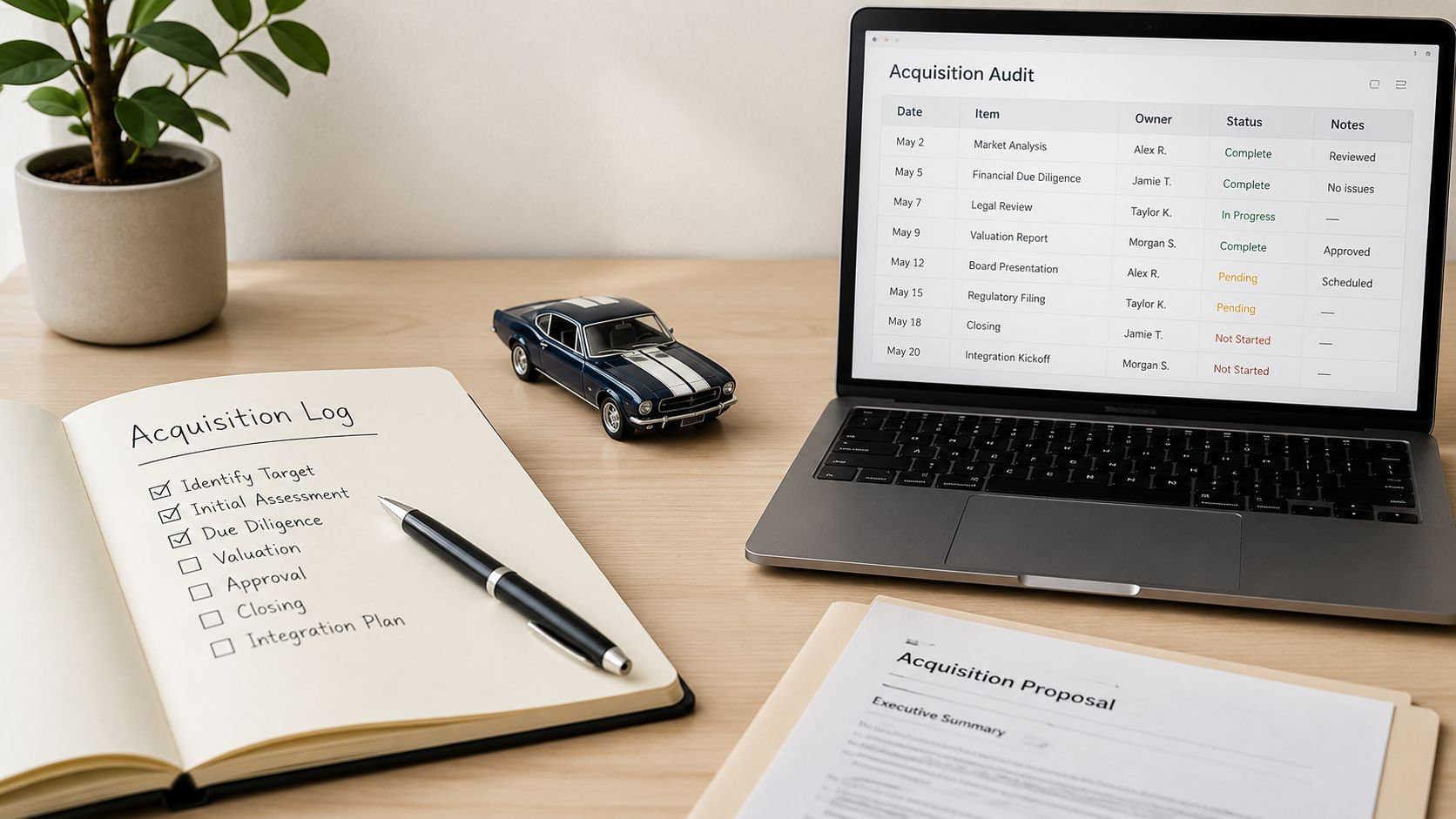
A buying decision without a written rationale is hard to defend and almost impossible to learn from. Most dealerships already remember the expensive mistakes. Fewer maintain a record detailed enough to show why the car was bought, which risks were known, and whether the pricing reflected them.
That audit trail matters in two directions. It helps if a post-sale issue raises questions about your diligence. It also helps internally when you're trying to improve buying standards across multiple people, sites, or stock profiles.
Write down why you bought it
A practical file doesn't need to be complicated. It needs to be specific. "Some history concerns" is useless six weeks later. "Three owners in 15 months, patchy servicing, mileage progression acceptable, priced with prep reserve" is useful.
The record should usually capture:
- What you checked: MOT, ownership, title, service support, finance exposure, insurance history, and condition notes.
- What you found: The actual red flags, not generic impressions.
- Why you still bought or walked away: The commercial reasoning behind the decision.
- What reserve you built in: Prep, warranty, disclosure, or slower stock-turn assumptions.
Trade teams that do this consistently tend to become calmer buyers. They argue less about memory, they review outcomes more objectively, and they build a stronger internal standard for motor trade risk over time. That's one of the least glamorous auction buying tips, but it usually separates repeatable buying performance from guesswork.
10-Point Pre-Auction Vehicle Due-Diligence Comparison
Item 🔄 Implementation complexity ⚡ Resource requirements ⭐ Expected outcomes 📊 Ideal use cases 💡 Key advantages Conduct Pre-Auction Vehicle History Analysis Before Bidding Medium, multi-source checks and analysis required Moderate, paid history services, DVLA/MOT access, analyst time Reduces post-purchase surprises and financial exposure Pre-bid shortlist screening; high-value or uncertain lots Early red-flag detection; supports realistic bid limits Identify Mileage Discrepancies and Odometer Irregularities Medium–High, requires trend analysis and domain knowledge Moderate, full MOT history, service records, comparison tools Detects clocking and protects valuation/compliance Older vehicles, high-mileage candidates, resale-sensitive stock Prevents odometer fraud; reduces warranty/complaint risk Analyse Ownership Patterns and Short-Term Resale Red Flags Medium, timeline interpretation with contextual judgment Low–Moderate, DVLA keeper records and record review time Flags flipped or problem-stock vehicles before purchase Vehicles with multiple recent keepers or trade transfers Reveals trader-flipping and recurring problem patterns Verify Vehicle Title Status and Ownership Documentation Medium, document checks and cross-verification Moderate, V5C inspection, DVLA lookups, possible lender queries Avoids buying vehicles with finance/theft/legal holds All auction purchases, especially higher legal-risk lots Ensures clear title transfer; reduces legal/compliance exposure Cross-Reference Insurance History and Loss Records High, insurance data limited and interpretive High, access to insurance databases, repair invoices, expert review Reveals prior structural/total-loss history and impacts valuation Suspected accident repairs or vehicles with major claims Uncovers concealed damage; informs price adjustments Assess Service History Gaps and Maintenance Pattern Anomalies Low–Medium, routine review of service intervals Low, service logs, dealer records, brief analysis time Predicts imminent repairs and informs warranty reserves Older cars or vehicles with inconsistent service records Forecasts maintenance costs; reduces surprise repairs Investigate Vehicle Type Changes and Category Shifts Medium–High, regulatory interpretation often needed Moderate, DVLA category history, conversion documentation, specialist checks Identifies salvage/commercial conversions and compliance risks Vehicles with reclassifications, conversions or unclear history Prevents misclassified acquisitions; protects resale value Establish Baseline Risk Profiles by Make, Model, and Age Cohort High initially, data collection and profiling High upfront, historical data, analytics tools; lower ongoing Faster, more accurate buying decisions and valuation consistency Dealers specialising in specific segments or high-volume buying Rapid screening; competitive advantage through specialist knowledge Use Advanced Risk Scoring to Prioritise Due Diligence Effort High, model development, weighting and calibration High, multiple data feeds, automation, analytics expertise Prioritises investigations and standardises decisions Large inventories or teams needing repeatable processes Efficient resource allocation; defensible audit trail Document Decision Rationale and Maintain Audit Trail for Compliance and Learning Low, process discipline required but simple steps Low, templates, secure storage, small time per vehicle Creates compliance evidence and learning dataset Every acquisition; regulatory scrutiny or dispute-prone operations Defensible records; supports continuous improvement and training
From Reactive Bidding to Proactive Intelligence
The strongest auction buyers don't rely on excitement, speed, or a feel for the room. They rely on process. That process starts well before the sale, and it usually has very little to do with the drama of bidding itself. It's about deciding which vehicles deserve your capital, which ones need a lower cap, and which ones should be ruled out before emotion has a chance to interfere.
That shift matters because auction risk rarely arrives as one obvious problem. It arrives as a stack of small signals. An ownership pattern that feels slightly off. A mileage progression that needs explaining. A title detail that isn't clean enough. A missing service story. A category change that narrows your retail audience. None of those issues automatically kills a deal. Together, they define whether the margin is real or imagined.
Professional buying discipline also means understanding the whole cost position before the hammer falls. In UK auctions, buyers typically need to pay an immediate 10% deposit, often amounting to between £3,000 and £5,000, and experienced buyers are also advised to keep a contingency budget of at least 10% for unexpected post-purchase costs. On the preparation side, 90%+ of auction vehicles need at least some repair or preparation after purchase, and traders are advised to run a full provenance-style history check because auction houses don't guarantee hidden issues such as Cat S or N status, outstanding finance, or mileage discrepancies.
Those facts explain why generic auction buying tips often fall short for the motor trade. "Set a maximum bid" is sound advice, but it isn't enough on its own. You also need a repeatable way to assess vehicle provenance, weigh ownership context, spot anomalies, and convert that intelligence into a realistic bid ceiling. That's where a proper vehicle history check UK workflow becomes commercially useful rather than administrative.
For many dealers, the next improvement isn't more instinct. It's better structure. A trade-focused platform such as AutoProv can support that by pulling vehicle provenance, ownership analysis, mileage signals, and broader risk indicators into one workflow at the point of decision. Used properly, that kind of trade vehicle intelligence helps you move from reactive bidding to disciplined acquisition.
In practice, that's what builds resilience. You won't win every lot, and you shouldn't try to. The objective is to buy stock you can stand behind, value accurately, prepare properly, and retail with confidence.
If you want to tighten your auction buying process with deeper provenance analysis and trade-focused risk signals, AutoProv provides UK motor traders with vehicle history, ownership, mileage, and risk intelligence designed to support better buying decisions before the hammer falls.
Frequently Asked Questions
AI-Generated Content Notice
This article was created with the assistance of artificial intelligence technology. While we strive for accuracy, the information provided should be considered for general informational purposes only and should not be relied upon as professional automotive, legal, or financial advice. We recommend verifying any information with qualified professionals or official sources before making important decisions. AutoProv accepts no liability for any consequences resulting from the use of this information.
From our AI insights
- Leveraging Auction Data for Strategic Car Purchases
Discover how to use auction data effectively to make profitable car buying decisions.
- Auction Pitfalls: Avoiding Costly Mistakes
Navigate UK car auctions with confidence by avoiding finance, write-off, and mileage risks.
- Mastering Paint Code Checks: Detecting Hidden Car Repairs
Discover how to use paint code verification to identify hidden car repairs and ensure a smarter purchase.
Related Articles

Your Ultimate Guide to Buying a Used Car in the UK
Navigate the UK used car market with confidence using our comprehensive buying guide. Tips, checks, and AutoProv Provenance insights included.

Difference Between MOT and Service: What You Need to Know
An MOT is a mandatory legal inspection that every car on UK roads needs to pass.Think of it as the government's way of ensuring your vehicle meets the absolute minimum safety and environmental standards to be considered roadworthy. A service, on the other hand, is a completely different beast. It's the proactive maintenance routine recommended by the people who built your car, designed to keep it running smoothly and catch problems before they start. In short, an MOT is a pass-or-fail exam required by law. A service is a comprehensive health plan for your car.
Your Ultimate Used Car Inspection Checklist
A solid used car inspection checklist is the single most powerful tool you have to avoid buying a lemon. It gives you a methodical way to look past the shiny paint and assess a car's real condition, helping you spot hidden problems and get a fair price before you shake hands on the deal.
Published by AutoProv
Your trusted source for vehicle intelligence