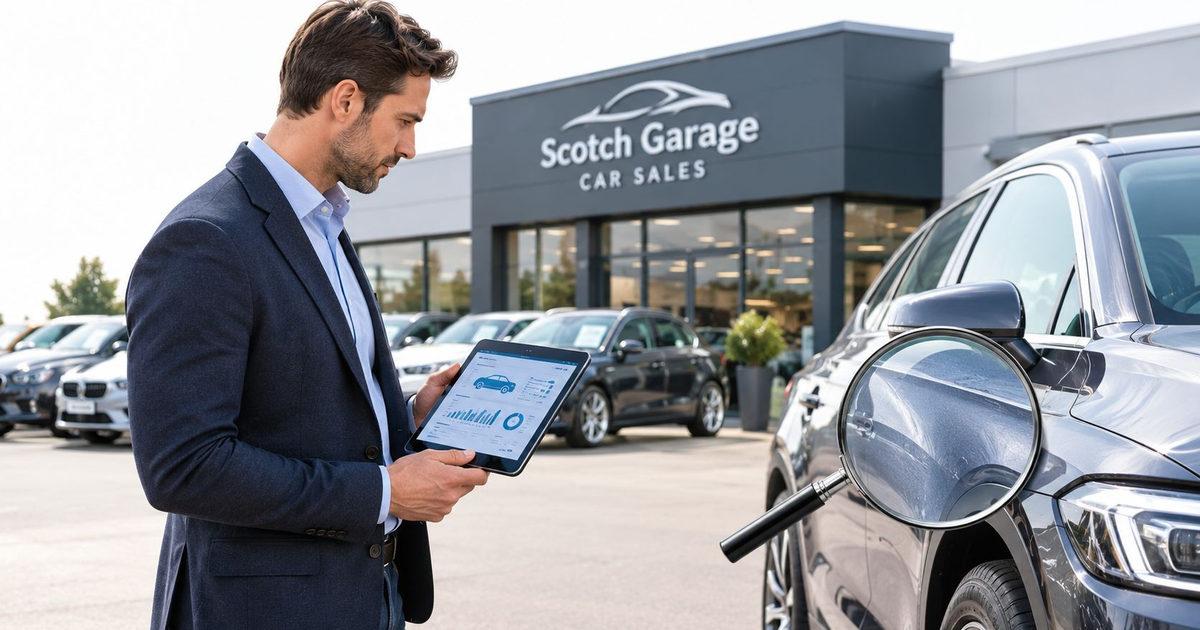
A dealer has a clean-looking car, a familiar retail proposition and paperwork that appears complete. The buying decision still isn't complete. For a trade buyer assessing Scotch Garage Car Sales, the question is whether the vehicle's provenance, mileage progression and ownership history support the price and the intended route back into the market.
That distinction matters across the UK used-car trade. A basic vehicle history check can provide a useful snapshot, but it rarely explains how several signals fit together. Dealer stability, sales processes and vehicle-level evidence need to be assessed separately, then joined at the point of purchase. This is the practical lens behind real-time vehicle intelligence, where current information is treated as decision support rather than a substitute for judgement.
Table of Contents
- Introduction Why Local Dealer Intelligence Matters in the Trade
- Who Scotch Garage Car Sales Is and How the Business Is Positioned
- Services and Typical Inventory What Trade Buyers Should Expect
- Reputation and Reviews Reading Signals Beyond Star Ratings
- Why Basic Vehicle History Checks Often Miss Trade Risk
- How to Verify Vehicle Provenance Before Buying From Scotch Garage
- Conclusion Smarter Buying Decisions With Better Vehicle Intelligence
Introduction Why Local Dealer Intelligence Matters in the Trade
A regional independent shouldn't be assessed like a supermarket group, and it shouldn't be dismissed because it operates from a local site. The buying risk sits in the detail. Who is selling the vehicle, how does the business present its stock, what documentation accompanies the transaction, and does the car's recorded history make sense when checked across more than one dataset?
Scotch Garage Car Sales provides a useful live example because it has a visible UK trading identity and a defined sales proposition. That gives a buyer a starting point, not an automatic approval. A dealer's corporate footprint may support confidence in provenance, but it can't validate the mileage on a specific vehicle or remove the need for independent checks.
Trade rule: Assess the seller and the stock as two separate risk questions.
The first question concerns the business. A formal company record, a declared business classification and published operating details help establish whether you're dealing with an identifiable trading entity. The second concerns the vehicle. Outstanding finance, theft or write-off markers, mileage inconsistencies and unusual ownership patterns can still affect a car offered by an established dealer.
Why local context affects the buying decision
A local independent may source stock through channels that differ from those used by national groups. It may serve a regional customer base, carry a varied mix of vehicles and rely on a traditional preparation and retail process. None of those characteristics is positive or negative, but each shapes the questions a trade buyer should ask.
The buyer's job is to avoid confusing presentation with evidence. A valet, an inspection statement and a warranty may reduce certain point-of-sale concerns, while the underlying vehicle history still needs to be checked. Good vehicle provenance work joins documents, MOT records, ownership events and other risk fields before capital is committed.
That approach protects more than the purchase price. It supports accurate valuation, sensible stocking decisions and a defensible response if a customer later challenges the vehicle's history. The dealer profile is therefore a due diligence input, not a substitute for a vehicle history check UK workflow.
Who Scotch Garage Car Sales Is and How the Business Is Positioned
Scotch Garage Limited is registered in the UK with Companies House under company number 06441036. Its declared SIC code is 45112, classifying the business as the sale of used cars and light motor vehicles, and the company record shows incorporation on 29 November 2007. Those facts establish an identifiable corporate presence and a trading history spanning nearly two decades, which is useful baseline intelligence for a motor trade buyer. Scotch Garage's published dealership details place the business in Bolton-le-Sands near Carnforth, Lancashire.

The positioning is clear. This is a UK regional independent used-car operation, not a national chain or a large supermarket-style retailer. That distinction matters when a dealer evaluates communication, stock profile, preparation standards and likely customer routes. It also means the buyer should focus on evidence that can be checked, rather than assuming that a local business follows the systems of a larger group.
What the corporate footprint tells a buyer
Companies House registration can help answer basic seller-verification questions:
- Identity: The legal entity can be matched against invoices, sales documents and published dealership information.
- Trading context: The SIC classification confirms that used-car sales are the declared business activity.
- Continuity: Incorporation in 2007 provides a long-established corporate baseline, although it doesn't prove the condition or history of any individual vehicle.
- Location: Bolton-le-Sands near Carnforth places the business within a regional Lancashire retail market.
These are valuable signals, but they're not a pass or fail decision. A company record tells you about the seller's formal footprint. It doesn't tell you whether the odometer reading is consistent with MOT checkpoints, whether ownership changes form an unusual pattern or whether finance and insurance-related markers need investigation.
How a regional independent should be assessed
The correct comparison is operational, not emotional. A small independent may offer direct communication and a straightforward sales process, while a national operation may provide more formalised systems. Neither model removes the need for vehicle provenance checks.
For trade buyers, Scotch Garage's established identity should therefore be recorded as context in the buying file. Then move to the vehicle itself. Match the registration and VIN details, retain the seller's documents, inspect the car's condition against its recorded mileage and investigate any conflict before setting a bid or retail value.
Services and Typical Inventory What Trade Buyers Should Expect
Scotch Garage's own sales listing states that its cars are HPI clear, MOT'd and serviced where applicable. It also says vehicles undergo a pre-delivery inspection and professional valet, with a 3 month or 3,000 mile used-car warranty included. These details describe the dealer's stated point-of-sale controls, but they shouldn't be treated as a replacement for a trade buyer's independent vehicle history check.
The warranty is a defined after-sales commitment. It gives the buyer a clear minimum period and mileage limit to record in the deal file, while the inspection and valet indicate a conventional independent retail preparation model. The practical question is what has been checked, when it was checked and whether the supporting documents match the vehicle being purchased.
Stock selection criteria for trade buyers should account for both mechanical preparation and provenance exposure. A car can be clean, roadworthy and commercially attractive while still requiring further investigation into mileage, owners or finance.
Reading the sales proposition properly
A trade buyer should separate each statement into an evidence request:
- HPI clear: Confirm what the check covered and retain the report or relevant result with the purchase file.
- MOT'd: Review the MOT history, including mileage entries and advisories, rather than recording only the current test status.
- Serviced where applicable: Ask for available service evidence and compare dates, mileage and vehicle condition.
- Pre-delivery inspection: Establish what the PDI included and whether defects were recorded or rectified.
- Professional valet: Treat presentation as a condition signal, not provenance evidence.
- Warranty: Record the 3 month or 3,000 mile limit and understand the terms before valuing the stock.
This approach prevents a common buying error. Retail preparation may reduce immediate reconditioning work, but it doesn't answer every question about the vehicle's past.
Opening hours and operating model
The published opening pattern is Monday to Friday from 9:00 to 17:00, Saturday from 10:00 to 17:00, and Sunday by appointment. Those fixed hours suggest a traditional independent retailer with a defined physical sales operation. For a trade buyer, that makes appointment planning and document collection straightforward, particularly when a vehicle needs a second inspection or paperwork review.
Inventory expectations should remain disciplined. A regional independent's stock may suit local retail demand, but the trade buyer still needs to calculate exit route, preparation cost and margin after the provenance review. Don't buy a car because the presentation is strong or because the dealer's stated package appears complete. Buy when the vehicle's history, condition and intended resale position align.
Reputation and Reviews Reading Signals Beyond Star Ratings
A small dealer's reputation should be read as a pattern, not reduced to a headline rating. Trade buyers need evidence of consistent conduct, clear descriptions, accurate paperwork and a process that remains transparent when a vehicle raises a question. Individual praise can indicate a good transaction, but it doesn't validate the history of stock currently offered.
Start with the basics. Does the business information remain consistent across its website, sales documents and physical location? Do listings describe preparation and warranty terms clearly? When a buyer asks for supporting evidence, does the response arrive promptly and match the vehicle identified in the deal?
What useful reputation evidence looks like
Look for recurring operational signals:
- Description accuracy: Stock details should match the vehicle inspected, including mileage, specification and condition.
- Process consistency: A dealer should apply the same documentation standards across transactions, not only when challenged.
- Issue handling: A clear response to a query is more useful than a polished review with no supporting detail.
- Information continuity: Business name, location and contact details should be coherent across published channels.
- Transaction evidence: Invoices, inspection records and warranty documents carry more weight than general praise.
For businesses managing their own digital presence, a practical resource such as Recepta's 2026 online review strategy is relevant because review activity should support consistent operational communication. That principle applies to trade buyers too. Reviews can reveal how a business communicates, but they don't replace a used car history report.
Reputation is not provenance
A well-regarded dealer can still receive a vehicle with incomplete or conflicting records. Mileage data may be absent because a garage didn't submit it or because a keeper left the mileage field blank during a keeper change, as explained in AutoTrader's mileage discrepancy guidance. That gap isn't automatically evidence of fraud, but it is a reason to investigate.
The same separation applies to adverse information. Reputation screening and adverse media screening can inform seller due diligence, while vehicle-level provenance analysis determines whether the specific stock is suitable. Keep those workstreams distinct in the buying process.
Why Basic Vehicle History Checks Often Miss Trade Risk
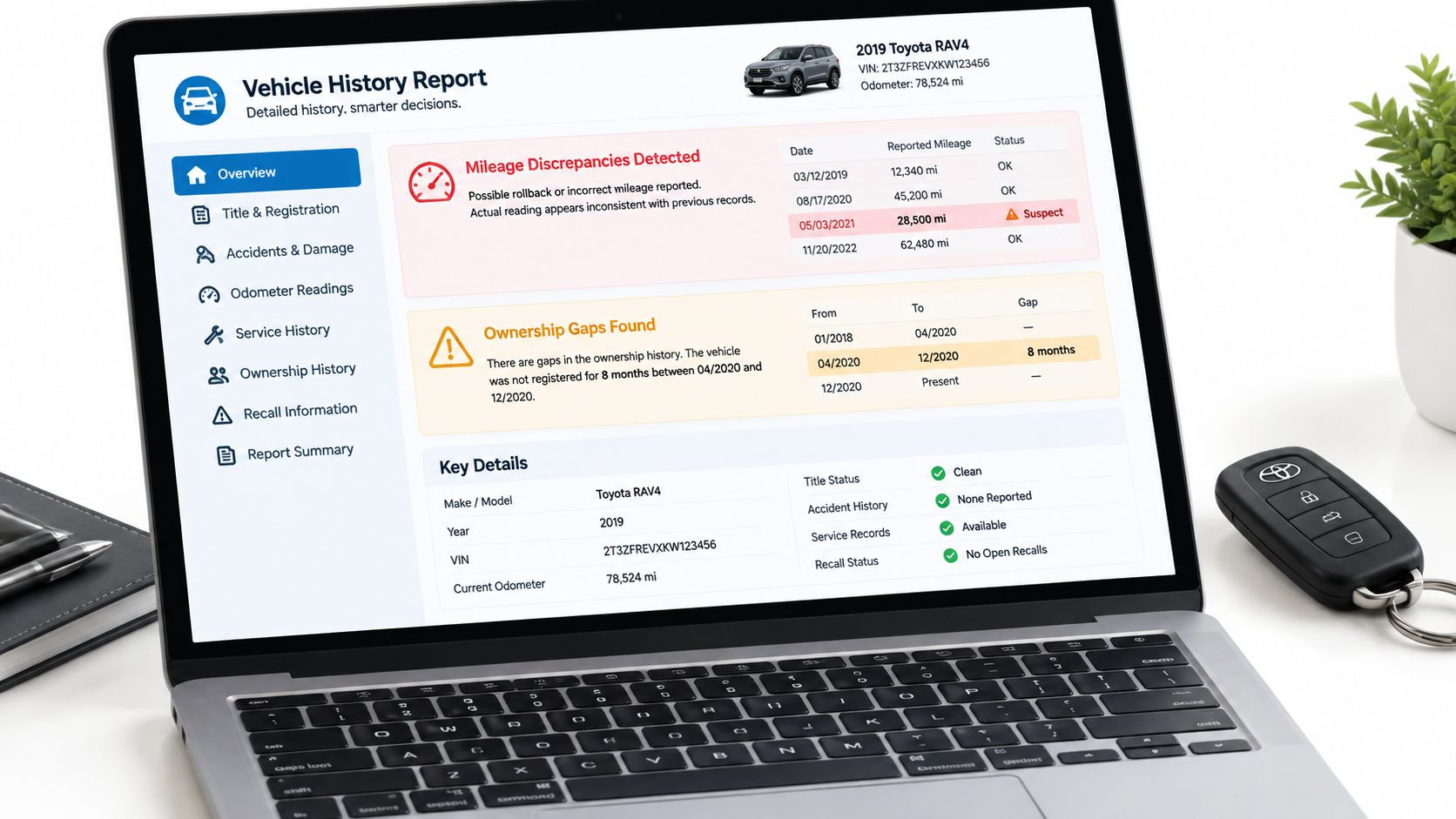
A single-source vehicle history check usually answers a narrow question. It may return a clear result, a discrepancy or no recorded issue, but the trade risk often appears in the relationship between several records. Vehicle provenance is a cross-dataset assessment, not a single green-light indicator.
Mileage demonstrates the problem. A UK-focused consumer article reported that one in 11 used cars checked by HPI showed a mileage discrepancy, and stated that the figure had risen 45% in five years. The same article stressed that a discrepancy doesn't automatically mean clocking, because errors and inconsistencies across MOT, service and ownership records can create the result. The mileage discrepancy analysis is useful precisely because it separates a warning from a conclusion.
Snapshot checks versus clustered signals
Compare the two approaches:
| Isolated check | Context-led assessment |
|---|---|
| Records a pass or fail result | Reviews how multiple records relate |
| Treats missing mileage as an empty field | Investigates why the data is missing |
| Looks at owners separately | Studies owner count, dates and rapid changes |
| Reviews finance or write-off status alone | Weighs finance, theft, write-off and mileage signals together |
| Supports a quick decision | Supports a bid, valuation and escalation decision |
The UK government competition decision on vehicle provenance data identifies previous owners and ownership-change dates, outstanding finance, stolen or write-off markers, and mileage consistency across MOT tests as core risk variables. That decision document supports a practical rule: clustered anomalies deserve more weight than one isolated flag.
Why missing data needs context
For vehicles over three years old, the GOV.UK MOT history record provides timestamped mileage checkpoints. A missing entry or inconsistent sequence should prompt a comparison with service invoices, inspection notes and the seller's declaration. Don't label the vehicle fraudulent without evidence, but don't ignore a gap because the basic check returned no adverse marker.
Traditional provenance checks can become too narrow for professional buyers. A trade-focused explanation of modern provenance checks is relevant to the underlying buying discipline. The goal isn't to collect more data for its own sake. It's to identify whether several independent signals point towards the same exposure before you commit stock money.
How to Verify Vehicle Provenance Before Buying From Scotch Garage
Use the same workflow for every vehicle offered by Scotch Garage Car Sales. Consistency matters because a repeatable buying process prevents a convincing presentation or familiar seller from shortening the investigation.
Start with the transaction documents
Write the vehicle's mileage on the purchase document and obtain a seller declaration stating whether the mileage is believed to be correct. UK dealer compliance guidance treats incorrect mileage disclosure as a misleading action and recommends comparing the stated mileage with mechanical condition, service history and MOT history. The Liverpool City Council Trading Standards guidance sets out that practical approach.
For vehicles over three years old, compare the declared mileage against the timestamped MOT record. Then reconcile the result with service invoices, inspection paperwork and the physical wear on steering controls, pedals, seats and loading areas. A mismatch is an escalation point, not an automatic verdict.
Cross-correlate the main risk variables
Review the following as one evidence set:
- Mileage progression: Check that recorded readings move logically through MOT and service events.
- Ownership timeline: Review previous owners and ownership-change dates, paying attention to rapid changes or short holding periods.
- Finance status: Confirm whether outstanding finance is recorded and establish how it will be settled before transfer.
- Stolen and write-off markers: Treat either marker as a reason to stop and obtain the relevant documentation before bidding.
- Condition alignment: Compare the recorded mileage with the vehicle's mechanical and cosmetic condition.
A current AutoProv vehicle provenance report can be used as one trade vehicle intelligence input alongside primary documents and direct inspection. Its role is to bring mileage progression, ownership timelines and other risk indicators into a context-led review, not to replace the buyer's responsibility for evidence.
Handle MOT mileage errors correctly
The GOV.UK process is specific. An MOT mileage error can be corrected only where evidence shows what the mileage should be and that the evidence is dated within one day of the MOT test. Accepted evidence includes an invoice, emissions printout, service receipt or MOT-centre job card. The request can be made through the MOT test centre or online using vehicle details and the MOT test number. GOV.UK's MOT correction process should be kept with the case file when a correction is needed.
Don't rely on a verbal explanation. Obtain dated evidence, record who supplied it and suspend the buying decision if the discrepancy changes the vehicle's valuation or resale route. Insurance and wider dealership risk controls also sit around this process, so trade buyers may find dealership insurance from Professional Insurance Advisors useful background when reviewing their broader operating arrangements.
Prioritise clustered anomalies
Use a simple decision matrix before making the bid.
| Risk Signal | What to Check | Trade Action if Clustered |
|---|---|---|
| Mileage inconsistency | MOT checkpoints, service documents and physical wear | Hold the bid, obtain dated evidence and revalue |
| Rapid ownership changes | Keeper dates and seller explanation | Investigate the reason, then assess exit risk |
| Finance marker | Settlement status and finance documentation | Do not complete without clear settlement evidence |
| Stolen or write-off marker | Record details, repair documents and identity checks | Escalate for full review before purchase |
| Missing mileage data | Garage submissions and V5C entries | Seek corroborating records rather than assuming a clean history |
The buying decision should reflect the cluster. One missing record may require clarification. Missing mileage combined with rapid ownership changes and condition inconsistency is a materially different proposition. Price the uncertainty, or walk away.
Conclusion Smarter Buying Decisions With Better Vehicle Intelligence
Scotch Garage Car Sales offers a clear example of why seller context and vehicle intelligence must work together. Scotch Garage Limited has a formal UK corporate footprint, a declared used-car sales classification and incorporation dating to 29 November 2007. Those facts help establish the seller, but they don't certify the provenance of every vehicle on its forecourt.
The dealer's stated preparation model is also useful. Cars are described as HPI clear, MOT'd and serviced where applicable, with a pre-delivery inspection, professional valet and a 3 month or 3,000 mile warranty. Record those terms accurately, then verify the vehicle independently. A warranty can define after-sales exposure, but it doesn't correct an unexplained mileage sequence or resolve a finance marker.
The trade buying standard
A disciplined file should contain:
- Seller verification: Match the legal business identity, dealership details and transaction documents.
- Mileage evidence: Write the mileage into the purchase document, obtain the seller declaration and compare it with MOT and service records.
- Ownership analysis: Review dates and patterns rather than counting owners in isolation.
- Core risk checks: Assess finance, stolen and write-off markers alongside mileage and condition.
- Decision records: Note the evidence reviewed, unresolved concerns, revised valuation and final reason to buy or decline.
That is the difference between a pass/fail purchase process and genuine trade vehicle intelligence. It gives stock buyers a stronger basis for valuation, negotiation, customer disclosure and margin protection.
For dealers and wholesalers, the recommendation is straightforward. Treat an established independent as a traceable trading counterparty, not as a guarantee. Treat a clean basic check as a starting point, not a conclusion. Then use cross-correlated provenance evidence at the point of decision, before the vehicle enters your stock plan.
AutoProv provides UK motor trade vehicle provenance reports covering vehicle history, mileage progression, ownership timelines and key risk indicators for dealer and wholesale buying workflows. Visit AutoProv to review how point-of-decision intelligence can support safer stock acquisition and more defensible valuation decisions.
Published by AutoProv
Your trusted source for vehicle intelligence