
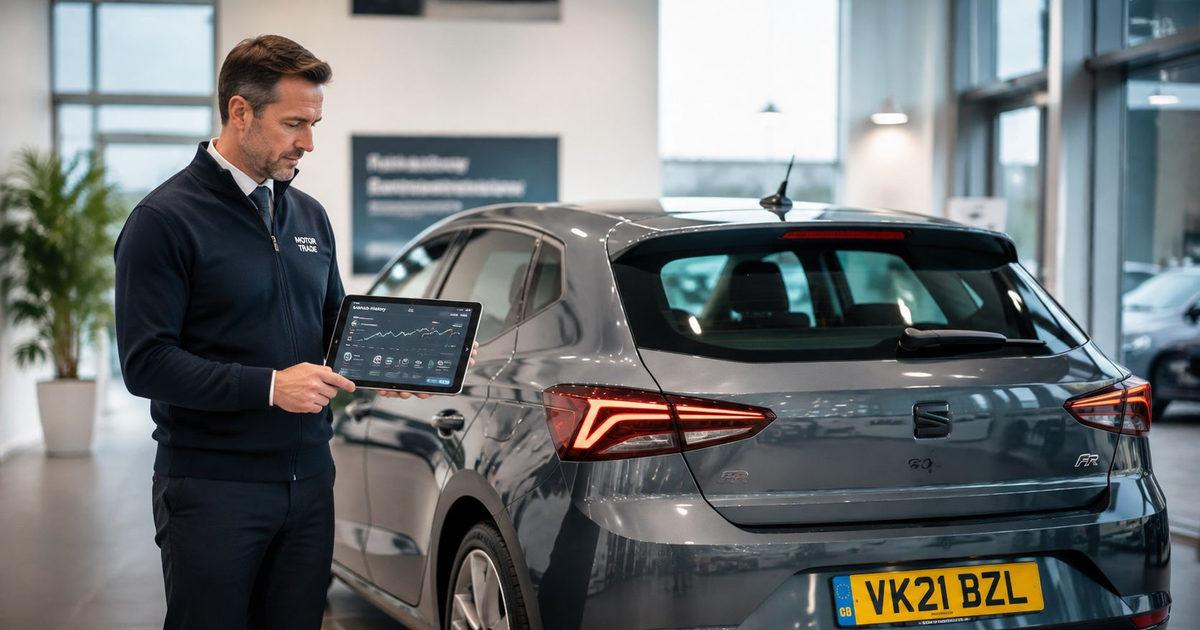
The customer is waiting for a part-exchange figure while you're looking at three keys, a V5C and a purchase invoice that doesn't quite fit together. The screen offers a clean guide value, but the dashboard mileage, MOT record and keeper story need checking before that number reaches the customer.
That's the point at which a trade in valuation either becomes disciplined buying or an expensive guess. The guide is useful, but it's only one layer. A defensible figure combines vehicle identity, mileage integrity, ownership context, condition, specification and current market movement. The result isn't just “what the car is worth”. It's what the business can responsibly pay after allowing for preparation, resale and provenance risk.
Table of Contents
- What a Strong Trade In Valuation Actually Demands
- The four inputs behind a trade in valuation
- The Core Data Sources You Need Before Quoting a Number
- Match each source to the question it can answer
- A sourcing checklist for the buying desk
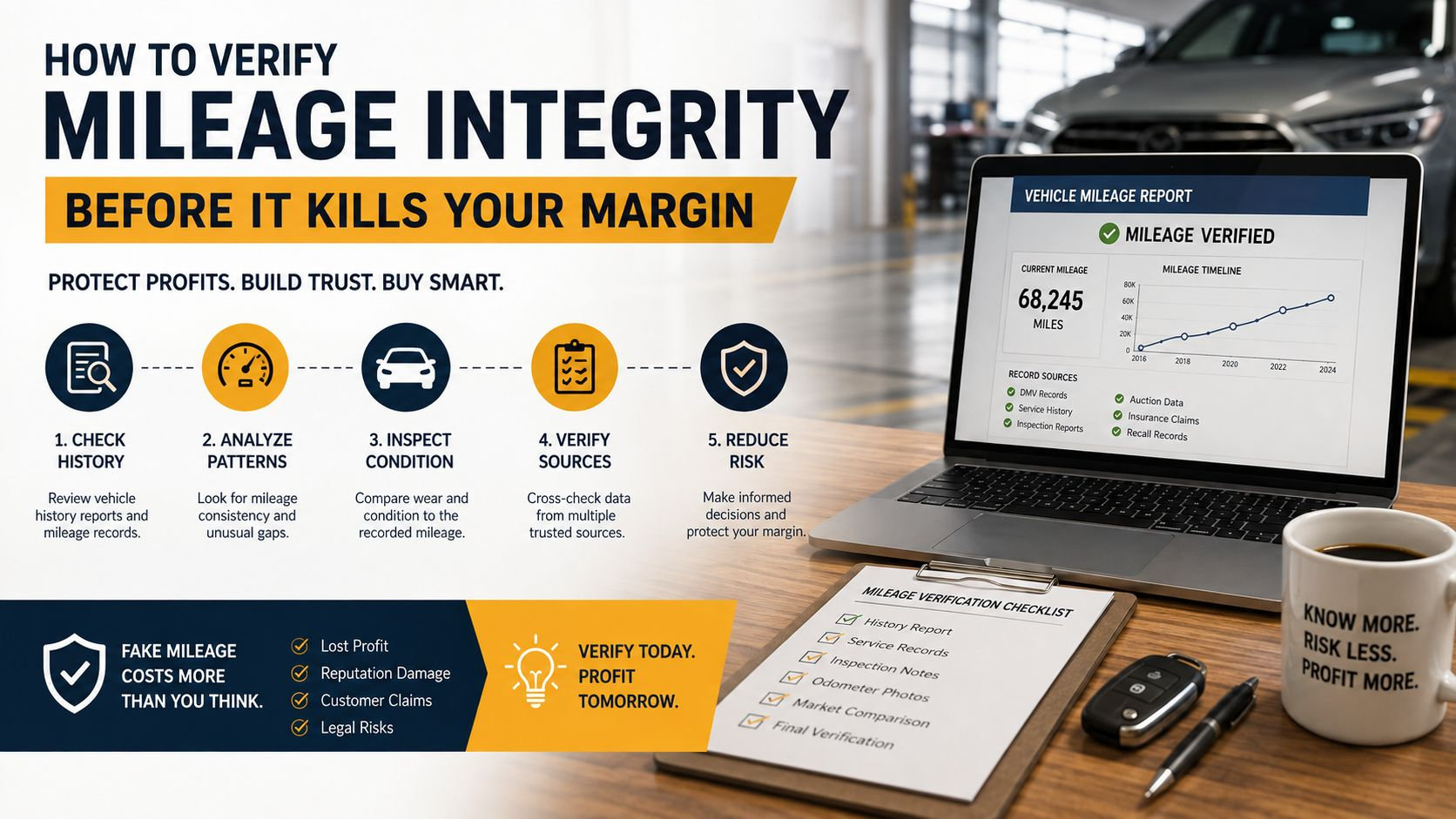
- How to Verify Mileage Integrity Before It Kills Your Margin
- Run the mileage audit as a sequence
- Signals that deserve escalation
- Ownership Patterns and Insurance Events That Change the Risk Picture
- Read the keeper story like a buyer
- Decide whether to discount, hold or walk away
- Quantifying Adjustments and Building Your Own Valuation Logic
- Use a fixed order of operations
- Worked desk example without false precision
- Putting It Into Practice at the Desk and on the Lane
- Follow the evidence in the order it appears
- Keep the negotiation anchored to evidence
- Your Repeatable Trade In Valuation Checklist
- Troubleshooting common conflicts
What a Strong Trade In Valuation Actually Demands
A strong valuation starts before anyone discusses price. First confirm that the vehicle in front of you is the vehicle represented by the registration, VIN and documents. Then establish whether the mileage is credible, whether the ownership history makes sense and whether the condition matches the trade band being considered.
The UK used-car market has already shown why static assumptions are dangerous. A quarterly index tracking used-car values from Q1 2019, set at 100, placed the market at 113.2 in Q1 2025, still 13% above pre-pandemic levels but 22.4% below the Q2 2022 peak (UK used car price index and market history). That movement affects stock bought today, not just historic reporting.
Practical rule: Treat the valuation figure as the final output of your checks, not the first fact in the conversation.
A customer may reasonably expect a guide-backed number. Your job is to decide whether the car qualifies for that number. A mileage break can move it into a different risk category. A short ownership cycle can make the same specification less attractive to the next buyer. An insurance event can affect disposal routes, financeability and buyer confidence even when the repair appears tidy.
The four inputs behind a trade in valuation
Input What it covers Impact on trade price Vehicle data Identity, registration, derivative, plate history and specification Determines whether you're valuing the correct vehicle and equipment level Mileage integrity MOT chronology, dashboard reading, recorded corrections and gaps Influences guide adjustments and confidence in future resale Provenance and risk Keepers, ownership duration, insurance-related events and anomalies May require a discount, further investigation or a decision not to buy Live market evidence Current wholesale guidance, comparable stock and local movement Prevents a stale guide figure becoming your purchase price This is why a basic lookup often fails at the desk. It answers a narrow question, while a trade buyer has to answer a wider one: what price leaves room for the vehicle's actual risk and likely route to sale?
The UK automotive sector generates trade worth more than £94 billion, and UK vehicles are described as the country's single most valued trade good at £34.4 billion by the SMMT figures referenced in this UK trade valuation overview. Accurate pricing matters because a small error is repeated across acquisition, preparation, stock holding and disposal decisions.
The Core Data Sources You Need Before Quoting a Number
A recognised wholesale guide gives the buying desk a starting point, not a purchase price. It cannot confirm every fact about the individual vehicle. A credible vehicle history check UK workflow combines the market baseline with identity, chronology, provenance and current demand before a figure is quoted.
Start with DVLA-recorded identity. Confirm the registration, make, model, engine and fuel type, then reconcile the V5C and VIN with the vehicle in front of you. DVLA and MOT access provides useful official information, but the public service remains limited to basic DVLA data and MOT history. It does not provide a complete trade view of finance, ownership context or risk interpretation, as the GOV.UK vehicle and driver information service explains.
Match each source to the question it can answer
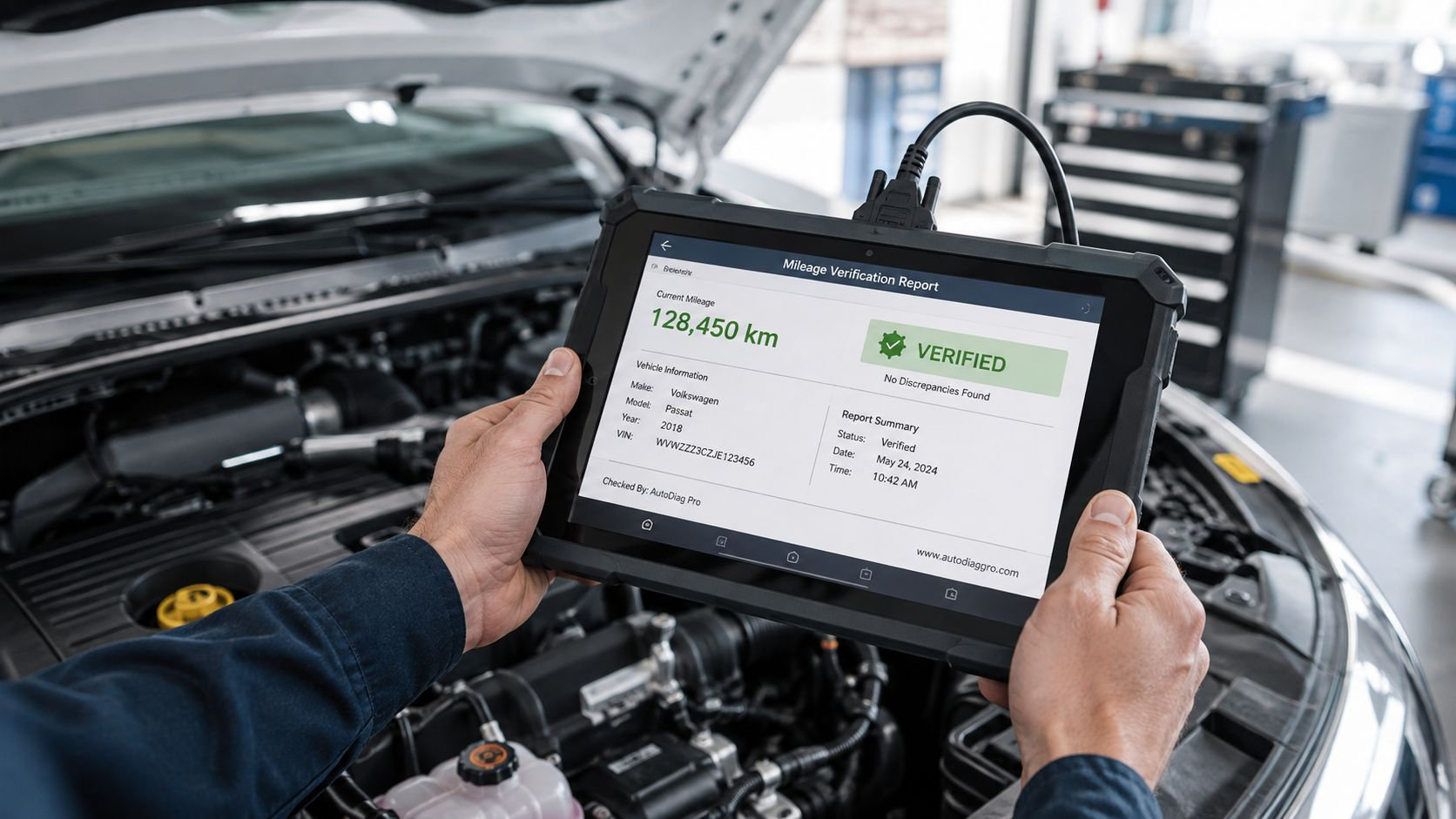
MOT chronology records mileage at test events and can expose an implausible sequence. It remains useful evidence, but it is not continuous telematics. The MOT history service records one mileage figure per test, leaving gaps where alteration, input errors or cloning risk may go undetected, as explained in this explanation of MOT mileage limitations.
Mileage patterns need comparison beyond the dashboard. Set the current reading against the historical sequence, service invoices, inspection notes and available provenance records. The buying question is whether the complete trail is credible, rather than whether one number looks neat.
The wholesale guide sets the commercial baseline. CAP Black Book uses manufacturer, model and derivative indexing alongside mileage variations, plate-change allowances, factory-fit adjustments, insurance groups and trade-condition bands, including Clean, Average and Below Average. Its role is to reflect current market value, while live updates respond to identified market changes (CAP Black Book methodology and live pricing).
Keep the evidence in one repeatable workflow. A vehicle data integration platform for automotive decisions can reduce the risk of separate browser tabs producing inconsistent interpretations.
A sourcing checklist for the buying desk
- Identity first: Confirm registration, VIN, derivative and fitted equipment.
- Chronology next: Read each available MOT event as a sequence, not an isolated entry.
- Mileage comparison: Reconcile the odometer with MOT, service and inspection evidence.
- Risk context: Review keeper changes, ownership duration and insurance-related records.
- Market baseline: Pull the current wholesale value, then adjust for condition, mileage and specification.
ONS uses daily UK second-hand car listing data from Auto Trader covering trade and private sales, with fields including mileage, year, make, model and fuel type (ONS used-car listings data context). The practical implication is clear. Price discovery keeps changing, so a monthly or historic figure can become stale before the vehicle reaches the lane.
How to Verify Mileage Integrity Before It Kills Your Margin
Mileage is both a major valuation input and a major risk signal. A dashboard reading can be correct, incorrect through data entry, or deliberately altered. You won't resolve that by glancing at the odometer while walking around the car.
The UK MOT record provides a useful timeline, but it has limits. Between January 2018 and mid-2025, more than 500,000 MOT certificates were amended, averaging around 450 corrections per day, and more than 285,000 of those corrections involved mileage or odometer changes (CAP Black Book Live mileage-risk context). Those figures make mileage provenance a routine buying control, not an unusual fraud investigation.
Run the mileage audit as a sequence
- Record the live reading. Photograph the dashboard and note the exact figure before negotiation. Don't rely on memory or a handwritten number that could be transposed.
- Read the MOT timeline from oldest to newest. Look for a broadly plausible progression. A later reading below an earlier one needs an explanation, even if the latest MOT is marked valid.
- Investigate gaps. A plate change, imported vehicle, prolonged off-road period or missing service evidence can interrupt the trail. A gap doesn't prove fraud, but it lowers confidence and should affect the decision until supported.
- Cross-check independent records. Service invoices, manufacturer servicing, repair orders and auction descriptions can either support the dashboard reading or expose inconsistencies. Date and mileage should progress together.
- Stress-test the buying figure. If the history cannot support the displayed mileage, don't apply the clean mileage band automatically. Hold the price, seek evidence or value the vehicle on a more conservative basis.
The DVLA mileage check guidance is useful when building a repeatable check, but the trader still has to interpret the pattern. Public MOT data offers snapshots at test dates rather than a continuous record, so a clean-looking endpoint doesn't erase an unexplained interval.
Signals that deserve escalation
Watch for a descending mileage sequence, a sudden increase followed by a lower reading, duplicated-looking entries, inconsistent service dates or a vehicle that presents as materially more worn than its displayed mileage. Pay attention to plate changes too. A private plate can make a chronology appear incomplete if the records aren't connected correctly.
Independent UK coverage has estimated that 2.1% of secondhand cars checked had inconsistent mileage histories, equating to around 160,000 vehicles potentially changing hands with mileage-fraud risk in a year (Auto Express coverage of mileage-fraud risk). The commercial response isn't to reject every anomaly automatically. It's to separate explainable data quality issues from a pattern that creates disposal risk.
A vehicle with a defensible mileage trail can use the appropriate guide adjustment. A vehicle with a broken or contradictory trail needs a different price, a stronger evidence requirement or a walk-away decision. That distinction protects margin more effectively than treating every report as pass or fail.
Ownership Patterns and Insurance Events That Change the Risk Picture
Mileage tells you how far the car may have travelled. Ownership history tells you how the car has moved through the market. The two should be read together because a tidy odometer sequence doesn't explain rapid resale, repeated keeper changes or an insurance event.
A short ownership period isn't automatically negative. A company fleet disposal, a relocation or a change in personal circumstances may explain it. The risk appears when the pattern combines short-term keepers, quick resale activity, missing paperwork and a seller who can't explain the timeline.
Read the keeper story like a buyer
Start with the number of keepers, then examine the intervals between changes. A vehicle with five registered keepers in six years is commercially different from a same-age vehicle with two keepers, even if the mileage and specification match. That isn't a mathematical rule for an automatic discount. It's a prompt to ask what each transfer represents and whether the next retail buyer is likely to ask the same questions.
Use this guide to checking how many car owners a vehicle has had when establishing the ownership sequence. Then consider:
- Short-term keeper changes: Look for repeated ownership periods that end quickly without a clear reason.
- Rapid resale: Compare acquisition and disposal timing where records make it visible.
- Keeper type: A business, fleet or leasing history may be commercially normal, but it changes how you interpret wear and service responsibility.
- Document alignment: Check whether the V5C, seller identity and vehicle history tell one coherent story.
Buying decision: A keeper count is a signal. The price adjustment comes from the explanation, supporting evidence and likely disposal friction.
Insurance-related events create another layer. Theft recovery may carry a different retail objection from a total-loss record. A vehicle with a recorded total loss needs careful assessment of category, repair quality, documentation and the route through which it can be sold. If the event affects financeability, consumer confidence or auction appetite, the trade value must reflect that commercial reality.
Decide whether to discount, hold or walk away
Discount when the event is understood, the repair evidence is adequate and your intended sales route accepts the history.
Hold when the vehicle may be viable but key facts remain unverified. Don't turn uncertainty into a generous purchase price just because the guide figure looks attractive.
Walk away when identity, ownership or insurance records conflict in a way you can't reasonably resolve. The cost isn't limited to the purchase. It can include preparation, delayed disposal, customer disputes and reputational damage.
This is the heart of motor trade risk. Provenance doesn't replace inspection or mechanical appraisal, but it changes how much confidence you can place in the number on the screen.
Quantifying Adjustments and Building Your Own Valuation Logic
A guide figure is only the starting point. At the desk, the buying decision has to account for mileage evidence, ownership pattern, condition and live demand before the offer is set. Once those facts are clear, each adjustment should be traceable rather than hidden inside a broad “dealer margin” allowance.
Use the current wholesale guide, confirm the exact derivative and choose the condition band before changing the baseline. The guide provides a consistent reference. Your responsibility is to decide whether the vehicle's evidence supports that reference and whether your likely sales route can absorb the remaining risk.
Use a fixed order of operations
- Identify the exact derivative. Confirm the engine, trim, gearbox and fitted equipment. A wrong selection distorts every later adjustment.
- Select the condition band. Assess tyres, bodywork, interior, warning lights, service requirements and preparation work.
- Apply mileage evidence. Use the appropriate mileage band only when the recorded timeline supports the displayed figure.
- Correct specification and plate factors. Add or remove value for factory equipment and account for registration context where the guide permits it.
- Apply market movement. Compare the guide with current comparable stock, local demand and the route you expect to use for disposal.
- Subtract risk costs. Allow for unresolved provenance, disclosure requirements, slower disposal and weaker buyer appetite.
A practical internal formula is:
Adjusted buying value = live guide baseline, plus or minus condition and specification adjustments, minus preparation, provenance and disposal risk.
Keep the calculation consistent, but do not manufacture precision. Two buyers reviewing the same evidence should reach broadly similar reasoning, even if their final bids differ because their stock needs or disposal routes are different.
Worked desk example without false precision
A family hatchback has a confirmed derivative, acceptable condition and a current guide value. Its MOT sequence then shows a gap around a plate change. The latest mileage appears plausible, yet service evidence does not support the intervening period.
Record the uncertainty instead of applying an invented mileage deduction. Request the missing documents and place the vehicle in a lower-confidence buying category until the timeline is reconciled. The issue is not what the car might be worth at retail. It is the cost of proving the story and finding a buyer who will accept it.
If the mileage evidence is later supported, retain the appropriate guide band and adjust for condition and local movement. If the gap remains unresolved, reduce the offer by the likely preparation and disposal risk, or decline the part-exchange. For a plain-English framework for calculating vehicle depreciation, see a plain-English framework for calculating vehicle depreciation.
Keep an audit note with the baseline, each adjustment, the evidence used and the reason for any hold or refusal. That record gives the customer, manager or auditor a clear explanation of the offer without relying on memory.
Putting It Into Practice at the Desk and on the Lane
A three-year-old family hatchback arrives as a part-exchange. The seller has a V5C showing a private plate, a fresh MOT and a confident claim of ownership from new. The car presents well, but the claim remains unverified until the records support it. At the desk, the valuation starts with risk, not the guide figure.
The buyer confirms identity first. Registration, VIN, private plate history and derivative are matched against the fitted equipment. A fresh MOT confirms the vehicle passed its test on that date. It does not confirm the ownership story or prove uninterrupted mileage.
Follow the evidence in the order it appears
Read the MOT events chronologically, then compare them with the keeper timeline. The seller may have owned the car from new, but a previous registered keeper or a quick transfer around the plate change needs an explanation. Ask neutrally: “Can you talk me through the plate change and the previous keeper entry?”
The latest mileage looks broadly plausible. The record still contains a gap, with no service invoice supporting use during that period. That does not prove clocking. It does reduce confidence, so the buyer should not price the car as though every mile were documented.
The wholesale guide sets the starting point. From there, apply the correct condition band, confirm the specification, assess preparation and consider the likely disposal route. Ownership pattern, mileage support and current local demand belong in the same decision. A guide value is useful only after the evidence has established how much risk sits behind it.
For a desk-ready process covering broader inspection points, use this vehicle appraisal checklist for trade buyers.
Keep the negotiation anchored to evidence
A flat statement such as “that's all I can offer” invites an argument. A risk-led explanation gives the customer something specific to address:
“The guide supports a figure around this level for the confirmed model and condition. I've had to allow for the mileage gap around the plate change because I can't verify that part of the history from the records we have. If you can provide the missing service or ownership evidence, I can review the figure. Without it, I have to price for the risk at disposal.”
This protects the relationship while keeping the offer commercially honest. If the evidence arrives and resolves the gap, update the valuation and record why. If it does not, retain the adjustment because the next buyer may ask the same questions.
On the auction lane, presentation and a fresh MOT can support a purchase, but neither overrides an unexplained provenance issue. A buyer who checks before bidding is making a risk-adjusted acquisition decision. The number follows the mileage integrity, ownership pattern and live market route, rather than dictating the decision on its own.
Your Repeatable Trade In Valuation Checklist
Run the same sequence for every part-exchange, even when the vehicle looks familiar or the customer is in a hurry.
- Confirm identity: Match registration, VIN, V5C, derivative, plate history and fitted specification.
- Read the timeline: Review MOT events from oldest to newest and note gaps, amendments or implausible progression.
- Validate mileage: Compare the dashboard with MOT, service and inspection evidence. Escalate contradictions.
- Assess provenance: Review keeper duration, rapid resale signals and insurance-related events.
- Set the baseline: Use the current wholesale guide and the correct Clean, Average or Below Average condition band.
- Apply adjustments: Account for mileage, specification, plate, preparation, local demand and disposal risk.
- Record the decision: Save the evidence behind the offer, including why you held, discounted or declined.
Troubleshooting common conflicts
The guide is high but the history is weak: Treat the guide as a baseline, not permission to overpay. Seek evidence or price for the unresolved risk.
The vehicle may be cloned: Stop the valuation and reconcile the VIN, registration, documents and timeline before discussing a firm purchase figure.
There's a gap in the MOT record: Don't assume fraud, and don't assume innocence. Mark the gap, request supporting records and reduce confidence until the sequence makes sense.
It's an auction-purchased part-exchange: Recheck disclosure, mileage and provenance rather than carrying the auction description forward unchallenged.
A repeatable trade vehicle intelligence process turns valuation from a rushed price lookup into controlled buying. It also gives the sales team a fair explanation when the evidence doesn't support the customer's expectation.
AutoProv provides UK-focused vehicle history, provenance and risk intelligence by analysing DVLA records, MOT history, mileage patterns, ownership timelines and insurance-related events for trade decisions. Use AutoProv to add point-of-purchase context to your trade in valuation workflow before committing capital.
Frequently Asked Questions
AI-Generated Content Notice
This article was created with the assistance of artificial intelligence technology. While we strive for accuracy, the information provided should be considered for general informational purposes only and should not be relied upon as professional automotive, legal, or financial advice. We recommend verifying any information with qualified professionals or official sources before making important decisions. AutoProv accepts no liability for any consequences resulting from the use of this information.
From our AI insights
- Advanced Mileage Verification for UK Dealers
Explore innovative mileage verification tactics for UK car dealers to mitigate risks and enhance negotiations.
- Harnessing Real-Time Data in UK Motor Trading
Explore how real-time data aids UK traders in identifying vehicle risks swiftly.
- Predictive Insights: Using DVLA Data for Stock Risk Analysis
Explore how DVLA data transforms into predictive insights for UK car dealers managing stock risk.
Related Articles

Navigating the UK Used Car Market
Explore the latest trends in the UK used car market and how AutoProv can reveal true vehicle values.
Understanding Market Insights for Vehicle Pricing
Learn how market insights can guide UK traders in setting the right vehicle prices.

7 Best Second Hand Cars to Buy UK: A 2025 Guide
The search for the best second hand cars to buy in the UK can feel like navigating a maze of private listings, vast online showrooms, and conflicting advice. With prices fluctuating and new models constantly entering the used market, how do you identify a reliable, fairly-priced vehicle that truly suits your needs? This guide is designed to cut through the noise and provide clear, actionable insights for your next purchase.
Published by AutoProv
Your trusted source for vehicle intelligence
