
Beyond the basics, stock acquisition still comes down to one familiar moment. The car looks right, the prep looks manageable, the margin looks clean, and then something buried in its history knocks the deal sideways after purchase. Most experienced traders have lived that once, usually more than once.
That pressure matters more in a market this busy. The UK used car market recorded 7,643,180 transactions in 2024, up 5.5% year on year, with eight consecutive quarters of growth, according to heycar's UK car sales statistics. More volume creates more opportunity, but it also means more chances to buy into a problem if your dealer vehicle checks stop at the obvious.
Basic provenance-style checks, MOT history and a quick appraisal still have value. They just don't tell the whole story. The better buying decisions come from reading patterns across the record: ownership velocity, mileage progression, gaps, inconsistencies, and whether the data from one source is consistent with what another source says.
Practical used car dealer tips emphasize process discipline over inspection habits. Traders who build context into every buying decision protect margin better, argue valuation more confidently, and avoid tying up capital in the wrong stock. If stock turn is part of the pressure on your business, it's also worth learning how to avoid overstocking.
Table of Contents
- 1. Understanding DVLA Record Discrepancies as a Primary Risk Signal
- Why a mismatch matters
- 2. Mileage Anomalies and Pattern Analysis as Fraud Detection
- Read the sequence, not just the last figure
- 3. Ownership Pattern Analysis and Short-Term Ownership Red Flags
- Short-term ownership needs context
- 4. MOT History Gaps and Service Record Discontinuities as Integrity Signals
- Gaps tell you where to ask harder questions
- 5. Write-Off and Salvage Title History as Non-Negotiable Risk Assessment
- A clean appearance doesn't override category risk
- 6. Insurance and Claim History Patterns as Behavioural Risk Indicators
- Claim patterns rarely sit alone
- 7. Verifying Import Status and Vehicle Origin as Compliance Foundation
- Imported stock needs a different standard of proof
- 8. Valuation Accuracy and Price-to-Condition Anomalies as Fraud Indicators
- Use valuation to test the story, not just set the bid
- 9. Multi-Source Data Cross-Referencing and Building Internal Trade Buying Protocols
- Build a protocol people can actually follow
- 9-Point Used Car Risk & Verification Matrix
- From Data Points to Decisions: Integrating Vehicle Intelligence
1. Understanding DVLA Record Discrepancies as a Primary Risk Signal
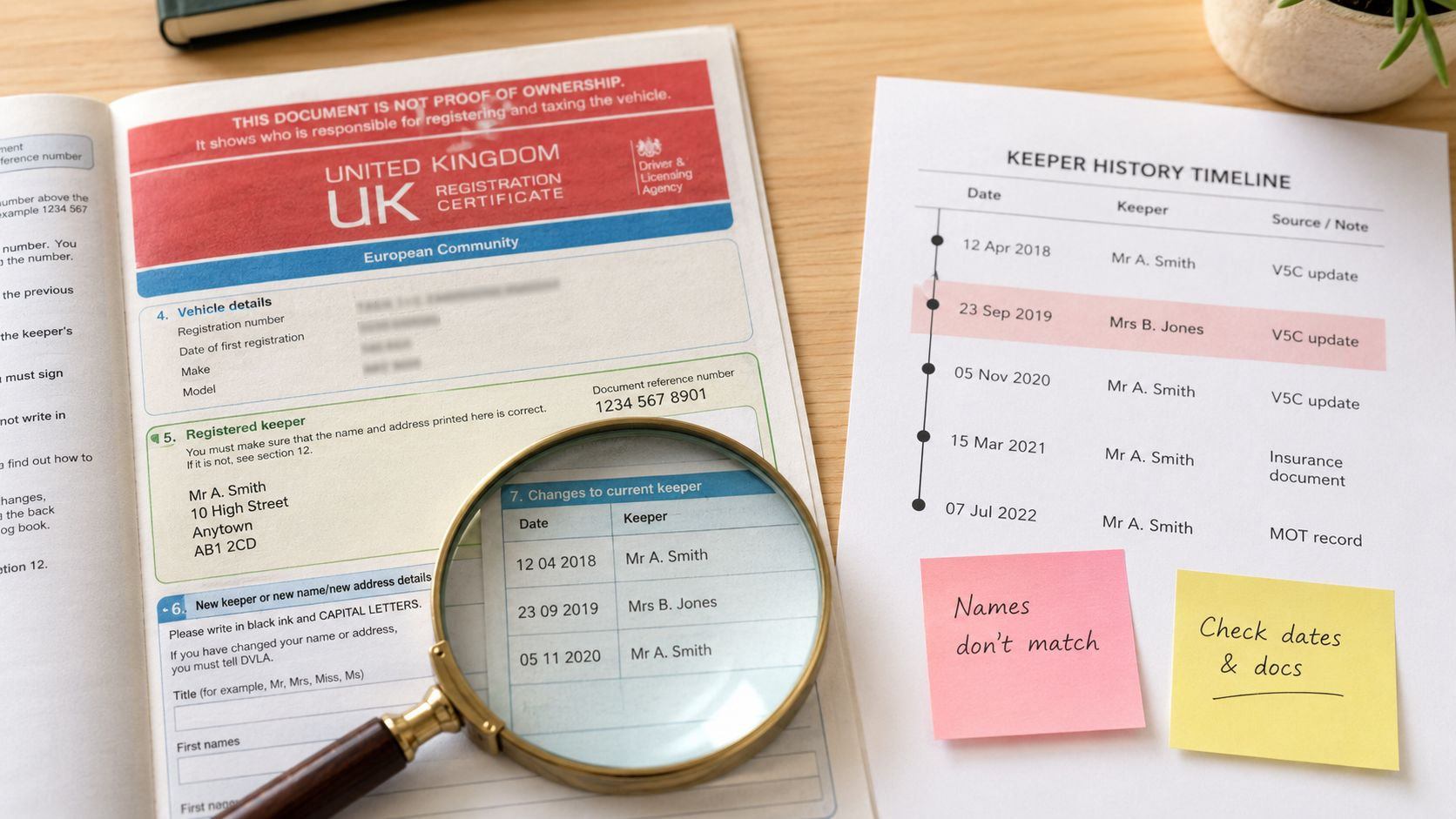
DVLA data is the base layer of a vehicle history check UK process, but it shouldn't be treated as the final answer. The stronger signal is often the discrepancy itself. When keeper dates, registration changes, addresses, or document history don't line up with the rest of the file, the issue isn't clerical until proven otherwise.
A common trade scenario is a car that appears tidy on paper but shows keeper movement that doesn't fit its use pattern. If a vehicle appears to move through several names in a short period, or the V5C trail feels untidy compared with the story you're being told, that's where margin risk starts. It can point to title washing, disguised trade circulation, or a seller who doesn't really control the vehicle's background.
Why a mismatch matters
The practical move is to compare DVLA keeper dates against MOT dates and service chronology. A car showing a keeper change with no corresponding change in use, no shift in testing location, and no sensible ownership narrative deserves more scrutiny than a car with a straightforward long-term keeper pattern.
Examples traders see regularly include:
- Rapid transfer pattern: A car registered to a dealer address, then moved through quick private sales, can indicate trade activity dressed up as retail history.
- Address inconsistency: Keeper addresses changing while MOT activity remains anchored to the same area can suggest paperwork that doesn't fully reflect actual use.
- Identity mismatch: Variations in names across records may be innocent, but if they sit alongside finance, insurance or mileage concerns, they become more meaningful.
Practical rule: Don't ask whether the DVLA record is technically present. Ask whether it makes sense as a timeline.
If the V5C story feels thin, proof of title and control matter just as much as registration detail. AutoProv's guide on proof of ownership of a car is useful for tightening that part of the process.
2. Mileage Anomalies and Pattern Analysis as Fraud Detection
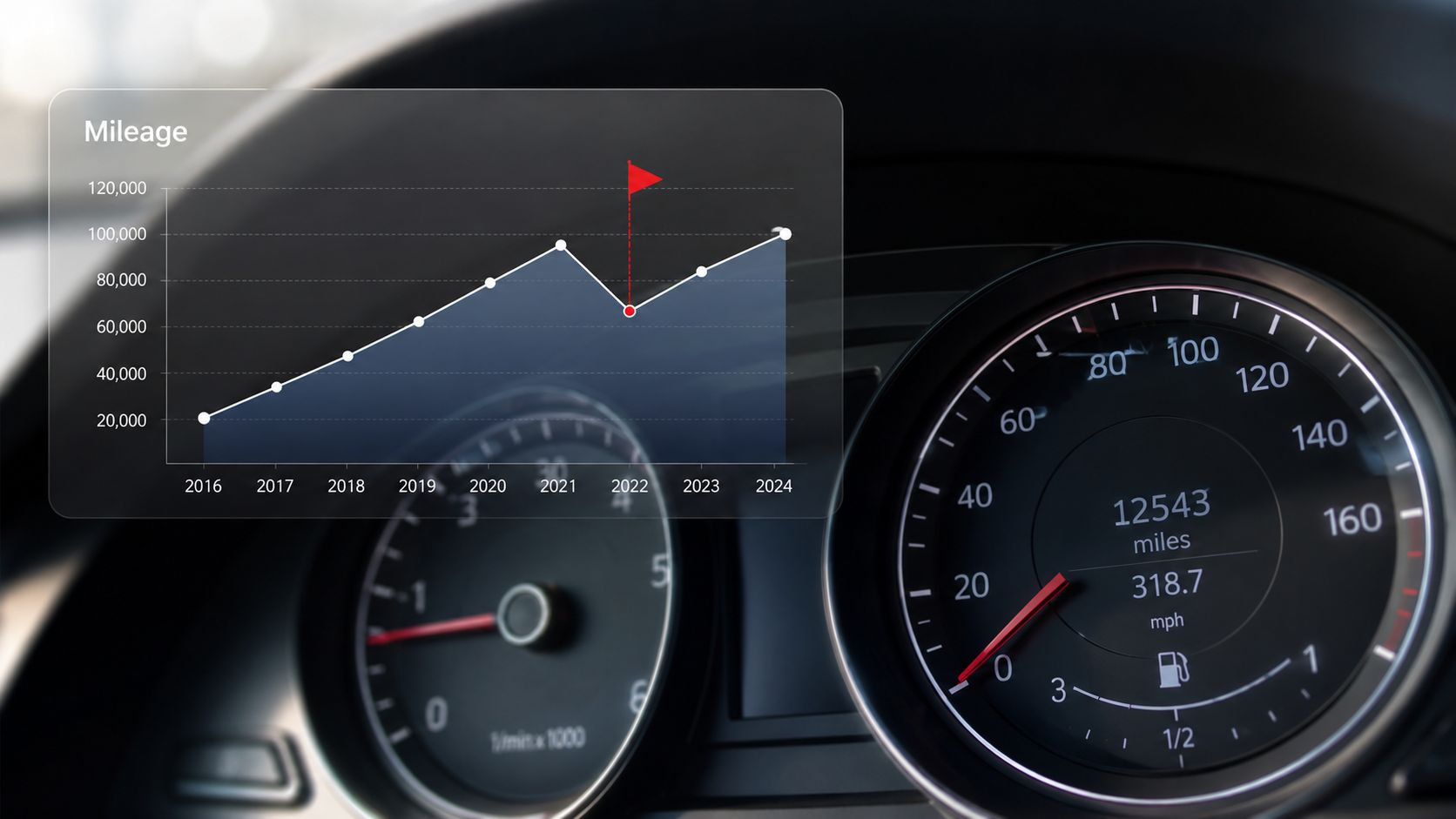
Mileage fraud hasn't gone away. It's just become easier to hide between visible checkpoints. According to AutoProv's review of RAC mileage check data, 1 in 11 cars show inaccurate mileage records, which is why a simple mileage check UK based only on MOT history leaves a blind spot.
That blind spot matters because MOT mileage is annual, not continuous. If a car is altered after one test and corrected, disguised or sold before the next pattern becomes obvious, the public record can still look broadly plausible to anyone reading it too quickly.
Read the sequence, not just the last figure
The sharpest traders don't just check for a rollback. They read progression rates across ownership periods. A BMW that climbs steadily for years, then suddenly goes static during several short-term keeper changes, is often more suspicious than a single obvious drop. The same applies to vans, taxis, rental stock and ex-fleet cars where usage should have a visible rhythm.
A workable approach is to assess three things together:
- Average usage pattern: Compare annual progression across the full life of the car, not just the last two MOT entries.
- Ownership fit: Ask whether the claimed use matches the miles. Static mileage during commercial ownership should never be waved through.
- Supporting records: Service invoices, warranty repairs and maintenance intervals should broadly support the odometer story.
Sometimes the issue isn't a dramatic reduction. It's an implausible pause. A van can sit in trade stock for a period, but if successive sellers claim ordinary use while the record barely moves, that's a pattern worth treating as motor trade risk, not a harmless oddity.
For a more structured way to flag irregular sequences, AutoProv's explanation of anomaly detection is closely aligned with how experienced buyers already think.
Mileage isn't a single data point. It's a behaviour pattern recorded over time.
3. Ownership Pattern Analysis and Short-Term Ownership Red Flags
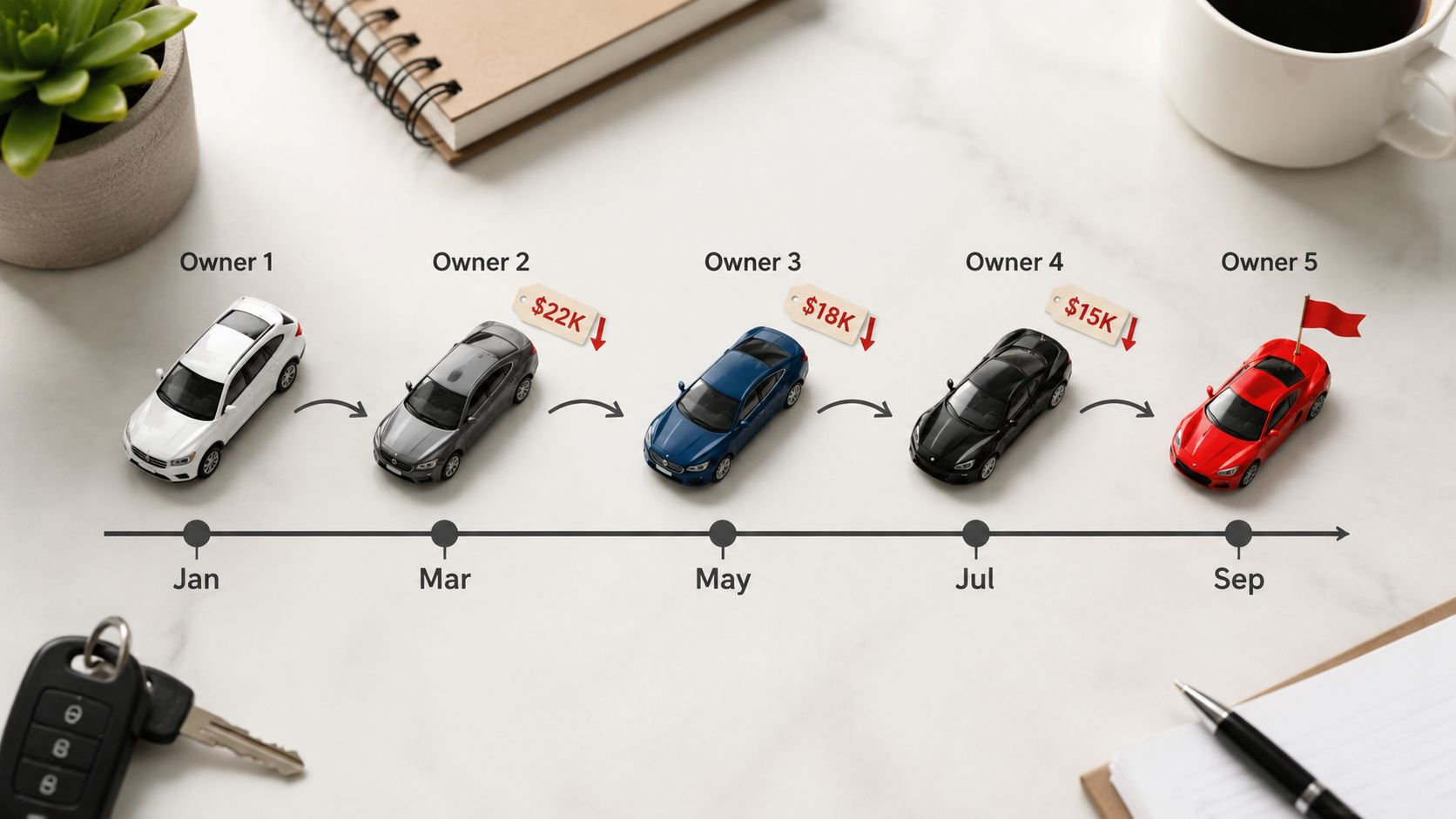
Ownership churn is one of the clearest signs that a vehicle provenance review needs to go deeper. Most mainstream buyer advice still focuses on checking the V5C and MOT, but it doesn't explain how to interpret churn patterns before acquisition. That gap matters because the Motor Ombudsman data cited in RAC's used car buying guide context shows 18% of post-sale disputes in 2024 to 2025 stemmed from undisclosed ownership churn or mileage inconsistencies that public DVLA-only snapshots don't detect.
For traders, this isn't abstract. A car that has circulated quickly through several hands often carries a reason, even if nobody writes it down. Mechanical faults, difficult diagnostics, unresolved finance issues, prior damage, or a car that looks easier to retail than it is.
Short-term ownership needs context
Not every brief keeper period is a red flag. Probate, relationship breakdown, relocation and genuine dealer transfers all happen. The issue is whether the sequence forms a believable narrative.
Useful patterns to map include:
- Repeated short holding periods: Several keepers holding the same car for brief spells can indicate a problem being passed along.
- Private-to-trade-to-private loops: These often reveal vehicles that have spent more time being moved than used.
- Descending trade confidence: If each seller appears less willing to hold the car, pay attention.
One of the better discipline checks is to plot each ownership period against MOT and service events. If the car changes hands, disappears from service records, reappears with a clean story and then moves again, the timeline itself is the warning.
Where this becomes powerful is in standardisation. If your buying team uses the same threshold for escalating short-term ownership every time, you stop arguing from gut feel. AutoProv's guide on how to check how many car owners is a useful foundation, but the trade value comes from what you do with that count.
4. MOT History Gaps and Service Record Discontinuities as Integrity Signals
An MOT pass history can look acceptable while the underlying chronology still feels wrong. Gaps between tests, abrupt changes in advisory patterns, and service records that stop and restart without explanation often tell you more than the latest pass certificate.
The trade mistake is to treat MOT status as binary. Pass means proceed, fail means negotiate. In practice, the sequence of tests and advisories carries much more intelligence than the headline outcome.
Gaps tell you where to ask harder questions
A car that tested consistently for years and then disappears before returning to the road deserves a proper explanation. Sometimes that explanation is benign. Stored vehicles exist. So do low-use second cars. But when the gap sits alongside ownership changes, mileage oddities or changed testing locations, it often points to off-road repair, deferred maintenance or a period where the car wasn't fit to retail.
This also matters at valuation stage. A 2025 analysis cited in a Reddit discussion on what to ask a car dealer found that cars with unresolved MOT advisories suffer a 6 to 9% average discount at private sale compared with compliant equivalents. That's a useful reminder that advisories aren't admin noise. They affect price, buyer confidence and post-sale friction.
A few high-value checks make a difference:
- Recurring advisories: If the same issue appears repeatedly and then vanishes without supporting repair evidence, verify what was done.
- Test centre changes: A sudden move to a different centre after a poor advisory pattern can be innocent, but it can also be avoidance.
- Service silence: Main dealer history that abruptly stops before resale often needs an explanation, especially on premium stock.
For a sharper reading of MOT sequences, AutoProv's breakdown of MOT history red flags is worth folding into your internal used car history report workflow.
5. Write-Off and Salvage Title History as Non-Negotiable Risk Assessment
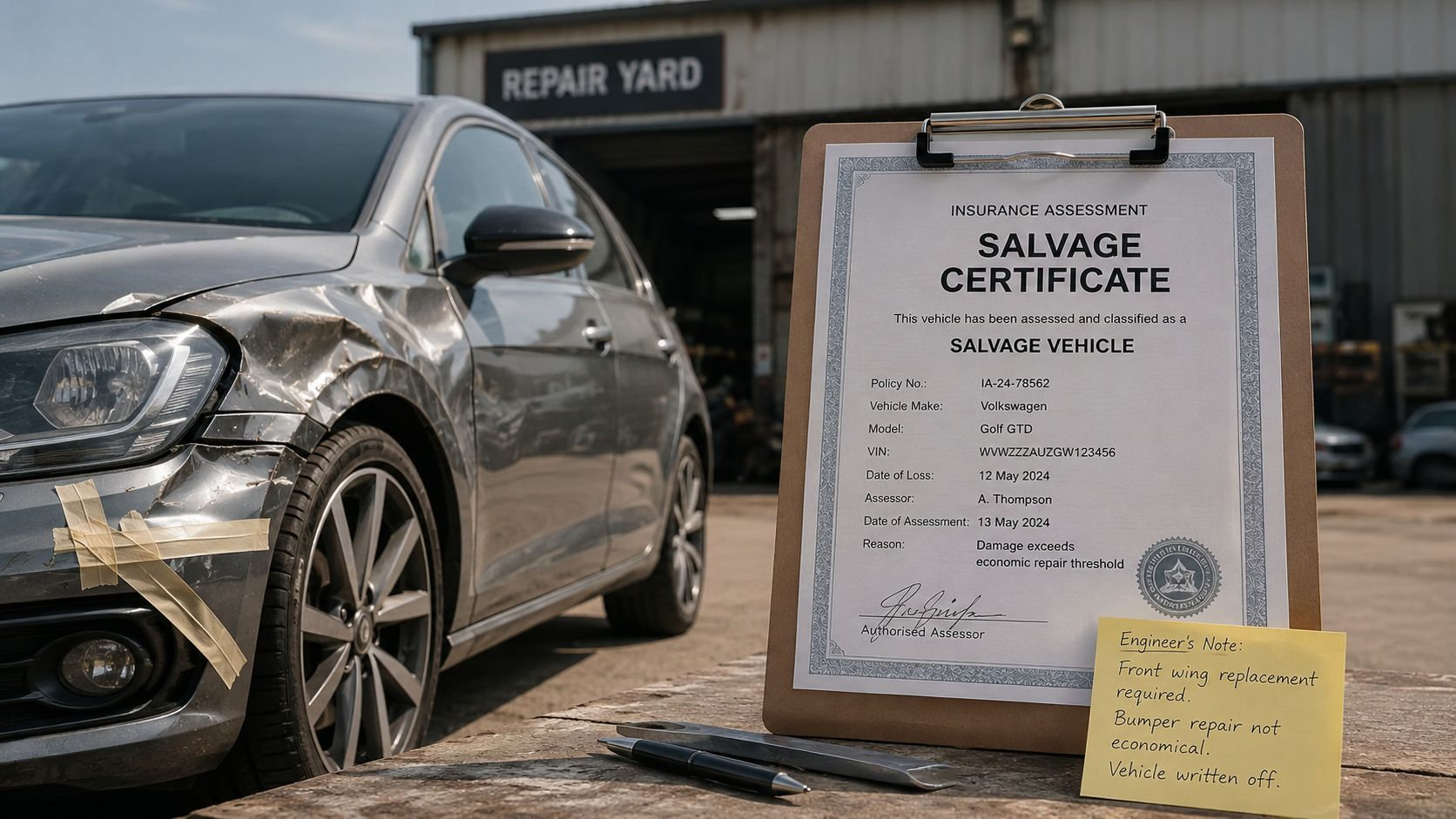
Write-off history is where too many buyers still rely on appearance. The car presents well, the repair looks neat, the drive is clean, and someone decides the paper can be dealt with later. That's backwards. Insurance-related status has to be understood before condition appraisal starts influencing judgement.
Paid vehicle history checks matter here because they access insurance industry records, police databases, finance records and specialist mileage or scrappage datasets beyond government-only checks, as outlined by Car Owl's explanation of vehicle history check data sources. If you're relying only on DVLA and DVSA information, you're not reviewing the full risk picture.
A clean appearance doesn't override category risk
The commercial question isn't only whether a repaired vehicle is roadworthy. It's whether its history supports the intended exit route, disclosure obligations, buyer appetite and margin. Some repaired cars can be retailed responsibly. Others should never get past appraisal.
A disciplined approach looks like this:
- Reject prohibited categories immediately: If the history indicates a vehicle that shouldn't be returning to the road, there's no trade-off to debate.
- Demand repair evidence: On any repaired insurance-loss vehicle, paperwork matters as much as panel quality.
- Value for market reality: The pool of buyers for a previously written-off car is narrower, more price-sensitive and more disclosure-aware.
Don't let visible condition overrule documentary risk. The paper decides whether the car is sellable before the forecourt decides whether it's attractive.
Salvage history also affects financeability, downstream buyer confidence and complaint exposure. AutoProv's guide on what title salvage means is useful if you're formalising how your team handles these files.
6. Insurance and Claim History Patterns as Behavioural Risk Indicators
Insurance events often get treated as yes or no markers. Claimed or not claimed. Written off or not written off. That misses the richer signal. Claim patterns can tell you how a vehicle was used, where it was kept, and whether a previous keeper's behaviour increased the chance of hidden issues.
The Car Expert found that 17.6% of checked vehicles had outstanding debt attached and 27.5% involved a number plate change issue, according to The Car Expert's analysis of UK vehicle history reports. Those two figures sit outside pure claims history, but they show the same principle. Risk tends to cluster. Vehicles with one irregularity often carry others.
Claim patterns rarely sit alone
A string of minor collision repairs over a short period can indicate harsh urban use, poor parking conditions or a driver profile that puts the vehicle under more stress than the odometer alone suggests. Theft-related claims can point to storage risk, key security issues or a vehicle profile that attracts targeting. None of these automatically kill a deal, but they should alter the depth of inspection.
In practice, traders should read claims alongside:
- Keeper changes: Did the claim pattern begin after a new keeper took over?
- Mileage story: Does the wear level fit the use implied by the claims?
- Repair evidence: Is there paperwork that supports what the insurance history suggests happened?
A car with one settled incident and transparent repair support is one thing. A car with plate changes, finance concerns, patchy servicing and claim activity is a different proposition altogether.
Trade vehicle intelligence becomes more useful than a pass or fail report. You're not just identifying incidents. You're deciding whether the vehicle's behavioural history fits the stock profile you want to carry.
7. Verifying Import Status and Vehicle Origin as Compliance Foundation
Imported stock can be profitable, but only if you buy it with the right burden of proof. UK records often start at the point of UK registration. They don't automatically explain what happened before the car arrived, how it was used, whether it was damaged abroad, or whether the odometer story was already compromised before the first UK MOT.
That's why origin checks shouldn't be folded into a general appraisal and left there. They need their own branch in your buying process, especially for higher-value or unusually specified stock where an attractive price can hide a thin history.
Imported stock needs a different standard of proof
A simple rule works well in practice. If the UK timeline starts later than the vehicle's life clearly began, treat the missing period as a live risk, not an administrative gap. Ask for import paperwork, registration evidence, foreign service documents, and anything that supports continuity.
Points worth checking closely include:
- First UK registration versus vehicle age: A delayed UK paper trail means there's history outside the UK system.
- Specification consistency: Features, trim, navigation language, safety equipment and instrument readings should fit the claimed origin.
- Document continuity: If import paperwork exists but maintenance history disappears during the foreign period, price accordingly or step away.
Imported vehicles aren't automatically high risk. Poorly documented imported vehicles are.
For experienced buyers, this is less about suspicion than stock discipline. If you can't build a coherent provenance story, you can't defend the valuation confidently when the car reaches retail, wholesale disposal, or complaint review.
8. Valuation Accuracy and Price-to-Condition Anomalies as Fraud Indicators
A seller offers a late-plate car at a price that looks comfortably under trade money. Clean photos, decent spec, quick sale, no obvious drama. Experienced buyers know that is not the point where margin is made. It is the point where discipline is tested.
Price is part of the evidence set.
If the number sits too far below the vehicle's apparent position in the market, treat that gap as something to explain, not a gift to accept. A cheap car can still be a strong buy, but only when the discount matches a clear and defensible reason such as cosmetic work, tyre spend, overdue servicing, weak colour, or limited retail demand. If the discount is larger than the known issues justify, there is usually another problem in the file, or one that has not surfaced yet.
Use valuation to test the story, not just set the bid
Valuation works best as a challenge process. Start with what the car should be worth if the history, condition, provenance and specification all align. Then test what has to be true for the offered price to make sense.
That means checking whether the price lines up with:
- Condition versus presentation: Fresh valeting and smart photography can hide tired interiors, poor paint readings, wheel refurbishment, water ingress or rushed repair work.
- History quality versus market level: Thin documentation, inconsistent mileage progression, keeper churn and unresolved chronology gaps should all depress value.
- Specification versus actual desirability: A high list price when new does not always convert into trade strength. Some option combinations narrow the retail audience rather than widen it.
- Exit route versus disclosure burden: Stock that looks retailable at purchase can become trade-only once adverse history is fully understood and declared.
- Reconditioning exposure versus headline margin: A cheap buy with uncertain mechanical, cosmetic or paperwork risk often loses its advantage after prep, warranty reserve and time in stock are costed properly.
The pattern matters more than the guide.
Public asking prices can anchor a buyer too high, especially on cars with weak provenance or unusual histories. Internal disposal data is usually more useful. If the business consistently takes longer to retail certain age-mileage-spec combinations, or repeatedly has to defend the same history points at handover, the valuation model should reflect that friction. Margin on paper is not margin in the bank.
The strongest buyers separate price anomalies into two groups. One group contains explainable discounts with a measurable cost to correct or disclose. The other contains discounts that do not reconcile with the visible facts. The second group deserves escalation, a harder inspection, or a walk-away decision.
That is how valuation becomes a fraud filter. Not by asking whether the car is cheap, but by asking whether the price, the condition and the history form one coherent commercial picture.
9. Multi-Source Data Cross-Referencing and Building Internal Trade Buying Protocols
No single source tells the full truth about a vehicle. DVLA tells part of it. MOT tells part of it. Insurance, finance, plate changes, mileage records and service history each add another layer. The actual decision happens where those layers agree, contradict each other, or leave a gap nobody can explain.
That's especially important because free and basic checks don't show the whole ownership picture. RAC states that a full vehicle history check identifies that 1 in 5 UK cars have had at least one number plate change, and that free checks don't provide the number of previous keepers or duration of ownership, which makes short-term churn harder to detect in trade buying decisions, as set out in RAC's guide to full car data checks.
Build a protocol people can actually follow
Smart buying ought to be operational, not individual. A buyer shouldn't need to be your most experienced appraiser to make a consistent call on obvious escalation cases. The process should do part of that work.
A strong internal protocol usually includes:
- A single chronology view: Plot registration events, MOT dates, mileage entries, claims, servicing and keeper changes in one place.
- Escalation triggers: Define what requires a second review. Short ownership spells, unexplained gaps, adverse insurance markers and mismatched mileage stories are typical examples.
- Documentation standards: Record why a car was approved, conditionally approved or rejected. This protects consistency later.
For larger groups or busy independent operations, the utility of a trade-focused platform becomes apparent. AutoProv supports that point-of-decision analysis by connecting vehicle provenance, used car history report data and anomaly patterns into one review process rather than leaving buyers to stitch it together manually.
When you formalise the workflow, you also improve training. Staff stop seeing checks as admin. They see them as capital protection.
9-Point Used Car Risk & Verification Matrix
Item 🔄 Implementation complexity ⚡ Resource requirements 📊 Expected outcomes 💡 Ideal use cases ⭐ Key advantages Understanding DVLA Record Discrepancies as a Primary Risk Signal Medium, requires contextual interpretation of official records Low–Medium, DVLA access and analyst time High 📊, reliable ownership/title flags; reduces title risk Pre-purchase ownership checks; title/keeper validation Authoritative source; strong early-warning for title/keeper anomalies ⭐ Mileage Anomalies and Pattern Analysis as Fraud Detection Medium–High, needs longitudinal pattern analysis Medium, MOT/service data plus analytics tools High 📊, effective at detecting clocking and mileage tampering Detecting odometer fraud; valuation integrity checks MOT-based historical mileage gives strong fraud signal ⭐ Ownership Pattern Analysis and Short-Term Ownership Red Flags Medium, timeline mapping and keeper-type classification Low–Medium, DVLA timelines, simple analytics High 📊, exposes trade-circulation and rapid-resale risk Identifying trader-cycled stock and rapid resale chains Clear indicator of trade-focused or risky resale patterns ⭐ MOT History Gaps and Service Record Discontinuities as Integrity Signals Low–Medium, pattern recognition of missing tests/services Low, MOT databases and service record checks Medium–High 📊, signals off-road periods, undisclosed repairs Spotting repair/storage history and maintenance gaps MOT data is mandatory and hard to fake; useful maintenance proxy ⭐ Write-Off and Salvage Title History as Non-Negotiable Risk Assessment Medium, requires category verification and documentation review Medium, insurer records, salvage checks, possibly engineer reports Very High 📊, decisive impact on legality, value and insurability Any acquisition; mandatory for compliance and value decisions Critical, often deal-breaking risk information; legally decisive ⭐⭐⭐ Insurance and Claim History Patterns as Behavioral Risk Indicators Medium–High, needs clustering and severity analysis Medium, insurer feeds and claim databases (may be incomplete) Medium–High 📊, reveals owner behavior and accident history Assessing behavioral risk, recurring damage, fleet exposure Third‑party verified incidents give independent evidence ⭐ Verifying Import Status and Vehicle Origin as Compliance Foundation Medium–High, cross-border data reconciliation High, international records, specialist checks may be needed Medium 📊, prevents hidden foreign damage and compliance issues Imported vehicles; re-imports or vehicles with late UK history Protects against missing foreign history and compliance surprises ⭐ Valuation Accuracy and Price-to-Condition Anomalies as Fraud Indicators Medium, comparative market analysis and benchmarks Low–Medium, market data sources and valuation tools Medium 📊, flags pricing that warrants deeper inspection Negotiation, spotting undervalued/overpriced stock Helps prevent overpaying and uncovers descending-value chains ⭐ Multi-Source Data Cross-Referencing and Building Internal Trade Buying Protocols High, process design, data correlation, rule definition High, data aggregation, tooling, staff training, governance Very High 📊, most comprehensive risk reduction and auditability Enterprise buying strategy; standardising due diligence across teams Reduces blind spots, supports compliance and consistent decisions ⭐⭐⭐
From Data Points to Decisions: Integrating Vehicle Intelligence
A buyer stands at the ramp with a car that looks easy money. Clean panels, sensible guide price, no obvious warning on the first report. Then the timelines are lined up properly. The mileage growth is technically possible but too uneven for the use case. The keeper changes are short and stacked. A registration detail does not match cleanly across sources. That is where profit disappears, not in the obvious cases, but in stock that only looks acceptable when each record is viewed on its own.
Experienced traders make money by reading context, not by collecting more PDFs. A tidy MOT sequence can sit alongside ownership churn that suggests a vehicle nobody wanted to keep. A believable odometer reading can still be wrong in commercial terms if the annual usage rate swings sharply without a credible reason. A clean appraisal does not cancel out weak provenance. It just delays the problem until prep, warranty, or complaint stage.
As noted earlier, the UK used car market remains large and competitive. In a market of that scale, margin is protected through selection discipline. The edge comes from identifying risk earlier than the next buyer, pricing it correctly, or walking away before time and prep spend are tied up in the wrong unit.
That requires a shift from box-ticking to pattern analysis. Provenance check, MOT status, finance, write-off markers and service evidence still matter, but on their own they are only data points. The buying decision improves when those points are read as a timeline. How quickly did keepers change? Does mileage progression fit the ownership profile? Do MOT advisories, servicing and claims history point in the same direction, or are they oddly disconnected? In practice, the inconsistencies between sources often matter as much as any single alert.
A proper buying protocol turns that judgement into a repeatable process. Buyers review DVLA detail, MOT continuity, mileage rate of change, ownership velocity, insurance-related markers, finance exposure, provenance, and valuation fit in the same order every time. Borderline cases are escalated against clear thresholds rather than gut feel. That protects buying standards across the team and creates an audit trail when a vehicle later becomes a dispute, a comeback, or an internal review.
AutoProv supports that process by pulling fragmented records into one risk view at the point of decision. It does not replace judgement. It gives buyers a cleaner way to compare timelines, spot source inconsistencies, and separate manageable risk from stock that is likely to consume margin after purchase.
The best operators do not stop at running checks. They compare sequences, test whether the story is commercially credible, and act early when the pattern is off. That is the point where raw vehicle data becomes buying intelligence.
AutoProv helps UK dealers turn raw records into practical buying decisions. If you want a clearer view of vehicle provenance, ownership patterns, mileage anomalies and hidden motor trade risk before you commit to stock, AutoProv provides trade-focused vehicle intelligence built for that exact job.
Frequently Asked Questions
AI-Generated Content Notice
This article was created with the assistance of artificial intelligence technology. While we strive for accuracy, the information provided should be considered for general informational purposes only and should not be relied upon as professional automotive, legal, or financial advice. We recommend verifying any information with qualified professionals or official sources before making important decisions. AutoProv accepts no liability for any consequences resulting from the use of this information.
From our AI insights
- Navigating ULEZ Compliance for Used Car Dealers
A deep dive into ensuring your used car stock meets ULEZ standards, avoiding costly fines.
- Mastering Paint Verification with VIN Decoding
Learn how UK traders verify original paint using VIN decoding and provenance data.
- Understanding VIN Decoding: Avoid Misleading Imports
Learn how VIN decoding reveals vehicle origins and specs, preventing import pitfalls.
Related Articles

Car Specs by Reg: Instantly Find Vehicle Details & MOT History
Trying to find the full car specs by reg? In the UK, that little number plate is the key to unlocking a huge amount of information about a vehicle. From the exact engine size and CO2 emissions to its MOT history and tax status, it's all tied to the registration.

How to Check Previous Owners of a Car in the UK
Before you even start thinking about how to check the previous owners of a car, you need to get your head around why it's so important. This isn't just about being nosy; it’s a non-negotiable step that protects you from serious financial headaches and safety risks lurking under a shiny bonnet.

How to Check Service History in the UK
Think of a car's service history as its detailed CV, not just some dusty folder in the glovebox. To check service history is to get the real story behind a vehicle, digging into everything from its routine oil changes to any major surgery it's had. For any savvy car buyer in the UK, this record is the single most important document you can get your hands on.
Published by AutoProv
Your trusted source for vehicle intelligence