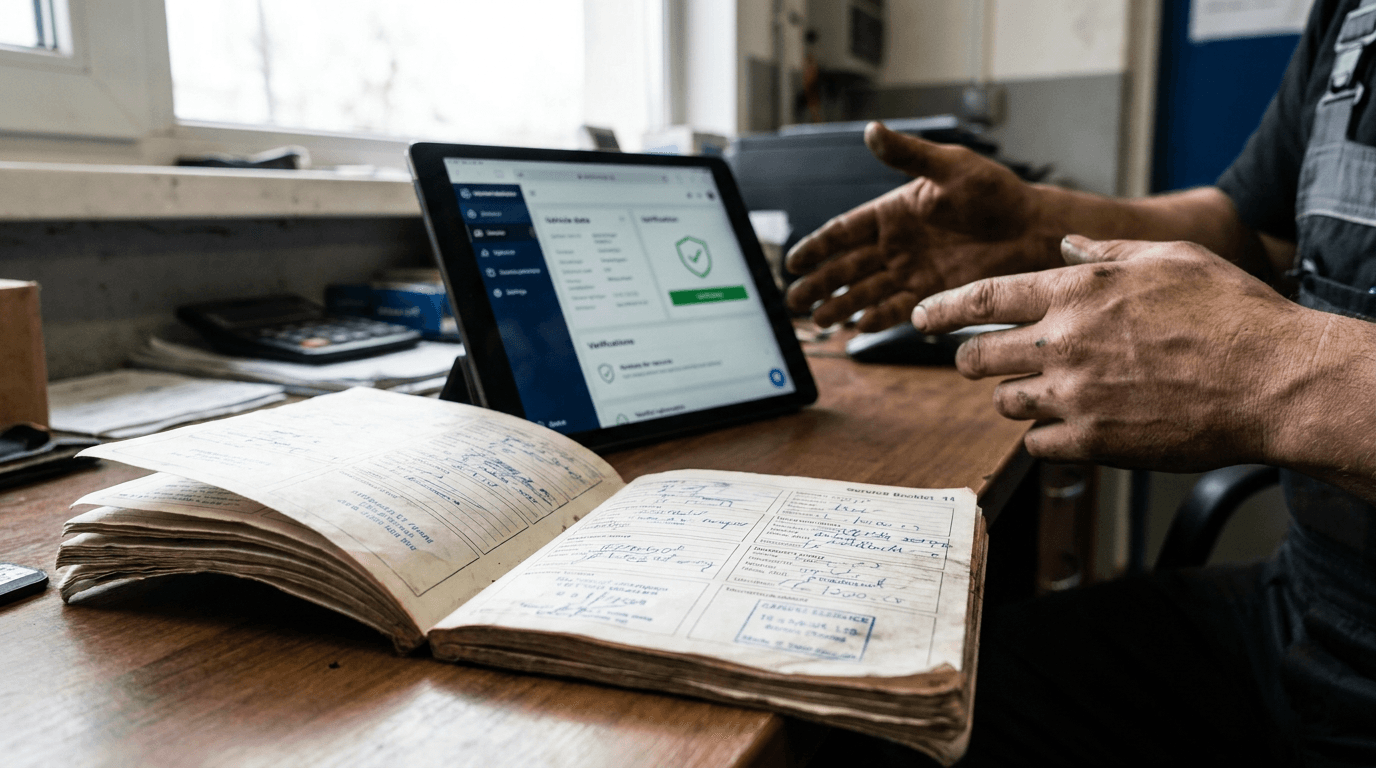
Paper logbooks get lost, stamps get faked, and service histories disappear. Discover why UK motor traders need digital service verification for proper due diligence.
By CiteFlow
The fundamental problem with paper service books
Paper service books are unreliable for trade due diligence because they can be lost, forged, incomplete, or deliberately withheld to hide maintenance gaps. A stamped logbook proves only that someone applied ink to paper, not that the work was completed to manufacturer standards or even performed at all. For UK motor traders operating under Consumer Rights Act 2015 requirements, accepting a paper service book at face value creates unnecessary risk when selling vehicles as having full service history.
The physical nature of service books makes them vulnerable to damage, separation from the vehicle during ownership changes, and simple misplacement. When a seller presents a vehicle without its service book, you face an impossible choice: reject a potentially sound vehicle or proceed without verification. Neither option serves your business well. Digital manufacturer records eliminate this problem entirely by maintaining permanent, tamper-proof histories that survive ownership transfers and physical book loss.
Forgery has become increasingly sophisticated. High-quality colour printers, readily available dealer stamps on online marketplaces, and knowledge of correct service intervals allow fraudsters to create convincing fake histories. The financial incentive is substantial. A three-year-old premium vehicle with full service history commands thousands more than an identical model with gaps or no documentation.
How service book fraud undermines your stock appraisal
Service book fraud directly impacts your purchasing decisions and subsequent selling price. When you base stock acquisition on a fraudulent service history, you overpay for the vehicle relative to its true condition and maintenance status. This error compounds when you advertise the vehicle as having full service history, price it accordingly, and later face rejection or warranty claims when the deception emerges.
The most common fraud patterns include backdated stamps applied all at once, stamps from non-existent service centres, and genuine stamps for work that was never completed. Some sellers purchase blank service books for their vehicle model and create entirely fictional histories. Others present books with selective pages removed to hide unfavourable MOT advisories or missed services that would reveal neglect.
Mileage discrepancies often accompany service book fraud. A clocked vehicle needs a corresponding adjusted service history to appear credible. Fraudsters create new service books showing lower mileage intervals or selectively stamp only the services that align with the reduced odometer reading. Without access to manufacturer database coverage showing actual recorded mileages at each service visit, these manipulations remain hidden until a subsequent check reveals the truth.
Your reputation suffers regardless of intent. Customers who discover they purchased a vehicle with fraudulent service history rarely accept that you were also deceived. They expect professional traders to verify claims before sale. Consumer protection regulations support this expectation, placing the burden of accurate description on the seller.
What digital manufacturer records actually verify
Digital manufacturer service records verify the date, mileage, work performed, and authorised dealer location for every service visit captured in OEM databases. These records come directly from manufacturer systems fed by franchised dealer workshop software, creating an audit trail that cannot be retrospectively altered. When a main dealer completes service work, the transaction enters the manufacturer's central database within hours, timestamped and linked to the vehicle's VIN.
The verification extends beyond simple service intervals. Digital records show specific work items completed during each visit, parts replaced, warranty claims processed, and technical campaigns or recalls addressed. This granularity allows you to assess whether the vehicle received appropriate maintenance for its use pattern and identify any recurring issues that might indicate underlying problems.
Mileage validation forms a critical component of digital service verification. Each service visit records the odometer reading at that moment, creating a chronological mileage history that reveals clocking attempts. Sudden decreases, implausible low mileage for vehicle age, or gaps that don't align with typical annual mileage patterns all become immediately visible when you review the digital timeline.
Coverage varies by manufacturer, with some OEM databases extending back fifteen years or more while others maintain shorter retention periods. Premium and volume manufacturers typically offer the most comprehensive digital records, though coverage continues to expand across all segments as digital workshop systems become universal in franchised networks.
The compliance risk of accepting paper-only verification
Accepting paper service books without digital verification exposes you to compliance risk under the Consumer Rights Act 2015 because you cannot substantiate claims about service history if the documentation proves fraudulent. When you describe a vehicle as having full service history based solely on stamps, you make a factual claim about its maintenance record. If that claim is false, the vehicle is not as described, triggering rejection rights and potential legal liability.
The burden of proof sits with you as the seller. A customer who discovers missing or fraudulent services need not prove you acted dishonestly, only that the vehicle differs from its description. Your reliance on a paper book provides no defence. Courts and arbitration services expect professional traders to exercise reasonable due diligence, which increasingly means verifying claims against independent digital sources rather than accepting seller-provided documentation.
Distance selling regulations compound this risk. When you sell vehicles online or through platforms requiring pre-purchase descriptions, customers rely entirely on your written claims. They cannot inspect the service book before purchase. If the service history proves inaccurate, the vehicle fails to match its description before the customer takes delivery, potentially triggering immediate rejection rights within the first 30 days.
Record-keeping requirements under consumer protection regulations demand that you can demonstrate the basis for your claims. A paper service book that later proves fraudulent does not satisfy this requirement. Digital verification reports with timestamps, data sources, and independent validation provide the documentation trail necessary to show you conducted appropriate checks before making claims about the vehicle's history.
Why main dealer history commands a premium
Main dealer service history commands a premium because it provides verifiable proof that manufacturer-trained technicians used genuine parts and followed OEM service schedules, reducing mechanical risk and supporting warranty claims. Buyers of premium and near-new vehicles particularly value this assurance, often refusing to consider vehicles serviced outside the franchised network during warranty periods.
The price differential is measurable. Identical vehicles with verified main dealer history versus independent service history or no documentation can differ by 5-15% depending on marque, age, and segment. For a £20,000 vehicle, that represents £1,000-£3,000 in additional margin, making verification of main dealer claims financially material to your stock decisions.
Approved used schemes operated by manufacturer franchises require unbroken main dealer service history as a condition of certification. Vehicles that qualify for these programmes access preferential finance rates, extended warranties, and manufacturer marketing support, all of which enhance saleability and justify higher retail prices. Without digital verification, you cannot confirm eligibility before purchase.
Manufacturer goodwill and warranty extensions often depend on service history. A vehicle approaching the end of its warranty period with a developing fault may receive goodwill coverage if it has complete main dealer history, but face rejection if services were completed elsewhere or cannot be verified. This potential liability transfers to you if the vehicle develops issues after sale and the customer discovers the service history was incomplete or fraudulent.
How digital verification protects your margin
Digital verification protects your margin by preventing overpayment for vehicles with fraudulent or incomplete service histories and enabling accurate pricing based on verified maintenance records. When you know the true service status before purchase, you avoid the common trap of paying full-history prices for vehicles that will later need to be retailed at no-history values.
The protection works in both directions. Digital records also reveal genuine service history on vehicles where the paper book has been lost, allowing you to pay appropriate prices for well-maintained vehicles that other buyers might undervalue due to missing documentation. This information asymmetry creates profitable opportunities when you can verify what others cannot.
Stock turn improves when vehicles are accurately described. Customers searching specifically for full main dealer history find your stock through filtered searches, while those willing to accept independent service history aren't disappointed by misleading claims. This matching efficiency reduces days to sell and associated holding costs.
Dispute resolution becomes straightforward when you have independent digital verification supporting your claims. A customer challenging your service history description faces documentary evidence from manufacturer databases rather than a he-said-she-said argument about paper stamps. This evidential strength typically resolves disputes quickly in your favour or prevents them arising in the first place.
The gap between service book stamps and actual work completed
Service book stamps and actual work completed often diverge because stamps can be applied without corresponding work, genuine work can be performed without stamping, and service books can be replaced or recreated after the fact. This gap creates a verification problem that paper documentation alone cannot solve.
Some service centres stamp books as a customer service gesture even when customers decline recommended work or request only partial service. The stamp suggests full manufacturer-schedule service occurred, but the actual work may have been limited to an oil change or specific repair. Without access to the detailed work order recorded in digital systems, you cannot distinguish between full and partial service.
Independent garages performing genuine quality work often lack official stamps or use generic service stamps rather than manufacturer-specific ones. The resulting service book appears incomplete despite the vehicle receiving appropriate maintenance. Digital records from independent garages rarely feed into manufacturer databases, creating a permanent documentation gap even when the work was completed to high standards.
Replacement service books present particular challenges. Manufacturers and dealers will issue replacement books for lost originals, but the new book arrives blank. Owners then face a choice: leave it empty (losing the value associated with service history) or recreate the history from memory, receipts, or imagination. The resulting stamps may be entirely accurate, partially accurate, or completely fabricated, with no way to distinguish between these scenarios without digital verification.
What comprehensive trade due diligence actually requires
Comprehensive trade due diligence requires verification of service history through manufacturer databases, cross-referenced against MOT mileage records, finance status, write-off history, and stolen vehicle registers to build a complete provenance picture. No single data source provides sufficient assurance on its own. Paper service books form one input, but digital verification from independent sources must confirm or contradict the claims those books make.
The verification process should occur before purchase commitment, not after. Auction environments create time pressure, but even a five-minute digital check provides substantially more protection than visual inspection of a service book alone. Mobile access to verification tools allows on-site checking before you bid or agree a purchase price.
Mileage consistency across multiple sources forms a critical verification layer. Digital service records showing mileage at each visit should align with MOT history mileage progression and current odometer reading. Discrepancies indicate either clocking or data errors, both of which require investigation before purchase. A vehicle showing 45,000 miles with service records confirming that figure but MOT history showing 78,000 miles two years ago has obvious problems.
Factory specification verification prevents a different category of mis-description. A vehicle may have genuine service history but be incorrectly described regarding its original equipment and options. Digital build data from manufacturer systems shows exactly what left the factory, preventing overpayment for claimed options that were never fitted.
Why traditional provenance checks miss service history verification
Traditional provenance checks miss service history verification because they focus on finance, theft, and write-off status rather than maintenance records and manufacturer service data. These checks answer important questions about legal title and insurance history but provide no insight into whether the vehicle has been maintained according to manufacturer schedules or what work has actually been completed.
The data sources differ fundamentally. provenance-style checks draw from finance company records, police stolen vehicle databases, and insurance write-off registers. Service history verification requires access to manufacturer OEM databases and franchised dealer workshop systems. These are separate data ecosystems that don't overlap in traditional vehicle check products.
Many traders assume a clear provenance check constitutes complete due diligence, but this assumption leaves service history entirely unverified. A vehicle can pass provenance checks with no finance, theft, or write-off issues while simultaneously having a completely fraudulent service book. The checks address different risk categories and both are necessary for comprehensive verification.
Integrated platforms that combine traditional provenance checks with digital service history verification provide the complete picture professional traders need. Rather than purchasing separate checks from multiple providers, a single report covering finance, theft, write-offs, MOT history, and manufacturer service records streamlines the verification process and ensures no critical data category is overlooked.
The manufacturer database coverage you can actually access
Manufacturer database coverage accessible through trade verification services currently spans 43-44 OEM systems including all major volume and premium brands sold in the UK market. Coverage includes European manufacturers (Volkswagen Group brands, BMW, Mercedes-Benz, Renault-Nissan, PSA Group, Volvo), Japanese manufacturers (Toyota, Honda, Mazda, Subaru), and British brands (Jaguar Land Rover). American and some specialist manufacturers have more limited digital service history availability.
The depth of historical data varies by manufacturer. Some OEM databases retain service records for the vehicle's entire life, while others maintain rolling windows of recent years. Premium manufacturers typically offer the most comprehensive historical coverage, reflecting their emphasis on main dealer service networks and approved used programmes.
Not every service visit appears in manufacturer databases. Only work completed at franchised main dealers using connected workshop systems feeds into OEM central records. Independent garages, fast-fit centres, and mobile mechanics operate outside this network. Their work may be entirely legitimate and high-quality, but it won't appear in manufacturer digital records. This limitation means digital verification confirms main dealer history but cannot verify independent service work.
Real-time updates mean recent service work appears in databases within hours or days of completion. When appraising a vehicle that the seller claims was serviced last week at a main dealer, you can verify that claim immediately rather than relying on a fresh-looking stamp that could have been applied anywhere.
How to verify service claims on vehicles without paper books
Verifying service claims on vehicles without paper books requires VIN-based lookup in manufacturer databases to retrieve digital service records directly from OEM systems, bypassing paper documentation entirely. The vehicle identification number provides the key to accessing the complete service history recorded by franchised dealers, regardless of whether physical documentation exists.
This capability transforms vehicles with lost service books from risky purchases into verifiable opportunities. A well-maintained vehicle that has been serviced exclusively at main dealers throughout its life retains that value even if the owner lost the service book years ago. Digital verification recovers the complete history, allowing you to pay and price the vehicle appropriately.
The verification process takes minutes. Enter the VIN, retrieve the manufacturer service records, and review the chronological history of service visits with dates, mileages, and work completed. Cross-reference this against MOT history to confirm mileage consistency and current odometer reading to identify any discrepancies.
Some manufacturers provide more detailed records than others. Premium brands often include specific work items, parts replaced, and technician notes. Volume manufacturers may show only service dates and mileage. Even basic records provide substantial verification value by confirming that services occurred and establishing a mileage timeline.
The future of service history in vehicle transactions
The future of service history in vehicle transactions will be predominantly digital, with paper service books becoming supplementary documentation rather than primary evidence of maintenance. Manufacturer databases will expand coverage, independent garages will increasingly feed data into centralised verification systems, and blockchain or distributed ledger technologies may create tamper-proof service records spanning all service providers.
Regulatory pressure will likely accelerate this transition. As consumer protection enforcement increases and courts expect higher due diligence standards from professional traders, digital verification will shift from competitive advantage to baseline requirement. Traders who continue relying solely on paper documentation will face increasing liability risk.
Connected vehicle technology enables automatic service record creation. Modern vehicles with embedded connectivity can report service visits, mileage, and even specific work completed directly to manufacturer systems without dealer input. This automation eliminates the human intervention points where fraud currently occurs.
The valuation impact will intensify. As digital verification becomes standard practice, the premium commanded by digitally verified service history will increase while vehicles with paper-only documentation face growing scepticism and corresponding value reduction. Buyers will simply expect verification, making unverifiable claims about service history increasingly worthless in the marketplace.
Frequently Asked Questions
AI-Generated Content Notice
This article was created with the assistance of artificial intelligence technology. While we strive for accuracy, the information provided should be considered for general informational purposes only and should not be relied upon as professional automotive, legal, or financial advice. We recommend verifying any information with qualified professionals or official sources before making important decisions. AutoProv accepts no liability for any consequences resulting from the use of this information.
From our AI insights
- Navigating UK Grey Imports: A Trader's Guide
Understand the complexities and opportunities of UK grey imports for savvy motor traders.
- Navigating Private Plate Challenges in UK Vehicle Checks
Learn how private plates affect UK vehicle checks and how traders verify provenance and spot cloning risks.
- Navigating VIN Checks Post-Brexit: What UK Traders Need to Know
Discover how Brexit impacts VIN checks for UK traders and the crucial data to review.
Related Articles

Essential Vehicle Checks Before Buying a Used Car
Learn essential checks to ensure your used car purchase is safe and sound in the UK market.

Why a Provenance Check is Essential for Used Car Buyers
Ensure your used car is a smart investment by understanding the importance of a provenance check and how AutoProv can help.
A Guide to Vehicle Check with VIN Number
A vehicle check with vin number is easily the most important thing you can do before buying a used car. Think of it as your first line of defence—a quick, simple step that pulls back the curtain on a vehicle's past, protecting you from expensive mistakes, legal headaches, and downright dangerous cars.
Published by AutoProv
Your trusted source for vehicle intelligence