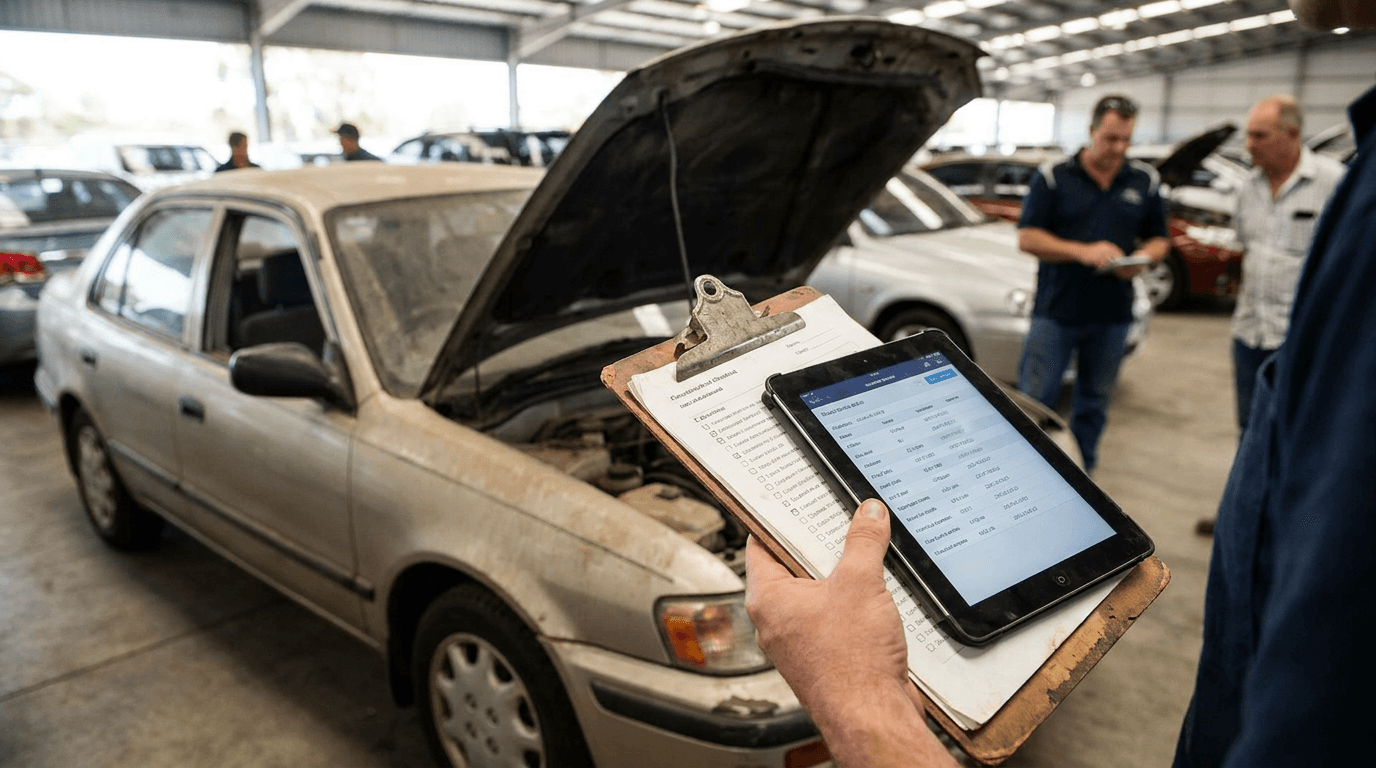
Master rapid auction due diligence with this trade-focused 10-minute vehicle intelligence checklist. Cover finance, provenance, specifications, and market data before
By CiteFlow
Why Auction Buyers Need a Rapid Intelligence Protocol
Auction buyers need a systematic 10-minute intelligence protocol because bidding decisions must be made quickly, often without physical inspection, and the consequences of buying blind can cost thousands. A structured checklist ensures you cover finance status, provenance red flags, specification accuracy, and market viability before committing to a purchase. The difference between a profitable stock buy and an expensive mistake often comes down to the intelligence work completed in the minutes before the hammer falls.
Auction environments compress decision-making timelines dramatically. Where forecourt purchases allow for leisurely appraisals and test drives, auction buying demands rapid synthesis of multiple data points. You are evaluating not just the vehicle's condition but its legal status, historical accuracy, specification authenticity, and market positioning, all whilst competing bidders are doing the same. The traders who consistently win profitable auction stock are those who have refined their intelligence gathering into a repeatable, time-efficient process.
This checklist assumes you have access to comprehensive vehicle intelligence tools that aggregate multiple data sources. Attempting to manually check each source individually will exceed your time budget and leave gaps in coverage. The protocol outlined here is designed for professional traders who understand that speed without thoroughness is recklessness, but thoroughness without speed means missed opportunities.
Finance and Legal Status Verification (Minutes 1-2)
Begin every auction intelligence check by confirming the vehicle has no outstanding finance, active hire purchase agreements, or legal encumbrances that would prevent you from obtaining clear title. Outstanding finance represents the single highest-value risk in auction purchases, as you may be forced to settle the debt or lose the vehicle entirely. Check the finance register immediately, before investing time in any other aspect of the intelligence process.
Verify the vehicle has not been recorded as stolen on police databases. Stolen vehicle recovery can occur months or years after purchase, leaving you with total loss and potential legal complications. Cross-reference the VIN and registration against theft databases as part of your opening checks. A clean finance and theft check provides the foundation for proceeding with the remainder of your intelligence gathering.
Confirm the vehicle is not currently subject to an insurance write-off categorisation that would affect its value or legal status. Category S and N vehicles can be viable stock if priced appropriately and disclosed correctly, but Category A and B vehicles should never be returned to the road. Understanding the importance of finance checks in vehicle purchases prevents costly legal complications that can arise months after the sale.
Provenance and History Red Flags (Minutes 3-4)
Examine the vehicle's recorded keeper history for patterns that suggest problems. Multiple short-term keepers, particularly in rapid succession, often indicate undisclosed faults that prompted quick disposal. A single long-term keeper followed by trade-to-trade movement is typically a positive indicator. Look for gaps in the timeline that might suggest periods off-road due to accident damage or mechanical failure.
Review the complete MOT history for mileage consistency and failure patterns. Mileage that decreases between tests, shows implausible jumps, or contradicts service records indicates clocking. Repeated failures on the same components suggest ongoing mechanical issues that the previous keeper chose not to resolve properly. Advisory items that appear consistently across multiple tests reveal deferred maintenance that will require attention.
Check for insurance database markers that indicate previous accident involvement, even if the vehicle was not written off. Accident markers can affect future insurability and resale value, particularly on premium and performance vehicles where buyers are more cautious. Cross-reference any accident dates with MOT and service records to assess whether proper repairs were completed. A comprehensive vehicle appraisal checklist helps identify these red flags systematically.
Specification and Build Data Validation (Minutes 5-6)
Verify the vehicle's specification against factory build data using the VIN. Auction descriptions frequently contain errors, omissions, or deliberate misrepresentations regarding optional equipment. High-value options like panoramic roofs, premium sound systems, advanced driver assistance packages, and performance upgrades significantly affect both your bidding ceiling and retail pricing. Confirming which options were actually fitted at the factory prevents overpaying for equipment that is not present.
Check that the stated engine, transmission, and trim level match the VIN decode. Mis-described vehicles are common in auction environments, sometimes through innocent error but often through deliberate attempts to inflate perceived value. A vehicle described as a higher trim level or more powerful variant than it actually is will disappoint retail customers and damage your reputation. The vehicle build sheet check provides definitive factory data that overrides seller descriptions.
Validate the exterior colour and interior specification against build records. Resprayed vehicles or those with replaced interior components may indicate accident damage or wear that exceeds normal use. Original paint and trim are particularly important on premium and classic vehicles where authenticity commands a price premium. Inconsistencies between build data and the vehicle's current state warrant further investigation or a reduced bid.
Service History and Maintenance Records (Minutes 7-8)
Retrieve digital service history from manufacturer databases where available. Digital records provide independent verification of maintenance that cannot be faked, unlike paper service books which can be lost, forged, or selectively edited. Confirmed dealer servicing at appropriate intervals indicates conscientious ownership and reduces the likelihood of deferred maintenance problems. Gaps in service history, particularly on premium vehicles, suggest either independent servicing or neglect.
Assess whether the service intervals align with manufacturer recommendations and whether major service items have been completed. Timing belts, dual-mass flywheels, and other high-value maintenance items that are due or overdue represent immediate costs that must be factored into your bidding strategy. Vehicles approaching major service milestones are less attractive to retail buyers and may require price adjustments.
Cross-reference service history mileage against MOT records and the current odometer reading. Consistent mileage progression across all data sources confirms accuracy, whilst discrepancies indicate potential clocking or data errors. Digital service records are particularly valuable for spotting clocked mileage because they create an independent audit trail that predates any tampering.
Market Intelligence and Valuation (Minutes 9-10)
Compare the vehicle's specification and condition against current market valuations for similar examples. Understand both the retail price you can reasonably achieve and the wholesale price that represents your competition in the auction. Your maximum bid should account for reconditioning costs, your margin requirement, and the time value of capital whilst the vehicle sits in stock. Overpaying at auction eliminates profit before you have even begun retail preparation.
Review days-to-sell data for this make, model, and specification in your geographic market. Fast-moving stock allows for tighter margins because capital turnover is rapid, whilst slow-moving vehicles require higher margins to compensate for extended holding periods. A vehicle that typically takes 60 days to sell ties up capital and forecourt space that could be generating returns elsewhere. Market intelligence informs not just how much to bid but whether to bid at all.
Assess current market supply levels for similar vehicles. Oversupplied markets depress prices and extend selling times, making auction purchases less attractive unless you can secure them at significantly below typical wholesale. Undersupplied markets offer opportunities to achieve premium retail prices if you can source desirable stock. The vehicle valuations and market insights tool provides the context needed for informed bidding decisions.
Critical Decision Points Before Bidding
Establish your absolute maximum bid before the auction begins, based on the intelligence you have gathered. Auction environments create competitive pressure that can lead to emotional bidding beyond rational price points. Your maximum should account for all identified risks, required reconditioning, your target margin, and market conditions. Once you have set this limit, treat it as non-negotiable regardless of bidding dynamics.
Identify any intelligence gaps that remain after your 10-minute check. Missing service history, unexplained keeper changes, or specification uncertainties represent risk that should either be reflected in a reduced maximum bid or should disqualify the vehicle entirely. Professional auction buyers walk away from dozens of vehicles for every one they purchase. Discipline in passing on uncertain opportunities protects profitability.
Consider whether the vehicle fits your stock profile and target customer base. A vehicle that represents excellent value but does not align with your typical inventory or customer demographic will sit in stock longer and may ultimately require discounting. Consistent stock profiling allows you to develop expertise in specific segments, improving both your intelligence gathering efficiency and your retail conversion rates.
Post-Purchase Intelligence Verification
Conduct a comprehensive physical inspection immediately upon collection, comparing the actual vehicle against the intelligence data you gathered pre-purchase. Auction purchases are typically sold as seen with limited recourse, but significant discrepancies between the described condition and the actual vehicle may provide grounds for complaint or rejection. Document any issues thoroughly with photographs and written records.
Obtain a complete provenance report that includes all data sources, not just the abbreviated checks possible during the 10-minute pre-purchase window. This comprehensive report becomes part of your due diligence documentation and supports your CRA 2015 compliance obligations when you retail the vehicle. Thorough documentation protects you in the event of customer disputes or rejection claims.
Update your intelligence checklist based on any discrepancies discovered between pre-purchase data and the actual vehicle. Continuous improvement of your process reduces future risk and improves bidding accuracy. Track which data points proved most predictive of problems and which proved less useful, refining your 10-minute protocol to focus on the highest-value intelligence.
Common Intelligence Mistakes Auction Buyers Make
Relying solely on auction house descriptions without independent verification leads to costly mistakes. Auction descriptions are often compiled from seller-provided information and may contain errors or omissions. Professional buyers treat auction descriptions as starting points for investigation, not as definitive statements of fact. Independent intelligence gathering is not optional.
Skipping finance checks because the vehicle appears to be trade stock is dangerous. Trade sellers can and do occasionally offer vehicles with outstanding finance, either through oversight or deliberate fraud. The legal status of the seller does not eliminate the need for finance verification. Every vehicle requires a finance check regardless of source.
Failing to account for reconditioning costs when setting maximum bids erodes margins. Vehicles requiring new tyres, brake components, or cosmetic repairs represent immediate costs that must be factored into purchase price. Auction buyers who focus solely on the hammer price without considering total cost to retail consistently overpay.
Ignoring market intelligence in favour of gut instinct leads to poor stock decisions. Your experience and intuition are valuable, but they should inform your interpretation of data, not replace it. Markets change, supply and demand fluctuate, and regional variations affect values. Current market intelligence prevents you from bidding based on outdated assumptions.
Building Speed Through Process Refinement
Develop a standardised sequence for your 10-minute intelligence checks, performing the same steps in the same order for every vehicle. Standardisation reduces cognitive load and ensures you do not skip critical checks when time pressure increases. Muscle memory for your intelligence process allows you to work quickly without sacrificing thoroughness.
Use technology that aggregates multiple data sources into a single interface, eliminating the need to manually check separate databases. Switching between multiple platforms consumes time and increases the likelihood of overlooking important information. Comprehensive vehicle intelligence platforms that combine finance, provenance, specification, and market data allow you to complete thorough checks within your time budget.
Practice your intelligence protocol on vehicles you are not bidding on, refining your process until the 10-minute timeline becomes comfortable. Speed without accuracy is worthless, but accuracy without speed means missed opportunities. Regular practice builds the proficiency needed to make confident decisions quickly.
Frequently Asked Questions
AI-Generated Content Notice
This article was created with the assistance of artificial intelligence technology. While we strive for accuracy, the information provided should be considered for general informational purposes only and should not be relied upon as professional automotive, legal, or financial advice. We recommend verifying any information with qualified professionals or official sources before making important decisions. AutoProv accepts no liability for any consequences resulting from the use of this information.
From our AI insights
- Navigating UK Grey Imports: A Trader's Guide
Understand the complexities and opportunities of UK grey imports for savvy motor traders.
- Navigating Private Plate Challenges in UK Vehicle Checks
Learn how private plates affect UK vehicle checks and how traders verify provenance and spot cloning risks.
- Navigating VIN Checks Post-Brexit: What UK Traders Need to Know
Discover how Brexit impacts VIN checks for UK traders and the crucial data to review.
Related Articles

Essential Vehicle Checks Before Buying a Used Car
Learn essential checks to ensure your used car purchase is safe and sound in the UK market.

Why a Provenance Check is Essential for Used Car Buyers
Ensure your used car is a smart investment by understanding the importance of a provenance check and how AutoProv can help.

A Guide to Vehicle Check with VIN Number
A vehicle check with vin number is easily the most important thing you can do before buying a used car. Think of it as your first line of defence—a quick, simple step that pulls back the curtain on a vehicle's past, protecting you from expensive mistakes, legal headaches, and downright dangerous cars.
Published by AutoProv
Your trusted source for vehicle intelligence