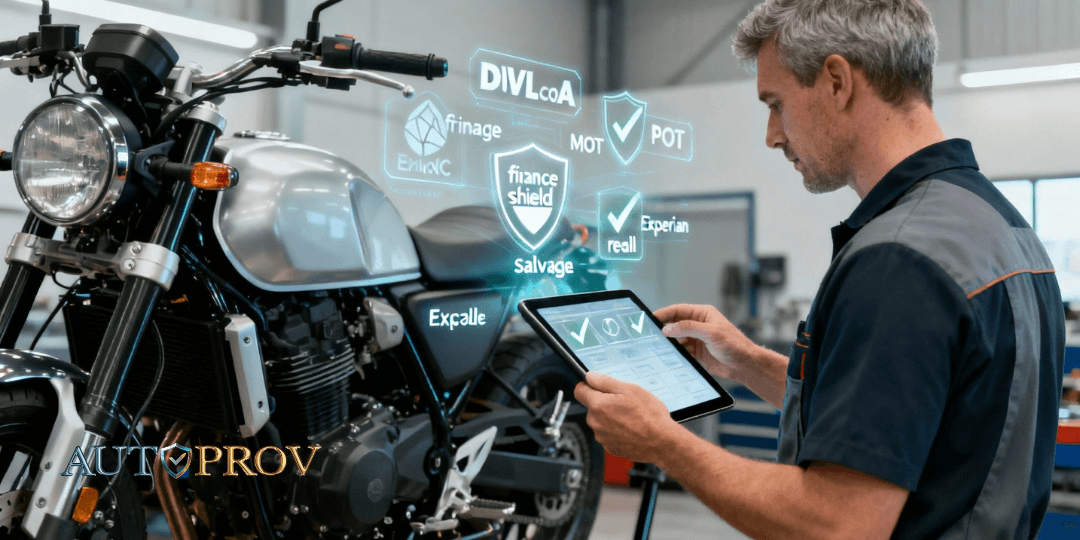
Before you even think about adding a used motorcycle to your stock, there’s one piece of due diligence that’s completely non-negotiable: a professional motorcycle history check. This isn’t just about ticking a box; it’s the single most important step you can take to uncover a bike's hidden past and shield your business from some seriously costly problems.
Before you even think about adding a used motorcycle to your stock, there’s one piece of due diligence that’s completely non-negotiable: a professional motorcycle history check. This isn’t just about ticking a box; it’s the single most important step you can take to uncover a bike's hidden past and shield your business from some seriously costly problems.
We're talking about liabilities that can sting badly, from outstanding finance and undisclosed accident damage to theft markers that could see your new purchase seized.
Why a Motorcycle History Check Is Not Just a Formality
For any professional in the motor trade, skipping a comprehensive history check on a used bike is a massive gamble. It's your first and best line of defence against the kind of hidden issues that can demolish your profit margins and, just as importantly, damage your hard-earned reputation.
Underneath that shiny fairing could be a financial time bomb. A bike with outstanding finance could be repossessed right from your forecourt, leaving you massively out of pocket. An undisclosed write-off category can make a machine almost impossible to sell, turning what looked like a tidy profit into dead stock.
Protecting Your Investment and Reputation
The smart move is to see the history check as a core part of your buying strategy. It’s not just about weeding out the bad bikes; it’s about making sharper, more profitable decisions every single time. Each check you run with AutoProv protects your investment and reinforces the trust your customers have in your dealership.
The UK's used motorcycle market is a real mixed bag, a reflection of our long and sometimes turbulent manufacturing history. From the days when British bikes ruled the world to the steep decline against foreign competition in the late 20th century, the result is a market full of everything from classic survivors to the latest superbikes. Each one has a unique backstory that needs careful checking.
A thorough check from AutoProv replaces guesswork with certainty. It gives you the hard data you need to judge a bike's real value and risk, ensuring you pay the right price for the right machine.
A Workflow Built for the Trade
This guide is designed to show you how a dedicated trade service like AutoProv can make all the difference. We’ve built a system that turns this vital due diligence into a fast, reliable workflow that slots right into your buying process. By pulling all the crucial data points together, we give you the power to act quickly and with confidence. For a wider look at the process, you can read our guide on how to check vehicle history in the UK.
Ultimately, a solid checking process with AutoProv means you can:
- Avoid Financial Loss: Instantly sidestep bikes with outstanding finance agreements or a hidden write-off history.
- Negotiate Like a Pro: Use verified data from our reports to back up your offers and secure much better buying prices.
- Build Customer Trust: Sell with total confidence, knowing every bike on your floor has a clean, verified history.
What a Professional Bike Check Actually Reveals
Going beyond a basic MOT history check is where a real pro adds value and protects their profit margin. A proper trade-grade motorcycle history check from a service like AutoProv isn’t just about looking for past failures; it's a deep dive into several critical datasets that, when put together, paint the full picture of a bike's past, its current status, and what it’s actually worth to your business.
You’re essentially querying multiple official and commercial databases to find the details a seller might conveniently forget to mention. Think of it like assembling a puzzle. Each piece of data AutoProv provides either confirms or contradicts the story you're being told, giving you the leverage you need to negotiate properly or simply walk away from a dodgy deal.
Verifying Keeper History and V5C Authenticity
Your first port of call should always be the DVLA data within your report. You’re not just confirming the reg number matches the bike; you’re digging into the keeper history and validating the V5C logbook. A high number of recent keepers is a massive red flag. It often points to a persistent, unresolved issue that owners keep passing on.
Just as important is checking the V5C document itself. A recently issued logbook could be innocent—or it could mean the original was 'lost' to hide a loan against the bike or previous owner details. An AutoProv check will confirm the V5C issue date and serial number, flagging potential fraud instantly.
The Non-Negotiable Finance Check
Outstanding finance is probably the single biggest financial risk you face when buying stock. A bike with an active hire purchase (HP) or personal contract purchase (PCP) agreement legally belongs to the finance company, not the seller. If you buy it, the lender has every right to repossess that motorcycle right off your forecourt, leaving you with a total loss.
An AutoProv check queries databases like Experian to give you a clear 'finance clear' or 'finance outstanding' marker. This is an absolute must. In the trade, a reported 4% to 5% of vehicles checked have an active finance marker, making this a common and costly trap to fall into.
Finding this out lets you insist the seller settles the finance before you buy, or you can just walk away. It’s a simple check that prevents a catastrophic business mistake.
Uncovering Stolen Status with the PNC
The Police National Computer (PNC) is the definitive UK record for stolen vehicles. A motorcycle flagged as stolen on the PNC is toxic stock. Simple as that. You can't legally sell it, and if it's found in your possession, the police will seize it, resulting in a complete financial loss for your business.
A professional motorcycle history check from AutoProv links directly to this database, giving you an immediate stolen status report. This is especially vital at auctions or in private sales where the pressure is on and you know nothing about the seller’s background. It’s your ultimate protection against handling stolen goods and the serious legal and reputational damage that follows.
Our reports consolidate crucial information, including DVLA data confirming keeper changes and V5C issue dates, Experian finance data revealing outstanding HP or PCP agreements, and a direct check with the Police National Computer (PNC) for any stolen vehicle markers.
The Hidden Story of Write-Offs
Picture this: a nearly new superbike rolls in, and it looks immaculate. The paint is perfect, not a scuff in sight, and it runs like a dream. But an AutoProv history check reveals it was declared a 'Category N' write-off six months ago for non-structural damage—think smashed fairings and fried electronics that were just too expensive to replace through insurance.
Now, 'Cat N' bikes can be safely repaired and sold, but that history permanently hammers their value. Without that check, you’d have paid top money. With it, you can negotiate a significant discount that reflects its past, protecting your profit margin. This is exactly the kind of critical insight a thorough check provides, turning a hidden liability into manageable information. To see how we pull all this data together, you can explore the trusted data sources AutoProv uses for our reports.
AutoProv is built to pull all these vital checks into one simple, instant report. Instead of you having to manually piece together information from different places, our platform queries all the essential databases at once. This turns a complex, time-consuming task into a single, decisive action, giving you the complete picture you need in under 30 seconds.
Decoding the Report and Spotting Red Flags
Getting the history report back is the easy part. The real skill, the thing that separates a seasoned trader from a rookie, is knowing how to read it. This isn't just a list of facts; it’s a collection of clues that piece together the bike’s true story. Learning to read between the lines is what turns a good buy into a great one and saves you from a costly mistake.
Sometimes, the smallest detail is the biggest warning sign. Take a recently issued V5C logbook. Seems innocent enough, right? But it could be a deliberate tactic to wipe a history of title loans or hide a previous keeper's details. Your ability to spot these subtle hints is what protects your bottom line.
The Tell-Tale Signs of Mileage Discrepancies
Mileage is, without a doubt, one of the most doctored data points in the game. A proper report from AutoProv arms you with multiple reference points – MOT records, service history, and more – letting you build an accurate timeline. Any inconsistencies in that timeline should immediately grab your attention.
The classic red flag is a big gap in the MOT history followed by a sudden, sharp drop in recorded mileage. It’s a textbook sign of clocking. The bike effectively goes off-grid for a year, the odometer gets a "haircut," and it pops back up with a fresh MOT and a suspiciously low reading.
Never, ever take the displayed mileage at face value. Always cross-reference it with the historical data in your report. Even a discrepancy of a few thousand miles that can't be explained is a massive cause for concern.
We designed AutoProv’s reports to make this impossible to miss. We lay out the mileage history chronologically and flag any drops or weird gaps. It gives you the hard evidence you need to either challenge the seller or, better yet, just walk away.
Keeper History Clues and Finance Markers
A bike’s keeper history tells you a lot about its life. A few owners over several years is perfectly normal. But a high turnover in a short space of time? That should set alarm bells ringing.
Frequent keeper changes often point to a nagging, underlying problem that owners find, get fed up with, and then pass on. It could be an intermittent electrical fault, a subtle engine issue, or something much worse. It's a clear pattern that suggests you're about to buy someone else's headache.
An active finance marker, on the other hand, is a complete showstopper. There’s no grey area here. The AutoProv report will tell you in plain English if there’s an outstanding hire purchase or PCP agreement. If finance is outstanding, the bike legally belongs to the finance company and you cannot acquire it until that debt is settled. If it’s clear, you're safe to proceed.
Ignoring this marker is asking for trouble. You risk the bike being repossessed right off your forecourt, resulting in a total financial loss. It's a non-negotiable check.
Interpreting Write-Off and Damage Records
Understanding the nuances of insurance write-off categories is absolutely crucial. A bike can look immaculate but be hiding a history as a 'Cat N' or 'Cat S' vehicle. While this doesn't automatically make it a bad purchase, it massively impacts its value and your potential margin.
A 'Cat S' (structural damage) marker, for example, is far more serious than a 'Cat N' (non-structural) one. It means the bike's frame or chassis has been compromised and needed professional repair. You need to know this not just for pricing, but for safety and for being transparent with your own customers.
The AutoProv platform highlights these categories so there's no ambiguity. We give you clear definitions to help you instantly assess the severity and make a smart call. Our guide on how to check if a car has been in a crash has some related insights that are just as relevant for two wheels.
Ultimately, decoding a report is all about pattern recognition. When you look at keeper changes, mileage records, and damage history as interconnected parts of a bigger story, you get the intelligence you need to make confident, profitable decisions in minutes.
Putting AutoProv Checks Into Your Buying Workflow
Understanding what a report says is one thing. Using it to make faster, more profitable decisions? That’s where the real money is made. This is where theory meets the tarmac. By building a professional motorcycle history check right into your buying process, due diligence stops being a chore and starts being your competitive edge.
This isn't about adding another step to your day. It’s about replacing slow, manual guesswork with instant certainty from AutoProv. In the fast-moving motor trade, speed and accuracy are everything. The ability to pull up a bike's full history on the spot is what lets you act decisively, whether you're at an auction, on a seller's driveway, or appraising a part-ex.
Speed and Certainty at the Point of Purchase
Picture this: you’re at a busy auction. A tidy-looking bike is next on the block, and the bidding is about to kick off. Instead of taking a punt, you pull out your mobile, punch the reg into the AutoProv app, and have a complete report in your hands in under 30 seconds.
You instantly see it has a clean finance record, no theft markers, and a consistent mileage history. With that confidence, you can bid aggressively, knowing exactly what you’re buying. On the flip side, if the report flags a 'Cat S' marker the auction house somehow missed, you can pull out immediately. You’ve just dodged a massive headache while others are bidding blind.
This real-time data gives you the upper hand in all sorts of situations. Whether you are dealing with private sellers, making auction buys, or handling part-exchanges, an instant check gives you a crystal-clear picture of its past. That means you can offer a value that’s both fair and safe for your business.
Think of an AutoProv history check as your silent negotiating partner. When you can point to a mileage discrepancy or a previous write-off category on a verified report, you have hard evidence to justify a lower offer—or to walk away from a bad deal entirely.
Designed for the Pace of the Motor Trade
The whole process has to be seamless. A clunky, slow system just creates a bottleneck nobody has time for. That’s why AutoProv is built specifically for trade use, with features that actually support your day-to-day operations instead of slowing them down.
The clean dashboard summaries give you an at-a-glance overview, with major red flags like finance or theft markers highlighted right at the top. You don't have to wade through pages of data to find the one detail that makes or breaks the deal. You can see for yourself how it works and how the platform is built from the ground up for speed and clarity.
This is especially critical if you're dealing with classic or vintage machines. Fun fact: the British motorcycle industry faced a major collapse by 1959, with worldwide imports dropping from over 51,000 units in 1950 to just under 26,000 a decade later. This bit of history means a lot of older British bikes have patchy or incomplete service histories, making a modern, data-driven check even more vital to piece together their true story.
Ultimately, integrating a professional motorcycle history check into your workflow turns it from a reactive chore into a proactive strategy. It ensures that every single bike you consider for your stock has been properly vetted, protecting your capital and your dealership's reputation with every single purchase you make.
Sorting Write-Offs from Safety Recalls
Getting to grips with insurance write-off categories is one of the sharpest tools in any motor trade pro's kit. These aren't just bits of admin; they tell you everything about a bike's structural integrity, whether it's even legal for UK roads, and, crucially, what it's really worth. Get this wrong, and a tidy profit can vanish overnight.
The current A, B, S, and N categories paint a much clearer picture than the old system ever did. When you run a motorcycle history check through a service like AutoProv, these categories are flagged up plain as day, taking all the guesswork out of your appraisal.
How Write-Offs Hit Your Bottom Line
The financial chasm between buying a 'Cat N' bike and accidentally paying top money for a 'Cat S' can be thousands of pounds. A simple mistake here can obliterate your margin before the bike even makes it onto your forecourt.
As a trader, it's vital to know what each category means. Category N (Non-Structural Damage) is common and relates to cosmetic or electrical issues. Category S (Structural Damage) is a serious red flag, indicating the bike's frame has been hit. Category B (Break) means the frame must be crushed, but parts can be salvaged. Finally, Category A (Scrap) means the entire bike must be destroyed.
Uncovering a 'Cat S' marker on a bike that looks immaculate is a classic 'gotcha' moment. Without a history check, you'd pay full market rate. With an AutoProv check, you have the leverage to either walk away or negotiate a price that properly reflects its past, protecting your investment.
The Hidden Risk of Safety Recalls
Accident damage isn't the only ghost in the machine. Another liability that can easily catch traders out is an outstanding manufacturer safety recall. These are official notices for known faults—think dodgy brake components or engine flaws—that could compromise a rider's safety.
If you sell a bike with an outstanding recall and that fault causes an accident, you could be held liable. It’s a huge risk that many in the trade overlook. A professional motorcycle history check from AutoProv is the only reliable way to spot these issues before you part with your cash.
AutoProv flags any outstanding recalls clearly in your report, so you’re never ambushed by unexpected repair costs or safety liabilities after the deal is done. You can get the recall work sorted before you even think about listing the bike for sale, protecting your business and your customers. To dig deeper into identifying damage, our article on how to check if a vehicle is a write-off has some great insights.
In a tough market, every penny of profit matters. Not long ago, British motorcycle registrations dropped to just 51,186 units in the first half of the year—a fall of 17.1%. When the market contracts like this, margins get squeezed hard. It becomes absolutely critical to avoid costly mistakes, like buying a bike with an undeclared history that turns a potential winner into a guaranteed loss. You can explore the British motorcycle market data to see the trends for yourself.
Your Motorcycle History Check Questions Answered
We’ve covered a lot of ground, digging into everything from the financial risks hiding behind a polished fairing to the red flags that can save your business from a nightmare buy. To wrap things up, let’s tackle a few of the most common questions we hear from traders about running a motorcycle history check.
Think of this as a final briefing before you head out to source your next bike. Getting this right isn't just about dodging bullets; it’s about building the confidence to bid higher on the right machines, negotiate from a position of strength, and fill your forecourt with stock that protects both your reputation and your bottom line.
How Quickly Can I Get a Motorcycle Check with AutoProv?
In this game, time is money. Speed is everything. With AutoProv, your checks are practically instant.
The moment you punch a bike's registration number into the platform, our system is already firing off real-time queries to the DVLA, the Police National Computer (PNC), and all the key finance databases. A full, professional-grade report lands on your screen in a matter of seconds.
This isn't just a convenience; it's a massive competitive advantage. Standing at an auction or with a private seller in their driveway, you get the data you need to make a solid, confident decision on the spot. No delays, no hesitation, no letting a great bike slip through your fingers.
Is a Free Bike Check Good Enough for My Business?
Let me be blunt: absolutely not. For any serious professional in the motor trade, relying on a free check is a false economy waiting to bite you.
Sure, a free service might confirm the basic tax and MOT status, but it leaves out the very data that protects your business from catastrophic financial loss. The biggest risks you face—like outstanding finance, stolen status, or an insurance write-off history—are completely invisible to these basic checks.
A free check will never tell you about outstanding finance, stolen vehicle status, or its insurance write-off history. Missing these details means you could lose the bike and your money.
A professional service like AutoProv is built specifically to deliver this crucial information, and it's all backed by an indemnity guarantee. It’s a small, essential business expense that acts as insurance on your much larger investment.
Is a History Check as Important for a Bike as a Car?
Yes, without a doubt. In some ways, it’s even more critical.
Think about it. A motorcycle's frame is its entire skeleton, and it’s far more exposed and vulnerable than a car's chassis. What might look like a minor off can easily lead to serious structural damage, earning the bike a 'Cat S' write-off status. An undisclosed issue like that doesn't just wipe out the bike's value; it makes it a dangerous liability to have on your forecourt.
Motorcycles are also a magnet for thieves due to being high-value, easy-to-move assets, and a huge number are bought on finance. These factors, combined with their vulnerability to damage, make a comprehensive motorcycle history check from AutoProv an indispensable part of your due diligence for every single bike you even consider buying.
Frequently Asked Questions
AI-Generated Content Notice
This article was created with the assistance of artificial intelligence technology. While we strive for accuracy, the information provided should be considered for general informational purposes only and should not be relied upon as professional automotive, legal, or financial advice. We recommend verifying any information with qualified professionals or official sources before making important decisions. AutoProv accepts no liability for any consequences resulting from the use of this information.
From our AI insights
- Uncovering Bargain Sports Cars in the UK for 2026
Explore the cheapest sports cars in the UK for 2026 with expert insights on risk assessment and provenance checks.
- Starting a Classic Car Dealership: Costs and Challenges
Explore the costs and challenges of starting a classic car dealership in the UK, including regulatory insights and expert tips.
- Seasonal Storage Tips for Classic Cars
Discover expert tips on preparing and storing your classic car for seasonal changes in the UK.
Related Articles

Understanding Classic and Specialist Cars in the UK
Explore what defines classic and specialist cars in the UK and their growing popularity.

Your Guide to Autotrader Vans UK for Business
Finding the right commercial van on Autotrader vans UK is a massive step for any business, whether you're a sole trader just starting out or managing a small fleet. As the UK's biggest online marketplace for new and used vans, the sheer choice can feel a bit much without a solid game plan.

Find Cheapest Sports Cars UK: Your 2026 Buying Guide
You see it in the auction lane or on a part exchange appraisal. Low entry money, strong visual appeal, easy headline for the advert, and a buyer base that still wants something fun even when budgets are tight. On paper, cheap sports cars in the UK look like ideal stock.
Published by AutoProv
Your trusted source for vehicle intelligence