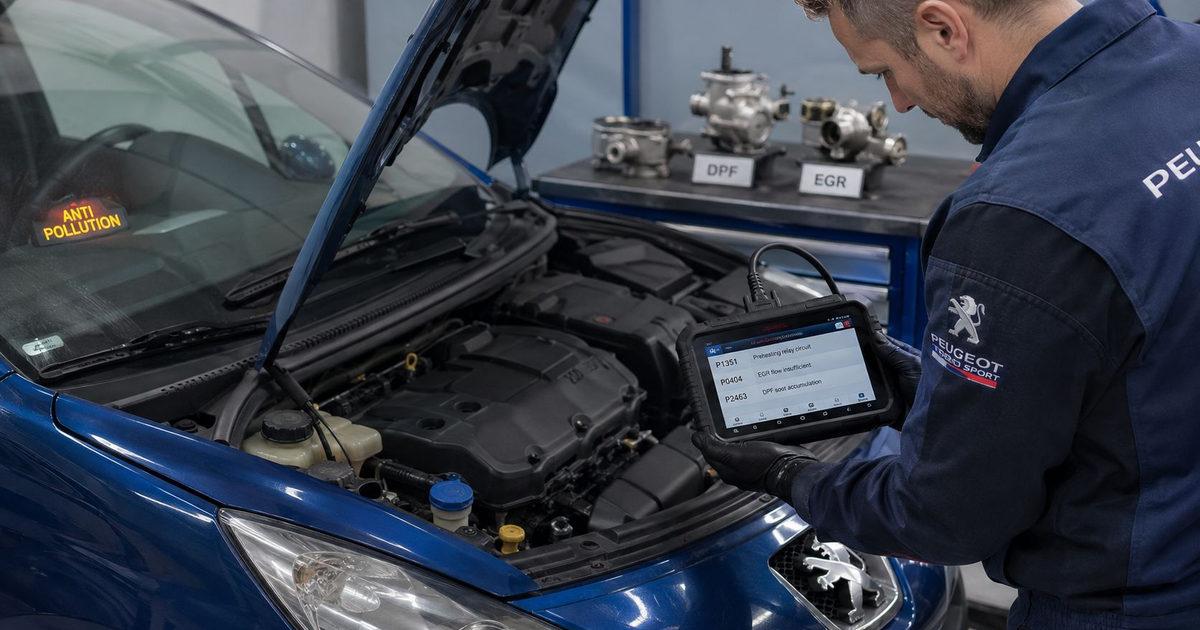
A Peugeot 207 rolls into the yard with an Anti Pollution Fault on the dash, the seller says it's “only a sensor”, and the numbers look tempting. That's the exact sort of car that can either turn into easy margin or eat time, labour, and goodwill before it's even cleaned up. The warning itself is vague, but the buying decision isn't. With the right vehicle history check UK data, a proper scan, and some trade judgement, you can separate a manageable fault from a car that's already telling you it's been neglected.
Table of Contents
- The Trader's Dilemma An Introduction to the 207 Fault
- Decoding the Anti Pollution Warning
- What the ECU is reacting to
- Why the wording misleads buyers
- A Professional Diagnostic Workflow
- Start with the ECU and the live data
- Split the diagnosis by powertrain
- Use workshop clues, not just the reader
- Repair Costs and MOT Compliance
- What tends to be cheap and what usually isn't
- Why clearing the light is not a repair
- Assessing Buying Risk with Provenance Intelligence
- Read the MOT pattern, not just the latest pass
- Ownership timing tells its own story
- Use provenance to decide how hard to negotiate
- Conclusion Making an Informed Buying Decision
The Trader's Dilemma An Introduction to the 207 Fault
You see it in auctions, part-exchanges, and cheap retail stock. A Peugeot 207 sits there with good paint, average miles, and a dashboard message that makes everyone hesitate. The seller wants to move it on, the lane is quiet, and you're left deciding whether you've found a quick reconditioning job or a car with a long tail of trouble.

The Peugeot 207 was a high-volume model, with worldwide production reaching 2,504,900 units by 2012. Independent technical sources also identify the anti-pollution warning as a recurring issue across 2007–2015 variants, often linked to the ECU, temperature sensing, or emissions hardware, which is why the fault crops up so often in trade stock Peugeot 207 production and recurring fault coverage. A car that common is easy to source, but common faults are also easy to underestimate.
Trade rule: treat the warning as a decision point, not a verdict. If the car has no supporting evidence, assume the fault could be deeper than the first code suggests.
For dealers, the core issue is uncertainty. A generic dashboard message can hide a cheap consumable, but it can also sit on top of repeated short-trip use, poor servicing, or a past repair that never cured the root cause. That's where a basic used car history report stops being enough and proper trade vehicle intelligence starts to matter.
Use the same mindset you'd apply to any warning light that affects stock turn and comeback risk. If you already use an engine-light process, keep it consistent with the approach in our engine management light guide. On a 207, the anti pollution fault Peugeot 207 message is less about panic and more about whether the car's previous life matches the story you're being told today.
Decoding the Anti Pollution Warning
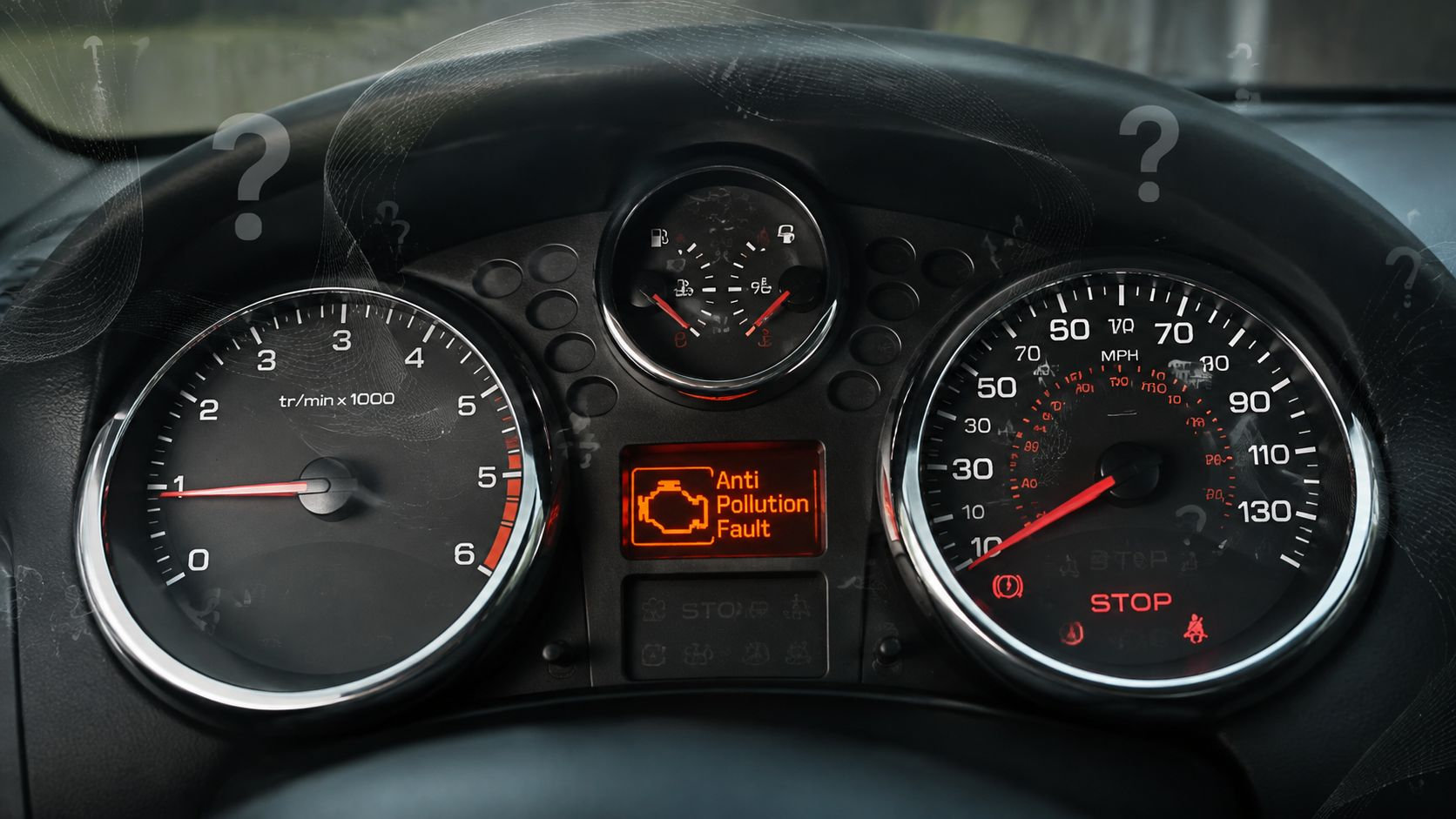
The Anti Pollution Fault is not a single-component fault code. It is a generic ECU warning that tells you something in the engine or emissions control system has drifted outside expected limits. On a petrol car, that usually means fuel and air mixture control. On a diesel, it often points to aftertreatment, EGR flow, or the sensors that sit around those systems.
What the ECU is reacting to
The ECU watches emissions-related inputs all the time. If the readings do not make sense together, it records a fault and may limit performance to protect the catalyst, DPF, or engine hardware. UK specialist guidance notes that the 207's warning often comes with reduced-power mode, which is the car's way of preventing further damage Peugeot 207 anti-pollution fault and engine management light guidance.
That matters in the trade because a warning light alone does not tell you whether you are looking at a bad sensor, an air leak, a fuelling issue, or a blocked emissions system. The same dashboard message can appear on a car that needs a straightforward repair, or on one that has been run in a way that keeps loading the same system again and again. If the diesel side of the fault pattern is unclear, the warning often sits in the same family of problems as a dedicated DPF warning light, which is why a quick read of the cluster message is never enough on its own.
Why the wording misleads buyers
The language sounds environmental, but the diagnostic task is mechanical and electronic. The car is not telling you it failed a general “pollution test”, it is telling you the control system cannot keep emissions within its target window. On UK-market 207s, the warning is commonly tied to incorrect fuel and air ratio on 1.4/1.6 VTi petrol cars, or EGR/DPF/FAP-related problems on HDi diesels Peugeot 207 anti-pollution fault overview.
A generic warning deserves a specific scan. If you do not pull the ECU codes first, you are guessing with your own money.
For a dealer, that is the first filter. If the car's history is clean, the fault may still be a simple fix. If the history is messy, the warning becomes part of a wider pattern, not an isolated event. Trade assessment also depends on provenance, because the service record and MOT trail can show whether the car has a repeat emissions issue, a missed maintenance interval, or signs of a quick cosmetic reset that never addressed the underlying cause. That is the same level of caution you would apply to heavy duty truck diagnostics, where the warning message matters less than the fault pattern and the vehicle's background.
If you want to handle it properly, use the same discipline you would apply when learning how to use an OBD2 reader. The warning is only the starting line.
A Professional Diagnostic Workflow
Start with the scan, not the parts shelf. That's the only sensible way to approach a Peugeot 207 with an anti-pollution message in the trade, because the car can throw the same dashboard wording for very different faults. A proper diagnostic check should be the first spend, not the last.
Start with the ECU and the live data
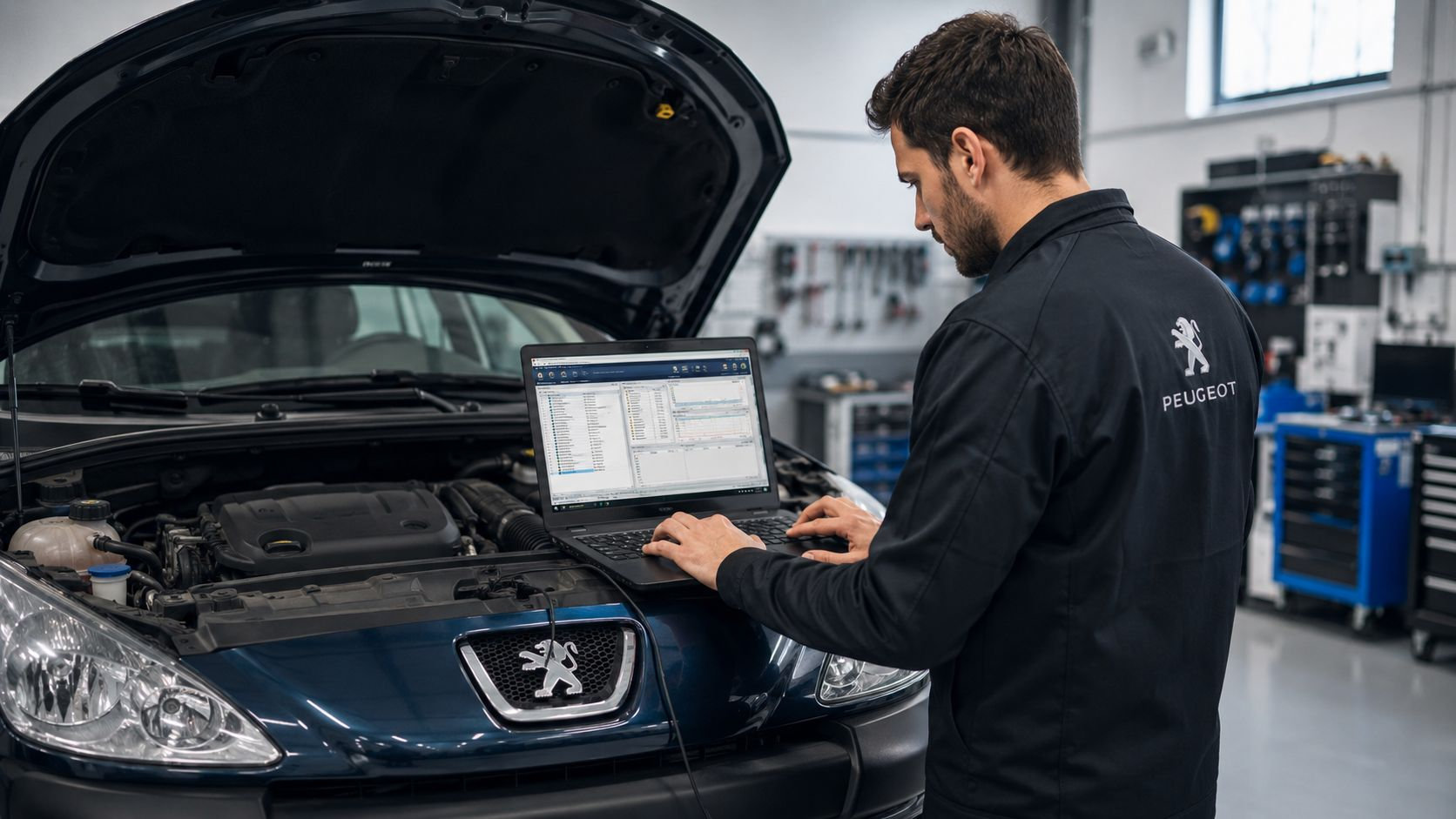
Read the fault codes first, then look at live data. The warning often means the ECU has seen an incorrect fuel/air ratio on petrol variants, or an emissions-flow problem on diesel ones, so the code family matters more than the message on the cluster. If the ECU has stored multiple faults, don't clear them until you've captured the evidence for appraisal, because a reset can hide a pattern without fixing it.
A clean scan also tells you whether the car has fallen into a reduced-power strategy. That's important because a buyer may report “it drives fine” while the ECU has already started protecting the system. In that case, the road test can feel normal enough to tempt a purchase, but the stored codes still point to risk.
Split the diagnosis by powertrain
On petrol 1.4 and 1.6 VTi cars, focus on the ignition, fuel delivery, air metering, and any sensor reading that would upset mixture control. A misfire or a mixture fault can trigger the warning without involving the exhaust system at all. That's the branch where compression checks, intake leaks, and temperature sensing deserve attention.
On diesel HDi cars, the usual suspects are the DPF/FAP, EGR, and the associated sensors. RAC forum guidance notes that the DPF needs sustained driving of at least 40 mph for about 20 minutes to help keep it clear, which explains why short, urban use keeps causing repeat warnings in the UK market RAC forum DPF guidance for the Peugeot 207. The same guidance says a forced regeneration can take up to 40 minutes, so if the car can't complete that cycle, you already know the fault isn't just cosmetic.
Practical rule: a diesel 207 used for short trips is never “just due a code reset”. Check whether it has the sort of driving life that would clog the system again.
Use workshop clues, not just the reader
Look for the symptoms that sit around the code. Hard starting, rough idle, persistent warning lights, or the fan running when it shouldn't all widen the picture. UK specialist guidance also flags ECU faults as a real cause of the warning, and those can bring coolant temperature sensor and gauge issues, a constant overheat warning light, idling problems, and stored thermostat heater control faults ECU-related anti-pollution fault symptoms.
That's the point where a proper trade process beats a quick fix. A dealer who keeps replacing sensors without reading the wider pattern ends up buying the same fault twice. The car's test drive, code set, and ownership story all need to agree before you price it.
For technicians who want a wider view of fault-finding discipline, heavy duty truck diagnostics is a useful reminder that the process matters more than the badge. Different vehicle, same principle, read, verify, then decide.
Repair Costs and MOT Compliance
The financial spread on this fault is wide. A simple sensor, ignition, or airflow-related fix can be relatively modest in trade terms, while a diesel aftertreatment issue can quickly turn a cheap part-exchange into a margin problem. That's why the first job is not to guess the repair, but to price the uncertainty.
What tends to be cheap and what usually isn't
If the fault is down to a minor sensor or an ignition-side issue, the reconditioning bill may stay manageable. If the fault sits inside the DPF/FAP, EGR, or ECU path, the car can need more time, more labour, and a much more cautious retail strategy. In trade, the difference is often the gap between a quick retail prep and a car that needs to be sold as a risk item.
The compliance side is simpler. If the engine management light is illuminated, the car's MOT position is weak. A cleared code doesn't erase the cause, and if the underlying fault remains, the warning commonly comes back. A vehicle can also still fall at emissions testing even if the dashboard looks calm on the day.
Why clearing the light is not a repair
A reset is only useful if you already know why the code appeared. If a warning has been cleared immediately before sale or test, you need to ask whether the car had time to complete a proper drive cycle and whether the issue has been cured. On a diesel 207, that's especially important because recurring short-trip use can bring the same fault straight back.
If you need a clear reference point for MOT implications, keep the UK MOT rules guide close during appraisal. It helps separate what's legally fail-prone from what's merely annoying to the driver.
A good trade buyer also plans for the call volume. When a fault is intermittent, the buyer, the prep bay, and the test centre can all end up chasing the same symptom at different times. Anyone who runs customer communication well, including teams that use tools to prevent missed calls for auto service businesses, knows how easily a “small” warning turns into a chain of delays.
The trade takeaway is straightforward. Price the fault on evidence, not on optimism. If the scan and road test point to a minor issue, the car may still work as stock. If they point to repeat emissions control failure, the margin needs to reflect the likelihood of repeat work.
Assessing Buying Risk with Provenance Intelligence
A 207 with an anti-pollution fault needs context as much as it needs diagnosis. In trade, a key question is whether the warning points to a single fix or to a car that has spent much of its life running on the edge. Strong vehicle provenance work separates those two cases, and a proper dealer vehicle checks process pays for itself when the fault keeps coming back.
Read the MOT pattern, not just the latest pass
A single current MOT result tells you very little. The useful question is whether the car has been close to emissions failure for some time. UK-focused guidance notes that this fault often sits alongside previous MOT emissions failures or a recent ownership change after a test, which is exactly the sort of pattern a quick look can miss Peugeot 207 MOT emission failure context.
That is the buying trap. A car that has just had the fault cleared may still carry the same underlying condition, especially if the last keeper was doing short trips or preparing the car for sale before another test. Once that pattern repeats, the issue stops looking like a single warning lamp and starts looking like a maintenance history problem.
Ownership timing tells its own story
Short-term ownership matters because it can point to disposal pressure. If the car changed hands soon after the last MOT or after a recent warning, that does not prove a problem by itself, but it does justify closer scrutiny. In trade, repeated quick flips are where hidden emissions faults, poor fixes, and patch repairs often cluster together.
Buying rule: if the dashboard fault, MOT history, and ownership timing all point in the same direction, treat the car as higher risk until proven otherwise.
A mileage check UK review on its own does not solve the problem. The odometer reading may be right while the usage pattern is still wrong for the car. A diesel 207 that has spent its life in stop-start urban use can be a worse buy than a higher-mileage example that has been driven in a way that keeps the emissions system cleaner.
Use provenance to decide how hard to negotiate
A used car history report should feed the offer, not just the folder. If the history shows repeat emissions advisories, a recent ownership change, or signs that the car was moved on after a recent test, the fault should be priced as risk, not just as a repair estimate. That is the trade difference between diagnosing a car and deciding whether it deserves your capital.
For a structured approach, compare the story the car tells with the data in provenance checks versus detailed provenance reports. This level of scrutiny matters whether you are judging a common Peugeot or a niche classic, a point reinforced in SwiftJet's 1995 Saleen buying guide. The stronger buyers do not rely on one data point. They stack MOT history, keeper timing, and diagnostic evidence until the commercial picture makes sense.
The gap in the market remains the same. Most content explains the fault, but not the purchase decision behind it. Disciplined provenance analysis gives dealers a clearer edge.
Conclusion Making an Informed Buying Decision
The anti pollution fault Peugeot 207 message is a warning to investigate, not a reason to panic. On the right car, it can be a contained repair with a sensible reconditioning plan. On the wrong one, it's a clue that the car has already been living in the part of the market where repeat faults, short-trip use, and weak history all overlap.
The best outcome comes from combining a proper ECU scan with vehicle provenance and MOT context. That's how you distinguish a fixable fault from a car that's been telling the same story for months. For dealers, that combination protects margin, reduces comebacks, and makes the buying decision sharper.
If you want a clearer read on risky 207 stock, use AutoProv to bring MOT history, keeper timing, mileage patterns, and provenance context into one trade-focused view. It helps you price the fault with more confidence before you commit capital, especially when a warning light might be hiding repeat neglect rather than a one-off repair.
Frequently Asked Questions
AI-Generated Content Notice
This article was created with the assistance of artificial intelligence technology. While we strive for accuracy, the information provided should be considered for general informational purposes only and should not be relied upon as professional automotive, legal, or financial advice. We recommend verifying any information with qualified professionals or official sources before making important decisions. AutoProv accepts no liability for any consequences resulting from the use of this information.
From our AI insights
- Navigating ULEZ Compliance for Used Car Dealers
A deep dive into ensuring your used car stock meets ULEZ standards, avoiding costly fines.
- Understanding VIN Decoding: Avoid Misleading Imports
Learn how VIN decoding reveals vehicle origins and specs, preventing import pitfalls.
- Spotting Hidden Mods: UK Dealer Insights
Learn how UK traders use build data and MOT checks to identify modifications.
Related Articles

Car Specs by Reg: Instantly Find Vehicle Details & MOT History
Trying to find the full car specs by reg? In the UK, that little number plate is the key to unlocking a huge amount of information about a vehicle. From the exact engine size and CO2 emissions to its MOT history and tax status, it's all tied to the registration.

How to Check Previous Owners of a Car in the UK
Before you even start thinking about how to check the previous owners of a car, you need to get your head around why it's so important. This isn't just about being nosy; it’s a non-negotiable step that protects you from serious financial headaches and safety risks lurking under a shiny bonnet.

How to Check Service History in the UK
Think of a car's service history as its detailed CV, not just some dusty folder in the glovebox. To check service history is to get the real story behind a vehicle, digging into everything from its routine oil changes to any major surgery it's had. For any savvy car buyer in the UK, this record is the single most important document you can get your hands on.
Published by AutoProv
Your trusted source for vehicle intelligence