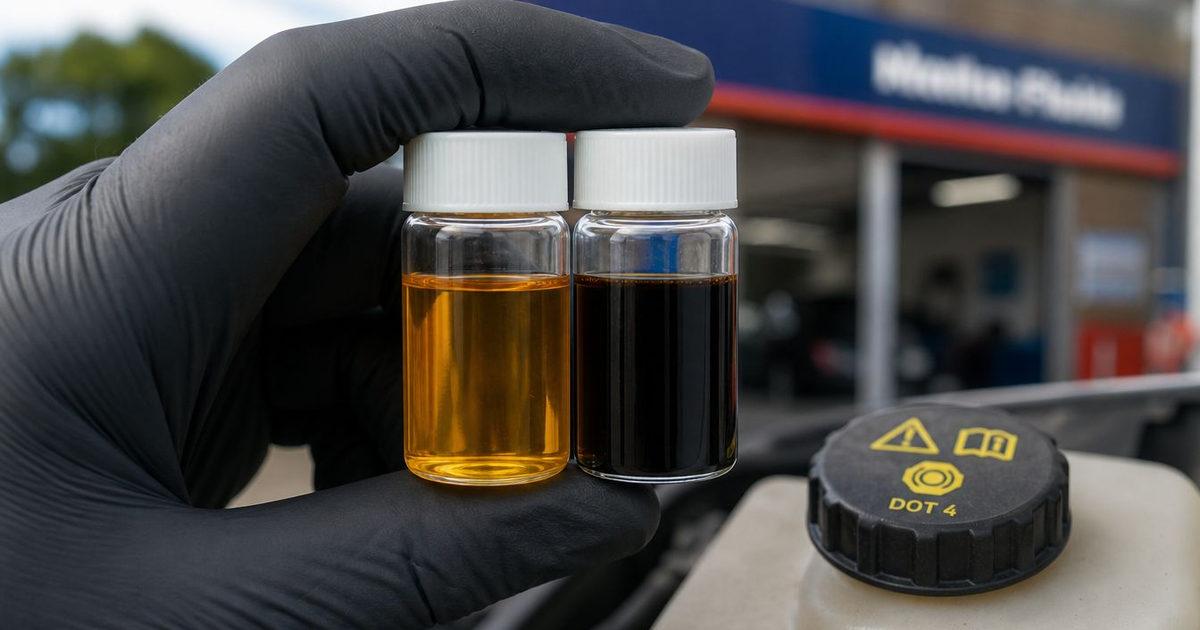
You're standing at an auction lane, the bonnet's open, and the car looks tidy enough at ten paces. Then you spot it, a brown brake fluid reservoir, the level's low, and the clutch pedal feels a touch vague on the short pull. That's the point where experienced traders stop treating fluid as a workshop footnote and start reading it as a risk signal.
Brake and clutch fluid tells you more than most buyers realise. It can point to service neglect, patchy ownership, a rushed prep, or a car that's been kept moving without the basic maintenance discipline you want to see in stock. In the UK motor trade, that matters because the same car that looks clean in photos can still carry latent hydraulic risk, and that risk often sits in plain sight before you've even pulled a full vehicle history check UK report.
Table of Contents
- Why Brake and Clutch Fluid Matters on the Trade Forecourt
- The forecourt clue most buyers miss
- Why this belongs in provenance thinking
- What Brake and Clutch Fluid Actually Is
- The chemistry behind the label
- Boiling Points, Moisture and Why Fluid Degrades
- Dry versus wet performance in real terms
- What moisture does in service
- Shared Reservoir Versus Separate Clutch Hydraulics
- Shared fluid doesn't always mean shared fault
- Why layout matters on older stock
- Practical Inspection Checks for Trade Buyers
- What to check before you price the car
- What the pedal tells you
- Fluid Condition as a Provenance and Risk Signal
- How it fits the wider evidence picture
- What the mismatch usually means
- A Trade Buyer's Quick Reference Checklist
- Common Dealer Questions on Brake and Clutch Fluid
Why Brake and Clutch Fluid Matters on the Trade Forecourt
A good trader learns quickly that the first useful clue isn't always under the ramp. It might be the reservoir cap, the colour in the sight line, or the smell of old fluid when you crack the bonnet at the lane. If the fluid looks tired before you've checked the tyres, the underside, or the paperwork, you already know the car has been living in a system where small maintenance jobs may have been deferred.
The forecourt clue most buyers miss
That's why I treat brake and clutch fluid as a front-end buying signal, not a post-sale workshop job. A fluid reservoir that looks dirty or neglected doesn't prove a car is bad, but it does tell you something about the kind of attention it's had. In trade terms, that can sit in the same risk family as patchy stamps, odd mileage behaviour, and a provenance file that needs closer reading.
The practical angle is simple. Fluid condition can expose a gap between what the car claims on paper and how it's been maintained in real life. A polished forecourt presentation means very little if the hydraulic consumable that keeps the pedals working has been ignored.
Practical rule: if the fluid looks old, assume the service discipline may be old too until you've proved otherwise.
Why this belongs in provenance thinking
UK buyers already use physical clues alongside the documents, and this is one of the best low-cost clues going. Brake and clutch fluid doesn't sit in isolation, it sits inside the wider maintenance picture, alongside invoice quality, ownership cadence, and the sort of prep a car has had before it reached you. A neat body and a rough reservoir often tell a more honest story than a clean advert.
That's also why detail products can be worth carrying in the prep bay, not because they change provenance, but because they help you separate superficial presentation from genuine condition. If you're also protecting appearance work, protect dark-finish wheels from staining is the sort of detailing reference that sits alongside a sensible inspection routine.
The used-car market rewards the dealer who spots the mismatch early. Brake fluid is one of the cheapest places to see it.
What Brake and Clutch Fluid Actually Is
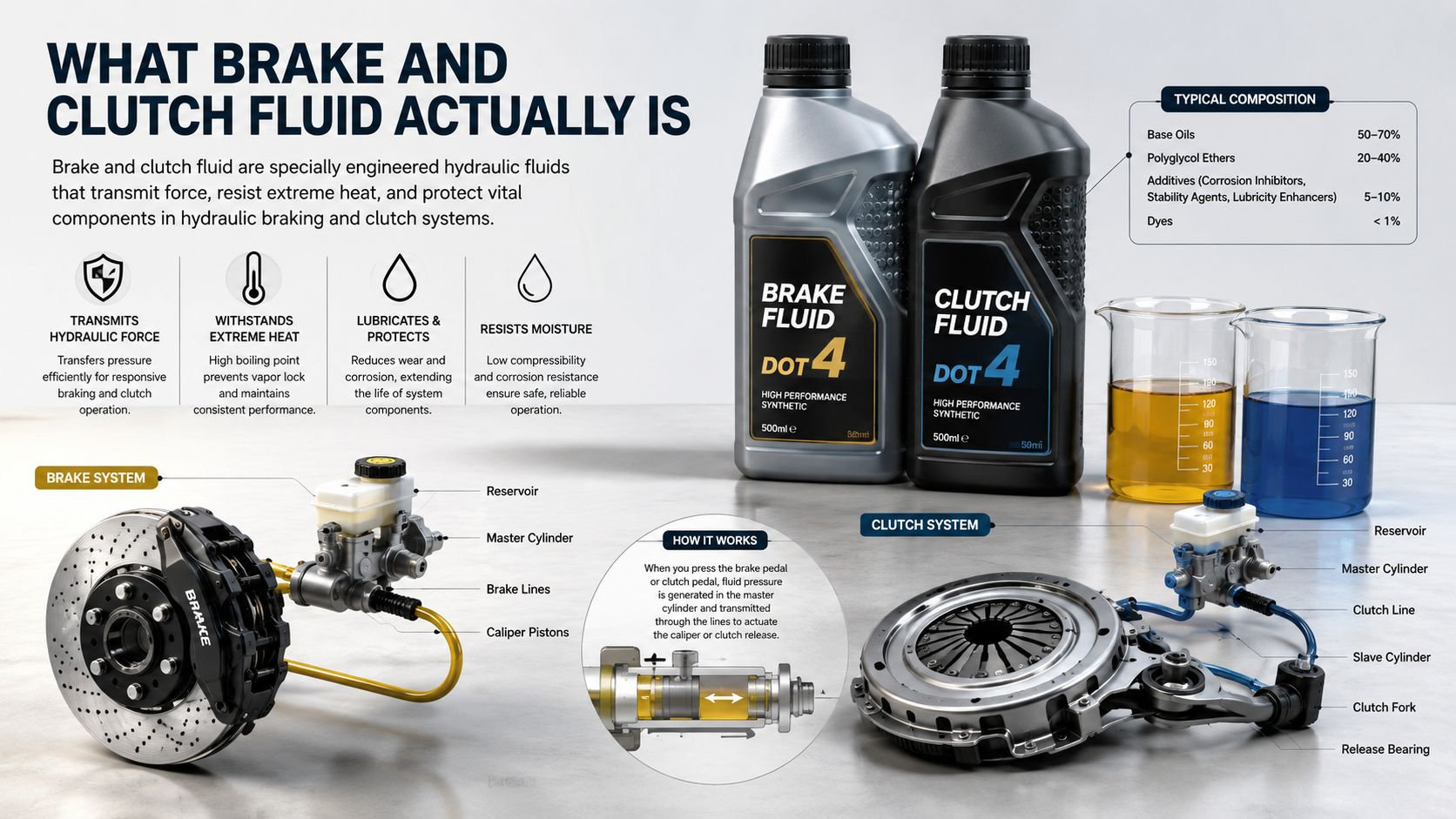
Hydraulic fluid is the medium that lets pedal input move pressure through lines and cylinders. In simple terms, it's what turns your foot movement into braking force or clutch release, and that's why the fluid has to work cleanly, consistently, and without attacking the seals it passes through. The main thing to understand is that brake and clutch fluid isn't just “oil”, it's a standards-controlled consumable with a chemistry that has to suit the system.
The chemistry behind the label
The easiest way to think about glycol-based fluid is as a sponge that absorbs water from the air. It doesn't look dramatic in the reservoir, but moisture gets into the fluid over time, and that changes how it behaves under heat and pressure. The common classes under FMVSS No. 116 are DOT 3, DOT 4, DOT 5, and DOT 5.1. DOT 3 is glycol-ether based, DOT 4 is a glycol-ether and borate-ester mix, DOT 5.1 uses borate ester with glycol ether, and DOT 5 is silicone based, as set out in the standards system and technical classifications used across the trade DOT fluid classification overview.
That distinction matters because the label on the bottle doesn't tell the whole story. Most UK passenger vehicles use one of the glycol-based fluids, and they're selected to work with the seals and cups in hydraulic brake and clutch systems. Standards like FMVSS 116 and ISO 4925 exist because the fluid has to be chemically compatible, not just hydraulically effective. The legal and technical framework also includes a pH window of 7.0 to 11.5 for brake fluid other than DOT 5 silicone fluid, which tells you this is a controlled product, not a generic workshop liquid FMVSS No. 116 requirements and ISO 4925 elastomer compatibility.
Silicone fluid is the outlier. It behaves very differently, and it's not the normal choice in mainstream UK stock.
That's why spec matching matters. The label on the cap doesn't replace checking what the vehicle was built for.
Boiling Points, Moisture and Why Fluid Degrades
A clean reservoir can still hide poor hydraulic margin. The reason is moisture, and moisture doesn't announce itself with a warning light. It lowers the fluid's resistance to heat, so a car that feels fine on the drive to the lane can still have a weakened system when you ask more of it.
Dry versus wet performance in real terms
UK product data gives a useful benchmark. One DOT 4 data sheet lists a minimum dry ERBP of 230°C and a minimum wet ERBP of 155°C UK DOT 4 product data sheet. That gap is the whole story in one glance. Dry fluid gives you headroom, wet fluid gives you less, and once moisture enters the system the reserve falls fast.
Property Typical UK DOT 4 value Specification role Dry ERBP 230°C minimum Sets new-fluid heat resistance Wet ERBP 155°C minimum Shows margin after moisture absorption Low-temperature viscosity Controlled to specification Supports ABS and ESC response Water content Controlled to low levels in product sheets Limits degradation before service That performance loss is why brake fluid becomes a maintenance item rather than a lifetime fill. Historical context shows why. In the late 1940s, a boiling point of 235°F was still considered adequate, but by about 1957 the minimum S.A.E. specification had risen to 302°F for cars with drum brakes, reflecting the way braking demands and hydraulic expectations had moved on history of brake fluid.
What moisture does in service
The practical maintenance point is straightforward. Glycol-based fluid absorbs water over time, and one source states DOT 3 fluid picks up about 1% to 2% water per year depending on climate and operating conditions, while another notes glycol-based brake fluid typically absorbs about 1% or more moisture per year and that many two-year-old vehicles can contain 2% to 3% water in the fluid brake fluid history and moisture data. That's why a car can look current on the outside and still have weakened hydraulic reserve inside.
For a trade buyer, the lesson is not to guess from mileage alone. A low-mileage car can still have poor fluid if it's been sat, short-tripped, or poorly maintained. If you want a useful comparison point for other fluid systems, hydraulic oil water testing tips are a sensible reminder that contamination diagnosis starts with evidence, not assumptions.
Shared Reservoir Versus Separate Clutch Hydraulics
A lot of guides blur brake and clutch hydraulics together as if every car is laid out the same way. They aren't. Some cars share fluid across both systems, some separate the reservoir internally, and some use layouts where a brake fluid change won't automatically renew the clutch side. That difference matters when a customer mentions a clutch complaint and the car has already had a “fluid top-up”.
Shared fluid doesn't always mean shared fault
Many vehicles use the same DOT 3, DOT 4, or DOT 5.1 fluid in both brake and clutch circuits, but clutch symptoms can come from heat stress, aeration, contamination, seal wear, or a separate clutch bleed circuit, so a simple top-up may not fix the issue shared brake and clutch fluid discussion. That's the bit trade buyers need to keep in mind. A soft pedal or a sticky engagement point might be hydraulic, but it might also be mechanical wear in the clutch system itself.
A brake-fluid service doesn't always cure a clutch complaint, especially when the clutch line has its own bleed path or its own trapped air.
The smarter approach is to split the diagnosis. If the fluid level is low because of wear or leakage, that's one conversation. If the fluid is present but the pedal feel is inconsistent, that's another. If the clutch returns slowly, feels sticky, or the bite point keeps changing, you're often looking at more than a routine fluid issue. Clutch pedal sticking patterns is worth cross-checking if the symptom is part of the buy.
Why layout matters on older stock
Older mixed-age stock can be the trap here. Some cars have a shared reservoir but a separate clutch circuit, and some model-specific designs split the reservoir into compartments. That means a brake flush can leave the clutch side effectively untouched. You can have fresh fluid in one part of the system and old fluid or trapped air in the other, which gives the seller a neat invoice and the dealer a comeback risk.
The practical takeaway is simple. Treat the clutch hydraulics as their own decision point, even when the car appears to have one common fluid. If the pedal report and the visual condition don't line up, assume the system needs more than a bottle top-up.
Practical Inspection Checks for Trade Buyers

A trade inspection doesn't need to be complicated to be useful. You're looking for signs that the hydraulic system has been cared for, neglected, or bodged, and the reservoir usually gives the first clue. On a short appraisal, I want to see the fluid's colour, the level, the cap condition, and whether the pedal feels consistent on a brief drive.
What to check before you price the car
Start with the reservoir itself. Clear or light amber fluid is one thing, dark or dirty fluid is another, especially if the cap looks disturbed or the level sits low without an obvious explanation. Then look at the common leak points, calipers, wheel cylinders, the clutch slave area, and the master cylinder. A damp fitting or a crusted hose end tells you the vehicle has already started to spend money.
The same UK industry evidence that flagged defective fluid in the market makes the point plainly, 26.5% of UK motorists had defective brake fluid, nearly 1 in 10 were unintentionally risking their lives every time they drove, and 1 in 7 vehicles with fewer than 80,000 miles had fluid with a boiling point below 200°C UK brake fluid danger research. That doesn't mean every car you see is compromised. It does mean a tidy-looking car can still carry a hydraulic problem well before it reaches the mileage that many traders mentally treat as “safe”.
What the pedal tells you
On the test drive, I care about consistency more than drama. A pedal that changes feel, sinks slightly, or comes back with a delayed response deserves a closer look. If the clutch engagement point moves around or the return feels sticky, that points you back toward the hydraulic system rather than the engine or gearbox.
Dealer rule: a good pedal on a short drive doesn't prove a healthy system, it only proves the fault hasn't shown itself yet.
That's why the buying decision should be tied to prep cost and retail risk. A fluid change can be ordinary stock prep, but visible contamination, leak evidence, or weird pedal behaviour should change how you price the car. If you run service operations, the right process also helps the workshop stay profitable, and boost service department profit is the kind of operational reading that fits alongside a disciplined prep workflow. For a practical fluid-change perspective, the linked brake fluid change guide gives a useful workshop reference point.
Fluid Condition as a Provenance and Risk Signal
Brake and clutch fluid belongs in the provenance conversation because it tells you about behaviour, not just mechanics. A car with clean MOT history and tidy invoices can still show degraded fluid if the maintenance has been shallow. A car with higher miles but properly renewed fluid often tells a more reassuring story than a lower-mileage example with stale hydraulics.
How it fits the wider evidence picture
The physical evidence and the paperwork need to agree. If the service book looks active but the fluid is dark and the pedal feels indifferent, you've got a mismatch worth probing. If the fluid has clearly been renewed but the service narrative is thin, that still matters, because provenance is about context as much as it is about records. service and maintenance history analysis earns its place in a trade buying process, since the value lies in joining the physical evidence to the documentary trail.
That's also how AutoProv fits naturally into the workflow. The platform is aimed at the UK motor trade and is built to combine history data, mileage patterns, ownership timelines, and other risk indicators into one view. Fluid condition won't replace a proper used car history report, but it does complement it. When the reservoir condition agrees with the paperwork, you gain confidence. When it doesn't, you've found a question that deserves answering before you commit capital.
What the mismatch usually means
A mismatch doesn't always mean fraud. More often it means a car has lived through uneven ownership, patchy servicing, or a hurried retail prep that fixed the visible bits first. That's still a motor trade risk. Buyers don't pay strong money for “probably fine”, they pay for cars that have evidence behind them.
The useful habit is to make fluid condition part of the same mental checklist you already use for mileage checks, MOT continuity, and short-term ownership patterns. It's a low-cost observation, but it can sharpen the whole provenance picture.
A Trade Buyer's Quick Reference Checklist
Use brake and clutch fluid as a fast yes, no, or not-yet buying signal.
- Check the colour early: dark, dirty, or sludgy fluid usually means the car needs a proper fluid service before retail.
- Check the level and cap: low fluid, disturbed caps, or signs of seepage should push you toward a closer inspection.
- Check the pedal feel: inconsistency, stickiness, or a changing clutch bite point suggests hydraulic risk, not just age.
- Check the leak points: calipers, wheel cylinders, master cylinder, clutch slave area, and hose ends can all expose hidden work.
- Check the paperwork against the metal: if the reservoir looks neglected but the history file looks clean, treat that mismatch as a buying question.
- Price the follow-up properly: fluid condition alone might be a prep item, but fluid plus leaks or bad pedal feel can justify renegotiation or walking away.
The key is context. Fluid condition should sit beside mileage pattern, MOT history, and ownership behaviour, not replace them. Read it as one more layer in the vehicle intelligence picture, not as a standalone verdict.
Common Dealer Questions on Brake and Clutch Fluid
Can DOT 3 and DOT 4 be mixed?
They're both glycol-based, but I'd still match the spec to the vehicle's requirement rather than treat mixing as good practice. The correct fluid for the system is the one that preserves the intended performance margin.
What if the wrong spec has been used?
Don't assume the car is fine just because it stops and starts. Wrong-spec fluid can change the system's reserve and handling characteristics, so it's worth correcting before retail.
Does fluid type affect warranty or service schedules?
Yes, because the manufacturer's maintenance logic is tied to the system's chemistry and service interval, not to a random top-up history. If the fluid doesn't align with the required spec or schedule, you've got a documentation and condition issue.
Is a hydraulic fault enough to reject a car?
If the fault is more than a simple service item, yes. A car with a bad pedal, visible leaks, or repeated fluid loss can bring enough post-sale exposure to justify a walk-away. Brake pad and related braking cost context is useful when you're deciding whether the repair burden still leaves margin.
AutoProv helps UK motor traders combine physical clues with documentary evidence, so a tired reservoir, a patchy service trail, or an odd mileage pattern gets assessed as part of one risk picture. If you're buying stock where hydraulic condition, provenance, and prep cost all affect margin, visit AutoProv and see how vehicle history intelligence supports the buying decision before you bid.
Frequently Asked Questions
AI-Generated Content Notice
This article was created with the assistance of artificial intelligence technology. While we strive for accuracy, the information provided should be considered for general informational purposes only and should not be relied upon as professional automotive, legal, or financial advice. We recommend verifying any information with qualified professionals or official sources before making important decisions. AutoProv accepts no liability for any consequences resulting from the use of this information.
From our AI insights
- Navigating Recall Compliance for UK Car Traders
Ensure compliance with recall regulations: essential steps for UK car traders.
- Unlocking Manufacturer Warranty Transfers for UK Traders
Master the nuances of manufacturer warranty transfers for used cars in the UK and avoid disputes.
- Navigating Incomplete Service Histories: A Trader's Guide
Effective strategies for UK traders managing incomplete vehicle service histories.
Related Articles
The Importance of Car Maintenance and Provenance Checks
Discover why regular car maintenance and proper provenance checks are essential for vehicle quality and longevity.

Essential Car Maintenance Tips for UK Drivers
Discover vital car maintenance tips to keep your vehicle roadworthy and compliant in the UK.

How Much Is a Car Service? Complete UK Price Guide
Trying to pin down exactly "how much is a car service?" can feel a bit like asking "how long is a piece of string?". Prices vary quite a bit, but to give you a ballpark figure, an interim service will usually set you back around £100 to get started. A more thorough full service often begins at £180, while a major service for many cars can easily top £300.
Published by AutoProv
Your trusted source for vehicle intelligence