
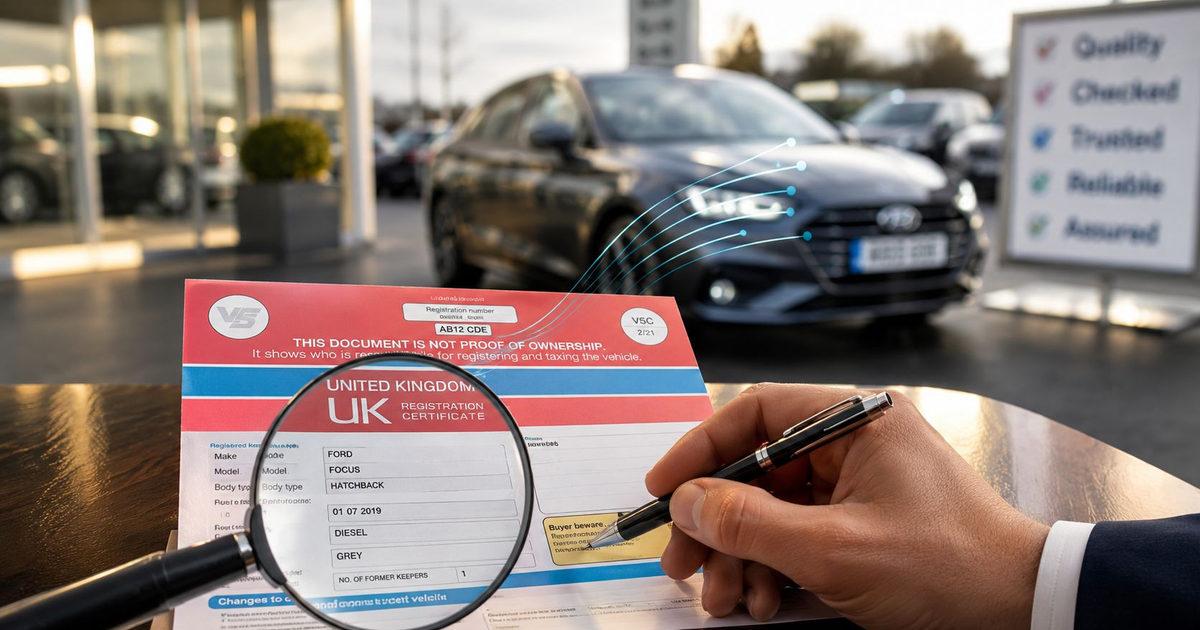
You've probably seen it on the forecourt, a car that looks tidy on the paperwork, the seller sounds consistent, the V5C is in hand, and the deal feels straightforward. Then, a few weeks later, the story changes. The mileage doesn't sit right with the history, the keeper trail looks odd, or the buyer you sold to starts asking questions your original trade appraisal never covered.
That's the trap with car documents V5 work in the UK motor trade. The V5C is useful, but it's not a title deed and it's not a cleanliness certificate. Used properly, it's a data reconciliation tool, one part of a wider provenance view that needs DVLA reads, keeper chronology, and mileage context before money goes out the door.
Table of Contents
- Why the V5C Catches Out Even Experienced Traders
- The clean-looking logbook that still caused a problem
- Why the usual trade instinct can fail
- What the V5C Actually Is in the UK System
- A registration certificate, not a title document
- Why DVLA data matters beyond one car
- How to Read a V5C Field by Field
- The fields that matter when money's on the table
- The keeper trail tells a separate story
- DVLA Checks, Online Enquiries and Timing Windows
- What to ask the DVLA before you pay a deposit
- Why the transfer gap matters
- Common Fraud Indicators Hidden in the Paperwork
- Why a missing logbook can mean more than missing admin
- Non-standard registration routes need more scrutiny
- The red flags that should pause a deal
- Buying and Selling Obligations Around the V5C
- What the seller has to do, and what the buyer has to keep
- The receipt is your actual audit trail
- Non-standard registrations need a wider file
- How AutoProv Layers Over DVLA Reads for Trade Buyers
- What a contextual read adds
- A worked trade example
- A Quick V5C Verification Checklist for Trade Purchases
Why the V5C Catches Out Even Experienced Traders
The clean-looking logbook that still caused a problem
A familiar trade problem starts with a decent unit, a decent seller, and a V5C that looks ordinary at a glance. The registration number matches, the colour and make line up, and the keeper count does not immediately raise any concern, so the car gets priced and bought. Weeks later, a fuller check produces a different picture. The timeline looks compressed, the mileage pattern does not sit with the recorded history, or the seller's account now clashes with the paperwork trail.
That is why a neat logbook can be misleading. Traders who stop at a quick visual check can miss the more useful job the V5C is doing, which is to let you reconcile the vehicle's data against the story you are being told. A proper review starts by comparing the logbook against DVLA reads, ownership timeline clues, and mileage movement, because the value is in the gaps as much as the printed fields. The government's DVLA record also carries fields beyond the printed logbook, including the last V5C issue date, MOT expiry, tax status, and first registration date.
Practical rule: if the paperwork looks tidy but the story feels rushed, treat that as a buying signal, not reassurance.
A missing logbook creates the same false comfort. Some traders treat it as admin noise, but dealer-focused guidance frames a missing V5C as a risk signal first and an admin issue second (AutoProv's lost log book guidance). That is the right order of thinking in trade buying. A missing, fresh, or awkwardly presented V5C should make you slow down and reconcile the car's identity before you commit stock money.
Dealer eyes also get drawn to paperwork that looks too tidy for the story around it. A clean sheet, an easy handover, and a neat-sounding explanation can all hide a gap in the chain if you do not test the vehicle history against the document trail.
Browse the West Wales registration guide if you want a separate look at how registration paperwork is presented in practice, especially where local guidance and trade checks need to line up.
Why the usual trade instinct can fail
Trade buyers are trained to trust patterns, and most of the time that instinct works. It breaks when the paperwork is used as a comfort blanket instead of a control. A V5C can be genuine and still sit alongside a story that does not hold once you check the vehicle properly.
The smart position is simple. V5C confidence is not the same thing as vehicle confidence, and the gap between those two is where avoidable losses usually live.
What the V5C Actually Is in the UK System
A registration certificate, not a title document
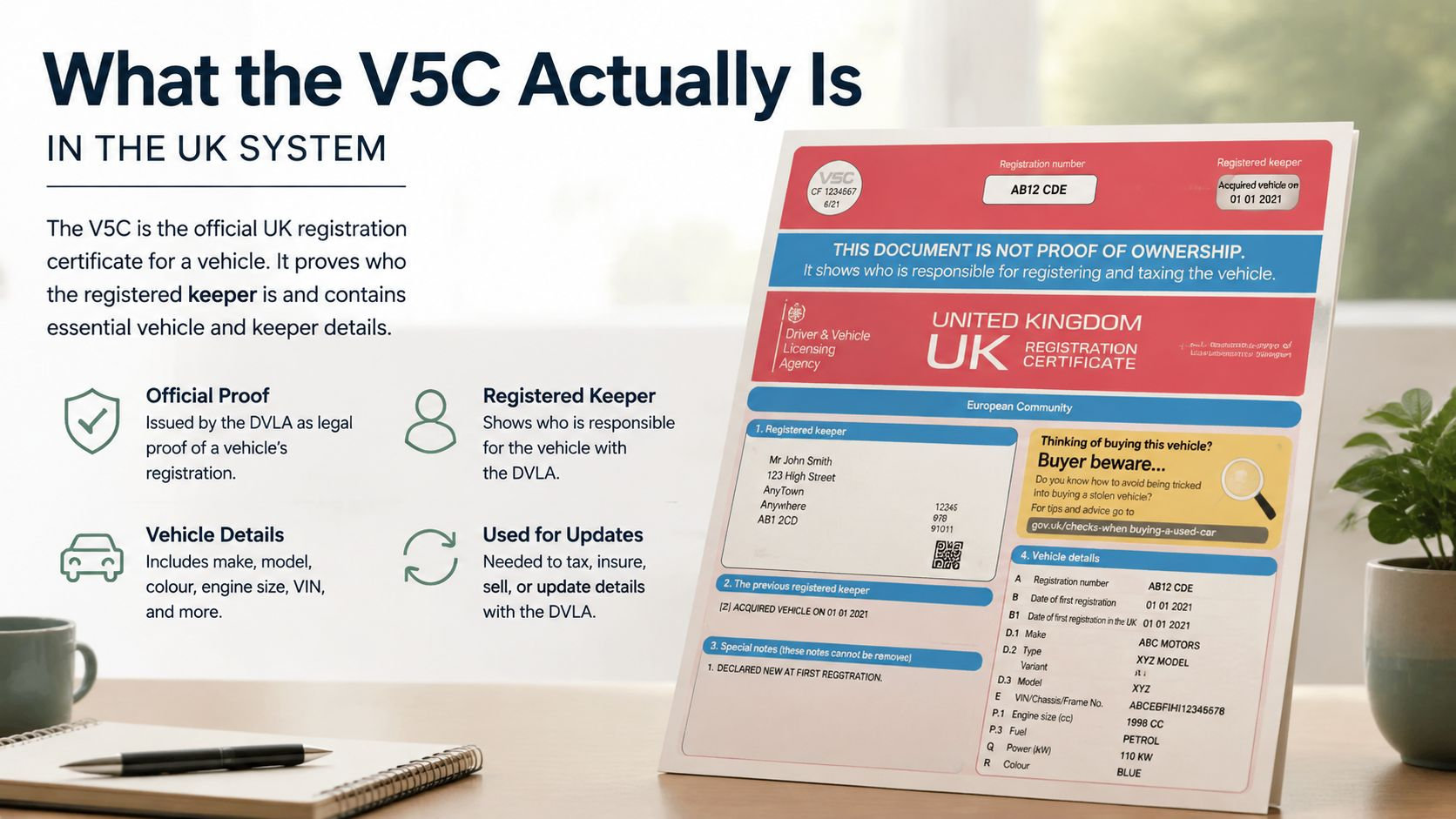
A V5C is the DVLA's vehicle registration certificate. In the trade, that means it is a data record first and a handover document second. It carries the vehicle's core identifiers, including the registration number, VIN, make, model, colour, engine size, fuel type, emissions, tax class, and the date first registered, and it also shows the current keeper and the number of previous keepers (AutoProv's registration certificate guide). It does not prove legal ownership.
That distinction matters because the V5C is best used as a reconciliation tool. If the document, the car in front of you, and the seller's story do not line up, the logbook has done its job by exposing the mismatch early. If you treat it as title evidence, you miss the point and you buy the wrong risk.
Why DVLA data matters beyond one car
The DVLA record sits inside a wider licensing system, not just a paper file in the glovebox. Vehicle licensing statistics are built from DVLA database extracts and published as official government statistics, with geographic and vehicle-type breakdowns (DfT vehicle licensing statistics tables). Those figures draw on licensed vehicle records and new vehicle registration data, so the same underlying system that tracks the national fleet also supports day-to-day trade checks.
That matters on the forecourt and in the auction lane. A V5C is useful because it lets you compare keeper timelines, first-registration data, and tax status against the story the seller gives you. In fleet exits, lease returns, and finance-backed disposals, those fields often flag a paper trail that looks neat but does not match the commercial history you are being told.
A quick registration read can stop you from carrying a problem forward.
If you want a plain-language refresher on how the registration certificate is described in practice, Browse the West Wales registration guide gives a useful external explanation. For a trade-first overview of the same document, see AutoProv's registration certificate guide.
How to Read a V5C Field by Field
The fields that matter when money's on the table
Start with the identity fields. The registration number, VIN, make, model, colour, and engine number are the quickest checks for whether the paper and the car belong together. The V5C also carries descriptors such as engine size, fuel type, emissions class, body type, and taxation class, which should line up with the vehicle in front of you and, where relevant, with MOT or factory build records (Carveto DVLA logbook guide).
That makes the V5C more valuable as a reconciliation document than as a standalone read. If a car is presented as standard but the paperwork doesn't sit comfortably with the engine capacity, emissions class, or fuel type, there's a reason to stop and check further. The strongest trade checks are usually the boring ones, not the dramatic ones.
The keeper trail tells a separate story
The keeper side of the V5C is where a lot of trade risk hides. The current keeper and previous keepers fields tell you how the car moved through the market, but they don't explain why it moved. A change in keeper is an event, not an answer, and it only becomes useful when you compare it with the vehicle's age, mileage pattern, and seller narrative.
A V5C can be technically correct and commercially misleading at the same time.
When I'm checking stock, the most useful read is usually the shortest one. Match the VIN. Check the engine number. Confirm the engine size and emissions class. Then look at keeper chronology against the age of the car. If those four touchpoints feel coherent, you've got something you can work with. If one of them is off, the rest of the paper file often starts to look fragile too.
V5C fields worth checking on every trade purchase Field What it records What to cross-check it against VIN Vehicle identity number Physical VIN plate, stamped VIN, factory or compliance records Registration number Current mark assigned to the vehicle Number plates, DVLA read, seller paperwork Engine number Engine identity Engine bay stamp, service records, compliance documents Engine size Declared capacity Factory build data, MOT history, model specification Fuel type Fuel system classification Physical vehicle spec, factory data, emissions records Emissions class DVLA-held emissions descriptor MOT history, manufacturer specification Taxation class Vehicle tax category DVLA enquiry, current use and body type Body type Vehicle configuration Physical inspection, factory build record Previous keepers Keeper chronology Seller story, ownership timeline, trade history Date first registered First UK registration date DVLA read, import or rebuild documentation
DVLA Checks, Online Enquiries and Timing Windows
What to ask the DVLA before you pay a deposit
The DVLA record is where I start if I want a live read on the car's paperwork position. Check the last V5C issue date, MOT expiry, tax status, and first registration date through the official vehicle enquiry service, because those fields tell you whether the record is current and whether the vehicle's administrative history makes sense against its age.
Treat that result as a reconciliation tool, not a green light. A recent V5C issue date with no clear reason, or a registration timeline that does not sit comfortably with the car's condition, deserves a slower deal and a fuller explanation from the seller. A vehicle history check UK process that only glances at the title page misses the part that usually matters in trade, whether the paperwork, the mileage pattern, and the physical car all agree.
Why the transfer gap matters
The transfer process does not complete the moment money changes hands. On a used-car purchase, the buyer first gets the green V5C/2 new keeper slip, while the rest of the V5C is sent to the DVLA and the full document follows later (Scrap Car Comparison guide to V5C transfer). That leaves a gap between the sale and the updated government record, and that gap needs to be factored into how you read the file.
For a trade buyer, timing matters as much as the form itself. A same-day DVLA read can be useful, but it does not settle every question when the transfer is still working through the system. You are looking at point-of-decision vehicle intelligence, so the practical job is to separate what is confirmed now from what is still in transit.
Mileage checks sit in the same lane. If you want a tighter read on how date fields and odometer history are matched, AutoProv's DVLA mileage check guide is the right place to anchor that process. The useful habit is simple. Check what the DVLA shows today, then compare it with the mileage pattern, keeper movement, and the seller's story before you commit stock money.
Trade habit: do not price a car as though the DVLA record has already settled when the transfer only happened moments ago.
Common Fraud Indicators Hidden in the Paperwork
Why a missing logbook can mean more than missing admin
A missing V5C often gets filed away as an admin lapse. In trade, it can also point to a wider reconciliation problem. The question is whether the missing document sits alongside mismatched identity, seller incoherence, unusual keeper timelines, or mileage that does not fit the rest of the file. That is the line between a lost piece of paper and a risk signal worth pricing in.
Freshly issued logbooks deserve the same treatment. A new V5C does not automatically mean the car is suspect, but it does mean you need to check how the vehicle got to that point and whether the timeline holds together. If the seller cannot explain the paper trail cleanly, the issue is usually larger than the form itself. For a wider fraud-check lens, AutoProv's logbook fraud guide is relevant reading.
Non-standard registration routes need more scrutiny
The DVLA route for registering a used vehicle for the first time uses the V55/5 form for vehicles that have already been registered before, including imported or rebuilt vehicles (DVLA guide to registering a used vehicle for the first time). The supporting paperwork can include valid identity and address documents, a V959 notification, duty payable where appropriate, and in some cases a V900 declaration or evidence of revenue or unladen weight.
That matters because provenance risk rises when a vehicle's identity trail depends on extra documentary steps. A car that came through V55/5 may be perfectly legitimate, but the data trail is wider and easier to get wrong. For traders handling high-volume trade stock, WebscrapingHQ data extraction methods can help automate identity verification across multiple vehicles, especially where imported or rebuilt stock needs faster cross-checks. If the buying team is not matching the paperwork against the car's physical identity and chronology, they are buying a risk they do not fully understand.
The red flags that should pause a deal
Some signs need action straight away, not a shrug:
- VIN inconsistencies: If the VIN plate, stamped identity, and V5C do not agree, stop.
- Keeper churn on a young car: Rapid keeper movement can be legitimate, but it needs context.
- Mileage that does not fit the story: If the receipt, V5C, and recorded mileage do not align, that is a control failure.
- Evidence of cloning or re-identity: Physical plate checks matter when identity is the core asset.
- Seller explanations that keep changing: A clean file usually stays consistent under pressure.
If the paperwork only makes sense after a lot of verbal editing, the file is not clean enough for stock.
Buying and Selling Obligations Around the V5C
What the seller has to do, and what the buyer has to keep
A V5C only helps if the transfer is handled properly. The seller needs to complete the change of keeper details and send the relevant part back so the DVLA record stays current, which is the point covered in the Scrap Car Comparison guide to V5C transfer. In trade, a loose handover is often where a later dispute starts, even if the sale itself was sound.
The buyer's job is simpler but still needs discipline. You should leave with the green V5C/2 new keeper slip and the 12-digit reference, then wait for the full V5C to follow from the DVLA. That slip is not proof of a finished transfer. It is the temporary record for the intake file, and it should be treated that way from the moment the car lands on site.
The receipt is your actual audit trail
The receipt carries more weight than many buyers give it. A proper used-car file should include the date of purchase, buyer and seller names, vehicle details including mileage and VIN, and signatures from both parties. That is the document you reach for later if the vehicle comes back as a dispute, a condition complaint, or a history mismatch, and the Carwow used-car document guide sets out the same practical baseline for what should be in the pack.
If the mileage on the receipt, the V5C data, and the vehicle's recorded history do not line up, treat it as a live control problem. A mismatch can be innocent, but it still needs explanation before the car goes live. The best time to get a correction is before the car is booked in, not after it has been cleaned, priced, and exposed to a buyer's inspection.
Non-standard registrations need a wider file
Cars that came through V55/5 registration need a wider evidence set than a routine keeper transfer. Imported and rebuilt vehicles often arrive with extra paperwork because the registration route is more complex, and the file should reflect that complexity rather than pretend it is a normal domestic handover. The V5C is only one layer. Trade buyers should read it alongside the supporting documents, the ownership timeline, and the mileage pattern, then use the DVLA transfer guidance to check that the change of keeper process has been followed cleanly.
That is the useful habit here. A logbook glance tells you what the paper says, but not whether the paper, the car, and the chronology agree.
How AutoProv Layers Over DVLA Reads for Trade Buyers
What a contextual read adds
A DVLA read tells you what the record says. A contextual provenance layer tells you what that record means next to ownership chronology and mileage pattern. That's the gap AutoProv is built to fill, it analyses DVLA-linked registration details alongside MOT history, mileage patterns, ownership timelines, and risk indicators so a trader can see the car in context rather than as a single document snapshot.
That matters because a V5C doesn't explain short-term ownership, rapid resale behaviour, or a mileage path that looks too neat to be natural. A car can pass a quick logbook glance and still flag once you read the keeper chronology against the rest of the file. The point isn't to replace the DVLA. It's to interpret the data the DVLA already holds.
A worked trade example
A used car arrives with a valid-looking logbook, sensible colour and model details, and a seller who's confident under questioning. On paper, it looks like a normal unit. A contextual read then shows a keeper pattern that doesn't sit comfortably with the age of the car and a mileage history that needs sharper scrutiny, so the buyer slows the deal and checks deeper before stocking it.
That's the practical value of trade vehicle intelligence. It doesn't need to shout. It just needs to show when a car is more complicated than the first glance suggests. For buyers who want to build that into their process, see how AutoProv works.
A Quick V5C Verification Checklist for Trade Purchases
Check the V5C/2 slip, match the VIN and engine number to the physical car, run the DVLA enquiry for MOT, tax status, and last V5C issue date, compare keeper count with the vehicle's age, and make sure the full V5C timing fits the transfer you've just completed. A V5C is a point-in-time snapshot, and profit comes from reading it in context, not in isolation.
If you're tightening your buying process around V5C checks, AutoProv gives you a trade-focused way to read DVLA data, keeper history, and mileage patterns together before you commit stock money. Visit AutoProv to see how its provenance and risk intelligence fits into your dealership's vehicle history check UK workflow.
Frequently Asked Questions
AI-Generated Content Notice
This article was created with the assistance of artificial intelligence technology. While we strive for accuracy, the information provided should be considered for general informational purposes only and should not be relied upon as professional automotive, legal, or financial advice. We recommend verifying any information with qualified professionals or official sources before making important decisions. AutoProv accepts no liability for any consequences resulting from the use of this information.
From our AI insights
- Avoiding Towing Missteps: Legal Checks for Dealers
Protect your dealership by ensuring vehicle weight and towing capacity compliance before listing stock.
- V5C Logbook: Untold Legal Limitations & Verification Needs
Explore the V5C logbook's legal boundaries and why traders need extra checks.
- Managing CRA 2015 Rejections: Evidence Essentials for Dealers
Learn how UK motor traders can effectively handle CRA 2015 rejection claims with proper evidence management.
Related Articles

Understanding the Consumer Rights Act 2015 in the UK Motor Trade
Explore the Consumer Rights Act 2015 and its impact on UK car buyers and sellers, offering essential protections and insights.

Understanding UK Automotive Regulations
Explore the complexities of automotive regulations in the UK, covering DVLA, FCA, MOT, and more.
What is a V5C Document: A Quick UK Log Book Guide
If you've ever bought or sold a car in the UK, you've definitely come across the V5C. It's often just called the 'log book', and it’s the official Vehicle Registration Certificate issued by the DVLA.
Published by AutoProv
Your trusted source for vehicle intelligence
