
A clean retail car lands in front of you. Good photos, sensible spec, tidy cabin, acceptable margins. The seller hands over the V5C registration certificate and expects that to settle any concern about identity, keepership and history.
It shouldn’t.
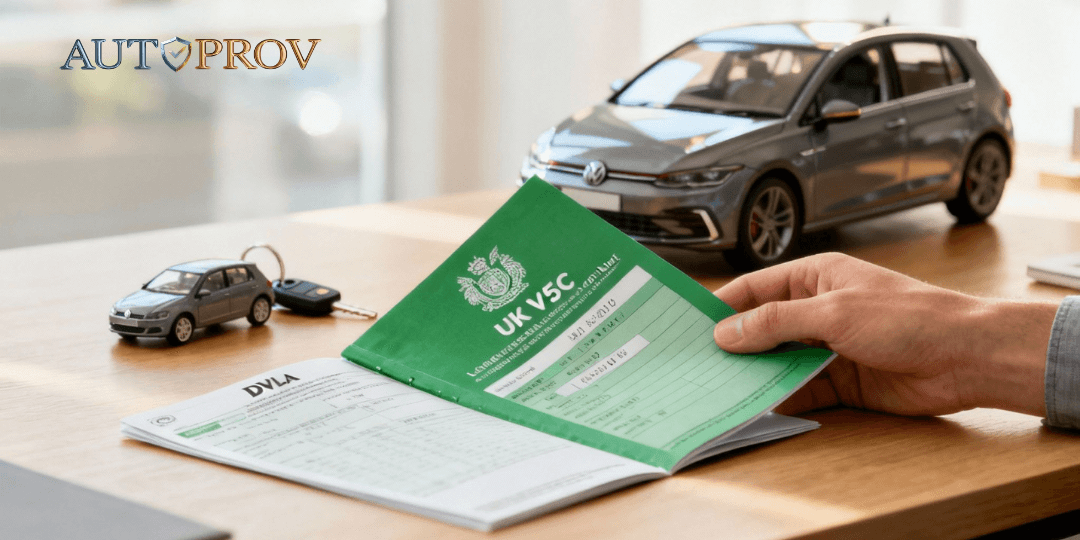
In the trade, the V5C is often treated as admin. Check the reg, glance at the keeper details, make sure it exists, move on. That approach misses one of the most useful risk signals on the vehicle. A registration certificate UK check isn't just about whether the paper is present. It's about whether the details on that paper fit the rest of the car's story.
A V5C can look fine and still point to problems. Dates can sit awkwardly against the MOT timeline. Keeper information can be technically correct but commercially uncomfortable. VIN formatting can expose a rushed listing, a cloned identity, or a seller who doesn't know the car well enough. For experienced buyers, the document isn't the answer. It's the starting point.
The V5C Beyond Paper A Critical Risk Tool
A trader reviews a car differently when his money is on the line. The issue usually isn't the obvious fake. It's the vehicle that feels right until one small document detail forces a second look.

A common example is a vehicle presented as straightforward part exchange stock. The seller has the V5C. The name matches their ID. The car starts, drives, and the panel gaps look honest. Then you notice the date the current keeper took the vehicle on doesn't sit comfortably with the way the sale is being described. That doesn't prove fraud. It does tell you the paper deserves interrogation, not a tick-box.
Why the V5C matters at appraisal
The V5C carries core identifiers that feed the rest of your checks. Registration mark, VIN, make, model, taxation class, keeper details, former keeper count and key registration dates all give you a framework for assessing whether the vehicle's story holds together.
What works is treating the certificate as a primary risk signal. What doesn't work is assuming presence equals legitimacy.
A strong buying process asks:
- Does the VIN on the V5C match the vehicle exactly. Not almost, not “close enough”, exactly.
- Do the keeper dates fit the sale narrative. A vehicle described as long-owned but recently registered to the current seller needs explaining.
- Does the former keeper pattern suit the stock profile. Some cars naturally move often. Others shouldn't.
- Do the details align with the wider record. MOT history, mileage pattern, valuation context and change activity all matter.
Practical rule: Never read a V5C in isolation. Read it against the car, the seller, and the digital record.
For traders running disciplined vehicle provenance reporting workflows, the V5C becomes more useful. It stops being a filing document and starts acting as a trigger for deeper checks. A mismatch on paper can be the first visible sign of a much wider issue. Equally, a clean-looking document can hide a pattern of rapid movement or inconsistent presentation that only shows up when you test it against external data.
The whole story is rarely on the page
Paper tells you what was recorded. It doesn't tell you whether the vehicle's background is commercially safe, whether short-term keepership sits behind the sale, or whether the seller's account stands up under pressure.
That gap is where profit gets lost.
What the V5C Is and What It Is Not
The V5C is the UK vehicle registration certificate issued for DVLA registration purposes. In trade terms, it identifies the registered keeper recorded against the vehicle. That distinction matters because a registered keeper isn't automatically the legal owner.
Dealers still get caught by this. A seller can appear on the V5C and still have no clean right to sell. Finance, agency sales, family-use vehicles, probate situations, company cars and informal arrangements all create separation between use, registration and ownership.
The critical distinction
If you rely on the V5C as proof of title, you're building risk into the deal. The document supports identity and vehicle matching. It doesn't replace proper commercial due diligence.
The V5C tells you who DVLA records as responsible for registering and taxing the vehicle. It doesn't, by itself, prove who owns the asset.
That matters most when the sale gets difficult. Complaints, finance disputes and identity issues don't get resolved by saying “the seller had the logbook”.
Older and newer V5C versions
You'll still see older blue-style V5Cs in circulation on long-held vehicles or where paperwork hasn't been updated for some time. More recent certificates are the red style most traders recognise. Style alone doesn't settle legitimacy, but document age can help frame questions.
If an older format appears, inspect it more carefully and be especially strict on cross-checking vehicle identifiers. If the seller is vague about when paperwork changed hands, that's a prompt to slow the deal down.
UK Vehicle Document Comparison
Document Primary Purpose Issuer What It Proves V5C registration certificate Records the vehicle and registered keeper with DVLA DVLA The registered keeper details and core vehicle registration data MOT certificate Records the outcome of an MOT test Authorised MOT testing station That the vehicle was tested on that date and the recorded result Service history Shows maintenance and repair activity Usually servicing dealer or workshop That certain work was recorded as completed Bill of sale or invoice Records the transaction between parties Seller Evidence of sale terms and who sold to whom This is why experienced buyers layer documents instead of trusting one. The V5C gives registration context. MOT records show testing chronology. Service history helps with use and maintenance. The sales invoice ties the transaction to a party.
Where traders go wrong
Three mistakes come up repeatedly:
- Treating the V5C as title proof. It isn't.
- Ignoring document interaction. The V5C has to make sense alongside MOT, invoice history and the physical car.
- Failing to verify identifiers early. The fastest way to waste time is to delay the VIN check. If you need a refresher on VIN structure, this guide on what a VIN is and how it works is worth keeping handy.
A proper registration certificate UK process is simple in principle. Use the V5C to identify what should be true. Then test whether it is.
A Section-by-Section V5C Breakdown for Traders
The quickest way to lose control of a purchase is to skim the V5C instead of reading it field by field. Traders need a repeatable method. The point isn't to memorise every box number. The point is to know which entries affect risk, valuation and confidence.

Vehicle identity details
Start with the vehicle itself. Registration mark, VIN or chassis number, make, model, body type, engine size, fuel type and colour should all align with what is physically in front of you.
Immediate checks:
- Match the VIN exactly against the car's VIN plate and any visible stamped location.
- Check colour and body description against the vehicle as presented.
- Read model information carefully on derivatives where trim or engine affects value materially.
A wrong colour entry isn't always sinister. It may point to an undeclared change, poor admin, or a car that's been altered and not correctly recorded. None of those should be ignored.
Registered keeper details
At this stage, many buyers become too relaxed. Name and address aren't just admin fields. They help you judge whether the seller's relationship to the vehicle is coherent.
Ask yourself:
- Is the seller the registered keeper?
- If not, what's the selling authority?
- Does the explanation come quickly and clearly, or only after probing?
- Does the stated ownership story fit the keeper dates?
A seller who hesitates on basic keepership facts may be disorganised. But hesitation around paperwork is also common where the seller wants the transaction completed before you look too closely.
Former keeper information
The number of former keepers affects more than presentation. It helps frame how the car has moved through the market. A frequent-change pattern isn't automatically bad, but it can alter your appetite and margin requirement.
Use this part of the V5C to ask sharper questions, not to reach instant conclusions.
If a vehicle has changed hands in ways that don't fit its age, condition or market position, treat that as a commercial issue first and a paperwork issue second.
Some cars attract rapid churn because they're desirable, cheap to trade or bought speculatively. Others move quickly because someone is trying not to hold the risk for long.
Dates that deserve attention
Several dates on the V5C can shift your view of the stock:
- Date of first registration helps anchor age and market expectation.
- Date the current keeper acquired the vehicle can expose short holding periods.
- Document issue date can indicate recent replacement paperwork.
A recent issue date doesn't mean there is a problem. It does mean you should ask why a replacement was needed and whether that story matches everything else you've seen.
Details that should never be “close enough”
There are fields where approximation has no place:
V5C field Trader action Why it matters VIN or chassis number Match character for character Identity errors and cloned vehicles often surface here Registration mark Confirm against plates and records Basic mismatch can indicate admin error or deeper identity issues Engine number Check if accessible and relevant Useful where identity concerns or rebuild questions arise Keeper acquisition date Compare with seller story Exposes recent transfers and hurried resale activity If the deal involves any uncertainty around title, sale authority or chain of possession, tighten your process. This guide on how to prove ownership of a car is useful because it separates registration paperwork from evidence of legal ownership.
What traders should write into the appraisal routine
Build the V5C into the appraisal, not the handover stage.
- Read it before discussing price. You want risk signals early.
- Photograph key sections clearly. That creates an audit trail for the buying file.
- Check narrative consistency. The document should support the seller's account, not force you to reinterpret it.
- Escalate uncertainty. If a field doesn't make sense, stop and verify before committing stock money.
The best buyers don't just ask whether the V5C is present. They ask whether the document and the vehicle belong together.
Spotting Forgeries and Tampering Before You Buy
Most fraudulent paperwork doesn't arrive looking obviously fake. The better attempts are designed to pass a quick desk check. The weaker attempts rely on pressure, speed, poor lighting and a buyer who wants the car badly enough to overlook detail.

Physical red flags on the document
Use a simple inspection routine every time. The point is consistency.
- Paper feel. Genuine documents tend to have a specific quality and finish. If the paper feels wrong, too glossy, too flimsy or unusually fresh, slow down.
- Print quality. Watch for blurred text, inconsistent type alignment, broken edges on characters or uneven density.
- Watermark and background pattern. Check for expected security features, including the visible patterning a genuine document should carry.
- Spelling and layout. Official text shouldn't contain obvious errors, awkward spacing or poor formatting.
- Signs of alteration. Look for rubbing, thinning, scraping, correction fluid, overwritten characters or inconsistent colour around edited fields.
A strong counterfeit may still look polished. That's why physical inspection only works when paired with data verification.
Seller behaviour is part of the inspection
Document fraud rarely sits on its own. It usually appears alongside a selling pattern that doesn't feel right.
Watch for:
- Urgency without reason. The seller wants payment before you've checked properly.
- Loose explanations. Keeper history changes each time you ask about it.
- Reluctance to show the car in daylight. Simple, but still relevant.
- Deflection on VIN checks. Anyone selling legitimately should expect this.
- The lost V5C script. Sometimes it's genuine. Sometimes it's used to keep you away from a problematic paper trail.
A missing or suspect V5C isn't just a paperwork inconvenience. It's a risk event. Price it that way or walk away.
The classic errors that catch buyers
Fraud doesn't always mean a fully fabricated certificate. It can be partial tampering.
Common examples include altered keeper names, changed issue details, chemically cleaned sections and replacement documents used to distance the vehicle from prior context. Traders should also be careful where the visible VIN on the car appears newly attached, disturbed or inconsistent with surrounding wear. If you need a practical refresher on locating and checking that identifier, this guide on how to find a vehicle identification number is worth bookmarking.
A short inspection checklist
Before any deal is agreed, make sure someone in the business has physically checked:
| Inspection point | What you’re looking for | |---|---|---| | Paper and finish | Consistent quality, no suspicious texture or sheen | | Security pattern | Expected watermarking or patterned background | | Printed text | Clean, aligned, error-free production | | Edited areas | No erasure, chemical disturbance or overwrite signs | | VIN consistency | Exact match between document and vehicle |
This isn't forensic science. It's disciplined buying. The trader who spots tampering early doesn't just avoid one bad purchase. He protects prep time, transport cost, reputation and dispute exposure.
Beyond the Document Advanced Provenance Checks
A convincing V5C is only one point in the chain. The bigger task is deciding whether the vehicle's documented identity lines up with its operating history. That's where a proper vehicle history check UK process becomes more valuable than a simple paperwork review.
Cross-reference the V5C against the vehicle story
The strongest workflow starts with the V5C and then tests it against external records and trade context. You want confirmation on core points, but you also want contradiction. Contradiction is where hidden risk appears.
Useful cross-checks include:
- Keeper chronology against MOT history. Do date changes line up sensibly with testing activity and use?
- Mileage pattern against ownership pattern. A mileage check UK is more revealing when you look at who held the car and for how long.
- Specification consistency. V5C vehicle details should support the physical car and the way it's being marketed.
- Recorded changes versus sale narrative. If the seller describes a settled history but the timeline suggests movement, ask why.
What the V5C doesn't tell you
The document may show the number of former keepers, but it doesn't provide commercial context. A high keeper count on an older enthusiast car may be explainable. A short, compressed series of changes on mainstream retail stock is different.
Instead of remaining theoretical, vehicle provenance becomes practical. You aren't just asking whether the car has records. You're asking what those records mean for dispute risk, margin pressure and buyer confidence.
Good provenance work isn't about collecting more documents. It's about testing whether the timeline makes commercial sense.
A solid used car history report should help you interpret, not just list. Traders need ownership duration, mileage rhythm, change points and anomaly signals presented in a way that supports a buy or no-buy decision.
Ownership pattern analysis
Experienced buyers already do this informally. They sense when a vehicle has moved too often or too quickly. Formalising that instinct improves consistency across the team.
Look closely at patterns such as:
- Short-term keepership
- Cars that don't stay with one keeper long can be perfectly legitimate. But repeated short holds often deserve tougher scrutiny.
- Rapid resale through trade channels
- If the vehicle appears to have bounced through hands quickly, ask what each holder knew that the next buyer should know too.
- Timeline gaps or awkward sequence
- A clean-looking logbook doesn't solve a chronology that feels incomplete.
For a deeper framework on building that chronology, this guide to car provenance reports in the UK is a useful reference.
Build a due diligence sequence that works
The order matters. A practical workflow looks like this:
- Check the physical V5C and the vehicle together
- Confirm key identifiers
- Run external history and mileage checks
- Review ownership timing and resale pattern
- Reconcile inconsistencies before negotiating hard
What doesn't work is running a basic check after you've already decided you want the car. Once emotional commitment enters the appraisal, weak explanations start sounding acceptable.
Trade buyers make stronger decisions when the V5C acts as a gateway into broader trade vehicle intelligence, not as a substitute for it.
Integrating Intelligence for Comprehensive Risk Assessment
The trade problem isn't lack of data. It's lack of context at the point of decision. A buyer can have a V5C, MOT history, auction notes, service paperwork and a sales pitch, and still miss the pattern that matters.
That's where an intelligence layer earns its place. A platform built for dealer vehicle checks should do more than return isolated records. It should connect the V5C details to the wider provenance picture and highlight where the paper trail and the market behaviour don't comfortably fit.

What better intelligence adds
When traders rely on basic checks alone, they often get confirmation without interpretation. The registration exists. MOT records exist. Mileage records exist. That's useful, but incomplete.
What serious motor trade risk assessment needs is linkage:
- Does the keeper timeline support the condition and presentation of the car
- Does the reported movement pattern look stable or transactional
- Does the mileage progression fit the ownership rhythm
- Are there anomalies that justify changing your bid, your prep assumptions or your retail strategy
This is the difference between a pass/fail report and decision support.
Why raw data isn't enough
A V5C might appear internally consistent while still sitting inside a poor-quality ownership pattern. A basic history result might show no headline shock, but the timeline can still suggest risk. Traders who buy in volume know this already. The expensive mistakes are often not the dramatic write-offs. They are the cars that create slow-burn problems after purchase.
An intelligence-led process helps identify:
Risk area Basic check may show Intelligence view should ask Keeper history Number of former keepers Whether the timing and sequence fit expected use Mileage Recorded mileages Whether the pattern is smooth, interrupted or commercially awkward Vehicle identity Matching registration details Whether identity data holds up across the broader record Resale behaviour Limited point-in-time facts Whether the vehicle has moved in a way that raises concern Buyers make better stock decisions when the system highlights patterns, not just records.
A strong platform for trade vehicle intelligence should support appraisal discipline. It should help the team spot rapid resale activity, interpret ownership duration properly, and isolate discrepancies worth escalating before any funds are committed. That doesn't replace a document inspection. It makes that inspection more useful.
The V5C remains important. But in professional buying, its value comes from what you can verify around it.
Frequently Asked Questions for Motor Traders
Is the V5C legal proof of ownership
No. The V5C identifies the registered keeper, not necessarily the legal owner. That's the core distinction traders need to keep front of mind in every deal.
If title is unclear, the V5C won't solve it for you. You still need to assess sale authority, supporting paperwork and the wider transaction context.
What if the seller has lost the V5C
Treat it as a risk issue first, an admin issue second. There are legitimate reasons for missing paperwork, but a lost V5C removes one of your quickest routes to identity and keeper verification.
Before progressing, tighten everything else:
- Verify the seller properly
- Inspect VIN locations carefully
- Review the wider vehicle record in more depth
- Ask why the certificate is missing and listen for consistency
If the explanation changes or the seller becomes impatient, that tells you something useful.
Is the V5C 2 slip enough to buy safely
The V5C/2 new keeper slip is helpful for process, but it isn't a substitute for checking the full certificate and the wider vehicle history. Traders shouldn't treat the slip as complete reassurance.
Use it for continuity and administration. Don't use it as the foundation of your due diligence.
How should traders notify DVLA when buying for stock
Your internal process should distinguish clearly between buying into stock and selling out to a retail customer. Staff need to know who is responsible for completing the relevant notification steps and when records must be updated.
The risk isn't just administrative delay. Poor stock movement records can create confusion around keepership, handover timing and customer disputes.
Should I walk away if the keeper and seller don't match
Not automatically. Plenty of legitimate deals involve a seller acting for a family member, a company, an estate or another party. But the burden of explanation rises immediately.
Ask for a clear chain of authority and supporting evidence. If that doesn't come quickly, don't let price talk distract you.
Do replacement V5Cs matter
Yes. A recently issued document doesn't prove wrongdoing, but it changes the questions you should ask. Why was the replacement needed, and does that answer fit the vehicle's recent timeline?
If the replacement explanation is thin, inspect harder.
What should my buyer check first on the forecourt or at the auction site
Use a short sequence:
- VIN match
- Keeper details and acquisition date
- Document issue date
- Vehicle description against the car
- History checks and ownership pattern
That order prevents wasted time. If the identity basis is wrong, the rest of the appraisal isn't worth much.
What's the most common V5C mistake traders make
They check for presence instead of meaning. A document in hand feels reassuring, and reassurance can lower scrutiny.
The stronger habit is to ask one simple question every time. Does this V5C support the vehicle story, or does it force me to explain away inconsistencies?
Is there any official context worth knowing about registration certificates more broadly
Yes, but it sits outside the vehicle sphere. In British nationality law, a Registration Certificate issued by the Home Office is the definitive legal proof of a person's registration as a British citizen, and passport examiners must validate certificate details against official records when processing first-time passport applications, according to GOV.UK guidance on naturalisation and registration certificates. The useful lesson for traders isn't citizenship law. It's the principle that important certificates only become reliable when their details are checked against the underlying record.
That same discipline applies to cars. The paper matters, but verification matters more.
If your team wants a sharper way to assess V5C risk, ownership patterns, mileage anomalies and broader vehicle provenance before buying stock, AutoProv gives the UK motor trade a more contextual view than a basic used car history report. It helps buyers connect the registration certificate to the wider record so pricing, appraisal and risk decisions are made with better intelligence.
Frequently Asked Questions
AI-Generated Content Notice
This article was created with the assistance of artificial intelligence technology. While we strive for accuracy, the information provided should be considered for general informational purposes only and should not be relied upon as professional automotive, legal, or financial advice. We recommend verifying any information with qualified professionals or official sources before making important decisions. AutoProv accepts no liability for any consequences resulting from the use of this information.
From our AI insights
- Avoiding Towing Missteps: Legal Checks for Dealers
Protect your dealership by ensuring vehicle weight and towing capacity compliance before listing stock.
- V5C Logbook: Untold Legal Limitations & Verification Needs
Explore the V5C logbook's legal boundaries and why traders need extra checks.
- Managing CRA 2015 Rejections: Evidence Essentials for Dealers
Learn how UK motor traders can effectively handle CRA 2015 rejection claims with proper evidence management.
Related Articles

Understanding the Consumer Rights Act 2015 in the UK Motor Trade
Explore the Consumer Rights Act 2015 and its impact on UK car buyers and sellers, offering essential protections and insights.

Understanding UK Automotive Regulations
Explore the complexities of automotive regulations in the UK, covering DVLA, FCA, MOT, and more.
What is a V5C Document: A Quick UK Log Book Guide
If you've ever bought or sold a car in the UK, you've definitely come across the V5C. It's often just called the 'log book', and it’s the official Vehicle Registration Certificate issued by the DVLA.
Published by AutoProv
Your trusted source for vehicle intelligence