
An 'as is' car sale contract, often referred to as a 'sold as seen' agreement, is a document designed to transfer a vehicle with the buyer accepting it in its current state, including any faults. While common terminology in the UK motor trade, its legal standing is not absolute. Its enforceability depends almost entirely on who the vehicle is being sold to.
What a UK 'As Is' Car Sale Really Means for Your Business
A common misconception must be addressed immediately. Simply writing 'sold as seen' on an invoice does not negate a dealer's statutory responsibilities, particularly in a retail sale. The legal framework for these contracts is divided into two distinct arenas: retail (B2C) sales and trade-to-trade (B2B) sales. Understanding this distinction is fundamental to managing risk effectively.
When selling to a private individual, the Consumer Rights Act 2015 is the governing legislation. It provides a robust set of protections that cannot be overridden by contractual terms. Regardless of what a sales agreement states, a retail customer's statutory rights are preserved. This means the vehicle must be of satisfactory quality, fit for purpose, and as described.
In a B2B transaction, the situation is different. A correctly drafted 'as is' car sale contract carries significant legal weight. It is an agreement between two commercial entities, both presumed to possess professional knowledge. In this context, the 'as is' clause legitimately transfers the risk associated with the vehicle's condition to the buying trader.
To clarify, here is a breakdown of how an 'as is' clause functions in different sales scenarios.
When an 'As Is' Contract Applies in UK Car Sales
Sale Type Can 'As Is' Terms Be Used? Governing Legal Framework Key Dealer Consideration Business-to-Consumer (B2C) No. An 'as is' clause is legally void. The Consumer Rights Act 2015 Statutory duties (satisfactory quality, fit for purpose, as described) always apply and cannot be contracted out. Business-to-Business (B2B) Yes. It is a legally binding term. Contract Law & Sale of Goods Act 1979 The contract must be clear and transparent. Both parties are considered experts, allowing for a genuine transfer of risk. The table illustrates a stark contrast: in a retail context, 'as is' is an unenforceable phrase, but in a trade deal, it is a core contractual term.
The True Purpose of an 'As Is' Contract
If an 'as is' clause does not absolve a dealer of responsibility in retail sales, what is its function? An 'as is' contract should be viewed less as a legal loophole and more as a professional tool for transparency and disclosure. Its primary role, in any context, is to meticulously document the vehicle's known condition at the point of sale. This is particularly vital for older, high-mileage, or part-exchange units where some degree of wear is expected.
A detailed contract listing specific, known faults protects your business by:
- Setting clear expectations: It defines exactly what the buyer is acquiring and formally records their acceptance of any declared issues.
- Providing a factual record: In the event of a dispute, the signed document serves as evidence of what was disclosed upfront.
- Demonstrating professional diligence: It proves transparent operation, which can significantly strengthen your position if a claim arises.
This decision tree illustrates the critical distinction required for every sale.
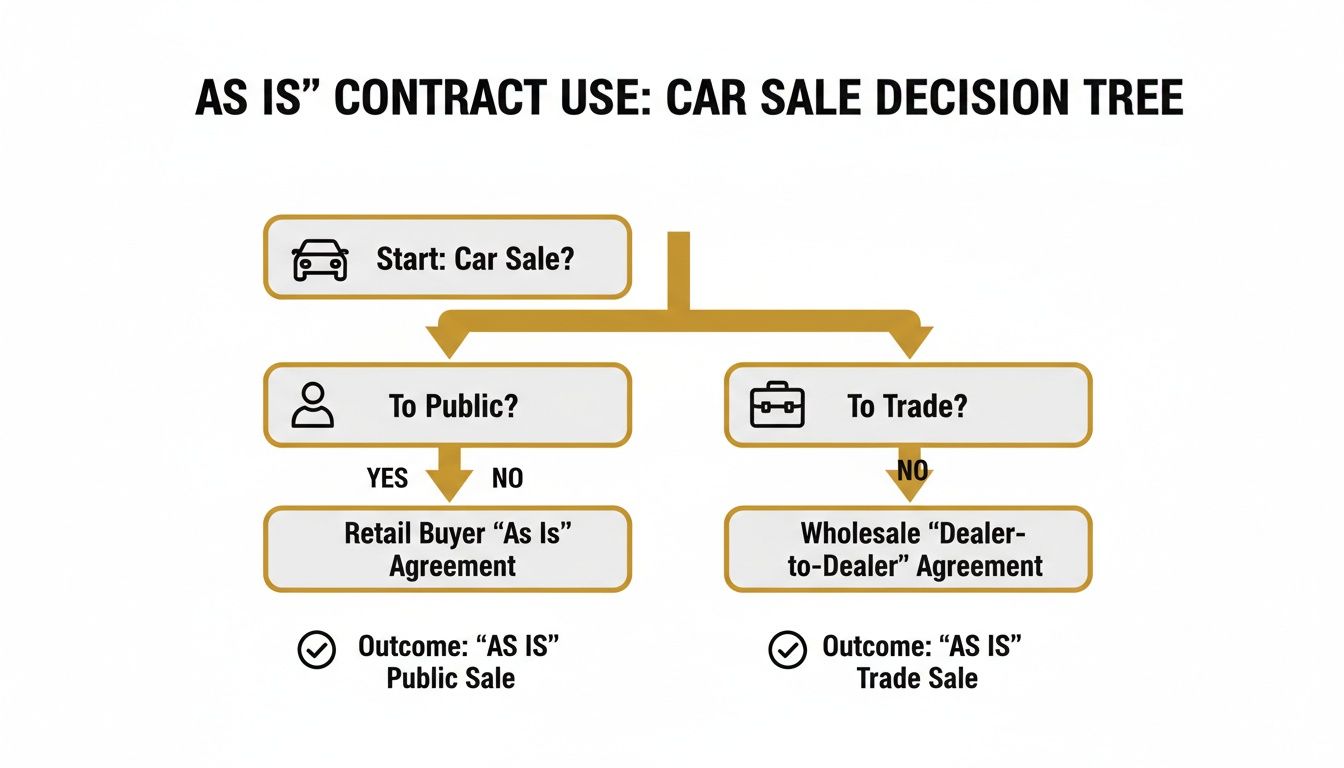
The primary determinant is always whether the sale is to the public or to another business. The answer dictates your legal obligations and the enforceability of your contract.
With the second-hand market experiencing high transaction volumes, this distinction is crucial. In 2023, the UK saw 7,242,692 used car sales. This volume, particularly of older stock where 'as is' terms are more common in trade deals, makes robust vehicle provenance checks a necessity before entering any contract where the buyer is expected to assume risk. Further trade-specific insights are available in our guide on how to successfully sell a car.
Crafting Clauses That Protect Your Business in a Trade Sale
A generic template is insufficient for professional motor traders. For a B2B transaction, your car sale as is contract is a critical risk management tool, and its effectiveness lies in its detail. It should be treated as a detailed operational document for transferring an asset—and its associated risks—from your inventory to another trader's.
Specify the Vehicle's Identity
Clarity is paramount. The foundation of any robust contract is unambiguous vehicle identification, which extends beyond the make and model.
Your agreement must specify:
- Vehicle Registration Mark (VRM): The current registration plate.
- Vehicle Identification Number (VIN): The unique 17-digit chassis number.
- Make and Model: For example, "Ford Focus Titanium".
- Recorded Mileage: The exact mileage displayed on the odometer at the point of sale.
This level of detail eliminates ambiguity and prevents potential disputes regarding the vehicle's identity, forming the factual basis for all other clauses.
The 'As Is, Where Is' Declaration
This is the core of the agreement. The phrase 'as is, where is' must be explicitly stated and understood by both parties. It signifies the buyer accepts the vehicle in its current state, including all known and unknown faults. It also confirms their responsibility for collection from its current location.
This clause must be supported by a declaration from the buyer. Include a statement where the buying trader confirms they have been given ample opportunity to conduct their own comprehensive inspection. This is crucial as it documents that they are a professional relying on their own assessment, not on verbal representations.
Transparency as a Defence: Disclose Known Faults
While it may seem counterintuitive, clearly documenting a vehicle's known faults is one of the most effective ways to mitigate risk. A contract that attempts to obscure issues is easily challenged. In contrast, one that transparently lists them demonstrates good faith and strengthens your legal position.
Create a dedicated section in the contract for itemising all known defects with precision.
Instead of "noisy engine," document "audible rattle from timing chain area on cold start." Rather than "bodywork damage," specify "10cm scuff on nearside rear bumper and stone chips to bonnet."
Requiring the buyer to initial this specific section provides undeniable proof that these issues were disclosed and accepted before the transaction was finalised. For more guidance on structuring these agreements, our article on creating a comprehensive contract for vehicle sale may be useful.
Defining Payment and Title Transfer
Ambiguous terms regarding payment and ownership are a common source of trade disputes. Your contract must define these terms with absolute clarity to prevent misunderstandings.
Ensure you include clauses that define:
- The Full Purchase Price: The total agreed amount.
- Payment Method: The means of fund transfer (e.g., bank transfer).
- Payment Deadline: The date and time by which funds must be cleared.
- Title Transfer: A statement confirming that title (ownership) of the vehicle does not pass to the buyer until full and cleared funds have been received by the seller.
This final point is non-negotiable. It ensures you retain legal ownership and control of the asset until payment is complete, protecting you against payment reversals or defaults after the vehicle has been collected. To further protect your business, understanding how to draft an indemnification clause can be vital for defining financial liability for specific post-sale issues.
Selling to the Public and the Consumer Rights Act 2015
When selling a vehicle to a member of the public, the concept of an 'as is' agreement is fundamentally altered. Any motor trader believing that 'sold as seen' on a retail invoice provides legal protection is operating under a serious misapprehension.
This is arguably the single greatest area of confusion and risk for dealerships, and it stems from one key piece of legislation.

The Consumer Rights Act 2015 is paramount. It provides private buyers with statutory rights that a trader cannot legally exclude, modify, or disregard in any contract. These rights render a traditional 'as is' or 'sold as seen' clause ineffective in a retail transaction.
The Three Non-Negotiable Pillars of Consumer Rights
Under the Act, every vehicle sold to a consumer must meet three core conditions. Understanding these is not just best practice—it is a legal requirement.
- Satisfactory Quality: The vehicle must meet the standard a reasonable person would consider acceptable, taking into account its age, mileage, price, and description. This is a nuanced but critical standard.
- Fit for a Particular Purpose: The vehicle must be suitable for its general purpose as roadworthy transport. If a buyer specifies a particular use (e.g., towing a caravan) and you confirm its suitability, it must meet that requirement.
- As Described: The vehicle must correspond with the description provided, whether in an online advertisement, on forecourt signage, or in verbal communication.
These three duties are automatically incorporated into every consumer sale. Attempting to circumvent them with an 'as is' clause offers no legal defence against a valid consumer complaint.
Defining Satisfactory Quality in Practice
The 'satisfactory quality' requirement often causes the most difficulty for traders. The standard is not absolute. The law recognises that a 12-year-old vehicle with 150,000 miles, priced at £1,500, cannot be expected to be in the same condition as a three-year-old model.
The standard is judged on a sliding scale. A worn clutch on the £1,500 vehicle might be considered fair wear and tear. The same issue on a £15,000, low-mileage vehicle would almost certainly be deemed unsatisfactory, providing the buyer with solid grounds for a claim.
This means your pricing and, critically, your descriptions are fundamental. They establish the benchmark against which the vehicle's quality will be assessed.
Managing Liability Through Meticulous Disclosure
If an 'as is' clause cannot be used to waive your obligations, how can you manage liability on older, lower-value, part-exchange-to-clear stock?
The solution lies in transparent and detailed disclosure. This is where your sales documentation transitions from a legally ineffective shield into a powerful tool for managing expectations.
Instead of a generic 'sold as seen' statement, you must create a specific, itemised list of all known defects. These must be brought to the buyer's attention and documented on the sales invoice or contract.
Consider this scenario:
You are selling a 10-year-old hatchback for clearance. A standard dealer vehicle check shows a clean history, but a workshop inspection identifies several issues.
- The Incorrect Method: Writing "Sold as seen, no warranty" on the invoice. This provides no protection if the gearbox fails a week later due to a pre-existing fault.
- The Correct Method: Listing specific, known faults on the sales agreement:
- "Advisory: Slight oil weep from rocker cover gasket."
- "Noted: Scratches to nearside front wing and dent on tailgate."
- "Buyer Aware: Intermittent fault with rear parking sensors."
By having the customer read and sign or initial against this list, you are not removing their statutory rights. Instead, you are adjusting the 'as described' and 'satisfactory quality' standards for that specific vehicle. The customer cannot then reasonably claim the vehicle was not of satisfactory quality due to the oil weep, as it was a declared and accepted defect at the point of sale.
This process mitigates the risk of post-sale disputes through professional transparency. Our detailed guide to the Consumer Rights Act 2015 for the UK motor trade provides a full breakdown of how the law applies.
Using Vehicle Provenance to Strengthen Your Contracts
A well-drafted car sale as is contract is a vital legal instrument, but its integrity depends on the accuracy of the information you hold about the vehicle. Legal paperwork and operational due diligence are two sides of the same coin; weakness in one compromises the entire transaction. An undisclosed issue that a basic check misses can undermine the agreement and expose you to claims of misrepresentation, even in a B2B sale.
This is where the limitations of standard data checks become apparent. While essential for identifying major issues, they often provide a simple pass/fail snapshot, lacking the deeper context required for genuine risk assessment. To truly fortify your legal position, you must go beyond basic data and incorporate comprehensive vehicle provenance intelligence.
The Limits of Standard Dealer Vehicle Checks
Most motor traders utilise a basic vehicle history check UK professionals have relied on for years. They are crucial for flagging critical alerts like outstanding finance, stolen markers, or insurance write-offs. However, they frequently miss subtle yet significant red flags indicative of underlying problems.
A standard check is unlikely to reveal:
- Rapid Ownership Cycles: A vehicle changing hands multiple times in a short period is a classic indicator of an intermittent or difficult-to-diagnose fault.
- Anomalous Mileage Patterns: Gaps in MOT history or inconsistent mileage progression can suggest potential clocking or extended periods off the road requiring investigation.
- Unusual Plate Changes: While often benign, a history of multiple private plate changes can sometimes be an attempt to obscure a vehicle's past.
These are the types of signals that often lead to post-sale disputes. A buyer may sign an 'as is' contract, but if they later uncover a significant issue that you could or should have been aware of, you risk being drawn into a dispute that consumes time, money, and reputational capital.
Connecting Provenance Intelligence to Contractual Integrity
This is precisely where advanced trade vehicle intelligence becomes a core component of your risk management strategy. A service like AutoProv is designed to analyse these patterns—ownership timelines, mileage data, MOT advisories, and other risk signals—to construct a complete narrative of the vehicle's history.
This deeper analysis provides the context needed to identify potential issues before drafting the contract. It elevates your due diligence from a simple check-box exercise to a strategic assessment.
When you understand a vehicle's true provenance, you operate from a position of knowledge. This empowers you to protect your business in tangible ways. You can disclose potential issues more accurately, price the vehicle to reflect its history, and ultimately, create a car sale as is contract built on a foundation of verifiable data. You can explore what a comprehensive vehicle provenance report includes and how it differs from a standard check.
A provenance report does not just list facts; it reveals the vehicle's narrative. The table below illustrates how this advanced intelligence provides a clearer picture of the risks involved compared to a standard check.
Comparing Standard Checks with Advanced Provenance Intelligence
Risk Area What a Standard Check Reveals What Advanced Provenance Uncovers Ownership History Number of previous keepers. Rapid ownership changes, dealer-to-dealer flipping, and duration of ownership. Mileage Current and last recorded mileage. Inconsistent mileage progression, gaps in MOT history, and potential clocking patterns. Hidden Damage Official insurance write-off categories (Cat S/N). Salvage auction history, previous sale listings with damage photos (even if not written off). Vehicle Use V5C class (e.g., private/light goods). History as a taxi, private hire vehicle, or emergency services vehicle. Plate Changes Current registration number. A complete history of all previous plate changes, including private plates. This level of detail moves the process from basic fact-checking to genuine risk profiling, which is essential when drafting a contract that must withstand scrutiny.
A Practical Scenario
Consider two identical vehicles at a trade auction, both with clean basic checks. An advanced provenance report reveals one has had four owners in the last 18 months, while the other has had one long-term owner for the past six years. This single piece of intelligence—missed by a standard check—fundamentally alters your risk exposure and the price you should be willing to pay.
The current market makes this level of insight more critical than ever. Autotrader projects UK used car sales will reach 7.8 million in 2025. This high volume, combined with a shortage of prime 3-5-year-old stock, is pushing traders towards older vehicles where hidden histories are more common. This environment makes robust motor trade risk intelligence indispensable, as detailed in the analysis on the UK's used car market momentum on Autotrader's corporate site.
By integrating provenance intelligence into your acquisition process, you ensure every 'as is' contract you sign is supported by the most complete information available, transforming a legal document into a robust shield for your business.
Implementing a Bulletproof Sales and Record-Keeping Process
A meticulously drafted car sale as is contract is an effective shield, but its strength is contingent on the process surrounding it. A deficient sales process or inadequate record-keeping can undermine even the most robust legal paperwork. Establishing a standardised, repeatable process for every 'as is' transaction is the final, critical step in managing your risk.
This involves more than securing a signature. It is about creating a clear, indisputable record of the transaction that can be defended if challenged. The objective is to leave no ambiguity for a customer to later claim they misunderstood or were not informed of a particular issue.
Executing the Sale with Precision
The point of sale is where contractual protections are formalised. Rushing this stage is a false economy that can lead to future complications.
Ensure both parties read and understand the terms. Verbally confirm the buyer comprehends the meaning of 'as is', particularly in a trade context. Do not make assumptions. Clear, direct communication is the best defence against future disputes.
A crucial practice is to have the buyer initial key clauses, most importantly the section listing declared faults. This small action provides powerful, undeniable proof that specific issues were brought to their attention and formally acknowledged before the transaction concluded.
The Vehicle Evidence File: Your Defence Dossier
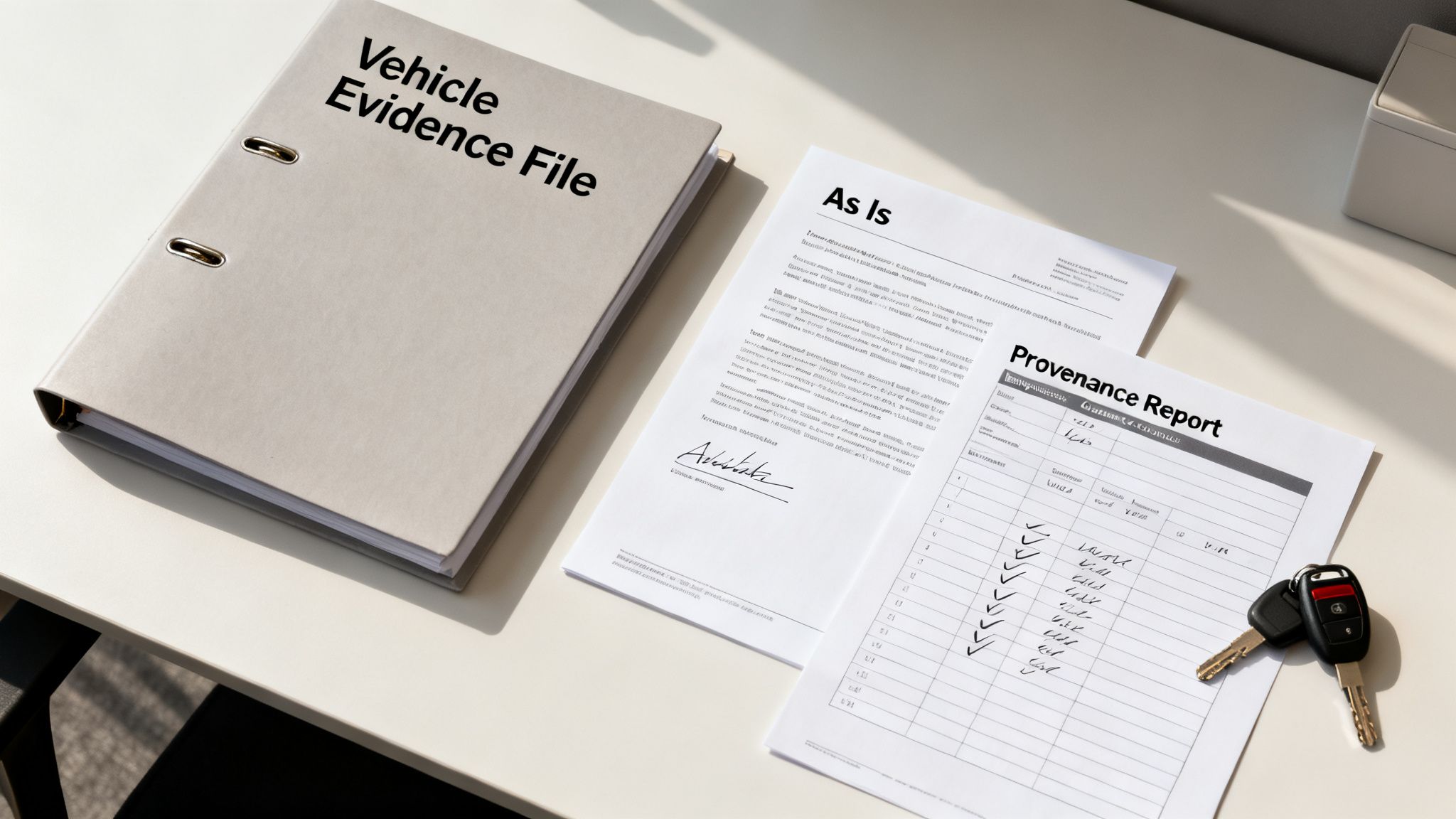
Meticulous record-keeping is non-negotiable. For every vehicle sold under 'as is' terms, you must create and maintain a comprehensive 'evidence file'. This file becomes the single source of truth and your primary defence should a dispute arise.
The file should document the entire transaction, from initial checks to final handover, demonstrating a professional and transparent process that carries significant weight in any legal context.
The evidence file serves as the vehicle's complete transactional history with your business. If a claim is made, this file provides the concrete proof needed to demonstrate what was known, what was disclosed, and what was agreed by both parties.
Your evidence file for each vehicle should contain, as a minimum:
- The Signed Contract: The original, fully executed car sale as is contract, with all signatures and initials.
- The Provenance Report: The full AutoProv vehicle provenance report run prior to acquisition, demonstrating due diligence.
- Inspection Sheets: Any internal or third-party mechanical inspection reports detailing the vehicle's condition.
- Advertisements: Copies of all online or print adverts, which form part of the vehicle's description.
- Communications: Relevant emails or messages discussing the car's condition with the buyer.
- Proof of Payment: A copy of the final invoice and confirmation of cleared funds.
Why This Process Matters in a Dispute
Imagine a scenario: six months post-sale, a buying trader claims a recurring engine management light issue was never disclosed. Without a robust evidence file, the situation becomes a contentious "he said, she said" argument.
With a complete file, your response is simple and factual. You can produce the signed contract where the buyer initialled a clause stating "intermittent EML on, fault code P0420 stored," alongside your workshop inspection sheet noting the same issue. This evidence immediately validates your position, proving the fault was declared and accepted.
When establishing robust documentation, including professional automotive repair receipt templates for any work carried out adds another layer of evidence. For further insight into vehicle maintenance, our guide on how to check service history in the UK offers valuable guidance.
Commonly Asked Questions About 'As Is' Sales
Navigating the specifics of an 'as is' contract can present challenges. Here are clear answers to some of the most common queries from UK motor trade professionals.
Can I Legally Sell a Car 'Sold As Seen' to a Private Buyer in the UK?
You can use the phrase, but it offers negligible legal protection and does not override a consumer's statutory rights. A retail buyer is always protected by the Consumer Rights Act 2015. The vehicle must still be of satisfactory quality for its age and mileage, fit for purpose, and match its description.
The generic "sold as seen" phrase is ineffective. The only viable method for managing liability is through specific disclosure. You must clearly and explicitly list every known fault on the sales invoice or contract. When the buyer signs to acknowledge this detailed list, you legally adjust the "satisfactory quality" and "as described" standards for that specific vehicle, which they then accept. A brief note on an invoice is insufficient.
What's the Difference Between an 'As Is' Contract and a Standard Trade Invoice?
A standard trade invoice is a receipt—a financial document recording the transaction details for accounting purposes. It is not a legal shield and typically lacks the detailed clauses required to manage risk in a B2B transaction.
An 'as is' contract is a specific legal agreement designed to define terms and transfer risk. It contains explicit clauses where the buyer confirms the vehicle's condition, acknowledges the opportunity for inspection, and agrees to waive certain warranties—which is permissible in a B2B context. For effective protection in trade sales, a proper contract should always be used in conjunction with an invoice.
The key distinction is purpose. An invoice proves a sale occurred. An 'as is' contract proves the terms under which it occurred, especially the buyer's acceptance of the vehicle's condition without a warranty.
Why Do I Need a Provenance Report for a Trade Sale If the Buyer Signs an 'As Is' Contract?
This is a critical point of risk management. The contract protects you from claims about the vehicle's post-sale condition. A vehicle provenance report protects you from claims of misrepresenting the vehicle's history before the sale.
Even if unintentional, selling a vehicle with an undisclosed history—such as a significant mileage discrepancy or a past life as a taxi—can lead to disputes. A comprehensive used car history report from a provider like AutoProv constitutes essential due diligence, uncovering risk signals that basic checks often miss.
- It demonstrates good faith: A report on file proves you conducted thorough checks and sold the vehicle based on the best available information.
- It prevents misrepresentation: It helps you identify and disclose issues upfront, strengthening the integrity of your 'as is' agreement.
- It provides evidence: In a dispute, the report serves as powerful evidence that you acted professionally and transparently, making it much harder for a buyer to claim they were misled.
Is It Safe to Use a Free 'As Is' Contract Template from the Internet?
Using a generic, free online template is a significant risk for any professional motor trade business. These documents are often outdated, not specific to UK law, and unlikely to include clauses critical for protecting a commercial entity. The potential cost of a single dispute arising from a weak contract will far exceed the investment in professional legal drafting.
While a template can provide a basic structural overview, it should always be reviewed and customised by a solicitor with expertise in commercial or automotive law. A properly drafted contract, tailored to your operations, is a fundamental investment in protecting your business from costly legal challenges.
When your reputation and profitability are at stake, robust due diligence is non-negotiable. AutoProv provides the advanced vehicle history, provenance, and risk intelligence UK motor traders need to strengthen their contracts and buy with confidence. Uncover the hidden story behind every vehicle before you commit. Learn more and protect your business at https://autoprov.ai.
Frequently Asked Questions
AI-Generated Content Notice
This article was created with the assistance of artificial intelligence technology. While we strive for accuracy, the information provided should be considered for general informational purposes only and should not be relied upon as professional automotive, legal, or financial advice. We recommend verifying any information with qualified professionals or official sources before making important decisions. AutoProv accepts no liability for any consequences resulting from the use of this information.
From our AI insights
- Avoiding Towing Missteps: Legal Checks for Dealers
Protect your dealership by ensuring vehicle weight and towing capacity compliance before listing stock.
- V5C Logbook: Untold Legal Limitations & Verification Needs
Explore the V5C logbook's legal boundaries and why traders need extra checks.
- Managing CRA 2015 Rejections: Evidence Essentials for Dealers
Learn how UK motor traders can effectively handle CRA 2015 rejection claims with proper evidence management.
Related Articles

Understanding the Consumer Rights Act 2015 in the UK Motor Trade
Explore the Consumer Rights Act 2015 and its impact on UK car buyers and sellers, offering essential protections and insights.

Understanding UK Automotive Regulations
Explore the complexities of automotive regulations in the UK, covering DVLA, FCA, MOT, and more.
What is a V5C Document: A Quick UK Log Book Guide
If you've ever bought or sold a car in the UK, you've definitely come across the V5C. It's often just called the 'log book', and it’s the official Vehicle Registration Certificate issued by the DVLA.
Published by AutoProv
Your trusted source for vehicle intelligence