Selling a car for the best price is about much more than just a wash and a quick advert. To really maximise your profit, you need a solid process covering preparation, verification, and strategic presentation. Get these steps right—prepping the car cosmetically and mechanically, verifying its history and finance status, and getting all your documents in order—and you'll find yourself turning stock faster and more profitably. At AutoProv, our services are designed to streamline this entire process, giving you the data and confidence you need at every stage.
Laying the Groundwork for a Profitable Sale
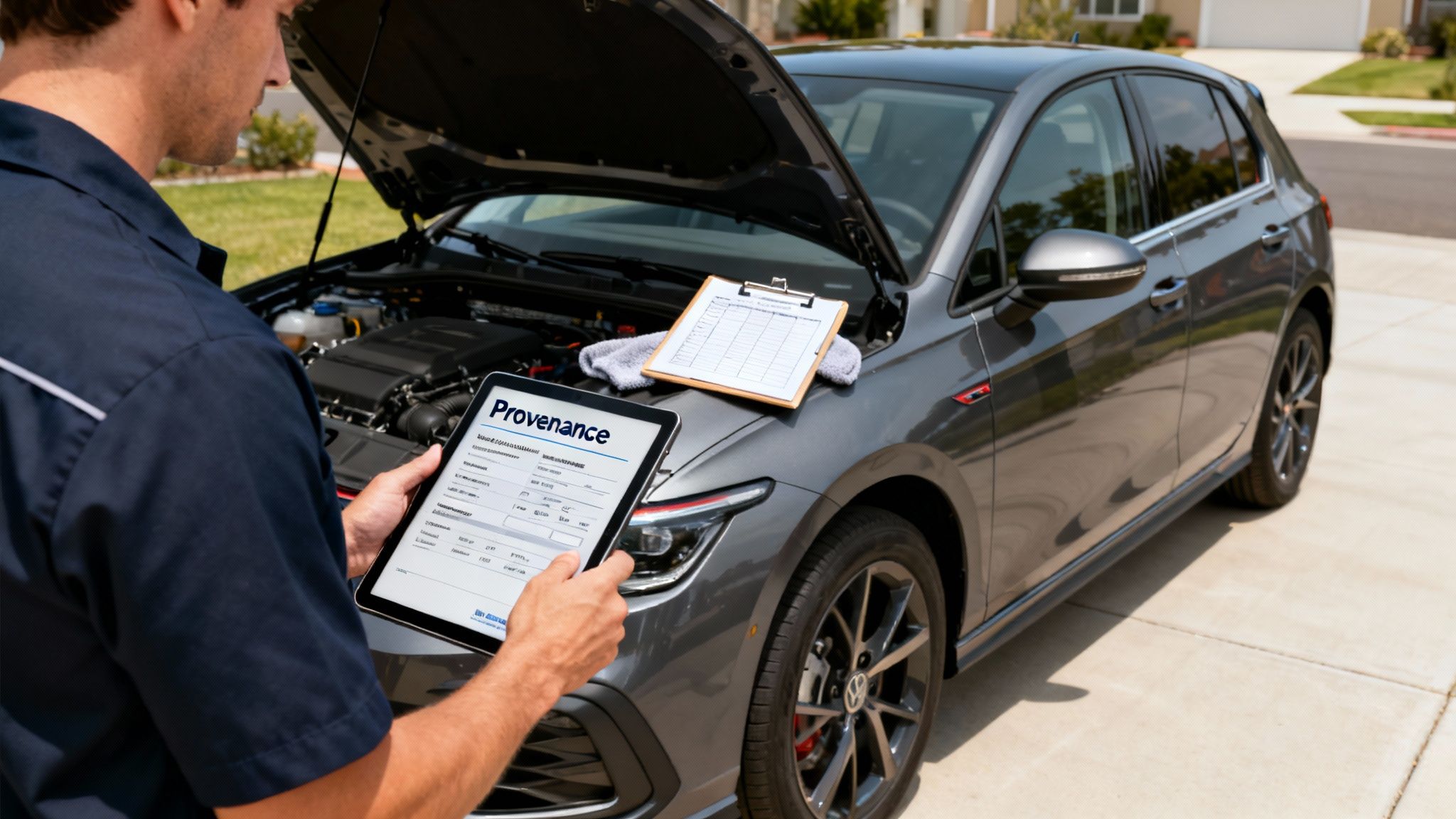
The difference between a car that flies off the forecourt and one that gathers dust is decided long before the first potential buyer lays eyes on it. Any seasoned dealer knows this initial groundwork is the most critical part of the entire sale. This isn't just about a superficial clean; it's a systematic approach to inspection, preparation, and, most importantly, verification.
This first stage really sets the tone for everything that follows. When you tackle potential problems and confirm the car has a clean history right from the start, you build a foundation of trust that makes your asking price easier to justify and the final negotiations a whole lot simpler.
Beyond the Bucket and Sponge
A professional appraisal starts with a critical eye, looking at the vehicle exactly how a buyer would. A full valet is a given, of course, but the real value is in spotting and sorting the small imperfections that, when added together, chip away at the car's perceived worth.
- Cosmetic Rectification: Get those minor scratches, stone chips, and kerbed alloys sorted. These small, inexpensive fixes have a massive impact on first impressions.
- Interior Deep Clean: Go beyond a quick hoover. Clear out any personal items, deep clean the upholstery to get rid of stains and smells, and make sure every switch and surface is spotless.
- Mechanical Health Check: This is non-negotiable. A basic mechanical check of fluid levels, tyre pressures, and tread depth is essential. Make sure every light and all the electrics work perfectly to avoid easily preventable issues cropping up on a test drive.
The goal is simple: present a vehicle that looks and feels like it’s been genuinely well-maintained. A car that appears cared for gives buyers the confidence that it’s been looked after mechanically, even before they’ve glanced at the service book.
The Non-Negotiable Provenance Check
While a gleaming exterior might draw a buyer in, it's the vehicle's history that will seal the deal. In today's market, trying to sell a car without a comprehensive provenance check is a massive business risk. Buyers are savvier than ever, and you can bet they'll be asking about outstanding finance or accident history. "I don't know" just isn't a good enough answer anymore.
This is where a professional vehicle intelligence platform like AutoProv becomes an indispensable tool. You can run an instant, in-depth check that verifies every critical detail of the car's past. Within seconds, you'll know for sure:
- Finance Status: Is there any outstanding finance secured against the vehicle? Finding this out early prevents serious legal and financial headaches down the line.
- Condition Records: Has the car ever been reported as stolen or been declared an insurance write-off?
- Mileage Accuracy: Do the mileage readings line up with the MOT and service history, or are there gaps that might suggest clocking?
Having an AutoProv report in your hands before you even think about marketing the vehicle is your ultimate risk management tool. It transforms your sales pitch from one based on hope to one built on hard facts.
Assembling Your Documentation
With the car prepped and its history verified, the last step is to get all the necessary paperwork together. A complete, neatly organised document pack screams professionalism and transparency.
Make sure you have the V5C registration certificate (the logbook), a full service history, all the valid MOT certificates, and any receipts for recent work. For a closer look at the V5C, our quick UK log book guide has all the essential info. A well-organised file shows the vehicle has been properly looked after and gives the buyer immediate confidence, ensuring a smooth and efficient handover once you've agreed on the sale.
Pricing Your Vehicle with Market Intelligence

You’ve got the car prepped to a professional standard. Now for the hard part: putting a price on it. Get this wrong, and you're either stuck with a vehicle haemorrhaging value on your forecourt or you’ve left good money on the table.
In today's market, guesswork is a fast track to losing profit. The real key is to move past the old-school book prices and get stuck into the data. You need to understand the live market, from how a specific model is depreciating right now to the subtle shifts in what buyers are looking for in your area. This is precisely the insight AutoProv provides.
Moving Beyond Static Book Prices
Relying on those generalised monthly valuation guides is a classic, and costly, mistake. They offer a rough benchmark, sure, but they just can't keep up with the pace of the used car market. They miss all the specific factors that dictate what a car is actually worth today.
A modern approach means diving deep into live market data. You need to know the specific trade and retail values for that exact make, model, and trim level right now, not what it was worth a month ago. This is where a proper vehicle intelligence platform becomes your most valuable asset.
Using Data to Your Advantage
Tools like AutoProv give you a clear, instant picture of the market. Instead of one static number, you get a whole range of data points that let you price with surgical precision.
This is the kind of intelligence that makes a real difference:
- Current Valuations: Live trade, retail, and private sale values pulled from real market activity.
- Desirability Scores: A clear indicator of how in-demand a particular model is, helping you gauge how fast it's likely to move.
- Depreciation Analysis: The specific depreciation curve for that model, so you can forecast its future value and price it smartly.
With this kind of information at your fingertips, you can stop guessing and start making decisions backed by facts. For a proper deep dive into this, check out our guide on mastering car valuation for accurate vehicle pricing. It lays out the framework for using data to your advantage.
By analysing real-time market data from AutoProv, you can confidently set a price that is both competitive enough to attract buyers quickly and high enough to protect your profit margin. It’s about finding the sweet spot where speed of sale and profitability meet.
The Impact of Provenance on Price
A car’s history has a direct, and massive, impact on what it’s worth. That provenance report you ran during the prep stage? It’s now one of your most important pricing tools. A car with a clean, fully verified history can and should command a premium.
On the other hand, if that report flagged an issue—like a previous insurance write-off, even a minor Category N—you have to price it accordingly. Trying to hide it is a terrible idea. A savvy buyer will find out, trust will be destroyed, and the sale will be dead in the water.
Being upfront allows you to control the narrative. You can price the vehicle fairly based on its history, explain the situation clearly, and use the documented evidence to justify your valuation. This turns a potential negative into a show of honesty, something genuine buyers really value. A clean report from AutoProv, for example, acts as a certificate of quality that justifies a higher asking price and builds instant buyer confidence, ultimately shortening the whole sales cycle.
Choosing Your Sales Channels and Crafting the Perfect Advert
You’ve done the hard graft—the car is prepped, priced, and its history is verified. Now it’s time to get it in front of the right buyers. Deciding where to sell isn't just a final step; it's a strategic move that dictates how fast you shift the metal and for how much.
There's no single "best" place to sell a car. A nearly-new, high-demand model will fly off a mainstream retail platform. On the other hand, that older, high-mileage part-ex you just took in might be better off sold quickly trade-to-trade. The game is all about matching the car to the marketplace where it’ll get the most traction from motivated punters.
Selecting the Right Route to Market
Picking your sales channel is a massive part of your overall strategy. Each one has its own audience, costs, and quirks. A smart approach usually means using a mix of them to keep different types of stock moving efficiently.
Here are the main players:
- Your Own Forecourt and Website: This is your home turf. You have total control over the presentation, the sales patter, and the brand image you project directly to retail customers.
- Online Marketplaces: Platforms like Auto Trader are non-negotiable for reaching a huge retail audience. The exposure is phenomenal, but so is the competition. Your advert has to be absolutely spot on to stand out.
- Trade-to-Trade Platforms: Perfect for shifting cars that don't fit your retail profile. Think older models, cars needing a bit of work, or anything outside your usual niche. They’re a fast track to turning awkward stock back into cash.
- Auctions: Both physical and online auctions can work well for unique or hard-to-price vehicles. You can spark a bidding war, but you also give up a lot of control over that final hammer price.
The real skill isn't just picking one channel. It’s about knowing which one gives you the best return for a specific car. With AutoProv’s valuation data, you can look at its age, condition, and desirability, then decide where to list it first to protect your margin.
Crafting an Advert That Actually Converts
On a packed online marketplace, your advert is your digital handshake. A lazy, half-hearted listing gets scrolled past in a heartbeat, no matter how good the car or the price is. You need to build trust and show value from the first glance, making a potential buyer want to pick up the phone.
A brilliant advert stands on two pillars: fantastic photos and honest, detailed copy.
Photography That Tells a Story
Buyers judge with their eyes first. Your photos must be sharp, well-lit, and show everything. Get the car looking its best, find a clean background, and start snapping.
Your photo gallery has to include:
- The Key Angles: Your hero shot is the front three-quarter view. Back it up with straight-on front, rear, and side profile images.
- The Inside Story: Get clear shots of the dashboard, front seats, back seats, and the boot. Make sure you show off the good stuff, like the infotainment screen or instrument cluster.
- The Details: Get close-ups of the wheels and any special features like a sunroof. And here’s a pro tip: be honest. If there’s a tiny, professionally touched-in scuff, show it. Proving you have nothing to hide builds more trust than pretending the car is flawless.
Writing Copy That Builds Trust
Right, this is your chance to sell the car's story and, more importantly, to show off the prep work you've already done. This is where you bring in the facts from your vehicle intelligence report from AutoProv. Don't just list features—explain the benefits and back them up with proof.
Instead of just saying the mileage, you write: "Fully verified low mileage of 42,500 miles, confirmed by its AutoProv provenance report."
Don't just say "good condition." Say this: "Provenance-clear with no outstanding finance, confirmed via its Experian check within our AutoProv report."
This approach immediately tackles a buyer's biggest worries and frames your car as a safe, transparent purchase. Highlighting these verified facts makes your listing stand out from private sellers and sloppy competitors. For a deeper look at how a professional platform can elevate your listings, check out our comparison of AutoProv vs Auto Trader. Weaving these data points into your description turns a standard advert into a powerful sales tool that justifies your asking price and brings in serious, ready-to-buy customers.
Managing Enquiries, Negotiations, and the Final Sale
This is where all your hard work starts to pay off. The phone begins to ring, emails pop up, and you’ve got potential buyers on the line. A sharp, organised approach here is what separates a smooth, profitable deal from a week of chasing your tail. It’s all about guiding the customer from that first point of contact right through to the final handover.
Every single interaction is a chance to build confidence and show the value of the vehicle you're selling. When a customer gets in touch, be ready. Having the car’s specs, service history, and especially its AutoProv report to hand means you can answer questions instantly and with authority. That immediate competence shows you’re a pro who knows their stock inside and out.
The journey to get to this point—from picking the right sales channel to crafting the perfect advert—is what attracts these quality enquiries in the first place.
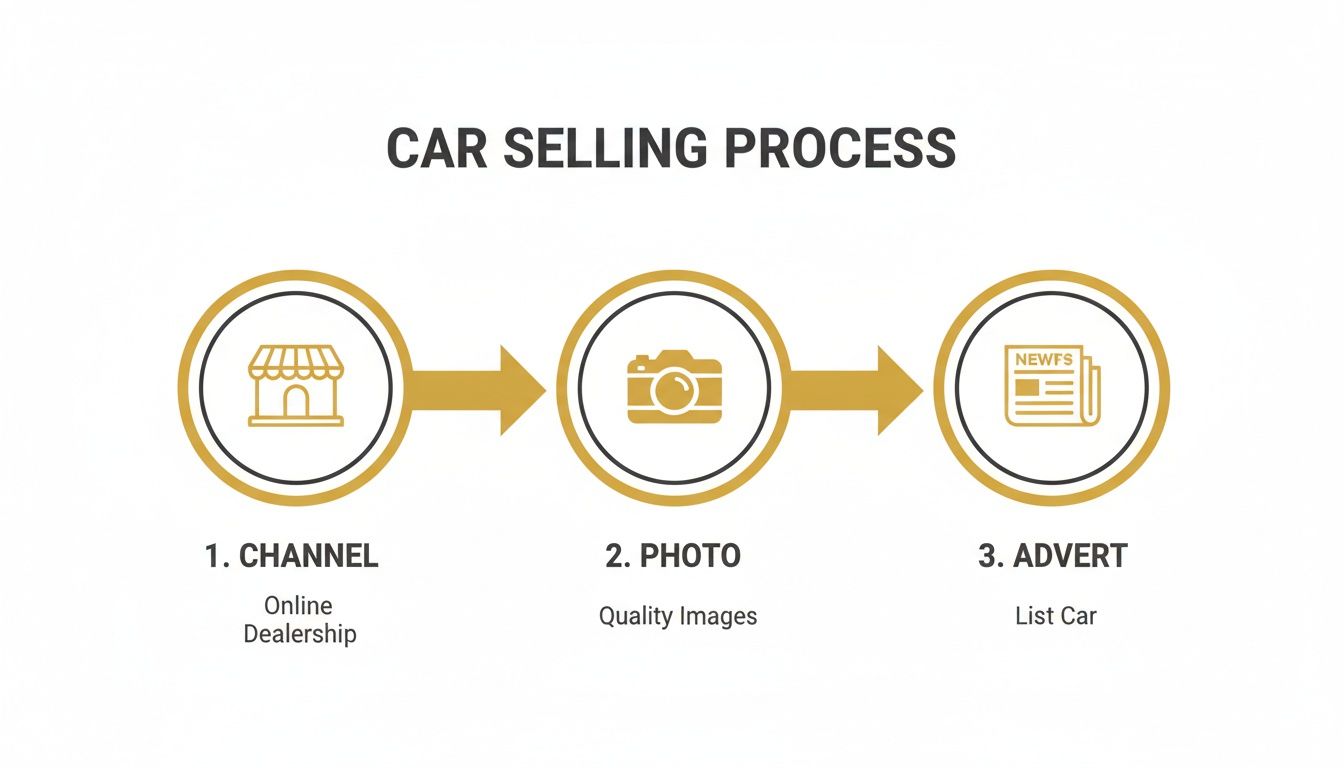
Each of these steps has laid the groundwork for the conversations you’re about to have.
Mastering the Negotiation
Negotiation isn't a battle; it's a conversation to find a price that works for everyone. The key is to come to the table from a position of strength, armed with hard facts and a clear grasp of the car's true market value. This is where your investment in an AutoProv provenance check becomes your single most powerful tool.
When a buyer questions the price or starts haggling hard, don't get defensive. Use the AutoProv report to calmly and confidently state your case.
- Tackling Price Objections: If a buyer claims the price is too high, you can walk them through the evidence. "I understand your point, but as the report confirms, this car has verified low mileage, no outstanding finance, and has never been written off. We've priced it fairly based on its excellent, fully documented history."
- Overcoming Scepticism: For buyers who are naturally wary of a used car's past, showing them a clean, official report is the ultimate proof. It shifts the conversation away from doubt and onto the vehicle's real strengths.
This evidence-based approach protects your margin while making the customer feel like they’re making a secure, smart purchase. For a much deeper dive into tactics, check out our professional playbook on how to negotiate used car prices.
A successful negotiation leaves both parties feeling good about the deal. By anchoring your price to verifiable data from AutoProv, you maintain professionalism and steer the conversation towards a fair outcome, not a race to the bottom.
Finalising the Sale and Handover
Once you’ve shaken hands on a price, the final steps need to be handled with precision. This is about being professional and legally watertight. A sloppy handover can come back to bite you weeks or months down the line.
First, draw up a proper sales invoice. It needs to be crystal clear, detailing the vehicle's specifics (make, model, reg, VIN), the agreed price, the date, and the names and addresses of both you and the buyer. Get both parties to sign it, and make sure you each keep a copy. This is your core legal proof of the transaction.
Next up is the V5C logbook—this is critical. Fill out the green 'new keeper' slip (V5C/2) and give it to the buyer. It is your legal responsibility to notify the DVLA of the ownership change. The quickest and safest way is using the DVLA's online service. It updates the record instantly and gives you immediate confirmation, protecting you from any future fines or tickets the new owner might rack up.
Finally, hand over all the documents you prepared earlier: the service history, MOT certificate, and any spare keys. Presenting them in a tidy, organised document wallet is a small touch that leaves a big impression. This smooth, professional handover doesn't just seal the deal; it builds the kind of reputation that creates repeat business and referrals.
Post-Sale Compliance and Mitigating Risk
The handshake and the handover aren't the end of the road. Far from it. For any professional in the motor trade, what happens after the customer drives away is just as critical for protecting your business and your reputation.
Getting your post-sale responsibilities right is the difference between a clean, profitable deal and a future headache. This final stage is all about meticulous compliance, clear communication, and mitigating your risk. It’s about making sure your process for selling a car is watertight from start to finish.
The Foundation of Good Record-Keeping
Once that vehicle is sold, your admin becomes your first line of defence. Solid record-keeping isn't just good business practice; it's a legal necessity that will shield you from future disputes.
For every single sale, you should have a clear, organised file—digital or physical—containing a signed copy of the final sales invoice, the archived AutoProv provenance report you used during the sale, copies of all finance and payment agreements, and proof of the DVLA new keeper notification.
This file creates an undeniable record of the transaction. Having that final provenance report tucked away, for instance, gives you concrete proof of the vehicle's verified status at the point of sale. That can be priceless if a historical issue is ever questioned down the line. For a closer look at the essentials, check out our guide to the UK car sale contract.
Handling Complaints and Protecting Your Reputation
Even with the most thorough prep, post-sale issues can pop up. It happens. Having a clear, fair, and consistent policy for handling customer complaints is essential for sticking to consumer rights law and protecting the reputation you've worked so hard to build.
Responding quickly and professionally is everything. Listen to the customer's side of the story, review your records, and keep the lines of communication open. A well-handled complaint can often turn a negative experience into a positive one, showing your commitment to customer care and reinforcing trust in your dealership.
A crucial part of this is knowing your stock inside-out. Understanding which models and manufacturers have better reliability records can sharpen your buying strategy and cut down the chances of post-sale issues from the get-go.
For example, a quick look at the UK market shows clear trends. Volkswagen has continued its strong performance, with sales jumping 7.4% to grab an 8.8% market share. In contrast, premium brands like Audi saw sales dip by 9.2%. Knowing these manufacturer-specific trends helps you source stock with better resale potential and reliability—a process made much easier with market desirability scoring from AutoProv.
The Financial Safety Net of Data Indemnity
Finally, let’s talk about your most powerful risk-mitigation tool: data indemnity. This provides a vital financial safety net against unforeseen historical problems that might crawl out of the woodwork long after the sale is done, protecting both your profit and your business.
Even the most accurate data can have hidden skeletons. If an issue like previously undisclosed outstanding finance or a mileage anomaly comes to light, indemnity cover can protect you from a serious financial hit. At AutoProv, we offer optional Experian indemnity tiers right up to £50,000, safeguarding your dealership against the unexpected and ensuring every sale you make is a secure one.
Your Questions Answered: Selling Cars in the UK
Even for seasoned pros, the UK motor trade can throw up some tricky questions. Here, we tackle the common queries we hear from dealers, giving you clear, expert answers to help you handle every sale with confidence.
Getting the fundamentals right—from paperwork to consumer rights—is what separates the professionals. It’s the key to building a reputation that keeps customers coming back.
What Legal Paperwork is Essential to Sell a Car?
The absolute cornerstone of any sale is the V5C logbook. It’s your legal duty to complete the right section and notify the DVLA of the new keeper, and doing it online is by far the quickest and safest way.
Alongside the V5C, you must give the buyer a valid MOT certificate if the car is over three years old. A solid service history is also expected, as is a proper written sales invoice. That invoice needs to detail the car's vitals (reg, VIN), the price, and the terms of sale. Always, always keep a signed copy for your records. It's your proof of the deal.
How Critical is a Vehicle History Check Before a Sale?
In today's market? Absolutely non-negotiable. Trying to retail a car without a full provenance check is just asking for trouble, plain and simple. It’s a huge risk to your business and your reputation.
A full history check, like the instant reports from AutoProv, is your due diligence done right. It verifies that the car has no outstanding finance, hasn't been reported stolen, and isn't a recorded insurance write-off. Crucially, it also cross-references mileage records to spot any dodgy discrepancies.
Presenting this clean bill of health to a buyer builds instant trust and backs up your asking price with hard facts. More importantly, it shields your business from the nightmare legal and financial fallout of unknowingly selling a car with a hidden, toxic past.
A verified history report isn't a 'nice-to-have' anymore; it's a core part of a professional sales pack. It shows you're transparent and gives buyers the confidence to commit, often speeding up the whole deal.
What’s the Safest Way to Handle a Test Drive?
Protecting your assets during a test drive is paramount. Before you even think about handing over the keys, you need to see a valid, full driving licence. It's also vital to confirm their insurance situation—your motor trade policy might cover them, but you need to be certain. Check the small print.
Always go with them on the drive. It’s your chance to point out the car’s features and answer questions on the move, all while staying in control. Plan a decent route with a mix of roads—some town driving, some faster A-roads—to really show what the car can do. Whatever you do, never leave a potential buyer alone with the vehicle or its keys.
Am I Legally Obliged to Provide a Warranty?
While there's no law that says you must provide a third-party warranty on every used car, it’s a powerful sales tool. It gives the buyer huge peace of mind and immediately sets you apart from private sellers. It shows you have confidence in your stock.
However, don't forget your responsibilities under the Consumer Rights Act 2015. The law is crystal clear: any car sold by a trader must be of satisfactory quality, fit for its purpose, and as described. Offering a warranty is a great way to manage customer expectations and gives you a clear process for handling any post-sale issues, protecting you from messier disputes down the line.
How Do I Price an Electric Vehicle Correctly?
Pricing EVs is a different ball game to traditional petrol or diesel cars. The market is moving incredibly fast, with battery-electric vehicles (BEVs) now making up 23.4% of all new car registrations in the UK. This surge means you need specific market intelligence to stay competitive. In fact, the total market share for electrified vehicles, including plug-in hybrids, is now around 34.5%—a trend that’s seriously shaking up residual values. You can read more about these market shifts on What Car?.
To price an EV accurately, you have to look at battery health and range, model-specific depreciation, and whether the charging cables and kit are present. This is where platforms like AutoProv become essential. They provide real-time valuations and desirability scores that understand the unique dynamics of the EV market. This data lets you price your electrified stock with precision, reflecting current demand and depreciation curves perfectly.
At AutoProv, we know that a profitable sale starts with knowing your vehicle inside and out. Our trade-grade reports give you the instant, deep-dive intelligence needed to verify provenance, price with precision, and sell with total confidence.
Find out how our platform protects your dealership and boosts your margins at https://autoprov.ai.
Frequently Asked Questions
AI-Generated Content Notice
This article was created with the assistance of artificial intelligence technology. While we strive for accuracy, the information provided should be considered for general informational purposes only and should not be relied upon as professional automotive, legal, or financial advice. We recommend verifying any information with qualified professionals or official sources before making important decisions. AutoProv accepts no liability for any consequences resulting from the use of this information.
From our AI insights
- Navigating ULEZ Compliance for Used Car Dealers
A deep dive into ensuring your used car stock meets ULEZ standards, avoiding costly fines.
- Understanding Days-to-Sell: Improve Dealer Stock Turn
Learn how to calculate and optimise days-to-sell for better dealership profitability.
- Leveraging VIN Data for Vehicle Option Verification
Discover how UK motor traders use VIN data to authenticate vehicle options and avoid mis-described purchases.
Related Articles

Car Specs by Reg: Instantly Find Vehicle Details & MOT History
Trying to find the full car specs by reg? In the UK, that little number plate is the key to unlocking a huge amount of information about a vehicle. From the exact engine size and CO2 emissions to its MOT history and tax status, it's all tied to the registration.

How to Check Previous Owners of a Car in the UK
Before you even start thinking about how to check the previous owners of a car, you need to get your head around why it's so important. This isn't just about being nosy; it’s a non-negotiable step that protects you from serious financial headaches and safety risks lurking under a shiny bonnet.

How to Check Service History in the UK
Think of a car's service history as its detailed CV, not just some dusty folder in the glovebox. To check service history is to get the real story behind a vehicle, digging into everything from its routine oil changes to any major surgery it's had. For any savvy car buyer in the UK, this record is the single most important document you can get your hands on.
Published by AutoProv
Your trusted source for vehicle intelligence