
Changing a car battery might seem like a straightforward task, but for any professional in the motor trade, it’s a critical procedure that demands precision. An incorrect replacement on a modern vehicle can trigger a cascade of issues with its complex electronics, leading to costly diagnostic work and potential comebacks. Following the correct process is not just best practice—it is an essential part of maintaining a vehicle's operational integrity and your professional reputation.
Why a Simple Battery Change Is Now a High-Stakes Procedure
For professionals working in the UK motor trade, fitting a new battery is a routine requirement. With the average age of cars on UK roads now at 8.7 years, millions of vehicles are operating with batteries approaching the end of their typical 4-6 year service life. Consequently, independent garages and dealerships handle an estimated 2.5 million replacements annually.

More Than Just a Power Source
In modern vehicles, the battery is integral to a network of sensitive electronic systems. The Engine Control Unit (ECU), infotainment systems, and Advanced Driver-Assistance Systems (ADAS) all depend on a stable power supply. An improper replacement can cause significant disruption:
- ECU Memory Loss: Key adaptive learning values, radio codes, and other critical stored settings can be instantly erased.
- System Malfunctions: An incorrect procedure can trigger multiple dashboard warning lights, often requiring recalibration of essential systems.
- Component Damage: In the worst-case scenario, a voltage spike can damage expensive modules, turning a routine task into a major repair.
This is particularly relevant for vehicles equipped with a Battery Management System (BMS), now standard on nearly all cars with Stop/Start technology. Simply swapping the battery without registering the new unit with the BMS will lead to incorrect charging cycles, premature failure, and other electrical issues.
Before proceeding with a replacement, it is prudent to confirm the battery is genuinely at the end of its life. Sometimes, understanding how to charge a car battery can resolve the immediate issue. For a comprehensive overview of battery longevity, you can check out our guide on battery lifespan.
The Provenance Connection
From a trade perspective, a vehicle's battery history is a key indicator within its provenance. A recent replacement, particularly when combined with a short period of ownership, can be a significant red flag. It may suggest the previous owner was disposing of a vehicle with a persistent and difficult-to-diagnose electrical fault.
A standard used car history report may not highlight this nuance. However, professional trade vehicle intelligence, such as that provided by AutoProv, enables you to connect disparate data points. It helps reveal these potential underlying risks before acquisition, turning a minor service detail into a crucial component of the vehicle's true history and mitigating motor trade risk.
Essential Toolkit and Safety Protocols
A professional and safe battery replacement begins with meticulous preparation. Attempting this task without the correct equipment and a thorough understanding of safety protocols exposes you, the vehicle, and your business to unnecessary risk.
Standard lead-acid batteries contain corrosive sulphuric acid and can vent flammable hydrogen gas. A stray spark from a metal tool bridging the terminals can cause an explosion, resulting in serious injury and damage to the engine bay. The use of appropriate Personal Protective Equipment (PPE) is therefore non-negotiable.
Mandatory Personal Protective Equipment
Before commencing work, ensure you are equipped with the following:
- Safety Goggles: Essential protection against acid splash or electrical arcing.
- Acid-Resistant Gloves: Standard workshop gloves are insufficient. Nitrile or heavy-duty rubber gloves are required to protect skin from sulphuric acid.
- Remove All Metal Jewelry: Rings, watches, and bracelets are excellent electrical conductors. If they bridge a live terminal to an earthed component, they can heat instantly, causing severe burns.
The Professional Toolkit
A well-organised toolkit is the foundation of an efficient and professional job.
A complete checklist ensures all necessary items are on hand, facilitating a safe and efficient workflow.
Essential Toolkit for Professional Battery Replacement
Item Category Specific Tool/Equipment Professional Rationale Safety Gear (PPE) Safety Goggles & Acid-Resistant Gloves Non-negotiable protection against corrosive acid splashes and potential electrical arcing. Core Hand Tools Socket & Spanner Set (typically 10mm & 13mm) Essential for loosening terminal clamps and battery hold-down brackets. Correct sizing prevents rounding of fasteners. Specialist Tools Battery Terminal Puller & Spreader Safely removes stubborn or seized terminals without damaging the battery posts or wiring. Cleaning Supplies Wire Brush & Battery Terminal Protector Spray Crucial for removing corrosion to ensure a solid electrical connection and for preventing future build-up. Diagnostic Equipment Digital Multimeter Used to verify the new battery's state of charge and check the vehicle's charging system (alternator output) post-installation. Vehicle Protection Memory Saver (KAM Device) Plugs into the OBD-II port to supply low-amperage power, preserving vital ECU settings, radio codes, and other stored data. This toolkit ensures the task can be completed to a professional standard without delays.
A critical piece of equipment often overlooked is the memory saver (also known as a Keep Alive Memory—KAM—device). This is connected to the OBD-II port before disconnecting the old battery. It supplies a low-voltage current to the vehicle's electronics, preventing the loss of radio codes, window initialisation settings, and sensitive ECU adaptive learning values.
Core tools should include a quality socket and spanner set, a terminal puller for seized connections, and a wire brush for cleaning corrosion. Applying a battery terminal protector spray upon completion helps prevent future corrosion, demonstrating a high standard of work. For further information on vehicle system maintenance, refer to our guide on essential car maintenance tips for UK drivers.
A Professional Guide to Battery Removal and Installation
Adhering to the correct process for battery replacement is fundamental. The sequence of operations is non-negotiable, as a single misstep can send a voltage spike through the vehicle’s electrical systems, potentially damaging sensitive ECUs and leading to costly, reputation-damaging failures.
Mastering this task ensures safety, protects the vehicle, and reinforces your credibility. While some vehicle owners may attempt this as part of DIY auto repair, the stakes are significantly higher for a trade professional responsible for valuable stock.
This flowchart outlines the foundational safety preparation: protect yourself, prepare the vehicle, and position your tools correctly before touching a terminal.
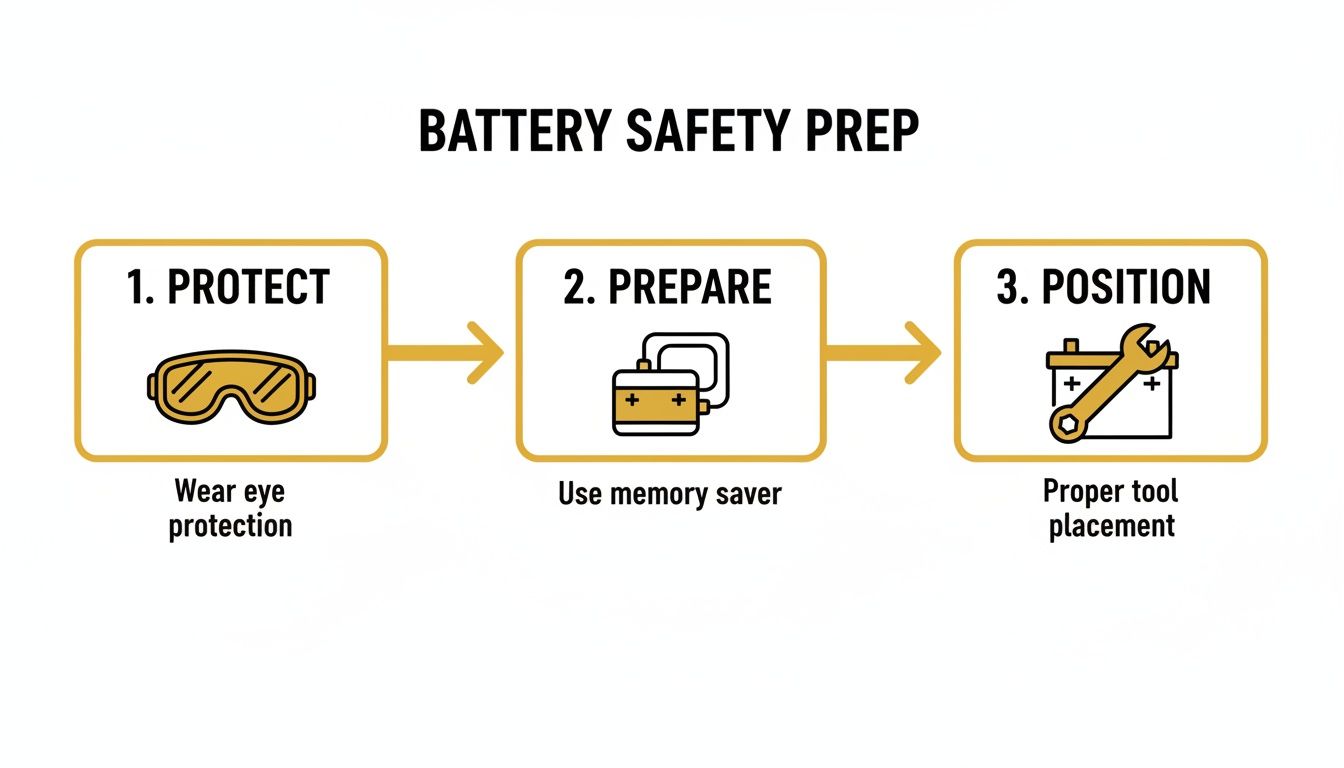
This pre-work check is essential for preventing incidents and protecting delicate electronics.
Safe Disconnection: The Negative-First Rule
The cardinal rule when changing a car battery is: always disconnect the negative terminal first. As the negative terminal is earthed to the vehicle's chassis, removing this connection first safely breaks the entire electrical circuit.
Consider the consequences of reversing this order. If a spanner on the positive terminal makes accidental contact with any metal part of the engine or bodywork, it creates an immediate, direct short circuit. This will cause a significant spark, can weld the tool in place, and carries a risk of battery explosion.
By isolating the ground connection first, this risk is eliminated. Once the negative lead is disconnected and secured away from the terminal, the positive terminal clamp can be removed without danger of shorting.
Addressing Common Removal Challenges
In a workshop environment, several common issues can complicate a straightforward battery replacement.
- Corroded Terminals: The presence of white or greenish crystalline deposits can make terminals difficult to remove. Use a wire brush to clean away as much corrosion as possible before attempting to loosen the clamp nut. A dedicated battery terminal puller is an effective tool for lifting a seized clamp without damaging the soft lead post.
- Stubborn Clamps: Over-tightened or seized clamps require careful handling. Once the nut is loosened, a terminal spreader tool may be needed to gently open the clamp. Never use brute force or strike the terminals, as this can damage the battery casing or internal connections.
- Inaccessible Batteries: Modern vehicle design often places the battery in less accessible locations, such as under scuttle panels, in the boot, or beneath seats. This requires a methodical approach. Carefully remove surrounding trim and components, keeping track of all fasteners to ensure a clean and secure reassembly.
A sobering statistic for the UK motor trade: battery-related warranty claims cost insurers over £450 million. AutoProv's risk analysis of DVLA and insurance data reveals that 28% of used car disputes originate from undisclosed battery replacements. This is directly linked to scenarios where traders miss provenance gaps, leading to 1 in 10 stock acquisitions suffering from post-purchase electrical failures.
The Installation Sequence and Final Checks
Installation is the reverse of removal, with one critical rule: connect the positive terminal first, then the negative terminal last. This sequence provides a final safeguard against accidental short circuits during re-tightening.
Before installing the new battery, clean the battery tray and ensure it is secure. Position the new battery and fasten the hold-down bracket until it is snug, avoiding over-tightening which can deform the casing.
Crucially, verify that you are fitting the correct type and specification of battery. Using an incorrect type (e.g., a standard flooded battery in a vehicle requiring an AGM for its Stop/Start system) or capacity will lead to charging faults and a drastically reduced service life. You can cross-reference the required specification with a vehicle build spec sheet report to ensure correct fitment. This simple check protects the vehicle’s systems and your professional standing.
Completing the Job with Post-Installation System Resets
Fitting the new battery is a significant step, but the procedure is not complete. The final checks and system resets differentiate a professional, workshop-quality job from a basic swap. Omitting these steps can lead to comebacks, dissatisfied customers, and the premature failure of the newly installed component.
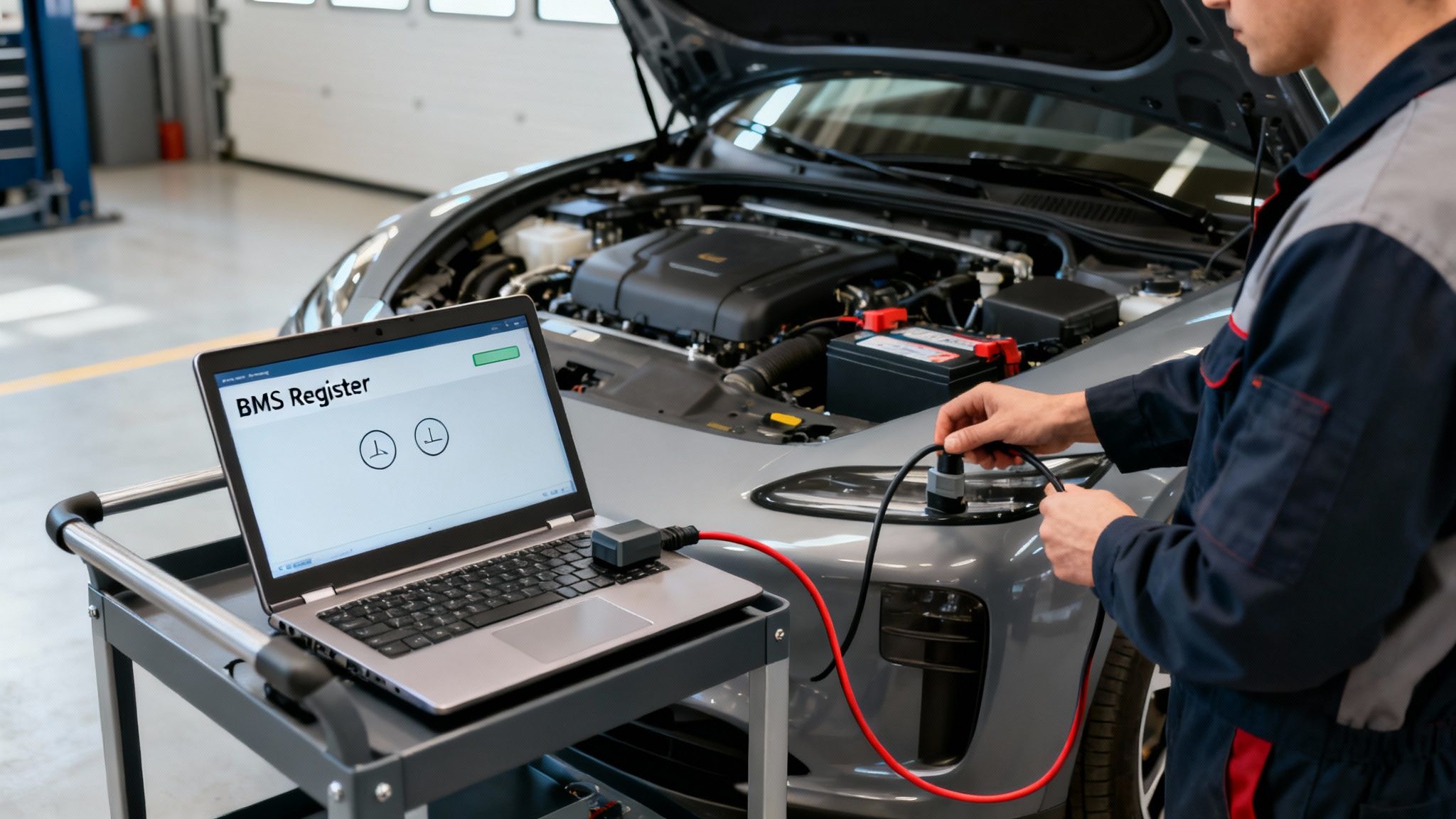
First, confirm the charging system is functioning correctly. With the engine running, use a digital multimeter on the battery terminals. A healthy alternator should produce a reading between 13.7 and 14.7 volts. A reading below this range may indicate a faulty alternator, while a higher reading could suggest a voltage regulator issue that will damage the new battery over time.
The Critical Step of Battery Registration
For any modern vehicle with Stop/Start functionality or a Battery Management System (BMS), registering the new battery is a mandatory step. This involves using a diagnostic tool to inform the vehicle's ECU that a new battery has been installed.
The process updates the BMS with the new battery's specifications—its type (AGM or EFB), capacity (Ah), and cold cranking amps (CCA). The system then resets its charging strategy, which had been adapted over time to the characteristics of the degrading old battery.
Failing to register a new battery on a vehicle with a BMS will cause problems. The system will continue to apply the aggressive charging parameters it used for the old, failing battery. This typically leads to chronic undercharging or overcharging, which can reduce the new battery's lifespan by more than 50%.
In short, skipping registration ensures the new battery is destined for premature failure, leading to avoidable warranty claims. For further context on related electrical issues, you can learn about the implications of a persistent battery warning light in our detailed guide.
Finalising the Handover with System Resets
Disconnecting the power supply, even briefly, can cause various electronic systems to lose their calibration or memory. Before returning the vehicle, it is essential to perform a functional check of common systems.
This checklist covers the most frequent resets required after a battery replacement:
- Electric Windows: Verify the one-touch up/down and anti-pinch functions. This usually requires running each window fully down, holding the switch for a few seconds, then running it fully up and holding the switch again to re-initialise.
- Steering Angle Sensor: A traction control or stability system warning light often indicates the need for recalibration. This can typically be resolved by starting the engine and turning the steering wheel from full lock to full lock.
- Sunroof: Similar to the windows, the sunroof may require its one-touch and anti-pinch settings to be reset by running it through a full open-and-close cycle.
- Infotainment System: Confirm that radio presets are intact (a memory saver should prevent their loss) and check if the unit requires a security code.
- Clock and Trip Computer: Resetting the clock and any trip meters is a small but important final touch.
Methodically working through these final checks ensures the vehicle is returned in full working order, reinforcing your professionalism and preventing follow-up calls regarding system malfunctions.
Connecting Battery Health to Vehicle Provenance
Viewing a battery replacement from a strategic perspective reveals its importance as a crucial piece of vehicle provenance intelligence. For a motor trade professional, this moves beyond workshop practice into the realm of risk and value assessment during vehicle acquisition. A vehicle's electrical health is a direct reflection of its history and maintenance record.
Repeated battery replacements or MOT advisories related to battery security can indicate deeper, persistent issues. These may point to chronic electrical faults, parasitic drains, or usage patterns—such as frequent short journeys—that cause premature wear to the entire charging system. These are the kinds of hidden flaws a basic dealer vehicle check will almost certainly miss.
Interpreting Red Flags in a Vehicle's History
Consider a common scenario: a vehicle is presented for part-exchange with a new battery, yet its history shows it was with the last owner for under 12 months. This combination should be a clear warning sign for any prudent trader. It strongly suggests the previous owner was disposing of a vehicle with a known and unresolved issue.
This is where in-depth trade vehicle intelligence becomes indispensable. A simple battery swap might appear insignificant in isolation, but when analysed alongside ownership timelines and MOT data, it can reveal a narrative of hidden problems that directly impacts your margin.
This level of insight is vital for motor wholesalers and dealers. UK data shows that 65% of car battery changes occur on vehicles over five years old, consistent with the UK parc's average age of 8.7 years and contributing to 3.2 million garage visits for electrical services. Critically for the trade, AutoProv's provenance reports have identified that 17% of potential stock had hidden battery-related claims from previous insurance events, helping prevent significant acquisition losses.
Uncovering Hidden Risks with Deeper Data
This kind of intelligence provides the context needed to ask critical questions. Why did a three-year-old premium vehicle require a new battery? Does the MOT history show a pattern of electrical-related advisories?
Answering these questions enables a more accurate assessment of the risk associated with a vehicle. A standard check might confirm a vehicle is clear of finance but will not flag the suspicious pattern of a recent battery change coupled with a rapid resale. This is precisely the kind of motor trade risk that AutoProv is designed to expose, transforming seemingly minor service events into actionable intelligence. For a deeper analysis, see our article on the importance of car maintenance in provenance checks.
By understanding these signals, you can protect your investment and avoid acquiring another trader's unresolved problems.
Frequently Asked Questions for Motor Trade Professionals
Even for experienced technicians, modern battery replacements can present challenges. Here are direct answers to common questions from workshops and dealerships, reinforcing professional best practices.
Is a Memory Saver Device Always Necessary?
Yes, on most vehicles manufactured since the mid-2000s, its use is essential. Disconnecting the power without a memory saver can erase the ECU's adaptive learning values, radio codes, and critical calibrations for systems like electric windows and steering angle sensors.
The minor cost of a memory saver prevents significant post-replacement hassle, saving time on reprogramming modules and avoiding customer complaints about lost settings. It is a fundamental tool for professional-standard work.
What Is Battery Registration and When Is It Required?
Battery registration (or coding) is a mandatory diagnostic procedure on many modern vehicles, particularly those with Stop/Start or a Battery Management System (BMS). It is the process of informing the vehicle's control units that a new battery has been installed, including its specific type (e.g., AGM or EFB) and capacity.
This allows the BMS to adapt its charging strategy to the new battery, which is vital for achieving its designed performance and lifespan. Omitting this step will almost certainly lead to premature battery failure and may trigger charging system faults, resulting in avoidable comebacks and warranty claims.
For any professional in the motor trade, this is a non-negotiable step. A vehicle provenance check revealing a recent battery replacement without a corresponding record of registration is a major red flag, indicating amateur work and potentially masking deeper electrical issues.
How Should Old Car Batteries Be Disposed of Legally in the UK?
As a motor trade business, you have a legal duty of care to dispose of old lead-acid batteries correctly. They are classified as hazardous waste, and placing them in general commercial waste is illegal.
The standard procedure is to arrange collection with a licensed hazardous waste carrier. Alternatively, you can return them to your battery supplier, who is legally obligated to accept them for recycling under the UK's waste battery regulations. Adhering to these regulations ensures compliance and protects your business from substantial fines.
At AutoProv, we understand that a vehicle's complete history, including its service and maintenance patterns, is crucial for effective risk management. Our advanced vehicle provenance intelligence is designed specifically for the UK motor trade, helping you connect the dots between maintenance events and potential underlying faults before you acquire a vehicle. Make smarter, more informed decisions with AutoProv.
Frequently Asked Questions
AI-Generated Content Notice
This article was created with the assistance of artificial intelligence technology. While we strive for accuracy, the information provided should be considered for general informational purposes only and should not be relied upon as professional automotive, legal, or financial advice. We recommend verifying any information with qualified professionals or official sources before making important decisions. AutoProv accepts no liability for any consequences resulting from the use of this information.
From our AI insights
- The Importance of Tyre Verification for UK Motor Traders
Discover why verifying tyre specs is crucial for UK traders to ensure safety and compliance.
- Decoding CO2 Emissions: A Trader's Guide
Learn how traders can verify CO2 data using factory build sheets to prevent disputes.
- Navigating Recall Compliance for UK Car Traders
Ensure compliance with recall regulations: essential steps for UK car traders.
Related Articles

The Importance of Car Maintenance and Provenance Checks
Discover why regular car maintenance and proper provenance checks are essential for vehicle quality and longevity.

Essential Car Maintenance Tips for UK Drivers
Discover vital car maintenance tips to keep your vehicle roadworthy and compliant in the UK.

How Much Is a Car Service? Complete UK Price Guide
Trying to pin down exactly "how much is a car service?" can feel a bit like asking "how long is a piece of string?". Prices vary quite a bit, but to give you a ballpark figure, an interim service will usually set you back around £100 to get started. A more thorough full service often begins at £180, while a major service for many cars can easily top £300.
Published by AutoProv
Your trusted source for vehicle intelligence