
A seller offers you a tidy-looking car at a price that leaves little room for hesitation. You have the registration number, the vehicle is in front of you, and another buyer may be ready to commit. Before you discuss transport, preparation or margin, check MOT and tax for free. That quick search is the right first move, but it isn't the decision.
For a UK dealer, a government record confirms administrative facts. It doesn't establish the vehicle's full provenance, commercial history or financial position. The useful skill is knowing what the free result can tell you, what it can't tell you, and when a basic vehicle history check UK should become deeper trade vehicle intelligence.
Table of Contents
- The First Five Minutes of Due diligence
- How to Use the Official Government Checkers
- Start with the tax record
- Then open the MOT history
- Reading MOT History Like a Professional
- Follow the mileage sequence
- Connect advisories across tests
- What Free MOT and Tax Checks Do Not Tell You
- The gaps behind a clean result
- Why ownership context matters
- Integrating Free Checks Into Your Buying Workflow
- Use a simple decision record
- From Basic Data to Smarter Trade Decisions
The First Five Minutes of Due diligence
A tidy vehicle can still hide a poor buying decision. Start with the registration number rather than the seller's description. A free government check confirms the current tax position, MOT expiry and broad test history, giving you a factual starting point before transport, preparation or negotiation.
Use that filter at auction, during a part-exchange appraisal and while reviewing a wholesaler's stock list. Compare the result with the vehicle, documents and stated mileage. If the tax status, MOT position or visible mileage conflicts, pause the purchase. Record the discrepancy, request supporting documents and avoid letting auction pressure replace judgement.
The free result has a clear limit. It is an administrative record, not a complete commercial history or condition report. It may reveal passes, failures, mileage readings, failure reasons and advisories, which can expose patterns across the vehicle's recorded tests. It will not confirm every repair, accident, finance position or mechanical weakness. Those gaps create the risk: a car can pass the first check and still leave too little margin after preparation.
Practical rule: Treat a free check as a buying gate. A pass opens the investigation, it does not close it.
The same workflow applies to motorcycles. Two-wheeler stock still needs the registration record checked against the physical inspection, and this essential advice for UK motorbike buyers can help frame that assessment.
Keep the first pass consistent across every vehicle. Use the 10-minute pre-purchase vehicle intelligence checklist for auction buyers to record the registration search, visible condition, document questions and follow-up checks. Capture the result before negotiating. The record available at the decision point should sit in your buying notes, alongside the reasons for proceeding or walking away.
How to Use the Official Government Checkers
A dealer can lose margin before the car reaches the workshop. Start with the two free government checks, record the result, then decide whether the vehicle merits physical inspection and paid due diligence. These services establish the administrative position, not the vehicle's complete commercial or mechanical history.
Start with the tax record
Use the GOV.UK guidance on vehicle tax, MOT and insurance to understand the separate services, then enter the registration in the GOV.UK vehicle tax checker. Check whether the vehicle is taxed or recorded as SORN, when the tax expires, and whether the displayed MOT expiry date matches the seller's information. The result can also show the first registration date, year of manufacture, fuel type, emissions data and last V5C issue date.
For a dealer, these details answer practical questions quickly:
- Road-use position: Can the vehicle be driven legally, or is it recorded as SORN?
- MOT timing: Does the remaining term allow for collection, preparation and retailing?
- Vehicle identity: Do the make, model-related details, fuel type and registration match the vehicle offered?
- Document trail: Does the last V5C issue date fit the seller's account?
A mismatch is a reason to pause, not automatic proof of fraud. Tax information can change, so check it at the point of purchase rather than relying on an old screenshot or verbal assurance.
Then open the MOT history
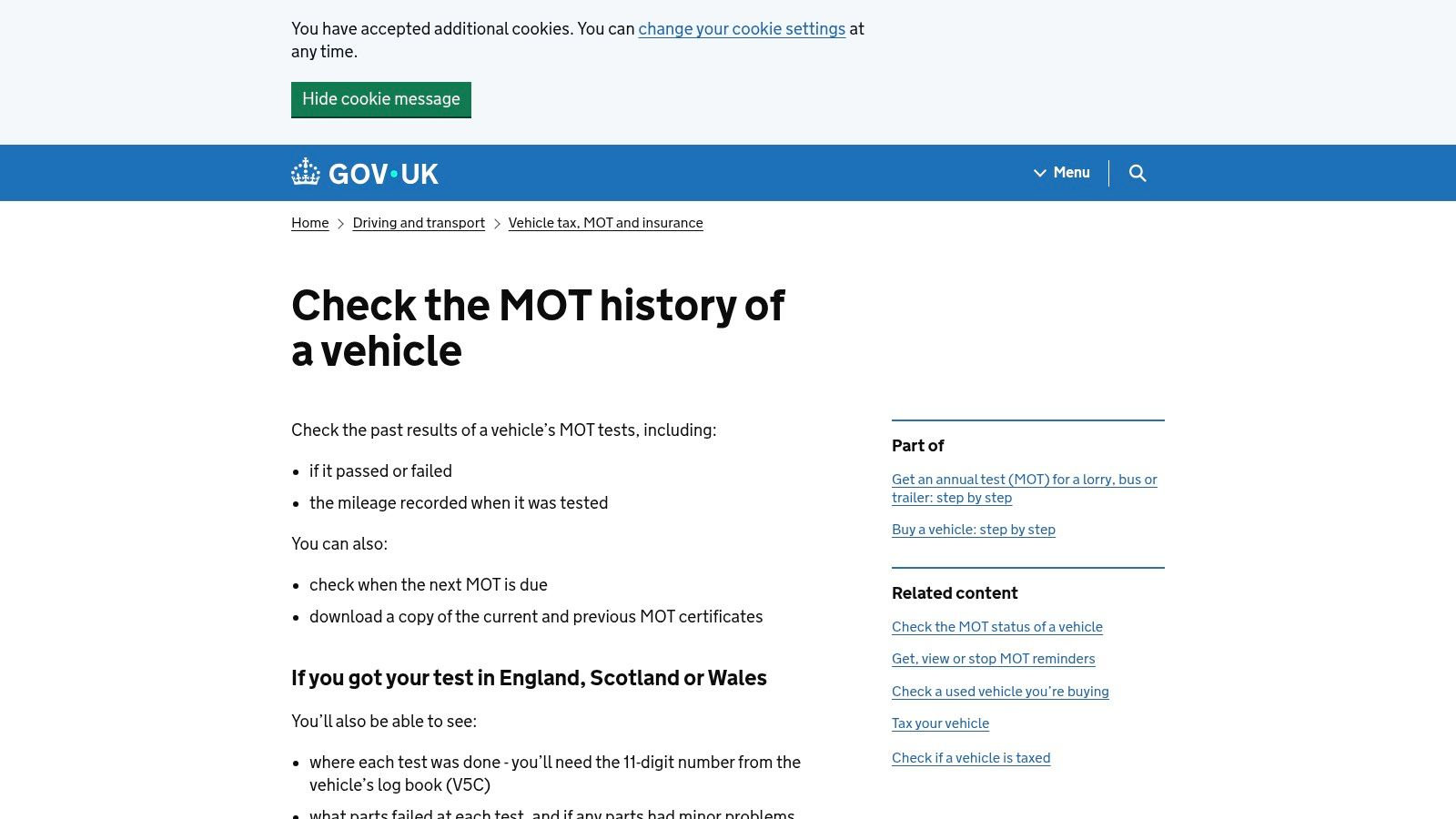
Open the GOV.UK MOT history service using the same registration. Confirm the latest result, test date, mileage at each test, failure reasons and advisories. Record the findings rather than stopping at a pass. Repeated defects or recurring advisory themes can change the preparation budget even when the latest test is clear.
The record gives you a standard reference point before capital is committed because it is not a dealer-written summary. Use the DVLA vehicle owner check guide for wider document and keeper-history context, while recognising that an MOT and tax lookup does not verify ownership.
Save the registration, check date and material findings in the stock file. Compare those entries with the physical vehicle, V5C and seller's paperwork. Any inconsistency should trigger supporting-document requests and a reassessment of the buying margin, because the free checks are only the first filter in professional due diligence.
Reading MOT History Like a Professional
A professional doesn't read MOT history as a series of isolated passes and failures. The useful question is whether the entries form a coherent story about mileage, maintenance and use.
The DVSA's MOT history API provides records for cars, vans and motorcycles in Great Britain from 2005, creating nearly two decades of potential test history. That depth allows a free lookup to reveal recurring failures, advisory trends and mileage patterns that a current-status search would miss, as detailed in the DVSA open data collection.
Follow the mileage sequence
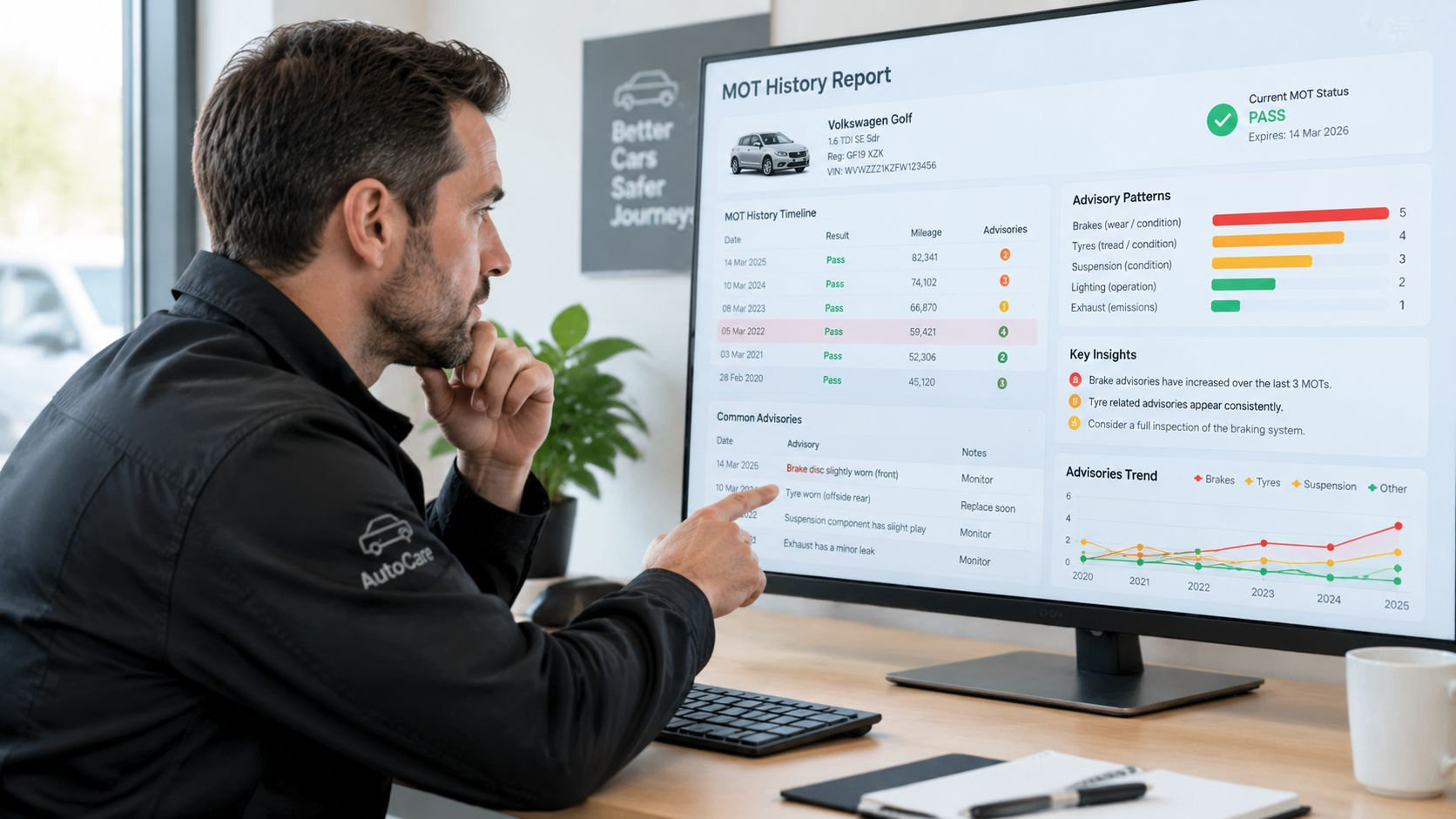
Read the mileage entries from oldest to newest. A normal sequence usually makes sense against the vehicle's age and the time between tests. An unexpected decrease, an implausible jump or a long unexplained gap deserves clarification before you value the stock.
Mileage fraud remains a material used-car risk. HPI reports that one in 11 vehicles undergoing its check was identified with a mileage discrepancy, using the last three recorded mileages on the National Mileage Register and MOT records to identify inconsistencies. That figure is cited in HPI's road-to-ruin fraud guidance.
Auto Express separately reported that 2.1% of 7.6 million cars checked over a 12-month period had odometer readings that didn't tally with recorded mileage history. The Auto Express report on mileage fraud reinforces the practical point: mileage is a risk signal, not a box to tick.
Connect advisories across tests
One advisory may be routine. A repeated reference to corrosion, suspension wear, braking components or tyres is more useful when viewed as a trend. Ask whether the issue appears again, changes description, disappears after a test and later returns, or sits alongside a failure involving the same system.
This doesn't prove that a vehicle is unsafe or poorly maintained. It tells you where to direct the physical inspection and what to ask the seller. A trader should also compare the recorded mileage with the dashboard, service invoices and any available preparation notes.
Test locations can add context, although they shouldn't be treated as definitive evidence. A change of station may reflect a genuine move, a fleet transition or a routine service decision. It becomes more relevant when combined with mileage anomalies, rapid ownership changes or inconsistent seller explanations.
A clean pass is an outcome, not a biography.
For a practical way to turn test records into a buying decision, use this guide to view MOT history and make smarter buying decisions. The aim isn't to reject every vehicle with an advisory. It is to price and inspect the vehicle according to the evidence rather than the presentation.
What Free MOT and Tax Checks Do Not Tell You
A vehicle can have current tax and a valid MOT yet still be a poor trade purchase. The government records confirm statutory status at specific points, but they do not provide a full risk assessment. Use the official status result for verification, then treat it as the starting point for wider due diligence.
The gaps behind a clean result
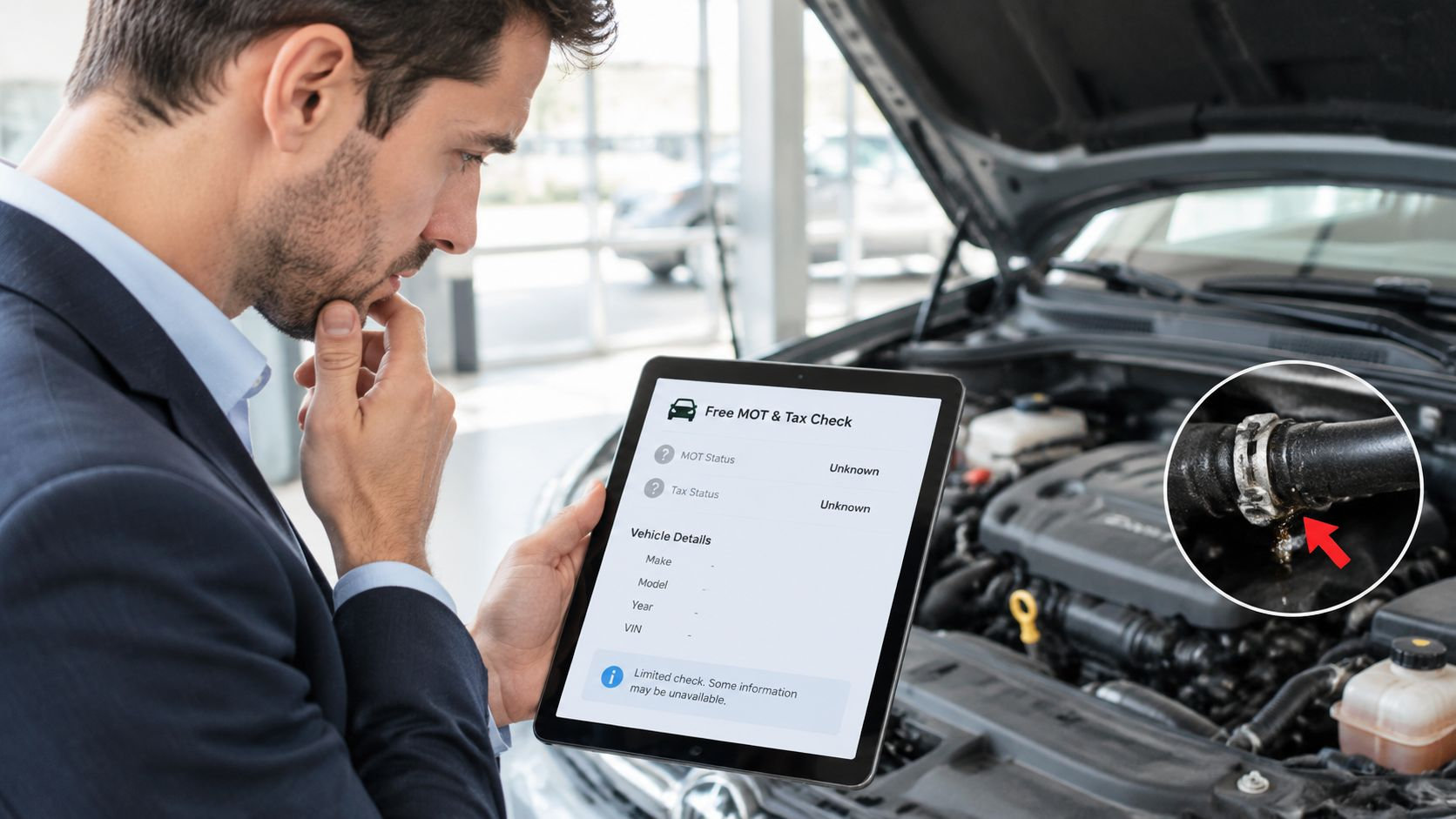
Free MOT and tax checks do not show whether finance remains outstanding. They do not independently confirm ownership provenance, reveal every insurance-related event, or explain why a vehicle has moved quickly between sellers. A pass record confirms that the vehicle met MOT requirements at recorded test points. It does not validate every part of the vehicle's identity, condition or history.
That gap creates motor trade risk. A dealer may buy stock with an undisclosed financial encumbrance, a disputed provenance trail or insurance history that affects its value. The cost can emerge after purchase, when the vehicle is harder to sell or the expected margin has disappeared. The free check has not failed. It was never designed to answer those questions.
Why ownership context matters
Short-term ownership and rapid movement through the trade can have innocent explanations. They can also suggest that several sellers chose not to retain the vehicle after finding a problem. Ownership timing becomes more useful when assessed alongside mileage inconsistencies, conflicting descriptions, repeated advisories or an unusually urgent sale.
A status lookup alone cannot establish the vehicle's full position. A professional vehicle history check UK should bring together administrative records, ownership timelines, mileage evidence and risk indicators. The aim is to examine relationships between events, rather than judge each record in isolation.
Use the free result to decide what needs escalation:
- Finance position: Establish whether a separate finance check is required before purchase.
- Insurance history: Request evidence where damage or repair history could change valuation.
- Ownership pattern: Investigate rapid changes or explanations that do not fit the paperwork.
- Identity and provenance: Compare the registration record, V5C details, physical identifiers and seller narrative.
- Commercial exposure: Adjust the bid or walk away when unresolved risk threatens margin or resale confidence.
A deeper report cannot replace inspection, documentation or judgement. It can make those activities more targeted by showing where the exposure sits. AutoProv supports this workflow by combining vehicle provenance information with mileage patterns, ownership timelines and risk indicators for trade decisions. Its role is to add context to the free statutory check, not to turn a pass into a guarantee.
Integrating Free Checks Into Your Buying Workflow
A vehicle can look right in an auction lane and still fail a basic record check. Make the registration lookup part of the buying routine before enthusiasm affects the bid. Run it alongside the stock number, keys, condition notes and expected preparation cost.
If the registration is available, check tax status before bidding. Open the MOT history next, then record the latest mileage, recent advisories and recurring failure patterns. Compare those findings with the vehicle itself. A dashboard reading that conflicts with the official record is a reason to pause, request evidence and reassess the bid.
For part-exchanges, complete the check during appraisal, not after agreeing a figure. A current MOT can support the initial conversation, while repeated advisories may change inspection questions, reconditioning allowance and valuation. With wholesaler stock, match the supplied vehicle list to the official records before booking transport.
Use a simple decision record
Keep the process short enough for a busy buyer to follow:
- Identify the vehicle: Match the registration, displayed details and physical identifiers.
- Confirm current status: Record tax, SORN position and MOT expiry.
- Read the history: Capture mileage progression, failures and advisories.
- Escalate anomalies: Request documents, inspect further or order a deeper provenance check.
- Set the buying position: Bid, negotiate, defer or reject according to unresolved exposure.
File the result with the vehicle records. Stock controllers can then see why a vehicle was bought at a particular level, while different buyers and sites follow the same standard.
The best process is the one a busy buyer follows every time.
Mileage review belongs in every preliminary check. HPI has reported that one in 11 vehicles checked had a mileage inconsistency, supporting a routine MOT mileage comparison. The linked advice appeared earlier in this article, so no duplicate source link is needed here.
Use the guide to proper due diligence when buying trade stock to structure the wider review. Free checks identify issues quickly, but physical inspection, document review and commercial judgement determine whether the vehicle belongs in your stock.
From Basic Data to Smarter Trade Decisions
Free MOT and tax checks are indispensable for preliminary due diligence. They give traders an official view of current status and a valuable test record, but they don't confirm finance, insurance history, ownership provenance or the wider commercial context.
That makes them a first filter, not a finishing point. A disciplined dealer combines the government record with physical inspection, document review, seller questioning and a deeper risk assessment where the evidence warrants it.
AutoProv provides UK-focused vehicle history, provenance and risk intelligence for dealers, motor traders and wholesalers. It analyses records such as DVLA information, MOT history, mileage patterns, ownership timelines and insurance-related events to help traders assess stock before committing capital.
Use the free GOV.UK checks for every candidate vehicle, then visit AutoProv when you need deeper provenance, mileage and risk intelligence at the point of purchase. Build the result into your buying and valuation process so unresolved history becomes a decision factor, not a post-sale surprise.
Frequently Asked Questions
AI-Generated Content Notice
This article was created with the assistance of artificial intelligence technology. While we strive for accuracy, the information provided should be considered for general informational purposes only and should not be relied upon as professional automotive, legal, or financial advice. We recommend verifying any information with qualified professionals or official sources before making important decisions. AutoProv accepts no liability for any consequences resulting from the use of this information.
From our AI insights
- MOT History: Understanding Seasonal Trends
Explore how seasonal trends impact MOT history and what it means for vehicle checks in 2026.
- Predicting Mechanical Issues with MOT Patterns
Learn how to analyse MOT patterns to foresee potential mechanical issues and make informed buying decisions.
- Mastering MOT Data for Smart Stock Acquisitions
Unlock the potential of MOT data to make smarter stock decisions and reduce risks.
Related Articles

Understanding the MOT History: A Comprehensive Guide
Explore everything you need to know about MOT history, including its significance, how to check it, and what to look out for.
Understanding MOT History: A Key to Smart Used Car Purchases
Discover how MOT history can guide your used car buying decisions and ensure you make an informed choice.

How to View MOT History and Make Smarter Buying Decisions
For anyone in the UK motor trade, a vehicle's Ministry of Transport (MOT) history is much more than a simple pass or fail certificate. It's the car's diary, a detailed logbook of its life on the road. Glancing only at the latest MOT is a rookie mistake, and a costly one at that. To really get under the bonnet of a vehicle's past, you need to view MOT history in its entirety—it’s the only way to see the true timeline of maintenance versus neglect.
Published by AutoProv
Your trusted source for vehicle intelligence