For motor trade professionals, establishing the true history of a motorcycle requires moving far beyond basic checks. It is a process of detailed investigation, analysing data from the DVLA, scrutinising MOT history, and querying insurance and finance databases. The objective is to identify patterns in ownership, mileage, and damage history to understand the vehicle's complete provenance, its true value, and its potential hidden risks.
Why a Standard Motorbike Check Is Insufficient
Relying on a standard, consumer-grade vehicle check presents a significant business risk for any dealer. These reports are designed for the public, offering a simplified "green light/red light" on major issues like outstanding finance or a stolen marker. While this is an essential first step, it is only the beginning of a professional due diligence process.
Operating solely on this surface-level information means acquiring stock with incomplete intelligence. A motorcycle's real story is often found not in the officially recorded data points, but in the gaps and patterns between them. It is in these details that costly problems for a dealer's forecourt are frequently concealed.
Beyond the Pass/Fail Mentality
A basic check will confirm if a bike is on the stolen register, has been written off, or has finance owing. It provides a snapshot in time but lacks the context required to make an informed commercial decision. The intelligence a dealer needs comes from analysing the bike’s provenance—its complete ownership and event history.
This deeper analysis is where professionals unearth risks that standard checks will almost always miss:
- Undisclosed Accident Damage: Many repairs are conducted without an insurer's involvement and therefore do not appear on a standard report. A bike could have sustained significant damage, been poorly repaired, and this would remain unknown.
- Suspicious Ownership Patterns: A rapid succession of keepers over a short period is a classic indicator of risk. It often points to a persistent, difficult-to-diagnose fault that owners are passing on rather than funding a repair.
- Mileage Discrepancies: While MOT history provides mileage readings, it does not account for the intervals between tests. Mileage tampering, or "clocking," still occurs, and a basic check may not cross-reference all available data to flag an inconsistency. You can learn more about how a vehicle's unique identifier helps track its history by reading our guide on a free UK VIN number check.
A standard history check answers the question, "Is there an obvious problem right now?" A professional provenance check answers a far more important one: "What is the probability of a hidden issue impacting my business in the future?"
The Importance of Trade Vehicle Intelligence
Moving beyond basic checks requires a shift in focus from simple data collection to active risk assessment. It involves connecting data points to build a clear picture of how a motorcycle has been used, maintained, and transferred between keepers. A clean report does not automatically equate to a quality asset for your stock.
Consider a bike with a perfect MOT history but three owners in the last 18 months. A standard check shows no issues. A professional analysis, however, flags this as a high-risk indicator, prompting further questions and a more rigorous physical inspection. That is the difference between simply buying a bike and making a sound commercial investment.
Platforms built for the motor trade, like AutoProv, are engineered to provide exactly this type of contextual insight. They aggregate and analyse data from multiple sources to highlight the subtle risk signals that consumer-grade checks overlook. This level of trade vehicle intelligence is fundamental to protecting capital, pricing stock accurately, and safeguarding a dealership's reputation.
Decoding the Essential Data Sources
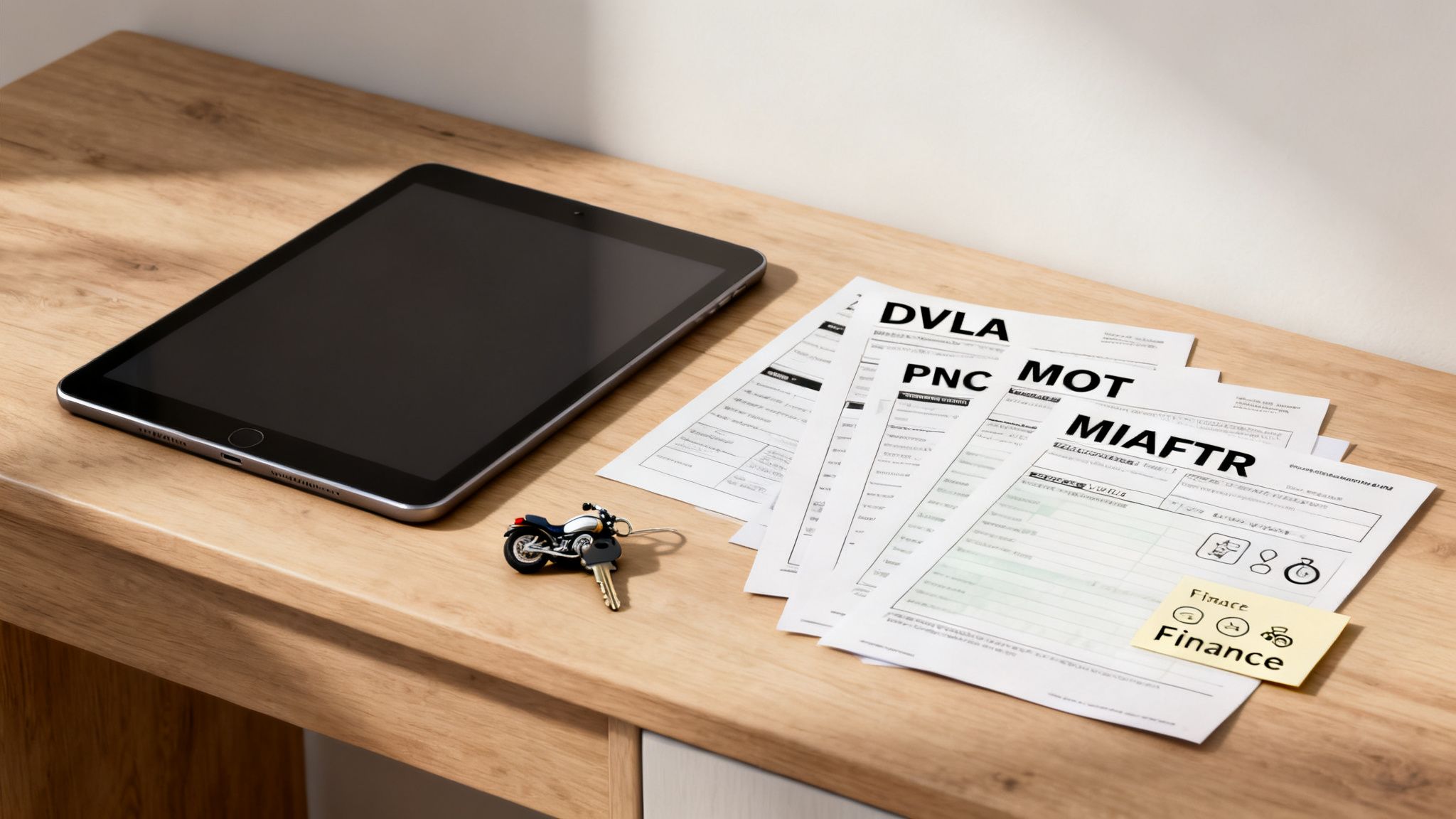
A professional motorbike history check is not about a single source of information. It is about synthesising intelligence from several authoritative UK databases to construct a complete picture. Each dataset provides a different part of the vehicle's story, and understanding the role of each is essential to establishing its true provenance.
Relying on one or two sources is like reading the first chapter of a book and assuming you know the ending—you miss the critical developments that determine the true value. Much as a detailed watch serial number lookup guide demonstrates how to verify an item's history, a motorcycle's registration and VIN are the keys to its past. The skill lies in knowing which datasets to query and how to interpret the findings.
The Foundational Government Databases
The bedrock of any credible check is data from official government and law enforcement sources. These databases provide the non-negotiable facts about a bike's identity, legal status, and roadworthiness.
- DVLA (Driver and Vehicle Licensing Agency): This is the definitive source for keeper history. The DVLA holds records on the date of first registration, the number of previous keepers, and the date of the last V5C issue. This data is vital for spotting high-turnover vehicles that may be concealing a recurring problem.
- MOT History Database: This is more than a pass/fail record; it is a critical source for assessing a bike's maintenance history. It provides a chronological mileage record and, importantly, a list of all advisory and failure items from each test. Identifying trends in advisories can flag recurring issues or neglect.
- Police National Computer (PNC): The PNC is the authoritative source for determining if a vehicle has been reported stolen. A stolen marker is an immediate, absolute red flag. No professional check is complete without querying this database.
A clean report from these three core sources confirms a bike's basic legitimacy. For a motor trade professional, however, this is the starting point of a proper risk assessment, not the conclusion.
Critical Insurance and Finance Intelligence
While government data covers legality and identity, insurance and finance records reveal a motorcycle's commercial history and any hidden liabilities. This is where you uncover events that directly impact a bike's structural integrity and your legal right to sell it.
Here are the key commercial databases that must be checked:
- MIAFTR (Motor Insurance Anti-Fraud and Theft Register): This is the official register of all vehicles that have been subject to an insurance write-off. It provides the crucial write-off category (e.g., Cat S, Cat N), which is fundamental for valuation and your legal disclosure obligations.
- Finance Agreement Data: A comprehensive check must query data from major finance houses to identify any hire purchase or loan agreement secured against the bike. Retailing a vehicle with outstanding finance can lead to its repossession from your customer, causing significant financial and reputational damage.
- Manufacturer Recalls: Checking for outstanding safety recalls is a non-negotiable part of professional due diligence. Failure to ensure a recall has been addressed exposes your business to considerable liability.
Combining Data for a Single View
Integrating these disparate datasets is the final part of the intelligence-gathering process. Each source helps to validate the others, and it is the inconsistencies between them that often point to the most significant risks.
A professional-grade system like AutoProv is designed to consolidate these data feeds into a single, actionable report. Instead of manually cross-referencing MOT mileage against DVLA keeper changes, the platform performs the analysis and flags anomalies automatically. This integrated approach saves time and, more importantly, reduces the potential for human error. A review of the various data sources AutoProv integrates demonstrates the power of this consolidated view.
How to Spot Hidden Risks and Red Flags
Acquiring the raw data is straightforward. The real skill—the one that directly impacts profitability—is in its interpretation. Knowing how to analyse a motorbike history report is what distinguishes a simple data-puller from a trader conducting a proper risk assessment. It is how you identify the subtle warnings others miss, refine valuations, and protect your business from acquiring problematic stock.
Interpreting a report is about spotting patterns, not just isolated facts. A single advisory on an MOT is not a deal-breaker. However, the same advisory appearing over several years points to neglect or a persistent fault that has not been correctly resolved. This is where a vehicle's true story begins to emerge.
Analysing Ownership and Usage Patterns
A bike’s ownership timeline is one of the most revealing parts of its history. A rapid turnover of keepers is a classic indicator that something is amiss. It often suggests an underlying, intermittent, or expensive-to-fix issue that owners have chosen to pass on rather than resolve.
When reviewing the keeper history, several key questions must be asked:
- How many keepers in the last 24 months? More than two in this period should be a trigger for closer investigation.
- What is the average ownership duration? A pattern of short ownership periods—for example, less than a year—across multiple keepers is a significant red flag.
- Do keeper changes align with major MOT failures? A bike that fails its MOT on a serious item and is sold shortly after strongly suggests the previous owner was unwilling to fund the repair.
The UK motorcycle market is mature and established, with around 1.4 million registered motorcycles. In such a stable market, anomalous ownership churn is a strong signal that a bike is an outlier for negative reasons. You can get more context on these trends in The Rise of Motorbikes in the UK on oreateai.com.
A motorbike's provenance is told through its timeline. Gaps, inconsistencies, and rapid changes are the footnotes that reveal where the real risks are hiding.
Decoding MOT Advisories and Mileage Consistency
An MOT history is far more than a simple pass/fail certificate; it is a continuous health record of the bike's operational life. Your focus should be on the advisories, as these are often early warnings of future failures and significant repair costs. Look for recurring themes, such as slight play in headstock bearings, a chain and sprockets "nearing their limit," or minor fluid leaks noted over multiple tests.
Cross-referencing mileage from MOTs with other records is also vital. A basic check might show a steady increase, but a professional analysis looks deeper. Are there erratic jumps in mileage between tests? Is there a long period with minimal mileage added, perhaps suggesting the bike was off the road?
Any discrepancy requires a logical explanation. A trade-grade platform like AutoProv automates this mileage check UK process, flagging inconsistencies across multiple datasets that would be difficult to spot manually. This helps to identify potential mileage tampering or data entry errors before a purchase commitment is made. Outstanding finance is another significant risk; get the full picture by reading our guide on how to check outstanding car finance UK.
Understanding Write-Off Categories
A clear understanding of insurance write-off categories is non-negotiable. It is not enough to know a bike has a "category" marker; you must understand what it means for its structural integrity, future value, and your legal duties as a seller.
- Category S (Structural): This indicates the bike has suffered structural damage and has been professionally repaired. This will always have a significant impact on its value and requires a thorough physical inspection of the frame and chassis alignment.
- Category N (Non-Structural): This means the damage was cosmetic, electrical, or otherwise non-structural. While less severe than Cat S, the quality of the repair is paramount. It could cover anything from stolen and recovered parts to damaged fairings.
A bike with a Cat N history may be a viable purchase if the repairs were purely cosmetic and completed to a high standard. A Cat S machine, however, carries a much greater risk and requires an expert physical inspection to confirm its safety. In both cases, the category status must be declared to the next buyer, and its impact must be factored accurately into your valuation. This type of intelligence turns a basic used car history report into a genuine tool for motor trade risk management.
Here's a quick rundown of what to look for and what it might mean when you're sizing up a bike's history.
Key Risk Indicators in a Motorbike History Report
Red Flag Potential Indication Recommended Action High Keeper Count Underlying mechanical/electrical faults; owner dissatisfaction. Investigate average ownership duration; scrutinise MOT history for recurring issues. Mileage Discrepancy Potential "clocking" (mileage tampering) or data entry error. Cross-reference all available mileage records; request service history; question the seller. Recurring MOT Advisories Neglected maintenance or a persistent, unresolved fault. Price in the cost of future repairs; conduct a thorough physical inspection of the component. Category S Marker Significant structural frame or chassis damage in its past. Commission an expert mechanical inspection; significantly adjust valuation downwards. Category N Marker Non-structural damage, but repairs were costly. Inspect quality of cosmetic and electrical repairs; confirm no underlying issues remain. Gaps in MOT History Bike may have been off the road, stored, or had an unrecorded write-off. Ask for evidence of SORN; check for signs of long-term storage or hidden damage. Remember, these flags are not always deal-breakers, but they are your cue to dig deeper. A comprehensive history check gives you the facts you need to turn potential risks into calculated decisions, protecting your margin and your reputation with every bike you buy.
Building a Repeatable Due Diligence Workflow
Knowing the risks is one thing. Turning that knowledge into a concrete, repeatable process is what separates consistently profitable dealerships from those operating on chance. Ad-hoc checks are a certain way to miss critical information. A robust, standardised workflow ensures every motorcycle undergoes the same level of scrutiny, reducing human error and embedding risk management into your buying culture.
This is not about creating unnecessary administration; it is about building professional rigour. The objective is a simple, thorough, and efficient system that ensures every step, from initial enquiry to final payment, is deliberate and informed by the best available intelligence.
Pre-Acquisition Screening: The Triage Stage
Before physically inspecting a motorcycle, a brief digital triage can eliminate unsuitable candidates. This saves considerable time, fuel, and resources. This first pass should be fast, focused, and designed to provide an immediate "go/no-go" signal based on the vehicle's registration number.
- Initial MOT Check: A quick review of the public MOT history is essential. Look for major failures, corrosion advisories suggesting a hard life, and significant mileage gaps. A bike with a patchy MOT history requires much closer inspection.
- Basic Provenance Flags: A trade-grade platform like AutoProv provides an instant snapshot. Does it flag a high number of keepers or a recent V5C issue? These early warnings from a professional dealer vehicle checks system inform whether a deeper investigation is warranted.
This is not the full investigation. It is a rapid risk assessment to filter out time-wasting prospects. If a bike fails this initial test, you can move on without investing further resources.
Point-of-Purchase Deep Dive: The Full Report
Once a motorcycle has cleared the initial screening and you are seriously considering an acquisition, it is time for a full analysis. This involves running a comprehensive vehicle history check UK report that consolidates all critical data into a single, easy-to-read format. This is the intelligence upon which your final decision will be based.
This process flow shows how the key risk areas—ownership, mileage, and damage—all feed into each other when you check a motorbike's history.
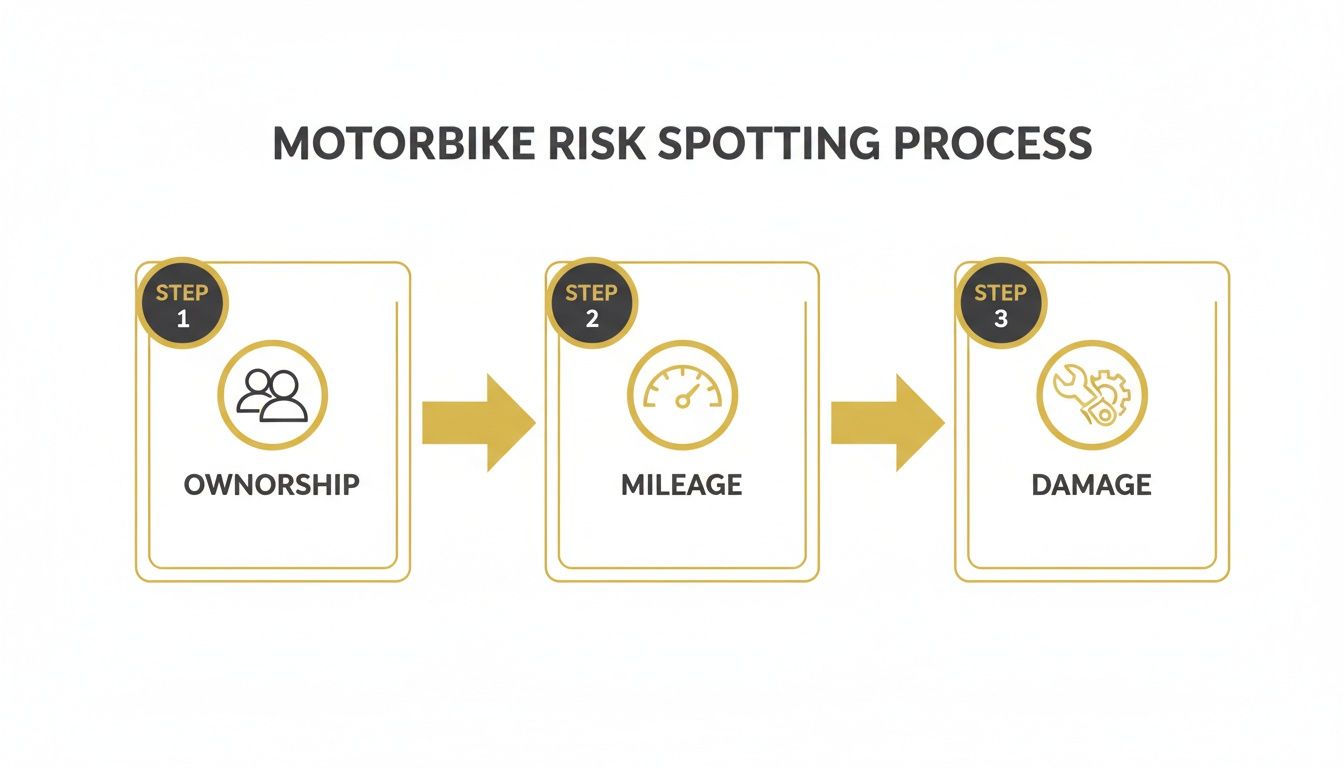
As illustrated, these factors cannot be assessed in isolation. A proper assessment requires understanding how these three pillars connect and influence one another.
At this stage, your workflow should involve a detailed review of these key report sections:
- Stolen & Finance Markers: The absolute deal-breakers. You need confirmation that the bike is not listed on the Police National Computer and has no outstanding finance.
- Write-Off History: Scrutinise any MIAFTR records. If it is a Category S or N, you must understand the implications for its value and how you will retail it.
- Ownership Timeline Analysis: Examine the keeper history in detail. Look for short ownership stints and rapid resales—they are classic indicators of hidden issues.
- Mileage Consistency Analysis: Compare every available mileage record—from MOTs, service history, and other sources in the report—to build a confident timeline. A robust mileage check UK is the foundation of this process.
Your workflow should treat the full history report as a mandatory step before any price negotiation begins. The facts it contains will directly inform your valuation and the questions you must ask during the physical inspection.
Post-Acquisition Verification: The Final Handover
The checks do not end once a price has been agreed. The final stage of your due diligence occurs at the point of collection and payment. This is your opportunity to verify that the physical documents match the digital records you have analysed.
This step is your last line of defence against fraud. Any discrepancies discovered here could negate the deal and reveal serious problems that digital checks could not identify.
Your final checklist should include:
- V5C Logbook Verification: Meticulously inspect the V5C document. Does the VIN/chassis number on the paper match the one stamped on the bike's frame and engine? Do the keeper's details match the seller? Check the document's watermark and serial number for any signs of forgery.
- Service History Correlation: If a service book is present, do the stamps and dates align with the mileage and timeline you have already established? Are the stamps from credible, verifiable garages?
- Physical Inspection: This is where digital intelligence meets physical reality. Your inspection should be guided by the risk indicators found in the history report. If there were advisories about chain wear, inspect it closely. If it is a Cat N, scrutinise the quality of the cosmetic repairs.
By embedding this three-stage workflow—Triage, Deep Dive, and Verification—into your buying process, you create a powerful system for managing motor trade risk. It transforms acquiring a motorcycle from a speculative act into a structured, data-driven business decision. For an in-depth look at what goes into a professional report, learn more about the AutoProv vehicle provenance report and the intelligence it delivers.
Using Provenance Intelligence to Boost Profit
This is where intelligence translates into commercial advantage. Obtaining a detailed report on a motorcycle is one thing; turning that data into profitable action is a separate skill. A professional check motorbike history process is not a cost centre—it is a direct investment in your bottom line.
When you have a complete picture of a bike's past, you move from buying on instinct to making data-driven decisions. This intelligence fundamentally changes how you assess every potential unit for your stock, allowing you to value a machine based on its unique history, not just its model, age, and mileage.
From Data Points to Negotiation Power
A detailed history report is one of the most effective negotiation tools available. When you can pinpoint specific issues, the conversation shifts from subjective opinion to objective fact, providing a solid foundation for agreeing a price.
Instead of a vague "it needs some work," you can present concrete evidence:
- Patterned MOT Advisories: Pointing out recurring advisories for the same component (e.g., "front brake pads wearing thin" for two consecutive years) demonstrates a history of minimal-effort maintenance. This justifies a lower offer to cover the inevitable replacement cost.
- High Keeper Turnover: Highlighting that a bike has had three owners in the last 18 months allows you to raise legitimate concerns about potential underlying issues. This creates leverage for a price that reflects that inherent risk.
- Category N History: Knowing a bike is a Cat N write-off provides a clear, industry-accepted reason to adjust your valuation. You can explain how its history will affect its future retail value and, consequently, your margin.
This approach is not about making low offers; it is about accurately pricing in the risk and future costs associated with a bike's specific past. It ensures you buy correctly, which is the most critical step to selling profitably.
Provenance intelligence transforms your buying process from a simple transaction into a strategic acquisition. It’s about knowing the bike’s true market value, not just its advertised price.
Making Smarter Retail vs Trade Decisions
Not every motorcycle is suitable for your forecourt. A key decision for any trader is whether to retail a machine or move it on through the trade. The intelligence from a comprehensive check makes this decision far less of a gamble.
A bike with a clean, low-owner history and a perfect MOT record is a prime candidate for retail. It presents a straightforward and trustworthy narrative for potential buyers. Conversely, a bike with a more complex history—perhaps a Cat S marker or a significant mileage discrepancy—may be better suited for an auction or trade sale where buyers understand and accept those inherent risks.
This strategic allocation of stock is crucial for maintaining both cash flow and reputation. By using data to filter your inventory, you ensure your forecourt is stocked with machines you can stand behind with confidence. For a deeper dive into market trends, explore our insights on vehicle valuations and market intelligence.
Protecting Your Reputation and Bottom Line
Ultimately, every bike you sell carries your business name. A comeback, a dissatisfied customer, or a major undisclosed fault can cause disproportionate damage to your reputation. A thorough vehicle provenance check is your most effective defence against these post-sale problems.
By identifying potential issues before you buy, you drastically reduce the chances of them surfacing after you sell. This leads to fewer warranty claims, fewer disputes, and fewer negative online reviews. In the long term, investing in quality trade vehicle intelligence pays for itself many times over by safeguarding your most valuable asset: the trust of your customers.
Platforms like AutoProv are designed to deliver this level of insight, turning a standard used car history report into a powerful tool for profit protection and risk management.
Frequently Asked Questions
Even experienced motor trade professionals encounter questions when investigating a motorcycle's history. Obtaining correct answers can be the difference between a smart acquisition and a costly error. Here are some of the most common queries from dealers and traders.
How Is a Trade Motorbike Check Different from a Consumer One?
The difference lies in their intended purpose. A consumer check is designed for a private buyer, providing a simple pass/fail on critical issues like theft or outstanding finance. It answers one question: "Should I buy this bike?"
A trade-specific check is a professional intelligence tool. It provides a deep analysis of vehicle provenance, including ownership patterns, MOT advisory trends, and mileage consistency. It is designed to answer a more complex business question: "Is this bike a safe and profitable asset for my stock?" It delivers the trade vehicle intelligence needed for accurate valuation and risk assessment, not just a simple go-ahead.
Can I Rely Solely on MOT History to Verify Mileage?
No. Relying exclusively on MOT history is a common but risky shortcut. While it provides a series of crucial data points, it is an incomplete record and should never be used in isolation.
The MOT database cannot account for the period between tests—a significant window where mileage can be altered. Furthermore, a simple data entry error by a tester can create a false reading that appears legitimate at first glance. A professional mileage check UK cross-references MOT data against service records and keeper change dates, building a more reliable picture and flagging discrepancies that the MOT history alone would miss.
What Is the Biggest Red Flag on a Bike History Report?
While obvious deal-breakers like a stolen marker are easy to spot, the most significant hidden risk is often a rapid succession of short-term owners. A motorcycle changing hands three or four times in a single year is a major warning sign.
This pattern almost always points to a persistent, underlying fault that previous owners have tried—and failed—to fix. It suggests the bike is being passed on to avoid a complex or expensive repair. This should trigger extreme caution and a much more thorough physical inspection before you consider making an offer.
Should I Avoid a Bike with a Category N History?
Not necessarily, but you must proceed with a full understanding of the implications. A Category N (Non-Structural) write-off means the damage did not affect the frame. For the trade, this can represent a buying opportunity, but only if the repairs have been completed to a high standard.
The key is to be confident in the quality of the repair work and to recognise that its history will affect its future resale value. Transparency with the next buyer is non-negotiable; you must declare the Category N status. This is precisely where a detailed used car history report helps you manage motor trade risk, providing the full context needed to value the bike accurately and sell it compliantly.
A robust check motorbike history process is fundamental to protecting your capital and your reputation. AutoProv delivers the advanced vehicle provenance and risk intelligence the UK motor trade relies on to buy smarter and with total confidence. Discover the difference at https://autoprov.ai.
Frequently Asked Questions
AI-Generated Content Notice
This article was created with the assistance of artificial intelligence technology. While we strive for accuracy, the information provided should be considered for general informational purposes only and should not be relied upon as professional automotive, legal, or financial advice. We recommend verifying any information with qualified professionals or official sources before making important decisions. AutoProv accepts no liability for any consequences resulting from the use of this information.
From our AI insights
- Navigating UK Grey Imports: A Trader's Guide
Understand the complexities and opportunities of UK grey imports for savvy motor traders.
- Navigating Private Plate Challenges in UK Vehicle Checks
Learn how private plates affect UK vehicle checks and how traders verify provenance and spot cloning risks.
- Navigating VIN Checks Post-Brexit: What UK Traders Need to Know
Discover how Brexit impacts VIN checks for UK traders and the crucial data to review.
Related Articles

Essential Vehicle Checks Before Buying a Used Car
Learn essential checks to ensure your used car purchase is safe and sound in the UK market.

Why a Provenance Check is Essential for Used Car Buyers
Ensure your used car is a smart investment by understanding the importance of a provenance check and how AutoProv can help.

A Guide to Vehicle Check with VIN Number
A vehicle check with vin number is easily the most important thing you can do before buying a used car. Think of it as your first line of defence—a quick, simple step that pulls back the curtain on a vehicle's past, protecting you from expensive mistakes, legal headaches, and downright dangerous cars.
Published by AutoProv
Your trusted source for vehicle intelligence