For anyone in the UK motor trade, comprehensive car insurance is the gold standard of cover you can get for your valuable stock. It’s the policy that acts as a proper financial shield, protecting your business assets against damage, fire, theft, and third-party liabilities. Relying on lesser policies can leave dangerous gaps, exposing your dealership or fleet to some serious financial pain.
What Comprehensive Cover Really Means for Motor Trade Professionals
In the high-stakes world of buying and selling vehicles, a vague understanding of insurance is a fast track to eroding your profits. For dealers, auction buyers, and fleet managers, comprehensive cover isn't just about ticking a box; it's a core part of your risk management strategy. It’s your first line of defence against the sheer unpredictability of holding and moving vehicle stock.
Here’s a simple way to think about it. A third-party policy is like having a single spanner in your toolbox—handy for one specific job, but that’s it. Comprehensive cover, on the other hand, is the entire professional toolkit. It equips you for almost any situation you'll face, whether a car is sitting on your forecourt or out on a test drive with a potential buyer.
The Business Case for Top-Tier Cover
So, why is this distinction so critical for your day-to-day operations? The answer goes far beyond simple accident claims. A solid, comprehensive policy directly impacts your ability to operate confidently and, ultimately, profitably.
- Protecting Your Assets: It covers damage to your own vehicles, no matter who is at fault. This is absolutely essential for protecting the capital you have tied up in your inventory.
- Managing Liability: It includes protection against claims from other people for injury or property damage, shielding your business from legal costs that could be ruinous.
- Enabling Operations: Let's be practical. You need proper cover for everyday business activities like customer test drives, moving stock between sites, and collecting cars from auctions.
The real value of comprehensive insurance is its sheer breadth. It’s built to absorb the financial shock from a massive range of incidents, making sure a single event doesn't threaten the financial health of your entire business.
But here’s the catch: the effectiveness of your insurance is directly tied to the quality and history of the vehicles you acquire. A car with a hidden past—like an undisclosed write-off or a dodgy mileage reading—creates huge insurance risks. This is where checking a vehicle’s provenance becomes a non-negotiable part of your due diligence.
Getting your head around the different UK car insurance types and legalities is the first step. But it’s the second step—verifying each vehicle's history—that turns that knowledge into a real protective strategy. This is where tools like AutoProv become indispensable. They uncover those hidden risks, allowing you to secure the right cover and protect your bottom line from the moment a car lands in your stock.
What Your Comprehensive Policy Actually Covers and Excludes
For anyone in the motor trade, a comprehensive policy is the financial safety net that lets you sleep at night. It’s sold as the highest level of protection, but to really understand what comprehensive car insurance meaning translates to in the real world, you have to look past the name. It’s less of an unbreakable shield and more of a detailed agreement with very specific rules.
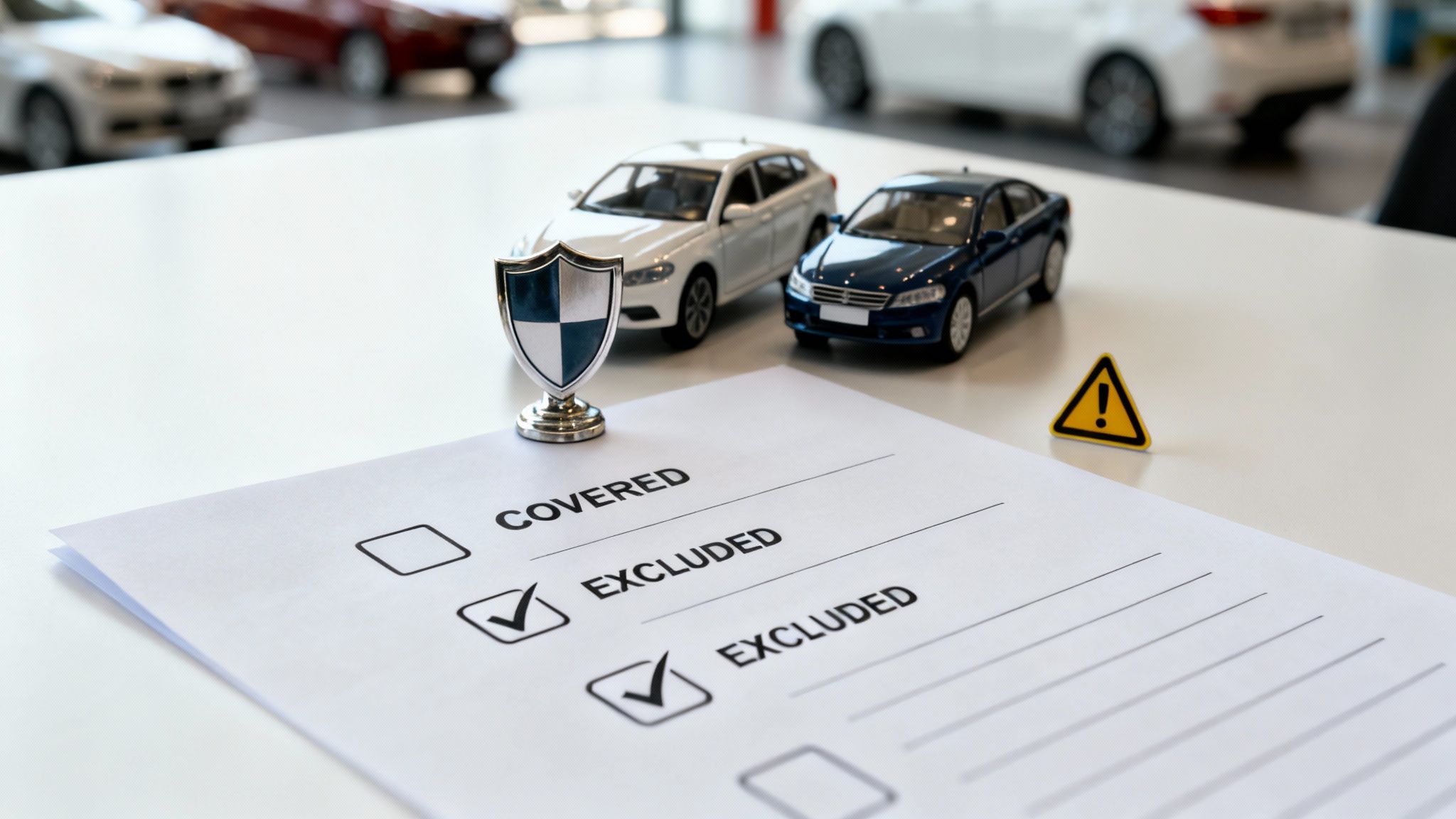
This policy is your first line of defence against the most common—and most expensive—risks you’ll face. It’s built to handle everything from a minor scuff on the forecourt to a major smash on the A1.
Core Protections Your Policy Should Include
The whole point of comprehensive cover is to pay for damage to your own vehicles, no matter who’s at fault. That’s the absolute game-changer compared to third-party policies, which would leave you footing the bill for your own repairs if your driver caused the accident.
Any decent comprehensive policy should have these as standard. The first is Damage to Your Own Vehicles. This is the big one. If a car in your stock gets damaged in a prang—whether it’s with another vehicle, a bollard, or a customer's gatepost—your comprehensive cover steps in to pay for the repairs (minus your excess, of course). Crucially, this applies even if you or your driver were to blame. Second is Fire and Theft. It’s exactly what it says on the tin. If a vehicle is stolen from your premises or damaged in a fire, you’re covered. This is non-negotiable for any business holding valuable stock. Finally, there's Third-Party Liability. Just like every other motor policy in the UK, it covers your legal responsibility if you cause injury to someone else or damage their property. This is what protects your business from the kind of compensation claims that can shut you down for good.
On top of these essentials, many policies throw in useful extras that are a godsend in the motor trade. Windscreen cover is a classic example, saving you from a full claim for a simple chip. A courtesy car is another key feature, making sure you or a customer aren't left stranded while a vehicle is off the road.
Think of comprehensive insurance as a safety net for sudden, unexpected disasters. It’s not a maintenance plan or a warranty for when things just wear out.
Common Exclusions That Can Catch You Out
This is where the rubber meets the road. Assuming your "comprehensive" policy covers absolutely everything is a classic—and often very expensive—mistake. Insurers are crystal clear about what they won’t pay for, and it’s all buried in the policy wording.
Getting your head around these exclusions is vital for managing your risk. Some of the usual suspects you need to watch out for include Wear and Tear, as insurance isn’t there to pay for things that naturally wear out over time. Bald tyres, a worn-out clutch, or faded paintwork are all on you as maintenance costs, not insurable events. Also excluded is Mechanical or Electrical Failure. If an engine blows or a gearbox gives up the ghost without being caused by an accident, your insurance won't touch it. That’s a mechanical breakdown, and you’d need a separate warranty product to cover that kind of failure. Another common exclusion is Unauthorised Use. If one of your cars is damaged while being driven by someone not permitted on your policy, or used for something daft like racing, you can bet your claim will be thrown out. A final major one is Damage from a Previous Write-Off. This is a massive headache for dealers. If you buy a car that was previously written off and you didn’t know, an insurer might slash the payout on a future claim or even void the policy altogether. That’s why knowing how to find affordable cover for a category car is so crucial, but more importantly, it's why you must identify these vehicles before they hit your forecourt with an AutoProv check.
Navigating the Fine Print of Your Insurance Policy
The real value of a comprehensive policy isn't in the big, bold promises on the first page. It’s tucked away in the jargon and clauses that make up the policy wording. Getting your head around this fine print is what separates a quick, painless claim from a drawn-out and costly dispute.
For any motor trade business, understanding these terms is non-negotiable. They directly control how much cash you get back after an incident, which has a massive impact on your bottom line.
Understanding Your Policy Excess
The first and most common term you'll come across is the policy excess. In simple terms, this is your contribution to the claim—the amount you have to pay out of your own pocket before the insurer steps in to cover the rest.
Think of the excess as your skin in the game. It's usually made up of two parts: the Compulsory Excess is the slice set by the insurer, a fixed amount you can’t change. The Voluntary Excess is the extra amount you agree to pay on top. You might choose a higher voluntary excess to bring your premium down, but remember: if you claim, that's more cash you'll have to find upfront.
Let's put it into practice. Imagine a car in your stock picks up damage that’ll cost £2,000 to fix. Your policy has a £250 compulsory excess and you’d opted for a £500 voluntary excess. Your total excess is £750. You'll pay the first £750 of the repair bill, and the insurer will handle the remaining £1,250. Finding the right balance here is crucial for managing your cash flow.
Agreed Value Versus Market Value
This is a big one, especially if you deal with anything rare, high-value, or heavily modified. When a car is written off, the difference between these two valuation methods can easily run into thousands of pounds.
An Agreed Value policy is exactly what it sounds like. You and the insurer agree on a vehicle's worth right at the start of the policy, and that figure is locked in. If the worst happens and the car's a total loss, that agreed amount is what you get back (minus your excess, of course). This is absolutely vital for classic cars, bespoke builds, or any vehicle where a standard "book price" just doesn't cut it.
A Market Value policy is far more common, but it's also where the arguments start. Here, the insurer will only pay out what the vehicle was worth at the moment just before it was damaged. An insurer's idea of market value can be worlds away from your own, potentially leaving you seriously out of pocket.
For a motor trader with unique stock, an Agreed Value policy isn’t a luxury. It’s a fundamental business tool that prevents valuation squabbles and ensures you can replace a special asset without taking a massive financial hit.
The Courtesy Car Clause Explained
Here’s another classic bit of policy small print that often catches people out: the courtesy car. It sounds simple—your vehicle is in for repair, so the insurer gives you a temporary replacement. But the devil is always in the detail.
Most standard policies will offer you a basic little runaround, maybe a small city car. That’s fine for a private owner doing the school run, but it’s next to useless for a business. If the vehicle being repaired is a commercial van you need for deliveries or a high-end sports car for a client, a 1.0-litre hatchback just isn't going to work.
What you need to be looking for is a policy offering a ‘like-for-like’ replacement. This ensures the stand-in vehicle is of a similar type, size, and spec to your own, letting your business carry on without a hitch. Checking this clause before you sign on the dotted line is the only way to make sure your cover is truly fit for purpose.
The Claims Process When a Vehicle Is Damaged or Written Off
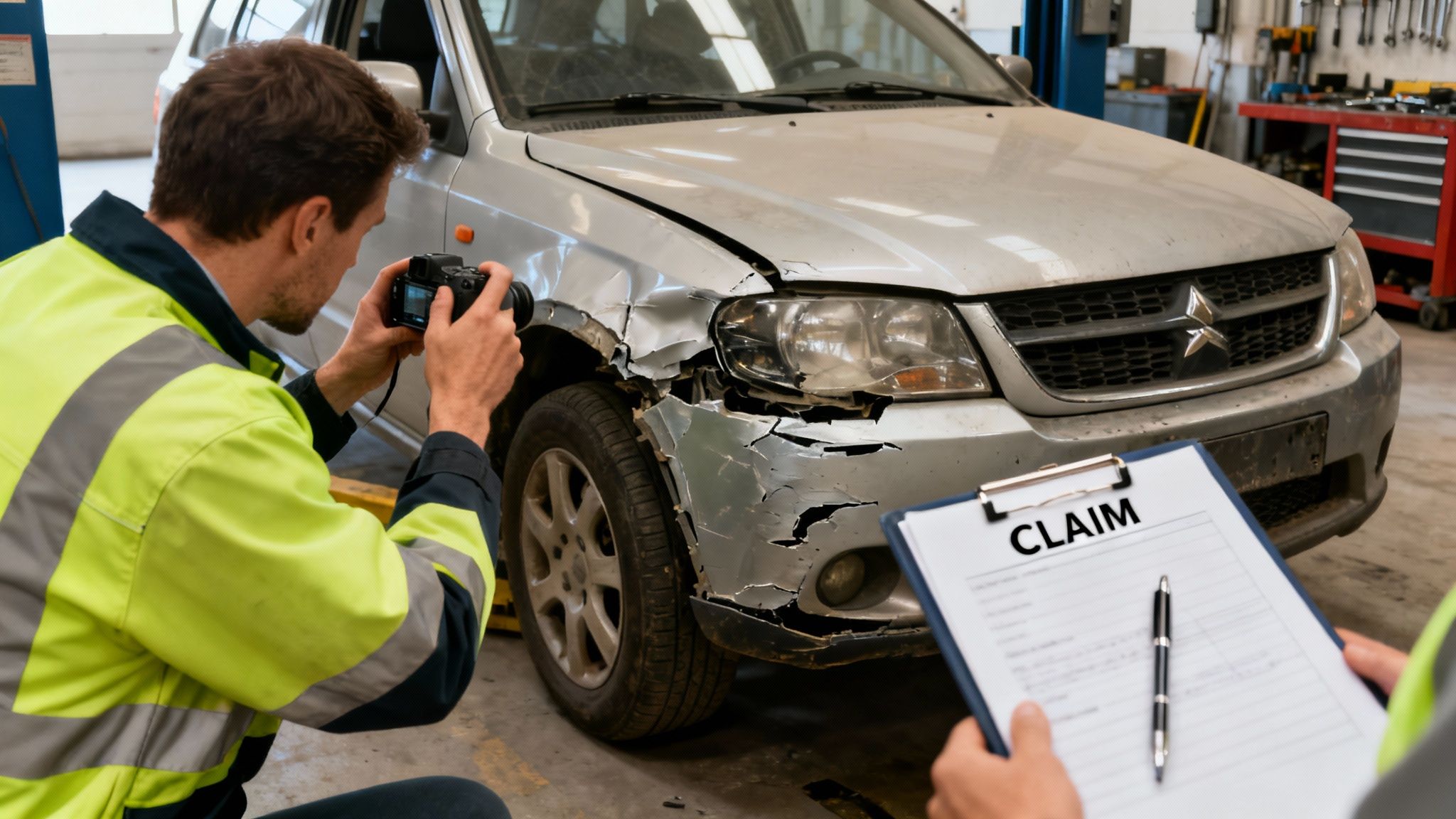
When one of your vehicles is involved in an incident, the clock starts ticking. A calm, methodical approach isn't just helpful; it's absolutely essential to protect your assets and keep business disruption to a minimum. It’s in these critical moments that the true comprehensive car insurance meaning comes to light, showing you exactly how your policy performs under pressure.
From that first phone call to the final decision, knowing the process inside and out lets you manage the situation, not the other way around. For a motor trade professional, this is about far more than just getting a car fixed—it’s about protecting your stock's value and making smart commercial decisions.
Immediate Steps After an Incident
What you do in the first few hours can make or break your claim. A systematic approach is your best defence against unnecessary complications.
First things first, ensure everyone is safe and report the incident to the police if necessary. Your very next call should be to your insurer. Procrastinating here can be a costly mistake, as almost every policy has a strict deadline for reporting a claim.
Be ready to give your insurer the key details. You will need your policy number and business details. You must also provide the date, time, and location of the incident, alongside a clear, factual account of what happened. Finally, you need details of anyone else involved—names, contact numbers, and their insurance information. This initial report gets the ball rolling and triggers the crucial vehicle assessment phase.
Vehicle Assessment and the Repair Workflow
Once the claim is logged, your insurer will arrange for an engineer to assess the vehicle. This expert inspection determines the extent of the damage and, critically, the estimated cost of repair. This is the fork in the road that decides the vehicle's fate.
If the damage is repairable and the cost makes financial sense, the insurer gives the green light for the work. You might use your own trusted bodyshop or one from their approved network. Once the repairs are done, you pay your policy excess, and the insurer handles the rest of the bill. Simple.
But what if the repair costs get close to—or even exceed—the car's market value? In that case, the engineer will recommend declaring it a total loss. In trade talk, it’s a 'write-off'.
For a motor trader, a write-off isn't just a claim; it's an event that directly impacts stock value and future profitability. Understanding the salvage categories that follow is non-negotiable.
The sheer volume of claims highlights why comprehensive cover is so vital for UK motor traders and auction buyers; it absorbs financial shocks that lesser policies simply can't handle. The FCA's Motor Insurance Claims Analysis paints a stark picture—with millions of active policies, claims costs have skyrocketed. The average claim cost has surged in recent years, with repair bills dominating payouts to the tune of billions every quarter, driven up by complex EV and ADAS technology. You can read the full analysis on the FCA’s motor insurance claims review.
Decoding the UK Salvage Categories
When a vehicle is written off, it's assigned a salvage category by the insurer. This code defines what can happen to it next and gets logged on databases like the Motor Insurance Anti-Fraud and Theft Register (MIAFTR). For a dealer, buying a vehicle without knowing its category history is a massive financial gamble.
A Category A (Scrap) vehicle is so badly damaged it must be crushed, and not a single part can be legally salvaged or reused. For Category B (Break), the main bodyshell is toast and must be crushed, but other parts can be professionally stripped and sold on. A Category S (Structural) vehicle has sustained damage to its core structural frame or chassis but can be professionally repaired and put back on the road. Finally, Category N (Non-Structural) covers vehicles with damage that doesn't compromise the main structure—think cosmetic issues, panel damage, or electrical faults. These can also be repaired and resold.
Getting your head around these categories is crucial. A Cat S or Cat N vehicle can be a viable purchase for your forecourt, but its value is permanently affected, and its insurance history is marked. Failing to spot this before you buy is a rookie error. To safeguard your business, it's essential to learn how to check if a car is a write-off before you commit your cash.
This is precisely where an AutoProv report becomes an indispensable part of your due diligence. It instantly flags any recorded write-off history, giving you the power to assess the true risk and value of a potential purchase. Armed with that knowledge, you avoid overpaying and protect your business from the financial fallout of a car's hidden past.
How Vehicle Provenance Impacts Your Insurance Premiums
For anyone in the motor trade, the true meaning of comprehensive insurance isn’t just about the cover it provides—it's about the business it protects. A policy is only as good as the vehicle it’s tied to, and this is where smart stock acquisition and risk management go hand in hand.
A car with a murky past is a liability waiting to happen. An incomplete or hidden history can inflate your insurance costs, slash your claim payouts, or worse, invalidate your policy altogether. Vehicle intelligence isn’t just about paying the right price at auction; it’s about buying an asset that’s insurable, safe, and free from the kind of baggage that can wreck its value and your reputation.
Simply put, a car’s past directly dictates its future risk profile.
The Hidden Risks That Inflate Your Premiums
Insurers are in the business of calculating risk. When they look at a vehicle, they see more than just its make, model, and age. They’re digging into its entire life story, and any gaps or red flags in that history translate directly into higher premiums or tougher policy terms for your business.
A vehicle with an unknown history is an unpredictable variable, and insurers hate unpredictability. That uncertainty forces them to price in a higher potential for claims, a cost that gets passed straight on to you.
Just look at the UK insurance market. While comprehensive cover remains the best protection you can get, WTW data shows that average premiums are always shifting. The Association of British Insurers (ABI) reports billions in claims payouts each quarter, meaning insurers are more vigilant than ever about risk. For motor trade professionals, this is a clear signal: spot issues before you buy to avoid insurance headaches later.
Key Data Points That Insurers Scrutinise
So, what exactly sends an underwriter’s alarm bells ringing? It’s not just about major accidents. A whole range of historical markers, all found in a professional-grade provenance check, can have a serious impact.
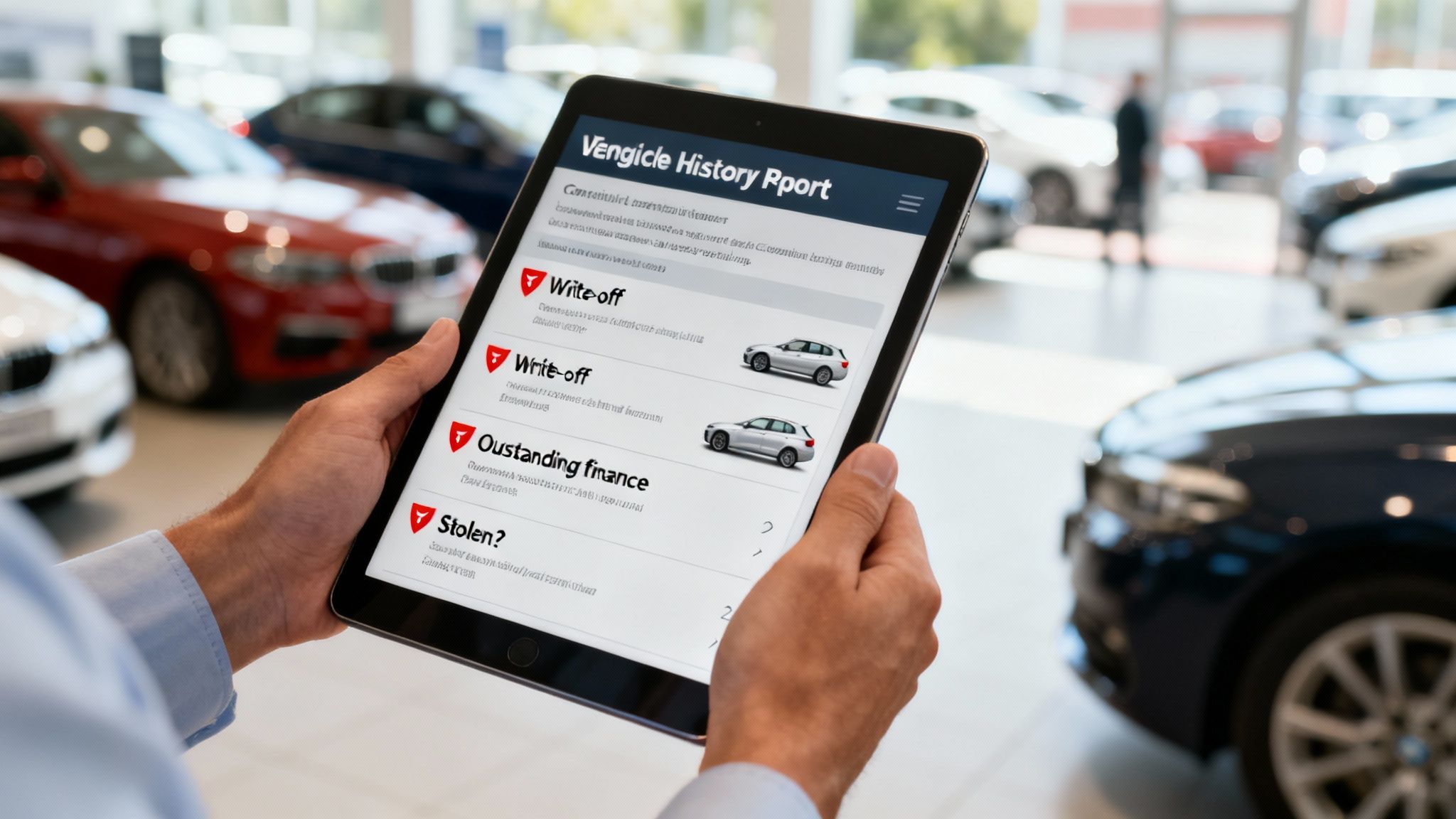
- MIAFTR Write-Off Records: This is the big one. Finding a vehicle on the Motor Insurance Anti-Fraud and Theft Register (MIAFTR) means it’s been written off before. Even a perfectly repaired Category N (non-structural) vehicle carries a permanent stain on its record that insurers will price in, often leading to higher premiums or an outright refusal to cover.
- PNC Stolen Markers: A car with a Police National Computer (PNC) stolen marker is toxic stock. Buying one, even by accident, exposes your business to massive legal and financial liability. No insurer will touch it, and you could lose every penny of your investment.
- Outstanding Finance Agreements: An Experian check that flags outstanding finance means the seller doesn’t legally own the car. This creates a title dispute that complicates ownership and, therefore, its insurability.
- Mileage Discrepancies: A major mileage discrepancy suggests clocking. This fraud doesn't just inflate the car's value; it also hides its true mechanical condition, making it a much bigger insurance risk.
Vehicle provenance is the bedrock of accurate insurance underwriting. A clean, verified history means predictable risk, which leads to fair premiums. A history riddled with inconsistencies or undisclosed incidents means unpredictable risk, and that always costs more.
Mitigating Risk with an AutoProv Report
This is exactly why data-driven due diligence is no longer a ‘nice-to-have’—it's an essential part of the buying process. An AutoProv report pulls all these critical checks into one clear, instant overview, letting you see a vehicle exactly as an insurer would.
By running a check before you place a bid or make an offer, you tackle these hidden risks head-on. Uncovering a MIAFTR record lets you walk away from a problem car or negotiate the price down to reflect its lower value and higher running costs. Spotting a PNC marker stops a disastrous mistake before it happens. Our detailed guide to a car provenance report in the UK dives deeper into these checks.
Ultimately, this proactive approach puts the power back in your hands. Instead of discovering a vehicle's expensive secrets after you’ve already paid for it, you can make informed decisions based on a complete, transparent history. This doesn’t just protect your investment; it ensures the comprehensive insurance you rely on is priced fairly and stays valid when you need it most. It’s about buying smarter, not just cheaper.
Turning Insight into Action with Proactive Provenance Checks
Knowing what comprehensive car insurance means is one thing, but that knowledge only helps after something’s gone wrong. In the motor trade, real risk management isn’t about reacting to problems; it's about getting ahead of them. That means embedding rock-solid vehicle due diligence into your daily buying workflow.
Think of it this way: your insurance policy is a safety net, but an AutoProv provenance check is your early warning system. For a tiny investment per vehicle, you can sidestep thousands in potential losses from insurance wrangles, hammered resale values, and serious damage to your reputation. It's one of the sharpest, most cost-effective moves any modern motor trade professional can make.
Securing Your Bottom Line
This proactive approach feeds directly into your profitability. The UK insurance market is never static. The ABI, for instance, recently flagged consecutive quarterly drops in premiums after earlier price hikes, but insurers are still paying out billions in claims each quarter. What does that tell us? It tells us they're scrutinising risk more aggressively than ever.
A car with a sketchy history, flagged by AutoProv’s Experian and DVLA checks, can quickly become a liability—either uninsurable or far too costly to stock. For anyone buying in bulk, that data is gold. It stops you from overpaying for vehicles riddled with hidden issues. You can learn more about recent motor premium trends on ABI.org.uk.
An AutoProv check transforms due diligence from a time-sucking chore into a swift, decisive action. For just a few pounds, you unlock indemnity protection and shrink hours of research into seconds.
This instant insight is a massive competitive advantage. By spotting red flags before you even make an offer, you shield your business from taking on liabilities that even the best comprehensive policy can’t fix. For a deeper dive into the checks that truly matter, our practical guide on provenance checks for traders has more valuable tips.
Your Questions, Answered
When you're in the motor trade, you're constantly weighing up a vehicle's history against its future insurance costs. It's a tricky balance. Here are a few of the common questions that pop up time and again, with some straight-talking answers.
Will a Previous Category N Write-Off Always Send My Premiums Soaring?
Not always, but it definitely throws a spanner in the works. A Category N write-off means the car had non-structural damage – so the core chassis and frame were thankfully untouched. What insurers really care about is the quality of the repair.
If the car has been properly sorted by a certified professional, some insurers will treat it almost the same as a car that’s never been damaged. Others, however, will slap on a higher premium or a bigger excess no matter what, seeing it as a permanently riskier car. This is exactly why an AutoProv report is so vital. Spotting that Cat N history before you buy gives you the full story, letting you properly judge what it'll cost to keep on the road.
Can I Get Comprehensive Cover on a Car That Still Has Finance on It?
Trying to insure a vehicle with an outstanding finance agreement is a massive red flag for insurers. It all comes down to ownership: until that final payment is made, the finance company legally owns the car, not you or your customer. Insurers will often flat-out refuse comprehensive cover because you don't hold a clear title. Imagine the nightmare if it gets written off – whose payout is it?
This is where running a finance check through AutoProv becomes an absolute must-do. It instantly tells you if there’s money owing, saving you from buying a vehicle that’s not just a legal headache but a potential insurance dead-end.
How Does a Dodgy Mileage Reading Affect an Insurance Valuation?
A big mileage discrepancy is a huge problem. It usually points to clocking, and that can completely torpedo an insurance policy. Insurers lean heavily on mileage to figure out a car's market value. If a vehicle is written off and the claims investigator uncovers a mileage anomaly, they can slash the payout amount.
Worse still, they could argue the policy was fraudulent from the start and void the cover completely. That leaves you with a total loss and zero payout. Your best defence? Verifying the mileage history with an AutoProv check. It ensures the valuation is based on real numbers, keeping your insurance watertight.
Frequently Asked Questions
AI-Generated Content Notice
This article was created with the assistance of artificial intelligence technology. While we strive for accuracy, the information provided should be considered for general informational purposes only and should not be relied upon as professional automotive, legal, or financial advice. We recommend verifying any information with qualified professionals or official sources before making important decisions. AutoProv accepts no liability for any consequences resulting from the use of this information.
From our AI insights
- Navigating Insurance Write-Offs in 2024: What UK Traders Need to Know
Explore how UK traders can navigate insurance write-offs using provenance intelligence in 2024.
- Impact of Write-Off Categories on Car Values in 2024
Explore how Cat S, Cat N, Cat A, and Cat B write-offs affect UK vehicle pricing and trader responsibilities.
- Navigating Experian Indemnity: A Deep Dive for UK Traders
Explore Experian indemnity protection in-depth: coverage, claims, and exclusions for UK traders.
Related Articles

Understanding UK Car Insurance: Types and Legalities
Explore the UK car insurance sector, types of coverage, and the legal implications of incorrect coverage.
How to Check If a Car Is Insured in the UK | Easy Guide
The quickest and most reliable way to check if a car is insured is by using the Motor Insurance Database (MID) online. All it takes is the vehicle's registration number to see if a valid insurance policy is on record. Remember, driving without at least third-party insurance is a serious offence here in the UK.
Hit by an uninsured driver: UK accident rights & claim guide
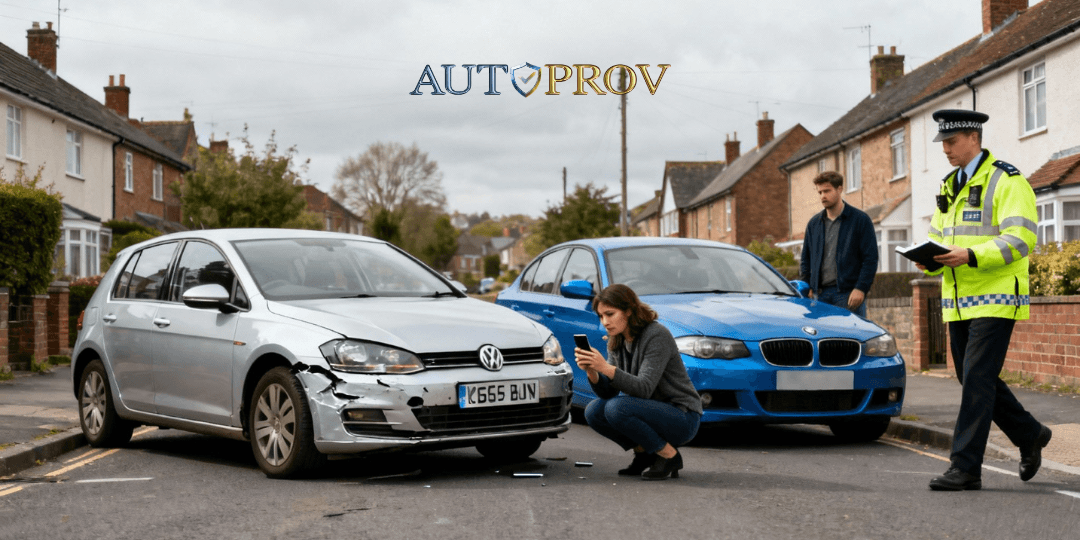
Being hit by an uninsured driver is a deeply frustrating experience. The shock of the accident is bad enough, but finding out the other party has no insurance just adds a whole new layer of stress and confusion. Suddenly, the straightforward path to getting your car fixed seems to vanish. This guide is here to cut through that noise and show you that you're not out of options.
Published by AutoProv
Your trusted source for vehicle intelligence