
The worst advice in the motor trade is that a dealer management system solves everything. It doesn't. A DMS is the operating backbone of the dealership, but it won't tell you whether a used car is a good stock decision, whether a provenance pattern looks wrong, or whether the risk sits outside your core workflows.
That distinction matters more in the UK than most vendors admit. Gartner describes a DMS as an ERP built specifically for vehicle dealerships, bringing sales, workforce, finance, inventory, workshop operations, and manufacturer reporting into one system of record, which is exactly why it has become the day-to-day operating layer for high-volume retail. The UK market is large enough that the operational gains compound fast, with about 1.9 million new car registrations in 2024 and roughly 7.6 million used-car transactions in 2024 in the same industry dataset from Gartner's dealer management systems review.
A DMS keeps the dealership moving. It doesn't replace judgement at the point of purchase.
Table of Contents
- What a Dealer Management System Actually Is
- Why the definition matters
- Why volume makes centralisation necessary
- Core Modules Inside a Modern DMS
- The modules that matter in trade language
- The data flow dealers should test
- What independent dealers and groups use differently
- Benefits and the Honest Limits for UK Traders
- What the DMS improves
- Where the platform stops helping
- How a DMS Connects With Provenance and Risk Tools
- Build the stack in the right order
- Why API-first matters
- What to ask before connecting anything
- A Realistic UK Trade Scenario Where Risk Layers Win
- The problem sits outside the core workflow
- What a better workflow looks like
- Vendor Selection Criteria UK Dealers Should Pressure-Test
- The checklist I'd use in the room
- Why deployment model still matters
- Cost, ROI, and Common Implementation Pitfalls
- The cost categories that actually bite
- What ROI should look like in practice
- The mistakes I see most often
- Security, Compliance, and Smarter Stock Decisions
What a Dealer Management System Actually Is

A dealer management system is dealership ERP. It records the transaction, routes the process, and keeps the operational record in one place. Stock, desking, aftersales, finance, accounting, and OEM reporting all sit on top of the vehicle and customer record. That is the job. The dashboard is only the front end.
Why the definition matters
Dealers still blur the line between a DMS, a CRM, and accounting software. That confusion causes bad decisions. A CRM manages people and follow-up, accounting software handles the books, and a DMS carries the dealership-specific transaction logic that generic systems do not model well.
Practical rule: if the software cannot handle the dealership's real workflows, it is not the core operating platform, it is a helper tool.
In a UK showroom or back office, that difference affects stock control, handover timing, and the quality of the records the manufacturer and accountant expect to see. The DMS is where the store keeps its operational truth. It tracks a vehicle from acquisition to sale, and it stores the detail that has to stay consistent across teams. That is why DMS platforms moved from basic stock and accounting tools into integrated dealership ERP environments as motor retail digitised.
Why volume makes centralisation necessary
Scale is what forces the issue. The UK retail motor trade moves enough volume that small inefficiencies become real money, especially for groups running multiple rooftops. A DMS gives one version of the truth across fast-moving new and used stock, service activity, and finance records as described in Gartner's dealer management systems review.
That is why dealers should stop asking whether they “need” a DMS and start asking how well it fits the way the business sells, services, and reports. The better question is how much control you want over the transaction layer, and where you still need specialist intelligence above it. For stock process discipline, AutoProv's guide to UK vehicle inventory management software is the right layer to examine alongside the DMS. For document flow, teams should also look at CRM document automation blogs because the handoff between enquiry, deal pack, and admin still breaks down in too many stores.
Core Modules Inside a Modern DMS
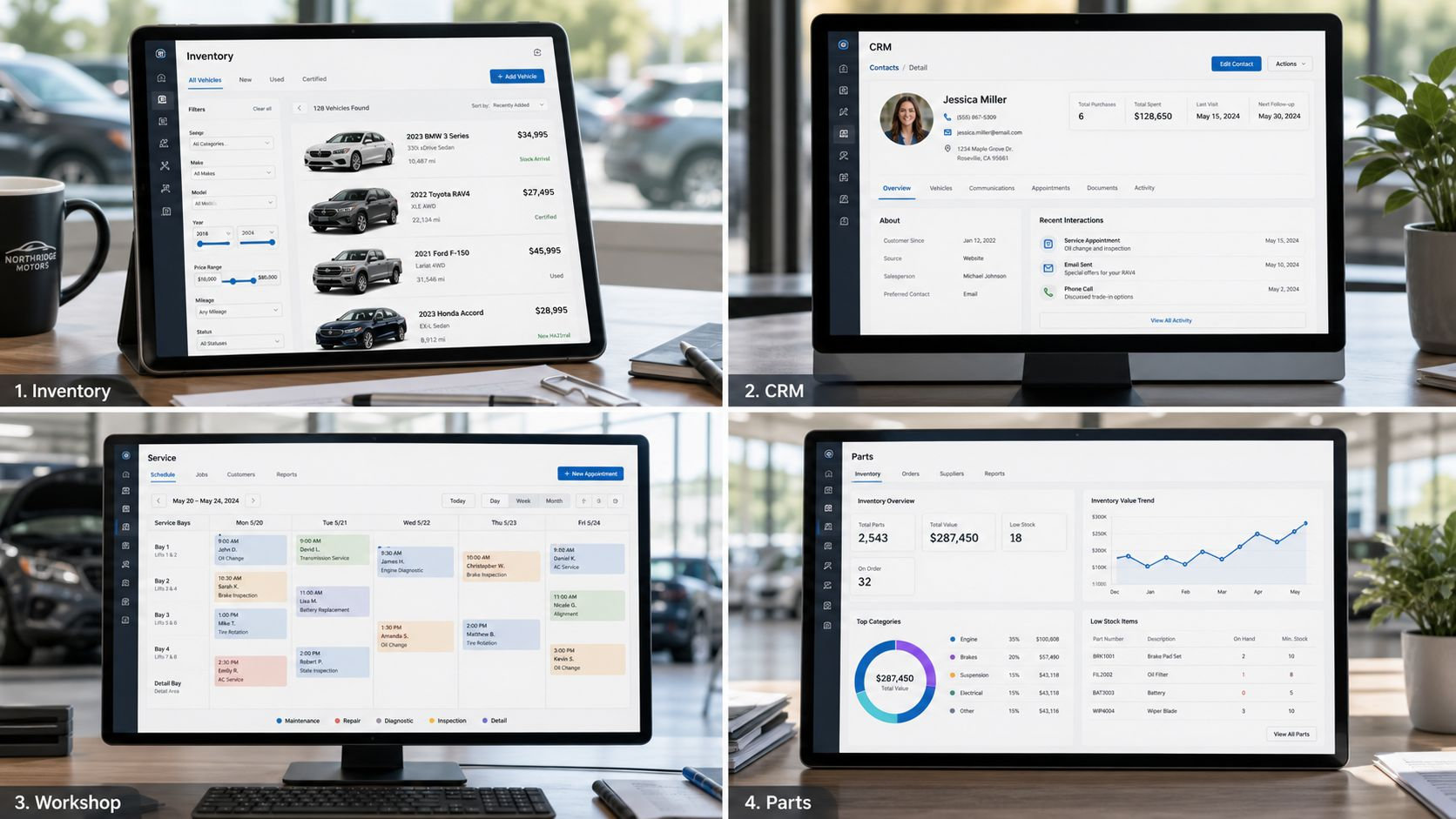
A modern DMS is only useful if the modules talk to each other. Dealers get sold feature lists. What they really need is a system where the vehicle, the customer, and the money move through one connected workflow.
The modules that matter in trade language
Start with stock and inventory, because that's where margin lives. The DMS should track acquisition, pricing, ageing, merchandising, and reconditioning against the VIN so a controller can see what's really tied up in each unit. Then look at sales and desking, where the deal structure gets built, including part exchange, finance, and documentation.
Next is workshop scheduling and fixed ops. That module matters less for a pure used-car pusher than for a multi-site group with meaningful aftersales volume, but it still drives capacity, booking discipline, and vehicle handover timing. Parts sits alongside that, because the parts desk and workshop feed each other constantly, and a loose setup creates avoidable friction across the lane.
The data flow dealers should test
The best way to evaluate a demo is to follow one vehicle from enquiry to disposal. Web lead enters the CRM. The sales team qualifies it. The deal is desking in the DMS. Finance and accounting post from the same record. Aftersales scheduling picks up the handover, and the service team sees the same customer and vehicle data without manual rekeying.
For a useful outside view on connected document workflows, the CRM document automation blogs are worth reading because they show how badly fragmented paperwork becomes when systems don't share clean data. That's exactly where dealership stacks break down.
What independent dealers and groups use differently
Independent dealers usually lean hardest on stock, sales, and accounting. Multi-site groups care more about standardised reporting, controls, and consistency across rooftops. The bigger the group, the more the DMS becomes a governance tool rather than just an admin tool.
Keep your eye on the handoff points. That's where delays, duplicates, and bad data enter the stack.
If you're assessing usability rather than just features, AutoProv's user interface guidance is useful context. A system can be powerful and still be painful to run if the interface slows the people who use it all day.
Benefits and the Honest Limits for UK Traders
The case for a DMS is practical, not romantic. It gives dealers visibility, tighter control over records, cleaner reporting, and one operational layer for stock, service, finance, and customer history. For multi-site businesses, it also makes standardisation possible, which matters when one group wants the same process discipline in every store.
What the DMS improves
A good DMS cuts duplication and forces better recordkeeping. That strengthens compliance, improves accounting accuracy, and keeps day-to-day operations more consistent. It also gives managers a clearer view of what is moving, what is ageing, and where processes are wasting time.
- Visibility: managers can see stock, sales, workshop, and accounting activity in one place.
- Compliance: records are easier to maintain when the transactional source is centralised.
- Productivity: fewer handoffs mean fewer chances for staff to rekey the same information.
- Multi-site control: groups can compare rooftops on shared reporting logic rather than local spreadsheets.
Where the platform stops helping
The limit matters just as much. Industry discussion notes that dealers often run alongside seven different software vendors, which fragments data even when the DMS is supposed to be the central source as cited in dealer data commentary on LinkedIn. That's the core issue. The DMS centralises the core record, but the dealership still lives in a messy software environment.
Operational Area DMS Strength Where It Falls Short Stock control Tracks inventory and ageing Won't judge hidden buying risk Accounting Posts dealership transactions Doesn't remove all manual reconciliation pain Workshop Handles bookings and ROs Doesn't solve every customer communication gap Reporting Standardises management data Still depends on clean inputs from other systems Integration Acts as the core record Can become constrained by vendor access rules That is why vendor claims about a single platform need scrutiny. A DMS is strong at transaction control, weaker at open-ended intelligence. Once you accept that boundary, you stop asking it to do jobs it was never built to do.
The buying decision changes once you see that split. A DMS should run the operation. It should not be treated as the whole intelligence stack. For acquisition decisions, provenance and risk layers sit above the DMS and answer a different question, which is whether a vehicle is worth buying in the first place. A useful reference point is the difference between a provenance check and a fuller provenance report, because point-of-purchase risk review needs more context than stock posting or a standard deal record.
How a DMS Connects With Provenance and Risk Tools
A DMS should sit underneath your acquisition and retail workflow, not swallow it. If you want provenance and risk intelligence to be useful, it has to sit on top of the operational layer and feed decision points without turning migration into a mess. That means clean architecture, disciplined integration, and clear ownership of the data.
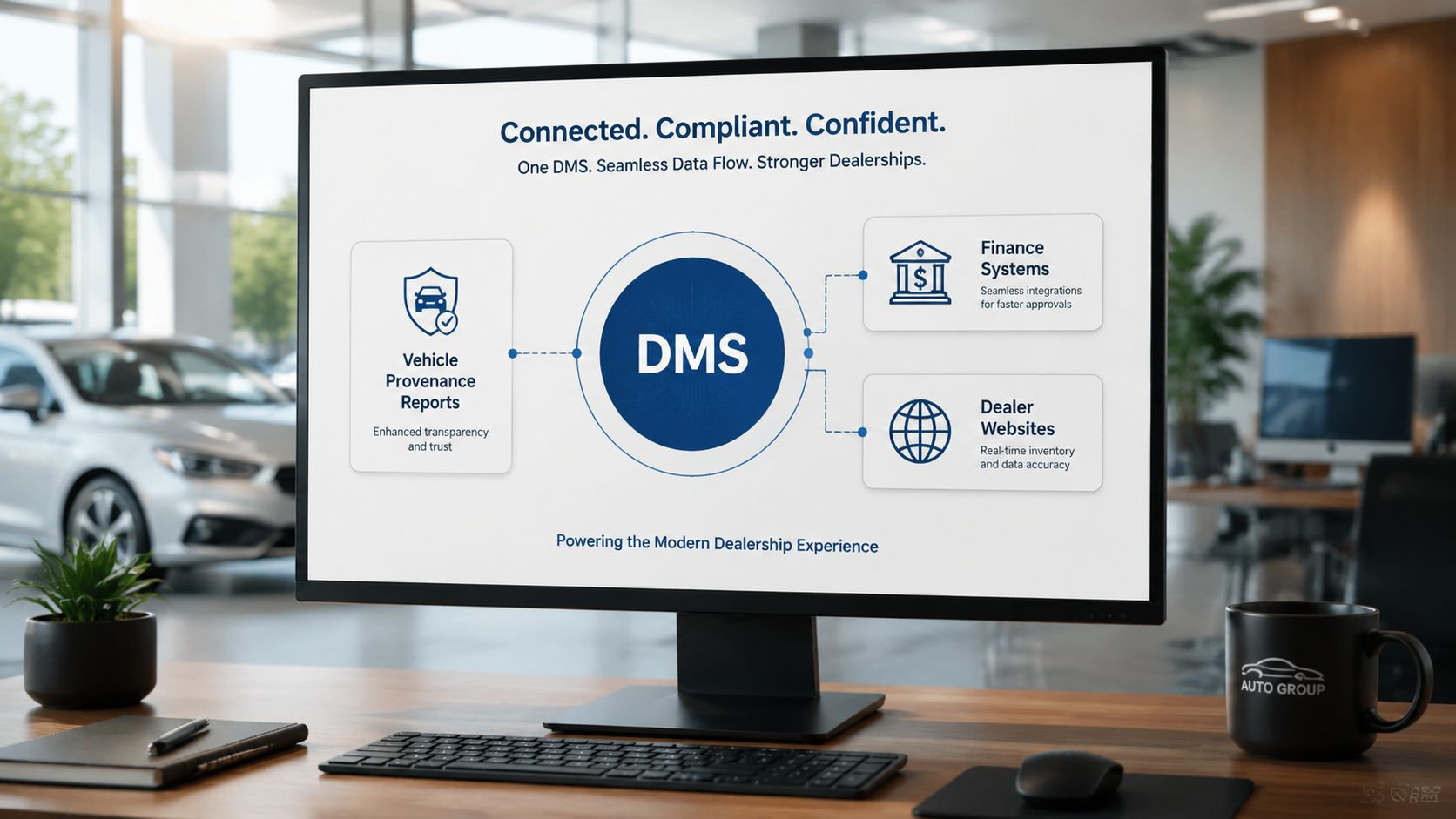
Build the stack in the right order
- Stabilise the DMS record. Get the core fields clean first. If the underlying stock, customer, and accounting data are messy, every downstream tool inherits the same problems.
- Connect CRM and digital retailing next. Those usually produce the fastest operational value because they touch lead handling, follow-up, and conversion.
- Add provenance and stock-risk layers. Vehicle history check UK workflows become useful at the point of purchase, not after the deal is done.
- Link finance providers and reporting feeds. Do this only after the main record structure is stable, otherwise you create audit and reconciliation headaches.
Why API-first matters
The technical direction is clear. Wipro's next-gen DMS reference architecture uses containerised Java Spring Boot services on Amazon EKS with AWS Fargate, while Amazon API Gateway handles authentication, authorisation, and rate limiting at the edge in AWS's published reference architecture. That matters because modular systems let functions scale and update independently instead of tying every change to a monolithic release.
What to ask before connecting anything
- Data fields: which fields can be read, written, and retained?
- Security controls: how are encryption, masking, and access rules handled?
- Migration scope: what moves, and what stays behind?
- Reporting integrity: will your management accounts still reconcile after cutover?
AutoProv's guide to provenance check versus comprehensive provenance report is a sensible companion piece here. Dealers don't need more disconnected reports. They need relevant risk signals attached to the buying workflow.
A Realistic UK Trade Scenario Where Risk Layers Win
A used hatchback lands on the buying desk with a clean-looking paper trail. The mileage appears plausible, the bodywork looks tidy, and the DMS can process the appraisal, stock the unit, and move it through recon without drama. Operationally, everything looks normal.
The problem sits outside the core workflow
The issue isn't the transaction. It's the ownership pattern and the context around the car. A dealer looking only at a standard history feed can miss a short-term ownership pattern, a rapid resale signal, or a mileage anomaly that deserves a harder look. That's where a DMS stops helping, because the DMS records what the dealership did, not whether the car should have been bought in the first place.
A layered provenance view changes the decision. Instead of treating the car as “clear” because no single obvious red flag has appeared, the buyer sees the pattern in context and can decide whether the margin justifies the risk. That's the point where trade vehicle intelligence earns its keep.
The best buying decisions are made before the unit enters stock, not after the warranty conversation starts.
What a better workflow looks like
The desk should review the vehicle at acquisition, not just at retail preparation. If provenance signals are weak, the car can still be bought, but the team should price it with eyes open. If the risk profile is noisy, the buyer walks away or sharpens the negotiation immediately.
That is where AutoProv fits naturally, as a trade-focused layer for uncovering UK vehicle history, provenance, mileage discrepancies, and ownership-pattern risk at the point of decision. It doesn't replace the DMS, and it shouldn't try to. It supports the buying call before the stock is committed.
This is the same go-no-go logic AutoProv sets out in its buying workflow guidance. A clean DMS process is useful. A clean DMS process backed by risk intelligence is safer.
Vendor Selection Criteria UK Dealers Should Pressure-Test
A DMS demo is not the test. The test is whether the platform gives you control over stock, accounts, service, and data without trapping you in vendor theatre. If the answers stay vague, stop the process.
The checklist I'd use in the room
- Hosted versus on-premise: who controls the infrastructure, patches, and uptime responsibility?
- Encryption and masking: how is sensitive data protected in transit and at rest, and what fields are masked?
- Third-party access: which suppliers can connect, and under what commercial terms?
- Available data fields: which records can you export, retain, and write back?
- Migration timeline: how long does a switch take, and what parallel running is needed?
- Exit terms: how do you get your data out if the relationship ends?
Why deployment model still matters
Vendors push cloud-first messaging because it sounds modern. That does not make it the right fit for every dealer group. A market study summarised by Demand Local notes that on-premise deployments still represented more than 60% of revenue in 2020, which tells you legacy preference and installed-base realities still shape buying decisions.
The right answer depends on whether the vendor can prove control, resilience, and access without locking your data behind commercial gates. Dealers should press for plain answers on backup routines, service continuity, and who can extract data if the relationship sours. The same scepticism applies to integration terms, because a platform that looks open in the demo can become restrictive once you ask for real access.
AutoProv's DMS integration guidance is a good reference point for the kind of questions buyers should be asking. Use it to pressure-test how a vendor handles connections, data flow, and exit options before you commit. If the stack cannot connect cleanly without hidden cost or data loss, it is not ready for a serious UK dealership.
Cost, ROI, and Common Implementation Pitfalls
DMS projects fail when people pretend the cost is just a licence fee. It isn't. You're paying for software, integration, migration, training, process redesign, and the pain of running two systems at once while the cutover settles.
The cost categories that actually bite
The obvious costs are licence and setup. The less obvious ones are data cleansing, staff training, report rebuilding, and the time controllers spend checking that numbers still balance. If you ignore the parallel-run period, you'll understate the actual spend and overstate the payback.
What ROI should look like in practice
Track the metrics that show operational drag coming out of the business. Stock turns, workshop utilisation, and sales conversion are obvious ones. So is the cost of correcting misdescribed stock or reconciling records that don't match after migration.
The UK context matters here because those small improvements compound across very large transaction volumes. That's why a DMS can justify itself even when the improvement in each process step feels modest. It's not one giant breakthrough, it's lots of small fixes working across high volume.
For lead management, a useful outside lens is to qualify paid acquisition leads properly before they ever hit the sales desk. If your front end is sloppy, the DMS just records the mess more efficiently.
The mistakes I see most often
Dealers usually underestimate migration time. They also treat integration as a feature-shopping exercise instead of a risk exercise. The third mistake is failing to validate reporting after go-live, then discovering too late that management accounts no longer line up cleanly.
If the go-live plan doesn't include reporting verification, it isn't a plan, it's optimism.
Security, Compliance, and Smarter Stock Decisions
A DMS has to be secure because it holds the operational core of the business. That means dealers should ask hard questions about access logging, hosted infrastructure, encryption, and how user permissions are controlled. GDPR handling matters because customer and vehicle data sit in the same operational environment.
Compliance is not just about records retention or FCA-aligned customer handling. It's also about protecting the buying decision. A dealership can run a clean DMS and still buy the wrong car if it relies on the wrong layer of information.
That's why the next edge is pairing a stable DMS with better trade vehicle intelligence. A provenance layer helps the buyer see hidden history, ownership patterns, mileage anomalies, and other risk signals before the unit hits stock. It reduces the chance of post-sale disputes and strengthens the internal buying process at the same time.
For a broader look at operational automation in fleet and business workflows, the Fleetalyse examples of fleet tools piece is a useful comparison point. The pattern is the same across vehicle businesses, good systems make the record better, but the judgement still has to sit with the operator.
The practical move is simple. Stabilise the DMS core, pressure-test every vendor promise about security and integration, and add a provenance layer where it changes buying decisions. That's how UK dealers reduce risk without pretending one system solves everything.
If you're buying used stock, running a multi-site group, or trying to tighten your acquisition process, AutoProv gives you vehicle history, provenance, and risk intelligence that sits above the DMS and supports the go, no-go decision. Visit AutoProv to see how trade-focused vehicle intelligence can help you buy with more confidence and fewer surprises.
Frequently Asked Questions
AI-Generated Content Notice
This article was created with the assistance of artificial intelligence technology. While we strive for accuracy, the information provided should be considered for general informational purposes only and should not be relied upon as professional automotive, legal, or financial advice. We recommend verifying any information with qualified professionals or official sources before making important decisions. AutoProv accepts no liability for any consequences resulting from the use of this information.
From our AI insights
- Dealer Management Systems: Maximizing ROI in UK Fleets
Discover how UK motor traders can maximise ROI with dealer management systems.
- Navigating Fleet Risk Management with Vehicle Intelligence
Discover how vehicle intelligence transforms risk management in UK fleet operations.
- Fleet Management: Impact of Brexit on UK Fleet Operations
Explore how Brexit has reshaped fleet management in the UK, affecting regulations, costs, and operations.
Related Articles

Essential Fleet Management Practices for UK Businesses
Discover key fleet management practices to enhance efficiency and compliance in UK businesses.

A Guide to UK Vehicle Inventory Management Software
In the fast-paced UK automotive market, vehicle inventory management software is what separates the dealerships that thrive from those just trying to keep their heads above water. Think of it as the central nervous system for your entire operation, going way beyond a simple spreadsheet to give you real-time, data-driven command over every car on the forecourt. It's the true engine room of any modern dealership.

A Guide to Modern Fleet Management for UK Businesses
Forget the old-school idea of fleet management being just about tracking vans on a map. Today, it’s the strategic heart of any profitable motor trade business, pulling together logistics, finance, and risk management into one essential role. The ultimate goal? To squeeze every drop of efficiency out of your vehicles, slash costs, and keep everything compliant throughout a vehicle's entire life on your books.
Published by AutoProv
Your trusted source for vehicle intelligence