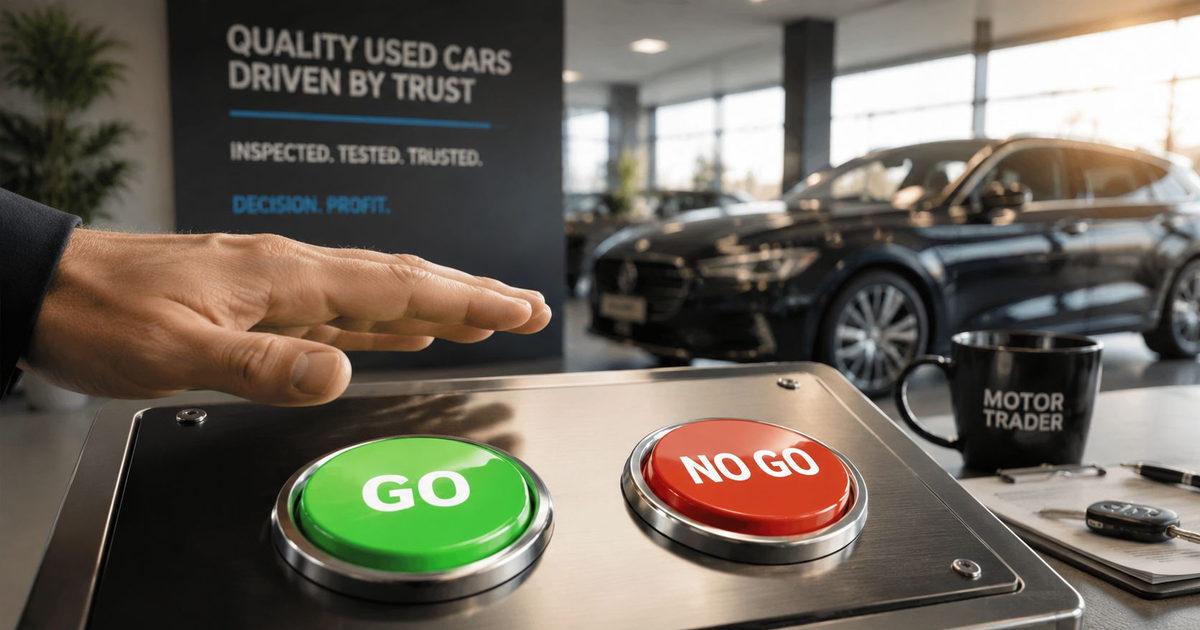
A car lands on your shortlist. The photos are clean, the panel gaps look straight, the spec is right for your forecourt, and the seller has answers ready for every obvious question. On a basic check, nothing catastrophic appears. That's exactly where expensive mistakes get made.
In the UK motor trade, the buying decision rarely sits at the level of “clear” or “not clear”. It sits in the grey area between acceptable risk and avoidable exposure. A vehicle can pass a simple used car history report and still carry the kind of provenance issues that lead to margin erosion, customer complaints, finance problems, or a post-sale argument you could have avoided at appraisal.
A proper go no go decision is a buying control. It replaces instinct with evidence, and it forces the buyer to separate a vehicle that is fundamentally unsafe to buy from one that is buyable only at the right number. That distinction matters because current trade guidance often defaults to a binary pass/fail mindset. AutoProv's trade guidance notes that many discussions stop at finance and salvage markers, even though some vehicles with flagged issues remain commercially viable if the risk is understood and priced correctly in the deal, while others should be rejected outright (AutoProv on UK motor trade buying risk).
The weakness in many dealer vehicle checks isn't a lack of data. It's a lack of structure. If the appraisal process doesn't account for context, ownership behaviour, mileage logic, and cross-source consistency, the buyer ends up making a high-value decision on partial information. That's why pattern review matters, including anomaly detection in vehicle intelligence, not just headline alerts.
Table of Contents
- Introduction Beyond the Basic History Check
- Why simple pass fail thinking breaks down
- What a disciplined decision gate changes
- Defining the Go No Go Decision in the Motor Trade
- The decision point that protects margin
- Mileage risk is enough to justify a formal process
- A Practical Go No Go Framework for Dealers
- Start with a fixed evidence pack
- Go No Go Decision Matrix
- How to treat amber vehicles properly
- Mapping AutoProv Risk Signals to Your Criteria
- From raw data to an at a glance decision
- What a risk score should trigger in practice
- Real-World Scenarios and Decision Examples
- Scenario one hidden risk behind a clean basic check
- Scenario two clear no go on mileage
- Scenario three a salvage category car that may still work
- Embedding the Go No Go Process into Your Workflow
- Turn buyer judgement into a repeatable standard
- What to record every time
Introduction Beyond the Basic History Check
The basic history check still has a place. It can eliminate obvious non-starters quickly. But it doesn't give trade buyers enough depth to make consistent stock decisions, especially when the vehicle falls into that familiar middle ground where the car looks usable, the seller wants a fast answer, and the risk isn't visible on the surface.
Why simple pass fail thinking breaks down
A basic vehicle history check UK result can create false confidence because it encourages buyers to ask the wrong question. Instead of asking, “Is there any alert?”, the better question is, “Does the full history make commercial sense?” Those aren't the same thing.
A car with no obvious headline marker can still show awkward ownership behaviour, rapid resale, weak provenance, or inconsistent chronology. Equally, a car with a known issue isn't always an automatic rejection if the issue is understood, documented, and reflected properly in the purchase figure.
Practical rule: A pass on a basic check is not a buying decision. It is only permission to investigate further.
That's where many used car history report processes still fall short. They identify isolated events but don't always help the buyer judge whether the overall story is coherent enough to support a confident purchase.
What a disciplined decision gate changes
A formal go no go decision puts the vehicle into one of three commercial positions:
- Buy now: The provenance is coherent, the risk profile is normal, and the stock fits your pitch.
- Buy only with conditions: There's an issue, but it can be managed through price, inspection, or documentation.
- Walk away: The risk is unpriced, unverifiable, or incompatible with retail sale.
That framework matters because it stops buyers drifting into hopeful decisions. It also improves valuation discipline. A trader who treats every anomaly as a hard fail will miss opportunities. A trader who treats every anomaly as negotiable will eventually buy a problem they can't unwind.
Good vehicle provenance work is about separating those two outcomes before capital is committed.
Defining the Go No Go Decision in the Motor Trade
The go no go decision sits at the point where appraisal stops being descriptive and becomes commercial. Up to that point, the buyer is gathering facts. At that point, the buyer is deciding whether the business should own the risk.

The decision point that protects margin
In practice, this decision protects three things.
- Margin: It stops buyers overpaying for stock with hidden reconditioning, provenance, or disposal risk.
- Defensibility: It creates a documented basis for why the business accepted or rejected a vehicle.
- Reputation: It reduces the chance of retailing stock that later produces a preventable dispute.
That's why the process belongs in appraisal, not after purchase. Once the car is bought, your room to solve the problem shrinks quickly. Your bargaining position is gone, disposal options narrow, and any hidden issue is now your issue.
Mileage risk is enough to justify a formal process
If anyone still sees the go no go decision as optional administration, mileage fraud alone settles the argument. In the UK used market, approximately 1 in 16 used cars, or roughly 6%, are believed to have discrepant or clocked odometer readings, representing an estimated 2.3 million vehicles. Mileage fraud is estimated to cost UK buyers at least £800 million annually, and the average financial loss per buyer who purchases a clocked vehicle is between £1,000 and £3,000 depending on the vehicle and the extent of the reduction, according to UK mileage fraud statistics published by CheckAcar.
That's not a fringe issue. It's a routine stock-risk issue.
The same source also identifies the clearest hard-stop trigger. A mileage drop between consecutive MOT records is a definitive red flag and should be treated as an immediate no-go because recorded mileage moving backwards has no innocent explanation in a normal chronology.
A buying process that doesn't test mileage logic is relying on appearance over evidence.
For motor trade risk, that has a direct financial consequence. A single bad purchase can wipe out the return from several ordinary, clean deals. It can also place the dealer in the worst position possible: trying to defend the retailing of a car whose history should have been challenged before it was bought.
A Practical Go No Go Framework for Dealers
Most buying errors happen because the appraisal standard changes with pressure. A vehicle at auction gets assessed one way. A part exchange gets assessed another. A direct-from-owner opportunity gets judged on feel. That inconsistency is the problem.
Start with a fixed evidence pack
Trade-level due diligence should begin from a fixed evidence list, not whatever information happens to be easily available on the day. AutoProv's trade guidance states that a definitive appraisal-stage decision requires cross-referencing at least 10 distinct data sources, including DVLA identity checks, full DVSA MOT history with mileage timelines, V5C keeper consistency, and finance or insurance markers, because single-source checks miss patterns such as short-term ownership and rapid resale (AutoProv on inventory risk management).
That point matters. One source tells you an event happened. Cross-reading sources tells you whether the vehicle's story holds together.
A practical evidence pack should include:
- Identity checks: Registration, VIN alignment where available, model and derivative consistency.
- Chronology checks: MOT timeline, keeper pattern, date logic, listing history if accessible.
- Encumbrance checks: Finance, theft, insurance write-off status, logbook concerns.
- Condition context: Service support, advisory trends, repeat failure themes, evidence gaps.
If your buyers need a simple model for consistency, the same logic used in other professional scoring systems can help. Structured decision trees are useful because they force the user to apply the same thresholds each time. This overview of decision-making for training leaders is from a different field, but the underlying discipline applies well to trade appraisals.
Go No Go Decision Matrix
Risk Signal Category Recommended Action Example Stolen marker or unresolved theft concern Red Reject immediately Vehicle appears correctly described but police-linked theft data is unresolved Mileage drop between MOT entries Red Reject immediately Odometer history moves backwards between tests DVLA, V5C and vehicle identity details don't align Red Reject until identity is verified Registration matches, but identifiers or paperwork timing do not Category marker with incomplete repair evidence Amber Inspect, cost risk, renegotiate Cat N car with acceptable condition but weak paperwork Short ownership spells or rapid resale pattern Amber Investigate provenance and reduce bid Car changes hands repeatedly in a short period Missing service support on a vehicle where history should be stronger Amber Demand evidence or price for uncertainty Premium stock with little maintenance proof Consistent MOT chronology and coherent ownership pattern Green Proceed at normal buying discipline Vehicle narrative matches seller description Full supporting paperwork and no conflicting markers Green Proceed, subject to routine inspection History and physical condition agree
How to treat amber vehicles properly
Amber vehicles are where buying discipline shows. In this context, a lot of dealers either become too cautious or not cautious enough.
A conditional go should only happen when three conditions are met:
- The risk is identifiable. You can describe the issue clearly.
- The risk is measurable. You can attach a cost, a disposal implication, or a retail limitation to it.
- The risk is reflected in the deal. You are buying the issue at the right figure, not hoping it disappears.
Working method: If the anomaly changes who will buy the car from you, it must also change what you pay for it.
That's the difference between trade vehicle intelligence and a simple warning list. The point isn't to collect more alerts. The point is to decide whether the vehicle is still commercially sound once its weaknesses are priced in.
For teams that want a more formal buying process, a documented inventory risk assessment workflow helps standardise which amber issues require buyer sign-off and which require management approval.
Mapping AutoProv Risk Signals to Your Criteria
The problem with manual appraisal isn't that experienced buyers miss obvious issues. It's that subtle patterns become hard to spot when decisions need to be made quickly, especially across mixed stock profiles.
From raw data to an at a glance decision
A useful trade intelligence system should convert scattered history records into a decision format a buyer can use in real time. That means bringing together MOT frequency, advisory trends, mileage logic, ownership behaviour, and provenance markers in one place rather than leaving the buyer to reconcile multiple systems manually.
Technical guidance for UK go/no-go frameworks supports this approach. It specifies the use of a quantified risk score from 0 to 100, derived from AI analysis of MOT failure frequency, advisory trends, and mileage consistency, with an automatic Avoid verdict triggered when scores exceed defined thresholds, turning raw DVSA history into practical buy, caution, or avoid outputs (Car Intellect on included risk scoring features).
That kind of scoring doesn't replace buyer judgement. It makes buyer judgement more consistent.
What a risk score should trigger in practice
A risk score only helps if your team agrees what it means operationally. The cleanest approach is to map platform signals to your own buying rules.
For example:
- Avoid outcome: Buyer cannot proceed. The vehicle is rejected unless a senior manager authorises an exception after independent verification.
- Caution outcome: Vehicle moves into conditional go review. Price, inspection depth, and retail plan all need adjustment.
- Favourable outcome: Vehicle can proceed through normal appraisal, subject to the physical checks you'd always carry out.
This is especially useful when the issue isn't a single catastrophic marker but a pattern. Repeated advisories in brakes or suspension, recurring MOT themes, or chronologies that are technically complete but commercially uncomfortable all sit in that zone where buyers need help deciding whether they're looking at ordinary wear or a stock headache.
A strong vehicle history check UK process should therefore do two jobs at once. It should surface hard-stop risks, and it should improve consistency on the debatable ones. That's where a platform workflow matters. If you want to see how a trade-focused system converts provenance data into decision support, the AutoProv workflow overview shows how those risk signals are assembled for point-of-purchase use.
Good systems don't tell a dealer what to think. They make it harder to ignore what the history is already saying.
Real-World Scenarios and Decision Examples
Theory is useful, but buyers remember examples. These are the kinds of appraisal calls that come up every week in the UK used market.

Scenario one hidden risk behind a clean basic check
The car presents well. No obvious headline issue appears on a free lookup. Seller story sounds tidy. At this point, many buyers move too fast.
Free UK vehicle history checks don't show ownership duration or number of previous keepers, which creates a provenance blind spot around multiple keepers in short periods. They also can't detect mileage alteration between MOT tests, testing-station data entry issues, or cloned vehicle risk, according to AutoProv's analysis of free vehicle history checks.
On deeper review, the car shows a rapid resale pattern. Nobody issue on its own is fatal, but together they suggest increased disposal or provenance risk.
Decision: Conditional go.
Reasoning: The car isn't necessarily wrong. But the ownership pattern changes confidence, buyer pool, and likely retail conversation. The purchase figure needs to move accordingly, and the file should carry clear notes on why the stock was bought despite the flag.
Scenario two clear no go on mileage
The second vehicle looks stronger on the surface. Better spec. Better condition. Better gross if it's clean.
Then the MOT timeline shows the mileage moving backwards.
There's no negotiation framework for that. No creative explanation makes a reverse mileage chronology acceptable in a trade purchase. It creates valuation uncertainty, retail disclosure risk, and reputational exposure immediately.
Decision: No go.
Reasoning: This is a hard-stop red flag. Once mileage credibility goes, the rest of the appraisal becomes secondary.
Scenario three a salvage category car that may still work
The third vehicle carries a known category marker. Many buyers reject it immediately. Some buy it too casually. Both approaches can be expensive.
A category record changes the resale audience and requires much stronger inspection and paperwork discipline. But if the repair quality is sound, the provenance is clear, and the price reflects the retail limitation, it may still be a viable stock purchase.
Use a simple test:
- Can the damage history be explained clearly?
- Does the current condition support the paperwork?
- Will your target retail buyer accept the history at the intended asking position?
- Are you buying with enough margin for slower stock turn and tougher objections?
If the answer to those questions is yes, the vehicle may fall into conditional go rather than rejection. If the paperwork is weak or the story keeps changing, walk away.
For auction and fast-turn environments, a short pre-bid routine helps avoid emotional buying. A practical pre-purchase vehicle intelligence checklist for auction buyers is useful for that exact decision window.
Embedding the Go No Go Process into Your Workflow
A framework only works if every buyer uses it the same way. The moment appraisal standards depend on who is on shift, the business is back to buying on instinct.
Turn buyer judgement into a repeatable standard
The easiest way to strengthen motor trade risk control is to formalise the decision points. That means every acquisition route, auction, trade-in, direct purchase, wholesale offer, goes through the same evidence and sign-off logic.
The V5C is a good example of why this matters. It is a critical fraud-screening document, but it is not legal proof of ownership. Irregularities in print quality, issue timing, or vehicle identifiers should be treated as live risk signals, and meaningful due diligence comes from cross-reading DVLA enquiry records, MOT history, V5C consistency, and finance or insurance markers together, as outlined in AutoProv's guide to checking a used car's history.
That cross-reading should be operational policy, not individual preference.
What to record every time
A workable process doesn't need to be bureaucratic. It needs to be consistent. At minimum, dealerships should record:
- Vehicle identity outcome: Did DVLA, MOT, V5C and visible identifiers align?
- Risk classification: Red, amber, or green, with a short reason.
- Commercial response: Bought, bought with conditions, or rejected.
- Pricing impact: What was discounted, reserved, or ring-fenced because of the risk?
- Approval trail: Who signed off the decision, especially on amber stock?
That record protects more than compliance. It helps train buyers. Over time, managers can review the amber purchases that turned out well and the ones that created hassle, then tighten the criteria accordingly.
A practical rollout looks like this:
- Set one checklist for all buyers: No separate “quick buy” process for busy days.
- Define hard-stop reds: Theft concerns, identity conflicts, and clear mileage credibility failures should not be negotiable.
- Give amber stock approval rules: Decide what a buyer can authorise and what must go upstairs.
- Store the rationale: A one-line note is better than memory. A structured log is better than a one-line note.
- Review exceptions regularly: If the same type of issue keeps causing trouble, move it closer to red.
The strongest buying teams aren't the teams that never take risk. They're the teams that know exactly which risks they are taking and why.
Useful support tools matter here, especially for standardising checks across a team. Dealer groups that want to tighten process consistency can also use trade compliance tools from AutoProv to reinforce the due diligence side of their workflow.
AutoProv supports UK motor traders with advanced vehicle history, vehicle provenance, and trade vehicle intelligence designed for point-of-decision buying. If your current process relies on basic checks and buyer memory, AutoProv provides a more structured way to assess risk, identify hidden anomalies, and make better go no go decisions before capital is committed.
Frequently Asked Questions
AI-Generated Content Notice
This article was created with the assistance of artificial intelligence technology. While we strive for accuracy, the information provided should be considered for general informational purposes only and should not be relied upon as professional automotive, legal, or financial advice. We recommend verifying any information with qualified professionals or official sources before making important decisions. AutoProv accepts no liability for any consequences resulting from the use of this information.
From our AI insights
- Leveraging Auction Data for Strategic Car Purchases
Discover how to use auction data effectively to make profitable car buying decisions.
- Auction Pitfalls: Avoiding Costly Mistakes
Navigate UK car auctions with confidence by avoiding finance, write-off, and mileage risks.
- Mastering Paint Code Checks: Detecting Hidden Car Repairs
Discover how to use paint code verification to identify hidden car repairs and ensure a smarter purchase.
Related Articles

Your Ultimate Guide to Buying a Used Car in the UK
Navigate the UK used car market with confidence using our comprehensive buying guide. Tips, checks, and AutoProv Provenance insights included.

Difference Between MOT and Service: What You Need to Know
An MOT is a mandatory legal inspection that every car on UK roads needs to pass.Think of it as the government's way of ensuring your vehicle meets the absolute minimum safety and environmental standards to be considered roadworthy. A service, on the other hand, is a completely different beast. It's the proactive maintenance routine recommended by the people who built your car, designed to keep it running smoothly and catch problems before they start. In short, an MOT is a pass-or-fail exam required by law. A service is a comprehensive health plan for your car.

Your Ultimate Used Car Inspection Checklist
A solid used car inspection checklist is the single most powerful tool you have to avoid buying a lemon. It gives you a methodical way to look past the shiny paint and assess a car's real condition, helping you spot hidden problems and get a fair price before you shake hands on the deal.
Published by AutoProv
Your trusted source for vehicle intelligence