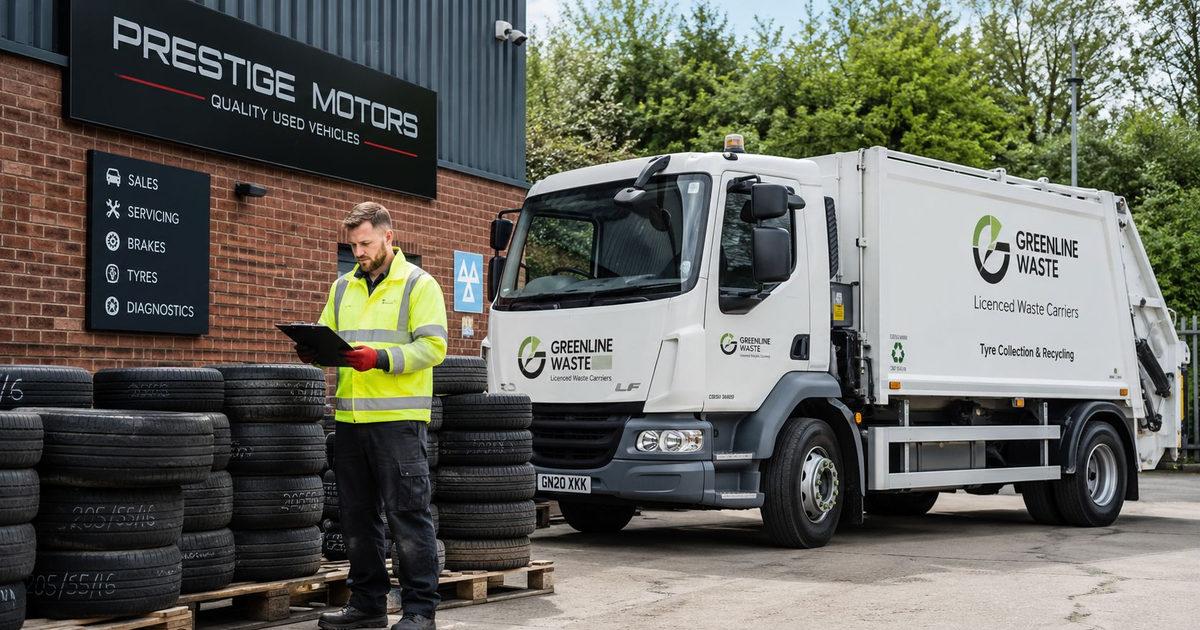
Tyres tend to pile up at the exact moment a site is busiest, after a part-exchange day, a service rush, or a wholesale clearance. That's when disposal gets treated as a quick collection job, and that's also when businesses leave themselves open to a paperwork gap, a carrier problem, or a storage issue that becomes expensive later. The disposal of tyres is not just about moving rubber off the forecourt, it's about proving that your business handled a regulated waste stream properly.
For UK motor traders, that proof matters as much as the pickup itself. Whole tyres were banned from UK landfill in 2003, and the wider European framework has pushed the sector toward recovery rather than burial, so the compliance question is always part of the transaction. The practical risk is simple, if you can't show what happened to the tyres, you may struggle to show that you acted lawfully. If you want a broader view of how waste decisions sit inside business risk control, see compliance risk management.
Table of Contents
- Why Tyre Disposal Is a Critical Compliance Risk
- Why the scale changes the risk
- Understanding Your Legal Responsibilities
- What that means in practice
- Approved Disposal and Recycling Routes
- What happens after collection
- Verifying Carriers and Maintaining a Paper Trail
- What the paper trail should show
- How traders get caught out
- Best Practices for On-Site Tyre Storage
- Store them for stability and access
- Reduce fire exposure
- Your Tyre Disposal Compliance Checklist
Why Tyre Disposal Is a Critical Compliance Risk
A dealer gets a letter, not from a customer but from an enforcement body, asking why a load of tyres was found where it shouldn't have been. The collection was months ago, the yard is busy, and nobody can immediately prove which contractor took them or where they went. That's how a routine disposal job turns into a compliance problem.
The legal issue sits inside Duty of Care. If you produce waste tyres, your responsibility doesn't end when they leave your site. You still need to know they went to a lawful destination, and you need records that support that decision. UK motor traders often focus on the pickup date, but the key protection is in the traceable chain from yard to lawful handler.

Why the scale changes the risk
This is not a niche waste stream. One industry analysis estimates that around 52 million end-of-life tyres are processed in the UK each year, equivalent to roughly 480,000 tonnes of material, and says the UK tyre recycling market generated £234.5 million in revenue in 2024 Gradeall industry statistics. That scale matters because it means the market is industrial, regulated, and document-heavy.
It also means disposal decisions are not made in a vacuum. A lawful recycler, a permitted recovery route, and a proper transfer record are part of normal trading practice, not an optional extra. A useful comparison is the discipline used in other regulated disposal chains, such as secure ITAD certification meaning, where custody and audit evidence are just as important as the physical handover.
Practical rule: if the tyres leave your premises without a carrier check and a written record, you've lost the evidence that protects your business.
Understanding Your Legal Responsibilities
A trader who generates waste tyres is a waste producer, so the legal duty starts with you. The tyres must be passed only to someone who is authorised to take them, and that point matters because handing them over for free does not remove your responsibility. If the receiving party cannot be shown to be lawful, the transfer is weak from a compliance point of view.
The wider policy position explains why landfill is no longer a sensible answer. A peer-reviewed review notes that storage of used tyres in landfills is prohibited in the European Union, and it cites ETRMA data showing Europe reached a 95% end-of-life tyre recovery rate in 2019. It also reports that tyres used in civil engineering, public works, and backfilling fell by about 14%, while energy recovery rose by 10%. That is the regulatory direction traders are working within, and it shows why a paper trail has to support the route you choose.
What that means in practice
The rule for a trader is straightforward. Tyres need to go into recycling, recovery, or another lawful route, and the records have to show that the transfer matched that route. Whole tyres were banned from UK landfills in 2003, so landfill is not a workable disposal option for normal commercial handling.
The task is deciding whether the handover can stand up to scrutiny. You need to know where the tyres are going, whether the carrier is allowed to take them, and whether the documents prove the transfer from your yard to the next lawful holder. In practice, that is what protects the business if a load is later found to have been mishandled. For a wider UK motor trade compliance context, understanding UK automotive regulations is a useful reference point when waste handling sits alongside trading controls.
If the destination cannot be defended on paper, it should not be treated as compliant.
Approved Disposal and Recycling Routes
A tyre leaves your site cleanly only if the route is lawful before the collection starts. That means using an authorised collector, a tyre specialist with a proper waste route, or a permitted recycling facility that can take the load into a recognised recovery chain. Any arrangement based on convenience, cash, or a promise to “sort it out” leaves you exposed if the tyres later turn up in the wrong place.
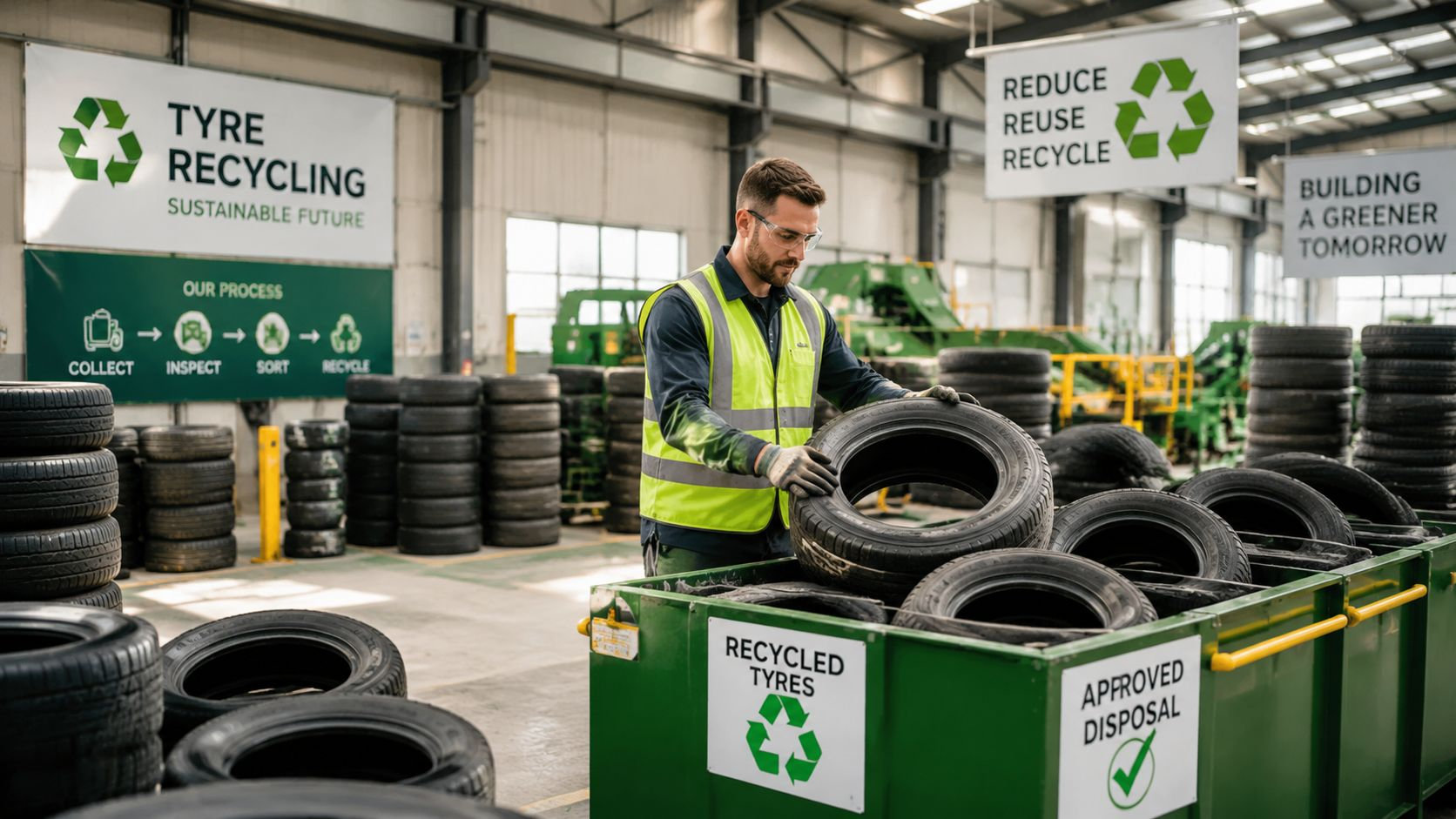
A compliant UK workflow for tyres typically involves shredding, steel liberation through magnetic separation, and granulation so rubber, steel, and textile can be separated into reusable fractions Basel technical guidance. The same Basel guidance treats landfill as a last resort only when recycling or energy recovery cannot be used Basel technical guidance. For a trader, that means the route has to make sense on paper as well as in practice. If it does not lead into recovery, it needs a closer check before you hand the load over.
What happens after collection
Once tyres are collected, the process is mechanical. They are broken down by size, unwanted material is removed, and metals are separated so the rubber can continue as a usable fraction. The point is not simple disposal, it is material recovery.
That matters even if the contractor owns the plant. If steel liberation is skipped, or oversize material is not controlled properly, the output quality falls and contamination rises downstream. A low-cost uplift can create a compliance problem for the trader who arranged it, because the business still has to defend the route chosen.
The Basel guidance also separates ambient grinding from cryogenic grinding, and both methods are used to produce reusable rubber granulate Basel technical guidance. Cryogenic grinding is used where finer, cleaner granules are required, because the tyre is cooled below freezing before milling Basel technical guidance. The practical point for traders is to match the disposal route to the intended end use, not just the cheapest collection quote.
For a broader look at how regulated workflows get documented in the trade, see compliance frameworks in the UK motor trade.
Verifying Carriers and Maintaining a Paper Trail
The collector's van is not enough evidence. Before any tyres leave your site, the carrier needs to be checked as an authorised waste carrier, and the record of that check should stay with your paperwork. If a contractor is evasive about licensing, that's a warning sign, not an admin detail.
What the paper trail should show
The written record needs to prove the transfer was lawful. UK guidance aimed at waste producers emphasises keeping written records to show tyres went to a lawful place, and it also notes that whole tyres were banned from UK landfills in 2003 waste producer guidance. That combination means the paperwork is not just an internal file, it's your defence if the disposal route is questioned.
A solid Waste Transfer Note should identify the waste clearly, name the producer, name the carrier, state the destination, and show the date of transfer. The point is auditability. An inspector or auditor wants to see that the tyres were described properly, the receiving party was known, and the route was lawful.
How traders get caught out
The most common failure is treating the collection as proof. It isn't. A contractor can collect tyres from your site and still be the wrong contractor, or take them to the wrong place, if you never checked the status properly. That's why the file should include the carrier check, the transfer note, and any internal sign-off that shows who authorised the job.
A similar discipline applies in digital record systems that need traceable sign-offs. If you're familiar with audit trail controls, the principle is the same, only here the consequence is environmental and regulatory rather than purely administrative.
Keep the record before the problem appears, not after someone asks where the tyres went.
For a practical template mindset and internal process support, free compliance tools can help teams standardise the evidence they keep.
Best Practices for On-Site Tyre Storage
Tyres should not sit around the yard loosely or in unstable piles. The longer they remain on site, the more they become a fire and housekeeping issue, especially if the stack is wet, contaminated, or easy to access. Good storage is part of disposal compliance because a badly managed pile creates its own risk before a collector even arrives.
Store them for stability and access
Stack tyres so they stay stable and don't topple into walkways or vehicle routes. Keep them arranged so they can be counted, moved, and checked without creating unnecessary handling hazards. If they can't be lifted or loaded safely, the storage setup is already wrong.
Water management matters too. Tyres that hold water create avoidable nuisance problems and make the site look unmanaged. Of greater significance, poor storage sends the wrong signal if your premises are ever reviewed after an incident.
Reduce fire exposure
Tyre stockpiles are a known fire concern, so keep ignition sources away from the storage area and maintain clear access for emergency services. Don't bury the pile behind parked cars, pallets, or scrap metal. If a route is blocked, you've made response harder before anyone has even turned up.
Site layout affects how well this works. For a useful way to think about access, segregation, and circulation space on a trading site, garage size and planning is a relevant planning reference even if the premises are not a workshop in the strict sense.
A tidy waste area is easier to defend than a yard where no one can say how the tyres were stored or moved.
The key test is whether the tyres remain under control from the moment they're removed from stock until the moment they're collected. That means supervised stacking, clear labels where needed, and no casual mixing with general waste. It's basic, but it's what keeps storage from becoming a liability.
Your Tyre Disposal Compliance Checklist
The best disposal process is the one your staff can repeat without guessing. If the answer to any step is unclear, stop and fix it before the tyres leave the site. Paying for a licensed service is part of the cost of doing business, and it's cheaper than dealing with a disputed transfer, a site clean-up, or a regulator asking for records you don't have.
Motor Trader's Tyre Disposal Checklist Compliance Step Verification / Action Completed 1 Confirm tyres are being handled as regulated waste Treat the load as a waste stream, not scrap to be handed over casually ☐ 2 Check the carrier's authorisation Verify the transporter is lawful before collection ☐ 3 Prepare a clear Waste Transfer Note Record the waste description, date, sender, carrier, and destination ☐ 4 Keep written evidence on file Store the transfer record so you can prove the tyres went to a lawful place ☐ 5 Use a lawful recovery route Send tyres into recycling, recovery, or another permitted destination ☐ 6 Store tyres safely before collection Keep stacks stable, accessible, and away from ignition risks ☐ 7 Retain records for auditability Keep paperwork ready if the disposal chain is ever queried ☐ The financial logic is straightforward. A proper tyre collection service may price by load, quantity, or tyre count, but the invoice is not the main cost driver. The actual cost is what happens if the tyres are traced back to your business after a poor disposal decision. That's where compliance failures become liability, and liability becomes reputational damage.
This is the point where waste control and business intelligence meet. A trader that documents its decisions, verifies the carrier, and keeps the transfer trail is protecting more than the yard. It's protecting the business.
If you want sharper visibility over operational risk across the motor trade, contact AutoProv and use its vehicle intelligence alongside your compliance checks to make better buying and risk decisions.
Frequently Asked Questions
AI-Generated Content Notice
This article was created with the assistance of artificial intelligence technology. While we strive for accuracy, the information provided should be considered for general informational purposes only and should not be relied upon as professional automotive, legal, or financial advice. We recommend verifying any information with qualified professionals or official sources before making important decisions. AutoProv accepts no liability for any consequences resulting from the use of this information.
From our AI insights
- Navigating Hidden Finance Claims: CRA 2015 Insights
Discover how hidden finance claims affect UK car dealers under CRA 2015 and strategies to manage them.
- Navigating CCR 2013: Niche Insights for UK Motor Traders
Explore niche insights on CCR 2013 for UK motor traders, focusing on compliance and cancellation rights.
- Decoding CRA 2015: Dealer's Guide to 30-Day Rejections
Explore CRA 2015's 30-day rejection rights from a dealer's perspective, highlighting key compliance strategies.
Related Articles

Understanding the Consumer Rights Act 2015 in the UK Motor Trade
Explore the Consumer Rights Act 2015 and its impact on UK car buyers and sellers, offering essential protections and insights.

Understanding UK Automotive Regulations
Explore the complexities of automotive regulations in the UK, covering DVLA, FCA, MOT, and more.

What is a V5C Document: A Quick UK Log Book Guide
If you've ever bought or sold a car in the UK, you've definitely come across the V5C. It's often just called the 'log book', and it’s the official Vehicle Registration Certificate issued by the DVLA.
Published by AutoProv
Your trusted source for vehicle intelligence