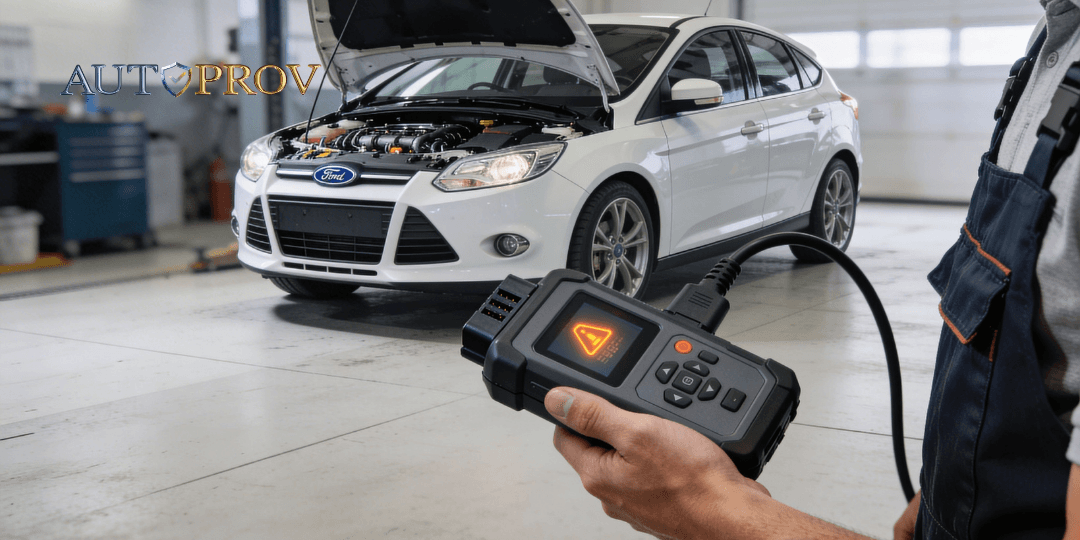
You know the stock. Clean enough in the photos, sensible age, right badge, right money. Then you turn the key, or press the button, and the dash gives you Engine Malfunction.
That is the point where a Ford Focus stops being an easy retail prospect and starts becoming a risk calculation.
In the trade, this is rarely about whether the warning light means “something is wrong”. It does. The true question is whether you are looking at a simple fix, a drawn-out electrical chase, or a car that has already defeated the last owner and is now being moved on quickly. That distinction matters more on Focus stock than many buyers admit. Motor traders report 22% higher dispute rates on Ford Focus stock due to hidden provenance issues, and since April 2025, UK insurance claims for Focus engine failures have risen 15% after DVLA digital MOT integration exposed patterns of short-ownership flips averaging 6 months (reference).
A good Focus can still be strong stock. The bad ones burn margin twice. First in prep, then again in comeback risk.
If you deal in this part of the market often, you will already know that the warning light on a Focus is not one problem. It is a family of problems, and the expensive mistakes happen when buyers treat all engine lights as equal. They are not. A Mk2 petrol with cluster and earth issues needs a different mindset from a Mk3 with Delphi ECU trouble. A short-trip diesel with emissions faults is a different negotiation again. Context changes everything, which is also why generation-specific checks matter on cars like the Ford Focus 2009 in trade stock.
The High-Risk High-Reward Ford Focus
The Focus remains one of those cars that tempts traders for good reason. It is familiar stock, broad in appeal, usually liquid enough, and often priced to leave room if you buy well.
The problem is that engine malfunction ford focus searches tend to collapse different faults into one bucket. That is how buyers get caught. The same dashboard message can point to a minor air metering issue, an intermittent communication fault, or a deeper engine or ECU problem that turns a saleable unit into workshop ballast.
Why this model catches traders out
The Ford Focus rewards fast decisions when the car is right. It punishes rushed decisions when the warning light appears late in the appraisal.
A common trade mistake is to value the car on appearance and service stamps first, then treat the engine warning as a small deduction. With Focus stock, that is backwards. The warning needs to drive the appraisal. Cosmetics come after.
Three things make these cars awkward:
- Fault overlap: Mechanical, electrical, and network issues can all present through the same warning.
- Intermittent behaviour: Some units drive acceptably on a short test but fail to restart, cut out, or drop into limp mode later.
- Trade circulation: The cars that are hardest to diagnose often move quickly between owners.
A Focus with an engine malfunction warning is not automatically bad stock. A Focus with a warning, patchy history, and unusual ownership timing often is.
Margin depends on diagnosis speed
On the forecourt, time matters as much as repair cost. A cheap fix that takes days of chasing can still wreck the deal.
That is why experienced buyers triage a Focus in layers:
- Identify the generation and engine first
- Read the codes
- Check the known physical weak points
- Judge whether the car’s history matches the fault story
Miss one layer and the rest becomes guesswork.
Common Causes by Focus Model and Engine
The most expensive error with Focus stock is assuming one generation behaves like another. It does not. The likely causes of an engine malfunction warning change sharply by age, engine, and electrical architecture.
This is the model-specific view I would use at the point of purchase.

Mk2 cars and the faults that waste time
On 2008 to 2012 Ford Focus models, persistent engine malfunction warnings are often tied to instrument cluster communication failures caused by corroded battery earth cables. Diagnosis data from Actronics shows a 78% first-fix success rate through cluster solder reflow or cable replacement, while missing the strut-mount corrosion point happens in 52% of initial inspections and can delay a correct diagnosis by an average of two days (Actronics diagnostic note).
That matters in the trade because these cars can look mechanically sound while throwing warnings that send people in the wrong direction. Buyers chase sensors, coils, or ECU faults when the root cause is communication loss or poor grounding.
On a Mk2, be slow to condemn the engine itself until the electrical basics are proven.
Typical warning signs include:
- Erratic dash behaviour: Gauges drop, messages stack up, warning lamps appear unrelated.
- Intermittent starting complaints: Especially after standing or in damp conditions.
- Poor previous repair logic: New parts fitted without a clean fault story.
Mk3 cars and the known Delphi ECU risk
Many buyers face issues at this point. In the UK, Ford Focus Mk III models from 2011 to 2018 fitted with Delphi ECUs have seen widespread engine ECU malfunctions that can lead to no-start conditions. Repair networks report average repair costs of £800 to £1,500 per incident, and a 2018 RAC breakdown survey noted the Focus as the third most common model for electrical-engine failures (ECU Testing reference).
The trade implication is obvious. If the car is cheap because it “just needs an ECU reset” or “probably wants a sensor”, you need to assume nothing.
The more serious pattern on these cars includes:
- intermittent cutting out
- failure to restart
- engine malfunction messages
- loss of communication with engine management
If communication with the engine management system drops out altogether, the car can become undrivable. At that point, the issue is no longer a routine prep item. It is a stock risk.
Petrol variants under the warning light
On UK Focus petrol models, engine failures with the check engine light frequently show up under 100,000 miles, often below 60,000 miles on 1.6L and 2.0L petrol variants, with faults such as spark plug misfires, MAF failures and EGR damage. Government MOT statistics cited in the verified data put Focus MOT pass rates at 82.3% in 2019 because of engine-related defects, against a national average of 88.7%, across more than 450,000 annual tests. The same verified dataset also notes over 2,500 Honest John user reports for Focus Mk2 and Mk3 engine malfunction cases, with 28% citing catastrophic failure before 80,000 miles, and a 2019 consumer group scrutiny around 1.5L and 2.0L Ti-VCT engine solenoid defects affecting 75,000 DVLA-registered units, with average repair bills of £2,200 (reference).
The practical takeaway is simple. A petrol Focus with a warning light is not automatically a bargain because it still runs. Some of the costly cars still drive well enough in the lane.
Diesel cars and usage mismatch
Diesel Focus stock creates a different issue. The fault may not be a dramatic hard failure. It may be a car used badly for its drivetrain.
Short-trip diesels often present with EGR or DPF-related symptoms, poor running, restricted performance, and repeat warning lights. The problem for the buyer is not just whether the car can be cleared today. It is whether the underlying use pattern means the fault will return after retail.
What works and what does not
A useful way to approach Focus stock is this short comparison:
Model area What often works What often wastes money Mk2 electrical warnings Earth and cluster checks first Firing parts at random Mk3 no-start or cut-out ECU communication assessment early Assuming every no-start is battery related Petrol misfire or poor running Matching codes to actual running symptoms Treating a rough idle as “just plugs” without wider checks Diesel emissions issues Judging use pattern and road-test behaviour Clearing faults and ignoring likely recurrence If the warning light story does not match the car’s age, use, and ownership pattern, price it as a problem car or leave it.
On-the-Spot Triage with OBD Codes
A scanner gives you clues, not certainty. With a Focus, that distinction matters because the code often points to the area of failure, not the part you should replace.
The right habit is to read codes in order of risk. Start with what makes the car unsuitable for purchase, then work down to what merely affects prep cost.

Read the pattern, not just the headline code
When a seller says, “It’s only a sensor,” the scanner is where that claim starts to stand or fall.
I want to know:
- whether the code is current or historic
- whether there is one code or a cluster
- whether the symptoms on the road test match the stored faults
- whether any modules fail to communicate
If the car throws one isolated fault and runs cleanly, that is one sort of job. If it logs multiple related faults, comms issues, or repeat returns after clearing, you are buying uncertainty.
For traders who want a broader refresher on scan logic and system checks, this complete guide to car diagnostic tests is a useful reference.
P0320 on a Mk2 needs proper follow-through
For Ford Focus MK2 models, DTC P0320, described as Ignition Engine Speed Input Circuit Malfunction, is frequently linked to Mass Air Flow sensor failures. UK garage data shows a 65% success rate when the fault is addressed through targeted MAF cleaning or replacement at £80 to £150, but failing to check related intake leaks can create a 30% rate of repeat faults (FocusRush code reference).
That single stat tells you something important. The first code is not the whole repair.
The better triage process is:
- Confirm the code with FORScan or IDS-VCM.
- Check related voltage and airflow codes rather than treating P0320 in isolation.
- Inspect MAF wiring and connections before pricing a part.
- Clean or replace the MAF only after checking for intake leaks.
- Road-test the car again under load.
If the fault returns after a basic MAF service, I stop thinking “quick fix” and start thinking “hidden air leak, wiring issue, or previous poor repair”.
When OBD is enough and when it is not
An OBD read is enough to make an initial call in some cases. It is not enough when the warning light sits inside a wider electrical problem.
Use a scanner to sort faults into rough groups:
- Likely prep items
- isolated air metering issues
- simple misfire clues with stable running
- faults that clear and stay cleared after a proper road test
- Caution territory
- repeat codes after clearing
- mixed engine and communication faults
- mismatch between clean running and severe stored faults
- Walk-away territory
- no communication with critical modules
- no-start combined with network irregularities
- seller explanations that do not fit the code set
A practical starting point for buyers using handheld tools is this guide on how to use an OBD 2 reader in real appraisal work.
The scanner helps you decide where to spend the next 15 minutes. It does not remove the need for physical checks.
Beyond the Codes Essential Physical and Electrical Checks
Some Focus faults become obvious only when you stop staring at the scanner and inspect the car like a buyer who has to stand behind the sale.
That means looking for the signs that do not always generate clean fault code stories.

Start with battery grounds and cluster behaviour
On 2008 to 2012 cars, one of the most useful checks is still the simplest. Inspect the battery negative and the earth point around the suspension strut mount before you let anyone talk you into major module failure.
That matters because the known pattern on these cars involves cluster communication failure and corroded battery earth cables. If that corrosion point is missed, diagnosis commonly drifts.
What to look for in person:
- Corrosion at the strut-mount earth area: White or green contamination, poor fastening, evidence of heat.
- Cluster oddities: Flickering display, gauges behaving strangely, warning messages that seem unrelated.
- Voltage behaviour under load: A car that looks fine static but drops out when loaded electrically.
If the car also shows immobiliser-style symptoms, odd start authorisation behaviour, or key recognition problems, this overview of common immobiliser problems is worth keeping in mind when narrowing the fault.
Listen and smell like a buyer, not a technician only
You do not need to strip the car on site to catch useful clues.
A quick sensory appraisal often tells you whether the warning light belongs to a manageable prep job or a deeper story:
- Listen on cold start: Rattle, harsh idle, inconsistent top-end noise, or a start that feels delayed.
- Smell the exhaust on diesels: A loaded, acrid smell can support concerns about blocked emissions hardware or poor running history.
- Watch the coolant area: Dampness, residue, or repeated topping-up signs matter on any car with engine warning issues.
- Check for recent disturbance: Fresh clips, bright fasteners, non-matching sealant, and unplugged or stressed connectors often suggest someone has already been chasing the fault.
Check what the seller is not mentioning
A lot of expensive Focuses come with a plausible explanation and visible signs that the explanation is incomplete.
That is where hands-on checks earn their keep:
Physical check Why it matters to the trade Earth strap condition Cheap issue if caught early, time sink if missed Cluster stability Can explain false or cascading warnings Connector condition Poor previous repairs often create intermittent faults Cooling system evidence Helps separate warning-light nuisance from engine risk Start behaviour hot and cold Intermittent faults often show up only one way A related habit I would keep on any modern Ford is checking the charging and battery warning context properly. A weak supply can distort the whole fault picture, which is why battery-system appraisal deserves the same attention as engine codes. This note on a battery warning light is relevant for that part of the process.
If a Focus only behaves when freshly charged, freshly cleared, or freshly started, value it on its worst version, not its best one.
Valuation and Negotiation The Financial Impact
Once you have a working diagnosis, the next step is not technical. It is commercial.
A warning light only matters in the trade when you convert it into cost, downtime, and comeback exposure. Too many buyers stop at “fault found” and never work out what that does to the deal.
Price the uncertainty, not just the repair
The easy mistake is to deduct the visible workshop bill and call it done.
That approach works on straightforward jobs. It fails on Focus stock because the hidden cost often sits in one of three places:
- Diagnostic time
- Parts escalation after first repair fails
- Reduced buyer confidence at retail
For example, a known MAF-related issue with a credible fault story is one thing. A no-start Mk3 with communication concerns is another. Even before parts, the second car absorbs time and ties up ramp space.
Estimated Repair Costs for Common Ford Focus Engine Faults (2026)
Fault Common Models Affected Estimated Repair Cost (£) Impact on Value MAF cleaning or replacement linked to P0320 Mk2 Focus £80-£150 Minor deduction if fault is isolated and verified Cluster repair or solder reflow 2008-2012 Focus £250-£400 Moderate deduction, mainly for diagnostic uncertainty Battery earth cable replacement and clean-up 2008-2012 Focus £50 Small deduction if clearly identified Delphi ECU-related no-start or cut-out repair Mk3 2011-2018 with Delphi ECU £800-£1,500 Major deduction or reject depending on comms and restart behaviour Ti-VCT solenoid defect repairs Affected 1.5L and 2.0L models £2,200 Usually a heavy deduction, often enough to change the buy/no-buy decision Every figure above comes from the verified data already cited earlier in this article.
Negotiating from a position of evidence
When the car is still worth pursuing, I would negotiate around fault class rather than emotion.
A practical framework:
- Known low-risk fault Deduct the repair cost, allow for retest time, and keep the deal moving.
- Known fault with uncertain root cause Deduct for the likely fix plus additional diagnostic exposure.
- Known expensive pattern on the model Price it as a risk vehicle, not a tidy retail car.
- No reliable diagnosis on site Buy only if the number leaves room for being wrong.
Valuation tools are useful, but they need context. A guide price is only a starting point when a car has warning-light exposure, which is why trade buyers should sanity-check asking prices against broader market expectations such as the Parker car guide, then layer fault risk on top.
The right deduction is not the cheapest possible repair. It is the amount that protects your margin if the first diagnosis is incomplete.
Using Provenance Intelligence to Mitigate Risk
A scanner tells you what the car is doing today. Provenance tells you what kind of life it has already had.
That matters with Focus stock because the same warning light means something very different on a well-kept car with stable ownership than it does on one that has clearly been moved on to escape a recurring fault.

What basic checks miss
A standard vehicle history check UK process usually answers the obvious questions. Stolen, written off, finance, keeper count. Useful, but not enough for engine warning stock.
The trade problems usually sit in the patterns behind the headline:
- repeated short-term ownership
- mileage movement that does not fit the condition
- MOT advisories that suggest a fault has lingered
- a timeline that hints the car was repaired, sold, then moved again quickly
Those are provenance questions, not scanner questions.
Why ownership timing matters on a Focus
In verified data, short-term flips, particularly those lasting less than half a year, correlate with a notably higher engine fault incidence on affected Focus stock. Separate trade reporting also notes that average short-ownership flip patterns, often occurring around six months, are associated with undisclosed faults. That is exactly the kind of context that changes a buying call.
A car may start, idle, and drive well enough in the lane. But if its ownership sequence shows rapid turnover, the warning light you see today may be the latest round of an older problem.
Verified data also indicates that a significant proportion of used Focus stock from the relevant era shows mileage inconsistencies when paired with ECU anomalies. For a trader, that is not just a fraud concern. It is also a wear and valuation concern.
What a proper used car history report should answer
On this type of stock, I want a used car history report and trade vehicle intelligence that help answer practical questions:
Provenance check Why it changes the decision Ownership timeline Shows whether the car has been moved on unusually fast Mileage check UK records Helps spot wear or tampering risk that supports engine concerns MOT chronology Reveals repeating emissions or engine-management themes Insurance and anomaly indicators Adds context where the fault story feels incomplete This is the gap between generic dealer vehicle checks and proper vehicle provenance work. Buyers who rely only on a quick scan and a visual appraisal are often buying the last chapter of somebody else’s unresolved problem.
For trade buyers who want that context before committing capital, a dedicated vehicle provenance report is the sensible layer that sits alongside road test and diagnostics, not after them.
Frequently Asked Trader Questions
Is a Ford Focus with an engine malfunction light always a bad buy
No. Some are still workable stock.
The key is whether the fault is isolated, diagnosable, and consistent with the car’s overall story. A minor air metering issue on an otherwise stable car is one thing. A warning light combined with comms faults, odd dash behaviour, and rapid owner turnover is something else.
Would you buy one that drives fine but still shows the warning
Only if the numbers allow for being wrong.
A Focus can drive acceptably and still hide a deeper issue. If the car performs well but the codes, electrical behaviour, or provenance do not stack up, buy it at a problem-car number or leave it.
When is the warning likely to be electrical rather than mechanical
Mk2-era cars with strange cluster behaviour, intermittent messages, and unstable dash symptoms should push you toward electrical checks early.
Poor grounding and cluster communication faults can imitate more serious problems. That is why battery earth inspection and module communication checks belong near the start of the appraisal, not the end.
What is the fastest way to avoid a comeback
Do not rely on one source of truth.
Use three layers together:
- Code read
- Physical inspection
- History and ownership context
Most expensive mistakes happen when one of those layers is skipped.
Should you clear the codes before deciding
You can clear them as part of diagnosis, but not as a substitute for diagnosis.
If faults clear and return quickly, that tells you something useful. If they clear and stay away only during a short appraisal, that tells you less than many buyers think.
What is the single biggest red flag
A seller explanation that sounds tidy, while the car’s condition, warning pattern, and ownership timeline tell a messier story.
That mismatch is where margin disappears.
If you buy, value, or appraise Focus stock regularly, AutoProv gives you trade-focused provenance and risk intelligence that goes beyond a basic vehicle history check UK. It helps dealers and wholesalers assess vehicle provenance, ownership patterns, mileage anomalies, and hidden risk signals before stock turns into a workshop problem or post-sale dispute.
Frequently Asked Questions
AI-Generated Content Notice
This article was created with the assistance of artificial intelligence technology. While we strive for accuracy, the information provided should be considered for general informational purposes only and should not be relied upon as professional automotive, legal, or financial advice. We recommend verifying any information with qualified professionals or official sources before making important decisions. AutoProv accepts no liability for any consequences resulting from the use of this information.
From our AI insights
- The Impact of EV Service Records on Resale Value
Discover how electric vehicle service records affect resale value and buyer confidence in the UK market.
- The Importance of Tyre Verification for UK Motor Traders
Discover why verifying tyre specs is crucial for UK traders to ensure safety and compliance.
- Decoding CO2 Emissions: A Trader's Guide
Learn how traders can verify CO2 data using factory build sheets to prevent disputes.
Related Articles

The Importance of Car Maintenance and Provenance Checks
Discover why regular car maintenance and proper provenance checks are essential for vehicle quality and longevity.

Essential Car Maintenance Tips for UK Drivers
Discover vital car maintenance tips to keep your vehicle roadworthy and compliant in the UK.
How Much Is a Car Service? Complete UK Price Guide
Trying to pin down exactly "how much is a car service?" can feel a bit like asking "how long is a piece of string?". Prices vary quite a bit, but to give you a ballpark figure, an interim service will usually set you back around £100 to get started. A more thorough full service often begins at £180, while a major service for many cars can easily top £300.
Published by AutoProv
Your trusted source for vehicle intelligence