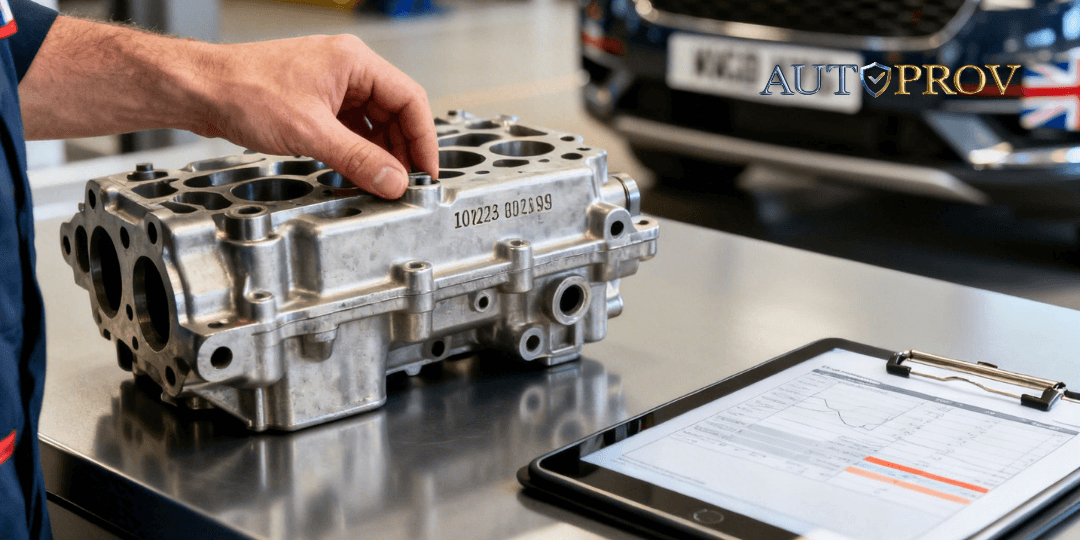
An engine number check is a fundamental component of professional due diligence within the UK motor trade. In essence, it involves the physical inspection of the engine's serial number and its verification against the vehicle's official records. For a dealer, this check is a critical line of defence against undisclosed repairs, sophisticated fraud, and high-risk stock before capital is committed. A mismatch is a significant red flag that indicates potential risk and directly impacts a vehicle's valuation and provenance.
Why the Engine Number Check Is Critical for UK Traders

Experienced motor trade professionals understand that the difference between profit and a problem often lies in the details that a standard vehicle history check can miss. While a clean report is a necessary starting point, it provides only a partial narrative. The engine number check offers a deeper layer of investigation—a non-negotiable step in building genuine vehicle provenance intelligence.
This check extends beyond the registration and VIN, focusing directly on the vehicle's most vital and expensive component. In a market characterised by tight margins and increasingly sophisticated fraud, assuming an engine is original represents an unacceptable business risk.
The Financial and Reputational Stakes
An engine number that does not match official records is more than a clerical error; it is a serious warning sign pointing to several potentially costly issues. Understanding these risks is fundamental to protecting your business's financial health and professional reputation.
A mismatched engine number can indicate several serious risks:
- Undisclosed Major Repairs: A non-original engine signifies a major failure at some point in the vehicle's past. Without a comprehensive, documented history of the replacement, you are acquiring a vehicle with a significant unknown in its mechanical history, which could lead to future liabilities.
- Potential Vehicle Cloning: A common criminal tactic involves using the identity of a legitimate vehicle to mask a stolen one. An engine number that fails to match factory records may be the primary indicator that the vehicle being appraised is not what it purports to be.
- Masking True Vehicle Mileage: Swapping a high-mileage engine for a lower-mileage unit is a method used to misrepresent a vehicle's usage. While the odometer reading may appear low, the chassis, transmission, and suspension have endured far greater wear, leading to unforeseen reconditioning costs.
A mismatched engine number isn't just an inconsistency; it's a direct challenge to the vehicle's stated identity and value. It forces a critical question: what else about this vehicle's history is being hidden?
Beyond a Simple Pass or Fail
The engine number itself is a source of valuable data. Its format can often be decoded to reveal the engine's original specification, build date, and factory of origin. When this information conflicts with the vehicle's registration date or other known details, it provides powerful leverage for negotiation or a clear justification to walk away from a high-risk acquisition.
For instance, identifying a 2022 engine in a 2019 vehicle immediately raises questions about its history, potentially involving a major write-off. You can learn more about how previous damage classifications affect a vehicle's provenance in our guide to understanding insurance category D cars.
Ultimately, integrating a rigorous engine number check as a standard part of your buying process is the hallmark of a professional trading operation. It is a proactive measure that transforms a simple string of characters into actionable trade vehicle intelligence, protecting your investment and reinforcing your reputation for supplying quality, reliable stock.
Locating and Verifying the Engine Number on UK Vehicles
A professional engine number check begins not in a database, but on the forecourt. Physically locating and correctly reading the engine's serial number is the foundational step upon which all subsequent digital verification depends. An error at this stage—such as misreading a digit or mistaking a part number for the serial number—can invalidate the entire appraisal and expose your business to significant risk.
This is a practical guide for buyers, focused on the specifics of locating engine numbers on the popular marques prevalent in the UK market. The objective is to establish a reliable method for capturing accurate data directly from the asset, ensuring the integrity of your dealer vehicle checks.
On-the-Forecourt Inspection Workflow
Preparation is key. Before opening the bonnet, ensure you have a good torch, a clean rag, and potentially a small wire brush for obscured or corroded surfaces. Engine numbers are often stamped in awkward locations, and having the right tools on hand improves efficiency and accuracy.
The primary challenge is knowing where to look, as placement varies significantly between manufacturers. While not an exhaustive list, here are typical locations for common UK market vehicles:
- VAG Group (VW, Audi, SEAT, Skoda): A sticker is often present on the plastic timing belt cover. However, this must be verified against the physical stamp on the engine block itself, usually found near the gearbox bell housing or on the front of the block.
- Ford: Typically stamped on the side of the engine block, often below the cylinder head. On Duratec engines, for example, it is frequently located on the exhaust side.
- Vauxhall/Opel: Look for a machined flat pad on the front of the engine block, near the junction with the gearbox. On some older models, it may be closer to the oil filter housing.
- BMW: The number is usually etched onto a flat surface on the left side of the engine block (intake side), just above the sump. A torch and sometimes a small inspection mirror are often required to view it clearly.
Common Pitfalls and How to Avoid Them
It is easy to make errors when working in cramped and dirty engine bays. Training your team to recognise these common pitfalls is a crucial aspect of risk management.
Mistaking Part Numbers for Serial Numbers This is the most frequent error. Engine blocks are cast with various numbers, including casting codes and part numbers, which are not the unique serial number. The engine's serial number is almost always stamped or etched into a machined, flat surface—not raised as part of the casting.
Dealing with Corrosion or Damage On older or poorly maintained vehicles, the number can be obscured by rust and grime.
Gently clean the area with a rag and a suitable degreaser. If it remains unreadable, use a soft wire brush with caution to avoid damaging the stamp. Taking a high-resolution photograph on a smartphone and zooming in can often make faint characters legible.
An engine number that appears to have been deliberately ground off or tampered with is an immediate and severe red flag. This often indicates a stolen engine or a sophisticated attempt to hide the vehicle's true identity. In such cases, the most prudent action is almost always to walk away from the deal.
Creating a Defensible Record
Once located, the number must be recorded meticulously. The best practice is to take a clear, well-lit photograph of the stamp itself. This image serves as undeniable evidence of the number present on the vehicle at the time of appraisal, protecting your business from future disputes.
This physical verification is the bedrock of a robust used car history report. For a related guide on another crucial identifier, you can learn more about how to find a Vehicle Identification Number in our article. By mastering this hands-on due diligence, you build a foundation of trust for every appraisal and purchase.
Turning Data into Decisions with Cross-Referencing
An engine number, in isolation, is merely a sequence of characters on a block of metal. Its value is realised through cross-referencing against key documents and databases to generate actionable trade intelligence. This process transforms a simple check into a genuine risk assessment, answering one critical question: does the story the engine tells align with the story told by the rest of the vehicle and its paperwork?
The entire process hinges on obtaining the physical number and then interrogating available data to verify its consistency and legitimacy.

As illustrated, a quick physical check is the vital first step before the main investigative work begins.
Key Data Points for Cross-Referencing
After locating and recording the physical engine number, the analytical work commences. The objective is to check for consistency across several official sources, each providing a piece of the provenance puzzle.
Essential checks include:
- V5C Logbook: This is the most fundamental check. Does the engine number on the V5C match what is physically stamped on the engine? A mismatch is an immediate deal-breaker unless accompanied by official DVLA documentation proving the change.
- MOT History: The public MOT database is a valuable resource. Look for any engine-related advisories or past failures, which can corroborate suspicions about a replacement or major repair.
- Manufacturer Build Data: Some manufacturer systems allow for the decoding of engine numbers. This can reveal the engine's exact model, original specification, and, critically, its date of manufacture.
A crucial check is to compare the engine’s build date with the vehicle’s first registration date. An engine built years after the car was first registered is a definitive indicator of a replacement, demanding a thorough investigation into the cause.
Uncovering Hidden Risks Through Analysis
Discrepancies found during cross-referencing are not merely administrative errors; they are red flags signalling potentially significant underlying problems. A diligent check is a powerful tool for identifying these issues before committing capital.
For context, UK MOT data reveals that 14.2% of all failed tests—over 1.8 million instances—are attributable to engine-related problems that a proper provenance check could often trace back. Furthermore, a 2025 study by Glass's Information Services found that 26% of wholesaler stock had unverified engine histories, a factor that correlated with a two-fold increase in breakdowns within six months of retail sale.
This is where true motor trade risk management is vital. You must synthesise these data points to form a complete picture of the vehicle’s history. You can find more information about this process in our guide to creating a complete vehicle provenance report.
When you investigate, certain patterns emerge. The table below outlines common discrepancies and their potential implications for your business.
Engine Number Red Flag Indicator
Discrepancy Signal Potential Risk for the Trader Recommended Action Engine number on V5C doesn't match the physical stamp. The vehicle may have had an undeclared engine swap, potentially hiding a major failure or indicating it could be a stolen unit. Reject the vehicle unless the seller provides official DVLA documentation confirming the engine change. Engine build date is significantly later than the car's reg date. Clear evidence of an engine replacement. This impacts resale value and raises questions about why the original engine failed. Investigate the vehicle's full history for signs of major accidents or mechanical failures. Adjust valuation down. Numbers on the block look tampered with or are hard to read. A major red flag for a stolen engine or an attempt to hide the vehicle's true identity. The vehicle could be cloned or rung. Walk away immediately. This is not a risk worth taking. Report suspicions where appropriate. MOT history shows recurring engine-related advisories. Suggests a persistent, unresolved mechanical problem that could lead to a costly failure post-sale. Factor the cost of potential repairs into your valuation, or reject the vehicle if the risk is too high. Recognising these signals is what separates a smart acquisition from a future liability.
Automating the Process with Trade Intelligence
Manually gathering and comparing this data for every appraisal is time-consuming and prone to human error. In a fast-moving trade environment, answers are needed in seconds, not hours.
This is where technology provides a significant advantage. To properly cross-reference engine data and make sharp, informed decisions on the spot, you need automated data integration. Platforms built for the motor trade can execute these complex checks almost instantly.
AutoProv, for example, consolidates data from multiple authoritative sources like the DVLA and MOT records into a single, easy-to-read report. Our system is designed to perform these checks automatically, flagging anomalies that would be almost impossible to spot manually.
- Identifies Mismatches: Instantly flags discrepancies between the V5C, DVLA records, and known vehicle data.
- Analyses Timelines: Cross-references the engine's likely age against the car's registration and ownership history to spot unusual patterns.
- Highlights Risk: Uses anomaly detection to alert you to combinations of factors that signal heightened risk, like a recent engine change paired with short-term ownership.
By automating this vital part of your due diligence, you can make smarter, evidence-backed buying and valuation decisions at the point of appraisal. It transforms the engine number from a simple identifier into a core component of your risk assessment strategy.
Real-World Scenarios and What They Reveal

Theory is one thing, but profit and loss are decided on the forecourt. In the motor trade, a proper engine number check is not a box-ticking exercise; it is a forensic tool that uncovers a vehicle's true history, separating good stock from serious liabilities. What you find stamped on the block can mean the difference between a clean sale and a costly, reputation-damaging problem.
Let's examine common scenarios where an engine number mismatch can signal everything from a documented repair to deliberate, expensive fraud.
Scenario 1: The Legitimate Replacement
You are appraising a five-year-old German saloon with 60,000 miles. The V5C engine number matches the number on the block, but a quick cross-reference with manufacturer data reveals the engine was built just 18 months ago. This is an immediate red flag.
Instead of walking away, you investigate further. The private seller provides a detailed invoice from a reputable specialist for a new long-block engine, fitted following a catastrophic timing chain failure. Crucially, the invoice lists the new engine number, and you confirm the owner correctly updated the V5C with the DVLA.
Investigation and Outcome The key is the documentation. The professional repair and correct paperwork provide confidence. You proceed with the purchase but adjust the valuation down by £1,500 to reflect the non-original engine. The vehicle is subsequently retailed with full disclosure, including the invoice, which builds trust with the next buyer and secures a clean, profitable deal. This represents the best-case outcome for a non-matching history.
Scenario 2: The Cloned Identity
At a busy auction, a three-year-old hatchback appears to be excellent value. The cosmetic condition is good, the mileage is low, and a basic history check is clear. However, an on-the-spot engine number check using a trade application returns a major warning: the number on the block is a mismatch with the V5C and DVLA records.
This is a serious anomaly. A deeper dive with a professional platform like AutoProv reveals the engine number belongs to an identical vehicle reported stolen six months prior.
Investigation and Outcome The car is almost certainly a clone—a stolen vehicle given the identity of a legitimate one. The mismatched engine number is the detail the criminals overlooked. The outcome is total loss avoidance. A few minutes spent on a proper check prevents the acquisition of a stolen vehicle that would be seized by the police, resulting in the full loss of the purchase price and significant legal complications. For more on these risks, see our guide on how to check for a stolen vehicle.
Scenario 3: The Clocking Cover-Up
A seven-year-old diesel SUV is offered as a part-exchange with an odometer reading of 55,000 miles. The V5C appears correct, but when you check the engine number, an anomaly is found. Decoding the number reveals it was manufactured only four years ago. A seven-year-old vehicle with a four-year-old engine is a classic indicator of a clocking cover-up. The original, high-mileage engine has been swapped for a younger unit to make the false odometer reading appear plausible.
Investigation and Outcome A full mileage check UK report confirms major inconsistencies in the MOT history around the time the engine was likely swapped. The chassis and drivetrain have endured far more wear than the 55,000 miles shown. This is not the bargain it seems. You politely decline the part-exchange, avoiding thousands in potential reconditioning costs and protecting your reputation from the damage of retailing a clocked vehicle. This check is vital.
What you find during an engine number check has a direct impact on your bottom line, turning critical data into your business's best defence.
Weaving Engine Checks into Your Buying Workflow
An engine number check is only as effective as its consistent application. To truly protect your business, it must become an automatic, non-negotiable step in your day-to-day acquisition process. This is about embedding a simple but powerful risk assessment tool at the point of decision.
Whether your buyer is at an auction, appraising a part-exchange, or sourcing from a wholesaler, the process must be second nature. This requires a clear framework that every member of your team understands and follows without exception.
Creating a Standard Operating Procedure
Formalise the process with a simple inspection checklist. This removes ambiguity and ensures no detail is missed under pressure. This checklist should become a standard part of your appraisal documentation for every vehicle considered.
Your checklist should mandate:
- Physical Location: Confirmation that the engine number was physically located on the block.
- Photo Evidence: A required action to capture a clear, legible photograph of the engine stamp.
- V5C Comparison: Confirmation that the physical number matches the V5C logbook.
- Digital Verification: Confirmation that a digital dealer vehicle check was run using the physical number.
This simple procedure creates a defensible audit trail for every appraisal, proving that diligent steps were taken to verify the vehicle's identity.
Establishing Internal Red Flag Rules
Not every discrepancy indicates fraud, but every single one demands closer scrutiny. Your team needs clear "red flag" rules that dictate when an appraisal must be escalated for a senior review. This empowers buyers to make fast decisions on clean stock while ensuring potentially problematic vehicles receive expert analysis.
Set clear triggers for escalation:
- An engine number that is missing, illegible, or appears tampered with.
- Any mismatch between the V5C and the physical stamp.
- An engine build date that is newer than the vehicle's registration date.
- Significant engine-related advisories in the MOT history.
When a red flag is raised, the vehicle should be set aside for a deeper investigation by a senior buyer or manager. This prevents a high-risk vehicle from being acquired in the heat of the moment. For more guidance, explore our free compliance tools for motor traders.
By systemising your response to red flags, you convert individual intuition into a consistent, business-wide risk management strategy. This protects junior buyers from costly errors and ensures your most experienced eyes review the highest-risk stock.
The financial stakes are significant. In 2025, the National Fraud Intelligence Bureau recorded 12,400 motor trade fraud incidents, 37% of which involved engine swaps that did not match original VIN specifications. This underscores the value of the engine number as a key data point for cross-verification. You can find out more about how to verify the history of a used engine from this report.
Using Technology to Empower Your Team
Performing these checks manually for every vehicle is inefficient and prone to error. Integrating a professional trade vehicle intelligence platform like AutoProv is the final piece of the puzzle. It streamlines your workflow by automating complex cross-referencing and data analysis.
With AutoProv, your buyers can input the engine number on-site and receive instant, comprehensive data. The platform automatically flags anomalies, highlights risk patterns, and provides the context needed to make a confident decision in minutes. This empowers your team to act fast, armed with robust intelligence, turning a procedural check into a real-time competitive advantage.
Your Engine Number Questions, Answered
Even experienced traders encounter difficult situations involving engine numbers. Here are direct, trade-focused answers to some of the most common questions we hear.
Is an Engine Number Check Part of a Standard History Check?
Most basic history checks provide a simple pass or fail—they tell you if the engine number on the V5C logbook matches what the DVLA has on file. For a professional trader, this is insufficient. A simple data match does not provide the complete picture. These checks will not reveal if the engine's manufacturing date is years newer than the vehicle's chassis or spot other risk signals in its history. A proper trade intelligence platform goes deeper, connecting disparate datasets to find anomalies a standard check would miss entirely.
What if the Engine Number Is Missing or Unreadable?
A missing, tampered-with, or illegible engine number is one of the most significant red flags you can encounter. While severe corrosion on an older vehicle can be a cause, it is more likely to be a deliberate attempt to conceal a serious issue, such as a stolen engine or a cloned vehicle identity.
In this situation, extreme caution is required. The vehicle's history is immediately in doubt, making its true value impossible to determine. Without a verifiable number, you cannot prove its originality, exposing your business to major financial and legal risk. The best advice is almost always to walk away.
How Does a Reconditioned Engine Show Up?
If an engine has been professionally reconditioned using its original block and serial number, it should not cause an issue, provided the work is properly documented. However, if the engine block itself has been replaced, this constitutes a 'replacement' engine. The new number must be updated with the DVLA on the V5C. Your check must then focus on whether this change is legitimate and fully documented.
- Demand the paperwork: Request invoices for the new engine and the labour to fit it.
- Be wary of gaps: An engine number that does not match the V5C without supporting documentation is a major warning sign.
A platform like AutoProv can add vital context, flagging if the vehicle has other risks in its history that make a suspicious engine swap an even greater concern.
Can an Engine Check Uncover Clocking?
Yes. This is one of the most powerful applications of an engine number check and a critical part of a modern mileage check UK. For example, if you are appraising a 2020 vehicle, but its engine number decodes to a 2023 manufacturing date, this strongly indicates an engine swap. While it could be a legitimate repair, it is also a classic tactic used to conceal a vehicle's true, high mileage. A younger engine is installed to make a false odometer reading seem more plausible. Cross-referencing the engine's age against the MOT history and ownership timeline is essential for spotting these fraudulent discrepancies.
At AutoProv, we provide the advanced vehicle provenance intelligence that UK motor traders need to make smarter, more secure buying decisions. Our platform is built to uncover hidden risks, from engine number anomalies to suspicious ownership patterns, giving you the context to protect your margins and your reputation. Get the full picture at https://autoprov.ai.
Frequently Asked Questions
AI-Generated Content Notice
This article was created with the assistance of artificial intelligence technology. While we strive for accuracy, the information provided should be considered for general informational purposes only and should not be relied upon as professional automotive, legal, or financial advice. We recommend verifying any information with qualified professionals or official sources before making important decisions. AutoProv accepts no liability for any consequences resulting from the use of this information.
From our AI insights
- Navigating UK Grey Imports: A Trader's Guide
Understand the complexities and opportunities of UK grey imports for savvy motor traders.
- Navigating Private Plate Challenges in UK Vehicle Checks
Learn how private plates affect UK vehicle checks and how traders verify provenance and spot cloning risks.
- Navigating VIN Checks Post-Brexit: What UK Traders Need to Know
Discover how Brexit impacts VIN checks for UK traders and the crucial data to review.
Related Articles

Essential Vehicle Checks Before Buying a Used Car
Learn essential checks to ensure your used car purchase is safe and sound in the UK market.

Why a Provenance Check is Essential for Used Car Buyers
Ensure your used car is a smart investment by understanding the importance of a provenance check and how AutoProv can help.

A Guide to Vehicle Check with VIN Number
A vehicle check with vin number is easily the most important thing you can do before buying a used car. Think of it as your first line of defence—a quick, simple step that pulls back the curtain on a vehicle's past, protecting you from expensive mistakes, legal headaches, and downright dangerous cars.
Published by AutoProv
Your trusted source for vehicle intelligence