
A vehicle can look clean, carry convincing paperwork, and still present a serious buying risk. HPI reported 836,214 UK vehicles with confirmed mileage discrepancies in 2019, an 8.99% hit rate, while one large analysis of DVSA MOT records found 3.42 million vehicles showing a mileage reduction between tests after obvious anomalies were removed, equal to 5.45% of the vehicles analysed. The sources are different, but the operational conclusion is the same: a mileage check UK process based on one document or one database isn't enough.
For dealers, the bigger issue is context. Rapid resale, short-term ownership, cloned identities, VIN inconsistencies, hidden salvage markers and model-specific clocking can sit between otherwise ordinary data points. A modern fraud detection system must connect those points before capital is committed, then give a buyer a clear reason to investigate, renegotiate or walk away.
Table of Contents
- The Scale of Vehicle Fraud in the UK Used Car Market
- Why the standard check has a ceiling
- How a Fraud Detection System Works for Vehicle Provenance
- The risk score is only useful if the reason is visible
- A practical operating model
- Comparing Rule-Based and Machine Learning Detection Approaches
- Fraud Detection Approaches Compared
- UK Vehicle Data Sources and Fraud Patterns That Matter
- Cross-source matching creates the useful context
- Newer patterns need model and resale context
- Deploying Fraud Detection in Motor Trade Buying Workflows
- Use risk tiers, not a crude pass or fail
- Make the response proportionate
- Evaluating Fraud Detection Vendors for Your Dealership
- Examine the decision output
- Test the workflow, not just the dashboard
- Best Practices for Reducing Fraud Exposure in Stock Acquisition
- Make provenance part of the buying file
The Scale of Vehicle Fraud in the UK Used Car Market
The financial exposure is large enough to change how stock acquisition should be managed. Honest John reported that clocked cars cost Britain over £750 million a year, with about 160,000 people at risk of buying a used car with fraudulent mileage annually (Honest John's reporting on clocked cars). That isn't only a consumer concern. A dealer can inherit the valuation problem, the dispute, the rectification cost and the reputational damage when provenance fails after sale.
HPI's published figures show how persistent mileage discrepancies are within vehicle checks. In 2018, 607,981 confirmed cases were recorded with a 7.35% hit rate. In 2019, 836,214 confirmed cases were recorded with an 8.99% hit rate, and the number of affected vehicles rose by 22.2% year over year (HPI's UK motor fraud data). HPI also stated that one in 11 vehicles undergoing an HPI Check was flagged for mileage discrepancy.
Buying principle: A clean result from a single check should be treated as one piece of evidence, not a conclusion about the vehicle's entire identity.
Why the standard check has a ceiling
A conventional vehicle history check UK report can retrieve recorded events, but retrieval isn't the same as analysis. A basic report may identify a written-off marker or an obvious mileage conflict, yet still leave a buyer to interpret ownership duration, mileage behaviour, data gaps and inconsistencies between records.
The motor trade needs a different question. Instead of asking whether a vehicle has a single negative marker, ask whether its identity, usage pattern, ownership timeline and recorded condition agree. A car that passes a document check but shows a mileage drop, an unexplained ownership change and a VIN inconsistency deserves a different buying decision from one with a corrected administrative entry.
The UK's National Fraud Initiative provides a useful public-sector precedent. It began in 1993 as a pilot with 13 London borough councils, matched housing benefit and student awards data, and identified 500 fraud cases. Its cumulative outcomes reached £2.9 billion across exercises from 1996/97 to 2022/23, while the December 2022 report said it helped prevent and detect or recover £443 million across the UK between April 2020 and March 2022 (National Fraud Initiative report). The lesson for dealers is practical: cross-dataset matching has greater value than isolated manual checks.
Security teams use the same distinction between a basic alert and joined-up detection. Dealers assessing the underlying principles can also refer to Securitec Security on IDS systems for broader context on how detection systems identify and escalate suspicious activity.
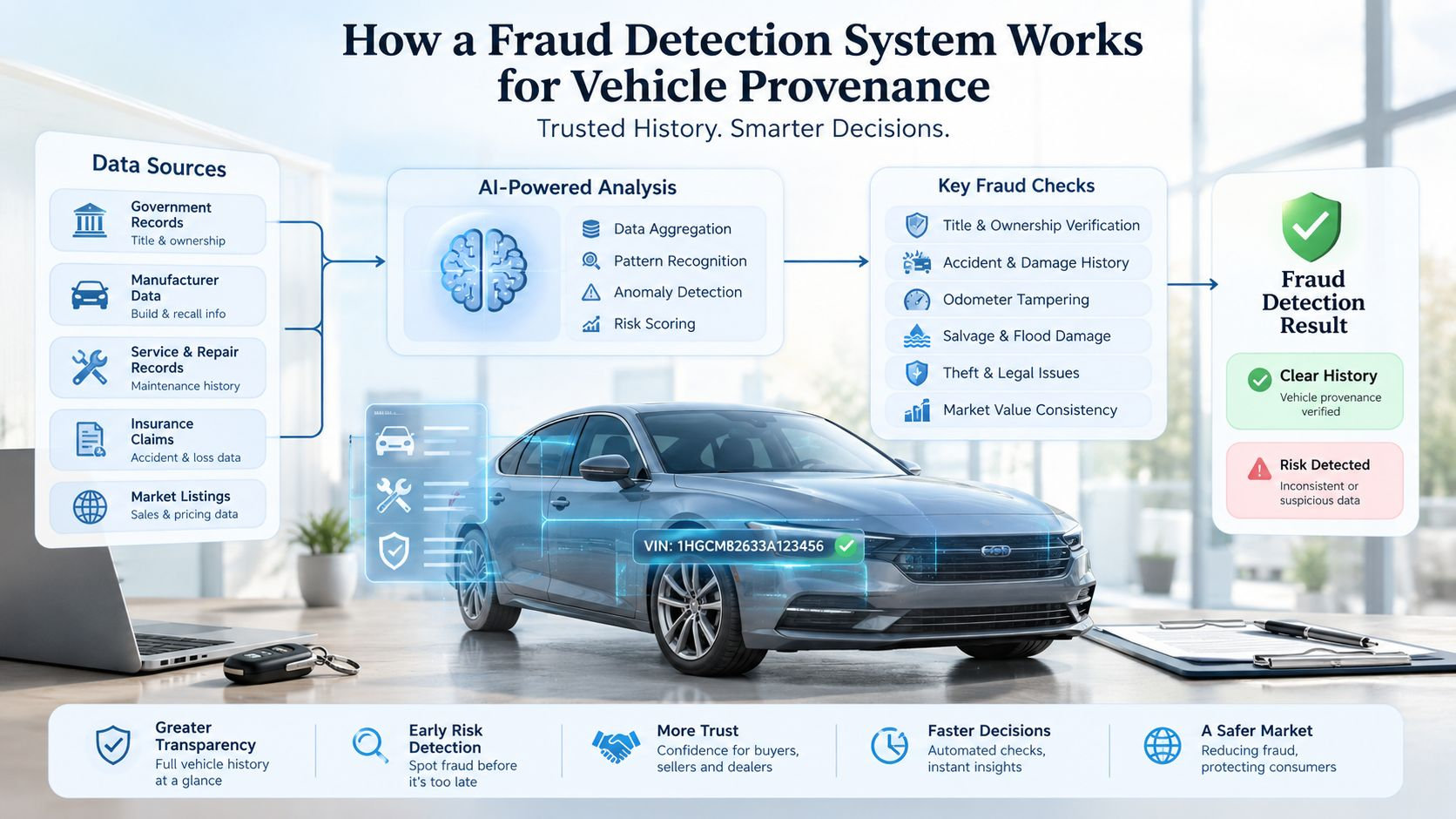
How a Fraud Detection System Works for Vehicle Provenance
An experienced buyer rarely looks at a service invoice, the bodywork and the seller's explanation separately. They compare them mentally. If the condition suggests heavy use but the recorded mileage is unusually low, the buyer asks for more evidence. A vehicle fraud detection system formalises that judgement and applies it consistently across stock.
The process has four practical layers:
- Data ingestion brings together vehicle identifiers, MOT records, mileage readings, ownership information, insurance-related events and other available provenance signals.
- Normalisation makes records comparable. Variations in registration details, dates, model descriptions or identifiers can otherwise create false conflicts.
- Pattern analysis tests relationships, such as whether mileage rises consistently, whether ownership changes fit the resale history and whether the VIN appears consistently across records.
- Risk flagging presents the buyer with an explanation, not just a pass or fail outcome.
The difference matters. A database lookup tells you what a source contains. An analytical platform asks whether the sources tell a coherent story.
The risk score is only useful if the reason is visible
A score without an explanation creates a new operational problem. Buyers can't sensibly challenge a seller, adjust a valuation or record an internal decision if the system only displays a red warning.
Useful explanations should identify the signal and its context:
- Mileage sequence: A recorded reduction between tests, a stagnant reading or an implausible jump.
- Identity consistency: A VIN, registration, make or model conflict between records.
- Ownership behaviour: A short holding period or rapid resale that needs supporting context.
- Event alignment: A mismatch between insurance, salvage, theft or statutory records and the vehicle presented.
AutoProv's vehicle provenance report is positioned around this type of contextual report, combining vehicle history and provenance signals for trade decision-making. The platform should still support, rather than replace, physical inspection and professional judgement.
A practical operating model
Run the analysis before the vehicle reaches the final buying decision. The first pass can triage auction or wholesale candidates. A second review can be triggered when the vehicle is physically inspected, especially if the condition doesn't match the recorded history.
The strongest systems also preserve an audit trail. A buying manager should be able to see which signals were present, what action followed and whether later information confirmed or weakened the concern. That feedback improves internal rules and helps teams avoid treating every data irregularity as fraud.
Comparing Rule-Based and Machine Learning Detection Approaches
Dealers don't need to be software engineers to question an artificial intelligence claim. They need to know whether the system catches known risks, identifies unusual combinations and explains its decisions clearly.
Rule-based logic is the most transparent approach. A rule can flag a mileage reduction between MOT readings, a missing identifier or a conflict between a vehicle's recorded make and its presented details. Rules are easy to audit and useful for established fraud patterns, but they only catch what someone has defined. A new pattern can pass until the rule is updated.
Statistical anomaly detection looks for behaviour that differs from an expected pattern. It can identify unusual mileage movement, ownership timing or combinations of events without requiring every fraud type to be labelled in advance. The trade-off is calibration. A threshold set too tightly creates false positives, while a threshold set too loosely leaves meaningful anomalies unflagged. AutoProv's explanation of what anomaly detection means in vehicle intelligence is useful background for buyers assessing this capability.
Supervised machine learning learns from labelled examples of higher-risk and lower-risk records. It can combine signals that are difficult to express as simple rules and adapt as new outcomes are added. However, it depends on suitable training data, ongoing validation and careful governance. A vendor using the phrase “machine learning” should be able to explain how the model is monitored, how false positives are handled and how a human buyer sees the underlying evidence.
Fraud Detection Approaches Compared
Approach Strengths Limitations Best Suited For Rule-based logic Transparent, auditable and effective against known patterns Can miss new or combined fraud behaviours Mandatory checks and clear compliance triggers Statistical anomaly detection Surfaces unusual relationships and patterns Requires sensible thresholds and review procedures Triage, mileage analysis and unusual ownership behaviour Supervised machine learning Can combine many signals and learn from labelled outcomes Needs quality data, validation and explainability Mature workflows with sufficient feedback and governance The practical answer is usually a layered architecture, not a contest between methods. Rules can handle obvious conflicts, anomaly detection can prioritise unusual records and machine learning can assist with more complex risk ranking. Dealers comparing providers should also distinguish technical education from product claims. Resources such as AI Image Detector's fraud detection posts can help teams understand the wider vocabulary, but a vendor still needs to demonstrate how its approach works on UK vehicle data.
Ask for examples of explanations, not just model labels. A system that says “high risk” without identifying the mileage, identity or ownership evidence leaves the buyer with an alert but no usable decision support.
UK Vehicle Data Sources and Fraud Patterns That Matter
A UK-focused used car history report is only as useful as the relationships between its data sources. MOT history provides the starting point. The official record includes each test date, result, advisory and recorded mileage. GOV.UK confirms that cars, motorcycles and vans show MOT tests from 2005, while HGVs, trailers, buses and coaches show tests from 2018 (GOV.UK MOT history guidance). MOT data carries strong signals, but it does not describe the vehicle's complete lifetime.
The first automated control should check whether mileage progresses consistently. A later reading below an earlier one warrants review. Analysts examining DVSA MOT records covering 62.7 million vehicles found 3.42 million vehicles, or 5.45%, with a mileage reduction between tests after obvious anomalies were removed (analysis of DVSA MOT mileage data). That establishes a meaningful base rate for investigation, not proof that every flagged vehicle was deliberately clocked.
Cross-source matching creates the useful context
The Motor Insurers' Bureau identifies the Motor Insurance Database as a source for insured-vehicle validation and the Vehicle Salvage and Theft Database as a source for written-off and stolen vehicle records. Its information for insurers and brokers links these datasets to risk assessment, policy validation, anti-fraud work and fraud detection (MIB information for insurers and brokers).
A dealer-grade system should compare:
- Identity records, including registration, VIN, make and model.
- MOT history, including dates, outcomes, advisories and mileage.
- Insurance markers, including written-off, salvage or theft indicators.
- Ownership timeline, including short-term holding and rapid resale.
- Service evidence, where available, to test whether the maintenance record supports the stated mileage.
One isolated missing record may be administrative, but a mileage reduction combined with a VIN inconsistency and an insurance marker indicates a materially different risk profile. Multi-source comparison turns trade vehicle intelligence into a decision aid rather than a set of unrelated database results.
Newer patterns need model and resale context
UK reporting has identified popular models including the Nissan Qashqai, Land Rover Defender, Volvo XC60 and Volvo XC90 in connection with clocking risk. A 2026 report said nearly 10% of checked Qashqais showed mileage issues and reported an average Defender rollback of 59,201 miles. The figures appear in Regit's report on clocked cars, but they should guide prioritisation rather than trigger automatic rejection. Model-specific risk matters most when combined with the individual vehicle's mileage, identity and resale history.
Insurance events also require evidence-led review. Overton Security's guide by Overton Security provides wider context on examining claims and vehicle events. For dealers, provenance review means testing whether the vehicle's identity, mileage and ownership timeline remain coherent across independent sources. AutoProv's vehicle data sources describe the multi-source foundation needed for that analysis.
Deploying Fraud Detection in Motor Trade Buying Workflows
A fraud detection system works best when it appears at the point where a buyer can still change the decision. Running a check after the vehicle has been bought turns a prevention tool into an investigation tool.
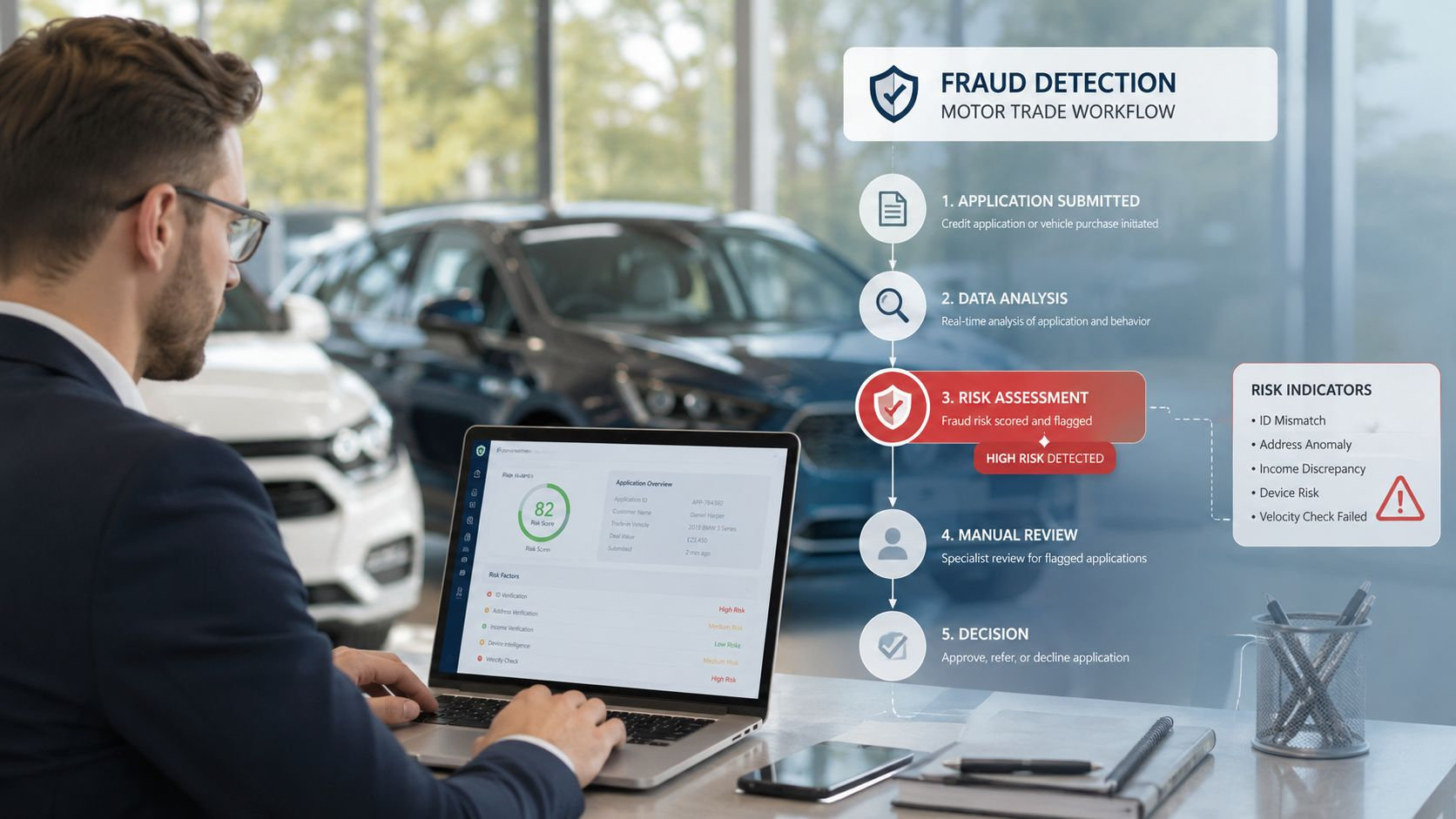
Start with the stock funnel. Run a light screening pass when vehicles first appear in an auction catalogue, part-exchange pipeline or wholesale feed. The objective is triage, not a full manual review of every candidate. Escalate vehicles with identity conflicts, mileage anomalies, unusual ownership behaviour or insurance-related markers before a buyer spends time arranging transport or valuation.
Use risk tiers, not a crude pass or fail
A practical workflow can divide outcomes into three operational groups:
- Routine: The available records align, so the vehicle proceeds to normal physical and commercial checks.
- Review: A limited inconsistency needs evidence, such as a service invoice, job card or clarification from the seller.
- Escalate or decline: Several independent signals conflict, or the seller can't substantiate a material discrepancy.
The system shouldn't make the final commercial decision in isolation. A flagged vehicle may still be buyable at a revised price if the evidence resolves the concern. Conversely, a vehicle with no obvious single red flag may deserve rejection when the condition, identity and paperwork fail to tell the same story.
Make the response proportionate
For a mileage discrepancy, ask for supporting documents and compare the physical wear with the recorded use. GOV.UK says an MOT centre can correct mileage within the last 28 days after re-checking the vehicle. After that period, the error must be reported to DVSA with evidence, such as an invoice, emissions printout, service receipt or vehicle job card (GOV.UK guidance on correcting MOT certificate mistakes).
That matters operationally because not every discrepancy is criminal. AutoTrader notes that mileage records aren't compulsory, and gaps can arise when a garage doesn't submit information or an owner leaves mileage blank on the V5C during a keeper change (AutoTrader's mileage discrepancy guidance). Record the explanation, retain the evidence and make the decision reproducible. Process automation can help buyers apply these controls consistently, and AutoProv outlines related process automation benefits.
Evaluating Fraud Detection Vendors for Your Dealership
The right supplier isn't the one with the longest feature list. It's the one that helps your buying team make a defensible decision quickly, using data that reflects the UK market.
Begin with source coverage and provenance depth. Ask which records the platform can analyse, how it handles missing data and whether it distinguishes a genuine conflict from a reporting gap. A supplier should explain how it treats MOT history, insurance and salvage markers, ownership timelines, VIN identity and mileage sequences. “More data” isn't enough if the platform merely displays separate results without testing their relationships.
Examine the decision output
A buyer needs more than a traffic-light result. Request sample reports and check whether each material flag includes:
- The evidence: Which source or relationship triggered the concern?
- The timeline: When did the relevant event or reading occur?
- The interpretation: Why does the combination increase risk?
- The next action: What should the buyer verify before proceeding?
- The audit trail: Can the business retain the result and decision?
False positives matter because excessive alerts cause staff to ignore the system. False negatives matter because an apparently clean result can create misplaced confidence. Ask vendors how they measure both, how thresholds are tuned and how users submit feedback when a flagged vehicle is later verified.
Test the workflow, not just the dashboard
A trade-focused platform should fit the way your team buys. Check whether buyers can run reports from existing systems, whether results load quickly enough for auction decisions and whether managers can review the same evidence across multiple sites. A polished dashboard that requires duplicate data entry won't be adopted consistently.
The distinction between consumer-facing and trade-focused tools also matters. A consumer report may answer whether a vehicle has a known marker. A dealer platform should support valuation, stock selection, negotiation, compliance and post-sale dispute records. AutoProv's discussion of AutoProv and traditional vehicle check providers provides a useful framework for examining that operational difference without treating a report as a guarantee.
Finally, ask how the provider governs model changes. If a platform uses anomaly detection or machine learning, the supplier should explain validation, explainability and escalation. Claims about AI have no practical value unless your staff can identify the signal, act on it and learn from the outcome.
Best Practices for Reducing Fraud Exposure in Stock Acquisition
The safest buying teams treat provenance as a routine control, not an emergency exercise after a dispute. They screen early, investigate proportionately and record why a vehicle was accepted or rejected.
Build model-specific risk profiles from your own outcomes and credible UK market evidence. Recent reporting has associated clocking risk with models such as the Nissan Qashqai, Land Rover Defender, Volvo XC60 and Volvo XC90, so buyers may choose to apply deeper checks to those segments rather than impose a blanket refusal (Regit's model-specific clocking report). The profile should guide attention, not replace vehicle-level evidence.
Make provenance part of the buying file
Retain the report, photographs, seller statements and supporting mileage documents together. Compare the recorded timeline with physical wear, service history and the seller's ownership explanation. When a discrepancy can be corrected, document the correction route. When it can't be explained, escalate before purchase.
Ownership deserves equal attention. A sequence of short holding periods or rapid resale can be legitimate, but it should prompt questions about why the vehicle moved quickly and whether an undisclosed issue travelled with it. A pattern becomes more meaningful when it appears alongside mileage or VIN inconsistency.
Operational rule: If the vehicle's identity, timeline and condition don't agree, pause the transaction until the disagreement is explained in evidence.
No platform catches every form of fraud, and experienced buyers remain essential. The strongest process uses technology to prioritise scrutiny, then gives people enough context to make a fair commercial decision. That approach reduces avoidable disputes because the dealer can show what was checked, what was found and why the vehicle was bought, priced or declined.
Review the process regularly. Analyse escalations, confirmed issues, harmless data errors and missed signals, then update buying rules and staff training. Provenance intelligence becomes a competitive advantage when it protects capital without slowing every transaction.
AutoProv provides UK-focused vehicle history, provenance and risk intelligence for dealers, wholesalers and professional buying teams, combining mileage patterns, MOT history, ownership timelines and other risk indicators in a trade-oriented report. Visit AutoProv to assess how multi-source vehicle intelligence could fit your stock acquisition and fraud review workflow.
Frequently Asked Questions
AI-Generated Content Notice
This article was created with the assistance of artificial intelligence technology. While we strive for accuracy, the information provided should be considered for general informational purposes only and should not be relied upon as professional automotive, legal, or financial advice. We recommend verifying any information with qualified professionals or official sources before making important decisions. AutoProv accepts no liability for any consequences resulting from the use of this information.
From our AI insights
- Decoding Mileage: Impact of Seasonal Driving Patterns
Explore how seasonal driving impacts your car's mileage verification.
- Tackling Mileage Fraud in Electric Vehicles
Explore how motor traders can prevent mileage fraud in electric vehicles using advanced techniques.
- Mileage Verification for Hybrid Cars: A 2024 Update
Explore the nuances of mileage verification for hybrid vehicles in 2024 with our expert guide.
Related Articles

Understanding Vehicle Mileage Importance
Discover the critical role of accurate mileage in vehicle provenance and how AutoProv can safeguard your purchase.
What Is the Average Annual Mileage in the UK?
Right now, the average annual mileage for a car in the UK hovers around 7,000 miles. For anyone in the motor trade, that number is more than just a statistic; it’s a vital benchmark that helps buyers, sellers, and insurers get a quick read on a car's usage and potential wear and tear.
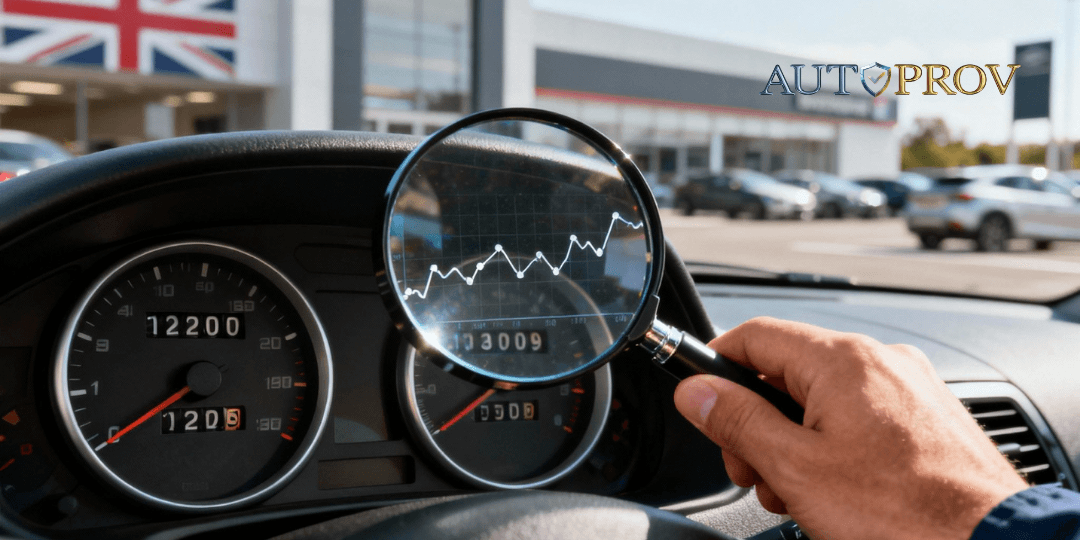
Car Mileage Discrepancy Explained: A Guide for UK Motor Traders
When it comes to a car’s history, its mileage record should tell a simple, straightforward story: the number always goes up. A mileage discrepancy is what happens when that story suddenly does not make sense.
Published by AutoProv
Your trusted source for vehicle intelligence