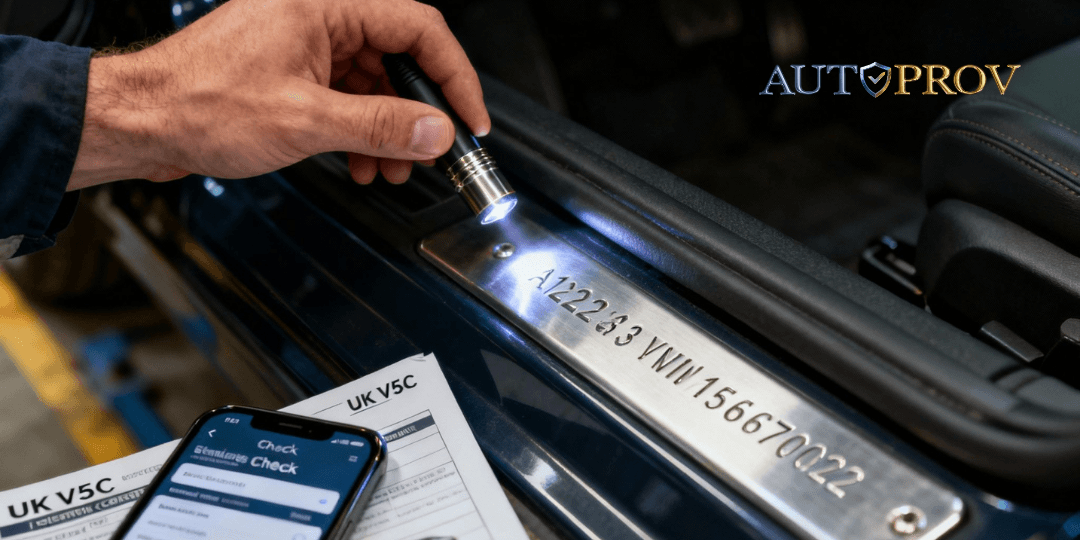
Right, let's get straight to it. The first thing you need to find is your car's chassis number, which you'll probably know as the Vehicle Identification Number (VIN). You can usually spot this 17-character code on a small metal plate. Have a look on the driver's side of the dashboard – you should be able to see it through the windscreen from the outside. Another common spot is on a sticker inside the driver's door jamb.
This unique code is the single most important identifier for your vehicle. Nothing else comes close.
Understanding Your Vehicle's Unique Fingerprint
Think of the chassis number as your car's DNA. It’s a critical piece of information that unlocks its entire life story, from the day it rolled off the production line to its current legal status.
For anyone in the motor trade, knowing how to find and verify this number is a fundamental skill. It’s your first line of defence against buying a dodgy vehicle. A quick check, like the ones provided by AutoProv, can instantly tell you if a car has been reported stolen, previously written off, or has a lurking finance agreement tied to it.
This guide is your practical field manual. We’ll walk you through:
- The exact physical spots to check on any car.
- Where the number is hiding on official UK documents like the V5C.
- How to tell it apart from other codes stamped on the vehicle.
Most importantly, we'll show you how our services at AutoProv can be used to instantly run a chassis number against official records. This gives you the full picture of a vehicle's history and complete peace of mind before you part with any cash.
While a registration plate can give you some basic details, as we cover in our guide to getting car specs by registration number, the chassis number is the ultimate source of truth.
Checking the Physical Chassis Number Locations on Your Car
Sometimes, the most reliable check is the one you do with your own two hands. Physically locating the chassis number on a vehicle is a fundamental skill, making sure the car in front of you actually matches its paperwork. Let's walk through exactly where to look.
Your first stop should almost always be the dashboard. Peer through the windscreen from the driver’s side, right down at the bottom corner where the glass meets the dash. You’ll usually spot a small metal plate showing the 17-character VIN. It’s the most common and easiest place to find it.
Next, open the driver’s door and check the door jamb. You're looking for a compliance plate or sticker on the B-pillar (that's the frame between the front and rear doors). This plate is a goldmine of information—it not only has the chassis number but often includes key details like the vehicle's paint code and recommended tyre pressures.
Deeper Inspection Points
Can't find it in the usual spots? No need to panic. Manufacturers can be a bit creative with placement, so it's time to dig a little deeper.
Here are the other common hiding places:
- Under the Bonnet: Pop the bonnet and have a good look around the engine bay. The number is often stamped onto the firewall (the metal wall separating the engine from the cabin), on the front of the engine block itself, or near the suspension mounting points.
- Inside the Cabin: Some manufacturers will stamp the number under the driver’s or front passenger's seat. You may need to slide the seat all the way back and lift a small, pre-cut flap in the carpet to see it.
- On the Chassis Frame: This is particularly common on larger vehicles like vans or 4x4s. The number might be stamped directly onto a visible part of the main chassis frame, often tucked away inside one of the front wheel arches.
Here's a pro tip for any inspection: always use your phone's torch. A bit of light makes all the difference, helping you read numbers that are dirty, faded, or stamped into dark, greasy metal.
When you find these physical numbers, look closely for any signs of tampering. Scratches, fresh paint around a plate, or digits that look unevenly stamped are all serious red flags that something isn't right. This hands-on visual check is a crucial part of your due diligence, which is why we created your ultimate used car inspection checklist to guide you through the whole process.
Finding the Chassis Number on Your UK Vehicle Documents
Sometimes, a physical inspection isn't practical, or maybe you just want to cross-reference the numbers on the vehicle itself. This is where the official paperwork becomes your most trusted resource. A vehicle's documents provide a crucial paper trail, and knowing how to find your chassis number across these records is a non-negotiable skill for any savvy buyer or owner.
Your first port of call should always be the V5C Registration Certificate, what most of us call the logbook. Think of it as the vehicle's birth certificate and passport rolled into one—it's the cornerstone of a car's legal identity in the UK.
The chassis number (listed as 'VIN') is clearly printed in section 4, 'Vehicle Details', right on the front page of the current V5C design. It's hard to miss. For a deeper dive, check out our quick UK guide to the V5C document for a full breakdown.
But the V5C isn't the only place this vital 17-digit code is hiding. Seeing that same number pop up across all the car's documents is one of the strongest signs you're looking at a vehicle with a legitimate, consistent history.
Other Key Document Locations
Beyond the logbook, there are several other important places to check. I always look at these secondary sources to build a complete and trustworthy picture of a car's provenance before making any decisions.
- MOT Test Certificates: Both current and past MOT certificates will display the full chassis number. This is fantastic for verifying that the number has remained the same over the years, flagging any potential identity swaps.
- Service History Book: A well-looked-after car will have its service book stamped by garages at regular intervals. This book almost always has a dedicated section for the vehicle's details, including the all-important chassis number.
- DVLA Records: For those in the trade, DVLA data is the definitive source. Services like AutoProv connect directly to this data, confirming the registered number officially linked to the vehicle and giving you an undisputed baseline for all your other checks.
For any secure transaction, the number stamped on the car's frame, printed on the V5C, and recorded in its service and MOT history must be a perfect match. Any discrepancy, no matter how small, needs an immediate and thorough investigation before you even think about proceeding.
Chassis Number vs VIN: Are They Actually Different?
In the UK motor trade, you’ll hear ‘chassis number’ and ‘VIN’ thrown around as if they’re the same thing. And most of the time, they are. But there’s a small, crucial difference that really matters, especially when you’re dealing with older or classic cars. Getting your head around this simple distinction can save you a world of confusion.
For any car built after 1981, the official chassis number is its 17-character Vehicle Identification Number (VIN). This was a global move to standardise how vehicles are identified, making it far easier and more reliable to track a car’s history across borders. Before this system came in, manufacturers all had their own ways of doing things, often using shorter, non-standard codes as chassis numbers.
So, here’s the key takeaway: every modern car’s VIN is its chassis number, but not every older chassis number is a VIN. This is absolutely critical to remember when you're looking at a classic car, where the original, shorter number is still the main identifier.
What the Modern VIN Tells You
That 17-digit code isn't just a random string of characters; it’s packed with information. It’s a vehicle’s fingerprint, revealing everything from its country of origin and manufacturer to specific details like the model, engine size, and the year it rolled off the production line. Learning to decode it is a handy skill. For instance, if the VIN points to a 2018 model but the V5C logbook claims it’s a 2019, that’s an immediate red flag.
A mismatch between the information coded in the VIN and the car's paperwork is a major warning sign. It could be a simple clerical error, but it could also point to something much more sinister, like a cloned or stolen vehicle.
This is precisely why running a professional check is non-negotiable. A comprehensive AutoProv report instantly decodes the VIN for you, cross-references it against DVLA and manufacturer databases, and highlights any inconsistencies you might otherwise miss. Our guide to vehicle checks with a VIN breaks down exactly how this process gives you total clarity and peace of mind.
When You Can't Find or Read the Chassis Number
Stumbling across a vehicle where the chassis number is missing, unreadable, or doesn't line up with the V5C logbook is a massive red flag. This isn't just a small hiccup; it's a high-stakes situation that could point to anything from a major accident cover-up to something far more sinister, like a cloned or stolen car.
Of course, sometimes there's an innocent explanation. Rust, corrosion, or even just a clumsy repair job can easily obscure a number stamped into the chassis. But if a VIN plate looks like it’s been deliberately tampered with, removed, or messed with in any way, you need to walk away. Don't guess, verify.
Moving from Manual Checks to Data Verification
This is the point where you stop squinting at rusty metal and turn to professional tools. The most foolproof way forward is to bypass the physical issue entirely and pull the vehicle’s official identity straight from the source. By entering the car's registration number into a platform like AutoProv, you can get the correct, DVLA-registered chassis number in seconds.
This lets you instantly cross-reference it against whatever might be visible on the car. Even better, it connects that number to the car's complete history.
A professional vehicle check doesn't just find the number; it reveals what that number's story is. This is the difference between making an assumption and making a data-backed decision.
This process is a non-negotiable part of any decent pre-purchase car check in the UK. AutoProv takes the correct chassis number and links it to critical data points, including outstanding finance alerts, stolen vehicle markers, insurance write-off history, and recorded mileage discrepancies.
This transforms a potential deal-breaker into a clear, evidence-based conclusion. It gives you the solid ground you need to either walk away from a dodgy deal or buy with complete confidence.
Frequently Asked Questions About Chassis Numbers
Before we finish, here are the questions that crop up most often when you’re hunting down a chassis number. Hopefully, this clears up any loose ends.
Can I Find The Chassis Number From The Registration Plate Alone
Yes, indirectly. You won’t see the VIN just by looking at the registration plate. However, you can use the Vehicle Registration Mark (VRM) with a service like AutoProv to retrieve the official chassis number. Our system queries DVLA and other accredited databases, matching the VRM to the vehicle's full details and history, providing the correct chassis number as part of a comprehensive report essential for trade professionals.
What If The Chassis Number On The Car And V5C Do Not Match
A mismatch is a major warning sign. It could mean anything from a simple clerical error to a stolen car masquerading under a clean identity. In any case, proceed with extreme caution. Running a full vehicle check with AutoProv will illuminate hidden issues such as stolen status, write-offs, or finance problems, so you know exactly what you’re dealing with.
Is The Engine Number The Same As The Chassis Number
No, they are different. The chassis number (VIN) identifies the entire vehicle, while the engine number is specific to the engine block itself. Both are important for sourcing parts and servicing, but only the VIN appears on legal documents like the V5C, MOT records, and registration certificates, where each number is listed separately.
Why Would A Chassis Number Be Missing Or Damaged
There can be innocent reasons like corrosion, damage from an accident repair, or general wear and tear eroding the VIN plate. However, if you see evidence of deliberate removal or alteration, it’s a serious red flag often linked to theft or cloning. When in doubt, it’s best to walk away. A quick check with AutoProv can help uncover any hidden history that might explain what's really going on.
Frequently Asked Questions
AI-Generated Content Notice
This article was created with the assistance of artificial intelligence technology. While we strive for accuracy, the information provided should be considered for general informational purposes only and should not be relied upon as professional automotive, legal, or financial advice. We recommend verifying any information with qualified professionals or official sources before making important decisions. AutoProv accepts no liability for any consequences resulting from the use of this information.
From our AI insights
- Navigating ULEZ Compliance for Used Car Dealers
A deep dive into ensuring your used car stock meets ULEZ standards, avoiding costly fines.
- Mastering Paint Verification with VIN Decoding
Learn how UK traders verify original paint using VIN decoding and provenance data.
- Understanding VIN Decoding: Avoid Misleading Imports
Learn how VIN decoding reveals vehicle origins and specs, preventing import pitfalls.
Related Articles

Car Specs by Reg: Instantly Find Vehicle Details & MOT History
Trying to find the full car specs by reg? In the UK, that little number plate is the key to unlocking a huge amount of information about a vehicle. From the exact engine size and CO2 emissions to its MOT history and tax status, it's all tied to the registration.

How to Check Previous Owners of a Car in the UK
Before you even start thinking about how to check the previous owners of a car, you need to get your head around why it's so important. This isn't just about being nosy; it’s a non-negotiable step that protects you from serious financial headaches and safety risks lurking under a shiny bonnet.

How to Check Service History in the UK
Think of a car's service history as its detailed CV, not just some dusty folder in the glovebox. To check service history is to get the real story behind a vehicle, digging into everything from its routine oil changes to any major surgery it's had. For any savvy car buyer in the UK, this record is the single most important document you can get your hands on.
Published by AutoProv
Your trusted source for vehicle intelligence