For a UK motor trade professional, knowing how to find previous owners of a car isn't about tracking down names and addresses. It’s about building a clear picture of the vehicle's past life to understand its real value and risk profile. This means going beyond the V5C, using professional data checks from services like AutoProv, and knowing which red flags signal trouble ahead.
Why a Car's Keeper History Is Crucial for Your Business
In this business, a vehicle's keeper history is much more than just a number on the V5C logbook. It’s a core part of your risk assessment, and getting it wrong can hit your bottom line hard. That single number on the logbook barely scratches the surface, leaving you with more questions than answers.
Was the car a privately owned, low-mileage pride and joy? Or was it a high-mileage ex-fleet workhorse that’s been driven hard every single day? The answer completely changes its value, its reliability, and ultimately, how much profit you’ll see on the forecourt. This isn't just about ticking a box; it's essential due diligence that shields your business from buying a lemon.
We’ve all seen it. A car with just one registered keeper looks like a safe bet on paper. But what if that "one keeper" was a taxi firm? Suddenly, the wear and tear profile is worlds apart from what you expected.
Beyond the V5C Count
The V5C gives you a starting point, but it lacks the commercial-grade detail you need to buy with confidence. To get the full story, a professional provenance check is non-negotiable. This is where tools built specifically for the trade, such as the services provided by AutoProv, step in, turning a vague keeper count into clear, actionable intelligence.
Take a three-year-old car showing two previous keepers. Without more info, that could mean anything. For instance, it could be a pre-registered vehicle sold to its first private owner, a short-term lease followed by a normal retail sale, or a rapid succession of owners trying to offload a car with a persistent, costly fault.
Without digging deeper, you’re essentially buying blind. The keeper count alone doesn't tell you how the vehicle was used, which is the most critical piece of the puzzle for an accurate valuation.
Think of a vehicle’s history as its CV. A high keeper count isn't always a deal-breaker, but unexplained gaps or rapid ownership changes are massive red flags. They demand a proper investigation before you even think about putting your money down.
Services like AutoProv take the basic keeper data from the DVLA and enrich it with crucial information from finance houses, police records, and insurance databases. This unified approach gives you the complete picture, letting you understand the real context behind every change of keeper. For a proper look at what these checks should cover, the essential used car history report for dealers is the place to start. This is the kind of intelligence that separates a profitable buy from a vehicle that will drain your margins and damage your reputation.
Navigating DVLA Rules and Data Protection Laws

Before you even think about digging into a car's history, you need to get your head around the legal landscape. Trying to find out who previously owned a car in the UK is a non-starter, and for very good reason. The whole process is locked down by strict data protection laws, with the Driver and Vehicle Licensing Agency (DVLA) holding the keys.
The most important thing to grasp is that a keeper’s personal information—their name and address—is protected. Under the General Data Protection Regulation (GDPR) and the Data Protection Act 2018, this data is private. The DVLA simply won't release it without a legally watertight reason, what they call ‘reasonable cause’.
For anyone in the motor trade, just wanting to know more about a vehicle to help with its valuation doesn't cut it. That doesn’t meet the DVLA's threshold. Their job is focused on tax and licensing, not helping out with commercial background checks.
What You Can Legally Access
So, if personal details are off the table, what information can you get your hands on? This is where the crucial difference between a ‘keeper’ and an ‘owner’ comes into play. While you can't get the owner's name, you can access vital keeper data that helps build a clear picture of the vehicle's past life.
A professional check allows you to legally find out the number of previous keepers, the dates of keeper changes, the date of first registration, and crucial vehicle details like MOT history. This information shines a light on maintenance, mileage, and potential red flags.
This is the information that forms the bedrock of a professional provenance check. It gives you the essential skeleton of the car’s timeline without ever crossing the line into someone's private life. Understanding these boundaries is the first step to doing your due diligence properly and legally.
The goal isn't to find out who owned the car, but how it was owned. A compliant check focuses on verifiable data points that reveal usage patterns and potential risks, all while respecting data protection laws.
Staying Compliant with Professional Tools
This legal framework is exactly why professional tools like AutoProv are so essential. We operate strictly within these legal boundaries, only pulling together the data that is permissible for the motor trade to access. Our systems are built to give you the insights you need—like keeper change dates and alerts for ex-taxi or fleet usage—without ever exposing protected personal information.
By using a compliant service, you get a huge intelligence advantage while making sure your business practices are completely above board. You get the real story behind the keeper count, backed by official data sources, which protects both your business and your customers.
For a deeper dive into what a standard DVLA check involves, our guide on free DVLA vehicle owner checks offers some great extra context. This approach turns what could be a legal headache into a structured, risk-managed process.
Reading Between the Lines of the V5C Logbook
The V5C logbook is always your first port of call, but any seasoned motor trade pro knows it’s a document that often hides more than it reveals. It gives you the basic facts, sure, but the real skill is in spotting what those details are hinting at—and, more importantly, what’s missing entirely.
On the surface, things like the 'Date of first registration' and the keeper count seem simple enough. Think of them as just chapter headings in a much longer, more complicated story. A high number of keepers isn't an automatic deal-breaker, but if you see a string of very short ownership periods, that should set alarm bells ringing about potential underlying faults.
Frequent V5C reissues in a short space of time are another major red flag. It could just be a clumsy owner who keeps losing the document. Or it could point to something far more sinister, like a cloned vehicle or a deliberate attempt to bury a damaging history. You can get a full rundown on the document's specifics in our quick UK log book guide.
Going Beyond the Logbook's Limits
At the end of the day, the V5C can only ever give you a skeletal outline of a car's life. It won’t tell you if the last keeper had outstanding finance, if the car was an insurance write-off, or if it spent its life as a minicab racking up city miles. This is where you have to move beyond the paper and into professional-grade intelligence from services like AutoProv.
The sheer scale of the UK's vehicle market makes these deeper provenance checks non-negotiable. Great Britain had nearly 32.2 million licensed cars on the road in 2022. And with a 17.9% jump in new car registrations in 2023, you’ve got millions of used transactions creating long, multi-keeper histories for countless vehicles. You can explore UK car registration statistics for more detail on these trends. This kind of volume means that any gap in your acquisition process can expose you to risk across a huge number of units every year.
A proper, professional check builds on the V5C's limited data, adding the layers of crucial context you need to make a smart buy. It can uncover the Police National Computer (PNC) status to flag stolen vehicles, finance agreements that could leave you liable, insurance write-off history, and evidence of commercial use as a taxi or private hire vehicle.
The V5C tells you that a keeper change happened, but it doesn’t tell you why. A comprehensive report from a service like AutoProv fills in these blanks, connecting the dots between keeper changes, MOT history, and hidden risk factors to give you the complete, reliable story that the logbook alone can never provide.
Using Professional Provenance Checks to Uncover the Full Story
Let’s be honest, the V5C logbook only scratches the surface. To turn potential risks into smart, calculated decisions, you have to dig deeper. A proper professional provenance investigation isn't about one single check; it's about layering multiple, distinct data sources to build a complete and accurate picture of a vehicle's life.
Think of it this way: each data point tells a piece of the story. When you bring them all together, they reveal truths the logbook was never designed to show. This multi-layered approach, a core feature of AutoProv's service, is the only reliable way to understand a car's history in a way that actually matters for business—by seeing the real impact of its previous keepers.
The sheer scale of the UK used car market makes this detailed approach a must. With over 7.24 million transactions in 2023 and more than 41.4 million vehicles on UK roads, the volume of metal passing through auctions and forecourts is staggering. This directly translates to more risk for dealers, as every keeper change introduces a new opportunity for undisclosed issues to creep in. For a closer look at the market dynamics, the government's evidence review on car ownership is quite revealing.
Weaving Together Critical Data Points
A truly effective provenance check synthesises information from several key areas. It’s like assembling a puzzle where each piece gives you vital context about what a previous keeper did—or didn't do—with the vehicle.
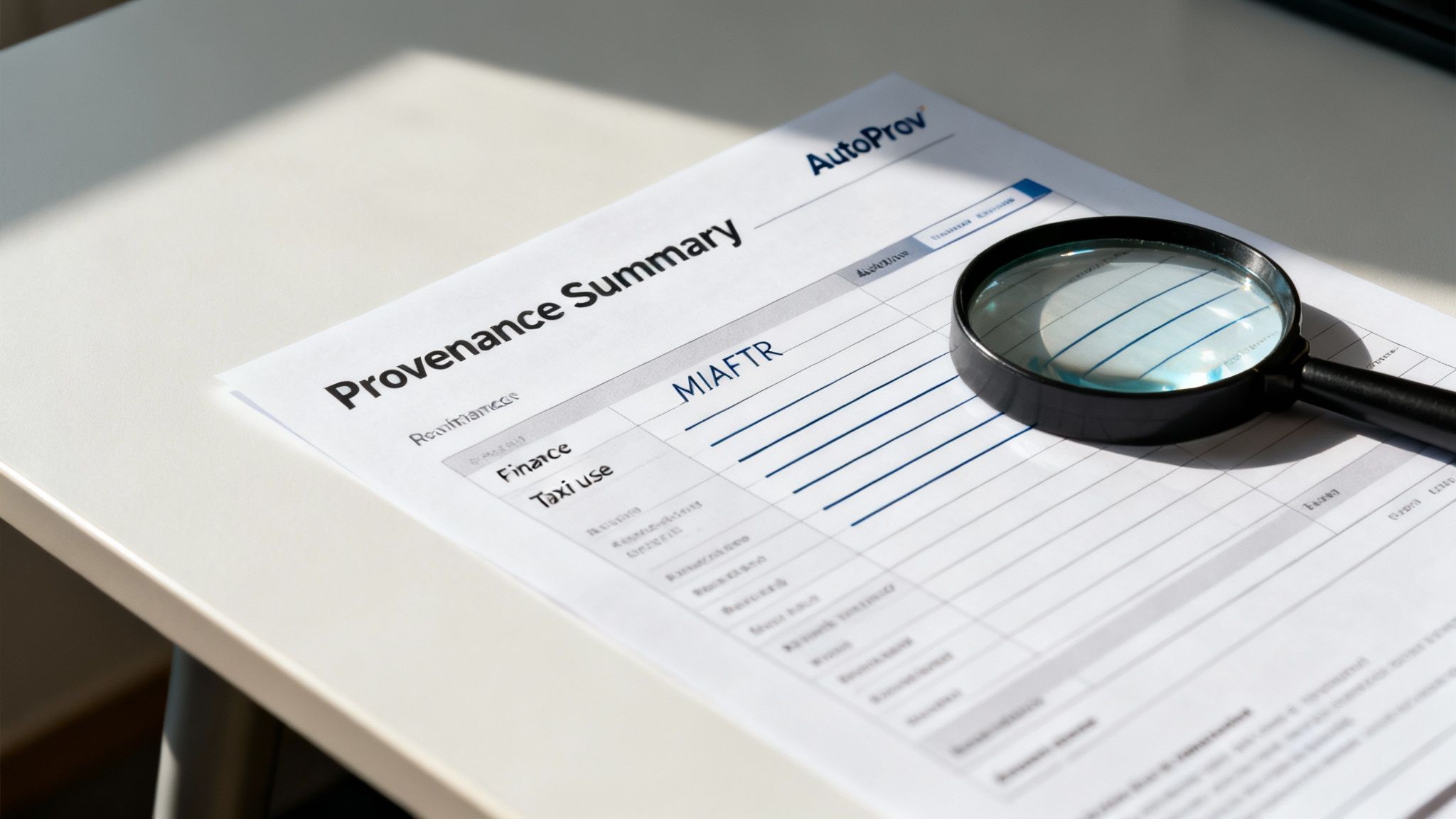
A professional report, such as one from AutoProv, pulls together crucial information for you. This includes a MIAFTR check to flag if a vehicle was written off by an insurer, finance markers to reveal outstanding debt tied to the car, taxi licensing history to uncover hidden commercial use, and mileage discrepancy analysis to spot signs of clocking.
The Power of a Unified Report
Trying to manually source and compare all these separate reports is not just a drain on time; it's also wide open to error. It’s far too easy to miss crucial details when you’re trying to connect the dots between a finance report, an insurance database, and the DVLA’s keeper timeline.
This is where a consolidated, intelligent approach becomes indispensable.
A professional provenance check isn't just a data dump. It’s an intelligence summary that turns complex historical data into a clear, easy-to-digest narrative. It gives you the leverage you need to price vehicles accurately based on their complete, unvarnished history.
Services like AutoProv are built specifically for this. We consolidate these critical checks into one seamless report. This unified summary saves you precious time, ensures no vital detail gets overlooked, and gives you the full story you need to make confident, profitable buying decisions. If you want to dive deeper into all the elements involved, our guide on what a car provenance report includes is an excellent place to start.
A Real-World Vehicle History Investigation

All the theory is great, but let's see how this plays out on the forecourt. Picture this: a three-year-old hatchback rolls in for appraisal. It's a popular model, looks tidy, and the V5C logbook shows just two previous keepers. On paper, it looks like a dead-cert for a quick, profitable turnaround.
This is exactly the kind of car that can catch you out. If you stop at the keeper count, you're essentially taking a punt. You need a proper, professional report to peel back the layers and understand the real story behind those two names. It’s about shifting from a hopeful guess to a calculated business decision.
This is where an AutoProv report really shines. It doesn't just list facts; it connects the dots. By layering data from multiple sources, it starts to build a narrative, hinting at why the car changed hands, not just that it did. That simple "two-keeper" history is about to get a lot more interesting.
Analysing the Report's Findings
The first red flag is a mileage discrepancy. The report shows an unusually low reading at its first MOT, but then there's a huge jump just before the first keeper change. This is a classic pattern for an ex-company pool car that's been hammered, potentially followed by a clocking attempt to make it more appealing on the private market.
Next up, the system flags a recently cleared finance marker against the second owner. Okay, the finance is settled now, but its existence tells a story. The previous owner might have been financially stretched, which often translates to skipped services or scrimping on maintenance. That’s crucial context you’ll never find on the V5C.
But here’s the real kicker. An insurance database check reveals a Category N (Non-Structural) write-off from 18 months ago. This is a complete game-changer. The car sustained enough damage for an insurer to wash their hands of it. Even though it's been repaired and put back on the road, that write-off history is a permanent black mark that torpedoes its value and desirability.
What looked like a promising "two-keeper" gem has just been exposed as a car with dodgy mileage, potential maintenance gaps, and a major insurance write-off in its past. This is the power of a proper provenance check—it turns assumptions into certainties.
From Good Buy to Calculated Risk
This scenario is the perfect illustration of why you have to look beyond the V5C. The logbook suggested everything was fine, but the layered intelligence from a professional check uncovered a trail of risk that hits your bottom line directly. With this information in hand, you can finally make a properly informed decision.
You might still decide to buy the car, but now you’re going in with your eyes wide open. You can negotiate a much sharper price that reflects its true, chequered history. This diligence also protects your reputation, ensuring you don't unknowingly sell a car with a hidden past to a retail customer.
Remember, one risk can often lead to another. That's why it's also worth understanding things like a motor trader's guide to a stolen car check. It’s all part of building a complete, 360-degree view of every vehicle you consider putting on your forecourt.
Common Questions About Finding Previous Car Owners
Even for the most seasoned pros in the trade, digging into a vehicle’s past can throw up some tricky questions. When you're trying to piece together a car's real story, it's easy to get tangled up in the jargon and legal red tape. Let's tackle some of the most common queries we hear from motor trade experts on the ground.
These questions usually pop up when you realise there’s a gap between what the V5C is telling you and what you actually need to know to make a smart buy. Getting straight answers is the only way to protect your margins and your reputation on the forecourt.
Can I Legally Contact a Previous Keeper?
This is the big one, and the answer is a hard no. Under UK data protection laws, including GDPR, the personal details of a previous keeper are strictly confidential. The DVLA won't release a name and address for commercial reasons like getting a bit more history for a valuation. Simple as that.
Trying to track down and contact a past keeper yourself isn't just a bad idea; it could land you in serious legal hot water. Your focus should always be on interpreting the legally available data to understand the car's life, not trying to identify the person who drove it.
The golden rule for any trade professional is this: you’re investigating the car, not the person. Professional tools are built to give you a forensic look at the asset's history while staying fully compliant with privacy laws.
Is a High Keeper Count Always a Bad Sign?
Not necessarily, but it should always make you pause and dig deeper. A car with five keepers over ten years? That’s pretty standard. But five keepers in just three years is a massive red flag that you can't ignore.
A rapid turnover of owners could be a sign of a persistent, nagging fault that previous owners got tired of trying to fix, the vehicle being passed quickly through the trade to obscure a dodgy past, or a history as a short-term lease or rental car that’s been worked hard.
Instead of just walking away, use that high keeper count as your cue to investigate properly. A professional report from a service like AutoProv can connect those keeper changes to other crucial data points, like MOT advisories or insurance claims, to reveal the real story behind the numbers.
What if the V5C is Missing or a Replacement?
A missing V5C is an immediate deal-breaker. Don’t even think about buying the car until the seller provides a new one. End of story.
If the V5C is a recent replacement (you can tell by the issue date and document reference number), you need to be cautious. Yes, people lose logbooks, but it can also be a classic move by criminals to sell a stolen vehicle or to 'cleanse' its history. A replacement V5C wipes the previous keeper's details from the physical document. The only way to be sure is with a comprehensive check that verifies the car's identity and confirms it isn’t flagged as stolen on the Police National Computer.
How Can I Spot an Ex-Taxi or Fleet Car?
This is where basic checks completely fall short. A vehicle could have spent years racking up astronomical mileage and heavy wear as a private hire car, with absolutely no mention of it on the V5C. Uncovering this is one of the most critical parts of figuring out how to find previous owners of a car in a commercial sense—it’s about the type of owner, not the name.
This is a problem that professional vehicle intelligence platforms like AutoProv solve head-on. We cross-reference the vehicle’s registration data against taxi and private hire licensing databases right across the UK. This gives you a definitive alert if the car has ever been used for commercial hire, letting you adjust your valuation and avoid paying retail for a car that’s had a much tougher life.
Frequently Asked Questions
AI-Generated Content Notice
This article was created with the assistance of artificial intelligence technology. While we strive for accuracy, the information provided should be considered for general informational purposes only and should not be relied upon as professional automotive, legal, or financial advice. We recommend verifying any information with qualified professionals or official sources before making important decisions. AutoProv accepts no liability for any consequences resulting from the use of this information.
From our AI insights
- Navigating ULEZ Compliance for Used Car Dealers
A deep dive into ensuring your used car stock meets ULEZ standards, avoiding costly fines.
- Mastering Paint Verification with VIN Decoding
Learn how UK traders verify original paint using VIN decoding and provenance data.
- Understanding VIN Decoding: Avoid Misleading Imports
Learn how VIN decoding reveals vehicle origins and specs, preventing import pitfalls.
Related Articles

Car Specs by Reg: Instantly Find Vehicle Details & MOT History
Trying to find the full car specs by reg? In the UK, that little number plate is the key to unlocking a huge amount of information about a vehicle. From the exact engine size and CO2 emissions to its MOT history and tax status, it's all tied to the registration.

How to Check Previous Owners of a Car in the UK
Before you even start thinking about how to check the previous owners of a car, you need to get your head around why it's so important. This isn't just about being nosy; it’s a non-negotiable step that protects you from serious financial headaches and safety risks lurking under a shiny bonnet.

How to Check Service History in the UK
Think of a car's service history as its detailed CV, not just some dusty folder in the glovebox. To check service history is to get the real story behind a vehicle, digging into everything from its routine oil changes to any major surgery it's had. For any savvy car buyer in the UK, this record is the single most important document you can get your hands on.
Published by AutoProv
Your trusted source for vehicle intelligence