
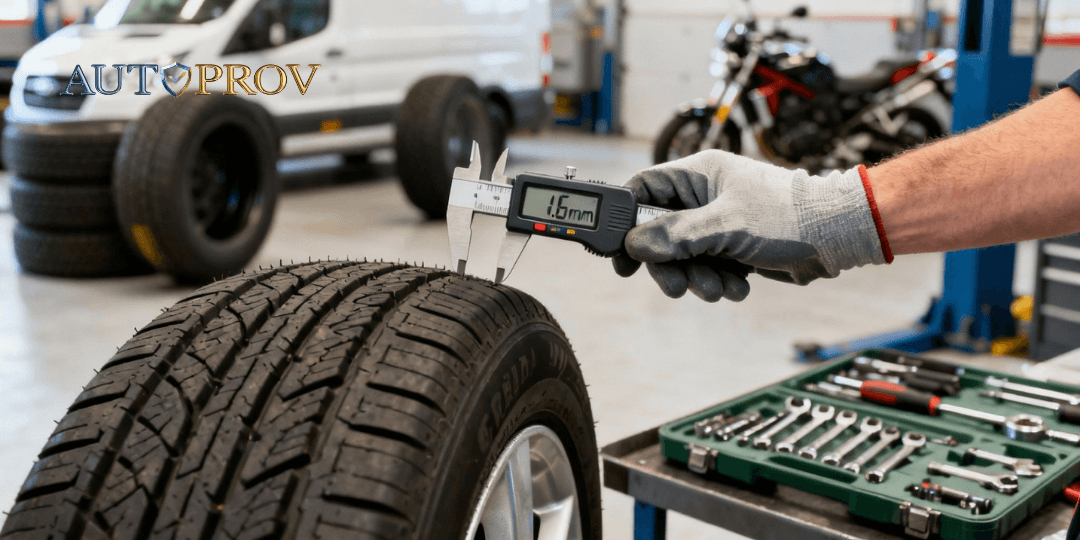
For anyone in the UK motor trade, one number should be front and centre in your mind: 1.6mm. That’s the legal minimum tyre tread depth. But it's so much more than a statistic—it’s a figure that has a direct line to your business's reputation, its legality, and ultimately, its bottom line. Getting this wrong isn't an option.
Why Tyre Tread Is a Critical Metric for Your Business
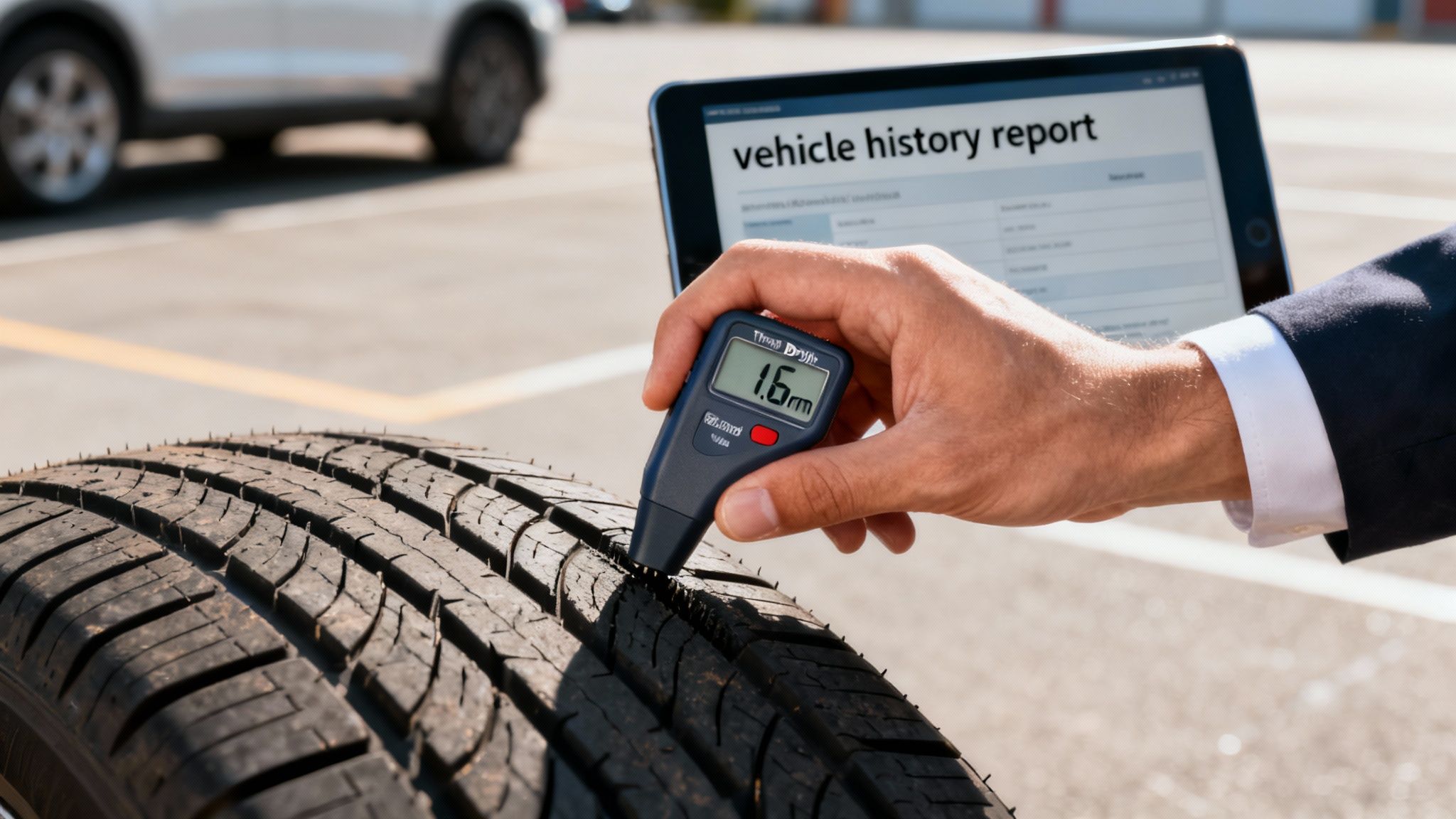
In our world, tyre tread depth isn't just a simple measurement. It's one of the quickest and most honest health checks you can give a vehicle. A glance at the rubber tells you a story about its maintenance history, its safety on the road, and any hidden costs lurking just around the corner.
A car or van with tyres sitting dangerously close to that 1.6mm limit isn't just a risk to its driver. For you, it's a guaranteed expense that must be priced into any valuation. Get that calculation wrong, and you're looking at the difference between a profitable sale and a costly, reputation-damaging mistake.
The Legal and Financial Stakes
The UK has had the 1.6mm minimum tread depth rule on the books since 1992, and it applies to the central three-quarters of the tyre's width. While that's the absolute legal baseline, the safety reality is much starker. Research highlighted by major retailers shows that at 70mph in the wet, tyres with just 1.6mm of tread can take significantly longer to stop compared to a healthy set with 4mm. That's a huge margin for error.
The penalties for getting it wrong are just as severe. We’re talking about fines of up to £2,500 and three penalty points for each illegal tyre.
Let that sink in. For a dealership selling a car or a fleet operator running a van with four illegal tyres, you could be facing a £10,000 fine and a potential driving ban. That's the kind of risk that can shut a business down.
This is exactly why you can't afford to guess. Before you even think about placing a bid, an AutoProv report gives you the vehicle's entire DVLA MOT history, complete with any past advisories on tyre wear. This data, alongside details on the original tyre specifications, is your first line of defence. It helps you spot potential liabilities early, avoiding the purchase of problematic stock.
For fleet managers, this kind of proactive check isn't just good practice; it's a fundamental part of responsible vehicle oversight. You can learn more in our guide on essential fleet management practices.
Understanding the 1.6mm Rule in Detail
Knowing the 1.6mm figure is just the start. To protect your business from legal headaches or a bad buy at auction, you need to understand the specifics. Getting this wrong can be a costly mistake, and the law is very particular about how and where you measure.
It all boils down to two critical phrases that every trade professional should have memorised.
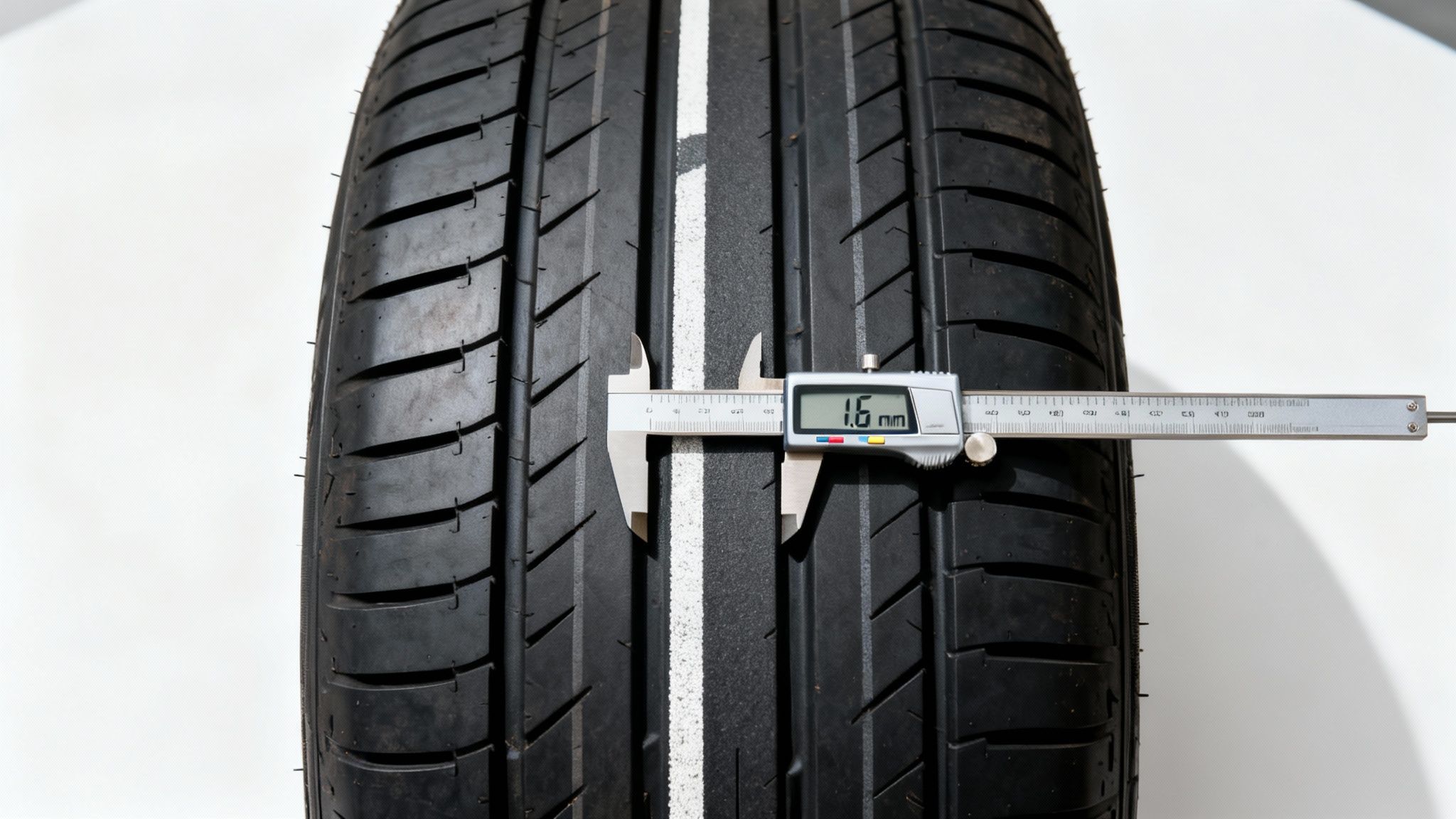
First up is the “central three-quarters” of the tread. This isn't just a vague guideline; it refers to the main strip of the tyre that does the real work on the road. The law demands that the 1.6mm minimum is maintained across this entire central section. A tyre that’s fine on the edges but bald down the middle is illegal, plain and simple.
Second, the measurement must be valid across a “continuous band” that runs around the whole tyre. This means you can't just check one spot and call it a day. A single low point anywhere on that band renders the entire tyre non-compliant. One dip below 1.6mm and it’s a fail.
Putting the Rule into Practice
This level of detail is gold dust when you're appraising a vehicle. For example, if you spot uneven wear across that central three-quarters, it’s a classic red flag for incorrect tyre pressure—often a tell-tale sign of a neglected car.
Likewise, finding a specific low spot in the continuous band could point to bigger problems lurking underneath, like suspension or wheel alignment issues. These are the kinds of problems that will chew through your profit margin if they’re not spotted early.
It's not just about scraping through an MOT; it’s about reading the story a car tells. A set of tyres can reveal a surprising amount about how a vehicle has been treated, giving you a much clearer picture of its true value.
Verifying Specifications with AutoProv
Beyond tread depth, you’ve also got to confirm the tyres are the right spec for the car. Fitting rubber with the wrong speed or load rating isn’t just unsafe, it’s also illegal. This is where a quick AutoProv report proves its worth.
Our reports pull up the original equipment (OE) data for the exact vehicle you’re looking at. In seconds, you can verify if the fitted tyres match the manufacturer’s specifications, giving you another layer of confidence in your appraisal. For a closer look at the rules that impact your bottom line, you can find more by understanding UK automotive regulations in our guide.
Armed with this knowledge and precise data from AutoProv, you’re in a much stronger position to make smarter, more profitable buying decisions.
Practical Ways to Check Tyre Tread Accurately
In the fast-paced motor trade, time is money. Whether you're sizing up a vehicle on the forecourt or making a snap decision at auction, you need fast, reliable ways to assess its condition. Mastering a few simple tyre checks is a non-negotiable skill for making sound judgements on the fly.
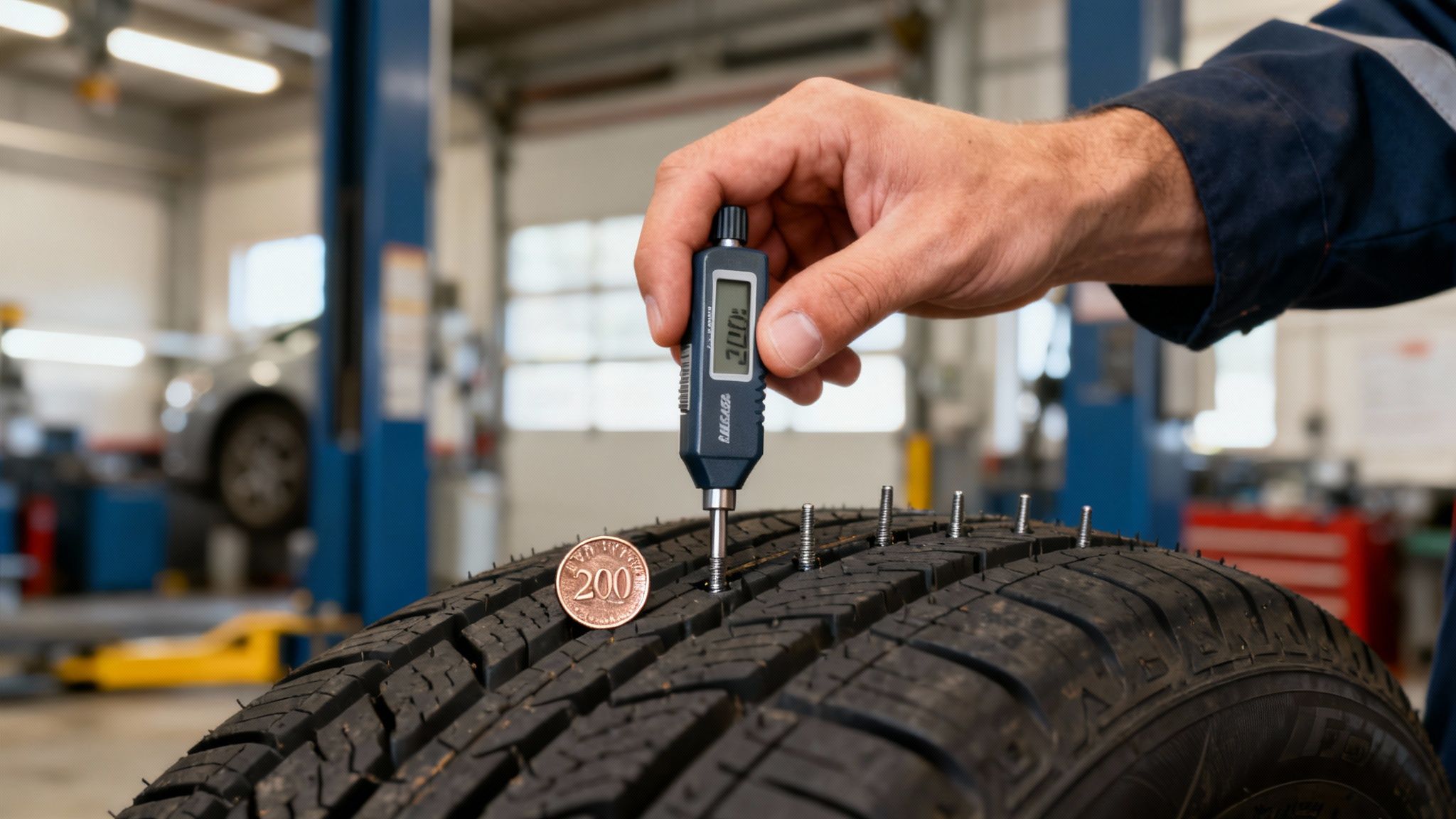
The gold standard, without a doubt, is a dedicated tread depth gauge. These small, inexpensive tools are worth their weight in gold, giving you a precise digital or analogue reading that cuts through any guesswork. You simply pop the probe into the main grooves of the tyre for an instant measurement—just be sure to avoid the small, raised tread wear indicator bars.
But what happens when you don't have a gauge to hand? That's when a surprisingly effective old-school trick comes into its own.
The Reliable 20p Test
The '20p test' is a well-known trick for one simple reason: it works. It’s the perfect quick-and-dirty method for getting a solid idea of whether a tyre is hovering dangerously close to the legal minimum tyre tread depth UK limit.
First, grab a 20p coin and slot it into one of the main tread grooves. Next, look at the coin head-on. If you can see the outer band of the 20p piece, the tread is almost certainly below the legal 1.6mm limit and needs a professional inspection, pronto.
If the tread covers the band, you’re likely in the clear. While it's no substitute for a proper gauge, it’s an invaluable field check for spotting an immediate problem.
A Systematic Approach to Inspection
A single measurement is never enough. To really understand a vehicle's story, you need to check multiple points on each tyre. This is where you uncover the real clues about its history and health. Uneven wear isn’t just a tyre issue; it's a glaring signpost pointing to deeper mechanical problems.
When you find heavy wear on the inner or outer edges, that screams poor wheel alignment. If the centre is worn down, it’s a classic sign of over-inflation. These aren't just tyre problems; they are red flags for neglect that can sink a vehicle's value and foreshadow costly repairs.
By adopting a systematic process for every car, you build a consistent, reliable picture. Your physical inspection is one half of the story; the data is the other. Combining your hands-on check with an AutoProv report gives you the complete, accurate assessment you need. The report details the vehicle's full MOT history, flagging any past advisories for tyre wear and giving you a powerful negotiating tool. This two-pronged approach, using AutoProv's data services, ensures you never miss a critical detail that could make or break a deal.
The Real-World Risks of Non-Compliance
Ignoring the UK’s minimum tyre tread depth rules isn't just a minor oversight—it's a gamble with serious consequences that go way beyond a slap on the wrist at the roadside. For any business in the motor trade, from a small independent dealer to a large fleet operator, getting this wrong is a legal and financial minefield.
The headline figures are enough to make you wince: a fine of up to £2,500 and three penalty points can be slapped on you for each illegal tyre. Think about that for a second. If you sell a car with four bald tyres, that’s not one fine; it's four. You're suddenly looking at a potential £10,000 bill and 12 points, which is enough to see someone banned from driving and cause huge disruption to your business.
Escalating Financial and Legal Dangers
As bad as those immediate fines are, the knock-on effects can be even more destructive for a professional outfit. One of the biggest dangers is your insurance becoming void. If a vehicle you're responsible for is involved in an accident and the insurer finds it was on illegal tyres, they have every right to refuse the claim. That could leave your business on the hook for eye-watering costs.
For dealerships and fleet managers, the risks just keep stacking up. Corporate manslaughter charges are a possibility in worst-case scenarios where a faulty vehicle leads to a fatality. Reputational damage from selling an unsafe vehicle can torpedo your brand, and attracting scrutiny from the DVSA could put your MOT testing status at risk.
Mitigating Risk with Comprehensive Due Diligence
This is exactly why you can't afford to treat due diligence as just another box-ticking exercise. A quick visual once-over simply doesn't cut it anymore when it comes to uncovering a vehicle's hidden skeletons. It's why a tool like AutoProv has become so indispensable for managing risk in the modern motor trade.
By running checks against the Police National Computer (PNC) for stolen vehicle markers and the MIAFTR database for insurance write-offs, you get a clear, undeniable picture of a vehicle's legal history. This data, paired with your own thorough physical inspection, builds a rock-solid defence against bringing toxic stock onto your forecourt.
Better still, an AutoProv report lays out the vehicle's entire MOT history, flagging every past advisory and failure. This historical log is gold dust, helping you spot recurring issues or patterns of neglect that a single check would never reveal. To see just how much these reports can tell you, have a look at our detailed MOT history guide. This kind of intel gives you the power to sidestep vehicles with hidden legal and financial baggage, protecting your investment and your reputation from the get-go.
How Tyre Laws Have Evolved in the UK
To really get a feel for today's safety standards, it helps to look back at where they came from. The current minimum tyre tread depth UK regulation of 1.6mm wasn't just plucked out of thin air; it’s the direct result of mounting concerns over road safety and some pretty alarming statistics.
Before 1992, the legal minimum was a much sketchier 1mm. Now, that might not sound like a huge difference, but when it comes to stopping distances and grip on a wet road, that extra 0.6mm is a massive safety buffer. The push for change really gathered steam as the evidence piled up, showing just how dangerous bald tyres were becoming on Britain's roads.
The Catalyst for Change
The shift to 1.6mm was a genuine landmark moment in UK road safety. It was a clear admission that the old standard just wasn't cutting it for modern traffic speeds and weather conditions. Dig into the parliamentary debates from the late 80s, and you’ll find a troubling picture of widespread non-compliance and a public that just didn't seem to care.
For example, during a 1989 debate, MPs were throwing around some shocking figures. It turned out over 60% of tyres being taken off cars were already below the old 1mm limit. Even worse, a poll at the time revealed that 19% of UK drivers admitted they never even bothered with a basic visual check of their tyres. They were just waiting for the annual MOT to flag any problems. You can dive into the full parliamentary records to see the historic road safety debate yourself.
This history is crucial when you’re sizing up an older or classic vehicle. Decades of different maintenance standards can leave a hidden legacy of neglect. What was once considered ‘acceptable’ would now be seen as dangerously illegal.
Using History to Inform Your Appraisal
Understanding this evolution isn’t just a history lesson—it’s a sharp tool for your vehicle appraisals. A car's long-term MOT history, which you can pull instantly with an AutoProv report, is like flicking through a timeline of its entire life. It lets you see past the shiny paintwork and uncover patterns of maintenance—or a distinct lack of it—stretching back years.
This kind of insight is invaluable. It helps you tell the difference between a well-cared-for classic and a motor that has a long history of just scraping through tests with a list of advisories. A quick walkaround can't tell you that story, but getting the complete data from AutoProv lets you assess a vehicle's true history and make a far smarter buying decision.
Connecting Tyre Condition to Vehicle Valuation
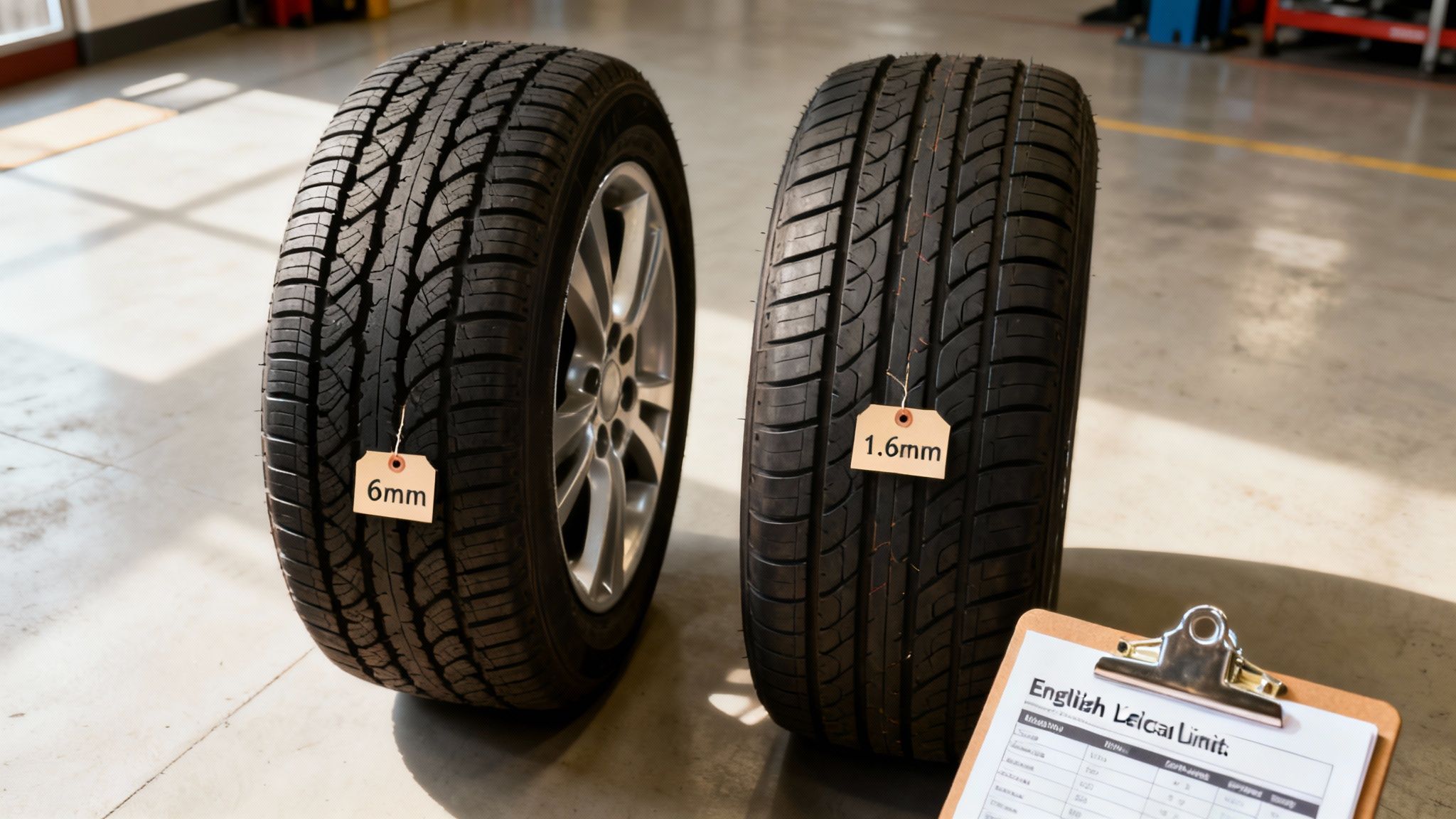
In the motor trade, you know that every last component on a vehicle adds up to its final value. But few things tell a story—or hit the bottom line—quite like the tyres. The state of the rubber is one of the most powerful levers you have in any valuation, directly influencing pricing, negotiations, and your final margin. It’s a dead giveaway of past maintenance and a clear sign of future costs.
Let's be honest, a car that rolls in on a set of premium-brand tyres with a healthy 6mm of tread is a world away from the same model limping along on budget rubber that's just scraping the 1.6mm legal limit. The difference isn't just about looks; it's a solid, quantifiable cost that has to be baked into any deal you make.
Factoring Replacement Costs into Your Bids
Whether you’re appraising a part-exchange or getting ready to bid at auction, the cost of replacing tyres has to be a non-negotiable part of your sums. Get this wrong, and your margin vanishes before the car even hits the forecourt. It's not enough to just glance at the tread depth; you need a professional eye on the brand, overall condition, and how much life is realistically left in them.
This means asking the right questions on the spot. How close are the tyres to the minimum tyre tread depth UK requirement? Is it a mismatched set of budget and premium brands? Can you see any uneven wear? The answers give you a hard number to subtract from your offer. It’s not about being difficult; it's just smart business. You're pricing the vehicle based on its real, ready-to-retail condition.
The Hidden Risks of Public Ignorance
This level of diligence is more important than ever because, frankly, the general public is often clueless about tyre safety. A study by TyreSafe revealed that a significant portion of UK drivers could not even name the correct 1.6mm legal limit, and many thought it was lower.
What does this mean for you? It means a lot of vehicles are coming onto the used market with dangerously worn or flat-out illegal tyres, creating a minefield for trade buyers. The RAC offers a complete guide on what makes tyres illegal that highlights just how common these issues are.
This is precisely where intelligent data becomes your most powerful tool. Cross-referencing your physical tyre inspection with AutoProv’s real-time market valuations and depreciation analysis transforms your appraisal process from an estimate into an exact science.
When you bring this data into your workflow, you can price your stock with pinpoint accuracy and negotiate from an undeniable position of strength. You're not just buying a car; you're acquiring inventory with complete confidence in its true market value. Understanding these details is critical, and you can dive deeper by learning how to calculate vehicle depreciation simply. This knowledge doesn't just protect your profits—it builds your reputation for quality and transparency.
Your Questions on Tyre Tread Depth Answered
Working in the motor trade means you're constantly appraising a mixed bag of vehicles, and the finer points of minimum tyre tread depth UK law can throw up some tricky questions. Let's clear up a few common queries you'll likely run into.
Are the Rules Different for Winter Tyres in the UK?
This is a great question, and the simple answer is no. The legal minimum tread depth stays put at 1.6mm across the central three-quarters, regardless of whether you're looking at standard, all-season, or dedicated winter tyres.
But here's the crucial bit for a professional valuation: safety experts and tyre manufacturers will tell you that winter tyres need at least 3mm of tread to actually do their job in snow and ice. Anything less, and their grip is seriously compromised. When you're appraising a car on winter rubber, you're not just checking if it's legal—you're assessing if it's genuinely safe and effective for the season it was designed for. Worn winter tyres will need replacing, and that's a cost that directly impacts your offer.
What Are the Regulations for Spare Tyres?
Spare tyres can be a bit of a minefield. If the car has one of those skinny, temporary-use 'space-saver' spares, it has its own set of rules, usually printed right there on the tyre wall.
However, if you find a full-size spare in the boot and someone has been driving on it, that tyre must meet the standard 1.6mm tread depth rule like any other. A quick check with an AutoProv report can pull up the original equipment (OE) fitment details, helping you instantly confirm if the spare is even the right spec for the car you're looking at.
An MOT advisory for tyres 'nearing the legal limit' is a major red flag for any trade buyer. It signals an imminent and potentially costly expense for the next owner.
How Does an MOT Advisory for Tyres Affect Value?
It hits the value, plain and simple. An MOT advisory for worn tyres is basically a bill waiting to happen. As a buyer, you have to assume that cost will be passed on to you.
This is where you need to be sharp with your valuation. The cost of replacing two, or more likely four, tyres needs to be factored directly into your offer. Using AutoProv's instant MOT history check means you can spot these advisories on the spot. It gives you the hard evidence you need to negotiate a fair price and ensure you can retail the vehicle profitably after sorting the rubber.
Frequently Asked Questions
AI-Generated Content Notice
This article was created with the assistance of artificial intelligence technology. While we strive for accuracy, the information provided should be considered for general informational purposes only and should not be relied upon as professional automotive, legal, or financial advice. We recommend verifying any information with qualified professionals or official sources before making important decisions. AutoProv accepts no liability for any consequences resulting from the use of this information.
From our AI insights
- Managing Takata Recall Liability: A Trader’s Guide
Explore how UK traders can manage liability for Takata airbag recalls effectively.
- Advanced Airbag and Safety Recall Checks for UK Traders
Ensure safety compliance with advanced airbag and recall checks for UK motor traders. Protect your stock and clients.
- Navigating the A2 Motorcycle Test: Risks & Regulations
Understand A2 motorcycle test rules, vehicle restrictions, and provenance risks to accurately value your stock.
Related Articles

Essential Car Safety Checks for UK Used Cars
Discover crucial safety checks for used cars in the UK to ensure your vehicle is safe and reliable.
A Motor Trader's Guide to the Vehicle Recall Check UK
Performing a vehicle recall check in the UK is an absolutely critical step for any motor trader. It’s not just paperwork; it’s about safeguarding your business, your reputation, and most importantly, your customers.

Cars Safety Ratings: Master Car Safety Ratings
Two cars roll through the same auction lane. Similar age. Similar mileage. Similar guide price. One carries a five-star Euro NCAP result from 2019. The other shows four stars from 2024. If you treat cars safety ratings as a simple hierarchy, the older car looks like the safer buy.
Published by AutoProv
Your trusted source for vehicle intelligence
