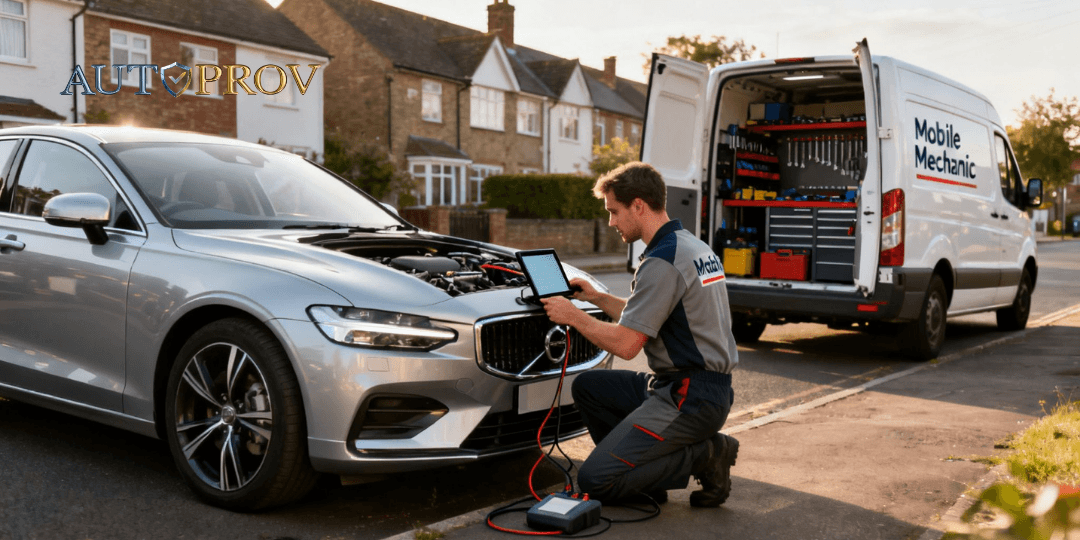
When a motor trade professional searches for a "mobile car mechanic near me," they aren't looking for mere convenience. They require a dependable technical partner capable of maintaining stock condition, reducing vehicle downtime, and supporting forecourt turnaround speed. The focus is on sourcing technicians who understand the operational pace of the motor trade and can deliver efficient service, transparent pricing, and verifiable expertise directly on-site.
The Strategic Shift to Mobile Mechanics for Motor Traders
For progressive dealers, integrating mobile mechanics is a fundamental operational shift, not just a trend. It's a strategic decision to enhance efficiency, reduce overheads, and accelerate the vehicle-to-market timeline.
Instead of the logistical burden of moving vehicles between a sales forecourt and a separate workshop for pre-sale inspections or minor rectifications, the workshop is brought to the vehicle. This on-site service model offers significant operational advantages.
For motor traders, the benefits are clear:
- Reduced Vehicle Downtime: Eliminates wasted time in transit. A mobile mechanic performs repairs and inspections on-site, making vehicles sale-ready significantly faster.
- Lower Logistical Overheads: Avoids costs associated with trade plates, fuel consumption, and staff time required to move vehicles to and from a garage.
- Increased Flexibility: Enables a reactive approach to repairs, addressing issues as they arise without removing a vehicle from the sales environment. This agility is a core component of modern fleet management practices.
The Growing Demand and Associated Risks
The demand for mobile mechanic services has increased substantially across the automotive sector. Google search interest has grown by over 300% since 2020, with service bookings following a similar upward trend.
However, this rapid growth introduces new risks. The low barrier to entry for establishing a mobile service means the quality, reliability, and professionalism of operators can vary significantly. While established services like those offered by Auto Repair Shops Dealerships have internal standards, the independent market is less regulated.
For a motor trader, engaging an inadequately vetted mechanic can lead to significant issues, including liability exposure, substandard work requiring further rectification, and delays that jeopardise sales. Diligent vetting is not merely advisable; it is essential for protecting assets, capital, and business reputation.
Sourcing and Shortlisting Trade-Focused Mechanics
Identifying a reliable mobile mechanic for motor trade purposes requires more than a simple online search. The objective is to find a technical partner who understands the specific demands of a dealership environment, where "fixed" means "forecourt-ready," not just temporarily roadworthy.
Tapping into your existing trade network is often the most effective starting point. Consult other dealers, participate in private motor trade forums, and seek recommendations from peers facing similar operational challenges. A referral from a business that has already tested a mechanic in a commercial setting is invaluable.
Dissecting Online Presence and Reviews
When evaluating online sources, it is crucial to analyse reviews with a trade-focused perspective. A high rating from a one-off private job does not confirm a mechanic's ability to manage the volume, complexity, or speed required by a dealership.
Search reviews for terms like "dealership," "trade work," "quick turnaround," and "professional." A mechanic commended for clear communication and operational efficiency is a more suitable prospect than one whose primary selling point is a low price.
Building a robust network of specialists is fundamental to smooth dealership operations. This includes having trusted contacts for unexpected issues, such as needing quick help mobile fuel drain services near me. For further insights on establishing a resilient business, our guide on how to start a car dealership offers practical advice.
The right mobile service can significantly streamline workflow, as illustrated below.
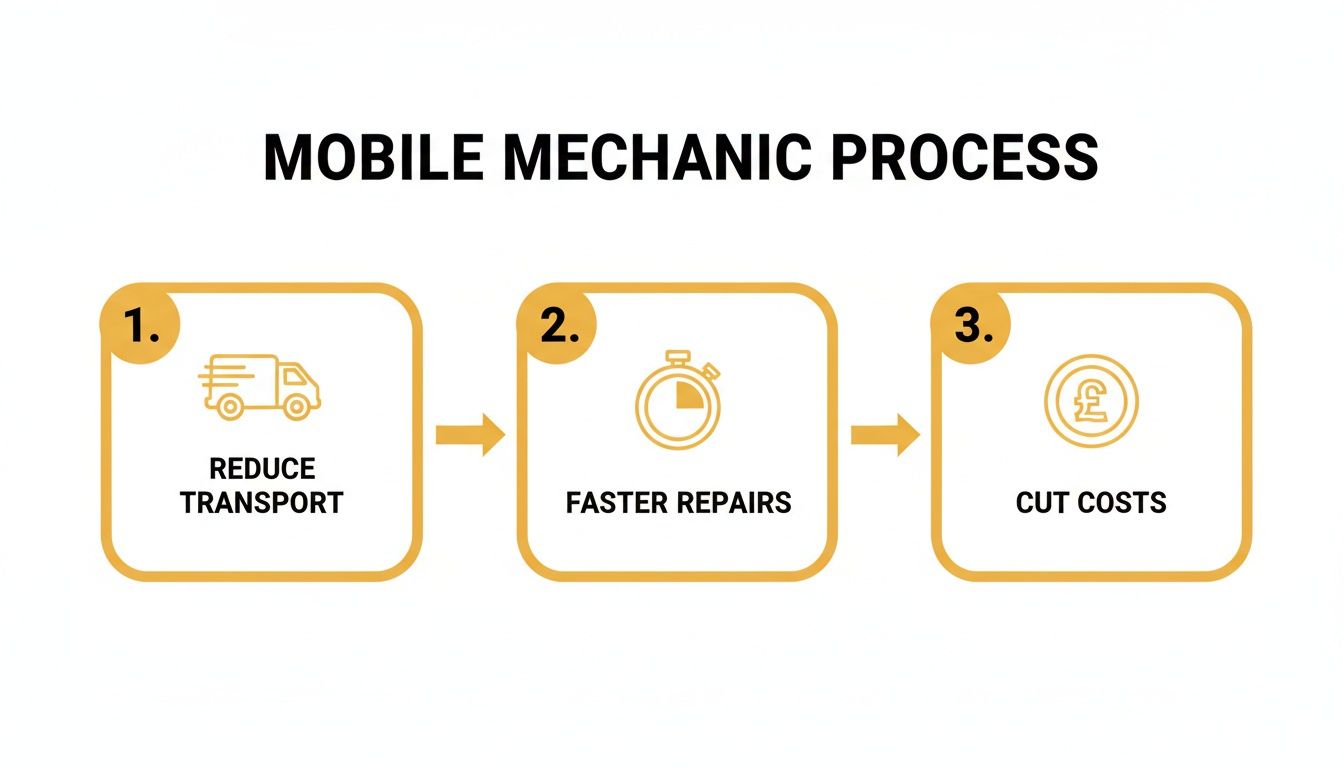
This model directly impacts operational efficiency. By reducing vehicle transport and accelerating repair times, you lower overheads and decrease the time-to-sale for each unit of stock.
Making the Initial Outreach
The initial communication serves as the first test of professionalism. The promptness and clarity of their response are strong indicators of their dependability when a vehicle is off-sale and incurring holding costs.
Use the initial discussion to gauge their understanding of the motor trade. Ask directly about their experience with pre-sale inspections, cosmetic preparation, or other common trade-specific tasks. Their answers will reveal their suitability for a commercial client. A hesitant or vague response suggests a lack of relevant experience.
Critical Questions to Ask Before Commissioning Work
Once a shortlist of potential mobile mechanics is compiled, a thorough due diligence process is required. Asking precise questions upfront is non-negotiable for safeguarding high-value stock. The goal is not to negotiate the lowest price but to identify a reliable, professional partner.
Before allowing any work to commence, you must be clear on their professional credentials and insurance coverage. Vague answers to direct questions are a significant red flag. You need verifiable proof that they operate as a legitimate business equipped for the demands and liabilities of the motor trade.
Verifying Insurance and Expertise
First, address the essential legal and professional requirements. Any professional mobile mechanic operating in the UK motor trade must hold appropriate insurance. Do not rely on verbal confirmation; request to see documentation.
Key questions to ask include:
- "Can you provide proof of your motor trade and public liability insurance?" This is the most critical question. Without adequate cover, any damage to your vehicle, property, or third parties could become your financial responsibility.
- "What is your experience with [specific marque or model]?" If your business specialises in certain brands, you need a mechanic with demonstrable expertise, particularly for complex diagnostic work.
- "How do you stand by your work?" Enquire about their warranty on labour and parts. A reputable mechanic will offer a guarantee, typically for a period of months or a specified mileage.
The role of mobile mechanics is significant. Recent industry analysis indicates they now conduct over one-third of all brake repairs (36%) and nearly three in ten engine repairs (29%) in the UK, competing directly with established garages. This capability to handle major repairs underscores the importance of thorough vetting.
Clarifying Logistics and Costs
With the fundamentals verified, focus on the operational details. Misunderstandings regarding pricing or parts sourcing can damage a working relationship. It is vital to establish clarity on all service aspects before work begins.
Obtain firm answers on their fee structure. Will you be charged a separate call-out fee, or is it included within the labour cost? Understanding this prevents unexpected charges on the final invoice and allows for accurate margin calculation on your part.
Finally, clarify their process for sourcing parts. Knowing their policies upfront ensures alignment with your standards for quality and efficiency. A valuable tool for standardising your own processes is our ultimate used car inspection checklist, which helps formalise vehicle evaluation before any work is commissioned.
Understanding Fair Pricing and Negotiating Trade Rates
Analysing the cost of a mobile mechanic involves more than a single hourly rate. A final invoice is typically composed of several charges. Understanding this structure allows for a more informed comparison of quotations.
Most mobile mechanics use a clear pricing model: a standard call-out fee to cover travel and initial diagnostics, followed by an hourly labour rate for the repair itself. This rate may increase for more complex tasks, such as advanced vehicle electronics, which require specialist equipment and expertise.
How Location Affects Cost
Pricing varies significantly across different regions of the UK. Your geographical location directly impacts labour rates and call-out fees, which in turn affect your operational costs.
For instance, a mechanic in London or the South East typically charges between £55 and £80 per hour, with call-out fees in the £60 to £85 range. In cities like Manchester or Birmingham, these rates may decrease to £45-£65 per hour. In more rural areas, the hourly rate might be lower, from £35-£55, but the call-out fee may be higher to compensate for longer travel times. For a detailed analysis of pricing, this breakdown on what mobile mechanics charge in 2025 provides useful context.
Exercise caution with any quotation that appears significantly below the market rate. An unusually low price can be an indicator of an inexperienced, uninsured, or substandard operator—a risk that is unacceptable when dealing with valuable stock.
Motor traders who can provide regular, consistent work are in a strong negotiating position. Many mobile mechanics are willing to offer preferential trade rates in exchange for a reliable volume of jobs. Once a trusted technician is identified, discuss establishing a formal arrangement. This could involve a reduced hourly rate or a fixed price for routine tasks like pre-sale inspections, leading to more predictable business costs. To better understand the market, you can also review our complete UK guide to car service pricing.
Using Vehicle Provenance to Guide Repair Decisions
Before authorising a mobile mechanic, an astute motor trader must look beyond the presenting fault. A directive to 'just fix it' can be a costly error if the vehicle's full history is unknown. A seemingly minor engine management light could be a symptom of a deeper, undisclosed issue that a comprehensive vehicle provenance check would reveal.
This upfront intelligence gathering transforms the decision-making process. You are no longer reacting to an isolated problem but making a strategic judgement based on a complete dataset. This prevents investing capital into a vehicle that is fundamentally unprofitable or, worse, has an undisclosed safety risk.
Linking History to Mechanical Faults
Consider a common scenario: a vehicle presents with a persistent engine management light. A basic diagnostic scan indicates a faulty sensor—a straightforward repair. However, a full vehicle history check UK report reveals a significant mileage discrepancy recorded at its last MOT. The context changes entirely. The issue is no longer a simple sensor fault but a major risk indicator for a 'clocked' engine with indeterminate wear.
Ownership history provides similar critical signals. A pattern of short-term ownership and rapid resale should be a cause for concern. If a vehicle has had three owners in the last 12 months and now requires a clutch replacement, this is unlikely to be standard wear and tear. It is more indicative of a recurring drivetrain issue that previous owners have chosen to pass on rather than resolve.
By running a full report before commissioning repairs, you shift from simply instructing a mechanic to providing them with vital intelligence. The conversation becomes, "Investigate this sensor fault, but be aware of a mileage anomaly and a history of rapid resale."
This intelligence-led approach enables the mechanic to conduct a more thorough and targeted diagnosis. Understanding a vehicle's background is crucial, and a detailed vehicle provenance report provides this essential context. Armed with the full picture, you can make a more informed decision on whether to invest in the repair, renegotiate the acquisition price, or reject the vehicle.
Frequently Asked Questions for Motor Traders
As a motor trade professional, profitability is driven by efficient and informed decisions. When seeking a mobile car mechanic near me, your requirements and questions will differ from those of a private car owner.
Here are concise, trade-focused answers to common queries when integrating a mobile mechanic into a commercial operation.
What Insurance Is Absolutely Non-Negotiable?
The two essential policies you must verify are motor trade insurance and public liability insurance.
Motor trade insurance provides cover while the mechanic is working on or moving your stock. Public liability protects against accidental damage to your premises or other vehicles on the forecourt. Request to see the current certificates for both policies before any work commences. If they cannot produce valid documentation, you should not proceed.
How Should I Handle Parts Sourcing and Supply?
This process must be clarified during the initial conversation. You need to establish whether they will source parts or if you are expected to supply them via your own trade accounts.
If they are sourcing parts, clarify their suppliers and the grade of parts used (e.g., genuine, OEM, or aftermarket). For trade work, a transparent process for parts approval and invoicing is essential to manage costs and prevent future disputes.
Is It Realistic to Expect Diagnostics on Complex Vehicles?
Many professional mobile mechanics are equipped with advanced diagnostic tools capable of interrogating complex electronic systems on most modern vehicles. However, this capability should not be assumed. It is vital to confirm their equipment is suitable for the specific marques you handle.
Ask them directly: "Which diagnostic systems do you use, and do they have full functionality for brands such as BMW, Mercedes, or VAG group vehicles?" A professional will understand the distinction between dealer-level diagnostics and a generic code reader and will be transparent about their system's limitations.
Ultimately, vetting a mobile mechanic for your business requires the same rigour as for any other supplier. Gaining clarity on insurance, parts, and diagnostic capabilities is key to building a reliable and profitable partnership.
Before you authorise any repair, ensure you understand the full history of the vehicle. AutoProv delivers the advanced vehicle provenance intelligence UK motor traders need to make smarter, risk-assessed decisions on every car. Learn more at https://autoprov.ai.
Frequently Asked Questions
AI-Generated Content Notice
This article was created with the assistance of artificial intelligence technology. While we strive for accuracy, the information provided should be considered for general informational purposes only and should not be relied upon as professional automotive, legal, or financial advice. We recommend verifying any information with qualified professionals or official sources before making important decisions. AutoProv accepts no liability for any consequences resulting from the use of this information.
From our AI insights
- Navigating Recall Compliance for UK Car Traders
Ensure compliance with recall regulations: essential steps for UK car traders.
- Unlocking Manufacturer Warranty Transfers for UK Traders
Master the nuances of manufacturer warranty transfers for used cars in the UK and avoid disputes.
- Navigating Incomplete Service Histories: A Trader's Guide
Effective strategies for UK traders managing incomplete vehicle service histories.
Related Articles
The Importance of Car Maintenance and Provenance Checks
Discover why regular car maintenance and proper provenance checks are essential for vehicle quality and longevity.
Essential Car Maintenance Tips for UK Drivers
Discover vital car maintenance tips to keep your vehicle roadworthy and compliant in the UK.
How Much Is a Car Service? Complete UK Price Guide
Trying to pin down exactly "how much is a car service?" can feel a bit like asking "how long is a piece of string?". Prices vary quite a bit, but to give you a ballpark figure, an interim service will usually set you back around £100 to get started. A more thorough full service often begins at £180, while a major service for many cars can easily top £300.
Published by AutoProv
Your trusted source for vehicle intelligence