
A dealer takes a 2018 BMW 3 Series in part exchange. The MOT is current, the V5C is present and the paperwork looks tidy. Two weeks later, a buyer pulls the full record and finds three consecutive brake-disc advisories that were never clearly addressed, followed by a sharp mileage jump. The car still passed its latest test, but the buying decision was made on a pass badge rather than on the vehicle's history.
That distinction matters across every vehicle history check UK process. An MOT record is valuable evidence, but it's only one layer of vehicle provenance. Used properly, it can expose recurring defects, mileage anomalies and periods that need explaining. Used alone, it can create false confidence.
Table of Contents
- Why a Clean MOT Paperwork Is Not the Same as a Clean History
- What the MOT record can tell you
- Pulling the MOT History of Car Records in Five Minutes
- Record the fields that affect the bid
- Reading Between the Test Entries
- What each field tells a buyer
- Recurrence is more useful than drama
- Tracing Mileage Patterns Like a Trade Buyer
- Recognise the staircase
- Where MOT History Stops and Provenance Starts
- The escalation rule
- Turning Red Flags into Buying Decisions
- Use evidence to set the action
- Trade Workflow Checklist and Common Dealer Questions
- The one-minute appraisal sequence
- Questions dealers ask most often
Why a Clean MOT Paperwork Is Not the Same as a Clean History
An MOT pass confirms that the vehicle met the test requirements at the time of inspection. It doesn't confirm how carefully the owner maintained the car between tests, whether previous advisories were repaired properly, or whether the vehicle's ownership and mileage story makes commercial sense. The GOV.UK explanation of MOT certificates is useful for understanding the document, but the trade buyer needs to read the history behind it.
The modern UK motoring system developed through legal, administrative and industrial changes rather than a single launch date. The Royal Automobile Club's motoring timeline traces the opening of public roads to motor traffic to 1896, when the restrictive Red Flag Act was repealed, and records that Britain had only about 14 to 15 cars on its roads by the end of 1895, compared with roughly 700 to 800 by 1900. That history is a reminder that records and regulation have always shaped how vehicles are bought, used and trusted.
What the MOT record can tell you
A public MOT history can show:
- Test dates: Whether the vehicle has been presented at a broadly expected rhythm.
- Recorded mileage: The sequence is more useful than any isolated reading.
- Pass and fail outcomes: A starting point, not a final verdict.
- Failure reasons: Evidence of defects that affected roadworthiness.
- Advisories: Early warnings that may become future repair items.
- Test location: A useful context signal when the vehicle appears to move between regions.
The record doesn't normally establish previous keepers, accident repair quality, finance status, insurance events or whether a vehicle identity has been manipulated. A basic MOT screen also won't explain why a car changed hands rapidly.
Practical rule: A clean vehicle has three forms of cleanliness. It passes the current test, its mechanical warnings show a credible repair pattern, and its provenance makes sense.
The opening 3 Series scenario would have been handled differently by copying every test entry, plotting the mileage sequence, checking whether the brake advisories recurred and escalating the vehicle to a wider used car history report. A VIN tool can also help confirm that the vehicle details align with the identification data. For Toyota stock, a resource such as the VinCheck Toyota VIN decoder can be a useful additional identity check, but it shouldn't replace the UK MOT and provenance review.
Pulling the MOT History of Car Records in Five Minutes
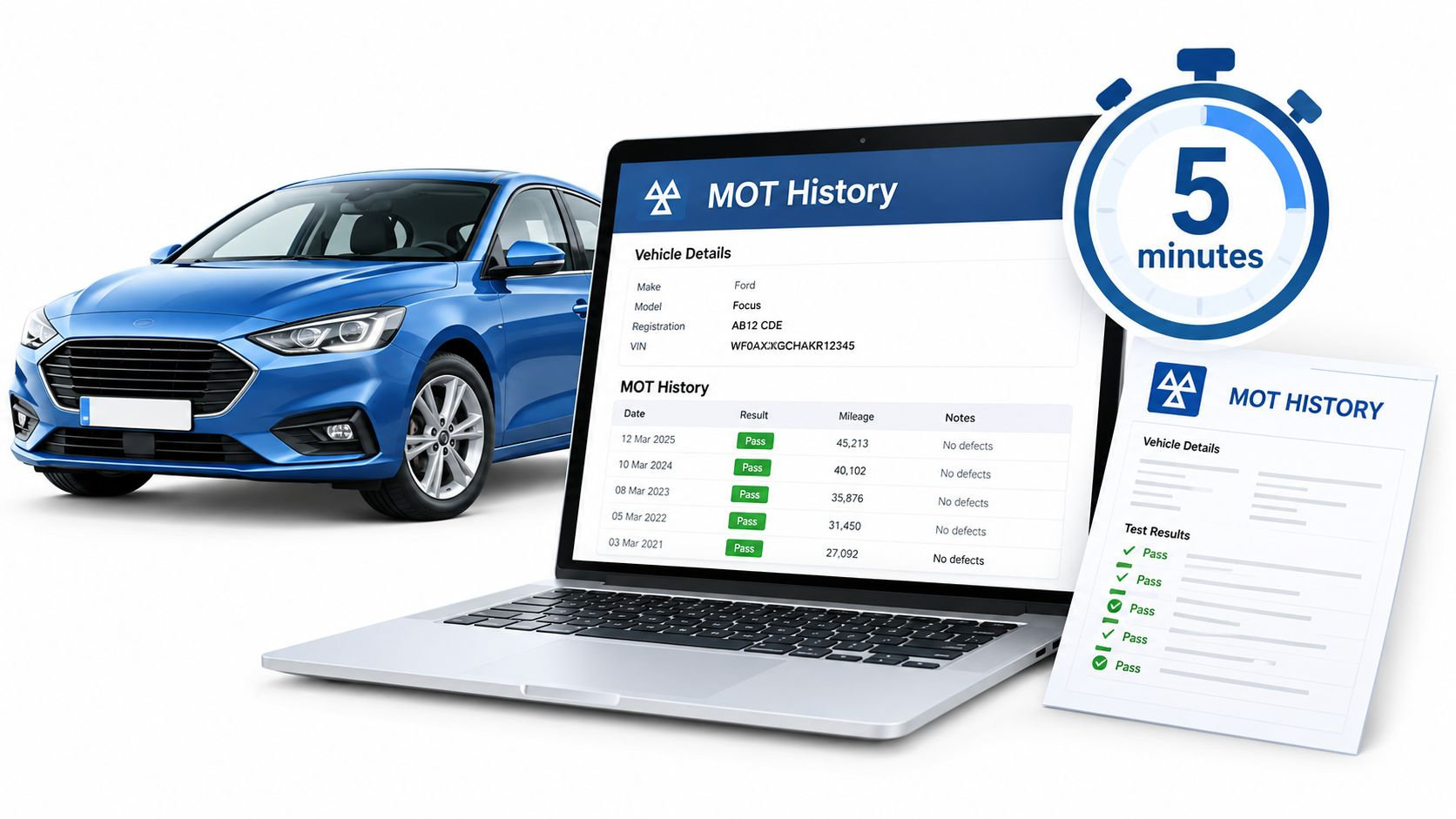
Start with the registration mark, not the seller's description. Open the GOV.UK MOT history service, enter the VRM and check that the make and model on screen match the car in front of you.
The public MOT record shows test outcomes and the mileage taken at each test. The underlying DVSA MOT testing data is updated every three months and includes MOT tests and outcomes, plus make or model, odometer readings and failure reasons since computerisation in 2005. For an older vehicle, that can give you up to roughly 21 years of mileage checkpoints, although the public history only starts once the car enters the MOT cycle.
Record the fields that affect the bid
Write a stock note before you leave the page. Capture:
- Test date, including the latest test and the gap between tests.
- Mileage, copied exactly, not rounded from memory.
- Result, pass, fail or refusal where shown.
- Defects and failure reasons, grouped by component.
- Advisories, including items that appear again in similar wording.
- Expiry date, which shows how much MOT cover remains.
- Test centre or location, where the record provides it.
Copying or screenshotting each entry is practical because portal data is harder to pull back later, especially when you are working from a yard, auction site or shared buying desk. It also keeps the evidence used in the appraisal if the deal is challenged later.
The process has edge cases. Vans over 3,500kg may follow an HGV-style testing route, and vehicles from Northern Ireland follow a different scheme. Do not force either type into a standard car workflow without checking the relevant record. For the related tax and MOT status check, see the guide to check MOT and tax for free.
A current pass is necessary, but it is not enough. In DVSA-published 2026 Q1 data for class 3 and 4 vehicles, 7,808,594 tests produced 26.75% failures, 21.72% refusals and 64.0% passes. The trade lesson is simple: a failed test is not always a bad buy, and a pass is not always a good one. Pull the MOT record before every trade appraisal, including repeat sellers, because mileage, keeper context and the latest test can change.
Reading Between the Test Entries
A clean result badge can still hide a messy file. A pass only means the car met the test standard on that day. It does not tell you whether the previous visit failed on brakes, whether the repair held, or whether the car has been carrying deferred maintenance for months.
What each field tells a buyer
MOT Data Field Headline Meaning Trade Interpretation Test date When the vehicle was examined Compare the spacing of tests and look for unexplained gaps Mileage Odometer reading at test Build the sequence and check for reversals, flat periods or sharp jumps Result Pass, fail or refusal Use it as a screening signal, then read the defect wording Failure reason Defect serious enough to prevent a pass See whether the same system keeps coming back Advisory Condition noted but not yet a failure Treat repeated advisories as deferred repair evidence Expiry date When the current MOT runs out Useful for valuation and prep timing, not a condition guarantee Test location Where the test took place Compare changes with the vehicle's keeper and usage story Defect categories matter more than the headline result. Repeated references to brakes, suspension, tyres, lights, exhaust, emissions or structure often tell you how the car has been treated. One worn tyre is normal appraisal material. Repeated brake-line corrosion or suspension faults point to a different sort of risk.
Advisories are often the sharpest part of the record because they show what the tester saw before the item became a failure. A tyre near its limit, an oil leak, or a corroded brake line may be manageable on its own. The trade risk rises when the same wording appears on consecutive tests, or when several related items move in the same direction.
Recurrence is more useful than drama
A single failure can reflect an isolated repair. A repeated failure in the same category suggests the previous keeper delayed the work, accepted a temporary fix, or faced a deeper problem than the wording first implied. The MOT record includes failure reasons and advisories because the pattern matters more than one snapshot.
Test-centre movement also needs context. A change of location may reflect a dealer sale, relocation, or a different garage. It can also mean the vehicle has moved between regions or owners, so compare it with keeper information rather than treating it as proof of risk.
The GOV.UK MOT checker shows test status and recorded mileage, but it will not explain ownership history for you. That boundary matters when a dealer is deciding whether to bid, negotiate, or move the vehicle to a wider trade vehicle intelligence check.
Tracing Mileage Patterns Like a Trade Buyer
Mileage analysis works best as a shape, not a single number. Put each recorded reading in chronological order, calculate the increase between tests and divide the increase by the time elapsed. You're looking for a credible usage story, not a supposedly perfect annual average.
An illustrative private-use pattern might show readings rising from 48,000, to 57,000, to 67,000 and then 78,000 miles at successive tests. The increases are broadly steady, which supports a normal-use explanation. It doesn't prove the odometer is genuine, but it gives the buyer a coherent baseline to test against the dashboard, service invoices and other records.
A different pattern might remain at 82,000 miles across several entries before moving suddenly to 119,000 miles. That could indicate an unrecorded period, missed tests, SORN or an incorrect entry. It could also point to clocking. The record alone doesn't tell you which explanation is correct, so the next action is evidence gathering, not an automatic accusation.
Recognise the staircase
A staircase of identical readings is particularly uncomfortable when it appears across multiple tests. If the odometer shows the same figure repeatedly and then increases by a large amount, someone may have stopped the clock, the readings may have been copied incorrectly, or the car may have spent a long period off the road. Each possibility changes the valuation and the level of proof required.
Use a practical review threshold. Flag any gap longer than 18 months for a written explanation and supporting evidence, while remembering that a gap isn't automatically fraudulent. A vehicle may have been declared SORN, stored, imported, undergoing repair or affected by a record error. Citizens Advice recommends treating gaps cautiously and checking whether the vehicle was legitimately off-road under SORN.
Mileage Pattern Tells in MOT History What It Looks Like Likely Cause Dealer Action Steady climb Readings rise in a broadly consistent sequence Credible ongoing use Compare with service and dashboard records Long flat period Little or no movement across tests Storage, SORN, missed test or clocking Request an explanation and supporting documents Sudden jump A large increase after a quiet period Unrecorded use, late test or corrected history Recalculate usage and revalue conservatively Downward move A later reading is lower than an earlier one Entry error or mileage manipulation Stop the appraisal until evidence is obtained Repeated identical readings The same number appears across successive tests Possible stopped clock or copied reading Escalate for a detailed mileage check UK review The guide to understanding mileage anomalies in MOT records is useful alongside the raw history, but the physical checks still matter. Compare the latest MOT reading with the dashboard, service book, invoices and vehicle job cards before money moves.
If a mileage entry is disputed, GOV.UK says the MOT centre must see the vehicle again, or the correction process needs evidence such as an invoice, emissions printout, service receipt or job card. The evidence should show what the mileage should have been and carry a date within one day of the MOT test. That makes documentary corroboration a control point, not an optional extra.
Where MOT History Stops and Provenance Starts
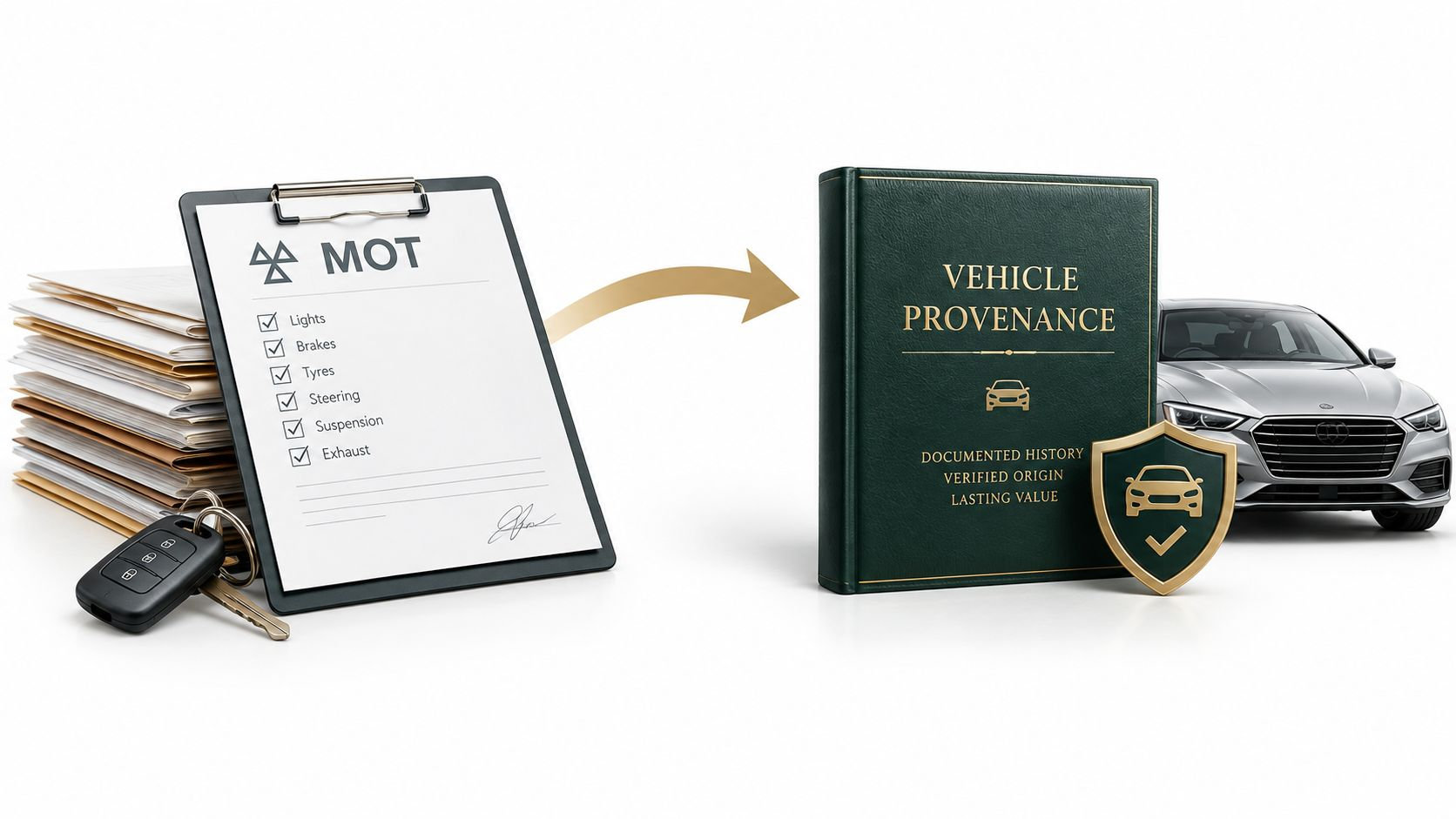
An MOT record proves that a vehicle was tested. It doesn't prove who maintained it, how it was driven, why it changed hands or whether it has an insurance-related history. That's the exact boundary between MOT history of car records and full vehicle provenance.
MOT data can establish a test timeline, mileage checkpoints, defect behaviour and test-centre activity. Ownership analysis sits elsewhere. The MOT history service doesn't show previous keepers, and online DVLA vehicle enquiry data doesn't normally display current or previous registered keepers. A dealer therefore can't derive a keeper timeline from MOT entries alone.
The escalation rule
Set a clear handover point in the buying process. Once the MOT record shows one of the following, the next check should fire:
- A keeper gap or rapid resale pattern: Establish whether the vehicle has moved through several short-term owners or trade channels.
- An insurer or write-off marker: Review the event and inspect the quality and scope of any repair.
- Mileage outside the expected band: Seek invoices, service history and correction evidence before valuing the car.
- An unexplained record gap: Check SORN, storage, import or registration context rather than accepting a verbal explanation.
- A VIN or identity concern: Match the vehicle identity across the physical car, documents and independent data.
A V5C provides continuity evidence, but it isn't a complete ownership history. Finance and insurance information adds another layer, while a provenance platform can connect ownership patterns, mileage behaviour and risk indicators in a single decision workflow. The difference between a provenance check and a comprehensive provenance report helps frame how far the investigation should go.
The trade-off is speed versus exposure. A basic MOT lookup is quick and inexpensive, which makes it appropriate for initial screening. It isn't sufficient when the car carries contradictory readings, unusual keeper activity or a repair history that could affect resale, margin and compliance records.
A dealer doesn't need every vehicle to have the same investigation. The dealer does need every investigation to escalate when the evidence changes.
Turning Red Flags into Buying Decisions
An anomaly is a decision point, not automatically a deal-killer. A single advisory on a wearable item may justify a price adjustment. Repeated failures in the same safety system can justify a much harder position because the previous repair pattern suggests ongoing exposure.
The response should match the evidence. If a tyre advisory appears once and the tread and sidewalls are now sound, record the observation and price the vehicle normally. If brake defects appear across multiple tests, require a condition-of-sale repair, obtain a proper inspection or reduce the bid enough to reflect the unknown repair depth.
Use evidence to set the action
Red Flag Type Example Signal Risk Level Recommended Dealer Action Isolated wear advisory One tyre or lamp advisory with no recurrence Lower Inspect the item, allow for preparation or negotiate Repeated advisory Similar brake, suspension or corrosion wording across tests Medium to high Request repair evidence, inspect independently and reprice Repeat failure The same component fails on consecutive tests High Require a documented repair or consider walking away Mileage reversal A later MOT reading is lower High Pause the purchase until correction evidence is verified Prolonged gap Missing tests without a credible reason Medium Check SORN, storage and keeper context before bidding Sudden clean record A pass with no advisories after years of defects Medium Request invoices and confirm the repair story Ownership churn Several short-term keeper changes or rapid resale Medium to high Escalate to provenance and identity checks The 2026 Q1 class 3 and 4 outcome data shows why a failed test alone shouldn't decide the deal. There were 7,808,594 tests, with 26.75% failures, 21.72% refusals and 64.0% passes in the DVSA-published results. The useful signal is the defect pattern and whether the owner or seller can show a credible response to it, not the emotional impact of seeing the word “fail”.
Missing years need a story backed by evidence. A SORN explanation should align with the vehicle's records and condition. A service invoice should correspond with the mileage and date. A claimed repair should be supported by a workshop record rather than a vague assurance that “it was all done”.
Walk away when the evidence is contradictory and the seller won't provide reasonable support, particularly where identity, mileage or structural repair is involved. A margin opportunity isn't a margin if the stock creates reconditioning uncertainty, a post-sale dispute or a provenance problem.
Trade Workflow Checklist and Common Dealer Questions
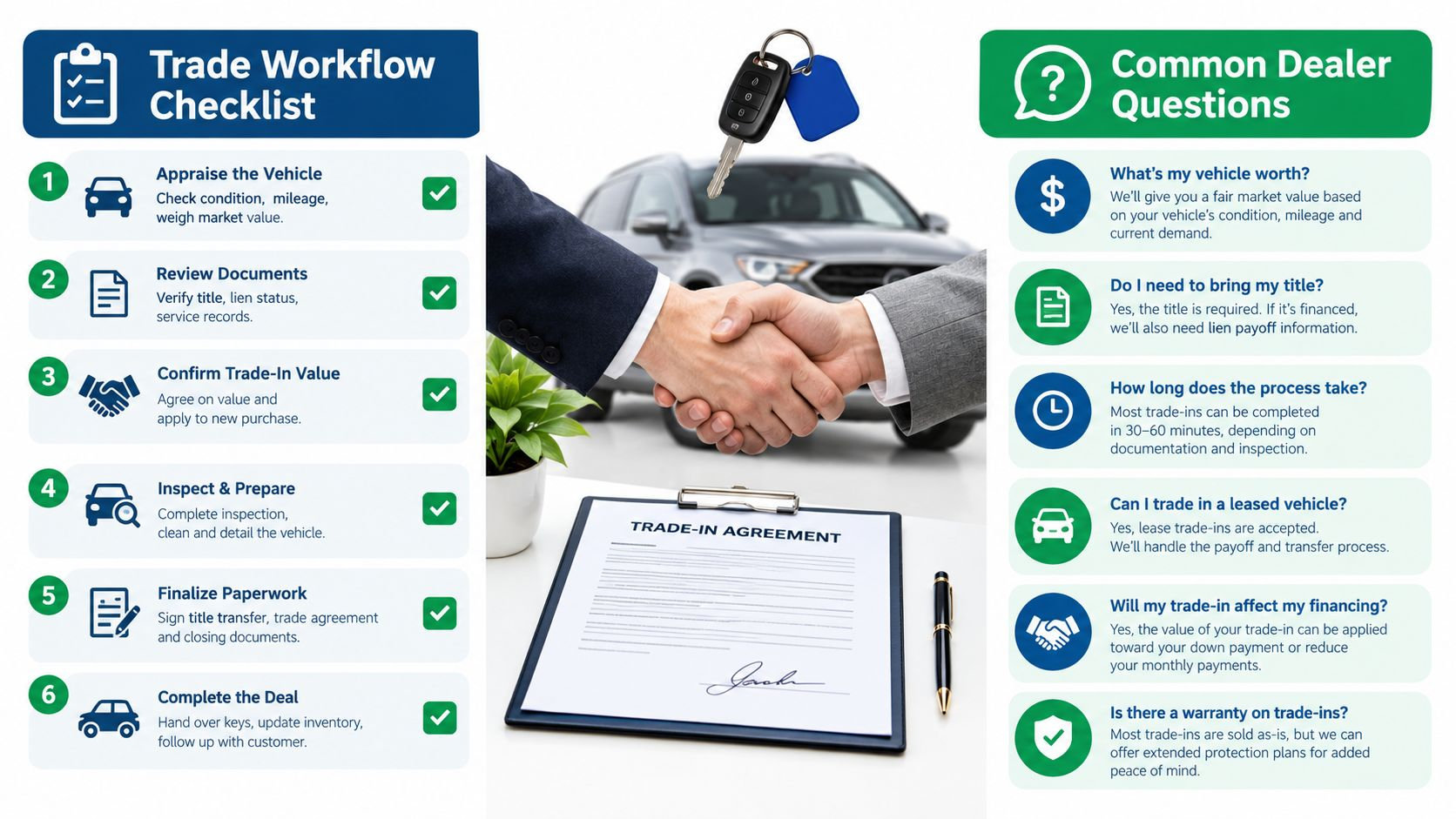
Run the same process on every unit, even when the seller is known and the car looks familiar. Consistency prevents a busy buying desk from treating a repeat seller's description as a substitute for current evidence.
The one-minute appraisal sequence
- Capture the registration: Match the VRM to the vehicle and documents.
- Pull the MOT: Record every visible test date, result and mileage.
- Trace the readings: Look for reversals, flat periods and abrupt jumps.
- Review advisories: Mark recurring language and safety-related items.
- Group failures: Separate isolated wear from repeated system faults.
- Cross-reference keepers: Compare ownership context with the test timeline.
- Check the physical car: Match the dashboard reading, VIN and condition.
- Choose the action: Buy, negotiate, condition the sale, escalate or walk away.
Keep the record with the appraisal, not in a browser tab that disappears after the auction closes. A clear note should show what was known at the point of purchase and why the buyer accepted, renegotiated or rejected the risk. The complete vehicle appraisal checklist for trade buyers can help standardise that process across a buying team.
Questions dealers ask most often
How far back does the MOT history go?
The DVSA dataset includes MOT tests and outcomes since computerisation in 2005, and it's updated every three months. Public history still starts from the vehicle's MOT cycle. GOV.UK states that a new vehicle needs its first MOT by its third anniversary, followed by annual testing for most cars and vans, so the early years won't contain the same mileage trail as later years.
Does an MOT gap mean clocking?
No. A gap can reflect SORN, storage, repair, import activity or a record error. It becomes a buying risk when the explanation doesn't align with the vehicle's mileage, condition, documents or keeper context.
What counts as a recurring defect?
The same component or defect category appearing on consecutive tests is more meaningful than several unrelated advisories. Repeated brakes, suspension, corrosion or emissions issues deserve a deeper inspection and evidence of repair.
When should an advisory block a sale?
An advisory should block or condition the transaction when it involves a safety-critical or structural concern, recurs without repair evidence, or combines with contradictory mileage and provenance signals. A minor isolated wear item usually calls for preparation or negotiation rather than automatic rejection.
A reliable dealer vehicle checks process doesn't ask whether the car has a clean MOT. It asks whether the record, the vehicle and the provenance story agree.
AutoProv combines MOT history, mileage patterns, ownership timelines and risk indicators for UK motor trade buying decisions. Use the AutoProv platform to review vehicle provenance before committing capital, then build the findings into your appraisal and negotiation process.
Frequently Asked Questions
AI-Generated Content Notice
This article was created with the assistance of artificial intelligence technology. While we strive for accuracy, the information provided should be considered for general informational purposes only and should not be relied upon as professional automotive, legal, or financial advice. We recommend verifying any information with qualified professionals or official sources before making important decisions. AutoProv accepts no liability for any consequences resulting from the use of this information.
From our AI insights
- MOT History: Understanding Seasonal Trends
Explore how seasonal trends impact MOT history and what it means for vehicle checks in 2026.
- Mastering MOT Data for Smart Stock Acquisitions
Unlock the potential of MOT data to make smarter stock decisions and reduce risks.
- MOT History: Navigating Recent Regulatory Changes for Traders
Explore the impact of recent MOT regulatory changes on UK traders and learn how to adapt effectively.
Related Articles

Understanding the MOT History: A Comprehensive Guide
Explore everything you need to know about MOT history, including its significance, how to check it, and what to look out for.
Understanding MOT History: A Key to Smart Used Car Purchases
Discover how MOT history can guide your used car buying decisions and ensure you make an informed choice.

How to View MOT History and Make Smarter Buying Decisions
For anyone in the UK motor trade, a vehicle's Ministry of Transport (MOT) history is much more than a simple pass or fail certificate. It's the car's diary, a detailed logbook of its life on the road. Glancing only at the latest MOT is a rookie mistake, and a costly one at that. To really get under the bonnet of a vehicle's past, you need to view MOT history in its entirety—it’s the only way to see the true timeline of maintenance versus neglect.
Published by AutoProv
Your trusted source for vehicle intelligence