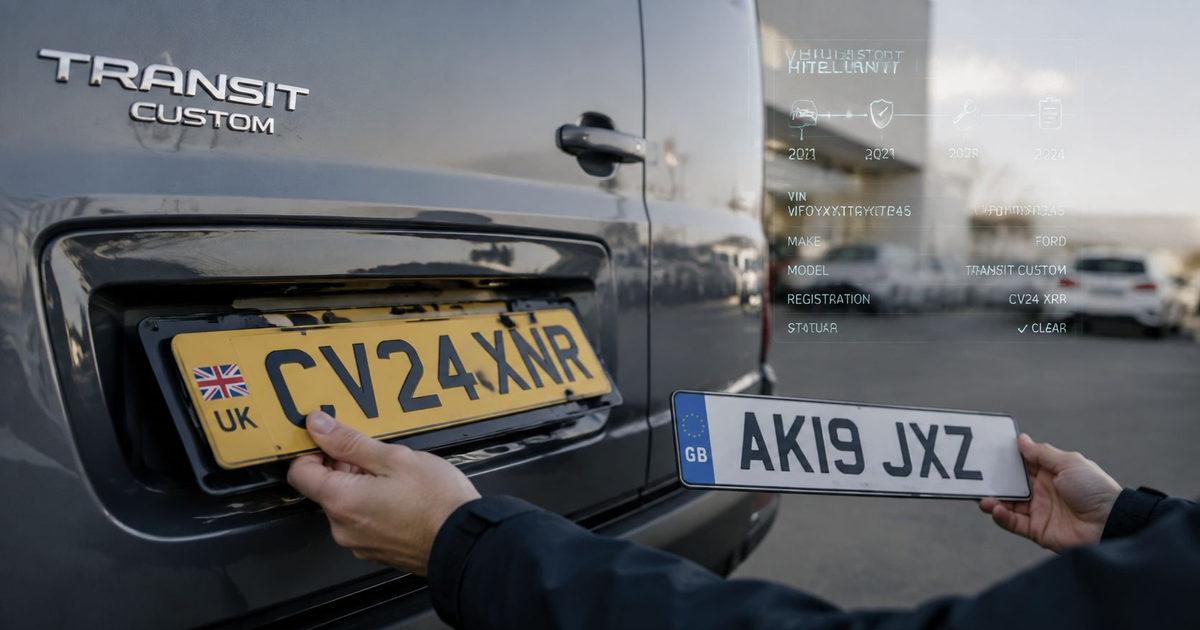
A van arrives at the buying desk wearing a 19-plate registration. The body presents well, the seller's description sounds credible, and the current number makes the stock look relatively young. Then the vehicle history check UK workflow shows a previous registration mark. The MOT record points to mileage and usage that fit an older vehicle, while the V5C reveals that the van was first registered under a different mark in 2017.
That discovery doesn't prove wrongdoing. It does change the buying decision. The buyer now needs to establish why the plate moved, whether the mileage timeline remains continuous, whether keeper changes align with the transfer, and whether the advertised age has been presented accurately. It can affect the bid, the retail description, the warranty reserve, and the questions asked before money changes hands.
Plate change history is therefore not a cosmetic curiosity. It is a provenance signal. Read alone, it tells you that a registration mark changed. Read against the DVLA record, MOT mileage, keeper timeline, SORN status, and V5C mechanics, it can show whether the vehicle's recorded story is coherent.
Table of Contents
- The Stock Deal Where the Plate Told a Different Story
- What Plate Change History Actually Means in the UK
- Registration mark versus vehicle identity
- The fields that matter at the buying desk
- Why Plates Change and What DVLA Records Capture
- Common reasons for UK plate changes and what DVLA records capture
- When a Plate Change Stops Being Innocuous
- Combinations that deserve escalation
- Building a Trade-Grade Plate and Provenance Workflow
- Start with identity and chronology
- Add keeper and licensing context
- Real Patterns Traders Should Recognise at a Glance
- Plate Change Patterns and Benign Versus Suspicious Signals
- Turning Plate History into Smarter Buying Decisions
- Plate change signals and trade pricing impact
- A Practical Plate Change History Checklist for the Trade
The Stock Deal Where the Plate Told a Different Story
The trade buyer had initially treated the 19-plate Transit as a straightforward piece of stock. Its current registration supplied an immediate visual age cue, and the van appeared suitable for a quick valuation. The MOT mileage, however, looked heavier than expected for the description, so the buyer ran a fuller used car history report before confirming the offer.
The report showed a previous registration mark. The V5C and registration chronology indicated that the vehicle had originally entered the UK record as a 2017 vehicle under another mark. The newer-looking plate had changed the first impression, but it hadn't changed the vehicle's first registration period or erased the earlier MOT trail.
That single field altered several parts of the decision:
- Valuation: The buyer couldn't price the van solely from the current plate's apparent age.
- Sourcing questions: The seller needed to explain the plate transfer and provide the relevant V5C information.
- Mileage assessment: Older recorded mileages had to be matched to the vehicle, not dismissed because the visible mark looked newer.
- Warranty exposure: Age, use, and mileage remained relevant to likely repair risk, regardless of the current registration.
- Retail presentation: Any description implying that the current plate represented the vehicle's original age could mislead the next buyer.
A plate change can be entirely legitimate. Personalised plates are retained, transferred, and reassigned. Registration marks can also move during administrative changes. The problem starts when a trader accepts the current mark as a complete history signal.
Practical rule: Treat the visible registration as the vehicle's lookup key, not as a complete statement of age, identity, or condition.
The right response isn't to reject every vehicle with a previous mark. It's to move from a quick lookup to trade vehicle intelligence, where the plate event is tested against independent timeline evidence.
What Plate Change History Actually Means in the UK
Under the current UK registration scheme, introduced in September 2001, a registration mark uses a local memory tag, a six-month age identifier, and three letters. The DVLA releases age codes twice yearly, on 1 March and 1 September, and the current series is designed to continue through 28 February 2051, as set out in this history of UK number plates.
Earlier systems used dateless marks from 1903 to 1963, suffix marks from 1963 to 1982, and prefix marks from 1983 to 2001. The first UK registration mark is widely traced to 1903, while the Motor Car Act took effect from 1 January 1904 and made registration compulsory nationwide. Those format changes matter because a recorded mark can provide an age-related reference point, but only if the trader understands whether it is the original mark or a later assignment.
Registration mark versus vehicle identity
The registration mark is the identifier displayed on the number plate. It isn't the same as the VIN, which identifies the vehicle itself. A plate can be retained or transferred, while the vehicle remains the same physical asset. For that reason, a trader should anchor every plate event to the VIN and the V5C rather than assuming that the current VRM tells the full story.
The DVLA Vehicle Information Database logs registration-mark and keeper-status changes as administrative events. It captures events at first registration, when keeper information changes, and when a vehicle is licensed or relicensed, according to this UK number plate check guidance.
The fields that matter at the buying desk
A useful plate history record should help you establish:
- The current registration mark, which identifies the vehicle for the initial search.
- Any previous registration marks, which show that the visible plate isn't necessarily the original one.
- The effective date of a transfer or change, where available.
- The vehicle's original registration period, which should be assessed separately from the current mark.
- Keeper and licensing context, including changes, address updates, SORN status, and licence dates.
- MOT-linked continuity, so recorded mileage and test chronology can be matched to the vehicle rather than the plate alone.
For dealers, the operational point is simple. A plate change is a state change in the vehicle record. It becomes meaningful when its timing and identity can be cross-read with other records. AutoProv's guide to plate changes and their implications for motor traders provides a related trade-focused explanation of that distinction.
Why Plates Change and What DVLA Records Capture
Most plate changes have an ordinary explanation. A cherished registration may be retained before a vehicle is sold. A plate may be transferred to another vehicle. A vehicle may be re-registered after import or a significant identity change, while a Q-plate can indicate a classification or registration outcome that deserves closer inspection.
The UK system also creates a strong reason to separate the current mark from the vehicle's age. The modern format uses six-month age identifiers, while earlier suffix and prefix formats were introduced as registration capacity changed. A mark can therefore alter how stock looks to a casual observer without altering the underlying chronology.
Common reasons for UK plate changes and what DVLA records capture
Cause of plate change DVLA event logged V5C visibility Source for trade check Personalised plate retention Registration-mark change recorded as an administrative event Current and relevant registration details should be checked against the document V5C, registration history, MOT chronology Transfer of a cherished mark Transfer or reassignment event, with the timing checked against the vehicle record The current V5C may not explain the full prior sequence on its own DVLA-linked plate history and keeper timeline Re-registration after import Registration event linked to the vehicle's UK record V5C should be checked for first UK registration and identity details V5C, VIN confirmation, MOT history Q-plate assignment Registration outcome linked to the vehicle identity V5C and registration mark require careful review DVLA record, V5C, physical VIN inspection Administrative change during keeper or licensing activity Event may appear alongside keeper-status or licence information V5C reflects the current registered keeper details DVLA keeper history analysis and supporting records The record doesn't necessarily give a trader a complete narrative in plain language. It gives linked administrative events that must be interpreted. The V5C is particularly important because it documents the registered keeper and vehicle details, but it isn't a legal title document.
A benign event usually has a coherent reason, a consistent VIN, and an MOT trail that continues without unexplained breaks. A risk-bearing event tends to gain significance from its surroundings, such as a mark change close to a sale, a keeper switch, a mileage inconsistency, or a gap in licensing history.
When a Plate Change Stops Being Innocuous
A plate change becomes a risk signal when it conflicts with the rest of the vehicle's story. The mark itself isn't evidence of fraud. The conflict between the mark, the V5C, the MOT record, and keeper chronology is what should make a buyer slow down.
A personalised plate transfer can make a vehicle appear newer or less obviously tied to its original registration period. That may be harmless if the seller discloses it and the records remain aligned. It becomes more concerning when the transfer is presented as though the current mark describes the vehicle's original age, or when the change sits beside unexplained mileage movement.

Combinations that deserve escalation
- A newer-looking mark with an older first registration period: Confirm the original registration details before setting a bid or writing retail copy.
- A mark change beside an MOT mileage gap: Obtain supporting documents and compare the last recorded mileage with the physical odometer.
- A transfer close to a keeper change: Check whether the vehicle moved quickly between parties after the mark changed.
- A Q-plate or unusual registration outcome: Verify the VIN, V5C, inspection history, and vehicle description before treating the stock as routine.
- A current mark that doesn't reconcile with the paperwork: Stop the process until the seller can account for the discrepancy.
The official MOT service is limited. It shows past MOT outcomes and the mileage recorded at each test, so it isn't a complete provenance file. For vehicles first used on or after 1 September 2012, MOT certificates show the current mileage and up to three previous recorded mileages, which gives a practical reference for identifying reversals, implausible jumps, or unexplained usage patterns, according to the GOV.UK MOT history service.
A normal plate transfer can still sit beside a serious mileage problem. Don't let the innocent explanation for one event close the investigation into another.
If an MOT mileage entry is wrong, the correction process requires the test centre to recheck the vehicle. An online correction request requires evidence showing the correct mileage, dated within one day of the MOT test, as explained by GOV.UK's MOT correction process. That standard is a useful trade lesson. Treat an inconsistency as a documentary risk, not as a minor database nuisance. You can also review the compliance implications of registration presentation in this number plate legality guide.
Building a Trade-Grade Plate and Provenance Workflow
A reliable workflow starts before the vehicle reaches the forecourt. The objective is to use plate history as a filter for further diligence, not as a substitute for inspecting the vehicle, its VIN, its documents, and its condition.
Start with identity and chronology
Use the current VRM to retrieve the vehicle record, then anchor every result to the VIN and V5C. Confirm that the physical VIN, the V5C details, and the returned vehicle description agree. Next, identify the original registration mark and any later marks, noting the date of each change where the data provides it.
Then overlay the MOT timeline. Compare recorded mileage at each test with the odometer reading, service invoices, dealer invoices, and any inspection photographs available from the seller. The sequence should make sense in both direction and usage. A plate change doesn't reset mileage, so a later mark must still connect to the earlier vehicle record.
Add keeper and licensing context
The DVLA ownership transfer process centres on the V5C and the registered keeper, not legal ownership title. The seller must notify DVLA, the buyer needs the green new keeper slip, and DVLA issues a new V5C in the new keeper's name, according to the GOV.UK vehicle sale and transfer process.
Review keeper changes around the plate event. A short period between a registration transfer, a keeper change, and a resale doesn't prove a problem, but it raises the value of asking for invoices, acquisition dates, and the seller's explanation. Check SORN periods and licence dates as well. A dormant period may be perfectly reasonable, yet the trader should understand how it fits with the claimed mileage and use.
A practical file should contain:
- Identity evidence: VIN, V5C, current VRM, previous VRMs, and vehicle specification.
- Timeline evidence: plate transfer dates, MOT tests, mileage readings, keeper changes, SORN periods, and licence events.
- Decision notes: the explanation received, documents supplied, unresolved gaps, and the resulting bid decision.
- Handover controls: copies of the new keeper documentation, outstanding finance checks tied to the relevant registration details, and photographs of the vehicle and VIN.

Cross-reading is the important part. A standalone report can flag a previous plate, but a joined timeline can show whether the event was routine or whether it coincided with other anomalies. Tools such as AutoProv's vehicle data integration platform can support that multi-source review, provided the buyer still verifies the underlying documentation and physical vehicle.
Real Patterns Traders Should Recognise at a Glance
Experienced buyers don't ask whether a plate has changed. They ask whether the sequence surrounding the change is plausible.
Consider a private keeper who retains a cherished registration before selling a newer vehicle. The mark moves off the vehicle, a replacement registration appears, the MOT mileage continues in order, the keeper timeline is stable, and the V5C details reconcile with the VIN. That is a routine pattern. The buyer still records it, but the event doesn't need to dominate the valuation.
Now consider a different vehicle. The plate changes three months before sale, the MOT record has an 18,000-mile gap at the same point, and the vehicle shows two keepers within nine months. None of those facts proves misconduct, and the figures should be checked against the relevant report and documents. Together, however, they justify a higher evidence threshold before purchase.
Plate Change Patterns and Benign Versus Suspicious Signals
Pattern Typical cause Signal to watch Trade response Cherished plate retained with clean chronology Private keeper preference MOT mileage and V5C remain consistent Record the event, verify identity, then continue normal appraisal Plate transfer shortly before sale Personalised mark removal or reassignment Transfer date overlaps with keeper or dealer movement Request the seller's explanation and supporting paperwork Re-registration after import UK registration process First UK registration, VIN, and MOT start point need alignment Confirm import and identity documents before valuing Q-plate or unusual marker replaced or reassigned Administrative or classification change Vehicle history, V5C description, and physical identity don't align Escalate to a physical and documentary inspection Plate change with mileage gap Transfer coinciding with incomplete disclosure or recording issue Reversal, implausible jump, or missing supporting evidence Pause bidding until the mileage source is resolved Multiple short keepers around the change Rapid resale, unsuccessful ownership, or trade movement Keeper cadence doesn't fit the seller's narrative Reprice for uncertainty or decline the stock Personalised plates can also make a round trip. A vehicle may carry a cherished mark, lose it before sale, and later receive another retained mark. The correct response isn't to count changes mechanically. Trace each event to the vehicle identity and ask what happened during the interval.
Re-registration after import needs similar discipline. The UK record may begin after the vehicle's earlier overseas use, so a trader shouldn't treat the first UK MOT as proof of the vehicle's entire life. The V5C, VIN, import documents, and seller evidence must establish what the UK record can and can't confirm.
Short-keeper timelines need context too. A dealer acquisition followed by retail sale can be normal. A sequence of private keepers, rapid mark changes, mileage irregularities, and weak paperwork is a different risk profile. Historical trend analysis, such as the approach discussed in vehicle history trend analysis, is useful only when it preserves event dates and doesn't reduce the story to a single score.
Turning Plate History into Smarter Buying Decisions
A plate change shouldn't produce an automatic accept-or-reject result. It should alter the questions asked, the evidence required, and the price paid for uncertainty.
Start with the strongest signals. A clean MOT mileage sequence, a coherent keeper cadence, an aligned V5C, and a plausible explanation for the transfer support a normal buying decision. A plate change combined with mileage inconsistency, unexplained advisory development, short-term keepers, or identity discrepancies deserves a different commercial response.
Plate change signals and trade pricing impact
Plate change pattern Cross-read signal Pricing adjustment Decision outcome Single personalised transfer MOT, VIN, V5C, and keeper records align No automatic reduction Proceed if documents and condition support the valuation Mid-life transfer with a clear explanation Stable mileage and no timeline conflict Price on the vehicle's true age and condition, not the visual mark Proceed with the history recorded in the stock file Transfer beside a mileage anomaly MOT sequence doesn't reconcile with odometer or invoices Allow for investigation cost and resale disclosure risk Hold, negotiate, or decline if evidence remains weak Transfer near several keeper changes Rapid movement doesn't fit the seller's account Increase the risk allowance rather than assuming the best case Escalate to senior buying review Q-plate or re-registration with incomplete documents Identity and provenance remain uncertain Avoid pricing as ordinary stock until verified Do not commit capital while the core record is unresolved This framework protects margin in two ways. First, it prevents a newer-looking current plate from inflating the valuation. Second, it stops a harmless personalised transfer from causing an unnecessary rejection when the wider record is sound.
The same logic applies to retail preparation. If the vehicle's original registration period differs from the current mark, the stock record should preserve that distinction. Buyers, sales staff, and warranty teams need the same factual baseline. Clear internal notes reduce the risk of inconsistent descriptions after the vehicle changes hands.
A basic check often returns fields. A trade-grade review interprets relationships between fields. That is the difference between spotting a previous plate and understanding what the plate change means for capital exposure, compliance, negotiation, and post-sale disputes.
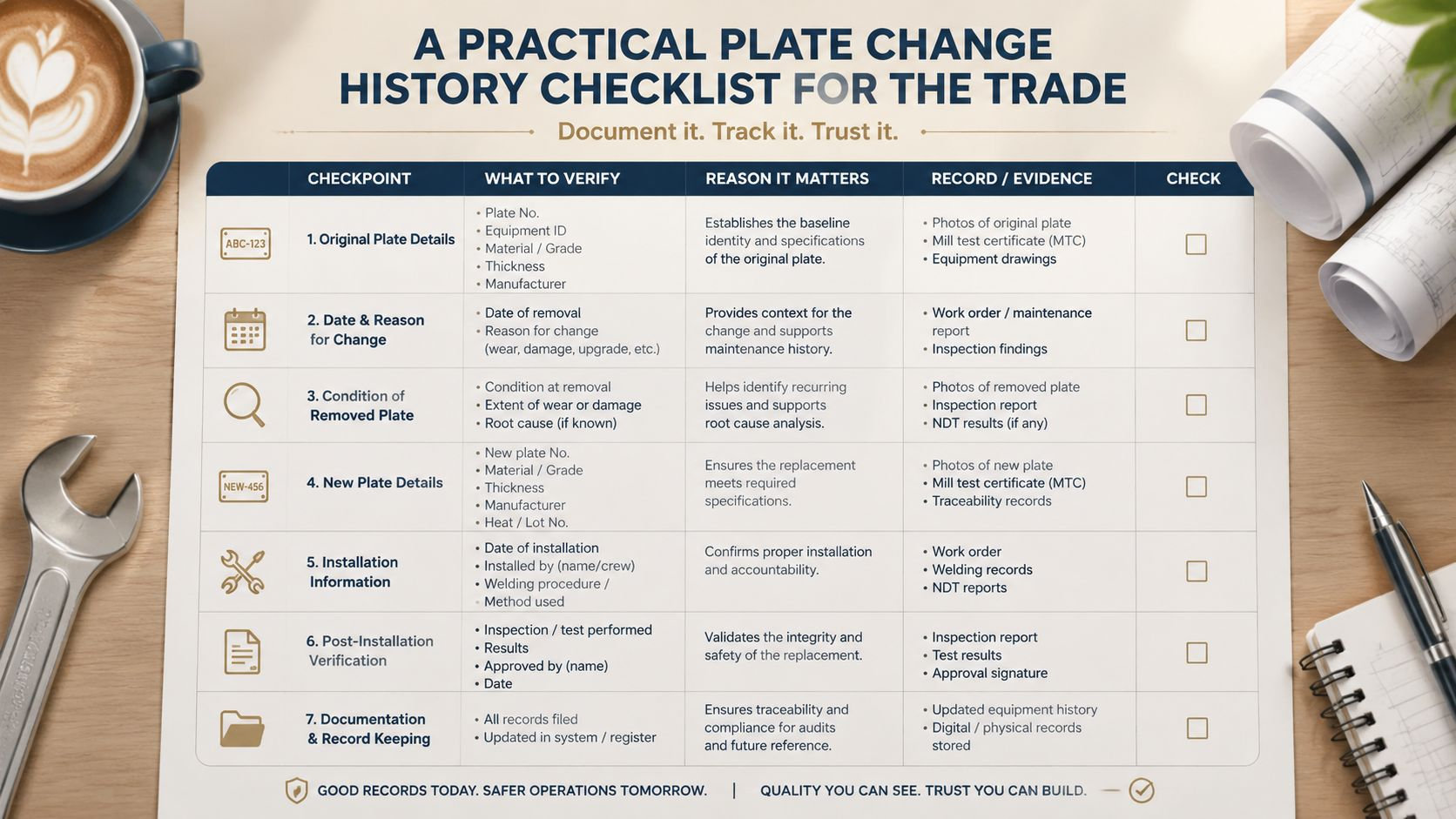
A Practical Plate Change History Checklist for the Trade
Use the checklist at three decision points, before bidding, when stock arrives, and at handover. Each item should either clear a risk or create a documented reason to investigate further.
- Confirm current and prior VRMs: Match the registration history to the V5C and physical VIN. If the marks don't reconcile, stop the buying process.
- Check the transfer dates: Place each plate event beside MOT tests, keeper changes, licensing activity, and sale timing. Timing often supplies the context that the mark alone lacks.
- Verify MOT mileage continuity: Compare every available recorded reading with the odometer, invoices, service evidence, and inspection photographs. Treat a reversal or unexplained gap as a source-document issue.
- Review keeper alignment: A transfer alongside a short keeper period may be routine trade movement, but it still needs to fit the seller's account.
- Inspect SORN and licence periods: Dormant periods should make sense alongside the claimed usage and mileage. An unexplained active-use story during a dormant period needs clarification.
- Confirm V5C mechanics: Check the seller's details, the green new keeper slip, and the process for obtaining the replacement V5C. DVLA records the registered keeper, not legal ownership title.
- Run finance and identity checks: Confirm that outstanding finance searches and vehicle identity checks cover the relevant registration details and remain anchored to the VIN.
- Document the decision: Record the explanation, evidence, unresolved questions, valuation effect, and approval. A clear audit trail helps the next buyer and the compliance team.
The advantage comes from connecting the records. A plate history report is a starting point, while dealer vehicle checks, mileage evidence, V5C verification, and keeper analysis determine whether the vehicle is acceptable stock.
AutoProv provides UK motor traders with vehicle provenance reports that include plate change history, DVLA registration data, MOT mileage patterns, keeper timelines, and related risk indicators. Visit AutoProv to review how its trade vehicle intelligence can support point-of-decision checks before you commit capital.
Frequently Asked Questions
AI-Generated Content Notice
This article was created with the assistance of artificial intelligence technology. While we strive for accuracy, the information provided should be considered for general informational purposes only and should not be relied upon as professional automotive, legal, or financial advice. We recommend verifying any information with qualified professionals or official sources before making important decisions. AutoProv accepts no liability for any consequences resulting from the use of this information.
From our AI insights
- Navigating UK Grey Imports: A Trader's Guide
Understand the complexities and opportunities of UK grey imports for savvy motor traders.
- Navigating Private Plate Challenges in UK Vehicle Checks
Learn how private plates affect UK vehicle checks and how traders verify provenance and spot cloning risks.
- Navigating VIN Checks Post-Brexit: What UK Traders Need to Know
Discover how Brexit impacts VIN checks for UK traders and the crucial data to review.
Related Articles

Essential Vehicle Checks Before Buying a Used Car
Learn essential checks to ensure your used car purchase is safe and sound in the UK market.

Why a Provenance Check is Essential for Used Car Buyers
Ensure your used car is a smart investment by understanding the importance of a provenance check and how AutoProv can help.

A Guide to Vehicle Check with VIN Number
A vehicle check with vin number is easily the most important thing you can do before buying a used car. Think of it as your first line of defence—a quick, simple step that pulls back the curtain on a vehicle's past, protecting you from expensive mistakes, legal headaches, and downright dangerous cars.
Published by AutoProv
Your trusted source for vehicle intelligence