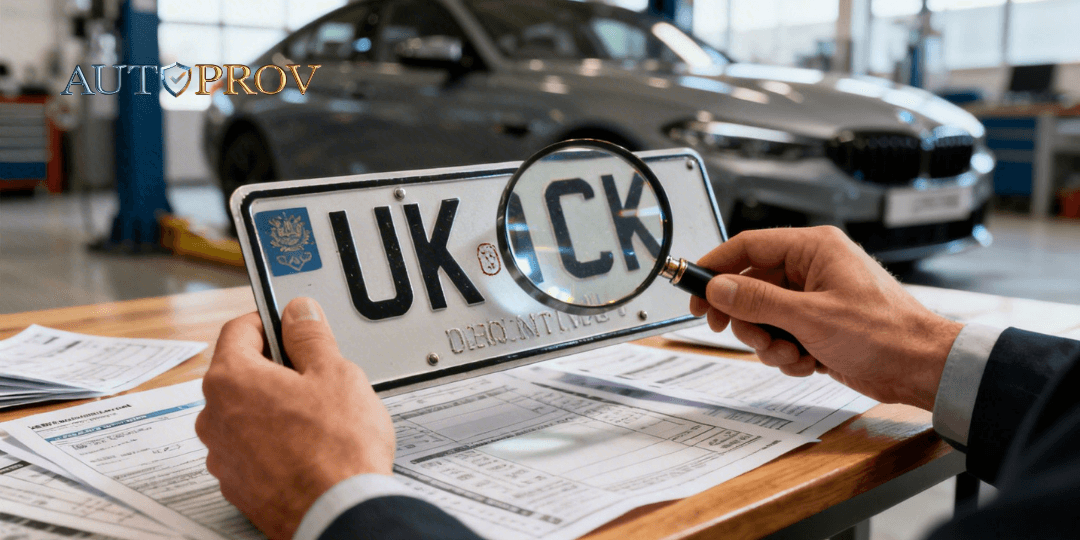
Illegal number plates are more than a minor MOT failure; for UK motor traders, they represent a significant and growing risk. Acquiring a vehicle with fraudulent plates can lead to dealing with stolen assets, regulatory scrutiny, and substantial financial loss. Relying solely on a standard used car history report to identify these threats is a critical oversight in modern stock acquisition.
The Scale and Impact of Number Plate Fraud

The prevalence of illegal plates on UK roads is likely far greater than many in the trade assume. This issue extends beyond non-compliant fonts or spacing for cosmetic reasons. It is increasingly linked to organised crime, directly threatening stock acquisition and business integrity.
Recent data highlights the scale of the problem. A report from the All-Party Parliamentary Group for Transport Safety (APPGTS) indicated that as many as 6.7% of vehicles on UK roads could have plates modified to evade ANPR cameras. This equates to potentially over 2.8 million vehicles, a statistic that underscores the level of risk present in the market. This is not a peripheral issue; it is a widespread challenge for the motor trade.
Types of Illegal Plates and Their Risks
For a dealer, the primary danger is not a failed MOT but the unintentional purchase of a vehicle with a fraudulent identity. Different types of illegal plates present distinct risks, some far more severe than others.
- Cloned Plates: A registration mark is copied from a legitimate, identical vehicle and applied to a stolen or illicit one. This is the most dangerous scenario, as a basic vehicle history check UK on the registration will appear entirely legitimate.
- Ghost Plates: These plates use materials that reflect light to blind ANPR cameras, effectively making the vehicle untraceable to automated systems. They are used deliberately to conceal involvement in criminal activities.
- Incorrectly Formatted Plates: This includes non-standard fonts, incorrect spacing, or illegally placed fixings. While often for aesthetic purposes, it is still illegal and can indicate a broader disregard for vehicle regulations and maintenance.
- Stolen Plates: Physical plates are stolen from one vehicle and placed on another, typically to commit crimes like fuel theft or evade congestion charges.
This type of fraud creates a complex risk environment for traders. Acquiring a vehicle with cloned plates often means purchasing a stolen asset. Upon discovery, the vehicle will be seized, resulting in a total financial loss.
A clean vehicle history check is no longer a guarantee of clean provenance. When a vehicle's identity is compromised via a cloned plate, standard checks merely verify the history of the legitimate vehicle. This makes deeper vehicle provenance analysis essential.
To clarify the risks, the following table breaks down what each type of illegal plate means for a motor trade business.
Types of Illegal Number Plates and Associated Trade Risks
This table provides a quick-reference guide to the common types of illegal plates and the specific dangers they pose during acquisition and resale.
Plate Type Description Primary Risk to Dealers Cloned Plates Registration copied from a legitimate vehicle onto a stolen or fraudulent one. Acquiring a stolen vehicle, leading to seizure and total financial loss. Ghost Plates Made with anti-ANPR materials to evade camera detection. Unknowingly buying a vehicle used in criminal activity, creating reputational and legal risks. Incorrectly Formatted Non-standard fonts, spacing, or bolt placement. Fails MOT, indicates potential for other hidden issues, and can deter retail buyers. Stolen Plates Physically taken from one car and placed on another. Vehicle may be implicated in recent crimes (e.g., fuel theft), causing administrative burdens. Understanding these distinctions is a first step in risk mitigation. The challenge is that these vehicles are often presented to appear legitimate. This is where robust dealer vehicle checks and trade vehicle intelligence become critical tools for risk management, enabling you to see beyond the plate and verify the true history of the asset.
Why Cloned and Ghost Plates Are a Dealer's Nightmare
While any illegal plate is a problem, cloned and ‘ghost’ plates represent a more serious category of risk. This is not about minor transgressions; it is a calculated tactic used in organised crime, from vehicle theft to complex finance fraud. A misstep here can have severe consequences for your business's finances and reputation.
The primary danger is that these plates are designed to deceive the standard checks that traders rely on. By definition, a cloned plate copies the identity of a legitimate vehicle. Consequently, a basic history check on that registration will almost certainly return a clean result, as it reflects the history of the genuine car, not the stolen or fraudulent one being appraised.
The Criminal Enterprise Behind Plate Fraud
It is a mistake to view plate cloning as an opportunistic, low-level crime. It is a strategic component of larger criminal operations. The illicit plate market in the UK has expanded, with data showing a sharp rise in related offences. Plate thefts and cloning incidents have surged, a clear indicator of their role in facilitating wider criminal activity. Criminals use these cloned vehicles to become invisible to ANPR cameras and police checks while committing other offences.
This creates an immediate and tangible risk for every stock acquisition. Consider a scenario: you purchase a late-model premium vehicle at auction. The history check is clear, the V5C appears legitimate, and the price is favourable. Weeks later, the police arrive to seize the vehicle, which has been identified as a stolen asset masked with cloned plates.
The consequences include:
- Total loss of the capital invested in the vehicle.
- A complex and time-consuming administrative process.
- Potential scrutiny of your buying processes by law enforcement.
Ghost Plates: The Escalating ANPR Threat
Ghost plates introduce a different but equally concerning problem. These plates use special reflective materials or films designed to over-expose when an ANPR camera flashes, obscuring the characters and making the plate unreadable to automated systems.
A vehicle with ghost plates is effectively invisible to authorities for offences like speeding, ULEZ non-payment, or toll evasion. More critically, they are a known tool for serious criminal activities, such as county lines drug trafficking or organised theft, allowing perpetrators to travel without leaving a digital trace. Retailing such a vehicle, even unknowingly, links your business to its criminal history and poses a severe reputational risk.
The unregulated online market has made it simple for criminals to obtain convincing fraudulent plates. This easy access directly increases the risk profile of every vehicle appraised, making deep vehicle provenance analysis non-negotiable.
Understanding the mechanics of these plates is vital. A fraudulent identity can be so convincing that only a deeper analysis of the vehicle’s entire ownership and event history, as detailed in our guide on how a reg plates check can uncover hidden risks, can reveal the subtle indicators of a clone.
It is the small inconsistencies—a recent plate change paired with an MOT from the other side of the country, for example—that a robust trade intelligence platform like AutoProv is designed to detect, protecting your investment before commitment.
A Practical Vetting Process for Number Plate Provenance
Relying on a single data point to verify a number plate is no longer sufficient. To effectively mitigate the risks of cloned or illegal plates, a systematic, multi-layered vetting process is required. This is not about adding hours to appraisals but about integrating smart, sequential checks to confirm a vehicle's identity from multiple angles.
The following is a practical, trade-focused framework that combines physical inspection with digital verification to create a robust defence against fraud.
Start With the Physical Inspection
Before consulting any digital records, conduct a thorough inspection of the physical plates. Criminals often fail on the small details that reveal their deception. The first step is to check for compliance with UK standards.
Look for these specific markers:
- BS AU 145e Mark: This is the current standard, mandatory for any plate fitted after 1st September 2021. Its absence on a newer plate is an immediate red flag.
- Supplier Details: A legitimate plate must display the name and postcode of the registered supplier who manufactured it. If this information is missing, crudely applied, or appears low-quality, exercise extreme caution.
- Correct Font and Spacing: The mandatory 'Charles Wright 2001' font has a specific, uniform appearance. Any deviation, such as stylised letters or manipulated spacing, renders the plate illegal and warrants further investigation.
Consider these physical checks your first line of defence. A discrepancy here does not automatically confirm the vehicle is stolen, but it is a clear signal that something is amiss and requires deeper scrutiny.
The path from plate theft to cloning and its use in crime is a common method in vehicle fraud, designed to make a fraudulent vehicle appear legitimate.

This process shows how a cloned plate is often the final step in preparing a stolen or fraudulent vehicle for sale into the unsuspecting motor trade.
Cross-Reference the Core Vehicle Identifiers
If the physical plates appear compliant, the next step is to ensure the vehicle's core identifiers align perfectly. This involves connecting the physical asset to its paper and digital records. Any mismatch is a major warning sign.
The VIN (Vehicle Identification Number) is the vehicle's true identity. It must be physically checked in multiple locations—typically on the dashboard (visible through the windscreen), on the driver's side door jamb, and stamped onto the chassis itself, often in the engine bay or boot.
Once located, cross-reference the physical VIN against two key sources:
- The V5C Logbook: Does the VIN on the logbook match the one on the vehicle, character for character? Scrutinise the V5C document for signs of forgery, such as missing watermarks or poor print quality.
- Your Vehicle History Check Report: The VIN recorded by the DVLA and displayed in your history report must be an exact match to the one on the vehicle.
A mismatch between the physical VIN on the vehicle and the VIN on the V5C is one of the most definitive indicators of a cloned vehicle. If they do not align, halt the transaction immediately. You are almost certainly dealing with a stolen asset.
Analyse the Digital History and Ownership Timeline
With the physical asset and its core identifiers verified, it is time to analyse the vehicle’s digital history for more subtle risk signals. This is where a basic history check often proves insufficient and where deeper trade vehicle intelligence becomes essential.
Look for anomalous patterns in the vehicle’s timeline. A comprehensive dealer vehicle check allows you to examine the MOT and ownership history for events that are out of context. For example, a sudden plate change followed by an immediate attempt to sell is a classic red flag. Similarly, a vehicle with a consistent MOT history at one location that suddenly appears for a test hundreds of miles away could indicate it has been stolen and given a new identity. If you suspect a vehicle is stolen, our guide on how to check for a stolen vehicle offers more specific guidance.
This is precisely where a platform like AutoProv demonstrates its value. It automatically cross-references these datasets to flag inconsistencies that are difficult for the human eye to spot. By analysing the ownership timeline, mileage progression, and geographical data from MOT records, AutoProv provides the context needed to identify the tell-tale signs of a clone. It adds a crucial layer of security to your acquisition process.
Moving Beyond Basic Checks with Vehicle Intelligence
Manual checks are a sound starting point, but they are reactive, limited to what is immediately visible. Relying on isolated lookups—a V5C check here, an MOT history there—is like attempting to solve a puzzle with half the pieces. You might spot an obvious fake, but you will miss the subtle, interconnected clues that expose a professional cloning operation.
To properly protect your business, you must transition from running disparate checks to using integrated vehicle intelligence. This involves a system that consolidates various data points to provide a comprehensive picture of a vehicle's vehicle provenance. It means building a process where deep analysis is a standard component of every acquisition decision.
A basic used car history report can confirm that a registration exists and has not been flagged as stolen or written off. What it cannot confirm is whether that registration has been illegally attached to a different vehicle. This is the exact vulnerability that criminals exploit.
The Limits of Single Data Points
Relying on a clean history check alone creates a dangerous false sense of security. Fraudsters are adept at making a cloned vehicle appear legitimate on paper. They count on traders performing a surface-level check, seeing a positive result, and proceeding without further inquiry.
Consider these scenarios where a basic check would fall short:
- Recent Plate Change: A standalone check will not flag a recent plate change as inherently risky. However, if that plate change is combined with data showing the vehicle was last serviced 300 miles away and is now being sold privately, the risk profile changes significantly.
- Mileage Anomaly: A standard mileage check UK might show a consistent history. But it is unlikely to connect a sudden, sharp drop in annual mileage with a recent change of ownership and a rapid resale attempt—a classic indicator of clocking before a sale.
- Unusual MOT Location: An MOT conducted in Glasgow for a vehicle that has supposedly spent its entire life in London is anomalous. A single MOT check will not provide this context, but a proper provenance platform will flag it instantly as a geographical inconsistency requiring investigation.
These are the types of patterns that become apparent only when analysing data from multiple sources concurrently. This approach is analogous to digital investigation work; the logic is similar to using OSINT tools for intelligence gathering, which connect publicly available information to uncover the true situation.
A clean history check does not guarantee clean provenance. It merely confirms the history of a registration mark, not the physical vehicle it is attached to.
This distinction is critical. True risk management comes from verifying that the vehicle being appraised is the one that actually lived the history associated with its registration.
How Provenance Intelligence Uncovers Risk
This is where a dedicated trade vehicle intelligence platform like AutoProv changes the dynamic. Instead of just presenting raw data, it actively analyses and cross-references multiple datasets to search for these exact risk signals. It is designed to answer the questions a basic check simply cannot.
By layering information from the DVLA, MOT history, keeper change records, and other trade-only sources, the system automatically flags anomalies that would be nearly impossible to spot manually. For instance, it can instantly connect a recent private plate transfer with a sudden appearance at a trade auction far from the registered keeper's address.
This level of deep, contextual analysis transforms your buying process from a box-ticking exercise to a genuinely informed, risk-assessed decision. It does not replace your expertise; it enhances it with superior, faster intelligence. By integrating this level of motor trade risk assessment into your workflow, you are not just avoiding illegal number plates—you are building a more resilient, profitable, and defensible business.
What to Do When You Suspect an Illegal Number Plate
You are appraising a vehicle and your professional instinct raises a concern. The plate appears incorrect, the VIN does not match the V5C, or your provenance check has flagged a major risk. How you respond in this high-stakes moment is critical.
A misstep can be costly and lead to legal complications. A calm, methodical approach and a clear, defensible procedure are essential.

The moment you have a credible suspicion about a vehicle’s identity, your first and only action should be to halt the transaction. Do not proceed with the purchase and do not transfer any funds, regardless of the seller’s explanation.
Secure and Document Everything
Once the deal is paused, your focus must shift to evidence gathering. This is not about conducting a private investigation but creating a robust record to justify your decision and support any subsequent reports.
Methodically and securely document all details. Use a smartphone to take clear, time-stamped photographs of:
- The front and rear number plates, capturing any non-compliant fonts, spacing, or defects.
- The VIN plate on the dashboard and the sticker in the door jamb.
- The V5C logbook, paying close attention to paper quality, watermarks, and print characteristics.
- The vehicle's overall condition, including any unique identifying marks.
Alongside the photos, make a written record of the seller's details, the date, time, and location of the appraisal. If you used a platform like AutoProv for your dealer vehicle checks, save a PDF of the report that flagged the risk. This creates a comprehensive evidence file demonstrating professional diligence.
When faced with a suspected clone or illegal plate, your primary duty is to your business. Never confront the seller or make accusations. Simply state that you will not be proceeding with the purchase based on your checks, disengage professionally, and secure your evidence.
Understand Your Reporting Obligations
Identifying a potentially cloned vehicle means you have likely encountered serious criminal activity. As a motor trade professional, you have an obligation to report this to the appropriate authorities to protect the wider industry.
Knowing who to contact is vital.
- For Suspected Cloning or Stolen Vehicles: If your checks strongly indicate the vehicle is cloned or stolen, report it to the Police on their 101 non-emergency number. You should also file a report with Action Fraud, the UK's national reporting centre for fraud and cybercrime.
- For Non-Compliant Plates: If the issue is limited to a non-compliant plate (e.g., wrong font, illegal spacing) with no other signs of cloning, you can report it directly to the DVLA.
This process is more than a formality. The intelligence you provide helps law enforcement build a larger picture of vehicle crime networks. Importantly, a clear record of your report provides an additional layer of legal protection for your dealership, proving you acted responsibly.
Understanding a vehicle's ownership history is a complex part of this process; for further reading, you can refer to our guide on how to prove car ownership, which examines the necessary documentation.
Ultimately, a robust internal policy for handling illegal number plates is a cornerstone of modern motor trade risk management. It ensures that when this threat arises, your team responds not with panic, but with a professional procedure that protects your capital and reputation.
Illegal Plates: Key Questions for the Motor Trade
Even for experienced traders, fraudulent number plates can present complex challenges. An incorrect assessment can lead to significant financial and legal repercussions. Here are direct answers to common questions from professionals.
What is the true cost of selling a car with illegal plates?
The consequences of selling a vehicle with illegal plates are severe and multi-faceted.
For a simple compliance issue, such as an incorrect font or spacing, you will face fines and rectification costs. However, if the vehicle is cloned, the police will seize it, and you will suffer a total loss of your investment.
Beyond the direct financial impact, the reputational damage can be substantial. An association with stolen or fraudulent vehicles erodes customer trust and attracts the attention of law enforcement and Trading Standards. It is a powerful reminder of the importance of thorough due diligence.
Will a standard history check identify a cloned plate?
This is a common and dangerous misconception. A standard used car history report verifies the history of the registration mark, not the physical vehicle to which it is attached.
By definition, a cloned plate is a copy of a legitimate one. When you run a check on a cloned registration, the report will almost always come back clean because it is retrieving the history of the genuine vehicle. It cannot tell you that the registration has been illegally affixed to a different, often stolen, car. This is precisely why a deeper analysis of vehicle provenance is essential.
A "clean" basic history check provides a false sense of security when dealing with cloning. It confirms the registration's history is clear, but it does not confirm the car in front of you is the one that actually owns that history.
How do ghost plates work and why are they a threat?
Ghost plates are designed with a single purpose: to be invisible to Automatic Number Plate Recognition (ANPR) cameras.
Using special films or highly retro-reflective surfaces, they are engineered to reflect a flash of light back at a camera. This flare overexposes the image, rendering the plate unreadable to automated systems used for speed enforcement, tolls, and ULEZ zones.
The risk stems from the intent. Unlike a vanity plate with a misplaced fixing, ghost plates are used deliberately to circumvent the law. More alarmingly, they are a known tool of organised crime, fitted to vehicles used in more serious offences. Acquiring a vehicle with ghost plates, even unknowingly, connects your business directly to that criminal activity.
My check is clear but the V5C seems suspect – what should I do?
Stop. Trust your professional judgement. If a dealer vehicle check is clear but the paperwork feels suspicious, you must halt the transaction immediately. A forged or tampered V5C is one of the most significant red flags for a cloned vehicle.
Your digital and physical checks must always corroborate each other. Any discrepancy between the vehicle, its documents, and its digital record is a deal-breaker. Do not proceed with the purchase. The risk of acquiring a stolen car is too high. This scenario perfectly illustrates the need for a process that combines robust data with hands-on inspection.
Navigating these complex risks requires more than standard checks; it demands deep vehicle intelligence. AutoProv provides the advanced provenance analysis UK motor traders need to identify red flags, verify vehicle identity, and make safer, more profitable buying decisions. Find out how our platform can protect your business at https://autoprov.ai.
Frequently Asked Questions
AI-Generated Content Notice
This article was created with the assistance of artificial intelligence technology. While we strive for accuracy, the information provided should be considered for general informational purposes only and should not be relied upon as professional automotive, legal, or financial advice. We recommend verifying any information with qualified professionals or official sources before making important decisions. AutoProv accepts no liability for any consequences resulting from the use of this information.
From our AI insights
- Avoiding Towing Missteps: Legal Checks for Dealers
Protect your dealership by ensuring vehicle weight and towing capacity compliance before listing stock.
- V5C Logbook: Untold Legal Limitations & Verification Needs
Explore the V5C logbook's legal boundaries and why traders need extra checks.
- Managing CRA 2015 Rejections: Evidence Essentials for Dealers
Learn how UK motor traders can effectively handle CRA 2015 rejection claims with proper evidence management.
Related Articles

Understanding the Consumer Rights Act 2015 in the UK Motor Trade
Explore the Consumer Rights Act 2015 and its impact on UK car buyers and sellers, offering essential protections and insights.

Understanding UK Automotive Regulations
Explore the complexities of automotive regulations in the UK, covering DVLA, FCA, MOT, and more.
What is a V5C Document: A Quick UK Log Book Guide
If you've ever bought or sold a car in the UK, you've definitely come across the V5C. It's often just called the 'log book', and it’s the official Vehicle Registration Certificate issued by the DVLA.
Published by AutoProv
Your trusted source for vehicle intelligence