
For any professional in the motor trade, a proper used auto checklist is the most critical tool in your arsenal. It’s what separates a profitable new piece of stock from a costly, unforeseen mistake. This isn't just about kicking the tyres; it's a systematic, evidence-based appraisal that protects your business.
For any professional in the motor trade, a proper used auto checklist is the most critical tool in your arsenal. It’s what separates a profitable new piece of stock from a costly, unforeseen mistake. This isn't just about kicking the tyres; it's a systematic, evidence-based appraisal that protects your business.
This guide breaks down that professional-grade inspection process, ensuring every vehicle you assess is exactly what it seems to be. At AutoProv, we provide the digital tools to make this process seamless, accurate, and transparent.
Why a Professional Checklist Is Non-Negotiable

Walking into a used vehicle purchase without a structured plan is a massive gamble. For those of us in the business, relying on gut instinct alone is a recipe for disaster. A detailed, repeatable process is your shield against the common traps, hidden faults, and the eye-watering repair bills that inevitably follow a quick glance.
This methodical approach goes beyond just avoiding lemons; it's about building a reputation for trust. When you stick to a consistent checklist, you create an accurate, defensible record of a car's condition at the point of appraisal. That builds confidence, whether you're dealing with sellers, buyers, or your own team.
The Foundation of Smart Acquisitions
A professional checklist provides a solid framework for every single inspection. It guarantees that no critical area gets overlooked, from that initial walkaround of the exterior right through to verifying the paperwork. This process standardises how your business evaluates potential stock, which naturally leads to more consistent and profitable buying decisions.
The UK's used car market is constantly shifting. After years of volatility, it has seen a significant recovery and a return to more predictable rhythms. According to Cox Automotive Europe, the market was predicted to hit 7.64 million used car transactions, a clear sign of stable activity. In an environment like this, a meticulous checklist is absolutely crucial for navigating pricing and availability to secure the best assets for your forecourt.
The real power of a checklist is its ability to transform an emotional decision into a data-driven one. It systematically replaces guesswork with hard evidence, and that’s the cornerstone of any successful motor trade operation.
From Paper to Platform
While a paper checklist is a decent start, modern tools can completely elevate the process. A digital platform like AutoProv, for instance, turns your checks into a permanent, shareable, and verifiable record. Instead of scribbled, hard-to-read notes, you get a clean report packed with photos, data points, and timestamps, all linked to the vehicle's registration.
Going digital brings some immediate wins:
- Accuracy: It drastically cuts down on human error, ensuring every last detail is captured correctly.
- Efficiency: Appraisals get done faster, freeing up your team to assess more vehicles.
- Transparency: A digital report can be shared in seconds, building instant trust with all parties involved.
Ultimately, a robust used auto checklist, especially when powered by a service like AutoProv, is fundamental to reducing risk and maximising your profit margins. For a deeper dive into the essentials, have a look at our comprehensive used car buying guide for the UK.
Mastering the Exterior and Structural Walkaround

A car’s exterior tells a story long before you even pop the bonnet. For any professional, learning to read that story correctly is the first, and arguably most critical, part of any appraisal. This isn’t about just spotting a few scratches. It’s a forensic examination to uncover the vehicle's hidden history.
Your walkaround has to be systematic. Start at one corner and work your way around methodically. You’re looking beyond the surface shine for the subtle inconsistencies that scream past damage. These are the red flags that separate a clean car from a problem waiting to happen.
Decoding the Bodywork and Paint
The paint and panels are where you'll find your first big clues. Get down low, squat, and look along the length of the car from different angles. This is the best way to spot the ripples or waves in panels that indicate previous bodywork. Factory paint is almost flawless, so any little imperfection demands a much closer look.
Pay serious attention to the panel gaps—the lines between the doors, bonnet, and boot. They should be tight and perfectly even all the way along. If a gap is wider at one end than the other, it’s a massive clue that a panel has been off or the car’s taken a hit.
Also, feel around the edges of panels and trims for overspray on the rubber seals, window surrounds, and plastic mouldings. This is a classic sign of a rushed repaint where the masking wasn't done properly—a dead giveaway of a cheap repair. You can find out more about spotting these kinds of issues in our essential UK guide to checking if a car has been in a crash.
The real skill is in spotting the inconsistencies. Does the orange-peel texture on one door look different to the wing next to it? Is one headlight crystal clear while the other is faded and yellow? It's these small details that tell the biggest stories.
Inspecting Tyres and Glass
Tyres can tell you a surprising amount about a car's mechanical health. Uneven wear across the tread is a classic sign of alignment or suspension trouble. Heavy wear on just the inner or outer edges, for example, often points straight to a camber issue, while feathered edges can signal a problem with the toe alignment.
Here are a few non-negotiables for your tyre check:
- Tread Depth: Ensure every tyre has legal tread depth right across its width. No excuses.
- Brand Matching: A mix of premium and budget brands on the same car? It often means the owner was cutting corners on maintenance.
- Sidewall Damage: Always scan the sidewalls for bulges, cuts, or cracks. These are a blowout waiting to happen and an immediate red flag.
Once you’re done with the rubber, move on to the glass. Check the windscreen for chips or cracks, especially in the driver’s line of sight, as that can be an instant MOT failure. Also, look for the manufacturer’s logo stamped on every piece of glass; if one is missing, it’s been replaced, which could be because of an accident.
Finally, do a quick functional test of all the exterior lights—headlights, indicators, brakes, and fogs. Make sure everything works as it should. Using a tool like AutoProv to capture photos of any issues you find creates a solid, indisputable digital record for your appraisal, ensuring every single detail is properly documented.
Getting Under the Bonnet for a Mechanical Health Check
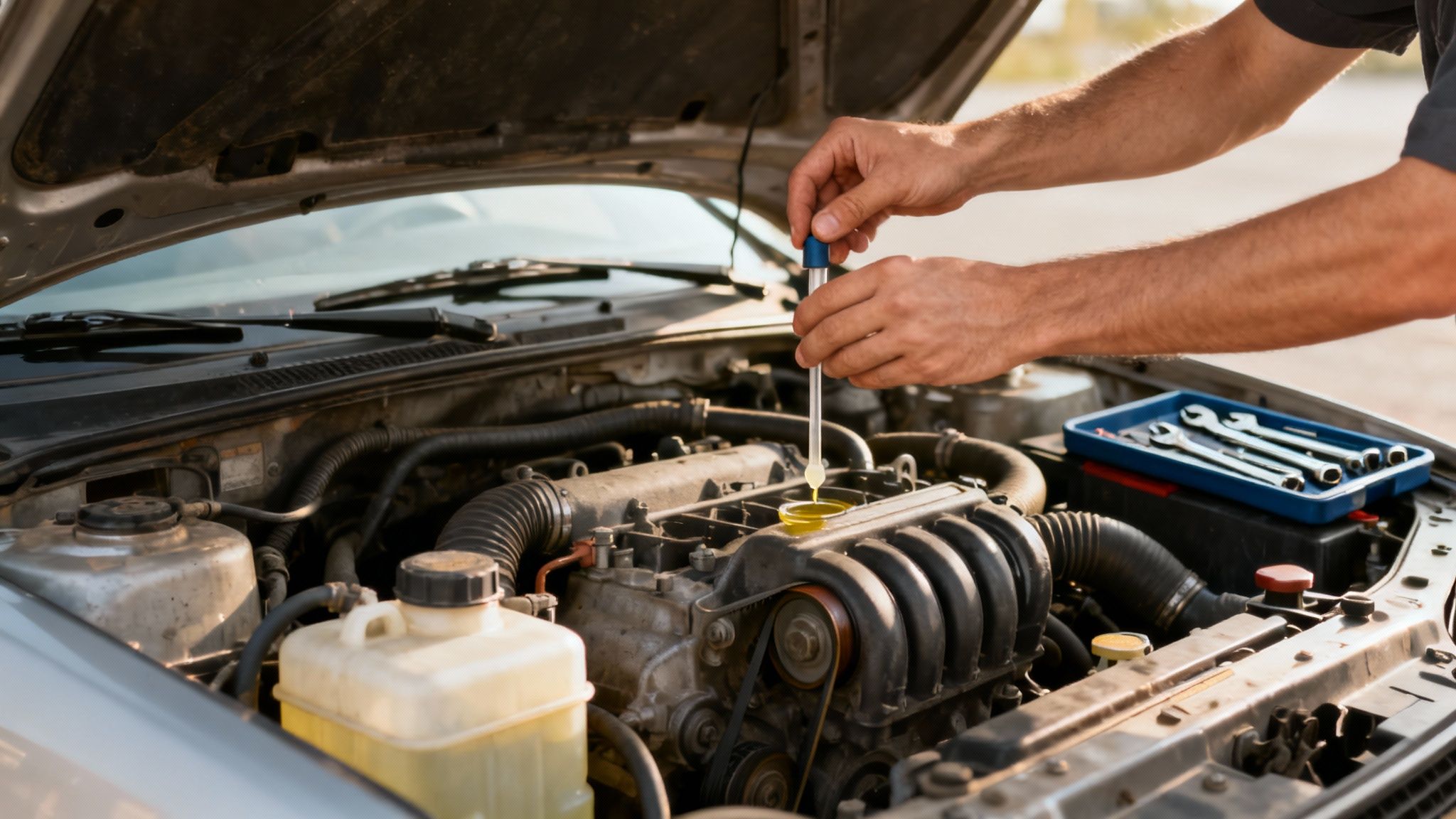
This is where the real money is made or lost. A car can look immaculate on the outside, but a neglected engine or a failing gearbox can quickly turn a profitable flip into a financial disaster. For any professional, a systematic check under the bonnet isn't just a step—it's a non-negotiable part of the process.
Before you even dream of turning the key, start with the basics. Your first look should be at the vehicle's lifeblood: its fluids. Pop the bonnet, secure it properly, and just take a moment to scan the engine bay. Does anything look immediately out of place? Look for signs of rodent damage to the wiring, excessive grime, or obvious leaks.
Assessing Vital Fluids
The state of a car's fluids can tell you a detailed story about its maintenance history, or lack thereof. You’re not just checking the levels; you're assessing the colour and consistency of every fluid you can find. A well-cared-for car will have clean fluids at the correct levels. Neglect, on the other hand, shows itself instantly here.
Your fluid inspection must cover:
- Engine Oil: Grab the dipstick, pull it out, wipe it clean, and re-insert it fully before pulling it out for a proper reading. The oil should be a clear honey or amber colour. If it’s jet-black and thick, it’s long overdue a change. But the real warning sign? Milky or frothy oil. That’s a massive red flag for a blown head gasket, where coolant is mixing with the oil. For a deeper dive, our practical UK guide to engine oil changes is a great resource.
- Coolant: Check the level in the expansion tank. The fluid should be bright and clear—usually pink, green, or blue. If it looks like rusty water, is brown, or has an oily film floating on top, you could be staring at serious internal corrosion or, again, a head gasket problem.
- Brake Fluid: Often overlooked, but absolutely critical for safety. This fluid should be a light golden colour. Dark brown or black fluid means it’s absorbed too much moisture and needs to be replaced immediately. This often points to wider neglect of the entire braking system.
Belts, Hoses, and Leaks
With the fluids assessed, it's time to shift your focus to the rubber components. Run your eyes over all the belts, looking for cracks, fraying, or a shiny, glazed appearance. A snapped serpentine or cambelt is one of the quickest ways to cause catastrophic engine damage, making this a vital check.
Give the main coolant hoses a good squeeze. They should feel firm but have a bit of give—not rock-hard or mushy. Look for any bulges, cracks, or perishing, paying close attention to the areas around the clamps where leaks often start.
Next, get a torch out and have a proper look under the engine bay. You're searching for any active drips or the tell-tale stains of old leaks on the components below. A minor oil seep from a rocker cover gasket might be an easy fix, but fluid coming from the gearbox or power steering system points towards much more expensive repairs down the line.
A gleaming engine bay can be a sign of a meticulous owner. However, be suspicious of one that looks like it's been recently pressure washed. Sellers sometimes do this to wash away the evidence of fluid leaks. Check deep in the corners and crevices for any leftover oil or grime.
The Engine Start-Up Test
Now for the moment of truth. Let's start the engine.
Listen carefully as it cranks over. A healthy motor will fire up almost instantly and settle into a smooth, even idle. Any clattering or rattling on start-up could be a worn timing chain or tensioner—a seriously expensive job on most modern cars.
Once it's running, listen for any deep knocking or tapping sounds from the engine itself. These could indicate severe bottom-end bearing failure. Finally, have a look at the exhaust. A bit of white vapour on a cold day is perfectly normal, but you need to watch out for anything more sinister. Persistent, thick white smoke points to coolant being burned (head gasket failure), while blue smoke means the engine is burning oil, likely due to worn piston rings or valve seals. This kind of practical knowledge is what separates a quick diagnosis from a costly mistake.
Diving into the Interior and Onboard Electronics
The cabin's condition and the state of its electronics are massive clues to a car's real story. They heavily influence its value and how quickly it will sell. A spotless interior often points to a meticulous owner, but it's the subtle wear and tear that can confirm—or contradict—the claimed mileage. This part of the inspection is all about digging into the details that buyers spot straight away.
Get started with the driver's seat. What’s the state of the seat bolsters, steering wheel, and pedals? These are the high-contact points that reveal a car's true history. If you're looking at a car with 30,000 miles on the clock but the steering wheel is shiny and worn, and the driver’s seat bolster has collapsed, you’ve got a major red flag. Something isn't adding up.
Testing Every Last Button and Switch
Today’s cars are loaded with tech, and just one faulty sensor or control module can lead to a seriously expensive repair bill. This is where you need to be methodical. Don't just give the dashboard a quick glance; you need to physically press every single button and test every function.
Your electronics checklist should absolutely include:
- Climate Control: Does the air-con blow properly cold, or is it just a bit cool? Does the heating kick in quickly and effectively? Run through all the fan speeds and check every directional vent.
- Electric Windows and Mirrors: Test each window from the driver’s master switch and then again from its individual door switch. They should move smoothly, without any juddering. Do the same for the electric mirror adjustments.
- Infotainment System: Pair a phone via Bluetooth. Check the sat-nav, test the radio signal, and plug something into the media inputs. A laggy or unresponsive touchscreen is a nightmare to fix and can be incredibly costly.
The most commonly missed checks? Heated seats, parking sensors, and the rear window wiper. Trust me, failing to test these is a classic rookie error. Documenting every single check with a tool like AutoProv creates a clear, verifiable report that ensures nothing gets overlooked.
Does the Interior Condition Match the Car's Age?
The cabin provides vital context, especially when you're appraising older vehicles. It’s interesting, actually—recent market data shows that older used cars are performing remarkably well right now. Cars in the 10-15-year-old bracket, for instance, saw a price growth of 6.5% year-on-year, hitting an average of £6,580. This trend makes it even more critical to accurately assess their condition against their market value.
When you're looking at these vehicles, you need a sharp eye. Check for sagging headliners, feel for worn carpets hiding under the floor mats, and have a good sniff for any odd odours that might point to dampness or a smoker's car.
It’s also crucial to verify the car’s original features. Our guide on finding car specs by registration number is a great resource for confirming exactly what equipment the car left the factory with. A meticulous interior inspection ensures the vehicle you're appraising isn't just mechanically sound, but is also a genuinely desirable piece of stock.
Conducting a Diagnostic Test Drive
 The test drive is the final, dynamic exam of your used auto checklist. This is where your suspicions from the static inspection are either confirmed or dismissed, and where problems that only show up under load reveal themselves. Turning a simple spin into a structured diagnostic assessment is the key to dodging costly mistakes.
Before you even turn the key, make sure you've got adequate insurance cover. Then, plan a route that puts the car through its paces. You'll want a mix of stop-start town driving, a stretch of dual carriageway for higher speeds, and ideally, a few speed bumps or a poorly surfaced road to properly test the suspension. This variety is essential for a complete evaluation.
Listening to the Drivetrain and Engine
With the engine at operating temperature, listen carefully as you move through the gears. On a manual, the clutch should have a clear biting point and engage smoothly without any juddering. An automatic gearbox should shift almost imperceptibly, with no hesitation, clunks, or lurching between changes.
Once you’re on an open road where it’s safe to do so, test the engine's performance under load. Accelerate firmly but smoothly. Does the power delivery feel consistent, or can you feel any flat spots? Listen out for any whining from the engine bay that gets louder with revs—this could be a failing alternator or water pump.
Any unusual noises from the drivetrain are a significant red flag. A humming or whining sound that changes pitch with your speed—but not engine revs—often points to a failing wheel bearing or differential issue. Both can be expensive to put right.
Assessing Steering, Brakes, and Suspension
A car's handling will tell you a lot about its health. The steering should feel direct and responsive, without any excessive play or vagueness. On a straight, flat road, the car should track true without pulling to one side. If it consistently drifts, that’s a clear sign of an alignment problem or, worse, underlying suspension wear.
Test the brakes with a firm, progressive application. Be on the lookout for any of these tell-tale signs:
- Spongy Pedal Feel: This often suggests air in the brake lines or old, ineffective brake fluid.
- Vibrations or Juddering: A pulsating feeling through the pedal or steering wheel under braking is a classic symptom of warped brake discs.
- Squealing or Grinding Noises: These are unmistakable signs that the brake pads or discs are worn out and need replacing immediately.
As you drive over bumps or uneven surfaces, pay close attention to the suspension. It should absorb the imperfections with a solid, controlled response. Any loud knocking, creaking, or banging sounds indicate worn components like bushes, drop links, or shock absorbers. This dynamic assessment is where you truly feel a car's mechanical health, turning your checklist from a list of items into a proper diagnostic tool.
Verifying the Paperwork and Vehicle History
A car can look pristine on the outside but be a complete liability on paper. This is the final, and arguably most critical, step in your inspection. It’s where you do your legal and historical due diligence, protecting your business from buying a car with a hidden, and potentially costly, past. The physical check is only half the battle; the paperwork tells the real story.
First up, get your hands on the V5C logbook. Don't just glance at it. You need to meticulously check that the Vehicle Identification Number (VIN) and engine number printed on the document are an exact match for the numbers stamped on the car itself. Any discrepancy here isn't just a small issue—it's an immediate, non-negotiable red flag. Walk away.
Digging into the Service History
What you’re hoping to see is a thick folder of receipts and a service book filled with stamps. This is your proof of consistent maintenance and tells you a lot about the previous owner's attitude towards the car.
Look for a clear, logical timeline of work. Has a high-mileage car had its cambelt changed at the manufacturer-recommended interval? This isn’t just about oil changes; a complete service history confirms the car has been properly looked after, which has a massive impact on its future reliability and resale value. Any significant gaps in the history should make you hesitate and ask some very direct questions.
Verifying a vehicle’s history isn’t just about dodging bullets; it’s about establishing trust and proving your own thoroughness. A clean history report is every bit as important as a clean engine bay, giving you the verified data you need to protect your business from legal blowback.
Running a Comprehensive History Check
Even with a perfect-looking service record, you absolutely must run a professional history check. This is where you uncover the kind of serious problems that sellers conveniently forget to mention. A proper check is your safety net.
A thorough report should confirm key details:
- Outstanding Finance: Is the car fully paid for, or could it be repossessed by a finance company?
- Insurance Write-Off Status: You need to know if the vehicle has ever been declared a write-off (e.g., Cat S or N).
- Mileage Discrepancies: By cross-referencing MOT and service records, you can spot the tell-tale signs of clocking.
- Stolen Vehicle Check: A quick confirmation that the car isn’t listed on the Police National Computer is essential.
Think about the sheer volume of transactions in the UK market. With over 2 million used cars sold in a single recent quarter, the odds of encountering a vehicle with a dodgy past are higher than you might think. You can see the latest market activity data from SMMT, which highlights why these checks are so vital.
This is where integrating everything into a single, reliable report becomes a game-changer. Platforms like AutoProv provide this instant verification, giving you the solid proof you need that a car is legally sound. For a deeper dive into this crucial step, check out our detailed article on how to check a vehicle's history in the UK.
Your Questions Answered
We get asked a lot about the nitty-gritty of vehicle inspections. Here are some of the most common questions, along with some straight-talking advice to help you fine-tune your process and catch what others might miss.
What’s the Single Most Important Check on a Used Car?
If you had to pick just one, it has to be verifying the vehicle's history and paperwork. No matter how good you are with a spanner or a paint depth gauge, you can't spot outstanding finance, a hidden write-off status, or a clocked odometer just by looking.
A physical inspection tells you the car's current condition, but its history tells you its real story. That's where a service like AutoProv becomes indispensable. It gives you instant, trade-grade reports that dig into these crucial details, protecting your business from buying a car with a toxic past you can't see.
How Can I Spot Hidden Rust on a Vehicle?
You need to think like water. Where does it sit and collect? Look beyond the easy-to-see body panels and get a bit more forensic.
Pop open the doors and check the very bottom edges. Get down on your hands and knees and inspect the inside of the wheel arches and along the sills. Don’t forget to lift the boot carpet and check the floor pan underneath. A good torch is your best friend here – use it to get a proper look at the chassis and suspension components underneath the car.
Keep an eye out for any bubbling or blistering paint. That's the classic giveaway that corrosion is starting to creep in from under the surface.
Frequently Asked Questions
AI-Generated Content Notice
This article was created with the assistance of artificial intelligence technology. While we strive for accuracy, the information provided should be considered for general informational purposes only and should not be relied upon as professional automotive, legal, or financial advice. We recommend verifying any information with qualified professionals or official sources before making important decisions. AutoProv accepts no liability for any consequences resulting from the use of this information.
From our AI insights
- Auction Pitfalls: Avoiding Costly Mistakes
Navigate UK car auctions with confidence by avoiding finance, write-off, and mileage risks.
- Mastering Paint Code Checks: Detecting Hidden Car Repairs
Discover how to use paint code verification to identify hidden car repairs and ensure a smarter purchase.
- UK Part-Exchange Checks: Protecting Dealer Margins
Explore essential part-exchange checks for UK dealers to safeguard profit margins, including provenance and finance verification.
Related Articles

Your Ultimate Guide to Buying a Used Car in the UK
Navigate the UK used car market with confidence using our comprehensive buying guide. Tips, checks, and AutoProv Provenance insights included.

Difference Between MOT and Service: What You Need to Know
An MOT is a mandatory legal inspection that every car on UK roads needs to pass.Think of it as the government's way of ensuring your vehicle meets the absolute minimum safety and environmental standards to be considered roadworthy. A service, on the other hand, is a completely different beast. It's the proactive maintenance routine recommended by the people who built your car, designed to keep it running smoothly and catch problems before they start. In short, an MOT is a pass-or-fail exam required by law. A service is a comprehensive health plan for your car.
Your Ultimate Used Car Inspection Checklist
A solid used car inspection checklist is the single most powerful tool you have to avoid buying a lemon. It gives you a methodical way to look past the shiny paint and assess a car's real condition, helping you spot hidden problems and get a fair price before you shake hands on the deal.
Published by AutoProv
Your trusted source for vehicle intelligence