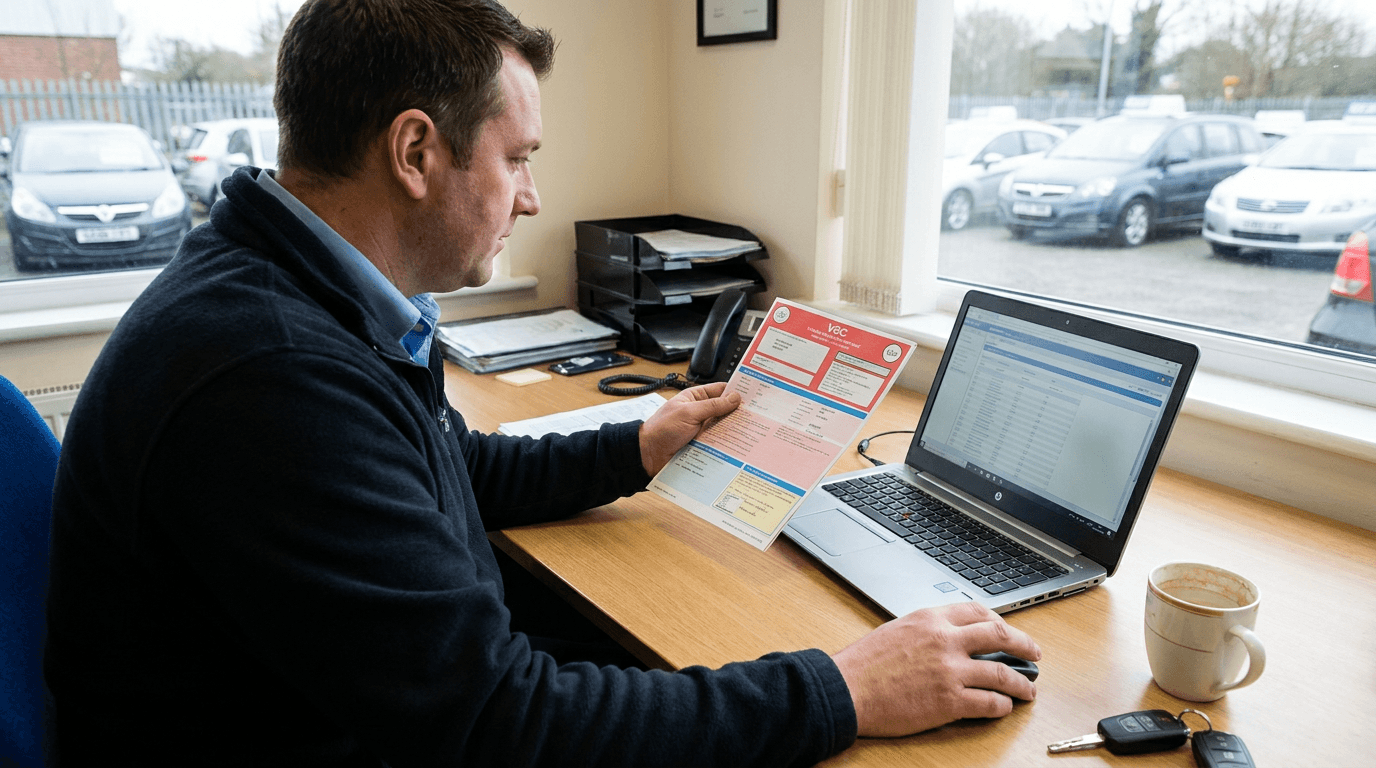
What V5C logbook data actually tells you and what it doesn't. Learn the legal limitations of registration documents and why traders need additional verification.
By CiteFlow
What the V5C logbook actually records
The V5C registration certificate records the current registered keeper of a vehicle, not the legal owner. This distinction matters because the registered keeper is the person responsible for taxing and insuring the vehicle, whilst legal ownership may rest with a finance company, leasing firm, or previous owner until payment clears. The V5C shows the vehicle's registration mark, VIN, make, model, colour, engine size, fuel type, and CO2 emissions, alongside the keeper's name and address. It does not verify mileage, service history, accident damage, outstanding finance, or whether the vehicle matches its described specification.
DVLA issues the V5C as an administrative record, not a proof-of-ownership document. The logbook itself states this clearly in its guidance notes, yet confusion persists in both trade and consumer transactions. For motor traders, this creates a fundamental problem: the document most customers associate with vehicle legitimacy provides almost no intelligence about the vehicle's actual history or condition.
The data fields on a V5C are limited to what DVLA requires for registration purposes. You will find the date of first registration, the current tax status, and any previous keeper count (though not their identities). The colour recorded may differ from the actual vehicle if changes were never notified. The VIN should match the chassis plate, but errors occur, particularly on older imports or vehicles that have undergone identity changes.
Why V5C data alone is insufficient for trade due diligence
Relying solely on V5C data exposes dealers to substantial risk because the document provides no verification of the vehicle's financial status, accident history, or technical accuracy. A V5C can be entirely genuine whilst the vehicle carries outstanding finance, has been written off and repaired, or has had its mileage wound back. The logbook confirms only that DVLA recognises a particular keeper for a particular registration mark.
Most experienced traders have encountered vehicles where the V5C told them nothing about the problems that emerged later. A clean logbook with a single keeper since new might seem reassuring until you discover the vehicle was category S two years ago, or carries £12,000 in outstanding finance. The V5C offers no protection against these scenarios because DVLA does not hold finance, insurance claims, or salvage data.
The keeper count shown on the V5C can be misleading. A vehicle registered to a leasing company, then a fleet operator, then three private keepers might show as five keepers, suggesting a troubled history. Conversely, a vehicle that has been clocked, crashed, and passed through four traders in six months might show just two keepers if the traders never registered it. The V5C records formal registration changes, not actual ownership chains.
Understanding the full range of data sources beyond DVLA records becomes essential for proper trade due diligence.
Common V5C discrepancies and what they indicate
Colour mismatches between the V5C and the actual vehicle often indicate unreported repairs or a colour change that was never notified to DVLA. Whilst some discrepancies are innocent oversights, others point to more serious issues. A vehicle described as black on the V5C but actually silver might have had panels replaced after accident damage. If the repair was substantial enough to involve an insurance claim, you need to know whether it was recorded as a category marker.
VIN discrepancies represent a more serious problem. If the VIN on the V5C does not match the chassis plate or the VIN stamped into the vehicle's structure, you are looking at either a clerical error or potential identity fraud. Clerical errors do occur, particularly on older vehicles or imports where VINs were transcribed manually. However, mismatched VINs can also indicate a ringer (a stolen vehicle given the identity of a legitimate one) or a cut-and-shut where two damaged vehicles have been welded together.
Engine size and fuel type errors appear less frequently but still matter for valuation and compliance. A vehicle recorded as 1.6 petrol on the V5C but actually fitted with a 2.0 diesel engine suggests either an engine swap or an administrative error dating back to first registration. Either way, the discrepancy affects valuations, insurance, and your ability to describe the vehicle accurately to customers.
Date of first registration anomalies can indicate import issues or plate transfers. A 2018-registered vehicle showing a 2015 first registration date might be a pre-registered vehicle that sat unsold, or it might be an import where the registration date was incorrectly recorded. Understanding plate changes and their implications helps identify when registration dates do not align with the vehicle's actual age.
What V5C data cannot tell you about vehicle history
The V5C provides no mileage verification whatsoever. DVLA does not record odometer readings, so the logbook offers zero protection against clocking. A vehicle might have covered 200,000 miles but show 60,000 on the clock, and the V5C will not help you identify the discrepancy. MOT history data and service records provide the mileage verification that V5C data cannot.
Finance status is entirely absent from V5C records. DVLA does not know whether a vehicle has outstanding hire purchase, PCP, or lease agreements. A vehicle can have a perfectly legitimate V5C whilst carrying thousands in outstanding finance that will create legal complications the moment you take ownership. Finance checks require access to separate databases maintained by finance houses and credit agencies, not DVLA.
Accident and salvage history does not appear on the V5C. A category S or category N vehicle (previously cat C and cat D) will have an identical logbook to a vehicle with no damage history. Insurance companies report write-offs to salvage databases and loss adjusters, not to DVLA. The V5C offers no indication that a vehicle has been substantially damaged and repaired.
Service history and maintenance records are not part of DVLA data. The V5C tells you nothing about whether the vehicle has been serviced according to manufacturer schedules, whether it has had major component replacements, or whether it has been maintained by franchised dealers or independent garages. This matters increasingly as manufacturer service history becomes a key differentiator in vehicle values.
Factory specifications and fitted options are not verified by the V5C. The logbook might show the model designation, but it will not confirm which trim level, option packs, or individual features were fitted at the factory. A vehicle described as having navigation, leather, and a premium sound system might have none of these, and the V5C provides no way to verify the specification.
The legal status of V5C documents in ownership disputes
Courts have consistently held that the V5C is not a document of title. In ownership disputes, possession of the V5C does not prove legal ownership. This principle was established in case law and is explicitly stated on the V5C itself. For traders, this means the logbook provides no legal protection if you purchase a vehicle from someone who is not the legal owner.
The registered keeper shown on the V5C may have no legal right to sell the vehicle. If the vehicle is subject to a hire purchase agreement, the finance company retains legal ownership until the final payment is made. If the vehicle is leased, the leasing company owns it. If the vehicle was purchased on credit that has not been paid, the seller may not have title to pass on. The V5C records none of this.
When a vehicle is sold with outstanding finance, the finance company can legally repossess it from the new keeper, even if that keeper purchased in good faith and had no knowledge of the finance. The V5C offers no protection in this scenario. This is why professional traders verify finance status through dedicated checks rather than relying on the logbook.
Understanding Experian indemnity coverage becomes relevant here, as proper provenance checks with indemnity protection provide the financial safeguard that V5C data cannot.
How DVLA registration data fits into comprehensive vehicle checks
DVLA data forms one component of a complete vehicle intelligence picture, but only one. The registration details, VIN, and first registration date from DVLA records provide the foundation for cross-referencing against other databases. The VIN allows you to retrieve factory build data, the registration mark enables MOT history lookup, and the keeper change count offers context for the vehicle's trading history.
Professional vehicle checks combine DVLA data with finance verification, salvage records, MOT history, service records, and valuation intelligence. The DVLA component confirms the vehicle's legal registration status and provides the identifiers needed to query other systems. Without accurate DVLA data, the other checks cannot be performed reliably, but without the other checks, DVLA data alone tells you almost nothing useful for trade purposes.
The integration of multiple data sources creates a verification chain where each element confirms or contradicts the others. If the DVLA first registration date does not align with the factory build date, you investigate further. If the V5C shows three keepers but MOT history reveals eight different testing stations in five years, you have evidence of undisclosed trading activity. If the logbook colour matches the vehicle but the insurance database shows a total loss claim, you have identified concealed damage.
Data quality standards and integration matter because errors in any single source can cascade through your decision-making process.
Practical verification steps beyond the V5C
Verifying the VIN against multiple sources catches identity issues that the V5C alone would miss. Check the VIN on the V5C against the chassis plate, the VIN stamped into the vehicle structure (usually visible through the windscreen or on the door shut), and the VIN returned by factory build data queries. Any mismatch requires investigation before you proceed.
Cross-reference the V5C registration date with the factory build date from manufacturer records. A vehicle showing a 2019 registration but a 2017 build date might be a pre-registered vehicle, an import, or a vehicle that sat in dealer stock for two years. Each scenario has different implications for valuation and marketability. Factory build data provides the manufacturing date that DVLA records do not.
Compare the V5C colour and specification against the actual vehicle and the factory build sheet. Discrepancies in basic details like colour often indicate more serious problems. If the V5C says blue but the vehicle is red and the build sheet confirms it left the factory in blue, you are looking at either a respray or a potential identity issue.
Verify the keeper count against MOT testing patterns. A vehicle showing two keepers on the V5C but tested at six different locations in three years suggests trade activity that was not formally registered. This is not necessarily a problem, but it changes your understanding of the vehicle's history and may indicate higher mileage accumulation than a simple two-keeper history would suggest.
Check for plate changes and registration transfers. If the current registration mark is significantly newer or older than the vehicle, investigate whether a private plate was added or removed. Plate changes can obscure a vehicle's age and affect its perceived value, particularly if a newer-looking plate makes an older vehicle appear more recent.
When V5C data contradicts other intelligence sources
When the V5C shows different information to other verified sources, the V5C is not automatically wrong, but it requires investigation. DVLA data is generally accurate for what it records, but it only records what has been formally notified. If a vehicle was resprayed but the keeper never told DVLA, the V5C colour will be wrong. If an engine was swapped but not notified, the V5C engine size will be incorrect.
MOT history often contradicts V5C keeper counts because MOT tests are performed regardless of whether the vehicle has been formally re-registered. A vehicle tested at a garage in Scotland, then Cornwall, then Newcastle in consecutive years clearly had more movement than a single-keeper V5C would suggest. The MOT data is not wrong, and neither is the V5C; they simply record different things.
Factory build data sometimes contradicts V5C specifications, particularly for imports or vehicles with complex option configurations. The build sheet represents what left the factory; the V5C represents what was registered with DVLA. If an import was incorrectly described at registration, the V5C will perpetuate that error. The build data is the authoritative source for original specification.
When contradictions appear, investigate using the most authoritative source for each data point. For original specification, use factory build data. For mileage, use MOT and service history. For finance status, use dedicated finance checks. For salvage history, use insurance databases. The V5C provides registration details and keeper information, nothing more.
Why professional traders need data beyond DVLA records
The used car trade operates in an environment where Consumer Rights Act 2015 obligations require you to describe vehicles accurately and ensure they are of satisfactory quality. You cannot meet these obligations using V5C data alone. The logbook tells you nothing about whether the vehicle has been clocked, written off, or mis-described, yet these are exactly the issues that create CRA 2015 liability.
Customer disputes increasingly hinge on whether you conducted adequate due diligence before purchase and sale. Presenting a V5C as evidence of a vehicle's history provides almost no protection in a dispute. Presenting comprehensive provenance data from multiple sources, including finance checks, salvage records, and mileage verification, demonstrates that you took reasonable steps to verify the vehicle's condition and history.
Risk management in stock purchasing requires intelligence that the V5C cannot provide. Every vehicle you buy without finance verification carries the risk of repossession. Every vehicle you buy without salvage checks carries the risk of undisclosed damage affecting value and safety. Every vehicle you buy without mileage verification carries the risk of clocking that will surface when the customer checks MOT history online.
Market positioning depends on your ability to offer customers verified history and transparent documentation. Dealers who can provide comprehensive provenance reports, verified service history, and factory build confirmation differentiate themselves from those relying on a V5C and a verbal assurance. The intelligence gap between basic checks and professional verification directly affects your ability to command premium prices and reduce returns.
Integrating V5C verification into your stock acquisition process
Building V5C checks into your acquisition workflow means verifying the document itself and using it as the starting point for deeper intelligence gathering. Check that the V5C is not a forgery by examining the paper quality, watermarks, and security features. DVLA uses specific paper stock and printing techniques that are difficult to replicate. If the V5C looks or feels wrong, verify it directly with DVLA before proceeding.
Use the VIN from the V5C to initiate your broader checks immediately. The VIN is the key to unlocking factory build data, manufacturer service history, and specification verification. The registration mark enables MOT history lookup and connects to insurance databases. The V5C provides these identifiers, but its value lies in what they unlock, not what the document itself contains.
Document any discrepancies between the V5C and the physical vehicle before purchase. Photograph the VIN locations, the V5C itself, and any areas where the vehicle differs from the logbook description. This documentation protects you if issues emerge later and provides evidence that you identified problems during inspection.
Treat the V5C as administrative confirmation, not historical verification. It confirms that DVLA recognises the vehicle and keeper, which is necessary but not sufficient for trade due diligence. Layer finance checks, salvage verification, mileage analysis, and specification confirmation on top of the basic DVLA data to build a complete intelligence picture.
FAQ
Does the V5C prove who owns a vehicle?
No. The V5C records the registered keeper, not the legal owner. The document explicitly states it is not proof of ownership. Legal ownership may rest with a finance company, leasing firm, or previous owner, none of which appears on the V5C. In ownership disputes, courts do not treat the V5C as evidence of title.
Can I rely on V5C mileage information?
The V5C does not record mileage at all. DVLA does not collect or verify odometer readings, so the logbook provides no protection against clocking. Mileage verification requires MOT history data and service records, which track mileage at each test or service interval.
Why does the V5C colour not match my vehicle?
Colour discrepancies usually indicate either an unreported respray or an error dating back to first registration. DVLA records only what keepers notify them. If a vehicle was resprayed but the keeper never updated DVLA, the V5C will show the original colour. Significant colour changes can indicate accident repairs that were never formally recorded.
Does the V5C show if a vehicle has outstanding finance?
No. DVLA does not hold finance information. A vehicle can have a legitimate V5C whilst carrying thousands in outstanding hire purchase or lease agreements. Finance verification requires separate checks against finance company databases, not DVLA records.
What should I do if the VIN on the V5C does not match the vehicle?
Investigate immediately before proceeding with any purchase. VIN mismatches can indicate clerical errors, particularly on older vehicles or imports, but they can also signal identity fraud or cut-and-shut construction. Verify the VIN against factory build data and contact DVLA to resolve the discrepancy before committing to the transaction.
Frequently Asked Questions
AI-Generated Content Notice
This article was created with the assistance of artificial intelligence technology. While we strive for accuracy, the information provided should be considered for general informational purposes only and should not be relied upon as professional automotive, legal, or financial advice. We recommend verifying any information with qualified professionals or official sources before making important decisions. AutoProv accepts no liability for any consequences resulting from the use of this information.
From our AI insights
- Navigating CCR 2013: Niche Insights for UK Motor Traders
Explore niche insights on CCR 2013 for UK motor traders, focusing on compliance and cancellation rights.
- Decoding CRA 2015: Dealer's Guide to 30-Day Rejections
Explore CRA 2015's 30-day rejection rights from a dealer's perspective, highlighting key compliance strategies.
- Navigating DVLA Conviction Checks: Dealer Compliance
Understand DVLA conviction checks and lawful access for UK dealers.
Related Articles

Understanding the Consumer Rights Act 2015 in the UK Motor Trade
Explore the Consumer Rights Act 2015 and its impact on UK car buyers and sellers, offering essential protections and insights.

Understanding UK Automotive Regulations
Explore the complexities of automotive regulations in the UK, covering DVLA, FCA, MOT, and more.
What is a V5C Document: A Quick UK Log Book Guide
If you've ever bought or sold a car in the UK, you've definitely come across the V5C. It's often just called the 'log book', and it’s the official Vehicle Registration Certificate issued by the DVLA.
Published by AutoProv
Your trusted source for vehicle intelligence