
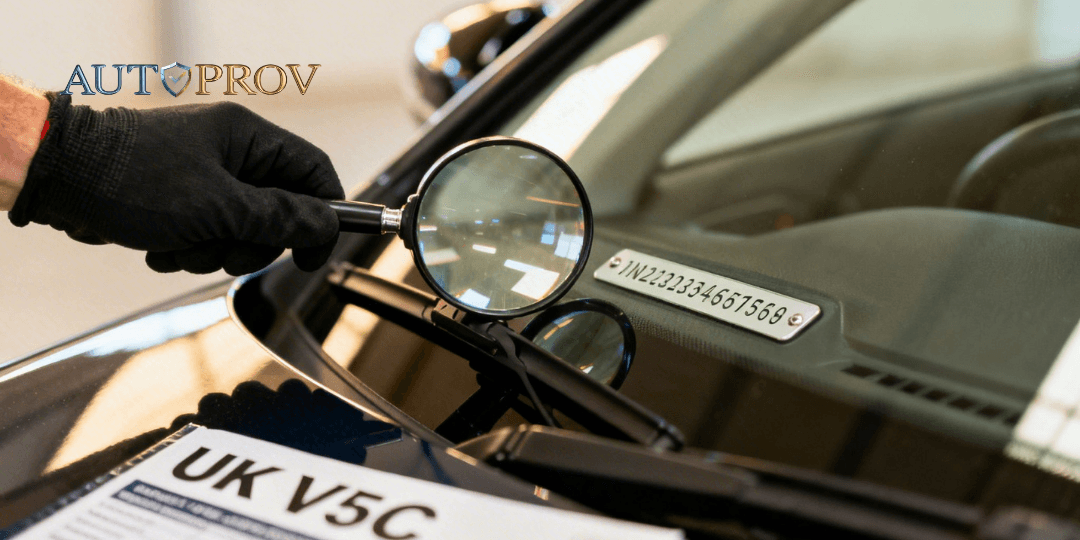
A thorough physical inspection is the first step in any professional vehicle appraisal. Central to this process is the Vehicle Identification Number (VIN). Correctly locating and verifying the VIN is a foundational element of risk assessment. The 17-character VIN is a vehicle's unique identifier. Verifying it correctly is a non-negotiable first step in establishing provenance. This initial check is a critical opportunity to identify inconsistencies that may indicate underlying issues. A methodical inspection of each VIN location sets the standard for the entire appraisal.
Key VIN Locations on UK Vehicles
The most common locations are designed for accessibility, while harder-to-reach stampings provide definitive verification. A motor trader's objective is to inspect every location and confirm a perfect match across all of them.
This diagram outlines the standard operational sequence for a VIN inspection.

The process flows from the most visible plate on the windscreen, to the B-pillar sticker, and finally to the definitive chassis stamping. Each location serves a purpose, from rapid identification to a permanent, tamper-resistant mark. The critical requirement is that the VIN must be identical in all locations. Any discrepancy, however minor, is a significant red flag.
For instance, a new-looking B-pillar sticker combined with a damaged or displaced windscreen plate could indicate a recent glass replacement, prompting further investigation into the vehicle's history.
What to Look for at Each Point
Inspecting each VIN is not merely about reading the number; it involves a forensic assessment of its condition and legitimacy.
- Windscreen VIN Plate: Typically located at the base of the windscreen on the passenger side. Assess if it is straight and professionally fitted. Look for signs of tampering, such as adhesive marks, a plate that is not flush, or disturbance to the surrounding dashboard material.
- B-Pillar Sticker: Found inside the driver or passenger door frame. This is often a manufacturer's sticker. Check for peeling, damage, or evidence of reapplication. The font and print quality should be consistent with factory standards.
- Chassis Stamping: This is the most critical point of verification, as it is stamped directly into the vehicle's metal frame. Common locations include the engine bay bulkhead, under the carpet near a front seat, or on a primary chassis rail. For a more detailed guide, see our post on how to find a vehicle's chassis number. These stampings must be clean, evenly spaced, and free from any signs of grinding, welding, or tampering.
This reference table is designed for on-the-spot inspections during an appraisal.
Primary UK VIN Locations and Risk Indicators
This table assists motor traders in quickly locating VINs and understanding potential risk signals during a physical appraisal.
Location Ease of Access What to Look For (Risk Indicator) Windscreen Plate Very Easy Signs of tampering, glue residue, poor fit, or a non-standard plate. Could indicate a stolen vehicle's identity being swapped. B-Pillar Sticker Easy Peeling, damage, mismatched fonts, or evidence of being reapplied. May suggest the door has been replaced or the identity altered. Chassis Stamp Difficult Any signs of grinding, welding, corrosion around the numbers, or uneven stamping. This is a major red flag for a "ringer." V5C Logbook N/A (Document) Mismatched number, typographical errors, or any alterations on the document. A compromised V5C invalidates the vehicle's identity. A consistent physical inspection process forms a solid foundation for your vehicle risk assessment, confirming its core identity before proceeding with any digital checks.
A consistent VIN across all physical locations is the first pillar of vehicle provenance. It confirms the vehicle's core identity before you even begin a digital history check. An inconsistency here invalidates any subsequent checks.
Mastering this initial physical check is a fundamental skill. It’s a non-negotiable first step that protects your investment and your business's reputation right from the very start.
Matching the Vehicle to its Documentation
A consistent VIN on the vehicle is only the first part of the verification process. The critical test is ensuring the physical asset matches its official documentation. Any discrepancy between the vehicle and its records should be considered an immediate deal-breaker.
This check connects the appraised vehicle to its recorded history. A single incorrect digit could be the only indicator of a cloned vehicle, a fraudulent history, or significant administrative issues.

Cross-Referencing Key UK Vehicle Documents
The inspection must cover all available paperwork to build a complete, watertight picture where every detail aligns.
- The V5C Logbook: This is the primary document. The VIN is clearly printed on the V5C. Compare it character-for-character against the chassis stamp and the windscreen plate. Physically inspect the document for authenticity; genuine V5Cs have a distinct feel and a watermark. Any signs of tampering, smudging, or unprofessional printing are immediate causes for concern. For a deeper dive, review this quick guide to the V5C document.
- MOT Certificates: The VIN is recorded on current and past MOT certificates. Verify this against the V5C and the vehicle. A mismatch could be an administrative error at the testing station or, more seriously, an attempt to obscure the vehicle's true identity.
- Service History: A comprehensive service history provides another valuable point of VIN verification. Check for the VIN on invoices and within the service book. A complete and consistent record not only confirms the vehicle's identity but also strengthens its provenance and value.
A vehicle’s paperwork is not just administrative clutter; it is a core component of its provenance intelligence. Treat every document as a data point to be verified, not just a box to be ticked.
For any UK motor trader, the 17-character VIN is the key to unlocking the full DVLA record. It is consistently located on the windscreen, the B-pillar, and the V5C logbook. These locations are designed for easy access, facilitating rapid issue identification.
What to Do When Numbers Don't Align
If a mismatch is identified, the next step is simple: stop.
Do not proceed with the acquisition until a definitive explanation for the discrepancy is provided. In the majority of cases, the most prudent course of action is to walk away. A mismatched VIN is one of the most significant red flags in the motor trade.
This is where a professional dealer vehicle check from a platform like AutoProv adds a vital layer of security. By entering the VIN from the vehicle's chassis, you can access its official digital record. If that record fails to match the V5C presented by the seller, you have likely uncovered a serious issue and protected your business from a potentially damaging acquisition.
Understanding the VIN Structure
A Vehicle Identification Number is more than a serial number; it is a 17-character code that details a vehicle's origin, specification, and identity. For motor trade professionals, the ability to interpret this code is a fundamental skill for identifying inconsistencies that a cursory glance at the V5C may miss.
The VIN is divided into three main sections, each providing a different piece of information.
The World Manufacturer Identifier (WMI)
The first three characters constitute the World Manufacturer Identifier (WMI). This identifies the manufacturer and the country of assembly. For example, a VIN beginning with 'S' indicates assembly in the UK, while 'W' signifies Germany.
This provides an immediate check for potential 'grey imports'—vehicles not originally manufactured for the UK market. If a vehicle is presented as a standard UK model, but the WMI indicates a North American factory, that is a clear red flag requiring investigation into its import history and UK compliance.
The Vehicle Descriptor Section (VDS)
Characters four through nine form the Vehicle Descriptor Section (VDS). This section encodes factory-fit specifications, including model, body style, engine type, and transmission. This data is invaluable for verifying that the vehicle's current specification matches its original build.
For example, if appraising a vehicle badged as a high-performance model, the VDS could reveal it was manufactured with a standard, lower-powered engine. This insight immediately uncovers either undeclared modifications or a deliberate misrepresentation, fundamentally altering its valuation.
The VIN’s internal logic is a powerful tool for on-the-spot fraud detection. A mismatch between the VDS and the vehicle’s physical attributes is a clear signal that its history requires deeper scrutiny.
The Vehicle Identifier Section (VIS) and the Check Digit
The final block, characters ten to seventeen, is the Vehicle Identifier Section (VIS). This part details specifics such as the model year (character 10), the assembly plant (character 11), and the unique production number.
Within the VDS, the ninth character is a check digit. This is the result of a mathematical algorithm applied to all other characters in the VIN, serving as an authentication mechanism. If even one character has been altered, the check digit will be incorrect.
While this calculation is not performed manually during an appraisal, its validation is a core component of any professional used car history report. A system like AutoProv performs this check instantly. A failed validation indicates the VIN is fraudulent or has been recorded incorrectly, protecting you from acquiring a vehicle with a compromised identity. Understanding this is a crucial part of an effective vehicle check with a VIN number.
Spotting VIN Tampering and Inconsistencies
Verifying a matching VIN on the vehicle and its documentation is the first step. The next stage requires a more detailed, forensic inspection. For an experienced trader, a sharp eye at this stage is what separates a good acquisition from a significant financial risk. While fraudulent methods are becoming more sophisticated, the physical evidence left behind is often detectable with careful examination.
This part of the appraisal focuses on identifying signs of disturbance. A vehicle’s identity is often attacked at its weakest points, so your inspection must be meticulous. You are not just reading a 17-digit number; you are verifying its entire physical history.

Physical Red Flags on the Vehicle
Begin with the VIN plate, typically located at the base of the windscreen or on the B-pillar. The method of attachment is a key indicator.
- Non-Factory Rivets: Manufacturers use specific, uniform rivets. Look for mismatched, damaged, or generic pop rivets, which are a classic sign that the original plate has been removed and replaced.
- Adhesive and Glue Marks: A genuine VIN plate should be flush and clean. Any sign of excess adhesive or residue suggests it has been re-attached.
- Suspicious Windscreen Condition: Pay close attention to the dashboard area around the VIN. Scratches on the inside of the glass, damage to the surrounding trim, or a poorly fitted replacement windscreen could indicate an attempt to access the plate.
Next, inspect the chassis stamp. This represents the vehicle’s permanent identity. Tampering here requires more effort and typically leaves clearer evidence.
The term 'ringer' describes a stolen vehicle given the identity of a legitimate, often written-off, car. A meticulous physical inspection of the VIN stampings is your primary defence against acquiring one.
Look for stamped VIN characters with uneven depth or spacing. Scan the surrounding area for grinding marks, welding, or a patch of fresh paint—all tell-tale signs of an attempt to alter the original number. This is particularly crucial for vehicles with a known salvage history, as it may signal more significant fraud.
For a comprehensive overview of these risks, our guide on preventing car cloning in the UK offers further trade-specific guidance.
Correlating Physical and Digital Clues
This is where physical inspection converges with data intelligence. For UK motor traders, the VIN is the key to unlocking risk intelligence, as platforms like AutoProv decode it to reveal a vehicle's full history from multiple data sources. The 17-character code is structured to deter fraud; the ninth digit, for instance, is a 'check digit' calculated from all others.
With 1.55 million new cars registered in 2023, each with a unique VIN, this identifier is the essential link to official DVLA records and MOT history. You can find more details about how the VIN links to a vehicle's registration on CarOwl.
When a physical anomaly is spotted, a digital check can instantly confirm suspicions by flagging inconsistencies that do not align with the expected record.
Red Flags for VIN Tampering: Physical vs. Digital Clues
Connecting physical observations with data-driven insights is key to identifying a ringer or cloned vehicle. This table links physical findings to potential digital red flags.
Physical Red Flag (What you see) Potential Digital Anomaly (What a check might find) Associated Risk Scratches/damage around the VIN plate The vehicle is flagged as a previous write-off (Cat S/N) Potentially a 'ringer' where a stolen car's identity is being swapped with a write-off. Mismatched or generic rivets The VIN doesn't match the V5C document or the DVLA record High risk of car cloning. The vehicle is not what it appears to be. Grinding marks near the chassis stamp No MOT history found for the registration, despite the car's age The car may have been off-road, stolen, or illegally imported. A major red flag. Uneven characters on the chassis stamp The VIN's 'check digit' (9th character) is mathematically incorrect Indicates a fabricated or altered VIN. This is a deliberate act of fraud. Fresh paint around the stamped area A recent colour change is noted in the vehicle's history Could be a legitimate repaint, but combined with other signs, it's a classic tactic to hide tampering. This dual approach—physical inspection corroborated by digital verification—is your most robust defence against fraud. Never rely on one method alone. When the physical and digital narratives do not align, it is time to walk away.
From Identification to Intelligence
Once a legitimate, physically verified VIN is obtained, its true value to your business can be realised. The 17-character code is the key to unlocking modern, data-driven vehicle intelligence, moving beyond a basic history check into a more sophisticated risk assessment. It is the starting point for uncovering a vehicle's true history.
A professional dealer vehicle check is essential at this stage. Platforms designed for the trade, like AutoProv, use the VIN to aggregate and cross-reference data from multiple authoritative UK sources. This process connects DVLA records, MOT history, insurance data, mileage logs, and ownership timelines into a single, coherent picture.
The purpose is to provide context, not just a list of data points. A standard check might confirm a vehicle is not stolen or written off but often fails to identify the subtle patterns that indicate hidden risk.
Moving Beyond a Simple "All Clear"
An "all clear" report is often insufficient for making a sound business decision. Deeper intelligence focuses on identifying the patterns and anomalies that emerge when datasets are analysed together. This is where you identify the kind of motor trade risk that can impact profitability and reputation long after a vehicle is in stock.
Effective trade vehicle intelligence involves looking for specific risk signals:
- Short-Term Ownership Cycles: A vehicle that has changed hands multiple times in a short period can be a significant risk. This pattern often points to a persistent, difficult-to-diagnose fault being passed from one owner to the next.
- Rapid Resale Activity: A vehicle reappearing on the market shortly after its last sale is a major red flag. It begs the question: what did the previous keeper discover that prompted such a quick disposal?
- Mileage Data Anomalies: A professional mileage check UK service will compare readings from MOTs, service records, and previous sale listings. Any discrepancies or illogical progressions are strong indicators of potential odometer tampering or data errors requiring further investigation.
The real power of a VIN isn't just in what it identifies, but in the historical patterns it unlocks. A series of rapid ownership changes can be a more telling risk signal than a single data point from a basic check.
Turning Data Into a Decision-Making Tool
This level of analysis transforms the VIN from a simple identifier into a powerful risk assessment tool. By examining the complete vehicle provenance, you can make sharper acquisition decisions. Understanding the context behind a vehicle's history—such as a long period off-road between MOTs or an unusually high number of keepers for its age—allows for more accurate valuation.
For instance, a used car history report flagging a two-year gap in its MOT history is not just a data point; it is a trigger for further questions. Was the vehicle in storage, or was it involved in an unrecorded accident? To understand what a comprehensive check should cover, you can learn more about a full vehicle details check and how it informs smarter buying.
Ultimately, using the VIN to access deeper intelligence is about protecting your capital. It helps you identify vehicles with hidden problems, value stock more accurately, and operate with greater confidence and compliance.
Common Questions About Vehicle Identification Numbers
Even for experienced motor trade professionals, certain VIN-related questions frequently arise during appraisals. Here are direct, trade-focused answers to common queries to help you manage risk effectively.
What if the V5C and Windscreen VINs Mismatch?
Stop all proceedings. If the VIN on the V5C logbook does not perfectly match the windscreen plate—and more importantly, the stamped chassis plate—you should terminate the deal immediately.
This is one of the most significant red flags in the motor trade. It is a classic indicator of a cloned or 'ringed' vehicle, where a stolen vehicle assumes the identity of a legitimate one. While there is a remote possibility of an administrative error, the risk of fraud is too high to justify proceeding.
Can I Use a Partial VIN for a History Check?
No. A partial VIN is insufficient for any credible UK vehicle history check. The full 17-character code is required to correctly identify a vehicle and retrieve its official records from sources like the DVLA.
The initial characters may provide information about the manufacturer and country of origin, but this is not enough for a detailed check. For investigating specific vehicle provenance data, a partial number is ineffective. Always insist on the complete, verified VIN before committing capital to a vehicle.
Is the Engine Number the Same as the VIN?
No, they are two entirely separate identifiers. The VIN is stamped onto the vehicle's chassis and serves as its primary legal identity. The engine number is a serial number stamped onto the engine block by the manufacturer.
While a manufacturer's database may link these numbers, they are not interchangeable for verification purposes. All official UK records—from registration and MOT history to finance agreements—are tied directly to the VIN. If an engine has been replaced, the engine number will change, but the VIN remains with the chassis for life.
Note that on older or classic vehicles (pre-1981), the standard 17-character VIN format may not apply. These vehicles often have a shorter chassis number located in different areas, such as the engine bay bulkhead. Verifying these often requires specialist knowledge.
A professional vehicle intelligence platform can cross-reference various identifiers, but for risk assessment within the motor trade, the VIN is always the definitive number.
A mismatched VIN is a deal-breaker, but subtle risks like rapid ownership changes or mileage anomalies require deeper analysis. AutoProv delivers advanced vehicle provenance and risk intelligence, empowering UK motor traders to identify hidden issues that basic checks miss. Protect your capital and make smarter buying decisions by visiting https://autoprov.ai.
Frequently Asked Questions
AI-Generated Content Notice
This article was created with the assistance of artificial intelligence technology. While we strive for accuracy, the information provided should be considered for general informational purposes only and should not be relied upon as professional automotive, legal, or financial advice. We recommend verifying any information with qualified professionals or official sources before making important decisions. AutoProv accepts no liability for any consequences resulting from the use of this information.
From our AI insights
- How to Secure Your Car Against Catalytic Converter Theft
Learn the best methods to protect your car from catalytic converter theft in the UK.
- Protecting Your Car from Keyless Entry Theft
Discover effective strategies to safeguard your vehicle from keyless entry theft in the UK.
- Seasonal Security Tips for UK Car Owners
Prepare your vehicle for seasonal changes with these tailored security tips for UK car owners.
Related Articles

Published by AutoProv
Your trusted source for vehicle intelligence
