
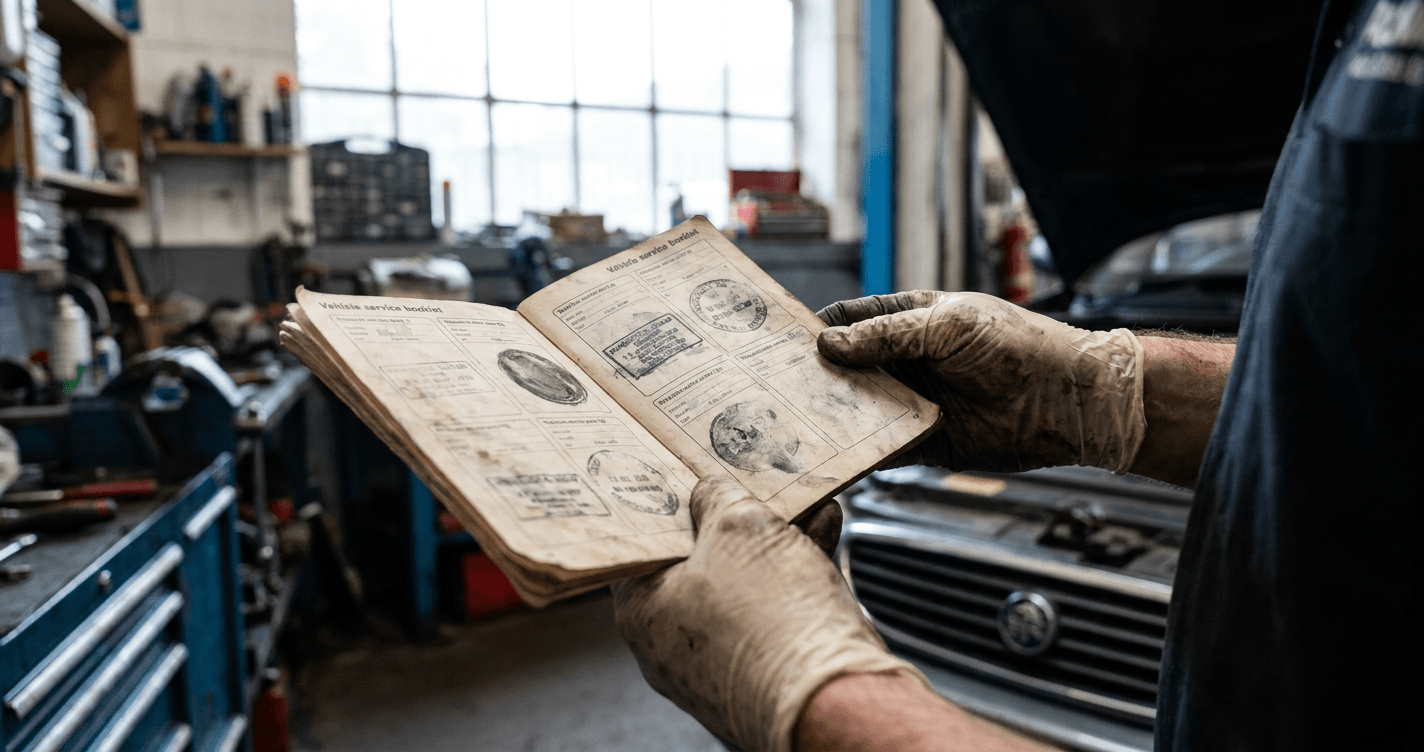
Paper service stamps are easily forged, lost, and unverifiable. Discover why UK motor traders can no longer rely on stamped logbooks for due diligence.
By CiteFlow
The Fundamental Problem with Paper Service Stamps
Paper service stamps cannot be trusted because they are trivially easy to forge, impossible to verify independently, and frequently lost or incomplete. Unlike digital service records held in manufacturer databases, a stamped logbook provides no chain of custody, no cryptographic verification, and no way to confirm the service actually took place at the claimed dealer or garage. For motor trade professionals conducting due diligence, a stamped service book represents unverified seller testimony, not proof of maintenance.
The UK motor trade has operated on paper service books for decades, but the system was always built on trust rather than verification. A stamp from a garage proves only that someone had access to that garage's stamp, not that the work was completed, the parts were genuine, or the mileage was accurate. As vehicle values have increased and fraud techniques have become more sophisticated, the gap between what a service stamp implies and what it actually proves has become a liability traders can no longer afford.
How Service Stamp Fraud Actually Works
Service stamp fraud operates through several well-established methods, all of which exploit the complete absence of verification mechanisms in paper logbooks. The most common approach involves purchasing blank service books online, often advertised as "replacement" books for vehicles with lost documentation. These books arrive with no history, allowing sellers to create whatever maintenance narrative suits their needs.
Stamp kits representing franchise dealers and independent garages are readily available through online marketplaces and specialist suppliers. Some fraudsters go further, using desktop publishing software to create convincing dealer stamps that include logos, addresses, and contact details of legitimate businesses. The stamps are then applied to the blank service book alongside fabricated dates and mileage readings that align with MOT records to create apparent consistency.
Another technique involves genuine service books from scrapped or written-off vehicles being paired with cars that share the same model and similar age. The VIN discrepancy is rarely checked by private buyers, and even some trade buyers fail to cross-reference the VIN in the service book against the vehicle's actual identity. This approach provides the fraudster with authentic-looking stamps from real dealers, making detection significantly harder without verifying digital service records held by manufacturers.
Why Independent Verification Is Impossible
The core weakness of paper service stamps lies in the impossibility of independent verification after the fact. When a trader examines a stamped logbook, they are looking at ink on paper with no supporting infrastructure. There is no central database of garage stamps, no authentication technology embedded in the paper, and no requirement for garages to retain records that correspond to the stamps they issue.
Even when a stamp appears to come from a franchise dealer, calling that dealer to verify the service often proves fruitless. Many dealers purge service records after a certain period, particularly for vehicles no longer under warranty or outside their customer base. Staff turnover means the person who stamped the book may no longer work there. Data protection concerns sometimes prevent dealers from confirming service history over the phone without the current registered keeper's consent, creating a verification barrier for trade buyers conducting pre-purchase checks.
Independent garages present an even greater verification challenge. Small workshops may not retain computerised records going back years, and some operate on cash-only terms with minimal documentation. When these businesses close, change ownership, or simply stop answering their phones, the stamps they issued become permanently unverifiable. The trader is left with a mark in a book and no means of establishing whether the claimed service ever occurred.
The Lost and Incomplete Service Book Problem
Beyond deliberate fraud, the simple reality of lost and incomplete service books creates enormous uncertainty in vehicle provenance. Service books are small paper documents that travel with vehicles through multiple owners, house moves, and changes of circumstance. They get left in glove boxes when cars are sold, thrown away during clear-outs, or damaged by water and wear.
When a genuine vehicle with legitimate service history loses its paper logbook, the maintenance record effectively vanishes. A trader examining that vehicle sees a car with no documented service history, which typically reduces its value and marketability despite the work having been completed. The owner may have receipts for some services but rarely for all, and loose receipts lack the narrative coherence of a properly maintained book. This creates a perverse situation where well-maintained vehicles are penalised purely due to documentation loss, while fraudulent vehicles with fabricated books appear superior.
Incomplete service books present a different challenge. Many vehicles have partial stamped history, genuine for the first few years but then becoming sporadic or stopping entirely. Traders must then decide whether the gaps represent deferred maintenance, a switch to independent servicing without stamps, or something more concerning. Without the ability to verify what actually happened during those gaps, risk assessment becomes guesswork. Understanding how to spot these inconsistencies is crucial, but even experienced traders cannot verify what the paper does not show.
What Digital Service History Actually Proves
Digital service history held in manufacturer databases provides the verification infrastructure that paper stamps completely lack. When a franchise dealer services a vehicle, the work is recorded in the manufacturer's central system against the vehicle's VIN. This creates a permanent, timestamped record that includes the service date, mileage at service, work completed, parts fitted, and the dealer location.
These digital records cannot be retrospectively altered without leaving audit trails, and they remain accessible regardless of whether the physical service book exists. A vehicle that has lost its paper logbook but was serviced at franchise dealers throughout its life retains its full service history in digital form. Traders can retrieve this history through manufacturer databases, providing verification that is completely independent of the seller's claims.
The digital record also captures details that paper stamps never include. Mileage progression across services can be analysed to identify inconsistencies suggesting clocking. Warranty repairs and recalls are documented, providing insight into the vehicle's problem history. Software updates and technical campaigns are recorded, showing whether the vehicle has received important manufacturer interventions. This depth of information transforms service history from a simple maintenance checklist into comprehensive vehicle intelligence.
AutoProv accesses official digital service history from 44 manufacturer databases, allowing traders to verify maintenance records that stamped logbooks cannot prove. The system retrieves dealer service records, mileage verification, and maintenance schedules directly from OEM systems, providing the independent verification that paper stamps will never offer.
The Regulatory and Liability Implications
Relying on unverifiable paper service stamps creates regulatory and liability exposure under the Consumer Rights Act 2015. When a dealer sells a vehicle described as having full service history based solely on stamps in a book, they are making a representation about the vehicle's condition and maintenance. If those stamps prove to be fraudulent or the services were never completed, the vehicle may not be of satisfactory quality or as described.
Under CRA 2015, buyers have rejection rights if the vehicle does not match its description or is not of satisfactory quality. A vehicle sold with claimed full service history that later proves to have fabricated stamps gives the buyer grounds for rejection, even months after purchase. The dealer faces the cost of refunding the purchase price, collecting the vehicle, and potentially dealing with a customer who has lost trust in the business.
The liability extends beyond individual transactions. Trading Standards authorities take mis-description seriously, particularly when patterns emerge suggesting systemic failure to verify claims. A dealership that repeatedly sells vehicles with fraudulent service history, even if the fraud originated with previous owners, demonstrates inadequate due diligence. This can trigger investigations, enforcement action, and reputational damage that extends far beyond the value of individual vehicles.
Professional traders cannot afford to treat service stamps as verified facts. Digital service history verification provides the independent confirmation needed to make defensible claims about vehicle maintenance and protect the business from liability arising from unverifiable paper documentation.
Why Stamped History Still Influences Retail Prices
Despite their unreliability, stamped service books continue to influence retail prices because consumer perception lags behind fraud reality. Private buyers and less sophisticated trade buyers still view a fully stamped book as evidence of good maintenance, creating a price premium for vehicles that present this documentation. This premium exists regardless of whether the stamps are genuine, creating a financial incentive for fraud.
The price differential between vehicles with stamped history and those without can reach hundreds or even thousands of pounds on prestige and performance models. This gap reflects buyer psychology rather than actual maintenance verification. A vehicle with a complete stamped book sells faster and achieves stronger prices than an identical vehicle with lost documentation but verified digital history, purely because the stamped book provides a tangible, easy-to-understand narrative.
This market dynamic puts honest traders in a difficult position. They can invest in proper verification through digital service history checks, discover that a vehicle's stamped book is fraudulent or unverifiable, and then struggle to achieve market prices because buyers still place value on the paper stamps. Meanwhile, less scrupulous traders who accept stamped books at face value move stock faster and achieve better margins, at least until the fraud is discovered and liability materialises.
The solution lies in educating buyers about the difference between stamped and verified history, and in traders positioning digital verification as a superior alternative that protects the buyer's investment. Vehicles sold with verified digital service history can command premiums over those with unverifiable stamps, but only when the buyer understands what verification actually means and why it matters.
The Transition to Digital-First Due Diligence
The motor trade is experiencing a fundamental shift from paper-based trust systems to digital verification as the primary due diligence tool. This transition is driven by increasing fraud sophistication, regulatory pressure, and the availability of manufacturer databases that provide reliable alternatives to stamped logbooks.
Traders who continue to rely primarily on paper service stamps are operating with 20th-century verification methods in a market where fraud techniques have evolved significantly. The investment required to check digital service history is minimal compared to the liability exposure from accepting fraudulent stamps, yet many traders still treat stamped books as sufficient evidence of maintenance.
Digital-first due diligence does not mean ignoring paper service books entirely. A stamped book that aligns with verified digital records provides useful supporting documentation and customer reassurance. However, the verification must come from independent digital sources, with the stamped book treated as corroborating evidence rather than primary proof. When digital records are unavailable or incomplete, traders must assess the vehicle on the basis that service history cannot be verified, pricing and describing it accordingly.
This approach protects margins by preventing the purchase of vehicles with fraudulent history at inflated prices. It reduces liability by ensuring claims about service history are based on verifiable evidence. It also positions the dealership as professional and thorough, differentiating it from competitors who still accept paper stamps at face value.
What Traders Should Do Instead
Professional traders should implement a verification hierarchy that prioritises digital records over paper documentation. The first step in assessing any vehicle's service history should be checking manufacturer databases for digital records. AutoProv retrieves official service history from 44 manufacturer databases, providing immediate verification of dealer services, mileage, and maintenance schedules.
When digital records confirm the service history, the stamped book becomes supporting documentation that enhances customer confidence but is not relied upon for verification. When digital records are absent or incomplete, traders must decide whether to proceed based on other factors such as vehicle condition, price, and market demand, but they should not describe the vehicle as having verified service history.
For vehicles serviced primarily by independent garages, verification becomes more challenging but not impossible. Some independent specialists maintain digital records and can provide confirmation of work completed. Detailed receipts with parts descriptions and labour breakdowns carry more weight than simple stamps. However, traders should recognise that independent service history will always carry more verification risk than manufacturer digital records.
The key principle is never to make claims about service history that cannot be independently verified. If the only evidence is stamps in a book, the vehicle should be described as having "stamped service history" rather than "full service history", making clear that the stamps have not been independently verified. This protects the business from liability while maintaining honesty with customers about what can and cannot be proven.
Regional Variations in Service History Fraud
Service history fraud patterns vary across UK regions, influenced by local market dynamics, vehicle values, and enforcement activity. High-value vehicle markets in areas such as London and the West Midlands see more sophisticated fraud attempts, including professionally forged dealer stamps and complete fabricated service narratives designed to add thousands to vehicle values.
Regions with strong prestige and performance vehicle markets experience particular pressure around service history verification. Buyers in these markets expect comprehensive maintenance records, creating strong financial incentives for sellers to present convincing documentation regardless of authenticity. Traders operating in Yorkshire and the Humber, Manchester, and Birmingham markets should be especially vigilant when examining high-value stock with apparently perfect stamped history.
Rural and regional markets sometimes see different fraud patterns, with service books from closed or untraceable independent garages being more common than sophisticated dealer stamp forgeries. The verification challenge remains the same, but the techniques used to create false history adapt to local market expectations and buyer sophistication.
Frequently Asked Questions
AI-Generated Content Notice
This article was created with the assistance of artificial intelligence technology. While we strive for accuracy, the information provided should be considered for general informational purposes only and should not be relied upon as professional automotive, legal, or financial advice. We recommend verifying any information with qualified professionals or official sources before making important decisions. AutoProv accepts no liability for any consequences resulting from the use of this information.
From our AI insights
- Navigating UK Grey Imports: A Trader's Guide
Understand the complexities and opportunities of UK grey imports for savvy motor traders.
- Navigating Low-Cost Vehicle Checks in the UK
Learn how to safely conduct low-cost vehicle checks and avoid pitfalls.
- Trade Secrets: Identifying Clocked Cars in the UK
Discover how UK traders can spot clocked cars using innovative tools and detailed checks.
Related Articles

Essential Vehicle Checks Before Buying a Used Car
Learn essential checks to ensure your used car purchase is safe and sound in the UK market.

Why a Provenance Check is Essential for Used Car Buyers
Ensure your used car is a smart investment by understanding the importance of a provenance check and how AutoProv can help.
A Guide to Vehicle Check with VIN Number
A vehicle check with vin number is easily the most important thing you can do before buying a used car. Think of it as your first line of defence—a quick, simple step that pulls back the curtain on a vehicle's past, protecting you from expensive mistakes, legal headaches, and downright dangerous cars.
Published by AutoProv
Your trusted source for vehicle intelligence
