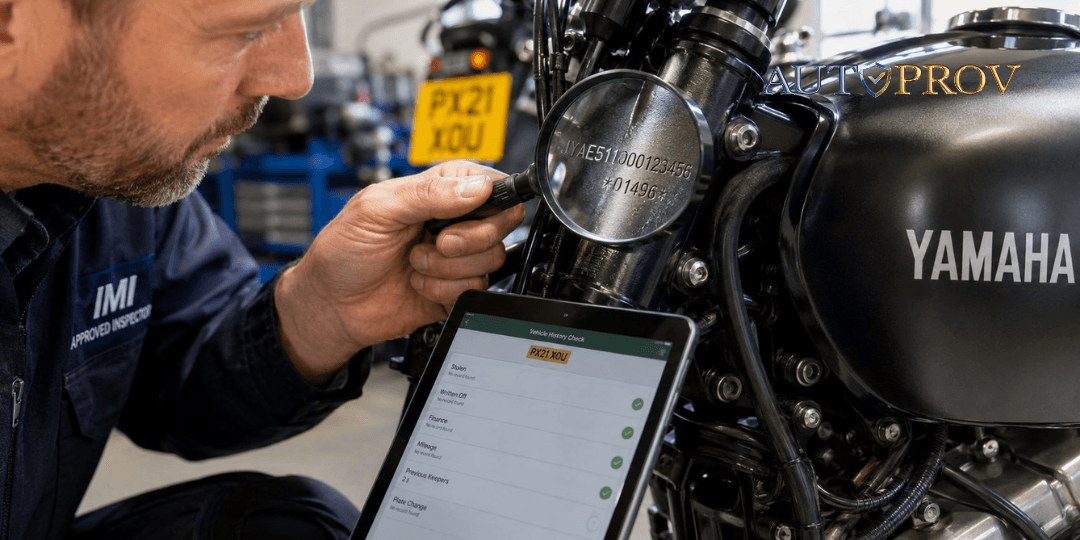
A Yamaha comes in as a part-exchange. It looks straight, starts cleanly, plastics are tidy, and the seller has a plausible story. That's exactly the point where traders get caught out.
A Yamaha comes in as a part-exchange. It looks straight, starts cleanly, plastics are tidy, and the seller has a plausible story. That's exactly the point where traders get caught out.
A Yamaha frame number checker isn't just a way to identify the bike. In the UK motor trade, it's the start of a risk workflow. If the frame number is wrong, altered, mismatched to the paperwork, or inconsistent with the bike's wider history, every later decision becomes unreliable, from valuation and prep budget to resale confidence and post-sale dispute exposure.
Most online content stops at “where to find the VIN”. That's useful, but it doesn't protect margin. What matters is what you do with that number once you've found it. The commercial question isn't merely whether the number exists. It's whether that Yamaha's identity stands up to physical inspection, document reconciliation, and the wider provenance trail you'd expect a legitimate bike to carry in the UK market.
Why the Frame Number Is Your First Line of Defence
A Yamaha taken in on part-ex can look saleable and still be a liability.
In the trade, the frame number is the first fixed identifier you can test against the bike, the paperwork, and the history trail you will rely on if the deal later comes under scrutiny. Registration numbers can be swapped. Bodywork can be replaced. Seller accounts can be rehearsed. The stamped frame number is much harder to fake cleanly, and it is the reference point that decides whether the rest of your checks mean anything.
Yamaha uses that identifier to match the machine to its formal identity for recalls, repairs, and model-specific records. For a trader, that has a simple implication. If the stamped number is wrong, incomplete, altered, or copied from another unit, every later check sits on bad ground. A Yamaha frame number checker is not just for confirming what the bike is. It is how you start testing whether the bike should be in stock at all.

What goes wrong when traders shortcut this step
The common mistake is running digital checks before confirming that the stamped number on the bike is genuine and consistent. That sounds minor. It is not.
A cloned bike can return a believable history if you search the copied identity rather than the machine in front of you. A paperwork set can look tidy until the V5C, service record, and frame stamping are compared character by character. By the time the discrepancy surfaces, you may already have agreed the allowance, booked workshop time, or advertised the unit.
That is where margin gets hit. You are no longer assessing stock. You are containing loss.
- Cloning risk. A database hit only proves that the number exists in a record somewhere. It does not prove the Yamaha in front of you carries that identity legitimately.
- Document conflict. One wrong character between the frame and the V5C is enough to stop a straightforward retail sale and trigger further provenance work.
- Mispriced stock. If identity concerns appear after appraisal, the trade value you agreed can quickly become indefensible.
- Post-sale exposure. A bad call here can lead to rejection, finance complications, insurer queries, or a dispute with the next buyer.
Use the physical frame number as the control point for the whole appraisal. If your team needs a refresher on the basics before inspecting a unit, this guide on where to find a VIN number on a vehicle is a useful starting point.
Why this matters commercially
Provenance errors are expensive because they distort several decisions at once. You can overallow on part-ex, authorise prep on a unit you should have declined, misjudge disposal route, and expose the business to comeback if the identity issue is discovered after sale.
Experienced buyers do not stop at confirming that a Yamaha frame number can be read. They ask whether it stands up to trade scrutiny and whether the wider provenance supports it. That is the difference between identifying a bike and underwriting the risk attached to it.
Locating and Validating the Yamaha Frame Number
A Yamaha arrives as a tidy part-ex. The registration checks out at first glance, the seller is confident, and the margin looks workable. Then the stamped frame number is faint, the characters do not sit evenly, and the V5C has one character that could be an 8 or a B. That is the point where a buyer either protects the deal or inherits a problem.
Start with the motorcycle itself. On Yamaha bikes, the frame number is commonly stamped on the steering stem area and is often readable by turning the handlebars for access, as noted in Yamaha's identification guidance mentioned earlier. On other Yamaha product types, the position can vary by model, which is why mixed-stock teams often keep a quick guide to where to find a VIN number on different vehicles close to hand during appraisal.

What to inspect before any digital lookup
The job here is validation, not just location. You are deciding whether the identity stamped into the bike is credible enough to support a purchase, a part-ex figure, or prep spend.
For modern Yamaha stock, expect a 17-character frame number. If the number is incomplete, hard to reconcile, or presented in a format that does not fit the age and type of vehicle, stop and investigate before you run any database check.
Inspect three things closely:
- Stamping quality. The characters should be consistent in depth, spacing, and style. Poor alignment, mixed character shapes, or uneven strike marks can point to interference.
- Metal around the stamp. Look for grinding, filing, fresh paint, local refinishing, or any surface change that isolates the stamped area from the rest of the frame.
- Plates and labels. A replacement plate or unusually fresh label on an older bike is not proof of wrongdoing, but it changes the risk profile and needs explaining.
Good buyers slow down here. A clean provenance-style result attached to a doubtful stamp does not reduce exposure. It can increase it if your team relies on the database result and misses the physical inconsistency.
Document reconciliation at appraisal
Once the stamped number is clear, compare it directly with the V5C and any supporting paperwork in front of you. Read it yourself. Do not accept a verbal readout from the seller, and do not work from a photo alone if the bike is on site.
Use a simple order:
- Read the stamped frame number from the bike
- Match it character by character to the V5C and supporting documents
- Run database checks only after the physical and document identity align
One wrong character matters. It can be a transcription issue, a previous admin error, or a sign that the bike and the paperwork should not be together. The commercial response is the same at appraisal stage. Hold the figure, qualify the deal, and resolve the identity point before you commit.
What traders get wrong
The common failure is speed. A rushed appraisal, poor light, and a registration-based lookup can make a doubtful Yamaha look cleaner than it is.
Physical validation and history checking are separate tasks. The first tests whether the identity on the bike appears genuine. The second tests what sits behind that identity in UK records. If the first step is weak, every decision that follows rests on the wrong asset.
Running Essential UK Vehicle History Checks
Once the Yamaha frame number has been physically validated, the digital work begins. During this digital work, many traders perform the basics well enough but still miss the wider risk picture.
The reason is simple. A database check can confirm records attached to an identity. It can't, on its own, confirm the validity of that identity as presented.
MOT history and mileage continuity
For UK stock, DVLA MOT history is one of the most useful corroboration tools after a frame check because it helps traders examine mileage progression and test history over time. The broader point, highlighted in this Yamaha VIN risk discussion, is that the key question isn't just what the frame number is, but whether it aligns with the bike's UK history and risk profile.
That means reading MOT history analytically, not just confirming that tests exist.
Check for:
- Mileage sequence issues. A jump, stall, or odd correction may need explanation.
- Patterned advisories. Repeat issues can point to long-running neglect or superficial prep.
- Testing rhythm. Gaps in the timeline don't always mean trouble, but they do change the risk picture.
For a trade workflow, this kind of motorbike history check guide is useful because it frames the digital checks around buying risk, not consumer curiosity.
Theft, finance and insurance markers
UK police guidance treats motorcycle theft as a real and ongoing risk. That's why frame-number validation should lead into theft-related checks and not stop at basic decoding. If the bike has a stolen marker, unresolved identity issue, or suspicious provenance gap, the problem is bigger than valuation.
The same applies to finance and insurance history. A trader needs to know whether there's active finance exposure and whether the bike carries insurance-related total loss history. Those are standard dealer vehicle checks, but they're still often read too narrowly.
Here's the issue:
Check type What it can tell you What it cannot prove MOT history Mileage trail, test dates, advisories, failures That the frame is original Finance check Whether finance exposure is recorded against the vehicle identity That no off-record dispute exists Insurance write-off status Whether the identity carries recorded damage history The true quality of any repair Stolen marker check Whether the identity is flagged on the relevant databases That the bike hasn't been cloned The gap traders need to respect
A clean result across core systems is necessary. It isn't conclusive.
A bike can pass a digital check and still fail a provenance review if the physical identity, documents, and history don't line up.
That's the commercial limit of a basic vehicle history check UK process. It helps you avoid obvious problems, but it doesn't always expose context, sequence, or anomaly. For that, you need to interpret the VIN properly and then assess the provenance around it.
Interpreting the VIN and Common Risk Indicators
A Yamaha VIN isn't just a serial string. It's structured data. If you understand the structure, you can spot problems before they become buying mistakes.
For modern vehicles, the 17-character VIN follows a standard format made up of WMI, VDS, and VIS segments. In practical terms, the early characters identify manufacturer and region, the middle section describes the vehicle, and the final section carries year, plant, and serial information. That standardisation is useful, but only up to a point.

Where a decoder helps and where it doesn't
For straightforward stock, a decoder can quickly confirm whether the format looks plausible for the model family. That's useful triage.
But decoding has limits. A public Yamaha dataset covering classic 9-digit VINs from 1961 to 2010 says it is “not 100% complete”, and that warning matters when dealing with older bikes, specialist stock, or imports, as noted in this classic Yamaha VIN reference.
Risk indicators inside the number itself
A frame number deserves manual scrutiny when any of these appear:
- Format inconsistency. The number doesn't fit what you'd expect for the model or era.
- Decoder failure on a supposedly standard modern bike. That doesn't prove a problem, but it does remove confidence.
- Age mismatch. The bike's presented age and the VIN-derived identity cues don't sit comfortably together.
- Partial obscuring or poor legibility. Dirt is common. Obscured characters with no obvious innocent reason deserve caution.
A good primer for teams handling mixed vehicle stock is this explanation of what a VIN is, especially when moving between cars, motorcycles and imports.
Older Yamahas need more judgement than software. If the tool hesitates, the trader shouldn't speed up.
The trade view on classic and imported stock
Many buying errors frequently occur. Traders apply modern VIN expectations to older bikes, or they assume any oddity must be acceptable because the bike is “just a classic”. Both approaches are weak.
Classic and grey-import Yamaha stock needs manual review, not blind trust in a decoder result. If the format is unusual, the paperwork is thin, and the identity trail is patchy, price alone won't compensate for the risk. A Yamaha frame number checker is useful here, but only as one part of a manual appraisal process.
Advanced Provenance for Deeper Motor Trade Risk Insights
A Yamaha can clear the obvious checks and still be the wrong unit to buy.
That is usually where margin slips. The frame number confirms identity. Provenance work tests whether the bike's history, paperwork and market behaviour support the seller's story well enough for trade money.

Basic checks answer isolated questions
A standard history report usually covers recorded theft, finance and damage markers against the current identity. Useful, yes, but limited. It gives you event flags. It does not tell you whether the bike has moved through the market in a way that makes commercial sense.
Patterns matter in appraisal:
- Short-term keeper churn can point to unresolved faults, buyer dissatisfaction, or a bike that never settles with one owner.
- Fast resale after a key event can suggest someone is exiting the unit before a mechanical, legal or value issue surfaces fully.
- Mileage behaviour that looks possible but still feels wrong in trade terms should affect confidence, even if no database returns a hard fail.
- Thin provenance on imports or older learner stock increases the chance of disputes later, especially when the paperwork trail is weak.
A practical example is lower-value commuter stock. Bikes in the same market as 2nd hand 125cc motorbikes often change hands quickly, and that speed can hide poor documentation, inconsistent servicing, or stock passed from trader to trader without proper scrutiny.
Lifecycle evidence changes the risk picture
The frame number is only the starting reference. The trade decision improves when that identifier is followed through prior adverts, MOT history, keeper patterns, service paperwork, import records and workshop notes where available. Clean databases do not remove the need for judgement.
I look for continuity. Does the bike appear to have existed in the market as one stable machine, or does the identity only make sense at isolated points? A unit with long gaps, abrupt changes in use, or repeated disposal after brief ownership deserves a lower confidence grade, even if it remains technically saleable.
Related identifiers matter as well. If stock history is incomplete, an engine number check for motorcycle appraisal gives you another comparison point, particularly where replacement engine concerns or paperwork mismatch could affect resale, warranty exposure, or customer trust.
The expensive mistake is often the bike with no obvious marker against it, but too many unanswered questions around how it got to you.
What stronger provenance work changes
It changes the bid.
One Yamaha may show coherent ownership, consistent use, sensible disposal timing and paperwork that supports the mileage and condition. Another may present clean on the headline checks but still carry enough friction to justify a reduced offer, a trade-only exit route, or a walk-away.
That is the commercial use of better vehicle intelligence. It helps traders grade stock by confidence, not by whether a single report says pass. That matters before prep spend, before a retail complaint, and before capital is tied up in a bike that never felt right in the first place.
Making Confident Buying Decisions with Complete Vehicle Intelligence
A Yamaha frame number checker is useful. On its own, it isn't enough.
The professional workflow is straightforward. Validate the stamped frame number on the bike. Reconcile it against the V5C and supporting documents. Run the core UK history checks. Then assess whether the wider provenance supports the story you're being sold.
That's how traders reduce avoidable exposure. It strengthens valuation discipline, helps flag stock that belongs in a different buying lane, and cuts the chance of taking on a bike that becomes a margin drain later. It also supports more defensible decisions when buyers, compliance teams, or downstream trade customers ask why a unit was acquired.
For dealers active in learner-legal and commuter stock, market context also matters. A buyer looking at popular entry-level machines may find this guide to 2nd hand 125cc motorbikes useful for understanding the kinds of bikes that routinely circulate through the used market, where provenance discipline often matters just as much as cosmetic condition.
If you want the process to be commercially repeatable, it helps to use one reporting view rather than piecing the story together from disconnected checks. A dedicated vehicle provenance report supports that approach by keeping the decision focused on risk, consistency, and buying confidence.
AutoProv helps UK motor traders move beyond a basic Yamaha frame number check. Its platform brings together vehicle history, provenance, mileage patterns, ownership timelines, and trade-focused risk signals so buyers can make stronger decisions at the point of purchase. If your team wants clearer context on what a bike's identity really means before committing stock funding, AutoProv is built for that job.
Frequently Asked Questions
AI-Generated Content Notice
This article was created with the assistance of artificial intelligence technology. While we strive for accuracy, the information provided should be considered for general informational purposes only and should not be relied upon as professional automotive, legal, or financial advice. We recommend verifying any information with qualified professionals or official sources before making important decisions. AutoProv accepts no liability for any consequences resulting from the use of this information.
From our AI insights
- Navigating ULEZ Compliance for Used Car Dealers
A deep dive into ensuring your used car stock meets ULEZ standards, avoiding costly fines.
- Mastering Paint Verification with VIN Decoding
Learn how UK traders verify original paint using VIN decoding and provenance data.
- Understanding VIN Decoding: Avoid Misleading Imports
Learn how VIN decoding reveals vehicle origins and specs, preventing import pitfalls.
Related Articles

Car Specs by Reg: Instantly Find Vehicle Details & MOT History
Trying to find the full car specs by reg? In the UK, that little number plate is the key to unlocking a huge amount of information about a vehicle. From the exact engine size and CO2 emissions to its MOT history and tax status, it's all tied to the registration.

How to Check Previous Owners of a Car in the UK
Before you even start thinking about how to check the previous owners of a car, you need to get your head around why it's so important. This isn't just about being nosy; it’s a non-negotiable step that protects you from serious financial headaches and safety risks lurking under a shiny bonnet.

How to Check Service History in the UK
Think of a car's service history as its detailed CV, not just some dusty folder in the glovebox. To check service history is to get the real story behind a vehicle, digging into everything from its routine oil changes to any major surgery it's had. For any savvy car buyer in the UK, this record is the single most important document you can get your hands on.
Published by AutoProv
Your trusted source for vehicle intelligence