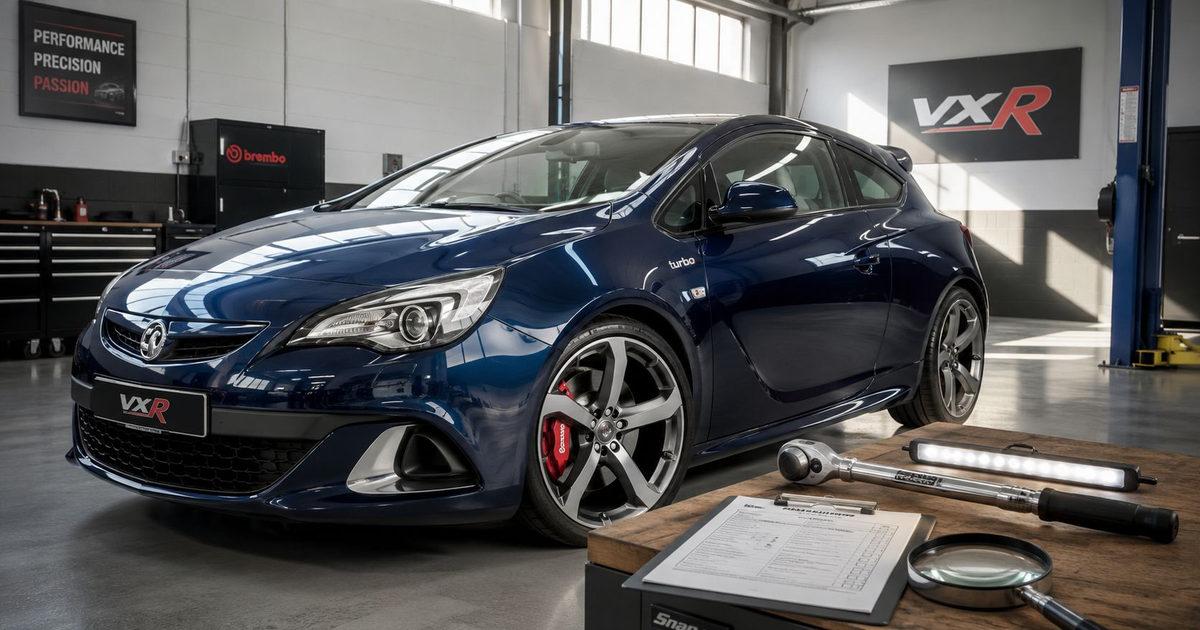
A cheap Astra J VXR can look like easy margin. The advert reads well, the stance is right, the photos flatter it, and the price sits just low enough to trigger that familiar trade instinct: buy fast, tidy it, retail it. That's where dealers get caught.
This model attracts attention for all the right reasons and all the wrong ones. It's desirable, fast, and still has a following in the UK trade. It also sits in a part of the market where hard use, patchy maintenance, cosmetic standardisation, and weak provenance can turn an apparently sharp buy into a slow, expensive problem. If you're buying one, you're not just buying a hot hatch. You're buying a risk profile.
Table of Contents
- The Astra J VXR Dilemma for the Motor Trade
- On-Site Mechanical Assessment and Key Failure Points
- Start with the powertrain, not the cosmetics
- Road test signs that change the deal
- Chassis, brakes and underbody judgement
- Assessing Aftermarket Tuning and Modification Risk
- Why modified examples distort value
- How to spot a car returned to standard
- What works commercially and what does not
- Advanced Provenance Checks and Digital Intelligence
- Basic checks leave blind spots
- Read patterns, not just entries
- Why insurer and theft signals matter on this model
- Strategic Valuation and Negotiation for Traders
- Build the offer from evidence
- Scarcity helps, but only for the right car
- Negotiation only works when your notes are disciplined
- Conclusion Buying the Right VXR with Confidence
The Astra J VXR Dilemma for the Motor Trade

The Vauxhall Astra J VXR earns attention because it's a proper performance car, not just a trim level with louder styling. According to the RAC review of the Astra VXR 2012 to 2019, it was sold exclusively between 2012 and 2019 in the UK with a 2.0-litre turbo petrol engine producing 280PS, which was 40PS more than the previous generation and 10% more powerful than the rival Ford Focus ST's engine. The same review notes a 155mph top speed, 0 to 62mph in 5.9 seconds, and 295lb ft of torque.
Those numbers explain why buyers still stop scrolling when one appears. They also explain why the wrong example can be expensive to own in stock.
Astra J VXR stock tends to split into two camps. The first is the car you want: well-kept, sensibly presented, standard or close to it, and supported by a believable paper trail. The second is the one that arrives looking saleable but starts unravelling after appraisal. That second car often has a cleaner appearance than history.
Practical rule: On an Astra J VXR, a tempting buy price usually means you're being asked to absorb someone else's deferred cost.
Enthusiast demand can cloud judgement on this model. Traders know the badge carries appeal, but appeal doesn't protect margin. A standard inspection might tell you the car starts, drives, and stops well enough to get through a short viewing. It won't tell you whether the car has lived on a hard map, been cycled through owners, had parts swapped back to standard, or carries digital risk that turns a retail deal into a comeback.
The commercial problem is simple. The Astra J VXR can retail strongly when the history, condition, and ownership story line up. It can also punish weak acquisition discipline faster than ordinary stock because buyers expect performance, but they won't forgive trouble.
Use it as a stock asset, not a passion purchase. That means every buying decision has to answer one question first: can this car absorb reconditioning, provenance risk, and slower disposal pressure while still leaving room for profit?
On-Site Mechanical Assessment and Key Failure Points
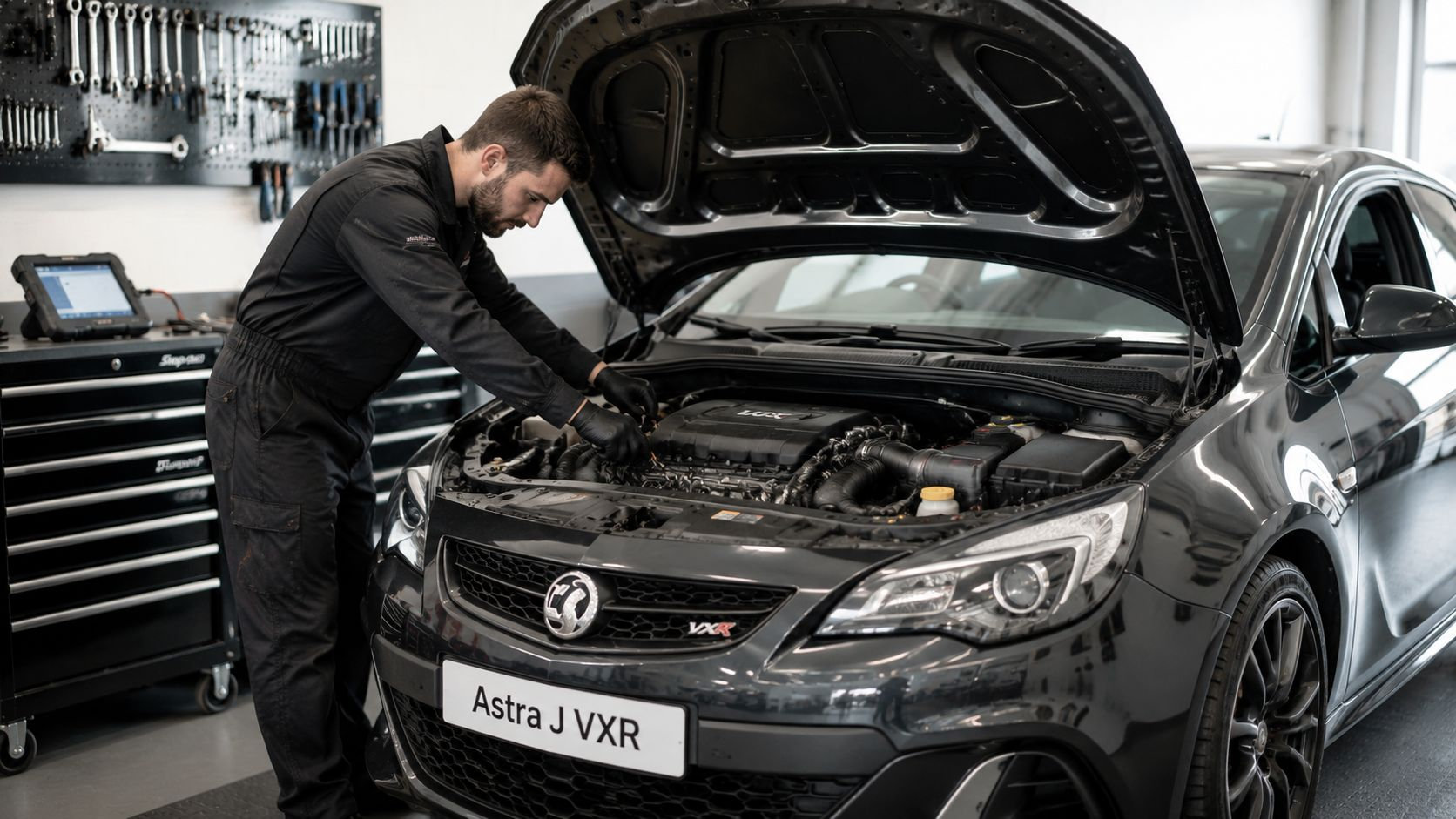
The Astra J VXR uses a serious drivetrain package. Courtenay Sport's Astra J VXR technical specification lists a turbocharged 2.0-litre Gen-3 Ecotec inline-four, 1998cc, 16v, 9.3:1 compression, 86mm bore/stroke, producing 280 PS (276 bhp) at 5500 RPM and 400 Nm (295 lb-ft) at 2500 to 4500 RPM, paired with a 6-speed manual front-wheel-drive transmission. On paper, that's the appeal. At appraisal, it's the load path you need to interrogate.
Start with the powertrain, not the cosmetics
Open the bonnet before you walk around admiring bodywork. On this model, presentation often outruns substance.
Check the engine cold if possible. A seller who has pre-warmed the car may be masking noise, smoke, or roughness. Listen at start-up and idle. You're not trying to diagnose every internal condition on-site, but you are looking for enough evidence to decide whether the car deserves ramp time and a serious offer.
Use a simple sequence:
- Listen first: Chain rattle, uneven idle, and harsh top-end noise matter more than a polished rocker cover.
- Watch the exhaust note: Any smoke on start-up or after throttle input needs context. Don't dismiss it as condensation unless you've verified it.
- Check for fresh cleaning: A heavily dressed engine bay can hide leaks, sweating joints, or recent disturbance.
- Inspect pipework and clamps: Mismatched clips, rubbed hoses, and witness marks often point to previous tuning work.
- Look for heat stress: Burnt shielding, tired plastics, and cooked under-bonnet trim tell you how hard the car has been run.
A basic clutch and flywheel feel check also matters. Pedal take-up, vibration through the floor, and shunt at low speed all deserve attention. If you need a quick refresher on warning signs before a viewing, this guide to dual mass flywheel failure symptoms is a useful checklist to keep in your buying workflow.
The biggest mistake on performance stock is treating a clean idle and a decent detail as proof of mechanical health.
Road test signs that change the deal
The road test should be short, deliberate, and repeatable. Don't drive it like a buyer trying to have fun. Drive it like someone protecting capital.
First, assess the gearbox under light and moderate load. The manual transmission has to shift cleanly, especially when cold and during slower changes where wear tends to show itself. Any reluctance, graunch, bearing-style noise, or vagueness under load should move your thinking from retail-ready to risk-loaded.
Then test torque delivery. A healthy car should pull with confidence and consistency. Hesitation, flat spots, over-boost feel, or a sudden change in exhaust tone can suggest mapping issues, boost leaks, or a car that's been altered and imperfectly put back together.
A useful road test pattern is:
- Low-speed manoeuvring for clutch take-up, steering weight, and driveline shunt
- Part-throttle acceleration for fuelling smoothness and boost build
- Cruise and lift-off for bearing noises, wheel bearing hum, and drivetrain resonance
- Firm braking for pull, vibration, and pedal consistency
Chassis, brakes and underbody judgement
The Astra J VXR isn't just an engine-and-gearbox decision. Chassis spend can wipe out a deal subtly because the car often still drives "well enough" to flatter a rushed appraisal.
Pay close attention to front-end composure. This car's performance setup means suspension wear, poor geometry, damaged wheels, and tired bushes often show up as tramlining, steering corruption, or uneven tyre wear rather than one obvious fault. Brake condition matters too. Performance-branded calipers look impressive in photos, but if the discs are tired, the pads are cheap, or the pedal feel is inconsistent, your prep bill is already growing.
Use this quick appraisal table on-site:
Area What to look for Why it matters commercially Front tyres Uneven shoulder wear, mixed brands, age mismatch Often points to alignment issues or hard use Brakes Lip on discs, vibration, weak bite, poor-quality pad choice Safety prep and credibility issue at retail Steering Pull, kickback, vague centre Can signal geometry or suspension wear Underside Exhaust contact marks, poor repairs, scrape damage Suggests lowered setup or rough ownership Wheels Cracks, repairs, buckles, heavy kerbing Costly to correct properly on performance stock If the car needs engine confidence, gearbox confidence, brake confidence, and suspension confidence all at once, don't convince yourself the margin is still there. It usually isn't.
Assessing Aftermarket Tuning and Modification Risk
The hardest Astra J VXR cars to value are rarely the heavily modified ones. Those at least declare themselves. The awkward stock is the car that appears standard enough to reassure you, while carrying the wear pattern of a modified example.
That distinction matters because this model sits deep in UK modification culture. As noted in This is Money's reporting on used car pricing and trade risk, the Astra J VXR's 2.0L turbo engine and heavy modification culture in the UK accelerate wear beyond standard performance metrics, and frequent MOT failures due to exhaust modifications create hidden liabilities that standard history checks miss.
Why modified examples distort value
A remap, intake, intercooler change, or exhaust alteration isn't automatically a no-buy. The issue is that these changes alter your risk in several directions at once.
They can change engine stress, warranty exposure, preparation scope, insurance positioning, and buyer pool. They also create argument after the sale. A retail customer may like the sound of a modified VXR until a warning light appears, a claim lands, or they discover the car's setup is less standard than advertised.
A trade appraisal should separate modifications into categories:
- Declared and documented changes: Easier to assess, easier to present truthfully, still narrower in audience.
- Poor-quality visible changes: Usually the clearest walk-away signal.
- Reversed modifications: Highest risk, because the car may show standard trim while keeping the fatigue of tuned use.
For broader context on how modified cars are assessed after damage or dispute, this modified vehicle appraisal guide is worth reading because it shows how quickly value becomes conditional once originality is in question.
How to spot a car returned to standard
Disciplined observation beats enthusiasm. A car put back to standard often leaves clues everywhere, just not in one convenient place.
Look for witness marks around hose clips, turbo pipe joints, intercooler fixings, undertray hardware, and exhaust fasteners. Check whether the airbox, heat shields, and fasteners all age consistently. If one part of the engine bay looks materially fresher than everything around it, ask why.
Then compare the physical car with what the factory build should suggest. A useful reference point in trade workflow is checking factory build data for mis-described vehicles so you can separate genuine specification from parts-bin standardisation.
If a VXR looks standard but the hardware tells a different story, price it as an unknown, not as a clean original car.
MOT history context also matters here, even before you get into deeper digital checks. Repeated exhaust-related failures, changing emissions-related notes, or abrupt presentation changes can support the suspicion that the car has moved between modified and standard forms.
What works commercially and what does not
A mildly altered car with coherent paperwork, sensible parts, and consistent maintenance can still be viable stock for the right forecourt and buyer profile. A car with unclear modifications, fresh reversions, and no convincing explanation usually becomes expensive twice. First during prep, then during disposal.
What works:
- Near-standard presentation with evidence that supports it
- Honest disclosure from the seller about what's been changed
- Consistent servicing that matches the car's use
What doesn't:
- "Only an exhaust" stories when multiple parts show disturbance
- Mapped but not declared histories
- Cheap cosmetic standardisation done to widen retail appeal without fixing underlying wear
On this model, modifications are valuation data, not added value.
Advanced Provenance Checks and Digital Intelligence

A physical inspection tells you what the car is today. Vehicle provenance tells you how it got there. On an Astra J VXR, that difference is where many of the costly mistakes sit.
Dealers who rely on a basic vehicle history check UK process often get enough data to feel reassured, but not enough to price risk properly. That's a problem on performance stock where short ownership cycles, cosmetic standardisation, and incomplete disclosure are common.
Basic checks leave blind spots
The limits of simple checks are well established. The Car Expert notes that in the UK, 27.5% of cars checked had an issue with a number plate change and 17.6% had outstanding debt attached in its discussion of whether a UK car history check is worth it. Those are exactly the sort of issues a trader can't afford to discover late.
Free tools are narrower still. AutoProv's explanation of a free car history check in the UK points out that a standard free MOT history check can't detect fraudulent mileage alterations between annual tests and can't confirm whether a vehicle has been officially declared scrapped by the DVLA. CarOwl's review of data sources used in paid history checks adds that paid reports can reveal outstanding finance, insurance write-off categories such as S and N or previous C and D, and scrapped vehicle markers that free checks omit.
That's the divide between a casual check and a proper used car history report. A free MOT lookup is a starting point. It isn't trade vehicle intelligence.
Read patterns, not just entries
On a VXR, the raw entries matter less than the pattern they create.
Look at MOT history for repetition rather than isolated failure. Repeated notes around tyres, brakes, or exhaust condition can suggest a car that has lived a harder life than the advert implies. Consistent advisories that return year after year usually tell you more than a single fail followed by a pass.
Ownership analysis matters too. Short-term keepers, rapid resale movement, and abrupt changes in mileage rhythm all deserve explanation. A car can be mechanically sound on the day and still be poor stock because its ownership story raises too many future arguments.
Use a structured provenance review:
- MOT pattern reading: Focus on repeated themes, not isolated items.
- Keeper behaviour: Fast churn can mean the car never really settles with one owner long enough to be maintained properly.
- Mileage logic: Annual use should make sense alongside wear, condition, and service evidence.
- Registration history: Plate changes can be innocent, but they still need context.
- Finance and insurance markers: These affect title, valuation, and disposal confidence.
A serious mileage check UK process isn't just about catching one impossible reading. It's about spotting timelines that don't behave naturally. Dealers using anomaly detection in vehicle data will recognise that unusual ownership and mileage behaviour often matters as much as a headline marker.
The car in front of you may be tidy. The data trail tells you whether tidy is the same thing as safe to buy.
Why insurer and theft signals matter on this model
This model carries another layer of commercial risk because insurer and claims-related context can change both desirability and exit strategy. Yahoo Finance reports that the VXR is disproportionately targeted by UK insurers for "excess" modifications and parked vehicle theft, leading to higher annual premiums and lower risk scores for dealers, and adds that its high theft rate in the UK and association with speed-related penalties raise the risk of claims and potential mileage fraud in ways that can be identified by cross-referencing DVLA records with insurance-related events.
That matters in the lane and on the forecourt. A car with increased insurance sensitivity can narrow your retail audience, complicate post-sale conversations, and make an apparently fair price too ambitious.
For dealer vehicle checks, the lesson is simple. Basic pass-or-fail history isn't enough for this sort of stock. You need context, sequence, and risk interpretation before you commit capital.
Strategic Valuation and Negotiation for Traders

Valuing an Astra J VXR properly means resisting the easy narratives. Scarcity can support pricing. It can't rescue a weak example. A clean-looking car with unresolved mechanical doubt and messy vehicle provenance isn't rare stock. It's expensive stock.
Build the offer from evidence
The right way to negotiate one is to stack risk in layers, then convert each layer into a buying decision. Mechanical findings sit in one column. Modification risk sits in another. Provenance concerns go in a third. Then you decide whether the combined profile still fits your stock model.
A useful approach is:
Risk area What it does to your valuation Mechanical uncertainty Forces a deeper reconditioning allowance or a walk-away Modification ambiguity Narrows buyer pool and increases post-sale friction Provenance anomalies Raises title, fraud, or disposal risk Weak presentation Increases prep time before photography and retail launch That last point is often underestimated. If the car is right, presentation still matters. Good retail prep helps serious cars look credible, and this overview of professional car detailing before selling is a practical reminder that finish quality affects buyer confidence, especially on performance metal where buyers inspect closely.
Scarcity helps, but only for the right car
There is genuine scarcity in the market. According to How Many Left data for the Vauxhall Astra VXR, there were 4,600 licensed Vauxhall Astra VXR vehicles remaining in the UK as of Q4 2025, and 21 used Astra VXR cars were listed on major UK dealer platforms like Parkers as of 2026, which indicates relative scarcity that can influence valuation.
That helps the right car. It doesn't help every car.
Scarcity gives stronger support to a well-bought example with coherent history, sensible specification, and believable ownership. It does very little for a car that creates hesitation the moment a buyer or underwriter starts asking harder questions. In practice, scarcity should make you more selective, not less. When supply is thin, the wrong car can sit because informed buyers know they're taking on risk, not rarity.
Negotiation only works when your notes are disciplined
Sellers respond better when you negotiate from evidence rather than opinion. If you say the car feels risky, the discussion becomes emotional. If you present a concise buying file, the negotiation stays commercial.
Keep your negotiation notes tight:
- Record what you saw: cold start behaviour, smoke, noise, clutch feel, brake feel
- Record what doesn't add up: disturbed hardware, inconsistent ageing, weak history support
- Record what the stock profile means: narrower retail audience, more prep, greater chance of comeback
For traders who want a cleaner structure, this guide on how to negotiate used car prices professionally is useful because it frames negotiation around documented acquisition risk rather than instinct.
A good Astra J VXR can justify strong money. A doubtful one should only be bought at a number that leaves room for reconditioning, delay, and disagreement. If that number doesn't work for the seller, leave it.
Conclusion Buying the Right VXR with Confidence
The Astra J VXR isn't a no-buy for the motor trade. It's a selective buy.
That distinction matters. Dealers lose money on cars like this when they let desirability override discipline. The badge, performance, and scarcity can all be real positives, but none of them remove the need for a proper on-site assessment, a hard look at modification risk, and a serious vehicle history check UK process that goes beyond the basics.
The profitable cars are usually the ones that make sense in several ways at once. The mechanical condition aligns with the seller's story. The visual presentation aligns with the wear. The MOT and ownership pattern align with the mileage and use. When those pieces support each other, you can buy with a clear plan.
Buy the Astra J VXR that explains itself easily. The one that needs excuses usually needs money.
That's why modern performance buying now depends on more than a road test and a gut feel. Motor trade risk on cars like this sits in the overlap between workshop judgement and digital evidence. Dealers who build both into acquisition workflows make better decisions, argue valuations more effectively, and reduce avoidable post-sale disputes.
If you want a tighter internal process for cars with this kind of exposure, keep a structured trade buyer vehicle appraisal checklist in front of every buyer and appraiser. It won't make the VXR risk-free, but it will stop the common errors that turn a promising hot hatch into a poor stock asset.
AutoProv helps UK dealers make those decisions with more confidence by combining vehicle history, vehicle provenance, mileage analysis, ownership patterns, and risk signals into a trade-focused view of the car in front of them. If you're buying high-risk performance stock and need more than a basic used car history report, AutoProv supports better point-of-decision judgement without relying on guesswork.
Frequently Asked Questions
AI-Generated Content Notice
This article was created with the assistance of artificial intelligence technology. While we strive for accuracy, the information provided should be considered for general informational purposes only and should not be relied upon as professional automotive, legal, or financial advice. We recommend verifying any information with qualified professionals or official sources before making important decisions. AutoProv accepts no liability for any consequences resulting from the use of this information.
From our AI insights
- Leveraging Auction Data for Strategic Car Purchases
Discover how to use auction data effectively to make profitable car buying decisions.
- Auction Pitfalls: Avoiding Costly Mistakes
Navigate UK car auctions with confidence by avoiding finance, write-off, and mileage risks.
- Mastering Paint Code Checks: Detecting Hidden Car Repairs
Discover how to use paint code verification to identify hidden car repairs and ensure a smarter purchase.
Related Articles

Your Ultimate Guide to Buying a Used Car in the UK
Navigate the UK used car market with confidence using our comprehensive buying guide. Tips, checks, and AutoProv Provenance insights included.

Difference Between MOT and Service: What You Need to Know
An MOT is a mandatory legal inspection that every car on UK roads needs to pass.Think of it as the government's way of ensuring your vehicle meets the absolute minimum safety and environmental standards to be considered roadworthy. A service, on the other hand, is a completely different beast. It's the proactive maintenance routine recommended by the people who built your car, designed to keep it running smoothly and catch problems before they start. In short, an MOT is a pass-or-fail exam required by law. A service is a comprehensive health plan for your car.
Your Ultimate Used Car Inspection Checklist
A solid used car inspection checklist is the single most powerful tool you have to avoid buying a lemon. It gives you a methodical way to look past the shiny paint and assess a car's real condition, helping you spot hidden problems and get a fair price before you shake hands on the deal.
Published by AutoProv
Your trusted source for vehicle intelligence