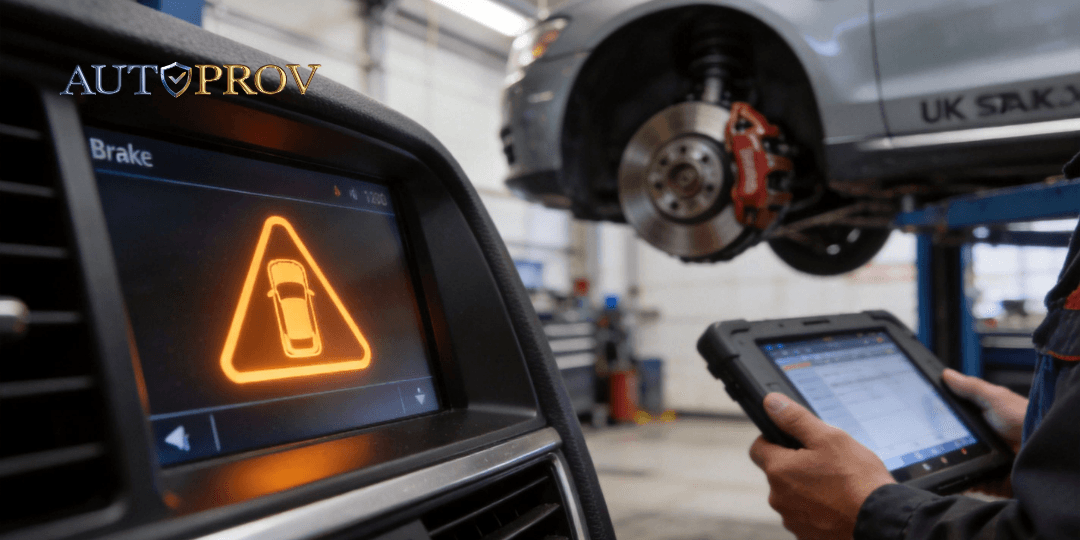
The car looks right on paper. Clean enough for the pitch, sensible miles, margin still intact. Then you turn the ignition on and the brake pads warning light stays up.
For a retail customer, that often sounds like a simple workshop job. For a buying manager, it's a different question. You're not just looking at front pads or a sensor. You're looking at how the last owner treated maintenance, whether the vehicle has been run beyond service points, whether discs are already involved, and whether the dashboard light is the first visible sign of wider deferred upkeep.
That matters because the cost difference can be small or painful. It can be a straightforward sensor issue, or it can be a negotiation point that turns into reconditioning creep, delayed prep, and a post-sale complaint if the first fix misses the actual cause. In the trade, the warning light isn't the story. It's the clue.
A lot of appraisals go wrong because the light gets reduced to a line on the workshop sheet. “Needs pads” is tidy. It's also incomplete. A better read is commercial: what does this warning tell you about the vehicle's recent use, its service discipline, and the likelihood that other routine items have been pushed back as well?
A brake warning on a used car should change the appraisal conversation immediately. Not because every car is bad, but because every light needs context.
Introduction More Than Just a Dashboard Light
A brake pads warning light often appears at the worst point in the buying process. You've already seen enough to want the car, the figures nearly work, and then the dash adds uncertainty. At auction, that uncertainty affects bid discipline. In part exchange, it affects allowance. On a fast trade purchase, it affects whether you proceed at all.
The mechanical issue might still be modest. The commercial issue rarely is. If a seller presents a car with an active brake warning, you have to ask whether the car has arrived at a normal maintenance point or whether the owner has knowingly run it with a visible fault. Those are different risk profiles.
What the light can really signal
A visible brake warning can point to more than wear on one axle. In practice, it can suggest:
- Deferred servicing that may extend beyond brakes into tyres, fluids, suspension wear and overdue routine items
- Hard use patterns such as urban stop-start driving, delivery work, or repeated short journeys
- Poor quality previous repairs where pads were changed but sensors were reused or not reset correctly
- Valuation drag because your reconditioning estimate is still uncertain at point of purchase
That last point matters. A used car history report or vehicle history check UK dealers rely on won't replace a physical inspection, but it should sit alongside it. If the warning light is present, the smart move is to assess the fault as both a workshop item and a vehicle provenance signal.
Why experienced buyers don't shrug this off
Good buyers know that obvious faults can still hide expensive ambiguity. A brake light is one of those faults. It's common enough to seem routine, but variable enough to catch out anyone who prices too quickly.
Commercial rule: If the dashboard says brakes, price the car only after you've decided whether you're valuing a consumable, a system fault, or a maintenance history problem.
That's where the rest of the appraisal has to tighten up. The light may be telling you about the brakes. It may also be telling you about the owner.
How Brake Pad Warning Systems Actually Work
Electronic brake pad wear systems are simple in principle. Think of them as a tripwire inside the pad. When the friction material wears down to a set point, the sensor changes state and the car logs a warning through the vehicle electronics.
In UK vehicles fitted with electronic brake wear sensors, the dashboard warning typically appears when pad thickness reaches around 2 to 3mm, before the legal MOT minimum of 1.5mm. On premium cars with two-stage systems, an earlier alert may appear at 4mm, with the critical warning at 2mm, as explained in Jurid's technical overview of electronic brake warning system operation.

Single-stage systems
The basic version uses a sensor embedded in the pad material. As the pad wears, the wire is exposed and the circuit is interrupted when it reaches the designed trigger point. The ECU sees that open circuit and turns the warning on.
This design is common because it's cheap, effective and easy to package. It doesn't estimate remaining life in any complex way. It tells you the pad has reached the threshold.
Two-stage systems
Many premium UK cars use a more advanced setup. The first warning is less urgent. It's there to give the driver time to plan replacement before the pad gets close to critical thickness. The second warning is the serious one.
That distinction matters during appraisal because a yellow or service-style alert may still leave room for routine prep. A red or critical alert suggests the car may already be too close to metal-to-metal contact, especially if the seller has continued using it.
If you need a quick refresher on how these components sit within the wider electronic architecture of a modern vehicle, T1A Auto's essential guide to vehicle sensor types is a useful background read.
What works and what doesn't
What works is understanding that the warning system is only as good as the sensor, wiring and reset procedure. What doesn't work is assuming the light always means exactly one thing.
Common trade mistakes include:
- Treating every alert as worn pads when the fault may sit in the sensor wiring or connector
- Ignoring warning colour and menu detail on cars that show service-stage and critical-stage messages separately
- Replacing pads without replacing the sensor on vehicles where the sensor is designed as a wear item
- Skipping the reset process after repair, which can leave a misleading warning active
For a more workshop-focused view of the replacement side, AutoProv's professional guide to brake pad replacement is a practical companion to the buying assessment.
The system is there to prevent expensive contact between backing plate and disc. If the light has been ignored, the real bill may already be beyond pads.
On-the-Spot Diagnostics for Trade Buyers
When you're appraising on the forecourt or in the auction lane, you usually don't have the luxury of a full strip-down. You still need a disciplined way to separate a likely sensor fault from likely genuine pad wear.
That distinction matters because industry analysis indicates that a meaningful share of used market brake warnings are false positives caused by sensor faults such as broken wires or corroded connectors, with a repair cost gap of over £250 per axle compared with pad and rotor work, as noted in this trade discussion of brake warning false positives.
Start with what the car tells you
Modern dashboards often give more than a simple warning lamp. Look for wording in the instrument cluster or infotainment menu. “Brake pads” or “service due” points you one way. “Brake system” or an accompanying red warning pushes you toward a more cautious read.
If the car supports it, a quick scan helps. A basic code check won't replace inspection, but it can tell you whether you're dealing with a stored wear event, an electrical fault, or multiple braking-related issues. AutoProv's guide on how to use an OBD 2 reader is useful if your buyers or appraisers need a sharper process.
Then move to the physical clues
Without taking wheels off, you can still collect useful evidence:
- Look through the spokes: If you can clearly see substantial friction material remaining, be cautious about assuming the light equals worn pads.
- Check for disc lip and scoring: Heavy lip formation or visible scoring supports genuine wear and possible delayed replacement.
- Watch for warning inconsistency: If the message appears intermittently, wiring or connector issues become more plausible.
- Ask about recent brake work: Pads recently changed with the light still active often means sensor reuse, improper reset, or a wiring fault.
Brake Warning Light Quick Diagnostic Guide
Symptom / Indicator Likely Cause: Sensor Fault Likely Cause: Genuine Pad Wear Warning appears soon after recent pad replacement Reused sensor, failed reset, damaged connector Less likely unless poor quality parts or incomplete repair Visible pad material still seems healthy through wheel Sensor wire damage or corroded plug Possible, but less likely without uneven wear Disc surface looks heavily scored or lipped Less likely as sole cause Strong indicator of delayed pad replacement Warning is intermittent over bumps or wet weather Wiring fault or poor connection Less typical Cluster shows brake service countdown reducing normally before warning Possible, but system may still be reporting correctly More consistent with genuine wear Seller reports grinding noise under braking Unlikely to be explained by sensor alone Strong sign of pad wear and possible disc involvement Questions worth asking the seller
The answers won't always be reliable, but they can expose weak points in the story.
- When were the brakes last done? A vague answer isn't proof of neglect, but it lowers confidence.
- Was the sensor changed with the pads? On many cars it should be.
- Has the warning been reset before? Repeat resets without repair are a bad sign.
- Is there any invoice support? A brake job with no paperwork shouldn't be valued as a completed repair.
- Has the car been standing? Corrosion and connector issues can complicate the picture.
If the seller can describe recent brake work clearly and produce matching paperwork, the light is easier to price. If the answers are fuzzy, widen your risk allowance.
What usually leads buyers astray
The biggest mistake is false certainty. Buyers often decide too quickly that the warning is either minor or major, based on one clue. A better trade habit is to build a probability view.
If the pads look thin, the discs look tired and the seller has no evidence of recent work, price for full brake prep. If the pads look serviceable, the warning seems isolated and there's evidence of recent replacement, price for diagnosis first, not immediate disc replacement. The goal isn't to diagnose perfectly on site. It's to stop yourself paying retail money for an uncertain fault.
Assessing the True Commercial Risk
The margin damage from a brake pads warning light rarely comes from the first repair line. It comes from what follows if the light has been ignored or misread. Pads become discs. A simple prep item becomes a delayed handover, workshop congestion, and a buyer arguing that the car should have been sorted properly before sale.
A 2024 survey found that 37% of UK motorists ignored initial brake warning lights for over three months, and that delay contributed to rotor damage that can turn a standard pad job into a £450+ per-axle repair, according to the cited survey summary in this UK motorist brake warning analysis. For a buying manager, that's the key commercial jump.

Why this light changes valuation
You're not valuing a warning lamp. You're valuing uncertainty around braking condition, elapsed maintenance, and prep timing. That uncertainty affects:
- Bid strength because unresolved brake condition widens your likely recon range
- Stock turn if the car waits for inspection, parts or comeback rectification
- Retail confidence because brake-related complaints carry obvious safety sensitivity
- Gross profit when the initial estimate only covers pads but the workshop finds discs, sensors and reset work
A light on a commodity hatchback can be absorbed if the entry price is right. The same light on a premium car with two-stage wear monitoring, larger discs and brand-sensitive retail buyers can shift your valuation more sharply.
Deferred maintenance is the bigger issue
Experienced buyers don't only ask, “What will the brake job cost?” They ask, “What else has this owner postponed?” A visible warning that's been left unresolved often points to a vehicle maintained reactively rather than properly.
That doesn't make every car a reject. It does mean the warning should trigger a tighter appraisal of tyres, fluids, suspension noises, service evidence and dashboard history generally. The same mindset applies to other visible system alerts. AutoProv's article on the DPF warning light shows how one dashboard issue can also indicate broader maintenance behaviour.
What works in practice
Two approaches tend to protect margin better than the rest:
- Price the worst credible outcome, not the best hopeful one. If the evidence is mixed, assume discs may be involved until proven otherwise.
- Separate fix cost from reputation cost. Even if the workshop bill stays manageable, a brake-related return absorbs time, trust and admin.
Buyers remember a trim fault. They react much more strongly to braking concerns. That changes the real cost of getting the appraisal wrong.
MOT Compliance and Provenance Implications
The brake pads warning light matters because it often has a paper trail. Not always a direct one, but usually enough to tell you whether this is routine wear or part of a pattern. That's where vehicle provenance becomes useful, because MOT history can turn a dashboard warning into a maintenance narrative.
Brake-related defects accounted for 18.7% of all MOT failures in the Brakes category, and vehicles with a history of triggered brake warnings had a 24% higher probability of subsequent brake component failures within six months if the initial issue wasn't properly rectified, according to the summary citing DfT data and follow-on brake failure analysis.
What to look for in MOT history
The warning light itself isn't the main issue at test time. The underlying condition is. If the pads are worn below the legal threshold, that's the problem. But for trade buyers, advisories matter almost as much as failures.
Scrutinise the sequence, not just the latest result:
- Repeated brake advisories: These can suggest a car repeatedly brought to the edge of required maintenance
- Brake fail followed by a clean pass: Usually normal if supported by repair timing, but worth checking if the story is thin
- Short intervals between brake-related entries: Often point to high-use cycles or uneven wear patterns
- Advisories that vanish without context: Sometimes harmless, sometimes worth probing harder
Reading the pattern, not the line item
One brake advisory on its own doesn't mean much. Several over successive tests, especially mixed with high annual use or abrupt mileage changes, can tell you more about the way the vehicle has lived.
That's why a basic used car history report isn't enough unless someone interprets it properly. A vehicle history check UK traders use should help answer questions such as:
- Was brake wear recurring unusually often?
- Did mileage progression fit the wear story?
- Did the owner appear to maintain the car only at MOT time?
- Were repairs evidenced by the subsequent pattern, or did the same category keep returning?
A good buyer combines that with physical condition. If the MOT file suggests recurring brake attention and the car now presents with another warning, don't treat it as isolated.
Provenance changes negotiation
The practical value of MOT scrutiny is simple. It gives you grounds to negotiate from evidence rather than hunch. If the history supports repeated brake neglect, your allowance can reflect more than today's visible fault.
For teams reviewing compliance updates and test interpretation, AutoProv's article on new MOT regulations is a useful operational reference.
A single brake warning may be a service item. A repeated brake story in MOT history is a management signal about the whole car.
Uncovering Hidden Risks with Vehicle Intelligence
The hardest appraisal problems aren't the obvious failures. They're the vehicles that present one visible issue while the underlying risk sits somewhere else. A brake pads warning light fits that pattern perfectly. It might be no more than a service item. It might also sit alongside mileage irregularities, patchy ownership behaviour, or unexplained MOT inconsistency.
That's why trade vehicle intelligence matters more than a simple pass or fail view. You need to know whether the brake issue stands alone or sits inside a wider risk profile.

Where hidden risk often shows up
For motor traders, vehicles with inconsistent MOT brake entries, such as advisories that disappear on the next test without evidence of repair, show a 35% higher risk of being linked to hidden issues like mileage tampering, according to the cited trade analysis in this brake warning and anomaly detection reference.
That matters because the brake warning may only be the visible trigger. The underlying issue could be a pattern such as:
- Mileage progression that doesn't fit wear history
- Short-term ownership and rapid resale
- Repeated advisory themes across different maintenance categories
- Retail prep that appears selective rather than thorough
Why standard checks fall short
A standard used car history report can confirm identity, finance markers and core records. Useful, but incomplete. It won't always connect a present dashboard warning with a suspicious MOT sequence or a broader pattern of reactive maintenance.
That's where dealer vehicle checks need more context. The strongest buying decisions come from combining workshop judgement with provenance analysis, mileage check UK data, and anomaly review. If you only inspect the car, you can miss the history. If you only read the history, you can miss the immediate mechanical risk.
Better decisions come from context
In practice, the best buying managers treat the brake pads warning light as a prompt to widen the lens. They ask whether the warning is credible, whether the history supports the condition, and whether the economics still work after risk is priced properly.
That's the value of a proper vehicle provenance report. It supports the decision at the point where stock buyers need it most, before capital is committed and before a minor warning turns into a broader liability.
AutoProv helps UK dealers and wholesalers go beyond a basic vehicle history check UK process by combining MOT history, ownership patterns, mileage analysis and risk signals into one trade-focused view. If a dashboard warning raises questions about maintenance quality, provenance or hidden liability, AutoProv gives your team clearer context for valuation, negotiation and stock selection.
Frequently Asked Questions
AI-Generated Content Notice
This article was created with the assistance of artificial intelligence technology. While we strive for accuracy, the information provided should be considered for general informational purposes only and should not be relied upon as professional automotive, legal, or financial advice. We recommend verifying any information with qualified professionals or official sources before making important decisions. AutoProv accepts no liability for any consequences resulting from the use of this information.
From our AI insights
- Decoding CO2 Emissions: A Trader's Guide
Learn how traders can verify CO2 data using factory build sheets to prevent disputes.
- Navigating Recall Compliance for UK Car Traders
Ensure compliance with recall regulations: essential steps for UK car traders.
- Unlocking Manufacturer Warranty Transfers for UK Traders
Master the nuances of manufacturer warranty transfers for used cars in the UK and avoid disputes.
Related Articles
The Importance of Car Maintenance and Provenance Checks
Discover why regular car maintenance and proper provenance checks are essential for vehicle quality and longevity.

Essential Car Maintenance Tips for UK Drivers
Discover vital car maintenance tips to keep your vehicle roadworthy and compliant in the UK.

How Much Is a Car Service? Complete UK Price Guide
Trying to pin down exactly "how much is a car service?" can feel a bit like asking "how long is a piece of string?". Prices vary quite a bit, but to give you a ballpark figure, an interim service will usually set you back around £100 to get started. A more thorough full service often begins at £180, while a major service for many cars can easily top £300.
Published by AutoProv
Your trusted source for vehicle intelligence