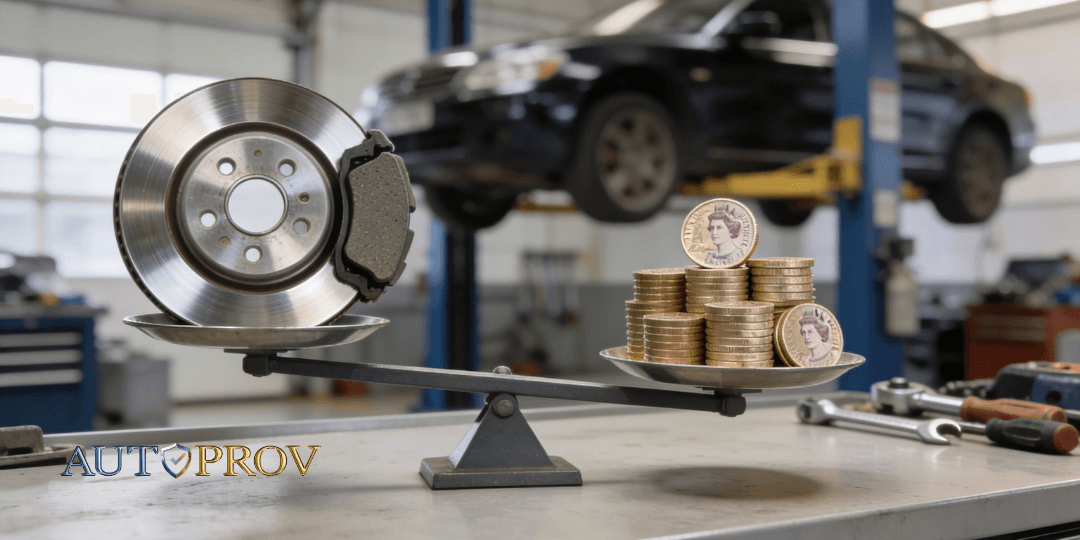
You're standing at the auction lane or walking a part-exchange. The paint is honest, the interior is saleable, the miles look sensible, and the screen price leaves room. Then the brake check starts to unravel the deal.
A car can look like easy stock and still hide a reconditioning bill that strips out the margin before you've even photographed it. That's why brake replacement cost isn't a workshop detail. For a trader, it's an appraisal problem, a buying problem, and often a provenance problem as well.
Most losses here don't come from dramatic failures. They come from ordinary used cars with ordinary deferred maintenance. Pads are worn. Discs are lipped. A caliper has started sticking. The MOT advisory was there, but nobody priced it properly. By the time the car is on your ramp, what looked like a routine prep item has become a negotiation you should've had before you bought it.
The Hidden Cost of Underestimating Brake Work
The mistake usually starts with language. Someone says, “It only needs brakes,” as if that's one line item with one predictable cost.
It isn't. In the UK, RAC servicing and repair data shows brake pads averaged £165.62 in Q1 2025, up 4.6% from £158.31 in FY 2024, while brake inspections averaged £20.82, up 28.3% from £16.23. The same data shows brake fluid replacement averaged £95.64, up 6.3% from £89.99. For a dealer, that matters because even routine brake-related prep now costs more than it did a year earlier.
A clean appraisal can still be misleading. The outer face of the disc may look passable through the wheel. The pedal may feel acceptable on a short move. The seller may insist the car has “just had pads”. Then your technician removes the wheel and finds disc wear, heat marking, poor-quality previous parts, seized sliders, or fluid that should've been changed already.
Practical rule: If a used car needs any confirmed brake work, treat the first quote as the opening number, not the final one.
That's the trade reality. Margin disappears when buyers price brakes as a retail advert line instead of a variable reconditioning stack.
Why traders get caught out
The common traps are familiar:
- Visual confidence: A quick look through alloy spokes doesn't tell you enough about disc condition, inner face wear, or hardware seizure.
- Service history assumptions: A stamped book doesn't prove good brake work, only that some service activity was recorded.
- MOT complacency: A pass doesn't mean the braking system is cost-free. It means the vehicle met the standard at test time.
- Bad stock matching: Expensive brake prep on a price-sensitive car can kill the deal faster than the same repair on premium retail stock.
Good buyers don't ask only “what are brakes on this car?”. They ask “what's the downside if this turns into a full axle job, and is the car still right at that number?”
Deconstructing a Brake Job From Pads to Calipers
When someone says a car “needs brakes”, you need to separate the simple work from the expensive work. The invoice rises because brake jobs build in layers.

Pads are the starting point
Pads are the friction material. They're also where many traders stop their estimate, which is where forecasting goes wrong.
UK trade pricing guidance indicates that front or rear brake pads supplied and fitted typically run about £195 to £300 per axle, while pads plus discs are usually £425 to £700 per axle, with both axles potentially reaching about £850 to £1,400. That's the key split to keep in mind during appraisal. Pad-only money and pad-plus-disc money are completely different buying decisions.
Discs change the job economics
Discs turn a light repair into a more serious prep event. Once thickness, wear lip, scoring, cracking, or heat damage puts the rotor outside service limits, replacement becomes the proper route.
That adds parts cost, labour time, and often associated hardware. If you need a deeper breakdown of disc condition and replacement logic, AutoProv's guide to brake disc replacement is useful background for appraisers as well as workshop controllers.
If the disc is already marginal at appraisal, don't budget for “pads and see how it goes”. Budget for the full axle properly.
Fluid, sensors and seized parts
Brake fluid often gets missed in early estimates. It matters because neglected fluid can sit alongside neglected friction components, especially on cars with patchy maintenance.
Wear sensors can add cost. So can anti-rattle clips, shims, pins and sliders. None of these items is dramatic on its own, but together they move the job away from a quick service item and into genuine reconditioning.
Calipers are where pain starts
A sticking or seized caliper changes the tone of the whole appraisal. It can explain uneven pad wear, overheating, poor braking feel, or one disc wearing differently from the other. It also creates a parts-and-labour question that's harder to contain.
Use this mental stack when assessing a car:
- Pads only if wear is straightforward and the rest of the axle is healthy.
- Pads and discs if the rotors are outside limits or badly damaged.
- Pads, discs and fluid where maintenance quality is weak or the system needs resetting properly.
- Pads, discs and caliper-related work when heat, drag, corrosion, or seizure shows up.
That's why “brakes” is never one price.
Key Factors That Determine Final Brake Replacement Cost
A trader who prices every brake job the same will overpay for stock. The final invoice depends on what the car is, what standard you're preparing it to, and how modern braking systems complicate labour.
Vehicle segment changes everything
Vehicle class is one of the clearest cost drivers. A UK-relevant parts-and-labour guide notes a Toyota RAV4 example at about £350 to £550 per axle for quality aftermarket parts, while premium marques such as BMW and Audi are materially higher because of larger components, specialised materials and greater labour complexity, as set out in this vehicle-class brake cost reference.
That matters in the lane because two cars can both “need front brakes” and still represent very different reconditioning risk. A volume hatchback can often absorb brake prep without distorting the retail plan. A premium SUV or performance saloon may not.
Estimated UK brake replacement cost by vehicle segment
Vehicle Segment Typical Cost Range (Per Axle) Mainstream car, pads only £195 to £300 Mainstream car, pads and discs £425 to £700 Medium SUV example such as Toyota RAV4 £350 to £550 Premium marques such as BMW or Audi Materially higher Parts choice affects gross profit, but so does comeback risk
OEM isn't always necessary for every used retail unit. Cheap friction parts aren't always smart either.
A quality aftermarket setup can make sense on mainstream stock where you need reliable braking performance, sensible warranty exposure and controlled prep spend. On heavier, faster or more premium vehicles, the wrong parts choice can create noise complaints, poor pedal feel, dust issues or customer dissatisfaction that comes back as a post-sale problem.
This is similar to other maintenance forecasting work. If you already review wider prep categories such as fan belt replacement cost, the principle is the same. The part price is only one part of the commercial decision. You're balancing retail suitability, labour time and risk of rework.
Modern systems can raise labour complexity
Electronic parking brakes can add workshop steps. Heavier vehicles can stress braking components harder. Electrified vehicles complicate the picture further.
Regenerative braking can reduce friction-brake use, but reduced use can also contribute to corrosion, sticking calipers and seized rear brakes, while heavier EVs and large SUVs increase brake load, as outlined in this discussion of changing brake maintenance patterns on electrified and heavier vehicles. That means lower pad wear on paper doesn't automatically equal lower total brake ownership cost.
A low-wear story can still become a high-remedial-work story.
For traders running broader operating reviews, it also helps to think in total fleet terms rather than isolated repairs. A practical resource on managing small business vehicle costs is useful if you're comparing prep trends across multiple units and trying to tighten stock control decisions.
What works in appraisal
Strong appraisers build a quick internal model:
- Vehicle type first: city car, family SUV, premium German, performance derivative, EV.
- Brake system complexity next: standard setup, larger hardware, EPB involvement, corrosion risk.
- Retail position after that: budget retail, finance-friendly mainline stock, prestige margin unit.
- Parts strategy last: quality aftermarket where appropriate, OEM where the vehicle and customer expectation justify it.
That approach is more reliable than asking for one universal brake replacement cost figure, because there isn't one.
How to Spot Impending Brake Work During Appraisal
Good buyers don't need a full strip-down to spot risk. They need a disciplined five-minute check that filters obvious cost exposure before the bid goes in.

Start with the wheels and pedal
Look through the wheel if visibility allows, but don't stop there mentally. You're not trying to diagnose every issue. You're trying to identify whether the car is likely hiding more than a pad set.
Use a quick routine:
- Check disc edge wear: A pronounced lip usually means the disc has seen enough service that pad-only budgeting is risky.
- Look for heat marks or scoring: Heavy grooves or blueing suggest harder use, poor previous maintenance, or a dragging component.
- Note pad thickness carefully: Thin friction material is obvious, but uneven wear can matter more than low wear.
- Feel the pedal on movement: A poor pedal, vibration, pulling, or inconsistency deserves a bigger allowance.
Listen for the expensive clues
Noise matters because different noises point to different cost paths. A light squeal may be wear-related. Grinding usually means you're well past simple servicing.
Short test-drive symptoms worth pricing aggressively include:
- Steering vibration under braking
- Vehicle pulling to one side
- Brake drag after release
- Harsh rear-brake binding feel after standing
- Warning lights linked to pad wear or braking faults
If a dash warning is present, don't guess. Check the likely causes properly. AutoProv's guide to the brake pads warning light is a useful reference when you need to separate routine wear from broader system concerns.
Don't buy the explanation that “it's probably just pads” unless the physical signs support it.
Read the MOT history like a trader
Brake-related defects are a major source of MOT trouble in the UK. DVSA-linked MOT guidance referenced here notes that brake system issues consistently sit among the top failure categories, which is why brake advisories deserve more attention than many traders give them.
You're looking for pattern, not one isolated comment.
MOT history signals that often precede bigger brake spend
- Repeated brake advisories: Deferred maintenance across more than one test cycle usually means someone kept postponing the proper repair.
- One axle repaired, the other ignored: That often leaves you buying the second half of the job.
- Long gaps between service evidence and MOT comments: The longer the gap, the less confidence you should have in current condition.
- Corrosion-related comments on vehicles that sit: Low-use stock can have worse brake remedial work than regular-use stock.
A basic MOT check tells you what was seen at test time. A disciplined appraisal asks what that pattern means for your prep invoice now.
Using Vehicle Provenance to Predict Maintenance Risks
Physical appraisal tells you what the car looks like today. Vehicle provenance helps explain why it got there.

A standard vehicle history check UK search can confirm basics. That's useful, but it often won't tell you enough about maintenance behaviour, ownership churn, or risk context. For brake forecasting, context matters because braking neglect rarely appears as one clean data point.
The signals worth combining
A stronger used car history report for trade use should be read alongside the car in front of you. The useful questions are practical:
- Has the vehicle moved through short-term ownership more than you'd expect?
- Are there rapid resale patterns that suggest previous keepers exited before spending money on maintenance?
- Does the mileage check UK picture make sense against the visible brake wear?
- Do MOT comments suggest a pattern of advisories followed by minimal intervention?
- Is there a service history gap that makes current brake condition less surprising?
None of those signals proves a brake bill by itself. Together, they sharpen your estimate.
Why context beats isolated data
A car with tidy cosmetics and a fresh valet can still be weak stock if its history suggests serial deferral. That's where trade vehicle intelligence becomes useful. You're not just confirming identity or finance status. You're building a risk view around how the car has been used, maintained and moved through the market.
For dealers who want that wider context at the point of decision, AutoProv's vehicle provenance report combines ownership timelines, MOT history, mileage patterns and anomaly signals in a format built for trade buying workflows. Used properly, that kind of dealer vehicle checks process helps you decide whether visible brake wear is a routine prep item or part of a larger pattern of neglected maintenance.
The strongest buying decisions come from matching what the ramp suggests with what the history pattern implies.
That's the difference between seeing worn discs and understanding whether the whole vehicle has been run on minimum spend.
Strategies for Managing and Negotiating Brake Costs
Once you've identified likely brake exposure, the job is commercial. You're deciding whether to buy, what to bid, and how to control the repair route without creating future headaches.
Negotiate from evidence, not instinct
Sellers argue less when your position is specific. If you can point to disc lip, uneven wear, dashboard warning, MOT pattern and likely axle scope, the conversation moves away from opinion.
Use a simple structure in negotiation:
- State the issue clearly: “This doesn't look like a pads-only car.”
- Price the likely scope, not the best-case scope: work from the repair path the evidence supports.
- Separate safety from cosmetics: brake spend is hard cost, not presentation spend.
- Keep your walk-away line: if the margin only works on an optimistic estimate, the car is overpriced.
A disciplined buying note helps. Record what you saw, what the MOT pattern suggested, and what you've allowed. That keeps stock buying consistent across the team.
Know when to walk away
Some cars still make sense with expensive brakes. Others don't.
Walk away more readily when the brake issue sits alongside other signs of neglect, weak service evidence, or awkward ownership history. The problem usually isn't one repair. It's cumulative reconditioning plus time lost plus the chance of another issue appearing once prep starts.
If you need a stronger process around price discussions generally, AutoProv's article on how to negotiate used car prices as a professional buyer is relevant because the same discipline applies here. Identify cost. Quantify uncertainty. Negotiate on evidence.
Choose the reconditioning route that fits the stock
Not every unit needs the same parts strategy. The right choice depends on vehicle type, retail profile and warranty risk.
A sensible approach often looks like this:
- Mainline retail stock: quality aftermarket parts where they suit the vehicle and expected customer.
- Premium or specialist stock: parts choice aligned with brand expectation, braking performance and likely buyer scrutiny.
- Margin-thin units: be honest about whether the repair spend still leaves a viable deal.
- Questionable cars: don't force a buy just because the headline purchase price looks attractive.
Margin is protected before purchase, not after the workshop invoice arrives.
That's the part newer traders often learn late. Brake costs are negotiable at appraisal. They're far less negotiable once the car is in your compound.
Conclusion Turning Brake Costs into a Competitive Advantage
The trade doesn't lose money on brake work because brakes are mysterious. It loses money because buyers treat brake replacement cost as a routine service line instead of a risk variable tied to appraisal quality.
The better approach is straightforward. Understand the cost stack. Judge the vehicle class properly. Look for physical signs that a pad quote may become a disc, fluid or caliper job. Read MOT history for maintenance behaviour, not just pass or fail. Then add provenance context so your decision reflects how the vehicle has been owned and maintained.
That's where motor trade risk management and workshop knowledge meet. A sharper buying process uses physical inspection, MOT interpretation, ownership context and a proper used car history report together. That produces more accurate bids, cleaner stock selection and fewer margin shocks after purchase.
Dealers who do this well don't just avoid bad buys. They buy with more confidence because they can separate routine prep from hidden liability. In a market where every pound of reconditioning matters, that's an edge worth having.
If you want a more informed buying decision before committing to stock, AutoProv provides UK-focused vehicle history, provenance and risk intelligence built for the motor trade, helping dealers combine MOT patterns, mileage context, ownership timelines and anomaly signals with what they see during appraisal.
Frequently Asked Questions
AI-Generated Content Notice
This article was created with the assistance of artificial intelligence technology. While we strive for accuracy, the information provided should be considered for general informational purposes only and should not be relied upon as professional automotive, legal, or financial advice. We recommend verifying any information with qualified professionals or official sources before making important decisions. AutoProv accepts no liability for any consequences resulting from the use of this information.
From our AI insights
- The Impact of EV Service Records on Resale Value
Discover how electric vehicle service records affect resale value and buyer confidence in the UK market.
- The Importance of Tyre Verification for UK Motor Traders
Discover why verifying tyre specs is crucial for UK traders to ensure safety and compliance.
- Decoding CO2 Emissions: A Trader's Guide
Learn how traders can verify CO2 data using factory build sheets to prevent disputes.
Related Articles
The Importance of Car Maintenance and Provenance Checks
Discover why regular car maintenance and proper provenance checks are essential for vehicle quality and longevity.
Essential Car Maintenance Tips for UK Drivers
Discover vital car maintenance tips to keep your vehicle roadworthy and compliant in the UK.
How Much Is a Car Service? Complete UK Price Guide
Trying to pin down exactly "how much is a car service?" can feel a bit like asking "how long is a piece of string?". Prices vary quite a bit, but to give you a ballpark figure, an interim service will usually set you back around £100 to get started. A more thorough full service often begins at £180, while a major service for many cars can easily top £300.
Published by AutoProv
Your trusted source for vehicle intelligence