
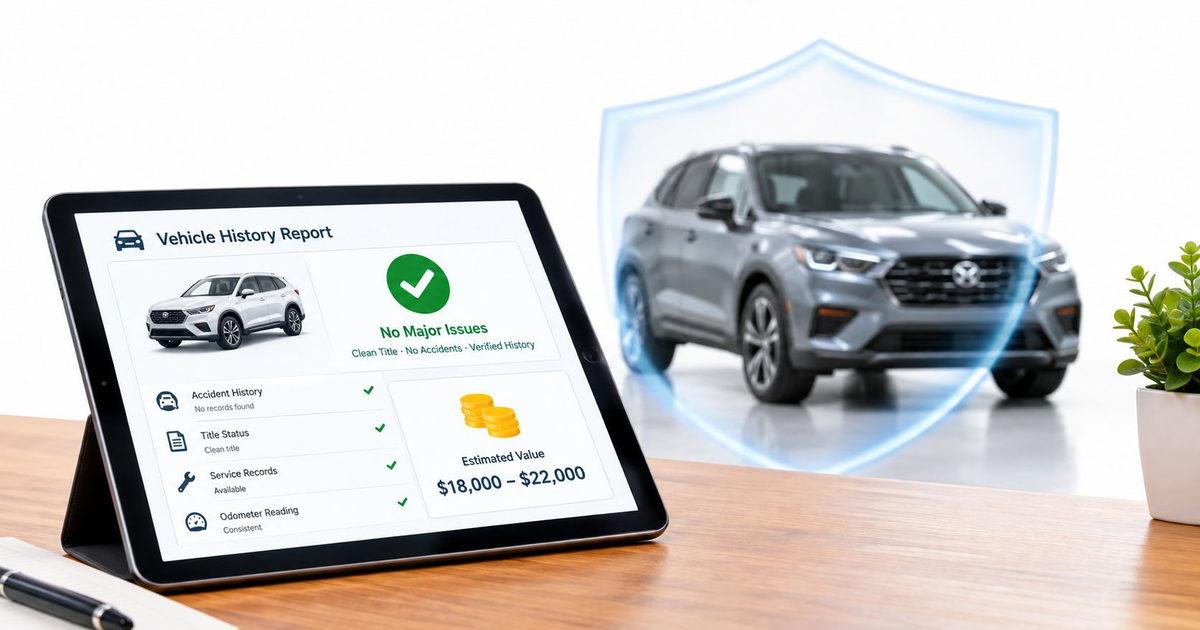
A lot of trade buyers know this one. The car looks straight, the price is keen, the seller has a tidy story, and the cheap report comes back clean enough to keep the deal moving. Then, after purchase, the awkward bits start showing up. The mileage pattern doesn't make sense when you line up older records. Keeper timing feels off. The car hasn't been written off or shown stolen, but it still doesn't stack up as clean stock.
That's why dealers keep searching for a car history check cheap option. The aim isn't to collect data for the sake of it. It's to avoid overpaying for stock while keeping enough margin left in the deal to prepare, retail, and stand behind the car later. Cheap checks have a place in that process. The problem starts when they're treated as proof instead of triage.
In practice, a low-cost report is only useful if you know what question it can answer. It can often tell you whether a vehicle appears in the usual records and whether an obvious issue is already logged. It usually can't tell you whether the ownership sequence, mileage pattern, and resale behaviour make the car a bad buying decision for the trade.
A better approach is to keep the first step inexpensive, but make the decision-making sharper. That means reading the official MOT timeline properly, checking whether identity and document details reconcile, and only paying for deeper provenance when the first layer throws up risk. That discipline matters more than chasing the lowest unit price on a report.
Table of Contents
- Introduction Why Cheap Checks Still Cost Dealers Money
- The false economy in pass or fail buying
- The safer mindset for low-cost buying
- What a Cheap Vehicle History Check Actually Covers
- What the cheap layer usually does well
- What cheap checks usually miss
- How to Run a Low Cost Car History Check Workflow That Works
- Step one is mileage sequence, not MOT outcome
- Step two is document and keeper sense-checking
- Step three is targeted escalation, not automatic spend
- A point-of-decision checklist for the buying desk
- Pay As You Go Versus Subscription and When to Upgrade
- Choosing the Right Check Model for Your Buying Volume
- Where traders usually misjudge it
- When it's worth moving beyond commodity reports
- Reading Risk Signals and Deciding What to Do Next
- Verify the anomaly before you price the risk
- Contextualise what it means commercially
- Escalate, renegotiate, or walk away
- Smarter Low Cost Buying With Better Vehicle Intelligence
- What disciplined low-cost buying looks like
Introduction Why Cheap Checks Still Cost Dealers Money
The expensive mistake usually doesn't start with a bad car. It starts with a cheap vehicle history check UK result that looks tidy enough to suppress further questions.
A dealer takes in a part exchange or buys from auction. The report says no immediate drama. MOT status looks current. The registration, colour, and basic vehicle details line up. The buyer moves on because the stock turn matters more than a long desktop investigation. A week later, the same car starts looking very different once older mileage entries, servicing paperwork, or previous sale records are compared side by side.
That gap between a clean-looking report and a safe buying decision is where money leaks out of the trade. Not always through fraud. Sometimes through data anomalies, document inconsistencies, or ownership behaviour that doesn't fit the seller's story. The result is the same. Margin gets squeezed, prep decisions become harder, and post-sale exposure goes up.
The false economy in pass or fail buying
Cheap checks feel efficient because they compress risk into a simple answer. Clear or not clear. Buy or don't buy. That's attractive when you're reviewing multiple vehicles in a short buying window.
The trouble is that motor trade risk rarely behaves like a warning light. Most problem cars don't announce themselves with one dramatic marker. They show patterns. A mileage interruption here. A short ownership period there. A registration history that technically exists but doesn't feel commercially clean.
Cheap checks save money only when they stop you paying for deeper work on the obvious non-starters.
When traders rely on pass or fail logic, they often pay twice. Once for the report. Then again when they have to discount, defend, or dispose of stock that should have been questioned earlier.
The safer mindset for low-cost buying
The stronger buying discipline is simple. Use low-cost checks to narrow the field, not to sign off the vehicle. That mindset changes the workflow completely.
Instead of asking whether the report is cheap, ask whether it helps you make the cheapest safe decision. Sometimes that means the free layer is enough to walk away. Sometimes it means the first anomalies justify a deeper used car history report or provenance review before capital is committed.
That's the trade-only lens behind better dealer vehicle checks. You keep the early process lean, but you stop pretending that a budget report is the same thing as full trade vehicle intelligence.
What a Cheap Vehicle History Check Actually Covers
Most low-cost checks pull from familiar record sets. That's useful, but only up to a point.

A cheap report usually gives you basic registration details, MOT status, recorded test history, and sometimes a small number of high-level markers. That can be enough for initial sorting. It is not the same as a proper vehicle provenance review.
Independent UK guidance is clear on one of the main blind spots. A clear finance result only means no finance is registered at the time of the search, and newly registered finance or settlement delays may not yet appear. The same guidance also notes that free DVLA-style checks do not cover finance, write-off status, stolen markers, or mileage from non-MOT sources, as explained in this independent guide to car history checks.
What the cheap layer usually does well
For triage, low-cost checks can still be useful because they answer practical first questions:
- Identity basics: Does the registration resolve to the vehicle you think you're looking at?
- MOT visibility: Is there a visible testing history and does anything obvious look odd?
- Administrative sense check: Do the seller's details and the vehicle's basic recorded details broadly reconcile?
- Early exit decisions: Is there enough concern to stop before spending more?
That's why many traders still start there. For low-value part exchanges, older stock, or fast auction filtering, that first pass has real operational value.
A dealer who wants a lighter entry point can also review broader thinking around a free car history check workflow, but that only works if the limits are understood at the outset.
What cheap checks usually miss
The weakness isn't always missing data. It's missing context.
A basic vehicle history check UK can tell you that a record exists. It often can't tell you whether the sequence of events makes commercial sense. It won't usually help much with ownership behaviour, short-term keeper patterns, rapid resale signals, or whether a mileage issue looks like a clerical anomaly or something more serious.
That matters because point-in-time data can give false reassurance. If the file looks clear today, some buyers assume the risk has gone. It hasn't. You've only confirmed what is visible in that moment.
A low-cost report is a snapshot. A buying decision needs a timeline.
That's the dividing line between a commodity check and proper vehicle provenance work. The first tells you what's listed. The second helps you judge what the listed data means for pricing, retail suitability, and downstream exposure.
How to Run a Low Cost Car History Check Workflow That Works
A low-cost workflow only works when the order is right. Traders often waste money by paying for depth before they've exhausted the free signals.
The highest-value first step is the official MOT history timeline on GOV.UK. The reason is simple. The service shows every recorded test mileage, and a mileage drop between tests is a strong anomaly signal. UK-based analysis of half a billion MOT records found 3.42 million vehicles, or 5.45% of the 62.7 million-vehicle dataset, had at least one mileage reduction event, with an average rollback of 46,089 miles, which is why the first cheap check should prioritise mileage progression rather than MOT pass or fail alone, as shown in the GOV.UK MOT history service.
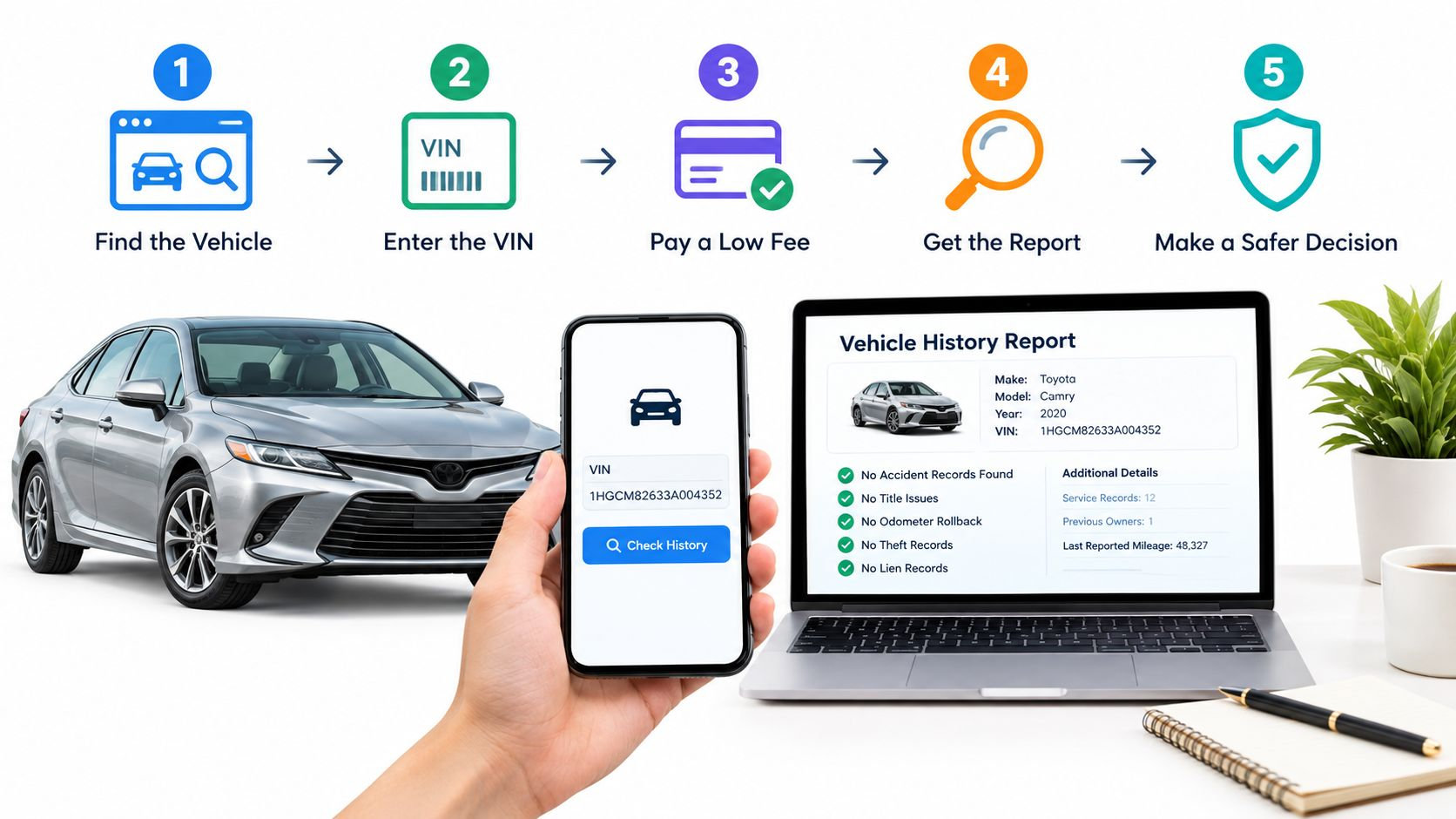
DVSA also notes that mileage mistakes can be corrected only with evidence. That matters because a bad reading can reflect error as well as fraud. The practical answer is to compare several test points, not one, and reconcile them against servicing or auction material where available.
Step one is mileage sequence, not MOT outcome
Traders often look at the latest MOT result first. That's backwards.
A fresh pass can create false comfort, especially if the mileage pattern behind it is unstable. What you want is monotonic progression. Each recorded mileage should move upwards in a way that broadly fits age, usage, and the seller's account.
Use this screen first:
- Check the full MOT timeline for every visible mileage entry.
- Look for drops or stalls that don't fit normal use.
- Read the dates as well as the miles so the time gap makes sense.
- Compare the pattern with the advert, appraisal, or auction catalogue.
If the sequence is smooth, you've earned the right to continue. If it isn't, don't explain it away too quickly.
Practical rule: A single recent mileage reading tells you almost nothing on its own.
Step two is document and keeper sense-checking
Once the MOT line broadly behaves, move to the paperwork and timeline logic.
Many cheap workflows stop too early. They confirm that the registration exists and move on. A trade buyer needs to ask whether the supporting documents and ownership story are coherent. Does the V5C timing fit the seller's story? Is the handover timing unusually short? Does the vehicle seem to have changed hands too quickly for the claimed reason?
Short-term ownership and rapid resale don't prove a problem. They do change the burden of proof. A car with compressed keeper timing deserves closer scrutiny because the resale pattern itself can be a risk signal even when the basic report looks clean.
Step three is targeted escalation, not automatic spend
Once the free and low-cost layers have done their job, decide whether to spend more. Don't buy every deeper check by default. Buy them when the early signals justify it.
Useful escalation triggers include:
- Mileage disruption: Any drop, plateau, or unusual jump that can't be reconciled easily.
- Identity uncertainty: VIN, registration, or spec details that don't line up cleanly.
- Ownership concern: Very short holding periods, repeated relisting, or an awkward keeper sequence.
- Record gaps: Missing continuity between MOT, servicing, seller paperwork, and sale history.
Where traders need a more integrated data workflow, tools tied into a DVLA vehicle check API process can help operationalise this at scale, especially for stock controllers screening multiple vehicles in a day.
A point-of-decision checklist for the buying desk
Keep the first-pass routine short enough to use in real buying conditions:
- Start free: Review the official MOT mileage timeline before paying for anything else.
- Test the story: Match mileage behaviour against age, condition, and seller narrative.
- Sense-check documents: Confirm V5C and identity details are consistent with the vehicle presented.
- Watch the ownership tempo: Rapid resale and short keeper periods deserve extra caution.
- Escalate only on signal: Pay for deeper provenance when the first layer raises a real question.
That's the difference between a cheap process and a careless one. A mileage check UK approach isn't there to prove the vehicle. It's there to decide whether the vehicle deserves more investment in due diligence.
Pay As You Go Versus Subscription and When to Upgrade
The buying model matters almost as much as the data. Dealers often focus on the price of an individual report and ignore whether the checking setup matches their monthly buying pattern.
A pay-as-you-go report works well when volume is inconsistent and the buyer only needs occasional escalation. A subscription can make sense when checks are routine and stock appraisal volume is stable. An advanced provenance platform fits a different problem altogether. It's less about raw access and more about structured trade vehicle intelligence at the point of decision.
Choosing the Right Check Model for Your Buying Volume
Check Model Best For Cost Efficiency Risk Coverage Pay as you go Lower-volume independents, selective auction buys, occasional part exchanges Efficient when you only escalate a small number of vehicles Good for isolated checks, weaker for workflow consistency and pattern analysis Subscription Dealers with regular monthly appraisal and acquisition flow Better when check volume is predictable Broader operational coverage, but still depends on what data context is included Advanced provenance platform Buyers, wholesalers, and groups managing repeated exposure across stock sources More efficient when decisions depend on speed, consistency, and fewer missed signals Strongest for ownership patterns, anomaly interpretation, and buying discipline
Where traders usually misjudge it
The common mistake at low volume is paying for a subscription that sits idle. The common mistake at high volume is the opposite. Buyers keep using single reports because the unit cost feels controllable, while the actual process becomes fragmented and inconsistent.
That inconsistency carries its own cost. Different buyers interpret the same warning differently. One person ignores a keeper pattern. Another escalates it. A third never checks it at all. The report price may be low, but the decision quality isn't.
For teams weighing buying models, this breakdown of enterprise versus pay-per-check pricing for dealerships is useful because it frames the choice around workflow rather than headline price.
When it's worth moving beyond commodity reports
Upgrade when the issue stops being access to data and starts being interpretation.
That usually happens when you're buying at pace, screening mixed stock sources, or trying to standardise decisions across several buyers. In those cases, the question isn't whether you can get a report cheaply. It's whether the process helps your team see repeated motor trade risk patterns early enough to change the buying decision.
One trade-focused option in that category is AutoProv, which provides UK vehicle provenance reporting built around MOT history, ownership timelines, mileage patterns, insurance-related events, and anomaly signals rather than a simple pass or fail output. That sort of setup makes more sense when your risk cost is no longer the report fee. It's the number of marginal cars slipping through because the first-layer checks aren't being interpreted consistently.
Reading Risk Signals and Deciding What to Do Next
A cheap check becomes useful when it changes what you do next. If it only produces a warning and nobody knows how to act on it, it hasn't improved the buying process.

The practical framework is verify, contextualise, escalate. That keeps the team from making two common mistakes. First, treating every anomaly as fraud. Second, waving away genuine warning signs as paperwork noise.
Verify the anomaly before you price the risk
Start with the narrow question. Is the signal real, or are you looking at a record issue?
That matters most with mileage. UK motor-trade buying data shows discrepancy rates vary sharply depending on source and detection method. One UK market study reported 2.1% of 7.6 million checked cars had odometer readings that did not match recorded history, while another analysis of UK cars checked by a vehicle-data provider found 16.25% showed evidence of mileage or VIN discrepancies. A separate UK-focused estimate put clocked-mileage prevalence at 2.27% with an average rollback of about 35,000 miles, which is why cheap checks should be treated as triage and followed by identity, timing, and continuity checks when they flag risk, as outlined in this UK clocked-car analysis.
A mileage drop may still turn out to be a correction issue rather than clocking. But until you verify it against the wider record trail, you don't have a clean car. You have an unresolved question.
Contextualise what it means commercially
Not every discrepancy has the same impact on a trade decision.
A small documentation mismatch on an older, cheaper car may justify a lower bid and tighter evidence request. A VIN concern, unexplained ownership churn, or a record continuity gap changes the car's commercial profile much more sharply. The point isn't just whether the issue exists. It's whether you can still defend the stock later, both in valuation and in customer conversation.
If you need three different explanations to make the car sound clean, it probably isn't clean enough for easy retail stock.
This is also where legal relevance starts to matter. From 6 April 2025, odometer misrepresentation by traders falls under the Digital Markets, Competition and Consumers Act 2024, while private-seller cases may fall under the Fraud Act 2006, which changes how mileage evidence may matter depending on who sold the vehicle and how the discrepancy arose, as discussed in this overview of UK odometer fraud law from 2026. That isn't legal advice. It is a reminder that seller type affects how you document and respond to risk.
Escalate, renegotiate, or walk away
Once the anomaly is verified and its context is clearer, the next move should be operational, not theoretical:
- Request evidence: Ask for servicing records, previous invoices, or sale documents that reconcile the issue.
- Reprice the car: If the risk is manageable but unresolved, bid accordingly.
- Commission deeper intelligence: Use a fuller provenance review where the vehicle still interests you commercially.
- Decline the deal: Walk away when the explanation depends on too many assumptions.
For buyers building a repeatable process around this, a structured vehicle risk assessment workflow helps keep decisions consistent across the desk.
Smarter Low Cost Buying With Better Vehicle Intelligence
Cheap checks aren't the problem. Confusing them with proof is the problem.
A sensible car history check cheap workflow keeps the first layer lean and the decision standard high. Start with the official MOT mileage sequence. Sense-check the paperwork and ownership story. Escalate only when the timeline, identity, or resale pattern gives you a reason to spend more.
What disciplined low-cost buying looks like
The dealers who buy cleanest stock at the lowest checking cost usually follow a routine, not a hunch:
- Use cheap checks for triage: Sort obvious non-starters without overpaying for every file.
- Read timelines, not snapshots: Buying decisions improve when the vehicle is judged as a sequence of events.
- Price uncertainty properly: If the record needs explaining, the bid should reflect that.
- Standardise escalation: Deeper provenance work should start from defined triggers, not mood or habit.
That's where better vehicle provenance and dealer vehicle checks start to earn their place. Not because every car needs a full investigation, but because some cars clearly need more than a commodity report if you want to protect margin and avoid avoidable disputes.
A lot of trade buyers are now trying to tighten that point-of-decision discipline by adding more contextual review to their acquisition process. The practical advantage of real-time vehicle intelligence is that it supports a faster decision without reducing the decision to a pass or fail label.
The cheapest report isn't always the cheapest outcome. The cheapest safe outcome comes from knowing when the free layer is enough, when the low-cost layer has done its job, and when the vehicle in front of you has earned a deeper look.
AutoProv gives UK motor traders a way to go beyond a basic report when a cheap check raises questions about mileage, ownership timing, or record continuity. If you need trade-focused vehicle provenance and risk context at the point of purchase, visit AutoProv.
Frequently Asked Questions
AI-Generated Content Notice
This article was created with the assistance of artificial intelligence technology. While we strive for accuracy, the information provided should be considered for general informational purposes only and should not be relied upon as professional automotive, legal, or financial advice. We recommend verifying any information with qualified professionals or official sources before making important decisions. AutoProv accepts no liability for any consequences resulting from the use of this information.
From our AI insights
- Navigating UK Grey Imports: A Trader's Guide
Understand the complexities and opportunities of UK grey imports for savvy motor traders.
- Navigating Low-Cost Vehicle Checks in the UK
Learn how to safely conduct low-cost vehicle checks and avoid pitfalls.
- Trade Secrets: Identifying Clocked Cars in the UK
Discover how UK traders can spot clocked cars using innovative tools and detailed checks.
Related Articles

Essential Vehicle Checks Before Buying a Used Car
Learn essential checks to ensure your used car purchase is safe and sound in the UK market.

Why a Provenance Check is Essential for Used Car Buyers
Ensure your used car is a smart investment by understanding the importance of a provenance check and how AutoProv can help.
A Guide to Vehicle Check with VIN Number
A vehicle check with vin number is easily the most important thing you can do before buying a used car. Think of it as your first line of defence—a quick, simple step that pulls back the curtain on a vehicle's past, protecting you from expensive mistakes, legal headaches, and downright dangerous cars.
Published by AutoProv
Your trusted source for vehicle intelligence
